

Living Knowledge of Nature,
Intellectual Fall from Grace
and Spiritual Elevation from Sin
GA 220
13 January 1923, Dornach
Translated by Steiner Online Library
Fifth Lecture
[ 1 ] As I intend to continue yesterday’s reflections, I would simply like to remind you that the three figures whose significance extends to us from the turn of the 16th to the 17th century—and whom I attempted to characterize—Giordano Bruno, Baco of Verulam, and Jakob Böhme, all point out to us how they were driven by a struggle to understand human beings, to know something about the very nature of humanity itself, and how, at the same time, these three figures were marked by a certain inability to arrive at such an understanding of humanity. This is the defining feature: that one can clearly see in this historical epoch, to which I referred, how an ancient understanding of humanity has been lost and how the most honest, most sincere striving of the most outstanding minds does not lead to a new understanding of humanity.
[ 2 ] We had to point out that, from Jakob Böhme’s peculiarly stammering language, something resonates like a longing to recognize the world within the human being and the human being within the world; yet from everything that Jakob Böhme brings together toward such an understanding of the world and humanity, something shines forth that appears to the present anthroposophical view as a reference to the nature of the pre-earthly human being—the human being before he descended into earthly existence—and that yet, again, a clear description of this nature cannot be found in Jakob Böhme. I expressed this in roughly these words: Jakob Böhme describes, in faltering words, the nature of the pre-earthly human being, but in such a way that the human being he describes there actually had to die as a spiritual-soul being in the spiritual world before he could descend to Earth. Jakob Böhme describes, so to speak, a rudimentary form of the pre-earthly human being. Thus, in his work, there is an inability to truly understand the world within the human being, or the human being within the world.
[ 3 ] If we then turn our attention to the poetic Giordano Bruno, we find a magnificent understanding of the world expressed through imagery. We also find an attempt to place humanity within this magnificent worldview—that is, once again, an attempt to recognize the world within humanity and humanity within the world. But such an understanding is not achieved. Giordano Bruno’s powerful images are beautiful and magnificent; they roam through infinities on the one hand, and into the depths of the human soul on the other. But they remain indefinite; they even remain blurred. In everything Giordano Bruno says, we find in him a striving to depict contemporary humanity within the spatial universe and the spatial universe itself.
[ 4 ] While Jakob Böhme refers to pre-earthly humanity in an inadequate manner, we find in Giordano Bruno a vague depiction of humanity as it lives on Earth, in connection with the spatial cosmos—that is, the cosmos that also exists for earthly humanity—but this, too, is inadequate. For a truly comprehensive view of the relationship between human beings and the cosmos in the present offers a glimpse of pre-earthly human beings and a glimpse of post-earthly human beings, as I outlined a short time ago here at the Goetheanum in the so-called French Course.
[ 5 ] And if we turn once more to Baco of Verulam, Lord Bacon, we find that he no longer holds any traditional views of human nature. Indeed, nothing of the ancient insights into human nature—which had been passed down from ancient clairvoyant perspectives—nor of the ancient truths of the mysteries is to be found in Baco of Verulam. But Bacon of Verulam turns his gaze outward to the world perceptible to the senses and assigns to the human intellect the mission of combining the phenomena and things of this world of sensory existence, discovering laws, and so on. He thus transposes the perception of the human soul into that world in which the human being, as a soul, exists from falling asleep until waking up; but there he arrives only at images of non-human nature. These images, if taken merely in a logical and abstract sense—as Lord Bacon does—represent only external human nature. When they are experienced, however, they gradually become something that offers a glimpse into human existence after death. For it is precisely through a genuine understanding of nature that an accurate, clairvoyant insight into the nature of the human being after death can be gained. Thus, Bacon, too, was one who struggled for that understanding of humanity in the world and the world within humanity at the turn of the 16th to the 17th century. But even his powers prove insufficient, for he did not intensify into a new experience that which appears merely as an image—because an ancient reality is no longer present in spiritual experience. He stands, so to speak, at the threshold of knowledge of life after death, but does not attain this knowledge.
[ 6 ] So we can say: Jakob Böhme offers another insight into ancient traditions concerning pre-earthly human beings, but it is insufficient. Giordano Bruno is faced with a description of the world that could present him with modern humanity—the earthly human being with his soul on the one hand, and the cosmos as his backdrop on the other. However, Giordano Bruno remains stuck with an inadequate description of the cosmos and an equally inadequate description of spiritual life, which in his view shrinks to a mere animated monad.
[ 7 ] Lord Bacon already shows how natural science must develop, how natural science must seek the spark of the spiritual within mere matter through free human knowledge. He points toward this free human knowledge, but it is given no substance. If it were to be given substance, he would have to point toward the post-earthly human being. He cannot do that. His capacity for knowledge, too, remains inadequate.
[ 8 ] All the living insight that could have been drawn from within during earlier epochs of humanity’s earthly development had passed away by that time. Human beings had, so to speak, come to find nothing when they looked within themselves and sought to gain insight into the world from within. One might even say that human beings had, in a certain sense, lost themselves—lost their inner life of insight. And all that remained for them was the view of the outer world, of outer nature, of that which is not human.
[ 9 ] As I hinted at yesterday, Jakob Böhme had drawn something like this from folk wisdom: Three principles live within the human being, which he called salt, mercury, and sulfur. In his language, these words still mean something entirely different from what they mean in our modern chemical terminology. For if one combines the terms commonly used in chemistry today with what Jakob Böhme so magnificently stammers, then this stammering of Jakob Böhme’s no longer makes any sense at all. The words were used to mean something else. And what did they mean? What did their very use in the folk wisdom from which Jakob Böhme drew indicate? Indeed, when Jakob Böhme spoke of the workings of the salty, the mercurial, and the sulfuric within the human being, he was speaking of something concrete, of something real.
[ 10 ] When people today speak of themselves, they speak of the spiritual realm entirely in terms of abstractions for which they can no longer find any substance; reality had vanished from human understanding. Jakob Böhme, so to speak, gathers up the last remnants of it. External nature lay spread out before humanity—perceptible to the senses and capable of being synthesized by the intellect. But in this external nature, people came to understand processes and things, and then, in the centuries that followed and up to the present day, they also constructed a conception of the human being based on what they had been able to recognize in nature. One had to, so to speak, understand human beings through what lies beyond the human. And in seeking to understand human beings through this non-human realm, one constructed one’s body without knowing whether this truly corresponded to human nature.
[ 11 ] In a certain sense, one ends up constructing a kind of “human specter” by combining, for the processes occurring within the human skin, those processes that one observes outside in the sensory world. But this approach no longer brings one closer to the human being. When one speaks of the human being, one may well speak of thinking, feeling, and willing, but these remain abstractions, shadowy mental images filled with so-called inner experiences. For these inner experiences are, after all, merely reflections of external nature. People actually no longer had any idea how the spiritual-soul aspect intervenes in the human physical being. And what had been traditionally handed down from ancient clairvoyant knowledge was no longer understood.
[ 12 ] What does our present-day anthroposophical spiritual science have to say about this? Recall some of what has been said on this subject. When we first look at the physical aspect of the human being, we are dealing with processes that take place in connection with the senses. We are dealing with processes that take place in connection with human nutrition. And we also see processes in which, so to speak, nutrition coincides with sensory perception. When a person eats, they take food into their body. Thus, they take in the external substances of nature. But at the same time, they taste them. In other words, a sensory perception is intertwined with a process that flows from the external natural world into the human being.
[ 13 ] Let us focus specifically on this process: that nutrition takes place in conjunction with taste perceptions. We find, first of all, that as the perception of taste takes place and the process of nutrition is initiated, the external substances are dissolved in the fluids contained within the human organism. The external substances that the plant absorbs from inanimate nature are, in their fundamental principles, all structured. That which is unstructured in inanimate nature on Earth is, in fact, fragmented. We must actually look for crystals in all substances. And those substances that we do not find in crystallized form—that we find formless or as dust and the like—are actually destroyed crystallizations. And from the crystallized inanimate nature, the plant draws its substances and builds them up precisely in the form that the plant can have. From this, in turn, the animal takes the substances, and so on. So we can say: Out in nature, everything has its form; everything has its structures. By taking in these structures, the human being dissolves them. — This is one form of the processes that take place within the human being: the dissolution of the structured external nature. All of this, so to speak, passes into the aqueous, into the liquid.
[ 14 ] But as this now passes into the aqueous, into the liquid state when a person ingests it, he internally forms these shapes once again from what he has just dissolved. He creates these shapes. When we consume salt, we dissolve it through the fluids of our organism, but we form within ourselves that which the salt once was. When we consume a plant, we dissolve the plant’s substances, but we form them anew within ourselves. However, we do not form them in the fluid state; we form them in the human etheric body.
[ 15 ] Now, the following is true: If you think back to earlier times in human evolution, people consumed salt, for example. They dissolved it, and then reshaped what had been dissolved within their etheric body. But they could perceive this entire process inwardly; that is, they could experience the thought of the salt’s form from within themselves. A person ate salt, dissolved the salt, and in their etheric body was the cube of salt, and from this they knew: salt has the form of a cube. And so, by experiencing themselves inwardly, a person also experienced nature inwardly. The thoughts of the world became his thoughts. What he experienced as imagination—as dreamlike imagination—were forms manifesting within him, taking shape in the etheric, yet these were the very forms of the world.
[ 16 ] The time had now come when human beings had lost the ability to experience inwardly their process of dissolution and reconstitution in the etheric realm, and they were increasingly compelled to turn to the external natural world for answers. He could no longer experience inwardly, through contemplation, that salt is formed into cubes. He had to investigate in the external world what the form of salt is. Thus, human beings were diverted from within and directed toward the external. The radical shift to this state—in which human beings no longer experienced the world-ideas inwardly through self-perception of their etheric body—took place precisely from the beginning of the 15th century onward and had, for example, reached a certain peak during the time when Giordano Bruno, Jakob Böhme, and Bacon of Verulam lived.
[ 17 ] Jakob Böhme, however, had just taken up the fragments of folk wisdom that essentially spoke to him in this way: Human beings dissolve everything they take in from the external world. It is a process, just as when one dissolves salt in water. Human beings carry this water within themselves as their life fluid. All substances, insofar as they are nutrients, are salt. This dissolves. In salt—in the salts—the world-ideas are expressed on Earth. And human beings, in turn, shape these world-ideas in their etheric body. This is the salt process. Thus, stammering, Jakob Böhme articulated what had been recognized in ancient times through inner experience. But if one does not shed light on what Jakob Böhme says using the tools of anthroposophy, one will not be able to decipher these stammering sentences correctly and will instead interpret all sorts of mystical, nebulous nonsense into them. So it is better to say: Jakob Böhme linked the thought process—the process through which one conceives of the world in images—with the salt process, with the process of dissolution and the process of reconstitution of what has been dissolved. That was his salt process.
[ 18 ] It is sometimes touching—if it did not at the same time betray the arrogance of many people—to see how they read Jakob Böhme and, whenever the word “salt” appears in his writing, believe they understand something, when in fact they understand nothing at all. Then they come along, holding their heads high, their noses in the air, and say they have read Jakob Böhme and that it is immensely profound wisdom. But this wisdom does not dwell in the interpreters, in those who make such claims. If it weren’t so arrogant, it would even be touching to hear people speak about what Jakob Böhme himself only roughly understood, having taken up folk wisdom and expressed it in stammering sentences.
[ 19 ] But this points us to a wisdom and science of ancient times of a completely different nature—a wisdom that was experienced through human beings’ direct perception of the processes occurring in their etheric bodies, which presented themselves to them as the “world-thoughts” repeating within them. The world, structured according to the thoughts we see embodied in the Earth’s crystallizations—thoughts that human beings in turn shape within their etheric bodies and experience through insight—that was the ancient form of knowledge that had disappeared at a certain point in time.
[ 20 ] If one immerses oneself in an ancient mystery and listens to the description that such a mystery initiate has given of the universe, then something becomes audible to one’s spirit and soul—just like the words I have just spoken: Throughout the universe, the world-thoughts are at work; the Logos is at work. Look at the crystallizations of the Earth! Within them are embodiments of the individual words of the universal Logos.
[ 21 ] The sense of taste is just one of the many senses. What a person hears and what a person sees must be treated in a similar way, even though in these cases the salt must already be perceived externally in a more ethereal form. But through their senses, people take in what is embodied in the salts and reshape it in their etheric body, experiencing it within themselves. The thoughts of the world are echoed in the thoughts of humanity; one recognizes the world in the human being, and the human being in the world. The ancient initiates described this with tremendous vividness and concrete intensity, drawing upon their dreamlike, visionary insights into the world and into human nature.
[ 22 ] Over the course of the Middle Ages, this had gradually disappeared behind a purely logical wisdom—which, while certainly very significant, was nonetheless merely scholastic—and it had seeped down to become folk wisdom. One might say that what was once a lofty cosmic and humanistic wisdom had been transformed into folk sayings, uttered by people who understood little more about it but who still sensed that an immense treasure had been preserved for them. And among such people lived Jakob Böhme; he absorbed these things, and through his own talent they came to life within him, enabling him to express more than the common people could. But he, too, could only manage to stammer.
[ 23 ] In Giordano Bruno, nothing remained but a general sense: one must understand the cosmos; one must understand humanity. But his capacity for understanding was not sufficient to state something as concrete as: World-ideas exist out there—a World-Logos that is embodied in crystals. Human beings take in the cosmic thoughts by perceiving and intuitively dissolving the salt element and allowing it to arise anew in their etheric body, where they experience it—the concrete thought of the multifaceted world, and that concrete thought of the human inner being, from which a world springs forth, taking shape just as richly in the etheric realm as the world outside is. Imagine these infinitely rich thoughts! The cosmic thought and the human thought—they merged, so to speak, in Giordano Bruno into a general description of the cosmos, which, as I said, did indeed wander into infinities, but was abstract. And what lives within the human being as the re-formed world merged into the description of the living monad: essentially an extended point, nothing more.
[ 24 ] What I have described to you was, in a certain sense, the insight of the ancient mystery priests. It was their science. But apart from the fact that the ancient mystery sages were able to attain such knowledge through their special method, which was shrouded in dreams, they also had the ability to enter into genuine contact with spiritual beings of the cosmos. Just as here on Earth one person enters into conscious contact with another, so these ancient sages entered into contact with spiritual beings of the cosmos. And from these spiritual beings they learned the other aspect found in their teachings: They learned from these spiritual beings that only the human being shapes within the etheric body that which makes him, in essence, an inner repetition of the cosmos—a small cosmos, a microcosm, an etheric rebirth of the great macrocosm—that what they possess in this way as an inner cosmos is, through the process of breathing, caused to fade away and subside by the elements of air.
[ 25 ] Thus, human beings were able to learn how the world is reborn within them in many forms, so that they experienced an inner world of forms. From the waters of their inner life, the entire world emerged ethereally within them (see drawing, lines). That was the clairvoyance of old. But this is a real process, a real phenomenon. And this phenomenon is also present in modern human beings; they are simply unable to experience it inwardly.
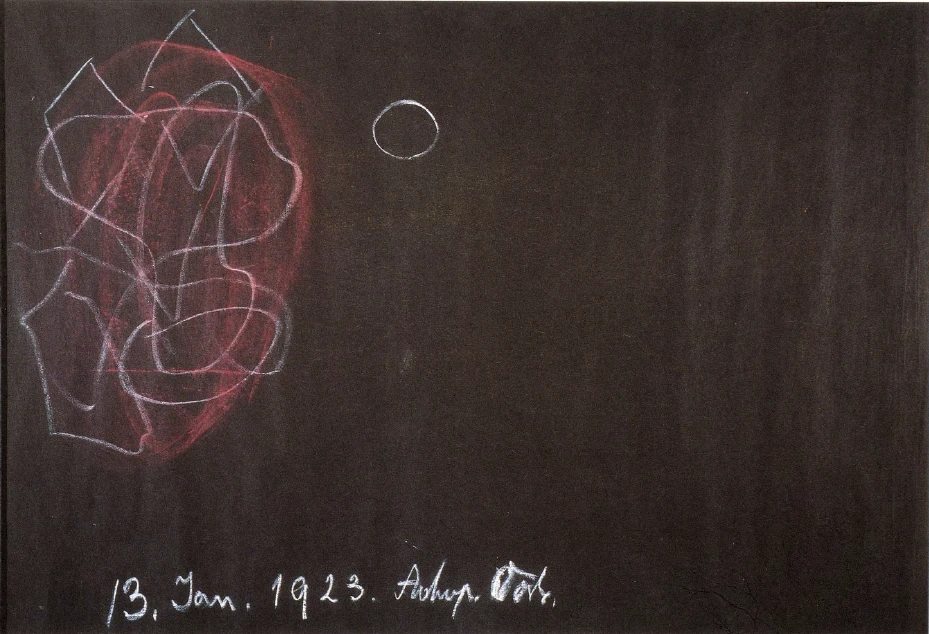
[ 26 ] Those beings with whom the ancient sage was able to establish genuine relationships did not merely point him toward his water of life—from which this microcosm was born—but also toward his breath of life, toward that which human beings take in as air through their breathing and distribute throughout their entire organism. What is diffused in this way, in a sense, pours back over this entire microcosm, rendering the forms within it indistinct (red hatching in the drawing). The wonderfully ethereal little world begins, as the breath passes over it, here and there—one might say—to fade, to become indistinct. That which was multifaceted becomes one, because the astral human lives within the airy form, just as the etheric human lives within the watery form. The astral human lives within it, and through the collapse of the etheric thoughts, through the transformation of the etheric thoughts into force, through the astral within the air human, the will is born—and with the will, the forces of growth that are related to the will.
[ 27 ] Once again, we do not have the abstract term “will,” but rather a concrete process. We have the concrete process in which the astral takes hold of the airy and spreads out over that which is etheric-aquous. And through this, a process truly takes place, similar to what is observed externally in nature at another level when the formed substance is burned. In ancient times, however, this process was understood as the sulfur process. And out of the sulfur process developed what is then experienced in the soul as the human will.
[ 28 ] In ancient times, people did not use the abstract term “thinking” to refer to something merely figurative; rather, when one spoke of thinking—and was truly a person of insight—one was referring to the salt process I have just described to you. People did not speak of “will” in an abstract sense; rather, if one was a true knower, one spoke of the grasping of the airy substance permeated by the astral, of the sulfur process in which will arises—the will that is directly perceived. And it was said that the balance between the two—for they are, after all, opposing processes—is achieved through the Mercury process, through that which is formative and fluid, which oscillates, as it were, back and forth from the etheric to the astral, from the aqueous to the airy.
[ 29 ] Such abstract ideas, as gradually developed by Scholasticism and adopted by modern natural science, did not even exist for the ancient thinkers. If one were to present such ancient thinkers with our concepts of thinking, feeling, and willing, they would have felt like a tree frog placed in a vacuum—among the emptied reservoirs of an air pump. That is how the ancient thinkers would have felt with our abstract concepts. They would have thought: One cannot live spiritually with these; one cannot catch one’s breath spiritually with them. It would have meant absolutely nothing to them. They did not speak of a mere abstract process of will, of a mere abstract process of thought, but of a salt process, of a sulfur process, and by this they meant something that was, on the one hand, spiritual-soul-like, but on the other hand, material-etheric. For them, this was a unity, and they perceived the workings of the world in such a way that the soul was active everywhere within the physical, and the physical was permeated everywhere by the soul.
[ 30 ] In the writings of the Middle Ages, which date back to the 13th, 14th, and 15th centuries, this old way of thinking still lingers—a way of thinking that was rich in content but based on insights experienced from within. These had died out by the time Giordano Bruno, Jakob Böhme, and Bacon of Verulam were alive. Ideas had become abstract. People were no longer encouraged to look within themselves, but rather out into nature. I told you that the ancient thinkers would have felt, faced with our ideas, like a tree frog beneath the receptacle of an air pump. But we can still hold onto these ideas. Most people, however, when they speak of thinking, feeling, and willing, conceive of nothing more than the reflections of external nature that occur within the human being. But especially in more recent times, one can attain something that was not possible in the past. In a sense, we have been abandoned by the self-activity that leads to knowledge from within. In the intervening period that has developed since the fifteenth century, human beings find nothing anymore when they look merely within themselves. They look out into nature, and there they form abstract concepts. But now these abstract concepts can, in turn, be intensified externally; they can once again become substance because they can be experienced. Of course, we are only at the very beginning of this process, but this is the beginning that anthroposophical spiritual knowledge seeks to establish.
[ 31 ] All the processes, however, to which I have referred—this salt process, this sulfur process—are, after all, processes that do not take place at all in external nature. They are processes that human beings can only perceive within themselves. They do not take place in external nature. In external nature, something takes place that relates to these processes in the same way that the processes in a corpse relate to the processes in a living human being.
[ 32 ] When modern chemistry speaks of sulfur processes and salt processes, these sulfur and salt processes stand in the same relationship to what Jakob Böhme drew from folk wisdom as the processes in a corpse do to those in a living human being. Everything is dead, whereas these ancient views possessed an inner life. One thus looked into a new world that does not exist around the earthly human being. Through this, however, one had the gift, with the help of firsthand experience, to see that which does not exist around the earthly human being, but rather belongs to another world. The moment one truly understands these salt and sulfur processes, one looks right into pre-earthly human life. For earthly life differs from pre-earthly human life in that the living sulfur and salt processes appear here in the outer sensory world as if they had died. What we perceive around us between birth and death through our senses—as if it were dead—is alive in those sulfur and salt processes, but we experience it in pre-earthly existence. This means that truly understanding these processes, about which Jakob Böhme still stammers, is tantamount to looking into pre-earthly existence.
[ 33 ] The reason Jakob Böhme does not speak of this pre-earthly existence is precisely because he did not truly possess it, but only had a vague sense of it. This human ability to glimpse into pre-earthly existence has been lost, and with it has also vanished that connection to the spiritual beings of the world who point toward post-earthly existence through the sulfur process. The entire constitution of the human soul has simply become different. And Giordano Bruno, Jakob Böhme, and Bacon of Verulam were immersed in this transformation of the soul’s constitution.
[ 34 ] I already pointed out yesterday that people today have no inkling of the way human beings were situated in the world in earlier eras. That is why they do not place much value on news that comes from a relatively recent past. I have pointed out the magnificent idea behind the origin of Merlin. We can also point to other examples. You see, we are now performing the Play of the Three Kings; we have staged it repeatedly. But this account of the Three Kings’ visit to the infant Jesus is also found in the Old High German poem Heliand. As you know, this dates back to the relatively early Middle Ages and originated in Central Europe. Yet there is something very noteworthy here. We learn that something else is connected to this visit by the Three Kings from the East. Namely, in the Heliand, the Three Kings recount that they come from regions where things were once very different from how they are now—that is, from the time at the beginning of our calendar—for they are the descendants of ancestors who were infinitely wiser than they themselves could ever be in their own time. And according to these three kings, they have one ancestor in particular who lived long ago, but this ancestor was one who could converse directly with his God. And when he was about to die, this ancestor gathered all the members of his extended family and told them that his God had revealed to him that a king of the world would one day appear, heralded by a star.
[ 35 ] And if one investigates what an outward sign of this ancestor is, one finds—as even the literature points out, and as can also be substantiated externally—that it is Balaam from the Old Testament, in the Book of Numbers; that is to say, these Three Wise Men, the kings from the East, refer to Balaam, the son of Beor, of whom the Book of Numbers tells how he converses with his God, and how he organizes his entire earthly life in accordance with this dialogue with his God. If we consider the entire matter, we simply find that at the time the Heliand was written in Central Europe, there was still a living awareness that people had once communed with the gods. A real conception of this process lived on in people.
[ 36 ] Here again we have something that was part of these people’s view of history, and which proves to us that we have transitioned from earlier eras—when people still lived in a living world, as I hinted at yesterday—into the age of Philistianism. For our civilization is, in essence, the universal Philistine civilization. Even those who believe they are outgrowing this Philistine civilization are by no means the opposite of the Philistine in the sense that they could still live within cosmic contexts as grandiose as, for example, the idea of Merlin or the tradition of Balaam as the forefather of the Three Wise Men. Oh no, these people are not non-Philistines—at most, they are bohemians.
[ 37 ] Now you see, when one says these things, one realizes for the first time what a tremendous shift has taken place in the state of humanity’s soul with regard to matters that do not attract our attention today. But in a certain sense, these things were foreseen. What did people already have centuries ago? People knew that there had once been a form of clairvoyance, albeit a dreamlike one. Through it, people were able to look into processes such as the sulfur process and the salt process. In this way, they gained the ability to look into pre-existing existence.
[ 38 ] Certain people, who wanted to lead humanity not upward but downward, yet who were also, in a certain sense, initiated, foresaw this: This ability will be lost to humanity; a time will come when people will be unable to say anything from within themselves about pre-existent life. And so they dogmatically decreed: There is no pre-existent life at all; the human soul is created at the same time as the physical body. And the fact of preexistence was dogmatically shrouded in darkness. That was the first step, the first stage, in moving from knowledge of the human being in the world to ignorance of the human being. For one no longer recognizes the human being when a part of him is taken away—and, moreover, a part as important as pre-existent life.
[ 39 ] Well, Jakob Böhme, Giordano Bruno, and Lord Bacon lived in an era when this perspective on pre-existent life had been obscured. And they lived in an era when what was now to be revealed did not yet exist: no longer the inner experience, but the spiritual contemplation of the external world, so that one finds in the external world the human being who can no longer find himself within.
[ 40 ] Once again, there were initiates long ago who, however, sought to lead people downward rather than upward, and who did not want to allow this new insight—which is the reverse of the old clairvoyance—to emerge; and who therefore sought dogmatic means to replace this new knowledge with mere belief in the afterlife, mere belief. And so, during the time when Giordano Bruno was active, human laws had eradicated the possibility of gaining insight into the pre-earthly human being, as well as the possibility of gaining insight into the post-earthly human being. And Giordano Bruno stood there like a wrestler; for he was a wrestler, more so than Jakob Böhme, and certainly more so than Lord Bacon, and he stood there with the people of his time and was unable to transform what had remained to him as Dominican wisdom into a genuine worldview. He poeticized what presented itself to him in an indefinite way as such a worldview.
[ 41 ] But from what Giordano Bruno could only vaguely perceive, a definite understanding of the world within the human being—and of the human being within the world—must emerge. It is not through clairvoyance reborn from within, but through freely attained clairvoyance that the whole human being must once again be recognized.
[ 42 ] I have thus described to you what must emerge in the course of human evolution. And today we are faced with the fact that an immense number of people hate—deeply hate—the very will to allow such an insight to emerge; they are enemies of this emergence. This can also be understood historically. Then one will understand how the hostile opposition to the anthroposophical worldview arises from within.