

Anthroposophy as Cosmosophy I
Human Traits in the Earthly and Cosmic Realms
GA 222
16 March 1923, Dornach
Translated by Steiner Online Library
Third Lecture
[ 1 ] Recently, I have had to point out repeatedly that one could just as easily provide a description of a person’s life during the time they spend between falling asleep and waking up as one could for the time between waking up and falling asleep. Everything a person experiences between waking and falling asleep is experienced through their physical and etheric bodies. Because they possess sensory organs in their physical and etheric bodies that are developed accordingly, they become aware of this world, which, as their environment, is connected to the physical and etheric bodies—it is, so to speak, one with them. Because, at their present stage of development, they have not developed spiritual-soul organs in their “I” and astral body in a similar way—organs that would, so to speak, be supersensory sense organs, if I may use this paradoxical expression—they cannot bring what they experience between falling asleep and waking up into their consciousness. Thus, only spiritual contemplation could survey what would, so to speak, constitute the biography of this “I” and astral body—parallel to the biography that comes into being with the aid of the physical and etheric bodies.
[ 2 ] Now, when we speak of a person’s experiences in the time between waking and falling asleep, these experiences necessarily include what takes place in their physical-etheric environment—what occurs together with them, is experienced by them, and is brought about through them. We must therefore speak of a physical-etheric environment, a physical-etheric world, in which a person exists between waking and falling asleep. Similarly, however, a person is in a world between falling asleep and waking up; only this is a world of a completely different nature than the physical-etheric world. And it is possible, through supersensible perception, to speak of this world, which is just as much our environment when we sleep as the physical world is our environment when we are awake. And in these lectures, we wish to bring to light certain aspects that can shed light on this world. The elements for this are provided, for example, in what you will find described in my Outline of Esoteric Science. There you will find, in a certain sense—albeit described in outline form—how the kingdoms of the physical-etheric world—the mineral, plant, animal, and human kingdoms—continue upward into the realms of the higher hierarchies. Let us keep this in mind a little today.
[ 3 ] Let us consider this: When we turn our eyes or our other sense organs outward toward our physical-etheric environment while awake, we perceive the three kingdoms of nature—or rather, the four kingdoms: the mineral, plant, animal, and human kingdoms. If we now ascend further into those regions that are accessible only to the supersensible, we find, as it were, the continuation of these kingdoms: the kingdom of the Angeloi, the Archangeloi, the Archai, the Exusiai, the Dynamis, the Kyriotetes, and so on (see diagram, page 47).
[ 4 ] So we have two worlds that interpenetrate one another: the physical-etheric world and the supersensible world. And we already know that between falling asleep and waking up, we are truly within this supersensible world and have experiences there, even though these experiences do not reach our ordinary consciousness precisely because of the lack of spiritual-soul organs.
[ 5 ] The point is that we can gain a more precise understanding of what human beings experience in this supersensible world if we provide—I would say—a kind of description of this supersensible world in the same way that we describe the physical-etheric world through the natural sciences and history. For such a—let us say—supersensible science of the actual course of events in the world in which we exist as sleeping human beings, one must, of course, begin by singling out individual aspects. And today I will begin by singling out an event that is of profound significance for the entire development of humanity over the past millennia.
[ 6 ] From one perspective, namely that of the physical-etheric world and its history, we have already discussed this event on numerous occasions. Today we want to discuss it, so to speak, from the other side—the side that reveals itself when one takes the perspective not from the physical-etheric world, but from the supersensible world. The event I am referring to—and which I have often described from that one perspective—is the one that falls within the 4th century A.D.
[ 7 ] I have, in fact, described how the entire constitution of the human soul in the West underwent a transformation in this 4th century A.D.—and how it is indeed the case that, without an esoteric scientific approach to the matter, one can no longer understand at all how people felt and perceived things in the period preceding the 4th century A.D. But we have, of course, described this feeling, this state of the soul, on several occasions. We have described in other words what people experienced over the course of the period that includes this 4th century A.D. Today we would like to consider a little what those beings belonging to the supersensible realm experienced during that time. We would like, so to speak, to turn to the other side of life; we would like to adopt the perspective of the supersensible.
[ 8 ] It is, after all, a prejudice of today’s so-called enlightened humanity that their thoughts exist only inside their heads. We would learn nothing about things through thoughts if those thoughts were confined solely to people’s minds. Anyone who believes that thoughts exist only in people’s minds is, as paradoxical as it sounds, subject to the same prejudice as someone who believes that the sip of water with which he quenches his thirst originated on his tongue and did not flow from the water jug into his mouth. It is, in essence, just as ridiculous to claim that thoughts arise in the human mind as it is to say—when I quench my thirst with a drink of water from my pitcher—that the water originated in my mouth. Thoughts are, in fact, spread throughout the world. Thoughts are the forces at work within things. And our thinking organ is simply something that draws from the cosmic reservoir of thought forces, something that takes these thoughts into itself. We must therefore not speak of thoughts as if they were something that belongs solely to human beings. We must speak of thoughts in such a way that we are aware: Thoughts are the forces that govern the world, spread throughout the cosmos. But these thoughts do not simply fly about freely; rather, they are always carried and shaped by certain beings. And, most importantly, they are not always carried by the same beings.
[ 9 ] When we turn to the supersensible world, we discover through supersensible research that the thoughts through which human beings make sense of the world were carried out into the cosmos—I might also say: streamed out; earthly expressions are hardly adequate for these sublime processes and essences—that is to say, these thoughts were carried, or streamed out, until the 4th century A.D. by the beings of those hierarchies we call the Exusiai or Form Beings (see diagram on page 47).
[ 10 ] When an ancient Greek, drawing on the knowledge of the mysteries, sought to understand where his thoughts actually came from, he had to do so by saying to himself: I turn my spiritual gaze upward toward those beings who are revealed to me through the science of the Mysteries as the beings of form, as the form-forces, the form-beings. These are the bearers of cosmic intelligence; these are the bearers of cosmic thoughts. They allow thoughts to flow through world events, and they impart these human thoughts to the soul, which brings them to life through experience. — Anyone who, through a special initiation in those ancient times of Greek life, had attuned himself to the supersensible world and had progressed to the point of experiencing these beings of form, beheld these beings of form; and in order to form the correct image, the correct imagination, of them, he had to attribute to them, as it were, the luminous thoughts flowing through the world. As an ancient Greek, he saw these form beings as, for example, emitting luminous thought forces from their limbs, which then entered into the processes of the world and continued to work there as the world-creating powers of intelligence. He might have said: The forces of form, the Exusiai, have the task in the universe, in the cosmos, of pouring thoughts through the processes of the world. — And just as sensory science describes human activity by recording this or that which people do individually or together, so a supersensory science, when it considers the activity of the form-forces for the era in question, would have to describe how these supersensory beings allow thought forces to flow between one another, how they receive them from one another, and how those cosmic processes—which then manifest outwardly to human beings as natural phenomena—are integrated into this mutual flow and reception.
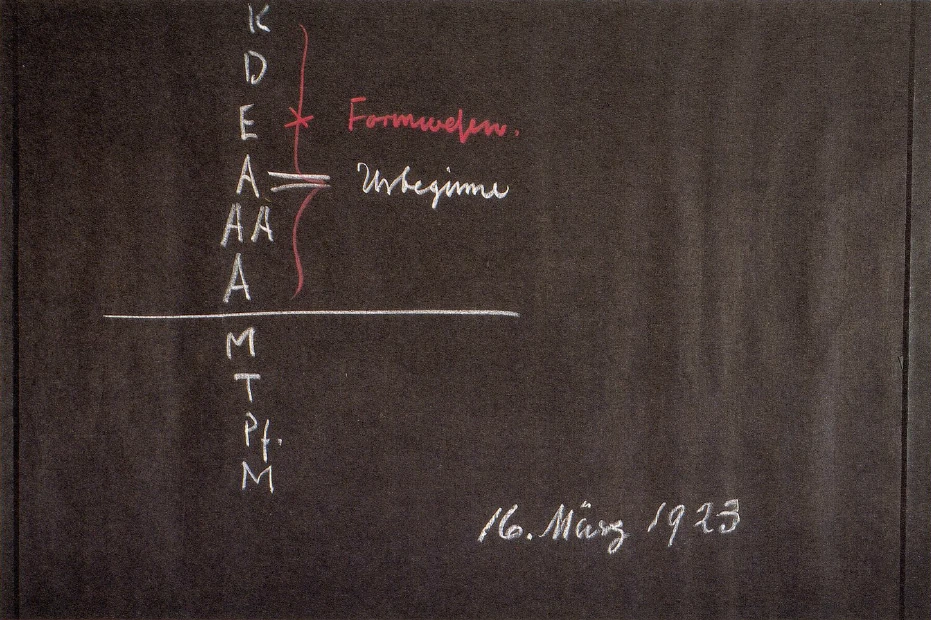
[ 11 ] Now, in the course of human evolution, that very 4th century A.D. was approaching. And this brought about an extraordinarily significant event for the supersensible world: the Exusiai—the forces, the beings of form—surrendered their powers of thought to the Archai, the primal forces or primal beginnings (see diagram).
[ 12 ] At that time, the Primordial Beings, the Archai, took on the role that the Exusiai had previously fulfilled. Such processes do indeed occur in the supersensible world. This was a cosmically significant event of the highest order. From that time on, the Exusiai—the beings of form—retained only the task of regulating external sensory perceptions; that is, of governing, through special cosmic forces, everything that exists in the world of colors, sounds, and so on. Thus, anyone who looks into these matters must say of the era that dawned after the 4th century A.D.: He sees how the world-governing thoughts are handed over to the Archai, to the Primordial Beginnings, and how what the eyes see and the ears hear—in its manifold world-formation, in its constant metamorphosis—is the fabric woven by the Exusiai, who formerly gave thoughts to human beings and who now give them sensory perceptions, while the Primordial Beginnings now give them thoughts.
[ 13 ] And this reality of the supersensible world was reflected here below in the sensible world in such a way that, precisely in that earlier time—in which, for example, the Greeks lived—thoughts were perceived objectively in things. Just as we today believe we perceive red or blue in things, so the Greeks did not merely grasp a thought with their minds, but perceived it as radiating out from things, just as red or blue radiates out.
[ 14 ] I have, in fact, described this in my book The Riddles of Philosophy—what this other, I would say, human side of the matter is. You will find a thorough description of how this important process of the supersensible world is reflected in the physical-sensory world in my book The Riddles of Philosophy. There, one must use philosophical terms, because the language of philosophy is a language for the material world, whereas when discussing the perspective of the supersensible world, one must also speak of the supersensible fact that the office of the Exusiai has passed to the Archai.
[ 15 ] Such events unfold within humanity over the course of entire epochs. They are linked to profound transformations of the human soul. I say that this supersensible event took place in the 4th century A.D.; but that is only an approximation, for it is, so to speak, merely a midpoint, whereas this transition actually unfolded over long periods of time. It had already been in preparation in pre-Christian times and was not fully accomplished until the 12th, 13th, and 14th centuries A.D. The 4th century is, so to speak, merely the midpoint that has been specified to point to something specific in the historical development of humanity.
[ 16 ] Well, this brings us to that point in human development when, for human beings in general, the view into the supersensible world begins to darken completely. The soul’s consciousness ceases to see and perceive the supersensible as the human soul devotes itself to the world. This may become even more vividly apparent to your soul if we examine it from another perspective.
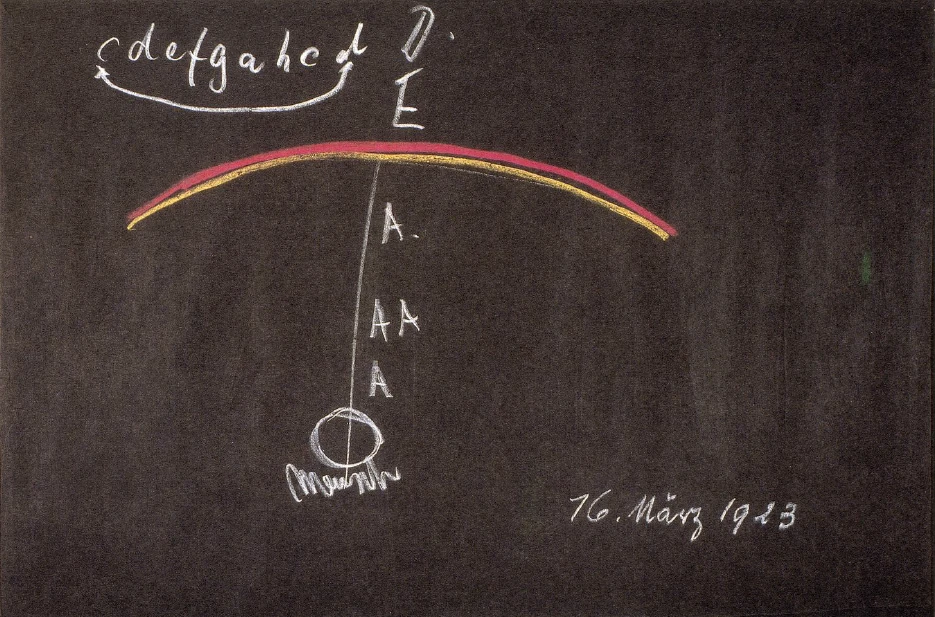
[ 17 ] What, then, is the very thing I wish to emphasize so strongly? It is the fact that people are becoming increasingly aware of their individuality. As the world of thought shifts from the beings of form to the primordial beginnings, from the Exusiai to the Archai, human beings perceive the thoughts of their own being more keenly, because the Archai dwell one step closer to human beings than the Exusiai. And when a person begins to see supersensually, they have the following impression. Then they say: Well, there is this world that I perceive as the sensory world. Let us say that the yellow (see diagram on page 50) is the side turned toward my senses, while the red is the side that is already hidden, turned away from the senses.
[ 18 ] Ordinary consciousness knows absolutely nothing about the relationships under consideration here. But the supersensible consciousness certainly has the sense that: when a human being is present here (see diagram, p. 50), then between the human being and the sensory impressions there are Angeloi, Archangeloi, and Archai; these are actually on this side of the sensory world. One simply cannot see them with ordinary eyes, but they actually lie between the human being and the entire tapestry of sensory impressions. And the Exusiai, Dynamis, and Kyriotetes are actually only on the other side; they are concealed by the tapestry of sensory impressions. Thus, the human being who possesses a supersensible consciousness perceives the thoughts—after they have been handed over to the Archai—as approaching him. He perceives them as if they were now more within his own world, whereas before they were located behind the colors—the red and the blue that are on things—and approached, so to speak, through the red, the blue, or even through the C-sharp or the G. Since this transfer, he feels he is in freer communication with the world of thought. This also gives rise to the illusion that human beings create thoughts themselves.
[ 19 ] However, it was only over the course of time that human beings developed the ability, so to speak, to internalize what had previously presented itself to them as an objective external world. This came about only gradually in the course of human development. If we now go back quite far in human evolution—if we go back beyond the Atlantean catastrophe to the ancient Atlantean era—I ask you to imagine the human form in the Atlantean era as I have described it in my Occult Science or in the essays From the Akashic Records. As you know, these human beings were, after all, quite differently constituted. Their physical substance was of a greater subtlety than it later became in the post-Atlantean era. As a result, however—and all of this is described in the books—the soul aspect was in a completely different relationship to the world, and these Atlanteans experienced the world quite differently. I’d like to mention just one aspect of this particular way of experiencing the world. For example, these Atlanteans could not perceive a third, not even a fifth. In fact, their musical experience only truly began when they perceived the seventh. And then they perceived wider intervals, the smallest of which was the seventh. They were inaudible to them; thirds and fifths simply did not exist for them.
[ 20 ] As a result, however, the experience of musical structures was entirely different; the soul had a completely different relationship to them. If, musically speaking, one lives solely in sevenths—and lives in sevenths as naturally as the Atlanteans did—then one does not perceive the musical at all as something taking place within oneself as a human being; rather, at the very moment one perceives music, one is outside one’s body, living in the cosmos outside. And so it was with the Atlanteans. For the Atlanteans, the musical experience coincided with an immediate religious experience. Their experience of sevenths presented itself to them in such a way that they could not say, for example, that they themselves had anything to do with the origin of the seventh intervals; rather, they sensed how gods, surging and weaving through the world, revealed themselves in sevenths. They could not have attached any meaning to it at all: “I make music.”—They could only attach meaning to it by saying: “I live in the music made by the gods.”
[ 21 ] Well, in a significantly diminished form, this musical experience was still present in the post-Atlantean era—the era in which people essentially lived in intervals of fifths. You must not compare this with the way people perceive fifths today. Today, people perceive the fifth in such a way that it gives them the impression of an unfulfilled exterior. For them, it has something empty about it—in the best sense of the word—but something empty nonetheless. It has become empty because the gods have withdrawn from humanity.
[ 22 ] Even in the post-Atlantean era, human beings experienced, through their fifth intervals, that the gods actually dwelt within these fifths. And it was only later, when the third—the major and minor thirds—appeared within music, that music, so to speak, became immersed in the human soul, so that human beings were no longer transported by their musical experience. In the true Age of the Fifth, human beings were still thoroughly transported by musical life. In the age of the third—which, as you know, emerged relatively late—human beings are immersed in the musical experience within themselves. They bring the musical into their physical being. They interweave the musical with their physicality. Hence, with the experience of the third, the distinction between major and minor arises, and one experiences, on the one hand, what can be experienced in major, and on the other hand, what can be experienced in minor. The musical experience is linked to the elevated, joyful, as well as the depressed, painful, and sorrowful moods that human beings experience as bearers of their physical and etheric bodies, through the emergence of the third and the introduction of major and minor modes into music. In a sense, the human being draws his experience of the world from the cosmos and unites himself with that experience. In earlier times, his most significant experience of the world was such—and this was certainly still the case in the “Age of the Fifth,” but to a greater degree in the “Age of the Seventh,” if I may use these terms—that it immediately transported him, so that he could say: The world of sounds draws my “I” and my astral body directly out of my physical and etheric bodies. I interweave my earthly existence with the divine-spiritual world, and the sound structures resound as something on whose wings the gods sweep through the world—a sweeping I experience firsthand as I perceive the sounds.
[ 23 ] So in this particular field, you can see how, so to speak, the cosmic experience approaches human beings, how the cosmos penetrates into human beings, how—if we go back to ancient times—we must, so to speak, seek the most important human experience in the supersensible realm, and how the time then dawns when human beings, as sensory-earthly phenomena, I would say, must be taken into account when describing the most significant world events.
[ 24 ] This occurs in the age that begins after the thoughts have been handed over by the beings of form to the primordial beginnings. This is also expressed by the fact that the old Age of the Fifth—which predated that handover—transitions into the Age of the Third, into the experience of major and minor keys.
[ 25 ] It is particularly interesting when this very experience takes us back to a time even older than the Atlantean era—that is, to a period of human evolution on Earth that, in the grayest and most distant past, blurs when viewed retrospectively, but whose vision can be brought to light through supersensible perception. This even takes us to an age — you will find it described in my Occult Science as the Lemurian Age — where human beings could no longer perceive musical intervals within a single octave, but rather could only perceive an interval when it spanned the octave, something like this: so that a person perceives only this interval c–d, that is, the d of the next octave.
[ 26 ] In the Lemurian Age, then, we certainly have a musical experience that cannot be conveyed by simply hearing an interval within an octave; rather, the interval extends beyond the octave, all the way to the first note of the following octave, and then continues to the next note of the octave after that. And there the person experiences something that is difficult to name; but one can perhaps get an idea of it when I say: The person experiences the second of the next octave and the third of the octave after that. They experience a kind of objective third, and there, too, the two thirds—namely, the major and the minor third. Except that the third—what they experience there—is, of course, not a third in our sense, for only if I take the prime in the same octave is the note I mean in relation to the second-next prime the third. But because the person was able to experience directly the intervals that, for us today, are such that we say: a prime in one octave, a second in the next octave, a third in the third octave—this ancient human perceived what is a kind of objective major and objective minor, a major and minor no longer experienced within oneself, but rather a major and minor that was felt as the expression of the gods’ spiritual experience. The people of the Lemurian Age experienced—one cannot now speak of joy and sorrow, elation and depression—but one must say: Through this special musical sensibility in the Lemurian era, as they were completely transported in their perception of these intervals, people experienced the cosmic sounds of the gods’ jubilation and the cosmic laments of the gods. — And we can look back on an earthly age truly experienced by human beings, in which, so to speak, what humans today experience in major and minor keys was projected out into the cosmos. What they experience inwardly today was projected out into the cosmos. What surges through his soul and feelings today, he once perceived—in a state of rapture, detached from his physical body—as an experience of the gods outside himself. What we would today have to characterize as an inner experience of the major mode, he perceived—in that state of rapture, detached from his body—as the cosmic song of jubilation, as the cosmic music of the gods’ rejoicing, an expression of their joy at their world-creating work. And what we today experience as inner experiences of minor key, humanity in the Lemurian era once perceived as the immense lament of the gods over the possibility that human beings might fall into what is then described in biblical history as the Fall, as the apostasy from the divine-spiritual powers, from the good powers.
[ 27 ] This is something that resonates with us from that wondrous insight into the ancient mysteries—which naturally flows into the realm of art—so that we perceive not merely an abstract description of how, in times past, human beings underwent Luciferic and Ahrimanic seduction and temptation and experienced this or that, but rather that human beings heard, how, in the most ancient times of the Earth, the gods made music jubilantly in the cosmos out of the joy of their world-creation, and how they had already looked ahead, as it were prophetically, to humanity’s fall from the divine-spiritual powers, and expressed this foresight in a cosmic lament.
[ 28 ] This artistic grasp of something that later took on increasingly intellectual forms is something that resonates from the ancient mysteries, and from which we can gain the deep conviction that it is a source from which knowledge, art, and religion have flowed. And from this must come our conviction that we must return to that state of the human soul which will arise once more when the soul perceives, as it is permeated by religious waves and artistic currents; to that state of the soul which, with deep vitality, understands what Goethe already meant by the words: “Beauty is a manifestation of secret laws of nature that would have remained eternally hidden without its appearance.” — The mystery of humanity’s development within earthly existence, within the process of becoming human—this is revealed to us by the very inner unity of all that a human being must experience together with the world through religious and artistic insight, so that he or she may experience his or her full development together with this world.
[ 29 ] And it is indeed true that the time has now come when people must once again become aware of these things, because otherwise human nature, in its spiritual essence, would simply have to decay. Today and into the near future, human beings would have to wither spiritually due to the increasingly intellectualistic and one-sided nature of knowledge, they would become spiritually dulled by art that has become one-sided, and would become utterly soulless through religion that has become one-sided, if they could not find the path that would lead them to the inner harmony and unity of these three; if they could not find the path to step outside themselves in a more conscious way than was once the case, and to once again perceive and hear the supersensible together with the sensible.
[ 30 ] It is precisely when one looks, through the lens of the humanities, at the earlier, more profound personalities of the emerging Greek culture—those personalities from whom figures such as Aeschylus and Heraclitus later developed—that one finds that these personalities, insofar as they were initiated into the mysteries, all shared the same feeling, arising from their insight and from their artistic creative powers—which they experienced precisely in this way, just as Homer did when he said, “Sing, O Muse, of the wrath of Achilles, son of Peleus”—not as something personally at work within them, but as something they performed in their religious sensibility in communion with the spiritual world, and through which they said to themselves: In ancient times, people actually experienced themselves as human beings by stepping outside of themselves through the most important human activities—as I have shown you in the case of music, but it was the same with the formation of thought—and experiencing things together with the gods. What they experienced there, people have lost.
[ 31 ] This sense of loss—the loss of humanity’s ancient intellectual, artistic, and religious heritage—weighed heavily on the deeper Greek souls.
[ 32 ] Something else must come about with regard to the modern human being. The modern human being must, through the unfolding of the right forces of his soul experience, come to rediscover what was once lost. I would like to say: Human beings must develop an awareness—since we are, after all, living in the Age of Consciousness—of how that which has now become inner can once again find its way outward toward the divine-spiritual. And this will be able to take place—I alluded to it in response to a question asked at the Goetheanum during the first School of Spiritual Science course—this will occur, for example, in a particular realm when the inner richness of feelings experienced in melody is eventually transferred to the individual tone, when human beings come to know the mystery of the individual tone, when, in other words, people will not only experience intervals, but will truly be able to experience the individual tone as a melody, with inner richness and a diversity of inner experience. Today, there is scarcely any conception of this yet.
[ 33 ] But you see how things proceed: from the seventh to the fifth, from the fifth to the third, down from the third to the unison, to the single note, and then onward. So that what was once a loss of the divine must be transformed for the sake of humanity’s development—if humanity on Earth wishes to continue evolving and not perish—it must be transformed for the sake of humanity on Earth into a rediscovery of the divine.
[ 34 ] We can only truly understand the past if we are able to contrast it with the true image of our development into the future, if we can feel—deeply, profoundly deeply—what a profound individual felt even in ancient Greece: I have lost the presence of the gods—and if we can counter this, again from a soul that is shaken yet intensely and most earnestly striving: Let us bring the spirit that lies dormant within us to bloom and bear fruit, so that we may rediscover the gods.