

Anthroposophy as Cosmosophy I
Human Traits in the Earthly and Cosmic Realms
GA 222
17 March 1923, Dornach
Translated by Steiner Online Library
Fourth Lecture
[ 1 ] Yesterday I attempted to at a significant point in the development of world history—one we have come to recognize as such for some time now, namely the 4th century A.D.—to show how one can only fully understand this development of humanity by considering not only what takes place, so to speak, in front of the scenes of world history, but also what lies behind those scenes. And I told you yesterday that we can mark, as a midpoint—roughly in the 4th century, since this process spans many hundreds of years—the transfer of the cosmic world of thought from the Spirits of Form to the so-called Archai, the primordial beginnings or primordial forces. And linked to this—because human beings now become dependent in their thoughts on entirely different spiritual beings—is the fact that they now relate to their thoughts in a completely different way than before.
[ 2 ] You must bear in mind how external world history—both external historical events and the spiritual history of humanity—unfolds during these centuries, and how this very supersensible fact intervenes in these historical events. Whereas in the past the spirits of form—that is, those beings whom the Bible, for example, calls the Elohim—administered the thoughts of the world, so that human beings had to turn unconsciously to these spirits of form whenever they wished to form thoughts about things, the life of thought has now passed over to the primal forces that are much closer to human beings. I illustrated this closeness to you yesterday by saying the following: Let us imagine that here is the boundary representing the sensory world. So everything we see and perceive in the sensory world—colors, sounds, sensations of warmth—is symbolized by this line (see drawing on page 59). What lies beyond sensory perceptions is the realm in which, as I said yesterday, the spirits of form are found—those whom the Bible calls the Elohim, then the so-called Dynamis, higher spirits, then the Kyriotetes, and so on. These, then, are the three realms that lie beyond the sensory world.
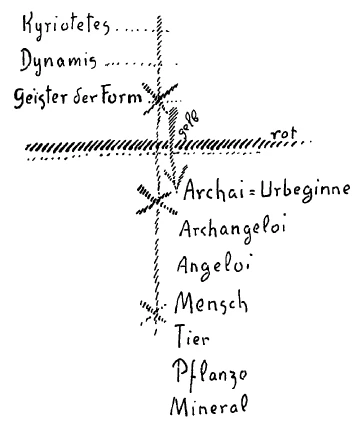
[ 3 ] Modern physics, when it becomes a philosophy of nature, fantasizes that behind the sensory world lie swirling atoms. But this is a fanciful materialistic notion. In truth, colorful, resonant processes take place there; they occur because these spirits of the higher hierarchies reign there through colors, sounds, and so on.
[ 4 ] Before the 4th century A.D., the spirits of form reigned not only in the impressions of the sensory world, but above all in thought. These thoughts have now passed over to the Archai, to the primordial beginnings. But these are closer to human beings than the spirits of form, for they exist prior to the sensory world. They lie between human beings and what human beings perceive through their senses; it is only because they are of a supersensory nature that human beings do not perceive them. Then come the Archangeloi, then the Angeloi, and then human beings themselves, followed by animals, plants, and minerals.
[ 5 ] So that during this period I have alluded to, behind the scenes of world history, lies this great, all-encompassing, mighty deed: that the thoughts which are in things, and which man draws from them, are no longer, so to speak, the sole possession of the Elohim, but rather the possession of the Primordial Beginnings, the Archai.
[ 6 ] However, in the evolution of the universe, it is the case that as spiritual beings progress, certain spiritual-cosmic beings are left behind. Thus, as spiritual beings generally progress, certain spiritual beings are left behind. And so, during this period—that is, in the first centuries of Christianity—spirits of form were also left behind.
[ 7 ] What does it mean that spirits of form were left behind back then? It means that certain spirits of form were unable to bring themselves to surrender the world of thought to the primordial beginnings, to the Archai; they kept it for themselves. And so, among the spiritual beings who preside over human affairs, we have the properly developed primordial forces that possess the world of thought, and we have backward-remaining spirits of form—backward-remaining Elohim beings—who now also administer the world of thought. This gives rise, within the spiritual current that governs humanity, to an interplay between primordial forces, the Archai, and spirits of form, the Elohim beings. Human beings are then subject to the following: The individual who, through his karma, is truly suited for it receives the impulses of his thinking through the Archai. As a result, his thinking—though it remains objective—becomes his personal possession. He increasingly develops these thoughts as his personal property. Others do not have the opportunity to develop these thoughts as their personal property. They either inherit these thoughts from their parents and ancestors, or they adopt them as conventional thoughts that prevail within their national community, tribal community, and so on.
[ 8 ] This supersensible fact, which I have described to you, is the source of the entire interplay between individual personalities—who are emerging more and more in this era of late antiquity and the dawn of the Middle Ages—and those currents of thought that sweep entire groups of people. This, in turn, is structured on Earth—I would say—in a geographical manner. First of all, certain spiritual personalities in the Near East, who belong to Arab culture, are seized by the impulses emanating as thought impulses from the Archai, the primordial forces. And in particular, what lies within these thought impulses spreads across Africa, over to Spain, and throughout all of Western Europe. We find, as it were, this great current of thought passing through Africa, through Spain, also reaching southern Italy, and moving up toward Western Europe (see drawing on page 67, arrow). We have a great stream of thought that stems from these characteristic impulses. This current of thought has permeated what developed as Arab-Spanish culture—a culture that, much later, would exert a great influence on thinkers such as Spinoza, and which also lives on in the natural sciences, as we can still observe in the thought impulses of Galileo, Copernicus, and so on. While the impulses of the Archai live on in such currents of thought and in what becomes world history from these currents, we also see everywhere, intruding into world events, that which is more under the influence of the backward spirits of form, who in turn permeate humanity with their own impulses. And we see yet another current of intellectual life and world events moving somewhat further north from Asia toward Europe. This current of thought did not find its particular, extreme expression until later, when the masses of Turks surged across from Asia.
[ 9 ] Thus we see European historical life from this period onward—from the 4th century onward—permeated, I would say, by a ceaseless spiritual struggle. The Archai are fighting for their rightful inheritance in world events against the backward Exusiai, against the spirits of form. Everything that takes place in the Middle Ages in a west-to-east and east-to-west direction—the surging and intertwining of migratory movements, the mutual conflicts, from the battles against the Huns to those against the Turks, from the Migration Period to the Crusades—where everything always follows a west-to-east or east-to-west direction, all of that is the sensory-physical, historical reflection of a spiritual struggle, as I have just characterized it, which takes place behind the scenes of world history. One can only truly grasp the reality of historical events on Earth when one sees in them a reflection of what takes place in the supersensible-spiritual world among the beings of the higher hierarchies.
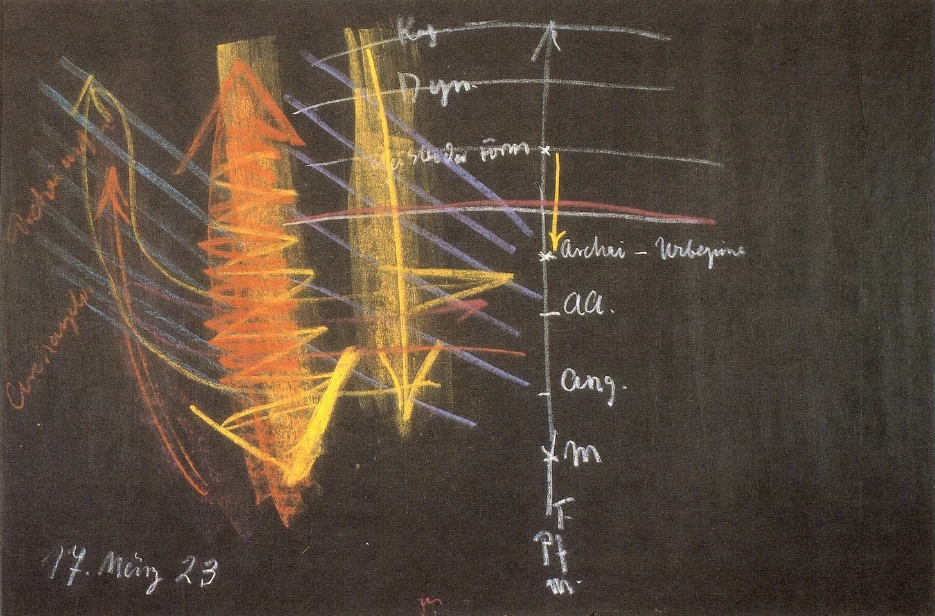
[ 10 ] To begin with, if we consider one aspect of this fact, we can say: We have two currents. The one I have sketched for you here (see drawing on page 67, yellow) causes the most diverse movements, again from west to east; the other current advances and then retreats again, so that these two currents are constantly intertwining. In this illustration, we see what takes place in the spiritual world during those struggles we know from the Migration Period—struggles in which ancient culture is partly destroyed, but in which ancient culture is also interwoven with human individuality.
[ 11 ] One might consider the following reflection. One might ask: What would have become of European civilization if the various peoples had not begun their migrations—sweeping across from Asia into Europe and settling in many places there—and if, at times, the human personality had not asserted its individuality in a wild manner during these migrations?
[ 12 ] We can see, indeed, within this Migration Period, how entire tribes are swept up by a shared spirit. But if we look through history, we see everywhere how, within these individual, closely-knit tribes—the Ostrogoths, Visigoths, Lombards, Heruli, Franks, Marcomanni, and so on—that are imbued with a collective spirit, individual personalities are seized by their own unique impulses. One might say: What is taking place everywhere is, on the one hand, the continuous flow of impulses from the old spirits of form—which are, in fact, no longer justified—and, on the other hand, the justified emergence of the spirits of personality, the primal forces, or primal beginnings.
[ 13 ] If history were to describe events more accurately, taking greater account of the spiritual forces at work in what is usually portrayed merely as a struggle between nations, then one would see how this dual nature of thought impulses within humanity actually dominated European life, particularly during the period of the Great Migration.
[ 14 ] One might, I said, consider the following: What would have become of European civilization if these partly barbaric peoples had not swept across from east to west and, with the youthful vitality of their individual members, poured down upon the aging Greco-Roman civilization?
[ 15 ] But one might also ask, from the other side: What kind of European civilization could these semi-barbaric peoples have established if they had not been influenced by what was present in Greco-Roman civilization—that which had been adopted through the spirits of personality and the Archai?
[ 16 ] That is incredibly interesting. For when one looks at the Greeks—and indeed even at the Romans—one sees quite clearly: they derive their ideas—their scientific, artistic, political, and social ideas—entirely from those influences that come from the spirits of form, from the Exusiai. One need only look—not with the crude gaze of modern historiography, but with a somewhat finer sensibility—at figures such as Pericles, Alcibiades, or Sulla, indeed even Hannibal—although he strongly embodies the archetype of the personality—and also at Caesar and all these figures, and one will find: in them, thoughts still reign like cosmic forces, like something instinctive.
[ 17 ] This is precisely because their thoughts stem from the spirits of form. Then a personality like this appears, one whose soul stands right in the midst of the struggle between the spirits of personality—now rightfully empowered—and the spirits of form—which have lost their rightful standing: This personality, whose soul is entangled in that struggle, is Augustine, the Catholic Church Father. I have described his inner struggle to you from a wide variety of perspectives. But if one regards this inner struggle as the earthly reflection of a cosmic-supernatural event, then one perceives in this spirit—who in his youth was inclined toward Manichaeism and who later became a Roman Catholic believer in the strictest sense— one sees in this inner conflict of a soul the earthly reflection, the earthly echo of something that is unfolding cosmically behind the development of humanity. Augustine leans toward the Manichaeans at a time when his soul is still entangled in the impulses of the spirits of form. They bring all the goodness of earlier times into his soul, yet it no longer suits the souls of his time. Yet because of what he has received from the spirits of form who have remained behind—namely, the good and exquisite cultural treasures of the past—he is hindered from fully developing his individual personality to embrace the new form of thought as it can be conveyed by the spirits of personality, the Archai, who have now become the rightful bearers of thought. And he can only embrace this by surrendering himself completely to the dogma of the Church.
[ 18 ] A personality such as Augustine can always be characterized from two perspectives. One can adopt the perspective of earthly existence and then look solely at the individual personality to see how the soul forces struggle with one another. But one can also consider the matter from beyond earthly existence and take into account how such a personality is guided and directed by the divine-spiritual forces of the higher hierarchies. Then, when one adopts the earthly perspective, one comes to know a human personality precisely as it lives out its life here on Earth. When one adopts the other perspective—the supersensible perspective—one comes to recognize in what way such a personality is a messenger of the spiritual world. This is, in fact, what a human being always is. Here on Earth, a human being is an earthly being and can be regarded in a self-contained way as an earthly being. It does not in any way hinder the freedom of this earthly existence that the human being is simultaneously impelled by the forces of the supersensible world—not directed or guided, but impelled—and that he is thus at the same time a messenger of the supersensible powers.
[ 19 ] And once again, in a different form, we are confronted by this interplay of the backward spirits of form, which—primarily over in Asia— I might say, seek out their core forces and constantly push them toward Europe, and the now-legitimate spirits of personality, the Archai, who have already advanced further westward and always seek to push back what comes from the backward spirits of form.
[ 20 ] In later times, this interplay of East and West—this intermingling of earthly reflections of higher spiritual impulses—manifests itself in the Crusades. Study the Crusades. Study how, initially driven by a certain impulse—one that is thoroughly connected to the nature of the spirits of personality, the Archai—the Crusades develop, and how mighty intentions underlie them. Then study how the Crusaders increasingly succumb to mass judgments, and how these mass judgments exert an ever-greater suggestive influence. I would like to say: The farther the Crusaders move from west to east, the more the individual becomes caught up in mass judgments. — And when the Crusaders then enter the sphere of Asian life, mass impulses spread over what has been instilled by individual personalities into individual personalities.
[ 21 ] We see how people lose their sense of self. We see how the European crusaders in the East are decaying in terms of their spiritual qualities. They are unable to develop the positive moral impulses they brought with them amid the mass suggestion they fall prey to. They become morally decadent. And amid this moral decadence of well-meaning people who have migrated from West to East, the impulses striving from East to West—which live within the Muslim and Turkish peoples—regain the upper hand.
[ 22 ] And so we see in the Crusades the second ebb and flow in world history of a struggle from East to West and from West to East—a struggle that is the mirror image of the other, the spiritual struggle between backward spirits of form and truly advanced spirits of personality.
[ 23 ] Over time, the whole situation would have developed in such a way that—if we look at Europe—in the West, the impulses of the spirits of personality would have spread more and more, albeit one-sidedly (see diagram on page 67, blue hatching), while in the East, the impulses of the backward spirits of form would have spread more and more (purple hatching). You can consider what I am describing to you today in conjunction with other perspectives that I have previously developed here regarding these cultural currents, for in the supersensible realm, things are indeed deeply intertwined, and one can only gradually come to understand them by engaging with the most diverse impulses.
[ 24 ] But it did not remain that way. If, however, we go back to the very early Middle Ages, to the time of the Crusades, we can say: For those times, what I have described here applies. But more and more, another factor comes into play—I am referring now to the supersensible realm— and that is that not only have the spirits of form remained behind, and not only have the Archai—the primordial beginnings—advanced, but it is always the case in the hierarchies of the supersensible world that certain spiritual beings remain behind, certain spiritual beings make their normal progress, while certain beings also overshoot the mark.
[ 25 ] And so we see that in the West—specifically, coming up from the South—archangelic beings who have fallen behind (red arrow on the left), archangels who have fallen behind, intervene in the entire process. So, in a sense, we have here (above) Archai beings in the proper sense, but here (below) we have Archangeloi beings who have remained at earlier stages—beings who actually represent the lagging entities of earlier stages, who have remained Archangeloi even though they could already be Archai. That is the nature of these spirits.
[ 26 ] And so we see that in Western Europe, more and more—if I may use this pedantic, philistine expression—normal Archai are working together with abnormal Archangeloi.
[ 27 ] If we consider the matter geographically, the Archangeloi have a south-north orientation, while the Archai and the remaining Exusiai have west-east and east-west orientations. In this way, the historical-geographical conditions unfolding on Earth emerge as reflections of the struggles and interactions of higher spiritual beings.
[ 28 ] Everything that happens in Western Europe—and one may well say, everything that has happened up to the present day—can be understood as a reflection of the interaction between such normal Archai and abnormal Archangeloi, abnormal Archai beings, who—above all because they are very close to human beings—strongly influence them, instilling in them, above all, an emotional relationship to their languages, that emotional relationship which—as you can imagine from a lecture I recently gave here—is of great significance to these people. This influence of the Archangeloi beings—which is so important, particularly for humanity’s relationship to language—shapes the very essence of human beings to an extraordinary degree. What binds people together precisely through language, causing them to appear fanatically united through language, can be explained as an earthly, symbolic phenomenon once one understands the supersensible realities underlying it.
[ 29 ] Now, in different historical epochs, this tendency is stronger or weaker on one side or the other. In the West, we see a predominance of the normal Archai, while in the South, there is a predominance of the impulses of the abnormal Archangeloi beings. It is entirely possible to characterize the historical life of individuals and peoples from the perspective of the supersensible.
[ 30 ] Furthermore, it must be said: What would happen in the East is significantly modified by the fact that the backward-remaining spirits of form—who, after all, possess great power—are strongly influenced by the—I may say this now, since you know their significance—by the normally developed Archangeloi beings acting from north to south. It pushes its way, so to speak (arrow, yellow), into that wild turmoil and upheaval caused in particular by the Turks—who are dominated by the lingering spirits of form and by Elohist entities— Mongols, and similar forces; something flows down from the north and mingles with it—if I may use the expression—that comes from good Archangeloi beings who are very close to human beings, who pour into every single human soul something that drowns out that collective spirit, which actually originates from backward-developing spirits of form.
[ 31 ] Once again, it is the case that, in various epochs of world history, a terrible, impersonal, and non-individual collective spirit soon prevails, while in other epochs individualities come to dominate. If someone were to portray the remarkable history of Russia in this way—as a reflection of the interplay of higher spiritual beings from the upper hierarchies—it would shed tremendous light on the events that occur in the individual epochs of that history.
[ 32 ] So now (see diagram on page 67) we have a current in the west flowing from south to north, which mixes with the west-east current, and here a current flowing from north to south, which also mixes with the west-east current. But these currents spread out again, and later on we have a south-to-north current that is constantly—I would say—set in motion by the west-to-east impulses, oscillating in a zigzag pattern (see diagram on page 67). And acting in conjunction with this, influencing it from within, is the north-south current, which in turn is set into zigzag oscillations by the west-east impulses (orange). This convergence of the two currents—which are already composite in themselves—occurs at a later stage of European development; it occurs at the time when the struggles of the Reformation begin.
[ 33 ] Here we see how a north-south current—which, however, is always intermingled with a west-east current—strongly carries within itself the normal archaic forces, as this current strives toward what remained of the earlier impulses that flooded over from Asia, brought by the lingering spirits of form. And because it has something to do with the spirits of form, something occurs in an elemental way, yet at the same time it relates to the normal impulses of human development.
[ 34 ] Study everything that, on the one hand, flows from the pure idea of Evangelical Protestantism from north to south, yet then influences the wildest warlike entanglements, and study what arises as countercurrents from the south, which in turn leads to warlike entanglements. Study, for example, the Evangelical-Protestant movement with its main north-south direction and the Catholic-Jesuit movement with its main south-north direction: there you will be able to study the interplay—the complex interplay—of what is taking place on Earth as a reflection of the higher spiritual struggles of the supersensible.
[ 35 ] And this results in something that you, as anthroposophists, should actually value. According to today’s accounts—which Schiller has only slightly adjusted, particularly regarding the beginning of the events—according to today’s accounts of the Thirty Years’ War, we know how that event developed out of the religious conflict in Prague, in which the agitated crowd stormed the Prague Town Hall and threw the two statesmen, Martinitz and Slawata, and then also the secretary Fabricius out the window—to whom, as you know, no harm came because they fell onto a manure heap, that is, a pile consisting entirely of discarded scraps of paper. It was not what one would ordinarily call a manure heap, but rather a pile of scraps of paper, for in those days it was customary not to use a wastebasket but to throw scraps of paper out the window, and afterward the agitated crowd hurled those politicians after them. If you start there and then follow the story further: it’s such a chaotic back-and-forth across the map of Europe; sometimes one side wins, sometimes the other; sometimes one elector comes up with an idea, then another general takes a different course, and so on. It’s like moving back and forth across the map of Europe, regardless of whether you map out this movement or merely describe it. In school, one is always at a loss when dealing with such depictions of such eminently important events as the Thirty Years’ War, because, according to the usual historical accounts, one is forced to tell the story in such a way that the students will soon forget it again—for it all gets jumbled up! There is nothing there that gives direction to the individual currents of thought. But if one looks at the truth of the matter, then one sees, behind the outward image, these north-south and south-north currents, which are also constantly crisscrossed by west-east ones.
[ 36 ] One sees in what comes from Wallenstein, what then comes down from the north—from Gustav Adolf and so on—one sees in all of this how what is happening externally in history is, so to speak—and again, I am not saying “guided” or “directed,” but rather “impelled”—by the supersensible forces that lie behind it. Nevertheless, human beings are free beings within this context; the human being is, after all, a free being, even though natural impulses also guide his actions. Isn’t that right? One cannot say that one becomes unfree simply because, upon looking out the window and seeing that it is raining, one takes one’s umbrella and opens it outside; one is simply adapting to the natural forces. Thus, with his soul-spiritual actions, the human being is fully embedded in the spiritual impulses, in the spiritual interplay of forces within it; he therefore remains a free being after all.
[ 37 ] But what unfolds on the stage of world history can only be understood when one grasps it from the perspective of the supersensible realm that lies behind it. And this leads one to the concrete impetus given to world-historical events by spiritual forces, whereas, if one speaks only of an abstract Divine, one cannot arrive at any kind of insight.
[ 38 ] Anyone who speaks merely of an abstract Divine—since he must conceive of the Divine as active everywhere—would actually have to seek this abstract Divine, say, in a medieval battle against the Turks, among the Turks themselves, and also among those who are fighting the Turks! That is to say, the abstract divine is engaged in a struggle with itself, caught in a self-conflict, if one views it solely as the abstract divine.
[ 39 ] The moment one encounters the specific spiritual beings whose mutual relationships are defined by the fact that, as I have described, certain tasks are transferred from one group to another—with some groups remaining behind while others advance to normal levels— and still others advance rapidly—at the very moment one recognizes that there is indeed a multitude of beings in the spiritual world who fight one another but who can also help one another—only then does one gain the ability to truly comprehend, in human terms, what is happening behind the scenes of world history in the supersensible realm of the cosmos, without falling into unwarranted contradictions.
[ 40 ] For you see, this is where concrete concepts come into play. One can see how, in the West, unauthorized Archangeloi interfere with the legitimate actions of the Archai, and thus how, in the struggles taking place there, the good is continually being undermined and worsened. We see how, in the East, Archangels working for good—as helping, protective spirits—balance out what would otherwise be shaped in a way not corresponding to the fullness of the human by the backward spirits of form. And we then see how, as these two currents converge, those ongoing confusions of the Reformation and Counter-Reformation arise within Central Europe, to the extent that these forces assumed during the Thirty Years’ War and in the subsequent conflicts that took place there.
[ 41 ] Two things must be before our minds: We consider the individual human being; but we do not view him as today’s official science does, which sees only: here is this muscle, there is that muscle, here is this bone, there is that nerve —but rather we regard the whole human being, in terms of his physical constitution, as an image of the supersensible, and we know that the physical human being, as he stands on Earth, is first and foremost shaped on the plane of thought—between ‘death’ and a new life—by the human being himself, who incarnates on Earth, in conjunction with the spirits of the higher hierarchies. And so we regard the individual human being as a reflection of a supersensible archetype of humanity.
[ 42 ] But secondly, we also regard what happens in history as a reflection of an event taking place behind the scenes of history—an event that unfolds in the supersensible world, in that world where whole hosts of supersensible beings—if I am to describe them using earthly terms—enter into social relationships with one another just as human beings do on Earth. The only difference is that the actions of these supersensible social beings are such that their impulses influence the Earth and find expression in human actions.
[ 43 ] It is particularly important for people today to understand in detail how, on the one hand, human beings are reflections of the supersensible, and on the other hand, historical events are reflections of the supersensible. And it is only through this path that human beings can find their way back to the divine-spiritual world. Today, mere abstractions of the divine can still have an effect on those who have not yet begun to seek to perceive and think in the spirit of modern spiritual life. But their numbers will continue to dwindle, and those who wish to perceive and think will grow ever more numerous. They, in turn, must be led back to religious life. They can do so only if the concrete, real processes of the spiritual world are presented to the eye of their soul, rather than being fobbed off with a mere abstract, general idea of the divine—about which one does not actually wish to say anything, but which is merely invoked as an all-encompassing term without any understanding of the details.
[ 44 ] This, my dear friends, once again highlights—from yet another perspective—one of the tasks that anthroposophical knowledge has and should have in the present.