

Anthroposophy as Cosmosophy I
Human Traits in the Earthly and Cosmic Realms
GA 222
18 March 1923, Dornach
Translated by Steiner Online Library
Fifth Lecture
[ 1 ] As we look back on what was presented to you in the previous reflections regarding the events, facts, and actions in the supersensible worlds—all of which, after all, served more or less as a supplement to my booklet The Spiritual Guidance of the Individual and of Humanity —you will understand that what is essentially at stake in our time is recognizing that the great, momentous event I spoke of—which I said belongs primarily to the 4th century A.D.—is now unfolding, and that it is the transfer of the administration of world thoughts from the Spirits of Form to the Spirits of Personality or Primordial Forces. If we consider the full meaning—the cosmic significance—of this momentous event, we can say: It consists entirely in giving humanity, in the course of its evolution, what it is meant to receive in our present fifth post-Atlantean epoch—the epoch of the development of the consciousness soul—namely, inner human freedom, the possibility for the individual human being to act out of his or her own being. We know, after all, that human development on Earth was essentially a kind of preparation for this epoch; that the natural foundation first had to be created within the human being so that, within the framework of what he has become through this natural foundation, he can then develop his soul life within himself toward freedom. How does this relate to the supersensible event described above?
[ 2 ] If we consider this event in broad strokes, we can say: On the one hand, we view the spiritual world in such a way that the principal spiritual guides of humanity are those beings whom we must refer to as spirits of personality, as Archai; but these spirits of personality, these Archai, have received the administration of world thoughts from the hands of the Exusiai, the spirits of form. These Archai—to whom, so to speak, humanity owes the possibility, in the course of its development, of arriving at thoughts through its own inner soul work—are hindered in their effectiveness by those beings who, as Exusiai, as Spirits of Form, remained at an earlier stage of development; by such beings who, as Spirits of Form, have not, so to speak, relinquished the administration of cosmic thoughts. And in this period of the consciousness-soul, in which we have been living since the 15th century, human beings are now faced with the great choice—in one of their incarnations—to truly choose freedom, or, which amounts to the same thing, to attain the possibility of this freedom through their turning toward the right Archai.
[ 3 ] In our own age, however, we see how people are reluctant to break away from those spiritual beings who, as Exusiai, have not been willing to relinquish their mental development. We can understand the role these beings play in humanity’s current development by considering the role that their counterparts—Exusiai undergoing normal development—rightfully played in earlier times.
[ 4 ] In earlier times, people did not develop their thoughts in the same way they do today. They did not develop their thoughts through inner activity or inner work. They developed their thoughts by devoting themselves to observing the external natural world, and just as we perceive colors and sounds today, they perceived thoughts at the same time. But in even earlier times, when people devoted themselves to instinctive, unconscious clairvoyance, they received thoughts as a gift from the divine-spiritual worlds along with the images of unconscious clairvoyance. So people did not work to develop their thoughts; they received them. That is what they had to do in earlier times.
[ 5 ] Just as a child must first develop its physical nature, just as a child must first lay the foundation for what it will only be able to learn later in life, so humanity as a whole could only achieve the inner, active development of a world of thought once that world of thought had first begun to work on the entirety of human nature from the outside.
[ 6 ] This preparatory period therefore had to be endured. But during this preparatory period, human beings could never actually say that they were called to become free beings. For, as you can see from my Philosophy of Freedom, the fundamental condition of human freedom is precisely this: that human beings develop their own thoughts through inner activity, and that from these self-developed thoughts—which I have called “pure thoughts” in my Philosophy of Freedom—they can also draw moral impulses.
[ 7 ] Such moral impulses, springing from the very essence of human nature, did not exist and could not have existed in the earlier stages of human development. At that time, moral impulses had to be provided alongside ideas that were, as it were, divinely given—like commandments that were absolutely binding and rendered people unfree. It is precisely this aspect of the matter that you will find presented in my Philosophy of Freedom: humanity’s transition from bondage to commandments that exclude freedom to action arising from moral intuition, which encompasses freedom.
[ 8 ] Now, the nature of the spirits of form is such that they always bring about something within the human being from the outside. Everything that the human being has brought about within his own being from the outside—all of that is contained in the deeds of the spirits of form. And it was indeed the case that, as long as the spirits of form implanted cosmic thoughts in human beings, these thoughts were something that either—I might say—came to human beings as perceptions from stones, plants, and animals, or else arose from within, from human instincts and drives. In a sense, human beings floated on the waves of life, and these waves were stirred up—but also calmed, insofar as they gave rise to thoughts—by the Spirits of Form. Thus, what came to human beings from the outside was what they then grasped within themselves. That is why, even in those earlier times, human beings felt toward their gods in such a way that they sought the gods rather than the causes of world events and of themselves. When human beings spoke of the gods, they did so in a way that sought in the gods the cause of what they are on earth and of what natural phenomena on earth are. Humanity always turned to the gods as the causes of things: Where does the world come from? Where do I myself come from? — These were the great religious questions of ancient humanity.
[ 9 ] If you examine the ancient myths, you will always find—even in the biblical creation story—that they refer to Genesis myths, because people initially sought the origin of the world above all else, but essentially remained stuck in this search for the origin of the world.
[ 10 ] This entire mood of the human soul was brought about by the fact that human beings, in their world of thought, were dependent on the spirits of form. Well into the 4th century A.D., and in its aftereffects even into the 15th century, the spirits of form were, so to speak, fully entitled—if I may use this expression—to exercise complete control over the realm of thought, to administer thought, and to bring thinking and the unfolding of thoughts to human beings from the outside.
[ 11 ] Since that time, things have changed. Since that time, the Exusiai—the spirits of form—have handed over the management of thoughts to the Archai. But how do the Archai manage these thoughts? Well, no longer by managing them themselves—by instilling them in people, by implanting them in people from the outside—but rather by giving people the opportunity to develop these thoughts themselves. — How can that be?
[ 12 ] This may simply be because we humans have all gone through a large number of earthly lives. In those earlier times, when the Exusiai rightly brought thoughts from outside, human beings had not yet gone through as many earthly lives as they have in the present age. Back then, even if they truly stirred up the impulse within themselves, they were not yet able to find within themselves the inner activity needed to generate the power of thought on their own. Today we are living, so to speak, in our such-and-suchth earthly incarnation. And if we only have the will to do so—for it all comes down to the will—then we can find within ourselves the power to generate our own world of thought, an individual world of thought, as I have also explained in The Philosophy of Freedom.
[ 13 ] But now take this idea completely seriously! Remember that we have entered an age in which human beings are engaged, from within themselves, in developing and shaping their thoughts. Yet they now also stand alone in the world. These thoughts would, so to speak, stand isolated in the world, having no significance for the cosmos, were it not for spiritual beings who now incorporate the thoughts that human beings develop in their freedom into the cosmos in the proper way as a force and an impulse. And thus we have the progression from the administration of thought by the Spirits of Form to that by the Spirits of Personality.
[ 14 ] The spirits of form have, so to speak, drawn these thoughts from the general cosmic reservoir of thoughts in order to bring them to human beings from the outside. Humanity has absorbed the world-thoughts into itself and had to feel like a kind of creature moving within the currents and waves generated by the spirits of form in the cosmos. The world of thought was so deeply embedded in the cosmos that it imparted its harmony to humanity itself. But humanity was an unfree being within the cosmos. Now humanity has attained the freedom to develop its own thoughts; yet these would all remain as “hermit thoughts” within the cosmos if they were not now absorbed and carried back into the cosmic harmony. And this is precisely what the Archai accomplish in our age.
[ 15 ] Here, the foundation has been laid for resolving that immensely significant historical conflict that has arisen in recent times and has plunged human souls into such infinite confusion. Do we not see this conflict? I have often mentioned to you from other perspectives how, on the one hand, human beings learn that the entire cosmos is permeated by a natural order, that this natural order also influences their own human being, and that there was once a primordial nebula from which the sun and planets coalesced, and from which human beings themselves also coalesced. Do we not see, on the one hand, the system of cosmic natural laws into which human beings feel bound? And do we not see, on the other hand, how human beings—in order to preserve their true human dignity—are compelled, now that they stand as beings given by nature, to stir within themselves the idea of a moral world order, so that their moral impulses do not vanish into the vastness of the universe but become a reality?
[ 16 ] I would like to point out that this conflict resurfaced time and again in certain philosophical speculations throughout the 19th century. Just look at the religious struggles within Protestantism that are linked, for example, to the Ritschlian school. Most people are unfamiliar with these religious-philosophical-theological struggles, since they took place within the narrow confines of theological or philosophical schools. But what takes place within these narrow confines does not remain confined to them. It is not a matter of whether you—or humanity as a whole—know exactly what Ritschl thought about the moral-divine world order or about the personality of Jesus. But what such figures thought about the personality of Jesus in the course of the nineteenth century trickles down and is already alive in the teachings imparted to six- to twelve-year-old children. This becomes—and has become—a general state of the human soul. And even if people do not bring this to full clarity for themselves, the fact remains that it exists within them as vague feelings, as a sense of dissatisfaction with life, and that it then gives way to such chaotic behavior that it was bound to bring about a chaotic age such as the one in which we live. This is precisely the great, anxious question facing humanity today, arising from the fact that human beings must tell themselves: There is the world governed by the laws of nature, originating from the primordial nebula and eventually ending in heat death, where everything that is soul-spiritual will have perished in a world no longer in motion but existing in a general state of heat, so that a vast graveyard must exist there. All moral ideals arising from the individuality of each person would have perished.
[ 17 ] People today do not realize this because they are not honest enough about it. But everything they derive from modern civilization should lead them to suffer from this immensely significant conflict in their worldview—only they do not know it— to suffer from the fact that there is a natural world to which they are subject, that they must accept a moral world, and that, from their current perspective, they have no way of attributing reality to moral ideas.
[ 18 ] It was not so for an earlier humanity. An earlier humanity felt that it had received its moral ideas from the gods. This was during the time when the Exusiai—the spirits of form—instilled thoughts into human beings, including moral thoughts. At that time, human beings knew that, truly, even if the Earth were to succumb to heat death, there would still be, in the future, divine-spiritual beings who, from throughout the entire cosmos, hold the world-thoughts. Thus, human beings knew: they do not create these thoughts; they simply exist, just as external natural processes exist; they must therefore have an eternal existence, just like external natural processes.
[ 19 ] We simply have to make it very clear to ourselves that today, many people are finding it increasingly difficult to cope with life. Some admit this to themselves—they are perhaps the best among us—while others do not, but their actions are creating the general global chaos into which we have fallen.
[ 20 ] But everything that exists today as chaos in the world, as disorder in the world, is the actual consequence of this inner conflict, this lack of knowledge regarding the extent to which the moral world order is a reality. People would like to numb themselves to the great questions of the world, since they do not want to bring themselves to admit where the conflict actually lies. They would prefer to forget it altogether. Well, this conflict cannot be resolved through what is today called our external civilization. It can be resolved only on the foundation of a spiritual worldview, which is sought through anthroposophy. And this is precisely where one comes to realize how there are Archai who have now been given the task in the cosmos, in cosmic guidance, of truly connecting the thoughts of human beings—which now arise in isolation through inner work in the soul—to the processes of the worlds everywhere, and of classifying them everywhere.
[ 21 ] And in a magnificent, powerful way, human beings once again find the foundation for the moral world order precisely in this manner. How do they find it? Well, human beings could not become free if they were unable to develop the feeling: You develop your thoughts from your own individuality; you are the creator of your thoughts.
[ 22 ] But in doing so, we simultaneously detach our thoughts from the cosmos. In a sense, it was like this in ancient times: If I were to depict the sea of cosmic thoughts here (see drawing, yellow) and there were people whom I were to sketch schematically like this (red), then I would have to depict what enters each person as their share of the cosmic world of thought in this way (yellow). Human beings were connected to the cosmic world of thought; it flowed down into them. That this could be so resulted from the workings of the spirits of form.
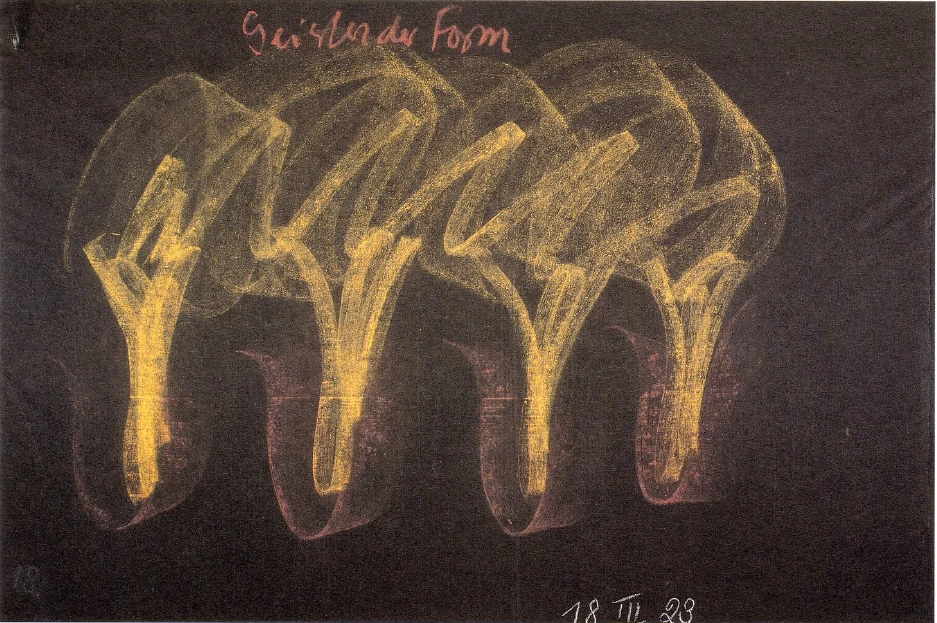
[ 23 ] This has changed in the course of human evolution. Here we have the sea of cosmic thoughts (see drawing, yellow); administration has passed to the Archai. When I now draw the individual human beings down there, their thoughts are cut off; they are no longer connected to the cosmic thoughts. — It must be this way. For human beings could never become free beings unless they severed their world of thought from the cosmos. They must sever it in order to become free beings; but then it must be reconnected. What is therefore necessary is the administration of these thoughts—which, after all, do not initially concern human life directly (green), but rather concern the cosmos—by the Archai, the spirits of personality.
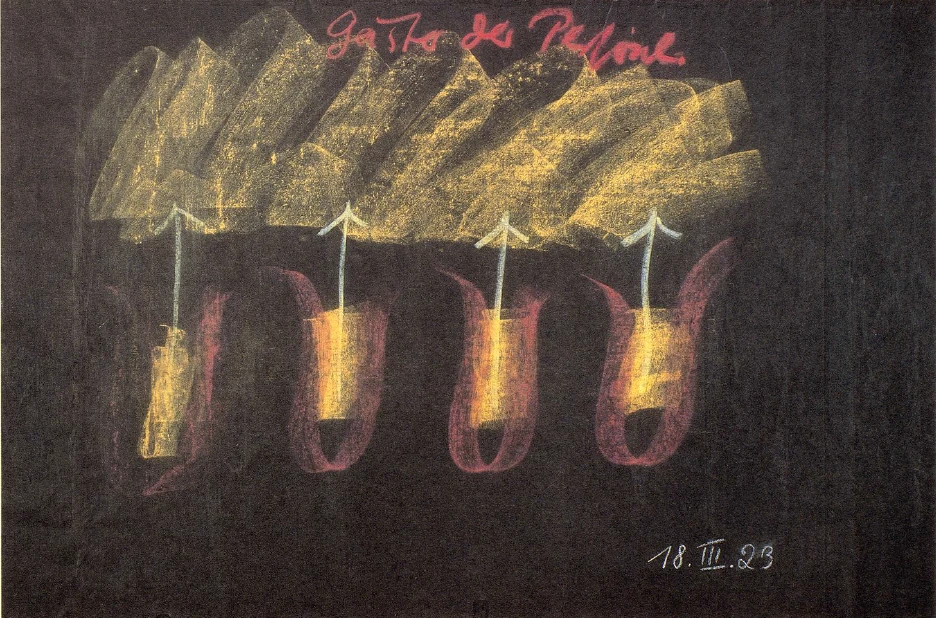
[ 24 ] But now let us consider this thought from a moral perspective, and let us feel how, when viewed from this perspective, it leads us to say to ourselves: When we enter the spiritual world—whether after passing through the gate of death, or elsewhere, or in the future of the Earth—we will encounter the spirits of personality, the Archai. We will then be able to perceive what they have been able to do with our thoughts, which were initially isolated within us for the sake of our freedom. And there we will recognize our human worth and our human dignity in what the Archai, the spirits of personality, have been able to do with our thoughts. And the cosmic thought turns directly to moral sentiment, to moral impulsiveness.
[ 25 ] Moral impulsiveness can certainly spring from a correctly understood anthroposophy everywhere today. One need only grasp, with one’s whole being, what anthroposophy is.
[ 26 ] If we grasp this idea—the idea of responsibility toward the normally developing Archai—and if we correctly understand our spiritual relationship within the cosmos, then we will truly live our way into our age, and we will become true human beings of our age. And then we will look in the right way at what always surrounds us: not only a sensory world, but also a spiritual world. We will look at these spiritual beings, the Archai, toward whom human beings are to become responsible if they wish to undergo their human development in a worthy and proper manner over the course of Earth’s history. We will see how, in the present age, what was once the necessary world order is still opposed by all that remains of such spirits of form who still wish to govern thoughts in the old way. And this is the most significant civilizational development of our time! These are humanity’s true, deeper tasks: to become free through its proper relationship to the Archai, to the spirits of personality, so that it may also attain the proper relationship to the spirits of form—who are not in the right today in their attempt to manage thoughts as they did in the past, though they were once within their rights to do so. And on the one hand, we will find what makes life difficult in the world today, but we will also find ways out of the world’s difficulties everywhere. We must, however, seek these paths as free human beings. For if we have no will for the free development of thought, what are the Archai to do with us?
[ 27 ] What really matters in our age is that human beings truly want to be free beings. Most of the time, however, they do not yet want this at first. They must first come to terms with wanting it. Even today, it is still difficult for human beings to will themselves to be free beings. What they would really like most is to be able to wish for whatever pleases them, and for the right spirits to be there to carry out their wishes in an invisible, supersensory way. Then perhaps they would feel free, feel worthy of being human! We need only look a few incarnations ahead—not even that long a time, just to the year 2800 or 3000—and then, in a future incarnation—when we will look back on our previous one—we will no longer be able to forgive ourselves for having once confused human freedom with the promotion of human comfort by indulgent gods!
[ 28 ] People today confuse these two things: freedom and the forbearance of benevolent gods with human comfort and convenient human desires. Even today, many people still want there to be benevolent gods who grant their wishes without much effort on their part. As I said, we need only wait until the year 2800 or 3000; in a future incarnation, we will then look down upon this with great disdain. But precisely if we develop the right moral attitude today, it must also be combined with a certain moral strength that truly desires freedom—inner freedom, first and foremost; outer freedom will then develop in the right way once the will for inner freedom is present. For this, however, it is necessary that we be able to observe correctly where these unjustified spirits of form are at work everywhere.
[ 29 ] Well, they are active everywhere. I could imagine—since the human intellect does have such a Luciferic tendency—that there might be people who say: Yes, it would be much more reasonable for the divine world order if these backward spirits of form weren’t operating there, if they weren’t there at all! — To people who think this way, I advise them, as reasonable people, to also consider that they could nourish themselves without their intestines simultaneously filling up with unpleasant substances. One simply cannot exist without the other. And so, in the world, it is not possible for the things that, in their grandeur and power, determine human dignity to exist without their corresponding correlates.
[ 30 ] Where, then, do we see these backward spirits of form at work? First and foremost, we see them at work today in the national chauvinisms spreading throughout the world—where people’s thoughts do not develop from an immediate, innermost human center, but rather from the blood, from that which surges up from the instincts.
[ 31 ] In this regard, there are two ways of relating to nationality. One is this: one despises the normal archaic elements and simply surrenders to what the backward spirits of form make of nationalities. One then simply grows out of one’s nationality, chauvinistically insisting on what one has become by virtue of being born of the blood of a particular nationality. One speaks from the perspective of one’s nationality; one’s thoughts are shaped by the language of that nationality; and through the specific form of that language, one also acquires one’s thought forms. One rises above what the spirits of form have made of nationalities.
[ 32 ] And if one is willing to give in to these backward spirits of form and at the same time is a terribly ambitious person whom fate has placed in a special position, then—precisely with the world’s national chauvinisms in mind—one fabricates “Fourteen Points”—and then find followers who regard Woodrow Wilson’s Fourteen Points as the very thing that is supposed to give the world something magnificent.
[ 33 ] In truth, what were they, these fourteen points of Woodrow Wilson’s? They were something to be thrown to the world so that it might indulge in what the backward spirits of form wish to pour out upon the various natural foundations of nations. They were directly inspired by that.
[ 34 ] One can discuss all these matters from a wide variety of perspectives. Exactly what I am saying today at a level that corresponds to the characteristics of Archai and Exusiai is exactly what I have always said for years to characterize the global significance of these fourteen points by Woodrow Wilson, through which—because they lulled the world into illusions—so much misfortune and chaos have come into the world.
[ 35 ] Furthermore, we see today how what emanates from these backward spirits of form asserts itself in the one-sided, scientific-materialistic worldview, where there is a true horror—or rather, a dreadful fear—of entering into the realm of active thought. Just imagine for a moment what a terrible scene a real professor would make today if some student in the laboratory were to look through a microscope and try to formulate a thought. That simply doesn’t happen! One must carefully record only what external sensory observation provides, without even realizing that this constitutes only half of reality; the other half of reality is generated precisely through one’s own human creative thinking. But one must know what the present mission of the properly developed Archai is. In science—which is being corrupted by the backward-looking spirits of form—the true mission of the spirits of personality must be asserted. This is the greatest fear imaginable today.
[ 36 ] Surely you’re familiar with the well-known anecdote about how science is conducted according to different national and natural foundations. For example, the question is asked: What happens when, in proper zoology, the goal today is to get to know a camel—how do different nations go about it? The Englishman takes a trip to the desert and observes the camel. It might take him two years to observe the camel in all its natural settings, but in this way he gets to know the camel in its natural environment; he describes it, omitting all personal interpretations, of course, but he describes everything—he does not invent his own ideas. The Frenchman goes to the menagerie, where a camel is on display; he looks at the camel in the menagerie and describes the camel as it appears there. He does not get to know the camel in all its natural settings the way the Englishman does, but rather describes it as it is in the menagerie. The German goes neither to the desert nor to the menagerie, but sits down in his study, compiles a priori all the ideas he can draw from what he has learned, constructs the camel a priori, and describes the camel based on this a priori construct. — That is how the anecdote is usually told. It is almost true—really, almost—because one has the feeling everywhere, whether a camel is being described or human beings themselves or the like: the description came about in this way. But there is one thing missing. That, I would say, would provide the correct conclusion, the correct answer to this threefold anecdote: There would be, somewhere, a fourth person—it doesn’t really matter whether he goes into the desert, or whether he studies books because he doesn’t currently have the opportunity to go to the desert or the menagerie, or whether he ultimately goes to an animal painter and looks at his pictures, in which camels are painted with brilliant artistry—who is capable, based on what presents itself to him, to pose the question to the divine-spiritual world order itself: What is the essence of the camel? — For the one who is capable of performing this inner work can still discern, by looking at the camel in the menagerie, how it behaves in the desert; indeed, he can even discern this from what he is able to form through reading various books, perhaps books containing hideously caricatured, philistine-pedantic, schoolmasterly descriptions. Yet if he can penetrate the essence of the camel, he will still be able to discern what it is all about—even from the schoolmasterly descriptions, from all manner of a priori constructs. |
[ 37 ] This is what humanity needs above all else today—not, of course, by excluding, but by including the experience of the external world, by including the sensory experience of the world: to find the path to the spiritual.
[ 38 ] Here again we find what, in every area of our quest for knowledge, should lead us to understand correctly how the backward spirits of form can mislead us, and how a correct understanding of the mission of the spirits of personality can properly situate us—precisely as human beings—within our own age. And it is most important to be able to orient ourselves in this way with regard to growing children in order to arrive at a true art of education. For this is precisely what is lacking everywhere today in all forms of educational art: People cling to what human beings have become in the course of historical development through the erroneous spirits of form, assuming that this is entirely correct, that this is what human beings are like.
[ 39 ] But—thank God, one might say—childlike nature still rebels against this. It will not put up with it yet. The adult, of course, is only too happy to put up with it; childlike nature still rebels against it, and youthful nature in particular rebels against it.
[ 40 ] Once again, we have one of the defining features of today’s youth movement and one of the defining areas where modern pedagogy, I would say, must become clairvoyant—or at least allow itself to be enriched by clairvoyance—so that it may truly be recognized how, when a human being is born today, the seed of inner thought activity is born with them. Then, when this seed of inner thought activity is present, we learn, above all, one thing that most people today are unable to do. Do you know what people today are unable to do? They are, in fact, unable to grow old. And young people, you see, want to have people who have grown old as their leaders. They do not want young people themselves to be their leaders—even if they say so, they are mistaken—they want to have as leaders people who have truly understood how to grow old, who carry the living seed of thought development with them into old age. If young people can recognize this, then they will follow such leaders, for they know that these people have something to say to them if they have understood how to grow old in the right way. But what do young people encounter today? They encounter nothing but—their own kind! People have not understood how to grow old; they have remained childish; they know no more than fifteen- and sixteen-year-olds already know. So it’s no wonder that fifteen- and sixteen-year-olds no longer want to follow sixty- and seventy-year-olds, because the latter haven’t actually grown older. They haven’t understood how to carry that vitality into their aging bodies. Young people want people who have truly grown old—not just those who look old with wrinkles, white hair, and bald heads, but who, deep down in their old hearts, are as young as they are themselves. Rather, young people want human beings who have understood how to grow old—that is, who have gained wisdom and strength as they’ve aged.
[ 41 ] The issue of the youth movement would be easily resolved if one were to grasp it in its full cosmic significance—namely, if one were to give in-depth lectures on the topic: How is it possible in today’s world not to remain childish well into old age? That is the problem.
[ 42 ] Youth will indeed naturally gravitate toward those who are not childish—those who have truly grown old—and will come together with them. But it can learn nothing from its own kind; rather, it seems simply grotesque to a young person—who is perhaps eighteen years old himself, who may not have learned all that much yet (though he has learned a few things)— he still has a full head of black or blond hair and no wrinkles yet, still has a chubby face, hasn’t even grown a beard yet—all right—and now, isn’t that so, he’s supposed to follow someone else who isn’t any older than he is on the inside, but who looks so strange—bald, with gray hair, having learned no more than he has himself—but it all looks so different! — That is, in essence, the very core of this fact that youth and old age do not come together.
[ 43 ] You must take what I have just tried to say in a humorous way entirely seriously, in all its gravity; then you will be able to immediately grasp, in your inner eye, many of the issues that are considered major, significant, and pressing in today’s civilization.
[ 44 ] Since I can’t bring myself to stop here—after all, I won’t be able to give the next three lectures because I’m supposed to be in Stuttgart on Friday—I’ll take the liberty of giving a lecture on Thursday at 8:00 p.m., but only for those who want to hear it.