Anthroposophy as Cosmosophy I
Human Traits in the Earthly and Cosmic Realms
GA 222
22 March 1923, Dornach
Translated by Steiner Online Library
Sixth Lecture
[ 1 ] Today, let us first recall the points I have made to you regarding the true nature, the essence, of human thought. In our present age, since that often-cited period in the 15th century, we have engaged in essentially abstract thinking—thinking devoid of images—and humanity is, after all, proud of this image-less thinking. We know that this image-less thinking only emerged during the period mentioned; that earlier, there was an image-based—and thus a living—form of thinking.
[ 2 ] Today, let us recall what the true nature and essence of this thinking actually is, as we experience it today. We could say: The living essence of this thinking dwelt within us during the time between death and birth, through which we descended from the spiritual worlds into the physical world. In a sense, the liveliness, the essential nature of this thinking, has been stripped away, and today, as human beings of the fifth post-Atlantean epoch, we actually carry within us a dead form of thinking—the corpse of that living, essential thinking that is our own between death and a new birth. Precisely because we carry this dead, this lifeless thinking within us—precisely because of this—we as people today, through our ordinary consciousness, are so strongly enabled to comprehend the lifeless for our own satisfaction, while we, as people today, have no capacity to perceive the world around us as alive.
[ 3 ] While this has indeed allowed us, as human beings, to attain our freedom and independence, we have also, in a sense, completely closed ourselves off from that aspect of the world which is the ever-becoming. We observe the things around us, which are not actually in a state of continuous becoming, which lack germinative power, but which essentially exist only in the present. Certainly, one might object that human beings perceive the germinative power in the plant and animal kingdoms; but in doing so, they are merely deceiving themselves. They perceive this germinative power only insofar as it is filled with dead matter; they also regard the germinative power as nothing more than a lifeless entity.
[ 4 ] If we wish to bring to mind what is particularly peculiar about this way of looking at things, it is precisely this: that in earlier periods of human development, people perceived life and vitality everywhere in their surroundings, whereas today they seek out only the dead everywhere and, in a sense, seek to understand life only through the dead. But they do not truly understand it.
[ 5 ] With this, however, humankind has entered a most remarkable epoch in its development. After all, people today perceive the sensory world without—just as colors and sounds are given to them in the sensory world—thoughts also being given to them within it. You already know from my exposition in The Riddles of Philosophy that thoughts were given to the Greeks just as sounds and colors are given to us today. We call a rose red; the Greeks not only perceived the redness of the rose, but they also perceived the idea of the rose—they perceived something purely spiritual. And this perception of the purely spiritual has gradually died out with the rise of abstract, dead thinking, which is merely a corpse of the living thinking we possessed before our earthly life.
[ 6 ] But now the question arises: How do these two things actually come together? How do they come together when we seek to understand nature, when we seek to form a worldview: the sensory world outside, and dead thinking within us? — One need only make this perfectly clear to oneself: that when people today face the world, they face it with dead thinking. But is death really out there in the world? At the very least, people today should intuitively say to themselves: Death is not out there in the world at all; in the colors and sounds, something alive seems to be announcing itself everywhere, at the very least! — So that for those who see through the senses, the very strange fact emerges that modern human beings, despite constantly directing their attention only toward the sensory world, cannot grasp this sensory world through thought at all, because dead thoughts are simply not applicable to the living sensory world.
[ 7 ] Just make this completely clear to yourself. People today stand before the sensory world and believe that their views should not extend beyond it. But what does it actually mean for people today to not want to go beyond the sensory world? It means renouncing all perception and all cognition altogether. For the red, the sound, and the warmth are not grasped at all by dead thought. Human beings therefore think in a completely different element than the one in which they actually live.
[ 8 ] And so it is strange that, upon our birth, we enter the earthly world, yet possess a mind that is the remnant of what we had before our earthly existence. And today, human beings seek to bring these two things together: they want to apply what remains—the remnants—of their pre-earthly life to their earthly life.
[ 9 ] And this is what has continually arisen since the 15th century in the form of all manner of doubts regarding thought and knowledge. This is what constitutes the great aberrations of the present; this is what has allowed skepticism—this obsession with doubt—to infiltrate every conceivable human way of thinking; that is what causes people today to have absolutely no concept of knowledge whatsoever. After all, there is nothing more unsatisfying than seeing through theories of knowledge formulated in today’s style. Most scientists do not do this at all; they leave it to individual philosophers. One can have quite remarkable experiences there.
[ 10 ] I once visited—it was in 1889 in Berlin—the philosopher Eduard von Hartmann, who has long since passed away, and we discussed epistemological questions. In the course of the conversation, he said: Epistemological questions should not be published in print; at most, they should be reproduced by mimeograph or some other means, because there are at most sixty people in Germany who are capable of dealing with epistemological questions in a competent manner.
[ 11 ] So just imagine: one in every million! Of course, among a million people there are more than one scientist—or at least more than one educated person. But when it comes to truly engaging with epistemological questions, Eduard von Hartmann was probably right, because if one sets aside the compendia that university students must quickly plow through to prepare for certain exams, one will not find many readers for epistemological writings if they are written in today’s style and from today’s perspective.
[ 12 ] And so, one might say, we just muddle along. We study anatomy, physiology, biology, history, and so on, without caring whether these sciences actually allow us to perceive reality; we simply carry on in the same old rut. But this fundamental fact really ought to become crystal clear to humanity once and for all: that in thinking—which is precisely abstract thinking, precisely because it is so luminous—human beings carry within themselves something supernatural in the highest sense, whereas in earthly life they are always surrounded only by the earthly. The two things do not fit together at all.
[ 13 ] Now you might ask: Did the mental images that people used to form in the past correspond better to what people had within themselves, back when they still possessed a living thought life? And to that, one must say: Yes. — And I will explain the reason for this.
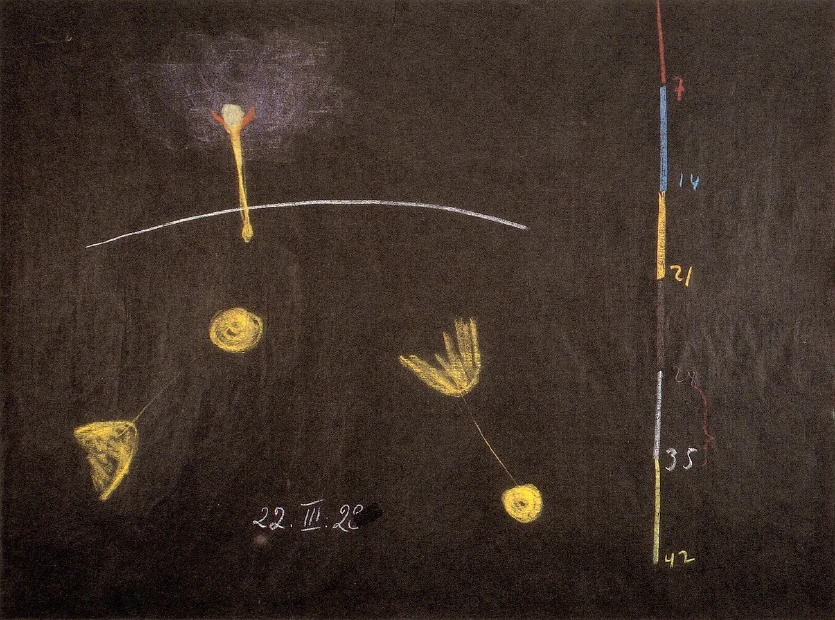
[ 14 ] In the case of modern human beings, it is true that from birth until the age of seven they live in the process of forming their physical body; and that, by living in this process of forming their physical body, they have reached the point by the age of seven where they also begin to form their etheric body more and more; this takes place from the seventh to the fourteenth year. Then the human being develops his astral body; this takes place from the fourteenth to the twenty-first year. Then he develops his feeling soul until the twenty-eighth year, then his intellectual or emotional soul until the thirty-fifth year, and finally his conscious soul. At that point, one can no longer say that the person is developing these bodies; rather, they are being fully formed as the spiritual self—which, though it will only be fully developed in the future, nevertheless already participates in this process—begins to take shape from the age of forty-two onward. And then the process continues in this way.
[ 15 ] Now, this is an extraordinarily important period of life, from the age of twenty-eight to thirty-five. This period has changed quite significantly for human life since the 15th century. Up until the 15th century, people during this time were still subject to influences from the surrounding world-ether. It is hard to imagine today—precisely because it is no longer the case at all—how people were influenced by the surrounding world ether. But they were. Between the ages of twenty-eight and thirty-five, people underwent, so to speak, a kind of experience of reawakening within themselves. It was as if something within them was coming to life anew. These perceptions were, in fact, connected to the fact that in those earlier times, people were allowed to attain mastery in a particular field by the age of twenty-eight, because it was only at the age of twenty-eight that they came to life again in a special way—albeit not strongly, of course, but in a special, subtle way. They received a new impulse. This was because the entire universal, all-encompassing etheric world—which, after all, surrounds us all beyond the physical world—was acting upon the human being.
[ 16 ] During the first seven years of life, it worked through the processes taking place in the physical body; it did not act directly upon the human being. Nor did it act directly until the age of fourteen—indeed, not until the age of twenty-eight, when it still had to pass through the life of feeling. But when the human being then entered the life of the intellect or consciousness of that time, the ether had a revitalizing effect on him.
[ 17 ] We have lost that. We would never have attained the independence of the individual, personal human being that we have today if we had not lost it. And it is connected to this that the entire inner state of the human soul has, in fact, become a different one since that time.
[ 18 ] Here you have to introduce a concept that may be extremely difficult for today's way of thinking, but which is nonetheless also extremely important.
[ 19 ] Isn’t it true that in physical life, we are quite clear about this: what will happen in the future does not yet exist today. But this is not the case in etheric life. In the etheric life, time is, in a sense, a kind of space, and what will one day be there already influences both what came before and what comes after. But that is not surprising, for the same thing happens in the physical realm as well.
[ 20 ] If one truly understands Goethe’s theory of metamorphosis, one will say to oneself: The flower of the plant is already at work in the root. — And indeed it is. And so it is for everything that exists in the etheric realm. There, the future is already at work in what has gone before. This is why this openness of the human being to the ethereal world is already at work in what has gone before—all the way back to birth—and affects, above all, the human world of thought. As a result, human beings truly had a different world of thought than they do in the period that is ours, where this gateway between the ages of twenty-eight and thirty-five is no longer open, where this gateway is closed. Human beings had living thoughts. These thoughts made them unfree, but at the same time they ensured that they were connected in a certain way to their entire surroundings, that they felt alive in the world.
[ 21 ] Today, human beings actually feel at home only in the dead world. They must feel at home in the dead world because the living world, if it were to influence them, would make them unfree. It is only because the dead world—which wants nothing from us, can determine nothing in us, and can cause nothing in us—exerts its influence upon us that we are free human beings.
[ 22 ] But on the other hand, one must also realize that it is precisely because of what a person now possesses within himself in complete freedom—his thoughts, which are, however, dead—that he cannot gain an understanding of the life around him, but only of the death around him.
[ 23 ] If no change were to occur in this state of mind, then the malaise in culture and civilization—which is, after all, becoming increasingly evident—would inevitably grow ever greater, and human beings would, in terms of the inner security and stability of their state of mind, inevitably become more and more shallow. This would become much more apparent if people paid direct attention to what they can already know today from what is said to be certain. But they do not yet pay attention to it. They still take comfort in old, traditional religious ideas that they no longer understand, but which have persisted. Even in the sciences, people take comfort in such ideas. Usually, when one pursues any branch of science, one is completely unaware that, at the very point where one begins to understand, one is still clinging to the old, traditional ideas, while the newer ideas—which are merely abstract, dead thoughts—can no longer come anywhere near the living reality at all.
[ 24 ] In fact, humanity first came into contact with the living aspects of the sensory world through the influence of the ether. In the time when people still believed in the spiritual world, they were also able to comprehend the sensory world. Today, when he believes only in the sensory world, the peculiar thing is that his thoughts are at their most spiritual—even if they are dead. It is, in fact, dead spirit. But human beings are not aware that today they are actually looking into the world through the legacy of what they possessed before their earthly life. If they still had living thoughts, animated by the ether all around them, they could look into the living reality of their surroundings. But since they no longer receive anything from their surroundings, but have only what they have inherited from a spiritual world, they can no longer understand the surrounding physical world.
[ 25 ] This is truly a seemingly paradoxical but extraordinarily important fact that answers the question: Why are people today materialists? — They are materialists because they are too spiritual. They would be able to understand matter everywhere if they could grasp the living force that dwells within all matter. But since they confront the living with their dead thinking, people turn this living essence itself into something dead, seeing dead matter everywhere; and because they are too spiritual—because they possess within themselves only what they had before their birth—they therefore become materialists. One does not become a materialist because one recognizes matter—one does not recognize it at all—but rather one becomes a materialist because one does not actually live on Earth at all.
[ 26 ] And if you ask yourself: Why have these extreme materialists—like Büchner, the fat Vogt, and so on—become such staunch materialists? — Because they were too intellectual; because they actually had nothing within themselves that connected them to earthly life, but only what they had experienced before their earthly life—which had since died away. This strange phenomenon of human civilization—this materialism—is truly a profound mystery.
[ 27 ] During this period, human beings have no other way of transcending dead thoughts—because they are no longer animated from the outside, from the ether—than by animating them themselves. And they can do this only by incorporating the living, as understood in anthroposophy, into their world of thought, by enlivening their thoughts, and by immersing themselves once again, independently, in the living essence of the sensory world itself. Thus, human beings must enliven themselves from within. They must enliven their dead thoughts through inner soul work, and in this way they will transcend materialism.
[ 28 ] Then people will begin to evaluate the things around them in a different way altogether. And you have already heard a wide variety of such perspectives right here.
[ 29 ] Let’s take a closer look at a special topic today. We see, for example, the plant world around us. We know that a large part of the plant world can be enjoyed by animals and humans; these plants are processed within them through nutrition and digestion. They can, as is commonly suggested, become integrated with the animal and human organisms. Now we suddenly encounter a poisonous plant—let’s say, the poison found in henbane or belladonna. We must ask ourselves: What is actually going on here? Suddenly, in the midst of other plant growth, we encounter something that does not unite with the animal and human organism in the same way as the other elements that are active in plant life.
[ 30 ] Let’s take a moment to clarify what the plant realm is based on. I have, after all, alluded to this on several occasions. Let’s imagine the Earth’s surface. The plant grows out of the Earth’s surface. We know that the plant has its physical organization. It is permeated by its etheric body. But the plant would not be able to unfold if it were not—as I have often described—touched from above, down toward the flower, by the astral element that is spread out everywhere (see drawing, purple). The plant does not have an astral body within itself, but the astral touches the plant everywhere. As a rule, the plant does not take the astral into itself; it merely allows itself to be touched by it. It does not process the astral within itself. It lives solely in a state of interaction; as it grows upward toward flowering and fruiting, it lives in a state of interaction with the astral. As a rule, the astral does not combine with the plant’s etheric body or with its physical body.
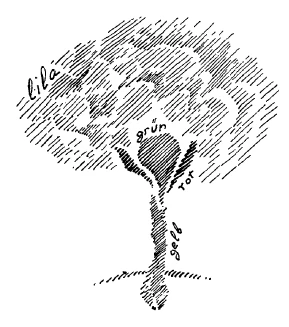
[ 31 ] With poisonous plants, it is different. The distinctive feature of poisonous plants is that the astral element penetrates the plant and unites with it. So when we have belladonna, or let’s say henbane (Hyoscyamus), such a plant, so to speak, absorbs the astral aspect to a greater or lesser degree and carries an astral element within itself; naturally in a disordered manner, for if it carried it within itself in an ordered way, it would have to become an animal. It does not become an animal; it carries the astral within itself in a kind of compressed state.
[ 32 ] This gives rise to a special interrelationship between what is present in an astral-saturated plant and what is present in the animal and human organisms. When we eat plants that are not poisonous, as they say, we do not merely take in what, I might say, a chemist in a laboratory extracts from the plant; we do not merely take in the material substance, but we also take in the ethereal, life-giving substance—which, however, as I have explained here before, we must bring to complete death precisely during our process of digestion. It is indeed necessary that, by nourishing oneself from the living, a person then brings the living within oneself to complete destruction. One must therefore extract the ethereal essence from the plant within oneself.
[ 33 ] Now, in the lower human being—the metabolic human—we find this remarkable process: We consume the plant, the plant-material substance—this is also the case with cooked food, but it is particularly pronounced when we eat raw pears, raw apples, or raw berries—we extract the ethereal essence and absorb into our own etheric body the force-structure that underlies the plant. The plant, after all, has a specific form, a specific shape. This shape that we take in—as revealed to the clairvoyant consciousness—is not always the same as the shape we see externally. It is something different. The shape of the plant wells up within us, and it adapts to the human organism in a remarkable way.
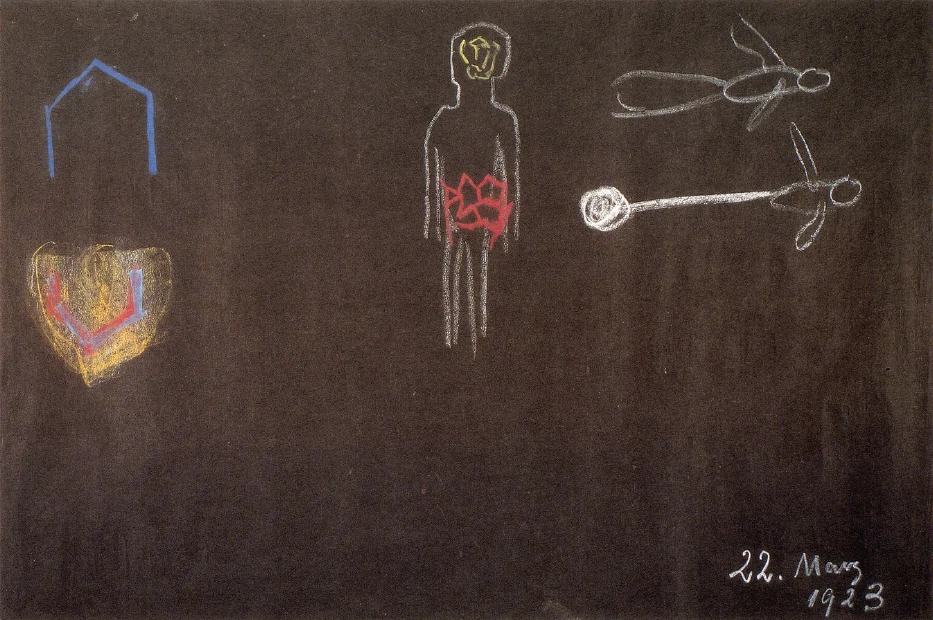
[ 34 ] Now something very peculiar happens. So imagine—one must, of course, speak somewhat paradoxically here, but the things are nevertheless true—suppose you eat cabbage; then, in the lower human being, a very specific formation first appears luminous (blue). There is an activity in the metabolic human being, in the lower human being, that is the result of the human being having eaten this cabbage.
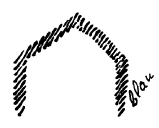
[ 35 ] To the same extent that this activity occurs in the lower human being through the consumption of cabbage, its negative—I would say, the empty space that corresponds to it—arises in the upper human being, the head human: an image, a true negative. So if I were to, say, draw the form that arises down there, then a reflection (blue, red)—a hollow structure—arises in the higher human being. It is indeed the case that cabbage produces a certain form within us, and its negative arises in our head.
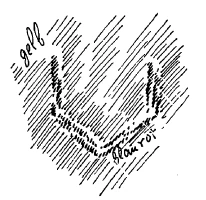
[ 36 ] And into this—I would say—“negative” of coal, we now take in the external world. It can impart its impressions to us because we carry, so to speak, an empty space within us—though, of course, this is all expressed only approximately—and this is how all plants that serve as nourishment take effect within us. Suppose we have ingested what is commonly called food; the connection to its form is intense only to the extent that we must continually dissolve it over the course of twenty-four hours. The cycle of waking and sleeping dissolves it. It must be reformed again and again. This is the case with those plants that, in their natural growth, possess a physical body and an etheric body and are, so to speak, merely enveloped by the astral.
[ 37 ] But let’s suppose we consume the juice of henbane. We then have a plant that has absorbed the astral into itself, and because it has absorbed the astral, it possesses a much stronger structural coherence, so that a much more solid form arises down below—one that we cannot process so easily, one that even asserts itself independently. This results in a more pronounced, more intensely acting negative force.
[ 38 ] And now let us suppose that a person has a brain that does not properly maintain its structure; he tends to experience states of drowsiness because his astral body is not firmly enough anchored within the physical body of the brain. He ingests the juice of henbane; this gives rise to an intense plant form that creates a strong negative. And so, in a person whose brain is, so to speak, too soft, by strengthening the etheric body of his lower abdomen and introducing a strong form into it through the henbane, clear thoughts can arise within him, and the drowsy state can subside. If he is then strong enough in the rest of his constitution—when he is prescribed this more frequently as a remedy for his drowsy states—to mobilize his corresponding vital forces, so that these are thereby revitalized and his brain returns to normal, then he can be brought out of his tendency toward drowsy states through such a poison.
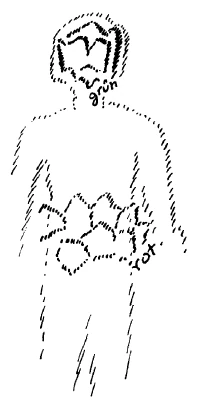
[ 39 ] Belladonna, for example, affects humans in a very similar way. Belladonna acts in such a way that the following occurs. I would like to illustrate this schematically. Through the ingestion of belladonna—which, of course, is not a “pleasure”—the etheric body is permeated by a strong framework. So when it is taken in an appropriate dose—one that the person can tolerate (for, after all, one can only be healed by a remedy if one can tolerate it)—a strong framework is, so to speak, built into the etheric body of the lower abdomen. This strong framework actually produces its negative counterpart in the head. And the healing process expected from belladonna is based on this interaction between the positive and the negative.
[ 40 ] You just need to realize that once you arrive at such effects, you no longer need the spatial distribution. Modern people, with their dead but massive intellect, can only imagine that if something is happening in their abdomen, it can only reach the brain by visibly flowing upward. But that is not the case; rather, processes in the lower abdomen give rise to corresponding processes in the head, without any spatial distribution being involved. If one is able to observe the etheric body, one can indeed see how it becomes bright in the etheric body of the lower abdomen, shining brightly in a regular pattern (red), while it becomes dark in the head (green), yet the form is reproduced as a negative image without any spatial-physical distribution being present.
[ 41 ] You can certainly visualize how nature strives for such things everywhere. You know, don’t you, that a typical wasp has a sort of head in front, then a sort of abdomen, and wings. That’s a typical wasp. But there are also wasps—sand wasps—that look like this (drawing below):
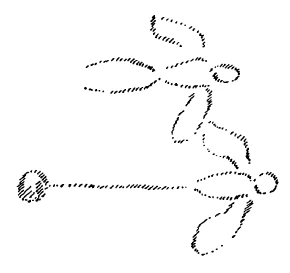
[ 42 ] They have a stalk here and drag their abdomen behind them. Physically, this connection between the anterior and posterior parts of the body is already reduced to a minimum; this stalk is very reduced.
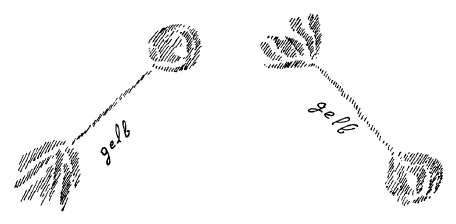
[ 43 ] As soon as you enter the spiritual realm, there’s no need for such a visible stem at all. And when you encounter certain elemental beings in the elemental world—you know, I spoke recently about the elemental realms—you might see, for example, one being, and then there’s nothing there; something else is far away, and only gradually do you realize: they belong together; wherever one goes, the other goes too. So you find yourself in a very strange situation—this can happen in the elemental world— where you have one part of an elemental-etheric organism somewhere, and here the other part, now in a subsequent state (see drawing below), for example, like this: it has turned around, but there is no stem or anything like that, and it’s not as if, when one part turns around, the other could simply come running straight over—rather, it must follow the path that the other has taken.
[ 44 ] So you see, the point is that one can indeed find a connection between those substances that the human and animal organisms cannot immediately break down—the more intense, more enduring ones—if I may put it that way — frameworks—and that one can find a connection with what can then, in a completely different part of the human organism, in turn have a structuring, organizing, and healing effect, in other words.
[ 45 ] This gives you a glimpse of how the world can once again be brought to life for human observation. Because humans today possess only the legacy from the spiritual world, they have no way of connecting with their living environment. In fact, they do not truly comprehend the sensory world. They will come to understand it again; they will once more look upon what sensory thinking is in relation to the entire universe. Then, from within the entire universe, they will discover why things are connected in this or that way—why, for example, a non-poisonous plant relates to the human and animal bodies differently than a poisonous plant does. Only in this way is it possible to revitalize the whole of human existence.
[ 46 ] Now, it may well seem to today’s complacent person that he might say: People in the past had it better after all; they were still influenced by the etheric environment, they had living thoughts, and they still understood such things as the real difference between poisonous and non-poisonous plants. — You know, animals still do that today, because they don’t have abstract thoughts that can detach them from the world. That is why animals, as they say, distinguish between poisonous and non-poisonous plants based on their instincts.
[ 47 ] Yes, but human beings would not—and this must be emphasized again and again—have come to exercise their freedom. For that which keeps us alive within ourselves, right down to our thoughts, robs us of our freedom. As paradoxical as it sounds, we must become virtually nothing with regard to the thoughts of our previous earthly lives; only then can we become free. And we become nothing when we take in the living thought-beings we had in our pre-earthly existence merely as corpses within us—that is, when we take them in within us in their non-existence. So we actually go about with our dead thoughts—in relation to our soul life—in our waking earthly state as “nothings.” And it is fundamentally out of these “nothings” that our freedom first arises.
[ 48 ] That is certainly understandable. But we cannot perceive anything if we do not carry something living within us. We can recognize what is dead, but the dead brings us no step further in our living relationship to the world. And so, in the face of the interruption in our cognition that has occurred, we must—while preserving our freedom—return to a state of cognition by beginning, in our earthly life, to enliven our thoughts once more through human will. Then we can distinguish at every moment: these are living thoughts, those are dead thoughts. When we rise to pure thoughts—as I described in my Philosophy of Freedom—we can be free human beings. If we feel our way into our thoughts, we will indeed step out of freedom, but in return we will also reconnect with our surroundings. We partake in freedom through the awareness that we are capable of moving ever closer to pure thought and, from it, deriving moral impulses through moral intuition.
[ 49 ] This makes us free human beings, but it also means that we must first shape our inner spiritual life—our spiritual disposition—through our own earthly actions. Only then can we carry the consequences of these earthly actions through the gate of death into the spiritual world. For what has been individually earned is not lost in the cosmos.
[ 50 ] Well, my dear friends, I may have asked a great deal of you today, but you can see from this discussion that we do indeed draw closer to the world by learning to understand human beings, and in particular the conditions of the physical human being—the seemingly physical human being, for he is not, after all, a purely physical being, he is always permeated by the higher members of the organism—to the other aspect of the world that manifests itself physically, as we have learned from the poisonous plants.
[ 51 ] As it turns out, I’ll still be here tomorrow, so for those who’d like to hear it, I can also give a lecture tomorrow evening at 8:00 p.m.