Anthroposophy as Cosmosophy I
Human Traits in the Earthly and Cosmic Realms
GA 222
22 March 1923, Dornach
Translated by Steiner Online Library
Seventh Lecture
[ 1 ] What has emerged to us as the essential aspect of our present time within the course of human development is the earthly human being’s possession of abstract thoughts—that is, thoughts that are dead to us, thoughts that exist within us in such a way that they are, in fact, the remnants of the living essence of the soul in its pre-earthly existence.
[ 2 ] Linked to this stage in humanity’s development toward abstract—that is, lifeless—thoughts is—as I have often explained—the attainment of a consciousness of freedom within the course of human development. Let us now turn our special attention to this particular aspect of the matter. We can do this by taking a brief look at the entire course of human development in the post-Atlantean era.
[ 3 ] You know that, following the great Atlantean catastrophe, the configuration of the Earth’s continents as we know it today gradually took shape, and that, based on this distribution of the Earth’s landmasses—or within this distribution—five successive cultural or civilizational periods gradually developed, which I have referred to in my Outline of Esoteric Science as the Proto-Indian, the Proto-Persian, the Egyptian-Chaldean, the Greco-Latin, and our present fifth epoch of civilization.
[ 4 ] These five epochs of civilization differ in that human beings, as whole beings, are in a different state in each of them. When we look back at the earlier epochs of civilization, this state is also expressed in the entire outward appearance of human beings—in what I would call their physical manifestations. And the closer we come to later times—that is, to our own epoch of civilization—the more what we might call the progress of humanity is expressed in the state of the soul. We have, of course, described what pertains to this on numerous occasions. Today I wish to describe it from a perspective that has received less attention thus far.
[ 5 ] If we go back to the first, primordial Indian epoch of civilization—which, I would say, had only just emerged from the Atlantean catastrophe—we find that people at that time felt themselves to be citizens of the extraterrestrial cosmos far more than citizens of Earth. And when we examine the details of life at that time—which, as I have often hinted to you, dates back to the 7th 8th millennium B.C., we must emphasize in particular that—not out of intellectual reflection (which, of course, did not exist at that time), but out of a deeply instinctive feeling—great importance was attached in these very ancient times of human development to the outward appearance, to the exterior of the human being. Not that these people of ancient times engaged in physiognomic studies, for example; that was, of course, far beyond their reach. Such things belong to ages in which intellectualism, though not yet fully developed, is already beginning to dawn. But they possessed a subtle physiognomic intuition. These people felt deeply that if someone had a particular facial expression, it indicated that they also possessed certain musical qualities. They placed great importance on discerning a person’s musical nature from their facial expression, but also from their gestures and their entire manner of being—I would almost say, by intuition. After all, in those ancient times, people did not strive for a more precise method of cognition when it came to what is universally human. People back then would have had no understanding at all if someone had come to them claiming that something had to be proven. That would have embarrassed them; it would have caused them almost physical pain—yes, in earlier times, it really would have caused them physical pain. “To prove” is like someone trying to attack you with knives—that is what these people would have said. Why should one prove anything? After all, one does not need to know anything about the world with such certainty that it must first be proven.
[ 6 ] This is because these people still possessed the most vivid sense of reality; they all came from a pre-earthly existence in the spiritual world. In the spiritual world, once you are there, you do not prove things. There, one knows: proving is a matter that certainly has its purpose on Earth, but in the spiritual world, one does not prove things. If one were to try to prove something there, it would seem as if one were, let’s say, using a specific standard: a person must be this long or that long—and one would then proceed as in the myth of Procrustes: You cut off a bit from those who are too tall, and stretch out those who are too short. That is roughly what proving would be like in the overall context of the spiritual world. Things there are not such that they can be carved into proofs. Things there are inwardly flexible, inwardly fluid.
[ 7 ] And to an Indian of the primordial Indian era, with his strong sense of: “I have descended from the spiritual world; I have merely wrapped this outer human form around myself”—to such an Indian, it would have seemed quite strange if anyone had in any way demanded of him that something be proven. Rather, these people loved what we today call “guessing.” They loved it because they wanted to be attentive to what manifested itself in their surroundings. And in this activity of guessing, they found a certain inner satisfaction.
[ 8 ] And likewise, they had a certain instinct for inferring from this or that face that a person was wise, from another face that a person was foolish, and from a person’s build to surmise, say, phlegmatic temperament and the like. Guessing was what people had back then in place of what we today call demonstrative knowledge. And in human interaction, all mutual behavior boiled down to inferring a person’s actual moral character from their inner state, their gestures, their bearing, and the way they walked.
[ 9 ] In the first epoch of the primordial Indian way of life, there was, of course, no such thing as the caste system that developed later. In connection with the primordial Indian mystery traditions, there was in fact even a kind of social classification of people based on their physiognomy and gestures. Such things were indeed possible in earlier times of human development, for people also possessed a certain instinct to follow such classifications. What later emerged within Indian civilization as the caste system was, I would say, already a kind of schematic classification derived from a much more individualized system that was originally based on physiognomy perceived instinctively. And in those ancient times, people did not feel offended when they were—if I may put it this way—placed here or there based on their facial features, for they felt themselves to be, quite simply, God-given beings on Earth. And the authority vested in those who, drawing upon the Mysteries, established such a classification—that authority was immense.
[ 10 ] It was not until the later post-Atlantean epochs of civilization that the caste system gradually emerged from conditions that I have already described in other lectures. In that earlier time, in that primordial Indian epoch, there was a strong sense that human beings are fundamentally endowed with a divine imagination.
[ 11 ] I have told you a great deal about how there was originally a kind of instinctive clairvoyance, a dreamlike clairvoyance. But if we go back to the very early times of the post-Atlantean period, people did not merely say that they saw dreamlike images; rather, they said: In the specific configuration of the human physical body when a person enters earthly existence, a divine imagination dwells. A divine imagination is laid as the foundation for the person who descends to Earth. From childhood onward, this divine imagination then shaped the person’s physiognomy; indeed, it shaped the entire physical expression of the human being.
[ 12 ] So people did not merely instinctively focus on physiognomy, as I just suggested, but they saw in physiognomy the imagination of the gods. People said to themselves: The gods have imaginations, and they imprint these imaginations upon the physical human being. — That was the very first conception of what the human being is on Earth as a being sent by the gods.
[ 13 ] Then came the second post-Atlantean cultural epoch, the Proto-Persian one. By then, people no longer had that instinctive sense of the physiognomic as strongly as before. They no longer looked to the gods’ imaginings, but to the gods’ thoughts. Previously, it had actually been assumed that a true image of humanity lived within certain divine beings before a human descended to Earth. Later, the idea was that it was precisely thoughts—thoughts that together formed the Logos, as it was later called—that underlie the individual human being.
[ 14 ] In this second post-Atlantic period, great importance was attached to whether a person was born—as paradoxical as that may seem to us today, it is true—in pleasant weather, or whether a person was born at night or during the day, in winter or in summer. There was no intellectual understanding of this, but people had the feeling that whatever celestial constellation the gods allowed—whether fair weather or a snowstorm, whether day or night—when they sent a human being down to Earth, this expressed their thoughts; it expressed these divine thoughts. And if, for example, a child was born during a thunderstorm or under some other unusual weather conditions, this was regarded in everyday life as an expression of this or that divine thought bestowed upon the child.
[ 15 ] If this was the case among the laity, it was also true on the other hand among the priesthood—which in turn was dependent on the Mysteries—where they kept records, so to speak, of births—though this should not be understood in today’s bureaucratic sense—in such a way that, based on these constellations of weather, time of day, season, and so on, one could discern how a person was endowed with the divine gift of thought. This was during the second post-Atlantean period, the Proto-Persian period.
[ 16 ] Very few such things have survived into our time. These days, it’s considered extremely boring when you have to say of someone: “He talks about the weather.” — Just think, it’s considered a negative thing today to say of someone: “He’s a boring person because he doesn’t know how to talk about anything but the weather.” — People in ancient Persia wouldn’t have understood that; they would have found someone who had nothing interesting to say about the weather to be incredibly boring. For in fact, it is said that one has completely detached oneself from one’s natural surroundings when one no longer feels anything truly human in response to weather phenomena. It was an intense experience of the cosmic environment, expressed in the fact that one conceived of events in general—and the birth of a human being was, after all, a most important event—in connection with what was happening in the world.
[ 17 ] It would certainly be a step forward if people—they don’t just have to resort to the saying: “there’s good weather and bad weather”—which is very abstract—but if people, by telling each other this or that, were once again to remember what the weather was like during this or that event they experienced, and what natural phenomena were occurring in general.
[ 18 ] This is extremely interesting when, in the case of remarkable phenomena, such occurrences are still mentioned here and there—as is the case, for example, with the death of Kaspar Hauser, because it was a remarkable phenomenon that, on one side, the sun was setting while, on the other side, the moon was rising, and so on.
[ 19 ] This allows us to empathize with human beings of this second post-Atlantean period.
[ 20 ] In the third post-Atlantean epoch, this instinct—to perceive the spiritual, to see divine thoughts in the weather—had largely faded away among human beings, and people gradually began to calculate. This was when the intuitive perception of divine human thoughts in the configuration of nature was replaced by the calculation of the constellations, and people calculated—for each individual upon their birth—the stars and the constellations of fixed stars and planets. This was essentially the third, the Chaldean-Egyptian period, in which the utmost importance was attached to being able to calculate, from the constellations, how a person had entered earthly life from their pre-earthly existence.
[ 21 ] So there was, at least, still an awareness that human life on Earth is a gift from the extraterrestrial realm. However, when it comes to doing the math, that is when we begin to lose sight of the connection between human beings and divine-spiritual beings.
[ 22 ] You need only consider how the entire mental process of human beings is, in fact, external when it comes to arithmetic. I certainly do not wish to speak in defense of youthful laziness or, for that matter, people’s later inattention with regard to arithmetic. That is not my intention. But there is, of course, a great difference when one emphasizes those external methods of thinking that actually have little to do with the whole human being—namely, computational methods. These computational methods were introduced into all aspects of life during this third post-Atlantean period. But at least they calculated what was extraterrestrial, and through calculation they at least introduced people into the extraterrestrial realm. The Egyptians and Chaldeans did not calculate as abstractly as we do; what they calculated was thoroughly felt. Today, everything that is calculated is sometimes thought through, sometimes not even thought through, but merely systematized. After all, today we often no longer calculate with content, but only with methods. And what is sometimes achieved in mathematics in terms of the remoteness of the content—which is reached only through methodological means—is, fundamentally speaking, I don’t mean this in a negative way, but it is terrible. There was still something human left in calculation during that Chaldean-Egyptian period.
[ 23 ] Then came the Greco-Latin era. This was the first post-Atlantean epoch of civilization, in which human beings actually felt that they lived entirely on Earth and were fully connected to the forces of the Earth. The connection between human beings and weather phenomena had already receded into the realm of myth. That which human beings still felt a living connection to during the second post-Atlantean period—the Proto-Persian cultural epoch—had receded into the realm of the gods. Human beings themselves no longer cared whether it meant anything when they ascended Mount Olympus and thrust their heads high into the mist; he now let his gods—Zeus, Apollo—stick their heads into that Olympian cloud. Anyone who traces the myths of this Greco-Latin cultural period will still sense that humanity once felt connected to the clouds and celestial phenomena, but that people have relegated this to the gods. Now it is Zeus who moves with the clouds, or Hera who manipulates them. This is what human beings used to do with their own souls. The Greeks had Zeus—one cannot really say such a thing, but it does reflect the reality—the Greeks had banished Zeus to the realm of the clouds, to the realm of light.
[ 24 ] The ancient Persian felt that his own soul was still within him. He could not have said, “Zeus lives in the clouds or in the light”—but rather, he would have said, “Zeus lives within me”—because he felt his soul in the realm of the clouds, in the realm of the air. The Greeks were the first people in the post-Atlantean era to feel themselves entirely—and this realization came only slowly and gradually—as earthly beings: That is why, in the Greco-Roman era, the sense of connection with pre-earthly existence was the first to be lost. In all three earlier post-Atlantean epochs of civilization, people felt a strong connection to pre-earthly existence. One should not have imposed a dogma on them stating that there is no pre-existence. Such dogmas can only be established if there is a prospect that people will accept them. One must then be wise enough to establish as dogma precisely that which a large number of people have been prepared to accept through human evolution. But the Greeks gradually lost their sense of pre-earthly existence through their human feelings and perceptions, and they came to see themselves entirely as earthly human beings. They did, however, see themselves as earthly human beings in the way I have described in earlier lectures—that is, they still felt permeated by the divine-spiritual, yet were thoroughly connected with everything that lives solely on earth.
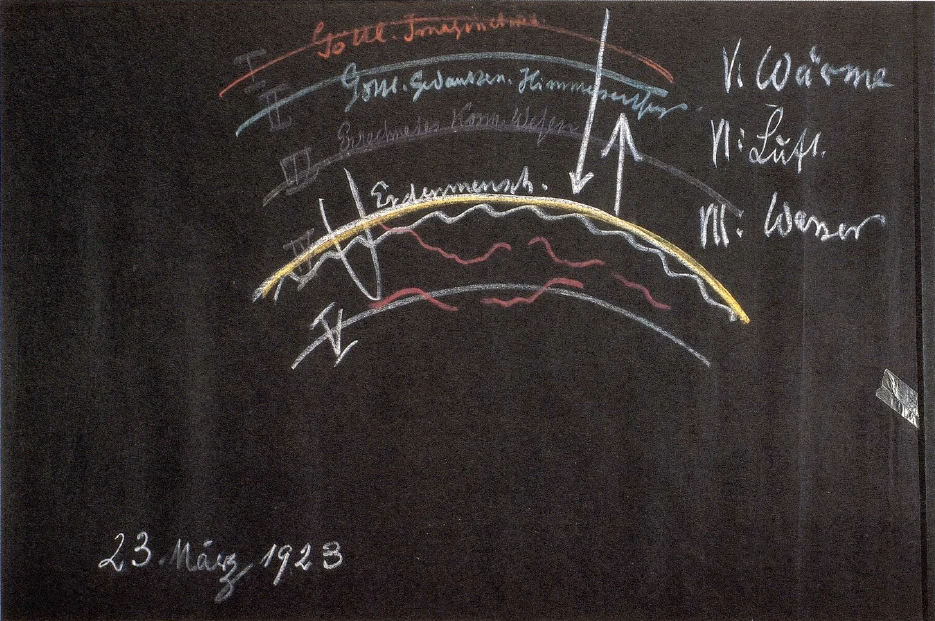
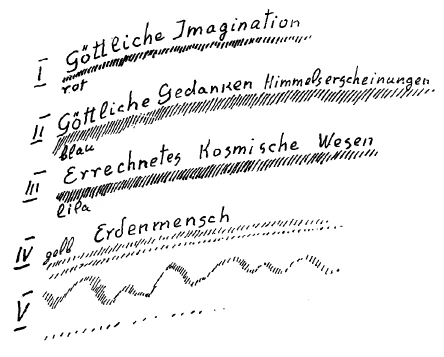
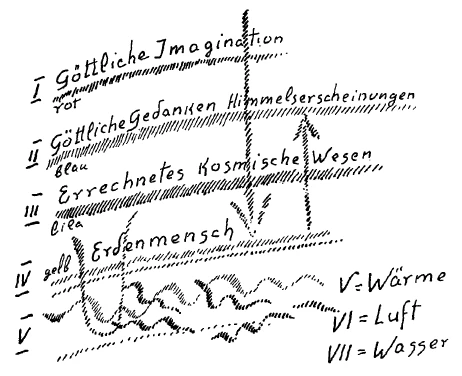
[ 25 ] One really must have a sense of how such a mythology could have developed in Greek times, after people had lost the connection between their own souls and the supernatural 115 manifestations. So that we can say: If here is the Earth—I am drawing a schematic diagram—then in the first post-Atlantean period, human beings felt themselves to be the result of divine imagination, which they sought entirely in the spiritual-soul realm. Then they felt themselves to be the result of divine thoughts, which they sought in celestial phenomena and so on, in wind and weather. Human beings then lost more and more of this consciousness that reached out into the vast expanses; they narrowed this consciousness more and more toward the Earth. Then came the Egyptian-Chaldean period, in which we find human beings as calculated cosmic beings. And then came the fourth, the Greek-Latin period, in which human beings are entirely earthly beings (see drawing).
[ 26 ] If we go back once more to the third post-Atlantean epoch, we encounter a time when people still felt deeply, even though they calculated their celestial existence based on where they were born on Earth. This is a particularly interesting fact. People had forgotten about their celestial existence except for the calculation; they simply had to calculate it first. It was the time of astrological calculations. But even someone who perhaps had no calculation at all for their date of birth still felt the result of that calculation. Someone born in the very south felt the result of the calculation in the way he was able to live out his life in the south; he attached far more importance to that than to the calculation itself. Someone born in the north was born under a different calculation. Well, the astrologers could calculate that, but the person felt the result of that calculation. And how did he feel it?
[ 27 ] He sensed this because, in fact, his entire human constitution—both soul and body—was connected to his place of birth and the geographical and climatic characteristics of that place, since human beings in this third post-Atlantean period of civilization felt themselves primarily as breathing beings. One breathes differently in the south than in the north. Human beings were beings of breath. Of course, external civilization had not yet advanced to the point where such things could be articulated; but what lived within the human soul was a result of the breathing process, and the breathing process was a result of the place on Earth where one was born and where one lived.
[ 28 ] This came to an end with the Greeks. In the Greek era, it was no longer the process of breathing and the connection to the earthly realm that were decisive; rather, it was the connection through blood—the sense of tribe, the tribal feeling—that gave rise to the awareness of group-soul identity. In the third post-Atlantean epoch, group souls were perceived in connection with earthly locations. Indeed, people in that third post-Atlantean epoch actually imagined that if there was a sanctuary here or there, the god within it—who represented the group soul—was bound to that place. This came to an end during the Greek era. That was when, with Earth consciousness—with the entire constitution bound to the Earth through all human feeling and sensation in the whole realm of human instinctual life—this sense of kinship through blood began to emerge. As a result, human beings were then fully grounded on Earth. They no longer looked beyond the Earth with their consciousness, but felt a kinship through blood with their tribe and their people. And what of us in the fifth post-Atlantean period? It follows almost directly from the schematic outline I have drawn up here quite appropriately. Yes, we have crawled into the earth. We have been stripped of the extraterrestrial forces; nor do we live—nor should we live—any longer by the mere earthly forces that vibrate in the blood, but we have become dependent on forces that lie beneath the earth.
[ 29 ] You can learn from potatoes that there are forces underground that are significant. As you know, farmers put their potatoes in pits during the winter; that way, they survive, whereas otherwise they would rot. Things are simply different underground. The summer heat lives on there during the winter.
[ 30 ] Indeed, the life of plants can only be fully understood if one realizes that a plant’s life up to the point of flowering is the result of the preceding year. It arises from the forces of the earth. Only the flower is what thrives in the sun. Well, I’ve discussed that here before.
[ 31 ] What does it mean for us humans to become dependent on forces beneath the earth? It does not mean the same thing as it does for potatoes; after all, we are not placed in pits during the winter so that we can thrive better there over the winter. It means something entirely different; it means precisely that the earth takes the influence of the supersensible away from us. We are deprived of the influence of the supersensible by the earth. In his consciousness, the human being was first divine imagination, then divine thought, then the result of calculation, and then an earthly human being. The Greeks felt themselves to be thoroughly earthly human beings, living in their blood. We, therefore, must learn to feel ourselves as independent of that which is supernatural, but also independent of that which lies merely in our blood. This has come about because, between the ages of twenty-one and twenty-eight, we live differently than people did in the past: we no longer awaken to the second experience described yesterday; we no longer have living thoughts as the results of a consciousness influenced by the supernatural, but rather we have thoughts that have become entirely free of inner vitality and are therefore also dead. It is indeed the Earth, with its inner forces, that kills our thoughts as we become earthly human beings.
[ 32 ] And a curious picture emerges: As earthly human beings, we bury what remains of the human being in the physical realm; we entrust the corpse to the elements of the earth. The earth is also at work in the case of cremated human beings; decay is merely a slow form of combustion. As for our thoughts—and this is indeed the remarkable aspect of the fifth post-Atlantean period—the gods, when we are born, when we are sent down to Earth, entrust our thoughts to the Earth. Our thoughts are buried—truly buried—when we become earthly human beings. This has been the case since the beginning of the fifth post-Atlantean period. To be an intellectualist means to have a soul with thoughts buried in the earth—that is, with thoughts from which the earthly forces have stripped away the heavenly impulses.
[ 33 ] This is, in fact, the defining characteristic of our present-day humanity: that we grow together with the Earth in the innermost being of our souls precisely through our thinking. But as a result, on the other hand, it is only now—in the fifth post-Atlantean cultural epoch—that we have the opportunity to send back to the cosmos the thoughts that we bring to life within ourselves through our earthly existence, in the manner mentioned at the end of yesterday’s lecture.
[ 34 ] Such impulses for development lie deep within humanity’s significant cultural achievements. And it certainly stirs a deep feeling within us when, at a time when European humanity is approaching this fifth post-Atlantean cultural epoch, works of poetry such as Wolfram von Eschenbach’s Parzival emerge. We have often considered the poem as such, but today we want to keep an eye—an eye of the soul—on something that confronts us here as a magnificent hallmark of the age. Consider the remarkable characteristic that now emerges—not only in Wolfram, but in the people of this era in general—as the power of poetry awakens within them.
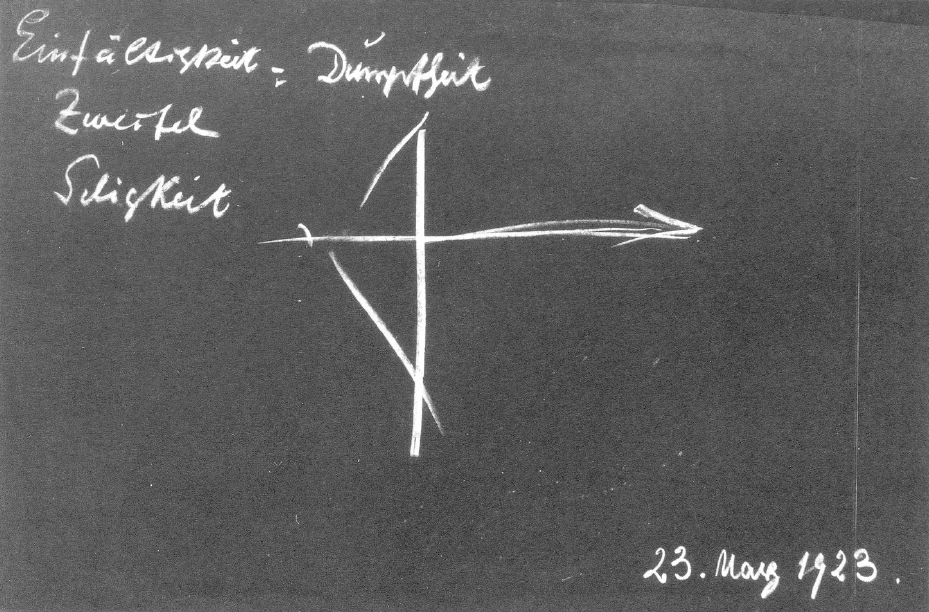
[ 35 ] Here, I would say, one sees a concern with three stages of development of the human soul. The first thing one perceives in a human being when they enter the world, when they surrender to their life, when they live in a naive relationship with the world—the first thing one perceives is simplicity and dullness.
[ 36 ] The second, however, is doubt. And it is precisely in this time of the approaching fifth post-Atlantean epoch that doubt is vividly portrayed. If doubt is a bond on the heart, then life must become bitter for the human being: that is the feeling in that time. But the feeling is also present: Human beings must force themselves through doubt to bliss, to beatitude. — And beatitude is what is called that state in which human beings once again bring divine life into thoughts that have become ungodly, into thoughts that have become entirely earthly and dead. This immersion of the human being, with his thoughts, into the earthly realm is experienced as the state of doubt. And bliss is experienced as a breaking away from the earthly through the act of bringing thoughts back to life.
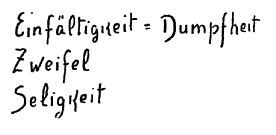
[ 37 ] This is precisely the mood that pervades the poetry of the 12th, 13th, and 14th centuries, as humanity was striving to enter the fifth post-Atlantean epoch. I would say that the first dawn of this fifth post-Atlantean epoch was experienced more vividly by people than it is today, when people are too tired to think about these things, when they have become too complacent. But they will have to begin again to think deeply about these things—and, above all, to feel them. Otherwise, the ascent of humanity would simply not be possible. And what is actually taking place there?
[ 38 ] It is a descent of the human being from the heavenly to the earthly, until the human being is entirely on earth. But what about the human being? Yes, it is as if the earth were a mirror for the human being. The human being is not meant merely to grow down into the earth. Thoughts, in their dead element, penetrate the earth and grasp what is dead—that which belongs solely to the earthly element. But human beings themselves are such that, when they enliven their thoughts, they send them out into the cosmos like mirror images. Thus, everything that arises as living thought within a human being is what the gods see shining back from the evolving human being. Humanity is called upon to be a co-creator of the universe by being expected to enliven its thoughts. For these thoughts are reflected by the Earth and go out again into the universe; they must take the path back out into the universe.
[ 39 ] That is why, when we take in the full meaning of human and cosmic evolution, we already sense that, in a sense, we are returning to the epochs that have already been lived through. In the Egyptian-Chaldean period, people calculated how human beings relate to the Earth; through these calculations, they connected human beings to the surrounding world of the stars. Today we approach this historically, starting with the human being, and the human being becomes our starting point for a contemplation such as you will find in my Occult Science, where we actually send out the animated human thoughts once more and observe how they develop as we follow them rushing away from us into the cosmic environment, as we learn to live with these living thoughts in the cosmic expanses.
[ 40 ] These are connections that reveal the profound significance of humanity having arrived at dead thoughts—that it has, so to speak, fallen into the danger of becoming completely bound to the Earth.
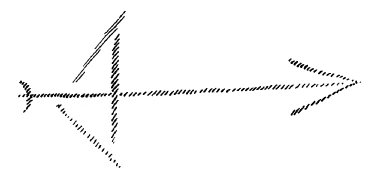
[ 41 ] And let’s explore this image further. Valid imaginings can be explored further. Only imaginary imaginings cannot be explored further. Imagine for a moment that there is a mirror here (it is drawn). It is said that it reflects the light back; the phrasing isn’t entirely correct, but in any case, the light must not pass behind the mirror. How, then, can the light pass behind the mirror? Only by breaking the mirror. And indeed, if a person does not bring their thoughts to life, if they remain stuck with merely intellectual, dead thoughts, they must shatter the earth.
[ 42 ] The breakdown, however, begins with the most subtle element: heat. And in the fifth post-Atlantean epoch, people have only the opportunity to corrupt the Earth’s atmosphere of heat through the ever-increasing development of purely intellectualistic thoughts.
[ 43 ] But then comes the sixth post-Atlantean epoch. If humanity had not by then turned away from intellectualism toward imagination, the corruption would begin not only in the thermal atmosphere but also in the air atmosphere, and people would poison the air with their purely intellectualistic thoughts. And the poisoned air would have a detrimental effect on the Earth, that is, it would first destroy the plant kingdom (see illustration on page 123).
[ 44 ] And in the seventh post-Atlantean epoch, humankind already has the opportunity to corrupt the water, and its vapors—if they were merely the result of intellectualistic thoughts—would pass into the Earth’s general liquid element. From the Earth’s general liquid element, the Earth’s mineral element would first be formed. And if human beings do not enliven their thoughts and thereby return to the cosmos what they have received from it, they certainly have the opportunity to shatter the Earth.
[ 45 ] Thus, what is spiritual in human beings is connected to their natural existence. And today’s purely intellectual knowledge is nothing more than an Ahrimanic product designed to deceive people about these matters. By convincing people that their thoughts are mere thoughts that have nothing to do with world events, one creates a fog around them, as if they could have no influence on the Earth’s development, and as if—with or without their involvement—the end of the Earth will come one way or another, just as mere physics dictates.
[ 46 ] But it will not be a merely physical end of the world that comes, but rather the end of the world that humanity itself will have brought about.
[ 47 ] Here again is one of the points where we see how anthroposophy brings together the moral-spiritual world with the physical-sensory world, whereas today no such connection exists at all, and modern theology even regards it as something admirable to make the moral realm entirely independent of the physical. And philosophers who today trudge along, gasping, stooped, with hunched backs under the burden of scientific findings, are glad when they can say: Yes, in nature there is science; but philosophy must extend to the categorical imperative, to that which we cannot know anything about.
[ 48 ] Today, these things often only come into play within schools. However, they will take hold of life if humanity does not become aware of how the soul-spiritual realm participates in creation within the physical-sensory realm, and how the future of the physical-sensory realm will depend on what human beings decide to cultivate in the soul-spiritual realm. From these underlying considerations, one can, on the one hand, gain an awareness of the infinite importance of humanity’s soul life; on the other hand, one can also gain an awareness that human beings are not merely creatures wandering arbitrarily about on Earth, but belong to the entire universe.
[ 49 ] But, my dear friends, true imaginations do indeed convey the truth. For if a person does not enliven his thoughts but allows them to die off further and further, then those thoughts simply crawl into the earth, and the person ultimately becomes, in relation to the universe, an earthworm, because his thoughts seek out the habitats of earthworms. This, too, is a perfectly valid imagination.
[ 50 ] Human civilization should prevent human beings from becoming earthworms, for otherwise the Earth will be shattered, and the cosmic goal—which is so clearly expressed in human nature—will not be achieved. These are things we should take to heart—not merely as theories or abstractions—for anthroposophy is a matter of the heart. The more it is grasped as a matter of the heart, the better it is understood.