

Anthroposophy as Cosmosophy I
Human Traits in the Earthly and Cosmic Realms
GA 222
12 March 1923, Dornach
Translated by Steiner Online Library
Second Lecture
[ 1 ] From yesterday’s reflections, you will have seen that if one wishes to understand human destinies—and, by extension, human coexistence—one cannot limit oneself to the abstract forces of nature, which are, in fact, the sole subject of discussion in mainstream science today. One must—as you saw yesterday—turn to those spiritual forces which, in a sense, constitute the upward continuation of what we here in sensory life call the kingdoms of nature. We speak of the kingdoms of nature: the mineral kingdom, the plant kingdom, and the animal kingdom; we must also regard the human being, insofar as he is a physical being, as a fourth kingdom of nature; but we must then simply ascend and assume, above the human being, the kingdom of the angels, above that the kingdom of the archangels, the kingdom of the primordial forces, and so on.
[ 2 ] These latter realms are, of course, initially inaccessible to external perception—to sensory and intellectual perception—but they play an essential role in human life.
[ 3 ] And yesterday I explained to you their role in that change in human life that occurs as a result of a person alternating between the waking state and the sleeping state. Today I would like to add another perspective to this consideration: the perspective that views the human being as a being who spends part of his entire life within the spiritual world, from which he descends to his earthly existence and to which he ascends again once he has passed through the gate of death.
[ 4 ] Now, as you know from the course I taught here last year on philosophy, cosmology, and religious knowledge, before a human being descends to Earth, they are a being with a very specific configuration—one that is simply not clothed in a physical body and is not connected to the physical forces of the Earth, but is clothed in a spiritual-soul aspect, one might also say, that is related to the spiritual-soul forces, just as we are related to the physical forces of nature through the physical body.
[ 5 ] Now, when a human being descends from pre-earthly existence into physical life on Earth, he or she, in a certain sense, still carries with them the aftereffects of the forces that resided within them during that pre-earthly existence. For there is indeed a spiritual element at work in the child that is an aftereffect of the forces that were within us before we descended to Earth. As the child grows, as the child develops its specific human form from more indeterminate forms, it remains under the influence of the super-earthly forces in which it existed before descending to Earth. And this actually continues—although it does weaken with the change of teeth—all the way through to sexual maturity.
[ 6 ] Human beings develop their physical body during the first seven years of life, and their etheric body—or body of formative forces—during the second seven years. While they are developing these two instruments of their earthly existence, the characterized forces from the spiritual world exert their influence.
[ 7 ] Now, as I already said yesterday: The human being is not merely the being as revealed to external sensory perception and intellectual understanding, but during his earthly existence he is also that supersensible, invisible being consisting of the “I” and the astral body, which is separated from the physical body and the etheric body during sleep. Every night, even in adults, the “I” and the astral body leave the physical and etheric bodies. In children, especially during the early stages of physical life on Earth, there is an indefinite coming together and separating of the four members of the human being. The child is still not very alert in the early stages of life. This means that the firm cohesion between the “I,” the astral body, the etheric body, and the physical body is present only for a short time. The connection between these four members of the human being is much looser in a child than in an adult. And so we must certainly take into account not only the life story of the human being that unfolds before the outer eye and the calculating intellect, but we must also take into account the other life story that the I and the astral body always undergo during the sleeping state. Even though the state of sleep is shorter in duration for adults, it is actually of much greater significance in the overall balance of the cosmos—for the overall constitution of the human being, but above all for the healing and health of the entire human being, and thus for earthly life in general—than the outer physical life.
[ 8 ] Through their outer physical life, human beings live on Earth together with the three visible realms of outer nature and their forces. When he sleeps, his I and his astral body are not among these forces, but are, so to speak, in a supersensible world that permeates the sensory earthly world and is connected to it. So let us make a distinction: There is, first of all, a supersensible world in which a human being exists between death and a new birth; this is what he goes through. One can describe it as a pre-earthly or post-earthly existence. He retains a remnant of the forces for his earthly existence, which is active—very strongly in children, and later becoming weaker and weaker. But the “I” and the astral body are in a supersensible world during sleep, which is different from this supersensible world of pre-earthly existence. The supersensible world of pre-earthly existence actually has little to do with the earthly world itself, as it appears outwardly. The supersensible world in which the astral body and the “I” must first be present from the moment of falling asleep until waking up has a great deal to do with earthly existence, and a great deal to do with the three realms with which human beings are associated on Earth.
[ 9 ] This supersensible world consists of the three so-called elemental kingdoms, which you will find described in my book Theosophy. So, in addition to what I said yesterday—that the I and the astral body enter the world in which the Angeloi, Archangels — from the moment of falling asleep until waking up, the I and the astral body must still dwell in a supersensible world that, as such, has no direct connection to that supersensible world in which the human being is present when disembodied—the world of the Angeloi and Archangels—but rather is the world of the elemental realms, those elemental realms in which there are beings who do not stand as high as human beings do when they are earthly human beings, who do not immediately possess a physical body, but who are nevertheless not merely of a supersensible nature. These beings of the elemental realms inhabit, so to speak, the other three earthly realms that manifest outwardly.
[ 10 ] While awake, human beings live in harmony with what is revealed from the earthly realms; while asleep, in terms of their ego and astral body, they live in harmony with the invisible, supernatural beings of the elemental realms.
[ 11 ] The setting that surrounds a person, so to speak, is different in both cases, but it is, first and foremost, an earthly one. And what I described yesterday—the relationship that a person enters into with the angels, particularly the archangels, while asleep—is, I would say, added to the more supernatural relationship with the elemental realms. Just as a human being, while awake within the physical world, takes in the nourishment from the realms of nature for his physical body and his etheric body, so too do the forces of the three elemental realms flow into him from the moment he falls asleep until he wakes up. That, then, is his setting. In these three elemental realms, as you know, one is dealing with living, weaving floods of color; one is dealing with a weaving world of sound. One is dealing with that which, here in the physical world, clings, so to speak, to the outer, solid material things—that which in the elemental world floats and weaves freely—because it is precisely in this free floating and weaving, in this streaming and flowing, that the surging spiritual expresses itself, just as matter does here in physical color and physical sound. But just as physical matter, I might say, holds the colors within fixed outer contours, so the spiritual essence of the elemental realms carries the flowing colors freely along in currents and undulations, in a manifold and ever-changing interplay.
[ 12 ] That life, however, remains initially unconscious or subconscious to earthly human beings in our present stage of development. But it is nonetheless present to such an extent that, in this regard as well, one could just as easily describe a life history of the “I” and the astral body between birth and death as one describes the outer physical life history between birth and death for human beings, insofar as they exist in the physical body and the etheric body.
[ 13 ] Now, for this “I” and this astral body, there is something quite specific in earthly life between birth and death. This specific aspect undergoes a transformation when a person reaches sexual maturity. Just as in the physical realm on Earth, a person stands, so to speak, on the Earth, perceives the realms around them, but also looks out into the vastness of the cosmos, perceiving the stars—that is, what is extraterrestrial and manifests itself physically—so, too, the “I” and the astral body initially experience in the elemental world that which, as elemental realms, surrounds this supersensible being from the moment of falling asleep until waking up. But from this elemental world, the human being looks up, and sees not merely dead, luminous stars; indeed, he sees the beings of the higher hierarchies. And he enters into precisely such a relationship with these beings of the higher hierarchies as I described yesterday in terms of language. Thus, from the moment of falling asleep until waking, the human being is in the elemental world, experiences there what I described in the course I mentioned earlier, and looks out from this elemental world into the expanses of the supra-elemental world, perceiving Angeloi, Archangeloi, and Archai.
[ 14 ] In this regard, however, human beings have changed quite significantly, most recently since they entered the fifth post-Atlantean cultural epoch—that is, since the 15th century. Ever since humanity developed that intense intellectual capacity—which had not really existed before—it has become more difficult for the sleeping human being to find the right balance between sleeping and waking than it was in the past.
[ 15 ] For people who lived up until the 15th century—and this applies to all of us, to our earlier earthly lives—it was the case that, while awake, they were not yet permeated by abstract intellectuality. As a result, when awake, they lived much more intensely in their physical and etheric bodies, and they carried a certain strength from these bodies into the sleeping state as well; they experienced the elemental world intensely, and they also intensely experienced what they could see or perceive in the realm of the Angeloi, Archangeloi, and Archai. For in those earlier times of human development, people carried over from their pre-earthly existence something that made them stronger for the state between falling asleep and waking up than they are today. And so, upon waking, human beings were also able to bring back with them from the elemental and super-elemental worlds they experienced during sleep something that gave them a firm foundation in both their etheric body and their physical body. Up until the 15th century, human beings were more integrated beings than they are today. Today, however, the situation for human beings is as follows: Through the inheritance they bring with them into earthly life from their pre-earthly existence, they do indeed possess sufficient forces from the spiritual world to grow as children and to absorb within themselves the other developmental stages they need until they reach sexual maturity. However, at this present stage of their development, human beings do not immediately possess sufficient powers to properly place the “I” and the astral body into the elemental world during sleep unless they absorb spiritual knowledge while awake.
[ 16 ] The fact is that what human beings used to perceive naturally from the spiritual world—and what, even after reaching sexual maturity, was still of service to them in the elemental world while they slept—they no longer perceive from the elemental world today. This is connected to the fact that human beings are meant to become free beings. In fact, if they do not acquire knowledge of the spiritual world through instruction and upbringing during childhood, they feel as though they are withering away as sleeping beings in the elemental world. And it is not only that state in relation to language that I described to you yesterday that arises, but something quite different also occurs. What happens is that, in the super-elemental realm, the human being now experiences the Archangels, but cannot communicate with them. What he no longer experiences—or at least experiences only very sparsely and feebly—are the Archai, the primordial forces. And since the 15th century, it has become a human peculiarity—simply a peculiarity of human development—that, in the sleeping state, the human ego and astral body, as it were, reach out for a connection with the Archai, with the primal forces, with the primal beginnings, but cannot attain them, feeling, as it were, powerless in their presence.
[ 17 ] However, the primordial forces, the Archai, are necessary for a person to immerse themselves deeply enough into their etheric body upon waking. So please understand me correctly: yesterday I explained to you that if a person does not absorb such spiritual knowledge, he does not even become aware of the Archai in the sleeping state, even though he has the most vital need to be able to establish such a living relationship with the Archai in this sleeping state as he does here on Earth in the physical state with the sun. This is extraordinarily important. And it is something that, if one looks at things correctly, can even be observed historically in characteristic phenomena.
[ 18 ] People who are born with the full force of humanity in our intellectualistic age may, under the influence of such things as I have described, end up like Goethe, for example. His experience was unique. He had a father who was truly a representative of the intellectualistic age—a thoroughly good representative of that intellectualistic age. In relation to this father, who played a major role in his upbringing, Goethe naturally felt: “Nothing spiritual flows from him; nothing spiritual reaches me.”
[ 19 ] His mother—as you can sense when you study the biography of the elderly Mrs. Rat, Goethe’s mother—had not yet fully embraced the age of intellectualism; from her, as Goethe himself says, he inherited “the love of storytelling.” So she had not yet fully embraced the intellectual world; but on the other hand, she was still unable to give him as much as he actually needed.
[ 20 ] And so he actually grew up with an unconscious feeling: You must actually be descended from other people. — Don’t get me wrong; Goethe was, of course, not a bad son or anything like that; in his own mind, he was quite decent. But in his subconscious there was a sense that his soul was telling him: “You should really have completely different parents.” — If Goethe had somehow been able to take in spiritual science externally, he might not have had this feeling so vividly. But spiritual science didn’t exist yet. So this is how it took shape in his subconscious: I should really have parents who are not living now, who lived long ago, much, much earlier. Back then, through the living atmosphere in which their language and the way they conducted their entire lives were embedded, parents passed on to one what was needed to live in the elemental world while asleep in such a way that one could truly grasp the etheric body.
[ 21 ] Goethe did all sorts of things—there are portfolios of drawings he made, and he tried his hand at all sorts of other things as well—but he never really succeeded in properly engaging with and utilizing the etheric body through his ego and his astral body. Take a look at Goethe’s drawings; you immediately get the feeling: This is drawn by an “I” and an astral body, and in that sense it is brilliant; but there is nothing in them of true drawing skill—that which one must acquire by making proper use of the physical and etheric bodies.
[ 22 ] And anyone who is not a Goethe philistine, but rather an open, free person, will also see this in Goethe’s early poems: Throughout them, there is the sense that he cannot quite connect his “I” and his astral body to his etheric body and his physical body. He cannot do that. And as he grows, this becomes particularly pronounced when he is a young man. The professors in Leipzig were certainly unable to provide him with the means to take from physical life into the elemental world that which would then have enabled him to take proper possession of his etheric body.
[ 23 ] And so this vague feeling, this unconscious feeling, persisted: You really ought to have been born to completely different parents in a completely different era, and in a completely different environment! — And because this vague feeling lived within his soul, he could no longer bear it in the end. Then one fine day, again not entirely consciously, but no less intensely for that, he had the feeling: Yes, if the Greeks had given birth to you, you would have become a real man; you must have had a Greek father and a Greek mother!
[ 24 ] This prompted him to take his trip to Italy in order to establish, at least there, a living connection to a different lineage, to a different set of ancestors, than he had been able to find in his immediate surroundings. In a sense, he sought out other ancestors in a completely unconventional way. He sought out Greek ancestors. For him, what had gradually crept into the intellectual world since the time of the Greeks did not sit well with him. And when he arrived in Italy, he truly felt as if the Greeks had given birth to him. And what he saw led him to the statement I have often quoted: “From what I see here, it seems to me as if I have penetrated the mysteries of Greek art; the Greeks create according to the same laws by which nature creates, and which I am seeking to uncover—and so on.” There he felt that the strength he needed to truly take control of his etheric body was coming to him.
[ 25 ] He then turned his attention to something like Iphigenia, which he had previously jotted down on paper. But that was not enough for him, because it had come from the “I” and the astral body, not from the etheric body. So he rewrote Iphigenia while in Italy.
[ 26 ] We have often presented these two versions—the German and the Italian “Iphigenia”—to you during our recitation lectures to show how, in a sense, Goethe made a leap in his development there. This leap consists precisely in the fact that, through the impression he gained from the aftereffects of Greek art in Italian art, he absorbed within himself that power which, in the proper way, connected him—as the “sleeping Goethe”—with the primal forces, so that the primal forces could now endow him with what properly united him with his etheric body and his physical body.
[ 27 ] This made Goethe different from the people of the materialistic age. It is indeed strange that these people of the materialistic age speak of matter and the physical world, while their ailment lies in the fact that their physical and etheric bodies are not in proper order. It is precisely because one cannot access the physical and etheric bodies—because the spirit is too weak to grasp the body in the proper way—that one becomes a materialist.
[ 28 ] Goethe actually spent the entire first half of his life working to grasp his etheric body in the right way. And while we can lead what I would call a relatively wholesome life if, during sleep, we enter into a certain relationship with the world of the Angeloi and Archangeloi, the Archai must help us to properly harmonize our sleeping and waking lives. The physical body and the etheric body lead their waking lives through the forces of nature that are outwardly visible and present in the three realms. Sleep life is conducted in the right way when a person lives in the elemental realms in the right way between falling asleep and waking up, and gains a relationship with the angels and archangels from within these elemental realms. But there is something else that is necessary for a person.
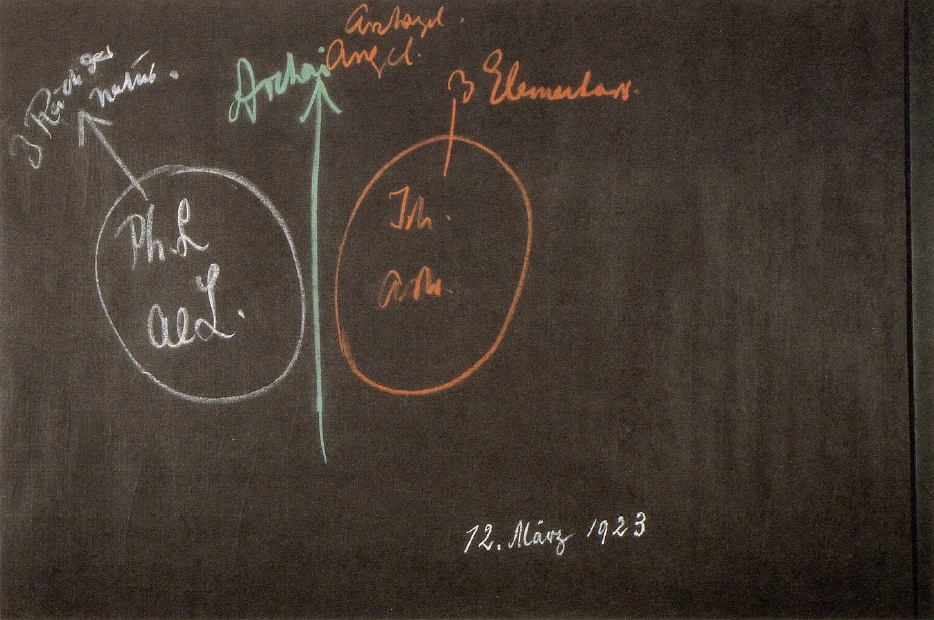
[ 29 ] Schematically, this can be illustrated as follows: The physical body and the etheric body must, in the waking state, establish a proper relationship with the three kingdoms of nature (see diagram). The sleeping human being—the “I” and the astral body—must establish a proper relationship to the three elemental realms, but also to the realms of the angels and archangels. However, if one has only a corresponding relationship to these realms, the proper interplay does not come about. There is no proper relationship between sleeping and waking. In order for the “I” and the astral body to emerge from and re-enter the physical and etheric bodies in the proper way, the human being must also have the right relationship to the realm of the Archai (middle arrow), to the realm of the primordial beginnings or primordial forces.
[ 30 ] Goethe’s inclination toward Italy was simply an inclination toward a proper relationship with the Archai, with the primal forces. These primal forces concern the whole human being, insofar as this whole human being must alternately be a waking and a sleeping being. And sleep simply does not provide the right strength, and not everything that should be drawn from life on earth is drawn from it, unless the right relationship to the primal forces is established through the development of those strong inner forces that are necessary for understanding spiritual science.
[ 31 ] To understand what is considered official science today, a relationship to the primordial forces is not necessary, for this can actually be grasped with the mind alone. To do so, one does not need to fully comprehend the rest of one’s organism in terms of the etheric body. However, if one wishes to permeate the whole human being with one’s human spiritual being, then one must have a relationship with the primordial forces.
[ 32 ] This relationship to the primordial forces existed in an atavistic way in ancient times. Back then, the primordial forces still exerted such a strong influence on human beings during their pre-earthly life that they brought with them the strength necessary to live within themselves. But our age is characterized precisely by the fact that these primal forces withdraw more or less as human beings transition from the spiritual world to the earthly world; that they, so to speak, allow human beings to descend to Earth in a more “thinned-out” state than they did in the past; and that human beings here on Earth must seek the spiritual through their own power in order to reestablish a relationship with the primal forces.
[ 33 ] If you have a feel for something like Goethe’s spiritual revelations, you can very easily picture the difference between Goethe and a mere intellectual in your mind’s eye. A mere intellectual presents all sorts of ideas to you; what he says can be extraordinarily logical. But if he is to go beyond what can be encompassed by mere logic, then he must fall back on his instincts—that is, on his animal nature—and there he sometimes becomes highly illogical. You may well have some experience of the fact that there are people today who are quite capable of writing logical books; but when you interact with them in daily life—and it’s not a matter of teaching a science, where they are logical—but rather of what everyday life is all about, dealing with them can be exasperating, because that’s where the most ordinary emotions and instincts come into play in the most illogical ways. One could even say: Intellectually, one can develop extraordinarily beautiful theories; they need not have anything to do with the whole person. — You need only recall that story, which is, after all, typical—it has happened everywhere—about a teacher in a school who has exceptionally sound pedagogical theories on how children must be taught to control their emotions, their passions, and so on, and he preaches this to his students. Then it happens that a student, because he’s a bit of a good-for-nothing, knocks over the inkwell. And the teacher shouts: “What? You’ve just given free rein to your passions! Because if you’d been logical and reasonable, you wouldn’t have knocked over the inkwell. I...!” — And he grabs the chair and starts lashing out. Even as he’s explaining the theoretical moderation of passion exceptionally well from his head, he starts beating away, perhaps breaking a chair leg or something like that. It’s, of course, a radically extreme case, but things like this happen all the time.
[ 34 ] So take such an intellectual on one side and Goethe on the other; everywhere you will see—in every detail of his life, but also in his greatest intellectual achievements—that it is the whole person, not merely the intellectual Goethe; it is the whole person, Goethe, within.
[ 35 ] With so many of the great minds in the history of humanity, one can forget the person behind the intellect. One gets the feeling that, in fact, only the mind is there. Isn’t that true? What does one really care about in Newton other than his mind! In history, Newton actually lives on only as a mind. Goethe as a mere mind would be inconceivable. With Goethe, one knows that he is present everywhere—even in his smallest ideas—as a whole person. One can see this, I would say, particularly in the second part of Faust, but also in Wilhelm Meister; it is precisely in Goethe’s most interesting works that this is evident. When Goethe sat down, he gave the impression of a tall man; when he stood up, he gave the impression of a short man. Goethe was what is called “tall when seated.” He had short legs and a large upper body. But if one has a feel for such things, one can see this reflected in his intellectual achievements as well: the whole person is simply there.
[ 36 ] And that is precisely what our age needs once again: to turn minds into whole human beings. For people today, it is merely a matter of chance that there is still something attached to their heads. For whatever they accomplish in their external lives, they accomplish with their minds. Their arms, for example, are really just tools. Consider this: some people today already have a handwriting that could be artificially produced quite accurately, even by some kind of spring-loaded machine attached to the head. If people had a sense of this—that spirituality also lives in their arms and hands, and that writing arises through the arms and hands—well, if that were the case, then the kind of writing instruction taught today at the elementary level could not be taught at all, for this writing instruction is merely instruction of the head, which uses the arms and hands only as external tools, like machines.
[ 37 ] It is, in fact, what is attached to the head that has, in modern humans, more or less become a machine. This is because that—if I may use the term—fluidum, or that fluidic force through which the spiritual-soul human being takes hold of his physical and etheric bodies, can develop properly only when the human being attains the right relationship to the primordial forces, to the Archai. Read my Outline of Esoteric Science; you will find that the Archai were the first, even during the ancient Saturn period, to approach human evolution as superterrestrial beings. Then the Archangels came, followed by the Angels; only then did the human being come into being. They are also, in turn, the first to withdraw from the human subconscious, and it is they whom the human being must once again reach through his or her consciousness.
[ 38 ] But we can only do this if we develop, during our waking lives, the powerful forces necessary for understanding spiritual insight. Then we will also be able to open our hearts and minds to the realization that out there in nature—where we live as physical human beings on Earth—there is something more than what we experience in our waking state through normal consciousness.
[ 39 ] Go back to the days of ancient medicine. Back then, no one involved in medicine ever thought of merely studying the external, abstract forces of nature and natural substances. Back then, people worked in their laboratories—if one can call their facilities that—in such a way that the modes of action of the elemental forces shone forth to them from the processes of nature everywhere. In fact, people have always asked: How does a process—such as one involving sulfur or some other substance—interact with another substance? What lies behind the mere sensory appearance? How do the beings of the elemental realms act within it? — People conducted their experiments, so to speak, to eavesdrop on such a transformation that a substance undergoes when it combines with another, or when it emerges from another—specifically, during the transition marked by a substance’s change in color—to observe how that which constitutes the beings of the elemental realms peeks out into the sensory world. Even Paracelsus, when he described sulfur, salt, and mercury, was not describing these ordinary physical substances, but rather that which, when these substances underwent transformations, peered out at him from the elemental realm. One cannot, therefore, understand Paracelsus anywhere if one takes his terms as they are used today in chemistry, because throughout he actually means that which peeks out from the elemental world in the manner just described. But these are also the healing powers. They are the true healing powers. In what you see in any plant—in what, say, the autumn crocus shows you outwardly—you do not see the characteristic healing powers of the autumn crocus. If you want to see the characteristic healing powers of the autumn crocus, you must observe it as it fades, when it undergoes that peculiar, bold change in color. For that is when the elemental being departs and brings about the color change through a similar process—well, you know, when the devil takes off, he leaves a stench behind, and the elemental beings assert themselves through their audacity in the coloring.
[ 40 ] At these transitions, one must recognize how a process in the elemental world underlies them. But the human soul—the ego and the astral body—also lives within this elemental process, from the moment of falling asleep until waking up. That is where it lives. And if you wish to assist a natural process within the human being so that a healing process—one that has become necessary—can take place, then the following actually happens: If you leave the person as they are, they transition irregularly from a sleeping state to a waking state, and again from the waking state back to the sleeping state. If you give them any substance—say, from the plant kingdom—that has a relationship to a very specific elemental being, then the person absorbs something into their physical body that imparts a certain power to their astral body within the elemental world, so that they can now establish a relationship with those specific elemental beings as a soul-spiritual being. They bring this back with them upon waking, and this actually has a healing effect. It is not the substance itself that has a healing effect; rather, it is the state into which the person is brought through the substance—since the substance has a connection to the elemental world and transfers this connection to the person. In fact, for a large number of illnesses, you can ask: What must change in the person so that they fall asleep and wake up in a different way than they are accustomed to as a sick person, so that they may become healthy? For the most part, the study of healing processes is a study of the changes in state that a person undergoes between their expression in the physical-sensory world and their expression in the elemental world.
[ 41 ] In the past, when the Archai—the primal forces—still maintained a living connection with human beings, it was possible to point to such manifestations in the elemental world; today, however, this is no longer possible if one relies solely on ordinary consciousness and does not open oneself to spiritual insight. One must open oneself to spiritual insight; then, gradually—at first simply through common sense—one gains an understanding of how to regulate this transitional state between waking and sleeping, between the outer physical world and the elemental world, in order to bring about healing processes.
[ 42 ] So you see, it is not only necessary for human beings—as I explained yesterday—to reestablish a proper relationship with the Archangels within the realm of language, but it is also necessary for them, through that stronger development of the will required to comprehend spiritual science, to reestablish a more intense relationship with the Archai, the primal forces. Then a completely different kind of knowledge will come naturally to them, unlike the kind that is presented to them today. That is, after all, what people shy away from so much today. Studying spiritual science requires the development of the will. The concepts one encounters in spiritual science—these ideas—must be taken in through the development of the inner will, through inner activity. People today do not like that; they would actually prefer to leave their inner will completely at rest and let the knowledge simply roll past them, letting it enter through their eyes without doing anything about it, and then set the brain in motion so that it runs along on its own. And in fact, many people today would actually prefer it if, instead of lectures, they were simply shown a kind of film—where they no longer need to think along with what is being conveyed to them, but where they can simply let themselves go without any inner activity and let everything just pass by. Then it strikes the eyes, creates images there that are imprinted in the brain, and this is done as often as possible so that it becomes deeply ingrained—and now one has absorbed it. But this turns one into a veritable automaton, a mental automaton: one no longer needs to internally process what is presented to one mentally; instead, it simply imprints itself on one. One becomes a mental automaton; for example, one does not need to recognize the human organism at all, for recognizing it absolutely requires inner activity. One cannot understand human beings unless one approaches them with inner activity, unless one also takes in ideas such as those that have been developed for you today. But, well, one can certainly try—without inner activity—to see, for example, how Antipyrin affects the human organism. You try it out; you don’t need to understand anything about human beings, but rather you observe how it affects them externally; this then becomes imprinted on the person. Once it has been imprinted often enough, you can write it on a prescription, and in this way, without any understanding of the human being, you become a “mental automaton.” A large part of life today, in fact, proceeds in this manner.
[ 43 ] But time calls us once again to inner activity, to the unfolding of the inner will. This is what youth wants from old age. Youth wants old age to pass something on to us once again, through which we may enter into the proper communicative relationship with the Archangels. But old age should also educate us in such a way that we enter into the right relationship with the Archai. For—as youth says—until we have reached the necessary age, it is essential that we submit ourselves to the education of the elders. But in the education of the elders lies this tendency toward the superficial, toward inactivity.
[ 44 ] This is the other side of the youth movement, viewed from within; I described the first side to you yesterday. Everything today calls on people to be whole human beings—not merely to surrender to passive ideas flowing in from the outside world, but to develop inner activity, to experience their spiritual and intellectual lives through inner activity, and to experience them with will.
[ 45 ] But in many respects, human nature today is far too fainthearted—not to say cowardly—for that. For as soon as a person applies their will to any context of ideas, they immediately think: “That’s not objective; that’s me; I’m the one creating those ideas”—because people shy away from first shaping their will in such a way that it can experience the objective in the spiritual world. After all, without the will, one cannot experience anything in the spiritual world—and therefore nothing objective either. Of course, the purely emotional will—the will that is dependent solely on the physical body or, at most, on the etheric body—cannot enter the spiritual world at all; it can only turn a person into a head-centered being. For the head is capable—just as it does not walk on its own but allows itself to be carried—of passively surrendering to what unfolds in the world like a movie.
[ 46 ] The whole human being must be actively engaged in the world in order to attain the spiritual. This is what emerges time and again from all the individual reflections, and what we must truly grasp clearly in the eye of the soul today. I will speak further on this next Friday.