Three Perspectives on Anthroposophy
Cultural Phenomena
from the Perspective of Spiritual Science
GA 225
7 July 1923, Dornach
Translated by Steiner Online Library
5. Community-Building in Central Europe
[ 1 ] Yesterday I attempted to offer a kind of overview of the century by describing to you how, particularly in Western European regions, people entered into social bonds connected with social class on the one hand and professional life on the other, and we saw how these connections, these forms of socialization, were grounded in the spiritual. Indeed, we even had to delve into the astral realm and the human ego in order to study the two opposing professional associations, the “Dévorants” and the “Gavots.” And the distinctive feature of these associations—which, as I said, are found primarily in the western regions of Europe, where modern civilization has developed predominantly in the West—the essence of these associations is that a person feels at home within such a community with his entire spiritual constitution, and that the various identifying marks, the symbols I have spoken to you about, the legends, have some connection to professional life, even though they have a thoroughly spiritual background.
[ 2 ] Just as I described to you yesterday what life was like a century ago in Western European countries, it would be impossible to describe life in, for example, the regions of Central Europe. It should therefore be understandable that when George Sand wanted to write a novel in which she addressed certain social issues, she chose these social settings as her backdrop. One can certainly say that Goethe, too, sought something similar with his Wilhelm Meister. He wanted to depict how the individual is connected to humanity and to humanity’s intellectual and professional life, and how the individual develops out of humanity itself. Goethe attempted this in his Wilhelm Meister. Had it been a reality for him, he would undoubtedly have chosen such craftsmen’s guilds as a foundation, just as George Sand did. He did not do so because it was simply not possible in the circles to which Goethe belonged by virtue of his education.
[ 3 ] What is peculiar is that in Central Europe, ever since what I have often referred to as “intellectualism” first emerged—that is, since the 15th century—human problems have been understood quite differently than in the West. Yesterday I had to describe to you how the individual craftsman makes his journey through France, how in some city he is admitted into what one might almost call a secret society, how he receives his identifying marks there, and how, when he sets out on his journey as a journeyman, he finds a similar branch of his guild in some other city: he identifies himself, and he is admitted into that branch of his guild. As I said, this was still very much the case as late as 1823. And these associations then had a profound influence on the life of the respective guild.
[ 4 ] One could not describe Central Europe in this way. For Central Europe, one would have to say that, ever since the beginning of the modern era—that is, since the 15th century—people have consistently strived to cultivate individuality and the human self. There was not such an intense connection between the individual and his profession or social class as there was in the West. Consequently, people approached their professions—one might say—sine ira, in a more detached manner. They did not become so closely intertwined with their professions; they did not link their spiritual lives to their professions.
[ 5 ] In the West, the terms and symbols were derived from the principal professions. This was not the case in Central Europe. Rather, intellectual life was more distinct from one’s profession and also more distinct from one’s social class. Of course, one still belonged to a social class, but when one turned to spiritual life, that spiritual life was more detached—both from one’s profession and from one’s social class. Consequently, people tended to live in such a way that they completely freed their thoughts from professional life when they wished to devote themselves to spiritual matters. And so, in Central Europe, those branches of spirituality that had nothing to do with professional life or class life were particularly cultivated.
[ 6 ] Humanity’s relationship to the world was conceived without regard to the nation, without regard to any national context. Humanity as such was at the forefront. And then, when the individual—let’s say, even a craftsman—wanted to devote himself to an intellectual life, he did so as an individual human being. He was more than just an individual when it came to life’s tasks. At the beginning of the 19th century, he had little access to the kind of intellectual life I described yesterday through any social connections. Consequently, intellectual impulses in Central Europe developed in a completely different way,
[ 7 ] The individual craftsman who had a special urge—who, to use the more southern German expression, became a “Sinnierer”—there is this wonderful word, “Sinnierer”—who, in other words, pondered a great deal—familiarized himself with the remnants of the knowledge that had survived from ancient alchemy, knowledge that had nothing to do with any social class, any nationality, or any profession; he familiarized himself with what remained of ancient astrology. And what he thus absorbed within himself, he carried with him as a treasure of great importance and value to his fellow human beings. So he wandered a great deal from place to place. There were always only individuals; one did not wear any identifying marks—one simply came as a human being. At first, people had strange names for such a person. These terms arose during a time when there was great confusion between the views of ancient times and those of more recent times; and those who stood out from the masses were not immediately welcomed with open arms. Such thinkers were regarded as eccentrics. They were called “Spornritter” when they appeared in this way. And such a person had to first earn his reputation by coming together with people—precisely because he now had something to say to them. Since no consistently cultivated connections had yet developed, he had to earn his reputation among the people he met—those who wanted to learn something from him—only when the opportunity arose. And by asserting what he had conceived, he gained a certain influence. And long before such a person arrived, there had already been vague talk that someone was coming.
[ 8 ] Well, at first it seemed strange to people, but afterward, when he left town, they thought long and hard about what such a deep thinker had said—such a particularly clever man who had so much knowledge in his head that they couldn’t even comprehend how a human mind could be so vast as to hold everything that he had inside his head.
[ 9 ] So the whole way in which intellectual life was approached in the human realm was simply different. And that is why it was inevitable that, in Western countries, education remained much more popular and much more broadly based, since it was closely linked to professional and class life. In Central Europe, on the other hand, this gulf gradually emerged between the educated and the masses, who could no longer keep up. Well, this is largely connected to the profound tragedy of Central European life—this gulf between those who, in the face of the demands of modern times, synthesized what remained of ancient wisdom—be it alchemical or astrological—and, from this perspective, looked more deeply into human life, and those who remained stuck at the more rudimentary concepts of education, such as those associated with a religious life.
[ 10 ] These were the circumstances Goethe faced. Consequently, in his Wilhelm Meister, Goethe could not have depicted things the way George Sand did, for example, in her novel Le compagnon du tour de France. Goethe portrayed the individual human being, individual human personality, and their relationship to the higher and lower worlds. Thus, in France, we encountered, so to speak, the influence of the astral realm in the Dévorants and the influence of the “I” in the Gavots—forces that worked through the social institutions. Within Central Europe, the search was on to understand how human beings are connected, on the one hand, to the heavens and, on the other hand, to the earth.
[ 11 ] In a beautiful way—though, I would say, deeply imbued with the sublimation of education and carried into the realm of the highly abstract—Goethe incorporated what has, in essence, been alive within Central Europe as human knowledge and wisdom since the 15th century into the two characters who appear in his Wilhelm Meister: Makarie on the one hand, and the “Metal Seer” on the other.
[ 12 ] This peculiar character appears in Goethe’s Wilhelm Meister, Makarie, a mature female character who, due to her frail, sickly nature, has little connection left to earthly life; who, so to speak, has completely detached herself from earthly life; who hardly moves within earthly spaces anymore; who is revered by everyone around her—by all family members in the narrower as well as the broader sense— and who, having become independent of the earthly realm, develops a remarkable cosmic life. And this cosmic life, which Goethe describes as if Makarie were attuned to the peculiarities of the stars rather than those of the Earth, leads to the disappearance, so to speak, of all physical perception of the world from Makarie’s mind and soul, leaving her entirely devoted to cosmic laws. But the more she surrenders herself to cosmic laws, the more the earthly laws of nature cease to have any meaning for her, and the more the laws of nature are transformed into cosmic moral laws. She becomes a moral authority for all who come to know her. And she does not advocate a morality based on commandments, nor any morality borrowed from this or that source, but rather a morality that, when a person frees themselves from the earthly—while still retaining it—appears to them as if it were revealed by the stars themselves in their course. And what Makarie proclaims in this way to those around her through her contemplation of the stars is interpreted by her friend, the astronomer, who is now becoming the seer’s disciple in the cosmic realms.
[ 13 ] Goethe depicted—in a subtly refined manner—what you must still imagine as being a living reality throughout the first third of the 19th century, but within a higher social class. One must imagine, for example, that during this period there were still—albeit scattered— there were still families—albeit scattered—whose female members, once they reached a certain age, were simply no longer able to move about on earth; they became bedridden, their skin turned white and translucent, revealing blue veins running in intriguing patterns through the white, translucent skin all the way to the surface of their bodies; they rarely spoke. But when they did speak, everyone in the vicinity listened carefully to what was said, for then these women proved to be seers of the kind that Goethe had only typified and highlighted in his Makarie. And indeed, throughout the first third of the 19th century, circles of legends could be found everywhere in Central Europe. It was said: Here and there, in that place, there lies such a seer; she has spoken this or that through her prophetic gift.” — And such stories were carried far and wide throughout the regions. And they were carried with that poetry that was possible within the human social order when there were no newspapers yet, for newspapers have, in essence, contributed enormously to the destruction of spiritual life.
[ 14 ] So Goethe introduces such a character in his Makarie. And now, at a certain point in The Wander Years, this Makarie is contrasted with the Metal Sensitive One. Her friend is Montanus. The Metal-Sensor likewise senses what is happening within the Earth—that is, I would say, the very spiritual essence of earthly nature. She knows how to speak of the secrets of the Earth’s metals; she knows how to speak of how the individual metals affect human beings. And Montanus interprets what happens with the Metal Seer in the same way that the astronomer interprets what is revealed through Makarie.
[ 15 ] Goethe thus contrasted, in an extraordinarily interesting way, the cosmic seer with this “metal-senser,” who reveals the secrets of the Earth through her special constitution—which is, in turn, a somewhat pathological one. Goethe shows that he does not seek what makes a human being capable—what enables a human being, above all, to carry out their deeds on Earth—neither among those who live on one side of the cosmos nor among those who live on the other side, within the Earth. He seeks what makes human beings capable of earthly life precisely where they are unaware of these two faculties in their state of consciousness—where they operate unconsciously—but where, like the beams of a balance scale, there is a balance between the two.
[ 16 ] Goethe does not know what lies at the root of this. But he senses it himself—drawing on his deep-rooted education—how these two extremes of life, these extremes of the spirit, interact and actually make a person truly human, not when one or the other exerts a one-sided influence, but when both, while retaining their distinct characteristics, work together to bring about a balance in human nature.
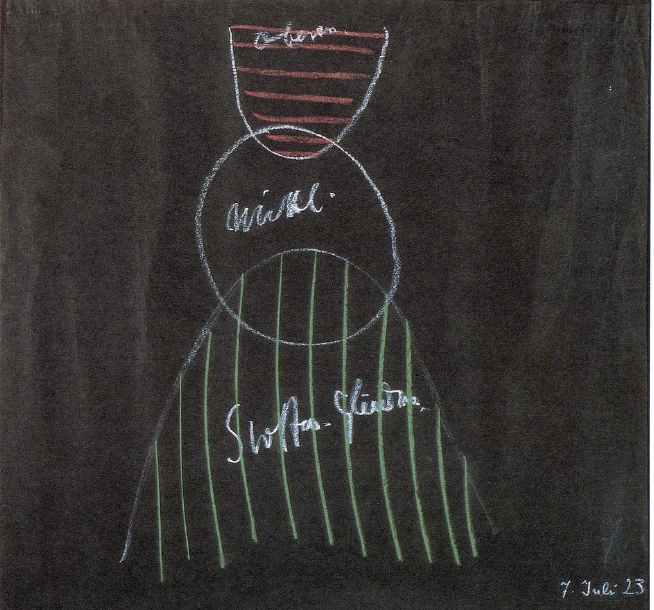
[ 17 ] Today, now that we can speak from the standpoint of anthroposophy, we can say: First, we have the upper human being within the person—the nervous-sensory human being; then we have the middle human being—the rhythmic human being; and finally, we have the lower human being—the metabolic-limb human being. If the upper human being predominates in a person and is not balanced by the lower human being—as in the case of Makarie, where, through a pathological development, as in the case of Makarie, the entire metabolic-limb human has fallen into a kind of rigidity—a rigidity that does not yet take away life but renders the human being incapable of moving within earthly space—if, in such a personality, the activity in the head predominates, then the human being becomes a cosmic seer. If, as in the case of the “metal-senser,” the nervous-sensory organization recedes and the metabolic-limb system develops particularly prominently, then the person lives primarily with the earthly realm; they live with the forces and effects of the earth’s metals and minerals. And in the average person, there is a balance.
[ 18 ] At this point in his social novel Wilhelm Meister’s Journeyman Years, Goethe actually intended to suggest how the search for what it means to be human was underway in Central Europe, how human beings were divided, on the one hand, toward the cosmos and, on the other, toward the earthly realm, and how true humanity lies in the balance between the two.
[ 19 ] Much, much thought has been given to this balance between astrology above and alchemy below. And while individual figures such as Paracelsus and Faust stood out—traveling from place to place to astonish people with what they, as thinkers, knew of these mysteries, so that people took notice of what a human being can know about humanity—when such significant personalities emerged, they were by no means the only ones. There were little Paracelsuses and little Fausts everywhere—they simply did not travel as far and had a smaller sphere of influence. And what is being explored today in the mysteries of dowsing was something that was quite commonplace back then. On more than one occasion, something like the following occurred.
[ 20 ] Such a philosopher came to a certain town and impressed the people there with what he had to say about the upper and lower worlds. And once he had made a powerful impression on the people, once they began to believe unconditionally in his authority, they finally said: “But Master, now you must do something else that is important for us. You see, we need a well, and you must tell us where the well should be built.” — So the one who had come to these towns as a philosopher walked around the area with the people; in some places he stopped, then walked on again, stopped once more, but finally he stopped at a spot where he said, “There it is! There we have it!” — And that’s where the well was built.
[ 21 ] History simply does not record these things; they extend into the first third of the 19th century, even though they became increasingly rare there. But these things are real. And this is precisely something that was particularly cherished among the lower classes of the people—something that, so to speak, constituted their spiritual life. Their spiritual life lay entirely in these things, because they had the deepest urge to grasp the human as such—I would say—not merely symbolically, but even cosmically. Here, people asked less: How is a person connected to the outside world through their class or their profession? This was certainly emphasized during the era of the guild system, when people wanted to display their insignia outwardly, when they wanted to put on parades and the like, but that did not actually have the same deep spiritual significance as it did in the West. In contrast, this life, detached from the external, had great spiritual significance here.
[ 22 ] I would like to say: In the West, the aim was to understand humanity spiritually through the external forces of social life. In Central Europe, it was the human being within his own skin who also wanted to experience what he encountered socially as a human being. This is precisely what elevated Central European spiritual life to a certain height, so that it could not become as popular as it did in the West. And this is also what, at the same time, gave rise to the profound spiritual tragedy of Central Europe. And we are already living in an age in which these things should be brought to the awareness of the broadest circles, in which people in the broadest circles should awaken to these matters. For it is only then that we can hope that our civilization, which has become chaotic, can receive new impetus, that new life forces can be infused into it, if we can grasp the true connection with historical life in this way.
[ 23 ] Even in Central Europe, people had already descended to the level of the Earth. This is demonstrated in particular by Goethe, who sought a balance between the “upper” and “lower” human beings, contrasting the two extremes: the “metal-sensing” woman and the “cosmic seer.” The aim was to place human beings on Earth as active beings; but one wanted to look up into the realm of the cosmic on the one hand, and look down into the realm of the earthly, the telluric, on the other, in order to recognize human beings as citizens of the Earth. These are the distinctions that modern civilization has brought to the surface from its depths.
[ 24 ] That is why, for example, something like Schiller’s Aesthetic Letters—which I have often discussed, and in which human beings are portrayed solely as human beings, detached from any nationality, and are to be understood only as human beings—could only have been written in Central Europe. And fundamentally, it went without saying that part of the reflection—even if neither Goethe nor subsequent generations found solutions for it—consisted in how to enable people, indeed all people, to understand this universal humanity once again in a modern way.
[ 25 ] For this reason, the so-called “pedagogical province” constitutes a large part of Goethe’s novel Wilhelm Meister. The education of human beings becomes a problem: a problem for which the time had not yet come back then, but for which the time has only now arrived, when one can seek an anthroposophical understanding of human nature.
[ 26 ] In the West, I would say, people had already moved beyond the human skin. They were groping in the dark: How does one connect with another person? How does one make oneself known to another person? How does one take their hand? How should one speak so that they recognize you? — Signs, gestures, and words, as they later appeared in a somewhat elaborate manner in Masonic lodges, were a vital and dynamic force in the West until the end of the first third of the 19th century. In Central Europe, people did not have much of an appreciation for such specific symbolism, but they did have a keen interest in unraveling the mystery of humanity in general.
[ 27 ] It is now interesting to compare this with Eastern Europe. There, human beings—not only until the end of the first third of the 19th century, but well into a much later period—came from within themselves; I would say, not quite to the surface. In a certain sense, they remained in a state of mind that did not quite lift them out of the divine, did not propel them forward to become fully human. Therefore, I would like to say: While in the West the attitude has emerged that the world is the world—at most, one must reflect on social utopias—the world is the world, one must live in it, one must have social institutions in order to live in it, or must regard those that already exist as if they were utterly wonderful in order to live within them—while this was the case in the West, in Central Europe the attitude was actually that one demanded: Man must first become human; he must first work his way toward humanity; only then will he find the earth. — In the East, people were convinced: Both ideals are actually wrong. The very moment a person thinks of working his way toward becoming human, he is on the wrong track, for in doing so he is actually leaving paradise. And a person should always be able to regard the patch of earth on which he lives as a paradise; otherwise, life becomes impossible. One must return more to what lies unconsciously within a person, and not venture too far out into life.
[ 28 ] For this reason, although a certain tolerance toward the West and toward Central Europe has always existed in Eastern Europe—arising from a certain good-naturedness and also from love of humanity—the regions where people relied either entirely on outward humanity, as in the West, or on individual human individuality, as in Central Europe, were nevertheless regarded, in a sense, as a deviation from the divine human being. And when—as is certainly the case with Russia, for example—the tendency arose in the East to form views about the West, we see precisely because human beings do not wish to go beyond themselves that, while a tolerance—a mere putting up with—is indeed present, especially among the best, there is no inner engagement with the rest of the world. The Russian, if he is a true Russian, does not penetrate as far as his skin; he remains stuck deeper within himself. It is already far too earthly to penetrate as far as one’s skin; one must remain more within.
[ 29 ] You see, this was a state of mind that was still present to the highest degree in Dostoevsky. And so it is certainly interesting to hear what Dostoevsky—that is, one of those who are, above all, representative of Eastern European life—has to say to people in the West.
[ 30 ] You can read about it in the latest issue of the journal Wissen und Leben, which has just been published and includes letters that Dostoevsky wrote to Apollon Maikov in 1868. But then again, such letters could have been written if traveling had already been so common back then, even in the first third of the 19th century.
[ 31 ] I may have to ask some of those seated here to excuse me for reading aloud a few passages from Dostoevsky’s letter, but it is Dostoevsky who says this, not I, and I am, of course, far from intending to say anything other than to let Dostoevsky speak for himself. Dostoevsky thus finds himself in Geneva; and the people of Geneva and those who live nearby will have to excuse me if I read aloud a few passages from a letter by Dostoevsky dated 1868, merely by way of illustration.
[ 32 ] “In Geneva, we suffered most from the material hardships and the cold. If only you knew how stupid, dull, insignificant, and wild these people are! It’s not enough to visit the country as a tourist. No, try living here for a while! But I can’t even briefly convey my impressions to you right now; there are simply too many of them. Bourgeois life in this republic has reached its absolute peak. In the government and throughout Switzerland—nothing but political parties, incessant disputes, pauperism, and a terrifying mediocrity in everything; the local worker isn’t worth a fraction of what ours are: it’s ridiculous to look at him and listen to him. The customs are wild; oh, if only you knew what is considered good and what is considered bad here. Low levels of education: what drunkenness, what theft, what petty swindling that has become the norm in commerce. Incidentally, there are also some good qualities that place them immeasurably above the Germans.”
[ 33 ] Now I have to apologize to the other side again!
[ 34 ] “In Germany, I was most astonished by the stupidity of the people; they are immeasurably stupid, they are incomparably stupid. Even Nikolai Nikolayevich Strakhov, a man of great intellect, refuses to see the truth; he said, ‘The Germans are clever—they invented gunpowder.’ But that’s just how their lives have turned out!”
[ 35 ] So, he does not count their invention of gunpowder as something that would in any way diminish their immeasurable stupidity. Well then:
[ 36 ] “... There is still plenty of forest in Switzerland; incomparably more of it remains in the mountains than in other European countries, although it is dwindling at an alarming rate year after year. Now imagine this: for five months of the year, there is terrible cold here, compounded by the Bisen winds. And for three months, the winter here is almost the same as ours. Everyone shivers from the cold, never taking off their flannel and cotton padding (and yet they don’t even have steam baths—so you can imagine the filth they’re used to); they don’t have winter clothes, walking around in almost the same clothes as in summer (though flannel alone isn’t enough for such a winter), and on top of that, they lack the sense to improve their homes even a little! What good is a fireplace with coal or wood, even if you heat it all day long? But heating all day costs 2 francs a day. So much forest is being needlessly destroyed, yet they still don’t have any heat. What do you think? If only they had double-paned windows, one could get by with just the fireplaces! I’m not even saying that stoves should be installed. Then the entire forest could be saved. In 25 years, there won’t be any forest left at all. They really do live like savages! They deserve what’s coming to them. In my room, even with the heating cranked up, it’s only +5 degrees Réaumur (5 degrees warmth). I sat there in my coat in that cold, waiting for money, sorting through my things, and thinking up a plot for a novel—isn’t that lovely? They say it got down to -10 degrees in Florence this year. In Montpellier, it was 15 degrees Réaumur below freezing. Here in Geneva, the temperature didn’t drop below -8 degrees, but it’s all the same when the water in the rooms freezes. I recently moved apartments and now have nice rooms; one is constantly cold, but the other is warm, and in that warm room I always have +10 or +11 degrees heat, so it’s still livable.” And so on and so forth.
[ 37 ] So you see: Central and Western Europeans do not exactly come across very well in this portrayal of one of the most outstanding Russians. And that must simply be attributed to the fact that there is no attempt to go even as far as the surface of the human being. There is still a distinct sense of self-containment, and hence a refusal to conform to one’s surroundings—rather, I would say, a demand that everything be just as one is oneself.
[ 38 ] As I said, from a certain historical perspective, it is quite interesting to reflect on this recently published excerpt from a letter. That is why I chose this particular passage—and not, for example, ones from the first third of the 19th century—for this historical overview. For in Russia, these matters actually only came to light with such clarity later on; yet they have always been woven into the fabric of life and have always been present. And one can also characterize the era of a century ago by considering these statements about a time that has already undergone some changes. Indeed, even things that are likely to cause quite a bit of astonishment in the West can be found there. If you consider Western or Central European accounts, then the following passage from a letter—which dates from the same period, March 1, 1868—will be of interest to you. From it, you will see precisely that one can view the affairs of the world from different perspectives.
[ 39 ] “Based on everything I have read, I have formed the following opinion about our courts: The moral character of our judges”—namely, the judges in Russia—“and, above all, of our jurors is infinitely higher than in Europe; they regard criminals as Christians. Even Russian traitors living abroad admit this. But one thing does not yet seem firmly established: I believe that this humane attitude toward criminals still contains a great deal that is derived from books—liberal and lacking in independence. That happens from time to time. Incidentally, I may be terribly mistaken from a distance. But our fundamental nature in this regard is infinitely superior to that of Europe.” And so on.
[ 40 ] So you see, the view of the courts here is presented from a different perspective than the one you often hear in Western Europe.
[ 41 ] I would like two things to emerge from yesterday’s and today’s discussion: First, that it is absurd to believe that today’s standards can somehow be applied to living conditions from a century ago; rather, one must genuinely and empathetically engage with the conditions of the past if one wishes to arrive at a valid judgment that takes reality into account. But even when it comes to people living in the same era, the point is to cultivate a certain generosity of judgment. That is what we must find today. We must find a way to set aside these national perspectives in order to truly adopt the perspective of a citizen of the world.
[ 42 ] But the fact is that this can arise, above all, only from a deeper understanding of the human being. The world simply could not reach this deeper understanding of the human being as long as it did not seek anthroposophy. And one might say: If one really immerses oneself in what existed in Europe a century ago, one sees that it was a longing for an understanding of the human being. But with what was known about nature at that time, it was not yet possible to arrive at an understanding of the human being in the modern sense. Then, in the second half of the 19th century, external natural science flooded everything. And now we must once again seek what people longed for a hundred years ago—what the best minds in Europe longed for, and which was only temporarily overwhelmed—we must now seek it anew through a higher spiritual understanding.
[ 43 ] That alone will provide humanity with the strength that can somehow lead to a rise in culture in the face of decline. It is disheartening that so little history and so little geography are cultivated in the sense mentioned yesterday, that things have taken on such an external form. The point is to truly seek the spirit in history—in history and across the earth in a geographical sense. History and geography, in particular, must undergo a spiritual metamorphosis. This is necessary.
[ 44 ] This is precisely what Goethe’s “pedagogical province” in Wilhelm Meister also lacked, yet it is the very thing for which the characters who appear there yearn. And much of this yearning from that era must now find its way into our civilization. People must awaken to what was once dreamed of with such longing, so that the dreams of that time can now become reality through the power of spiritual insight. For people need this reality for their civilization.