Three Perspectives on Anthroposophy
Cultural Phenomena
from the Perspective of Spiritual Science
GA 225
6 July 1923, Dornach
Translated by Steiner Online Library
4. A Century in Review: 1823–1923
[ 1 ] Today I would like to offer a kind of reflection on the century. In a more superficial sense, the impetus for such a reflection on the century may be the fact that in a very significant novel by the French writer George Sand, Le compagnon du tour de France, the plot—which I will not be examining in detail here—is set in the year 1823, that is, one hundred years before our own time. It is therefore possible for some to draw inspiration from this very novel, because an imagination as expansive and vivid as George Sand’s actually contributes more to the characterization of an era than so-called scholarly historical analysis. One can certainly say that this writer has, with true intensity, made the period around the year 1823—and specifically for the French West of Europe—the backdrop for a significant novel.
[ 2 ] Well, I will not follow the style employed in this novel, but rather I will attempt to provide the social background for the period in question, based on its intellectual foundations. George Sand has, in fact, portrayed a number of characters who belong to the petty-bourgeois artisan class, and the experiences of aristocratic family life also play a role in the lives of these members of the petty-bourgeois artisan class. But what is magnificently depicted in this novel is precisely the social life of the artisan class. And one can say: With that distinction, with that difference that must necessarily stem from its folksy character, George Sand has depicted humanity’s embeddedness in the social conditions of that era—an era we can trace back, indeed, by decades; I would say, for France, just as far back as the social conditions from which Goethe drew his Wilhelm Meister. So, with that distinction—which must be inherent in her folksy style—we see how the social conditions are vividly portrayed as the backdrop of the novel, how the individual grows out of these social conditions, and how he reveals his own personality in a particular nuance precisely by growing out of them.
[ 3 ] As you know, Goethe’s Wilhelm Meister characters also emerge from these social conditions. As early as the first half of the 19th century, various figures drew a sort of parallel between the social background of George Sand’s novel and Goethe’s Wilhelm Meister. Of course, as I said, we must take into account the differences that arise from their respective national character. Goethe’s novel is thoroughly cosmopolitan; it has nothing national about it, nor anything political. Sand’s novel is thoroughly national, thoroughly political. We must, of course, take this into account when making the otherwise valid comparison between the two novels.
[ 4 ] Well, these conditions, which serve as the social backdrop, are indeed extraordinarily characteristic of the entire way in which modern humanity, over the course of the last decades of the 18th century and the first half of the 19th century, worked its way up from certain depths to the surface of human existence. Today, it is not easy for people to imagine how things were a century ago, because today the human personality actually stands isolated within the social order. Even those who are connected through work or family are gradually shaping their lives in such a way that they break away from these connections, from these social bonds, and achieve a certain degree of individuality.
[ 5 ] In this regard, a tremendous shift took place in the development of European humanity precisely in the 19th century, and the inner state of mind with regard to social connectedness or lack thereof was quite different in the second half of the 19th century than in the first half. In the first half—and let us set aside other circumstances for now and focus primarily on conditions in Western Europe—people at that time actively sought to place themselves within a framework of social ties. They sought to connect with those individuals who shared common interests with them—interests that, so to speak, were composed of the interests of their social class on the one hand and the interests of their profession on the other.
[ 6 ] For the peasant population, which at that time was even more tied to the land, it is precisely this attachment to the soil that comes into play. But for those who, through their craftsmanship, grew out of this peasant mindset and achieved a certain liberation from their attachment to the land, it is very significant that they sought—one might say quite desperately—social connections precisely during this period. And what is remarkable about this first half of the 19th century—that is, the period we can now view in retrospect—is that despite class, caste, and occupational ties, which form the external glue for such social groupings, there nevertheless existed everywhere a spiritual, a concrete spiritual foundation for these groupings.
[ 7 ] In French, however, everything is intertwined with the national. If one were to consider the same conditions—which we might perhaps do to a certain extent—with regard to the German character, one would have to point out from the outset that, for example, the German apprentice also traveled abroad during his journeyman years, and that he paid no heed to political borders when it came to seeking the kind of social integration I have described. The French character, which is thoroughly national in nature, allowed even craftsmen to travel only within the borders of France.
[ 8 ] But there, within the borders of France, precisely such groupings by class and profession emerged—groupings that were desperately sought after and in which, in the background, one can see everywhere the effect of spiritual impulses working their way into people’s souls. When these artisans travel from city to city, they feel at home in a kind of spiritual sense because in every city they find the community to which they belong. They would join a community in any city, and that community extended throughout all of France. As I said, this was still the case a century ago. When a craftsman’s apprentice traveled, he would find the same guild in the city where he intended to continue his craft. He did not carry any written documents with him, but rather a distinguishing mark—a certain handshake or some other sign of recognition. When he presented this identifying mark, people knew he belonged to this very guild, which had branches in every city.
[ 9 ] Now, such associations were—and I must emphasize this again and again—undoubtedly linked to a spiritual context everywhere, and if one wishes to investigate these matters seriously and honestly, it can actually present some difficulties in determining the nature of that spiritual context.
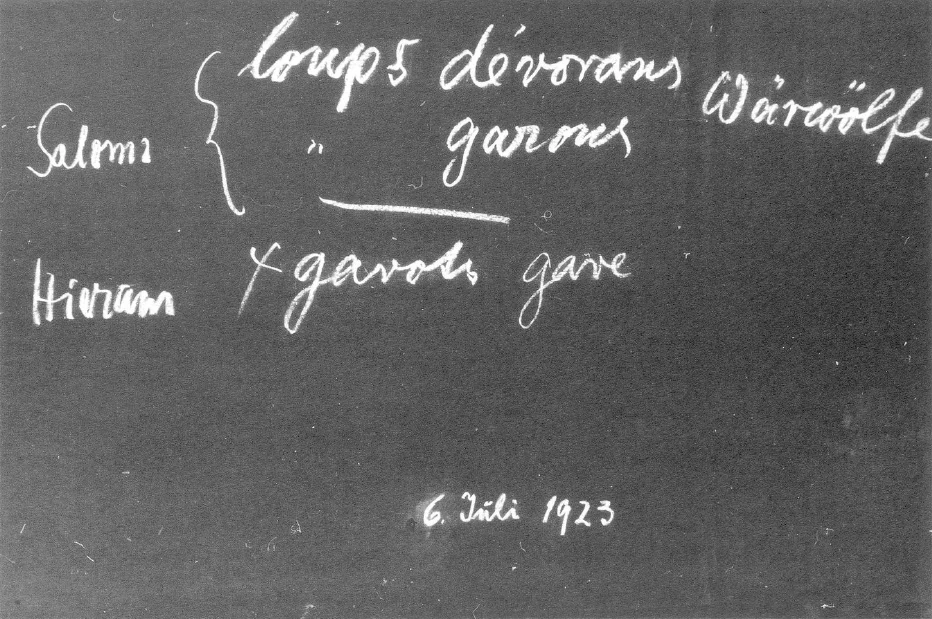
[ 10 ] Thus, in France around the time mentioned, there were essentially two such guilds of artisans. One guild was called “Loups Dévorants” or “Loups garous.” That was one. The other was called “Gavots.” Both were organized as I have described, and in the days when they could devote themselves to such matters, they held gatherings that took place in the same manner throughout the various cities. At these gatherings, there was first a careful rehearsal of the recognition signs; this was followed by festivities during which people spoke in symbols, and the banquet hall was decorated with symbols. There were festivities during which legends were told, tracing such societies far back into history. Thus, among the “Dévorants” and the “Loups garous”—if I were to use a German word, I would have to say “Werwölfe”—the entire history of this association was traced back to King Solomon, and a legend was told that went back to King Solomon. Among the “Gavots,” the legend—which was told in a wide variety of ways—traced its origins back to the Phrygian architect Hieram Abiff. These societies differed in a multitude of ways. And only by carefully examining their customs can one gradually uncover the spiritual underpinnings of which the members were fully aware.
[ 11 ] Thus, one important difference between the two was one that related to membership or to the fact that, let’s say, both associations existed in a given city. After all, there were both Dévorants and Gavots in a wide variety of cities. Now, the rule was very strict: no one was allowed to enter a trade in any way—this was strictly enforced—unless they did so through the mediation of these guilds. Thus, there were members who were Dévorants in one guild and members who were Gavots in the other. Whenever someone arrived in a city, he would turn to his guild, and the guild would then arrange the appropriate position for him in his profession, after he had identified himself in accordance with the regulations—that is, once it was known that one was dealing with someone who belonged to the guild.
[ 12 ] Of course, it sometimes happened that, say, far more people arrived in a city than there were jobs available. At first, the leadership of the two associations didn’t know how to handle the situation. The question now was: In this scramble for jobs, should the Dévorants prevail—that is, should the Dévorants secure the majority of positions for those who had arrived—or should the Gavots prevail, meaning should more of them be placed in jobs?
[ 13 ] It is characteristic that this usually led to fierce conflicts between the associations themselves, and just as today there are all sorts of much more trivial but—I would say—more brutal discussions between the various union leaders and so on, so too were there measures designed to determine which side—one or the other—should prevail in such a case. The Dévorants usually did not propose anything in particular; instead, they would gather in public squares and beat up the Gavots. The Gavots, on the other hand, proposed that a contest for a prize be announced, in which judges from both parties would then decide whether the Dévorant or the Gavot had performed better. This is a very significant difference. The Dévorants were essentially inclined to bring about a decision through brawling and outward displays, while the Gavots relied on more intellectual matters; and so it was that sometimes the customs of one side, and sometimes those of the other, emerged victorious. This is the kind of difference that reveals the nature of their underlying intellectual foundations.
[ 14 ] Another difference that offers insight is the way each of the two parties buried their dead. The Gavots buried their dead in such a way that they followed silently behind the coffin. The coffin was lowered silently into the grave. To the left and right of the grave stood the most distinguished members of the association in question, and they spoke over the grave, one to the other, whispering certain mysterious words. And then they formed a sort of circle and spoke again in mysterious words.
[ 15 ] In contrast, the Dövorants accompanied their dead with a voice of immense power—let me put it this way: If one stood in the distance and heard a funeral procession passing by, and especially when it reached the grave and as earth was thrown onto the coffin, it sounded from afar like the howling of the wind. But this was precisely the way the members of this society conducted their solemn funeral rites. They simply held the view—which they traced back to ancient traditions—that a person must amplify and nuance their voice in such a way that the sounds resound in a powerful, wild manner, as if these sounds were echoing into the physical world from the very realm the deceased is about to enter.
[ 16 ] There you have a hint of how these ancient societies had traditions that stemmed precisely from ancient insights. The funeral customs of the Dévorants were such that they took into account what ancient beliefs held regarding, let’s say, Purgatory—whatever it may be called—Kamaloka, and the like. But the term “wolves,” “loups,” itself points to what actually lay at the root of this. In many esoteric teachings, these words—or at least the idea expressed by this word—were used to describe that which is active in the human astral body when the intelligence is absent, that is, when the regulator of the brain is missing. What asserts itself from the depths of human nature in a passionately emotional way—what manifests itself particularly in the desire to be with other people in such a way that, as legend has it, one even craves their blood—was precisely what many esoteric teachings referred to as the “wolf.” So one can indeed say, if one wishes to view things quite honestly and correctly, that these “dévorants” actually believed they had to behave on such an occasion—such as a funeral—as if they had left their physical body, that is, specifically, their brain.
[ 17 ] And so were the festivities. While the Gavots’ festivities were quiet and gentle, those of the Dévorants were loud and boisterous. It was as if the astral world had been unleashed and was giving free rein to itself during these festivities. The symbols—which played such a major role in these festivities—and the composition of the legends all showed that, on these occasions, people were actually bringing to the fore, in a wild manner, what had once been different in ancient times.
[ 18 ] On the other hand, it is quite telling that the other party is called “Gavots.” That comes from “gave.” That is the name of very small spirits who come down from the densely wooded slopes of the Pyrenees; they do not make their presence known, yet they do descend from the heights of the Pyrenees—one might say they emerge like tiny elemental spirits, acting as representatives for the Grail people who otherwise come down from the heights of the Spanish mountains. Thus, the members of this other group, the “Gavots,” saw themselves as these little spirits who nevertheless belonged to the army of the Grail Knights.
[ 19 ] While one faction, the Dévorants, sought to emphasize what resides in human astral nature, the Gavots sought to emphasize what, according to the understanding of the time, resided in the “I.” Thus, the contrast between these two factions is truly rooted in the contrast between human astral nature, the astral body, and the human “I.” And what is striking—and immensely interesting—is that even in the first half of the 19th century, we find associations that exerted immense influence and power within their social class and profession, where it was customary to join them, and which were firmly grounded in precisely such spiritual foundations.
[ 20 ] It is certainly true that people want to organize their social relationships in the external world—albeit because life necessitates it—according to occupation and class. That is why such associations use precisely these as their binding force: occupation and class. But in the first half of the 19th century, such associations would have found it completely inconceivable to be mere labor unions or professional associations. Outwardly, they were professional associations, just as a person outwardly has a physical body. Inwardly, however, they were constituted in a spiritual and psychological sense; they attached immense value to their distinguishing marks and symbols, lived by them, and ensured that the true character of the association was preserved through these symbols.
[ 21 ] Notice the enormous difference between this era and the previous one. Just consider this: What people actually learned in school back then was extremely limited; the intellectual education these people received did not come through formal schooling. Through formal schooling, they learned only the bare minimum of reading, writing, and a little arithmetic. Everything else only became part of the formal school system for the broad masses of the population later on. Nevertheless, these broad masses of the population were not ignorant in those days. And that is the sad thing about our view of history: that history is actually always constructed solely on the basis of documents found in state, municipal, or other archives. But that is by no means the full, living history. We discover it only when we are able to perceive what lives in the soul, in the spirit of a person from any era, in any profession, in any social class.
[ 22 ] Well, the people who were actually extraordinarily influential in professional life as a whole drew the spiritual substance of their souls from these gatherings at their associations. They therefore did not have a school-based, abstract education. For this is the peculiar thing: when education became school-based, it took on an intellectualistic-abstract character. In all these associations, education did not have an intellectualistic-abstract character, but rather a pictorial-symbolic character—something that sought to grasp the world in images. When speaking about the world, people spoke in images, and they derived these images from these associations. And they cherished the images they received in one association or another, because they knew that through the knowledge and handling of such images by closed societies, the will is directed toward a specific goal and, above all, strengthened to a certain degree. While abstract education leaves the will entirely unaffected, these people, who received their education in this way, were deeply moved in their entire being. As whole human beings, they were, so to speak, always representatives of what lived spiritually within these associations.
[ 23 ] And so the world was truly dealing with these associations. We will not have a social history of the 19th century until we correctly recognize the following, until we say to ourselves: It was within such associations that the spiritual currents thrived—those that lived within all the artisans, that is, within everything that lay in the middle between the peasantry and the nobility, within all those souls. What lived in the souls of these people is something we cannot learn from today’s history, because no one pays any attention to these things.
[ 24 ] And then, as we enter the mid-19th century, ideas suddenly begin to emerge. All sorts of ideas emerge among the political parties that form around the mid-19th century, and all sorts of ideas emerge among politically inclined poets. What are these ideas? Anyone familiar with history—real history—knows this: these ideas live within such fraternities; they are not written down there. But then there are people who adopt the practice of writing everything down, of printing everything. This takes hold—it takes hold precisely around the middle of the 19th century. The members of such societies would have been grateful if any journalistic mindset had asserted itself within their ranks. They would very quickly have resorted to the measure of asking the gentleman in question to close the door from the outside! Everything there was bound up with what is vitally human.
[ 25 ] Such people, who no longer had any sense of this living humanity, brought that into literature, journalism, and everything else that, so to speak, began to dominate the world around the middle of the 19th century. It flows from the bottom up, but often it produces very murky bubbles at the top, and then these murky bubbles are recounted in history. This history is not authentic, for it does not know where the origins of such things lie; this history fades everything away and caricatures it, degrades it, trivializes it. Within such communities, there lived many things of immense depth that were later completely trivialized. In fact, these communities gave their members a certain inclination of their souls toward the spiritual world in all its breadth.
[ 26 ] Now you must bear in mind that the year 1823 is a good choice to illustrate this, for by then the “nivellement”—the leveling effect of the French Revolution—had already been underway for so many years. Yet these things had remained fully alive even beyond the French Revolution. People spoke of the ideas of the French Revolution; yet actions regarding how one secured a position in life, or how one interacted with others when moving from one city to another, took place according to the customs that prevailed in these societies. People also felt rooted in social life through their sense of belonging as members of such a society.
[ 27 ] Consider this: Modern life—which, on the one hand, rightly leads to individuality and freedom—began, as I have often explained, in the 15th century. By then, the old ties and bonds no longer held people together. The further west one goes, the less people are held together by these old bonds. The further east one goes, the greater a role blood ties play, because the old customs have been preserved there. But the further west one goes, the more people become isolated, and the more the social fabric becomes individualized. Yet people feel they cannot yet be fully self-reliant, for true self-reliance will take two millennia to develop, beginning in the 15th century, and we are, after all, only in the first millennium now. However, a tremendous upheaval did take place, particularly in the 19th century. But if one looks beyond the—how is it often called?—the upper crust, be it the upper crust of the external nobility or the intellectual nobility, if one looks beyond these and turns to the broad masses of humanity, then one must say: They are resisting this process of individualization. Now, even those who are caught up in this process of individualization are also resisting it. The nobility and the clergy can hold together; they have bonds; the artisan class, however, is torn away from these bonds. What is sought in these associations is precisely a desperate search for bonds that no longer exist historically—bonds that must be forged.
[ 28 ] And so, as early as the 15th and 16th centuries onward, we already see such communities held together by intellectual bonds, particularly among those who distinguish themselves as artisans from peasant labor and who do not rise either to the nobility or to the higher intellectual classes—the clergy, the literati, and so on—for among all of them we find precisely this aspiration to be united. And it is a magnificent and awe-inspiring sight to see how cohesion is not yet sought within the same profession, but — even though one isolates oneself within one’s profession, even though the profession provides the framework — how it is sought in the spiritual, in the soul, how one feels truly human only when, on the one hand, there is work, but on the other hand, within that work, the freedom to fit into a vivid conception of life and the world, that is, when one incorporates this into one’s humanity. This is precisely the hallmark of the great upheaval of the 19th century: that this inclination toward the spiritual is being lost; that it is indeed preserved in the frivolities of all manner of secret societies; but that these secret societies no longer have any connection whatsoever with the real world. These are the Masonic and other secret societies that mimic what was cultivated in such external professional associations—groups held together internally by spiritual bonds. And when we consider that one is even guided toward a greater cultivation of the astral aspect in the human being, toward a greater cultivation of the “I”-aspect in the human being through these two shades—the Dévorants and the Gavots—then we have evidence of how something is at work in the history of humanity that can be recognized as the impulses in the structure of the human being.
[ 29 ] If one looks at the geographical picture, one sees that, although Gavots and Dévorants were actually found throughout France, the Dévorants were more widespread in the cities of northern France, while the Gavots were more prevalent in those of southern France. This is related to the fact that the subtle distinction between the warmer, southern climate and the colder, northern climate comes into play here: the colder climate brings out more of the astral nature in people, while the warmer climate brings out more of their ego nature. That is why, the further we move into warmer regions, we see how
[ 30 ] the difference in blood color between arteries and veins is less pronounced, whereas in the north, people have distinctly red and blue blood vessels. The difference between red and blue blood vessels diminishes the further one travels into hot regions. The less a person has differentiated between these two types—arterial blood and venous blood—the more deeply their astral body, and thus their current “I” configuration, is immersed within their “I”; we find more of the “I” the more we move into hotter climates. It is interesting that even the external geographical distribution is related to what, simply from a geographical standpoint, makes a person more of an “I” or more of an astral body.
[ 31 ] And so one sees that, when following the course of history, one can only recognize the external forces of history if one knows that in one group of people the astral is more active, while in another group the ego is more active. Only when one understands the astral nature and the “I” nature can one truly trace the driving forces of history, whereas what is written in history books today is just as if an uninformed clerk somewhere in a telegraph office were to write a book on electric telegraphy based on his own knowledge, telling himself: “I can do this better than those who have studied it, because I’ve always been there.” That is roughly how historians living in the present day relate to the facts. Only those who know the inner, active forces are truly in touch with the facts of history. But these can be drawn only from an inner understanding of the human being. And in the same way, one can only come to know geography. Geography shows us that human beings are distributed across the various regions of the Earth according to race. Indeed, the races differ not merely in hair color and the shape of the nose, but in the way in which the etheric, astral, and ego-beings are integrated within the human being. All of this arises from the spiritual realm.
[ 32 ] And during the periods I have just described—in order to provide a century-long perspective—people also aligned themselves, even in the associations they formed arbitrarily, with the spiritual impulses at work in the various regions. In northern France, people seek what acts more from the astral realm, while in southern France they tend to seek what acts more from the “I.”
[ 33 ] But for humanity to become a unified whole across the earth, these differences must in turn blend together. And so we see: the longer these unions endure, the more communal divisions are worn down, and the more these members intermingle with one another. At the very end of the 18th century, or before the French Revolution, we find how, with immense enthusiasm and true fury and emotion, many belonged to their respective associations, pouring all their ambition into them—if they were “Gavots,” to triumph intellectually; if they were “D’avant,” to triumph with a club in hand. But one’s entire humanity is brought to bear in order to stand within such a self-created association in a dignified and proper manner. These associations draw upon the spiritual impulses that are spread across the earth.
[ 34 ] Such things show us how rapidly the human state of mind changes over the course of time. People go through life so blindly, believing that the way they live is simply the way their fathers lived. That may still be true for the present day, although anyone who knows children today knows full well that they are not of the same disposition in their souls as their fathers were when they were the same age, and so on. But if we go back another century—precisely to the mid-19th century, when that tremendous upheaval took place—we find what an immense difference has occurred in the configuration of human social bonds.
[ 35 ] And this transformation of social life—that is history, not what one finds in archives. And one can truly, let’s say, from the simple little book that a journeyman carpenter, I believe in 1821, as a sort of catechism for his traveling journeymen—in which only the outward details are mentioned, such as what life is like there, how one should travel, and the like—one can learn an extraordinary amount about history from this simple little book, if one is able to deduce the historical context from the outward details.
[ 36 ] You see, even in the details, things are structured in such a way that history, too, can in reality only be brought to life through spiritual science. And that is why spiritual science is not an accumulation of knowledge, not something that would simply be a continuation of what we are accustomed to learning in schools today; rather, spiritual science can only be compared to a coming to life in relation to the world, to an awakening. The other science—and we can indeed regard this as our secret—can be compared more to pulling one’s nightcap down tightly over one’s ears. But anthroposophy is meant to be a true awakening. That is why it also awakens us to historical conditions.
[ 37 ] With this, I wanted to begin today—precisely in the year 1923—a century-long reflection on specific, concrete facts, one that would look back in perspective all the way to 1823. George Sand’s novel can only be an external impetus, for she naturally had no idea of these intellectual backgrounds. But with a certain instinctive genius, she portrayed the year 1823—and that era in general—in such a magnificent way that one feels inspired to continue this reflection from 1823 to 1923.