Three Perspectives on Anthroposophy
Cultural Phenomena
from the Perspective of Spiritual Science
GA 225
22 September 1923, Dornach
Translated by Steiner Online Library
11. The World of Dreams as a Transitional Current Between the Physical-Natural World and the World of Moral Conceptions
[ 1 ] If one wishes to classify what can be recognized as the stages of the path into the spiritual world in terms of what is already familiar from ordinary life, it is a matter of being able to correctly assess the three states of consciousness that a person already experiences in ordinary life. We have, of course, described these three states of consciousness time and again: waking, dreaming, and sleeping. And we also know that true wakefulness for a human being actually exists only in their thinking and imagination; that feeling, too, operates in such a way that, although it appears different from the dream world in their experiences, it is nevertheless, in its entire nature and in the way it relates to the human being, similar to the dream world. In ordinary consciousness, we experience feelings in a manner just as indeterminate as dreams, but not only in such an indeterminate manner—they also exist, so to speak, in a context similar to that of dreams.
[ 2 ] A dream strings one image after another. In doing so, it pays no heed to the connections in the external world. It has its own connections. The same is essentially true of the emotional world. And anyone who, in the eyes of ordinary consciousness, possessed an emotional world as rich as their world of imagination would be a terribly sober person, a dreadfully dry, icy human being. In the world of imagination—that is, in full wakefulness—one must pay attention to what is, in the ordinary sense, logic. It would be impossible to get anywhere in real life if one were to feel everything exactly as one thinks it.
[ 3 ] And as we have often mentioned: The will emerges from the hidden depths of human existence. It can be conceived of, but its true nature—the way it acts and weaves its way through the human organism—remains as unknown or unconscious to the human being as the experiences of sleep itself. And it would also be, at first, extraordinarily unsettling for a person to experience what the will actually does.
[ 4 ] Will is, in reality, a process of combustion, a process of consumption. And to constantly be aware of how, in the very act of willing, one consumes one’s own organism—and must repeatedly replace what has been consumed through food or sleep—would, if it were to accompany one’s entire waking life, be, at first, not a very comfortable process for ordinary consciousness.
[ 5 ] So, in a certain sense, we can juxtapose the emotional world of the human being in the waking state—a kind of “waking dream,” so to speak—with the dream world in a drowsy or half-asleep state, in terms of their images, particularly since the person does not initially perceive these images as the “self,” but rather as something that belongs to the external world. The dreaming person perceives what unfolds as dream images so strongly as an external world that he can sometimes perceive himself within these dream images.
[ 6 ] But what should particularly interest us today about these dream images is this: Don’t we go through ordinary life, with one experience following another? The dream jumbles these experiences together. It pays little heed to the connections between experiences that a person has in waking life. It is a poet that unfolds the most remarkable inclinations.
[ 7 ] A philosopher once said that he very often dreams that he has written a book that he has not actually written, but in the dream he believes that he has written that book—the book that is better than all his other books. But at the same time, he dreams that the manuscript has been lost. He cannot find it; he has misplaced it. And now he rushes from drawer to drawer, searching through everything in his dream, but he cannot find the manuscript. A terribly uneasy feeling creeps over him in his dream—that he has lost precisely this manuscript of his very best book and may never find it again. He then wakes up from this feeling of unease. Of course, this is quite an experience, especially for the philosopher I’m referring to, who has written many books. So many of them have been published that once, when I visited this philosopher—and his wife was also present—she said to me: “Yes, my husband writes so many books that one is always competing with the other.”
[ 8 ] In fact, there was always a strangely practical streak in this philosopher’s household, so that once, when I visited him with a publisher, I actually got a little annoyed, because I had intended to discuss epistemological problems with him. Now I had dragged the publisher along—actually, he had dragged himself along—and the philosopher immediately began: “Based on your expertise, can you tell me whether a large number of copies of this or that work of mine—I’ve forgotten which one now—are available at antiquarian bookstores?”—So there was indeed a very practical sensibility in this philosopher’s home. I don’t mean to disparage that at all; I’m just recounting it as something characteristic. Well, someone else might have dreamed something different, which would have colored the experiences in an equally fantastical way.
[ 9 ] Everyone will be able to recognize that dreams do not unfold in the same way as external experience, but that different connections are created within the dream. On the other hand, everyone will also be able to recognize how dreams are, in fact, intimately connected to what a human being truly is. It is indeed the case that many dreams are actually merely reflections of even the physical inner self, and one weaves within the dream as if within something that is intimately connected to oneself.
[ 10 ] Now, little by little, one really becomes aware of how the dream puts together these experiences in its own way. If one keeps this very clearly in mind, one gradually comes to realize that one actually lives within these dreams. But in these dreams, one lives precisely during those moments when one is either just leaving the physical body and the etheric body or when one is returning to them. It is always during these transitions between waking and sleeping, sleeping and waking, that the dream actually takes place. I have repeatedly cited examples that show that the most essential part of the dream occurs during the process of waking up and falling asleep. Among the characteristic examples, I have cited—as you may recall—the case of a student who dreams that two students are standing at the door of a lecture hall. One of them says something to the other that, according to what is called “comment,” absolutely demands satisfaction. A duel ensues. Everything is dreamed vividly—going out to the duel, first choosing the seconds, and so on, until the shots are fired. He still hears the bang, but the moment he wakes up, the bang immediately transforms into the thud made by a chair he had just knocked over. So at that very moment, he’s already waking up. The falling of the chair triggered the entire dream. The dream thus fades away at the moment of waking; it merely appears that way because it contains its own time within itself—not, that is, the time it would actually take to last. Some dreams, according to their inner time, last so long that one does not actually sleep as long as one would have to if the dream were to last for the time it carries within itself. Nevertheless, the dream is intimately connected with what a person experiences inwardly—but experiences inwardly right down into their physical body.
[ 11 ] People in earlier times were quite aware of such things, and regarding a certain kind of dream—you can read about this yourself in the Bible—the ancient Jews said: “God has punished you in your kidneys.” — So it was known that a very specific kind of dream is connected to the function of the kidneys. On the other hand, you need only read something like The Seer of Prevorst to see how people actually describe the dysfunction of their organs through their dreams—people who are particularly predisposed to this, so that a diseased organ is symbolically revealed in powerful imagery, which can lead to the remedy appearing alongside that diseased organ. In earlier times, this was even used, in a certain sense, to prompt the sick person themselves to identify their own remedy from the interpretation of their own dreams. And what was practiced in the Temple of Sleep must also be studied in this light.
[ 12 ] When one considers this entire relationship between dreams and external experiences, one must simply say: Dreams defy the laws of nature. According to the laws of nature, we live from the moment we wake up until we fall asleep. Dreams do not conform to these laws of nature. In a sense, the dream thumps its foot in defiance of the laws of nature. And what is investigated as the laws of nature for the external physical world is not the lawfulness of the dream. The dream contains within itself a living protest against the laws of nature. If, on the one hand, one asks nature what is true, it answers in terms of the laws of nature. If one asks the dream what is true, it does not answer in terms of the laws of nature. And anyone who judges the course of a dream according to the laws of nature will simply say that the dream lies. In this conventional sense, it does indeed lie. But this dream touches upon the spiritual and supersensible in human beings, even if the images of the dream belong to the subconscious, as one might say in abstract terms; and one does not judge it correctly unless one knows that it touches upon the inner spiritual reality of the human being.
[ 13 ] Well, that is something that is difficult to admit in our time. People want to abstract the dream. They want to judge it solely on the basis of its fantastical nature. People do not want to acknowledge that, after all, a dream presents us with something that is connected to the inner life of the human being. Isn’t it true that if the dream is, in a certain sense, connected to the inner life of the human being and protests against the laws of nature, then this is a sign that the inner life of the human being itself is something that protests against the laws of nature?
[ 14 ] I ask you to understand that this is a weighty statement: that when one approaches a person, their inner self actually protests against the laws of nature. For what does that mean?
[ 15 ] When, today, the scientific way of thinking observes the laws of nature in a laboratory-like manner based on what exists out there in nature, this scientific worldview also applies to human beings and treats them as if the laws of nature were to continue within them—or, to put it more vividly, within their skin. But that is not the case at all. The dream, with its denial of the laws of nature, is much closer to this inner world than the laws of nature themselves; the human inner world is such that it does not act according to the laws of nature or unfold its activities in accordance with them. The dream, which in a certain sense is a reflection of this human inner world in its structure, bears witness to this. And for anyone who understands this, it is simply the case that they must say: it is actually absurd to believe that the same laws govern the inside of the heart or the liver as they do externally in nature. Logic belongs to external nature. Dreams belong to the human inner world, and anyone who calls dreams “fantastical” should also call the human inner world “fantastical.” One can indeed sense this; for the way the human inner world unfolds between birth and death here in earthly life—where illness arises from one corner and well-being from another—is much more akin to the “I-space” than to external logic. But our present way of thinking completely lacks this approach to the human inner life, for our present way of thinking is entirely entangled in what is observed in external nature or carried out in the laboratory. People are determined to find the same thing within the human inner life as well.
[ 16 ] In this regard, it is indeed of great importance to learn, for example, how science approaches the physical aspects of the human being that often play a role today. We know that human life consists of proteins, fats, carbohydrates, and salts—essentially, of course. We know that. So what does science do? It analyzes the proteins, finds a certain percentage of oxygen, a certain percentage of nitrogen, and a certain percentage of carbon in them; it analyzes the fats, the carbohydrates, and so on. We now know how much of each element is contained in everything. But you will never learn from such an analysis what influence, for example, the potato has played in European culture. There is also little discussion of this influence of the potato diet on European culture, because from this analysis—where you simply find how carbon, nitrogen, and so on are distributed in one food and another, you’ll never discover why, for example, rye is primarily digested by the forces of the lower abdomen, whereas the potato draws upon forces all the way up to the brain for its digestion—so that when a person eats too many potatoes, they must use their brain to digest them, and thus loses some of their brain power for thinking.
[ 17 ] It is precisely in matters like these that one realizes how neither today’s materialistically oriented science nor the more theologically colored views come close to the truth. Science describes foodstuffs in much the same way as if I were to describe a watch, and so I begin: Silver is mined in a silver mine; that’s done this way and that way. Then the silver is loaded up, shipped to the cities, and so on. But the description stops at the watchmaker. We don’t look any further into his workshop. Then, perhaps, we describe the porcelain dial and how the porcelain is manufactured. Again, we stop short of the watchmaker’s workshop. This is how modern science approaches food. It analyzes it. In doing so, it says something that actually has no bearing on the significance of food in the human organism, for—despite all the analysis—there is a huge difference between enjoying the grain of something, such as rye or wheat, and enjoying the tubers, as with potatoes.
[ 18 ] Tubers integrate into the human organism in a completely different way than fruits or seeds do. So one can truly say that today’s way of thinking no longer comprehends material existence at all. Therefore, materialism is the worldview that does not understand matter in its effects at all. Spiritual science must shed light on this so that we may come to know matter. That is why those with a materialistic, scientific mindset say: Anthroposophy is fantastically spiritual. And those who adhere to theosophy or theology and wish to remain stuck at the level of an abstract spirit—one that never engages in real creation, one that never reaches the point of actually demonstrating how it intervenes as spirit in material effects—they say that anthroposophy is materialistic because it extends its insights all the way to matter.
[ 19 ] And so one is actually attacked from two fronts: both by those who treat everything in an ideal, abstract way, and by those who treat everything in a material way. But the former, who treat everything in an ideal, abstract way, do not come to know the spirit, and the latter, who treat everything in a material way, do not come to know matter. In this way, a way of thinking is emerging today that is increasingly unable to relate to human beings at all.
[ 20 ] But actually, something very strange has been happening recently in the course of our intellectual development. People can no longer help but acknowledge at least the darker aspects of spiritual life, unless they want to be completely stubborn. And it is a telling indication of the way in which people who are so deeply immersed in the natural sciences behave when they enter these dark realms of spiritual life—or, as I will mention in a moment, when they cannot deny something else.
[ 21 ] A memorable example of this is Ludwig Staudenmaier’s book, Magic as an Experimental Science. It’s almost as if one were to say: “The Nightingale as a Machine.” But still, this book was written in our time as something quite distinctive.
[ 22 ] So how does this man actually go about things? What is peculiar about him is that his life has driven him to the point where the magical has come to him experimentally through his own efforts. One day he had to begin—it was, I might say, a dark fate—to experiment on himself. After some of the things he had experienced, he could not deny, for example, that there are writing mediums. You know, I do not recommend these things and always point out their dangers; but if there is such a thing as what writing mediums do, then something highly peculiar comes through, and one must, in turn, be very critical in distinguishing truth from error. Well, this writing of things that a person does not have in mind at the very moment they are writing them—this mediumistic writing—became an experimental problem for Staudenmaier, and he began to put pencil to paper himself, and lo and behold, things came out that he had never thought of that way. He wrote the most curious things. Just imagine—it’s quite a surprise when, thinking entirely in scientific terms, you pick up a pencil, make yourself the writing medium, and believe it won’t work. But then, suddenly, that pencil gains power, guides your hand, and writes down all sorts of things that leave you utterly astonished. That’s what happened to Staudenmaier.
[ 23 ] And what surprised him most was that this pencil became capricious—as people say—just as a dream becomes capricious, writing down things completely different from what he had intended. So it seems—as can be seen from the context—that the pencil once exerted a compulsion on his hand to write: “You’re a cabbage!” and other such lovely things.
[ 24 ] Well, those are things that the Lord certainly did not think of Himself! And after such things had piled up—time and again the pencil had written down the wildest things—Staudenmaier asked: “Well, who is it, actually, who’s writing there?” — “It is spirits who are writing,” it replied. — In his view, that wasn’t true either, because ghosts don’t exist for someone who thinks scientifically. What was he supposed to say now? He couldn’t very well say that the ghosts had lied to him, so he said: “My subconscious is constantly lying.” It’s a disastrous situation, isn’t it, when the subconscious suddenly convinces a person that they are, for example, a head of cabbage, and they even write it down, so that—as we say in everyday life—it’s there in black and white.
[ 25 ] But he continued to act as if spirits were speaking. And so he asked them why they didn’t tell the truth. They replied, “Yes, that’s just the way we are; we are the kind of spirits who have to lie to you; it’s in our nature—we have to lie.”
[ 26 ] That was exceptionally telling. Now, however, we’re entering a realm where things really start to get quite troubling, because, you see, if it turns out in this way that the truth resides only up there and lies are constantly being told down here, that naturally creates an uncomfortable situation. But if one is completely caught up in a scientific worldview, then in such a case one can’t help but conclude that this deceitful fellow is hiding within oneself.
[ 27 ] Nevertheless, Staudenmaier concludes that objective spiritual beings never speak; it is always and only the subconscious that does so. — After all, one can summarize everything in such general terms.
[ 28 ] But you see, what is characteristic is that these spirits did not bother to guide Staudenmaier’s hand in such a way that they would, for example, have written down a new mathematical proof for him or solved a scientific problem. That is actually what is particularly characteristic—that they always said something else.
[ 29 ] There had already been plenty of reason for Staudenmaier to be a bit out of sorts, and then a doctor friend of his advised him to go hunting. Much medical advice consists of such instructions. For example, one particularly popular piece of advice in medicine is sometimes that one should get married. In this case, the advice was that he should go hunting to get away from all this crazy stuff—to take his mind off things, so to speak.
[ 30 ] But lo and behold, even though he was now, as he describes in detail, hunting magpies—that is, constantly on the lookout for them—all sorts of demonic figures peered down at him from the trees, not magpies. There, perched on some branch, were creatures that looked like a cross between a cat and an elephant, making all sorts of faces at him or sticking their tongues out. And when he looked away from the tree toward the grass, he didn’t see hares, but all sorts of fantastical figures playing tricks on him.
[ 31 ] Not only had the pen jotted down all sorts of things, but now his imagination had been stirred in such a way that it wasn’t magpies he saw, but demons—all manner of ghostly creatures—so, once again, it was all a lie. Actually, what he saw there was like a dream, and it could have happened—if his will had remained intact—that instead of a magpie, he would have shot some sort of monstrosity that was half tomcat and half elephant. If it had fallen to the ground, it would surely have transformed; it would have been half tree frog and half nightingale with a devil’s tail, for it would have already transformed while falling.
[ 32 ] In any case, one could say that this experimenter was confronted with a world very similar to the world of dreams, and this world is also a protest against the entire framework of natural laws. For what would that framework of natural laws have been like? Well, he would have taken his shotgun off his shoulder, and after shooting a magpie, there would have been a magpie down below. But none of that happened; instead, what I have described to you occurred: yet another protest by this nocturnal aspect of the spiritual world—into which the man had been thrust—against the laws of nature. And at the very least, if the man had remained at the level of the subconscious, he would have had to say to himself: If all of this is down there in the subconscious, then my subconscious is protesting against the laws of nature. — For what does this subconscious actually tell him? Yes, it conjures up all sorts of demons and the like, as I have described. It tells him something entirely different from what he had imagined about himself. He would therefore have to conclude, at the very least: If the world were organized solely according to the laws of nature, then my inner self could not possibly exist; I could not exist as a human being at all, for when this inner self speaks, it speaks in a way entirely different from the laws of nature. The inner self of a human being thus encompasses a world entirely different from the one over which the laws of nature are spun—a world that, in its very structure, protests against the laws of nature.
[ 33 ] After all, that is the only interesting thing about this magical experimenter—or experimenting magician—who has made such an extraordinary impression on so many people. This is something that shows us how, in fact, human beings can come to perceive such a world in other ways as well—a world similar in its context to the world of dreams, which otherwise occurs more or less constantly throughout life.
[ 34 ] And this leads us, through a proper understanding of ordinary life, to recognize that simply because human beings exist, the ordinary world—which is interwoven with the laws of nature—is bordered by another world that is not interwoven with those laws.
[ 35 ] If one looks at these things correctly, one must simply say to oneself: Here is the world interwoven with the laws of nature that we study. Adjacent to this is another world that has nothing to do with the laws of nature; entirely different laws prevail there. Thus, by immersing oneself in the world of dreams in a real sense, one enters a world where the laws of nature cease to apply. The fact that a person initially perceives this world as fantastical through their ordinary consciousness stems solely from their lack of ability to recognize the connections that present themselves there. They bring their own fantasy with them. But what unfolds and lives there is precisely another sphere of existence into which a person dives in a dream.
[ 36 ] This leads us directly to something else. When you speak with someone who is completely caught up in the prevailing worldview of today, they say: “I study the laws of falling objects by observing a falling stone.” I deduce the laws of gravity. Then I go out into the world and apply them to the stars as well.” — And the thinking goes like this: Here is the Earth, on which I discover the laws of nature, and there is the cosmos. I believe, as stated in Plate 10, that the laws I have discovered here on Earth also apply to the Orion Nebula or to anything else.
[ 37 ] Now everyone knows that, for example, gravity decreases with the square of the distance—that it grows weaker and weaker—and that light diminishes; and as I have already said: the truth of our laws of nature also diminishes in this way. What is true with regard to the laws of nature here on Earth is no longer true out there in the universe. It is true only up to a certain distance. But out there in the universe, beyond a certain distance, the same regularity begins that we encounter when we plunge into a dream. Therefore, people should realize that when they look out at the Orion Nebula, in order to truly understand it, they should not think in physical terms using the experimental method, but rather begin to dream, for the Orion Nebula reveals its laws through dreams.
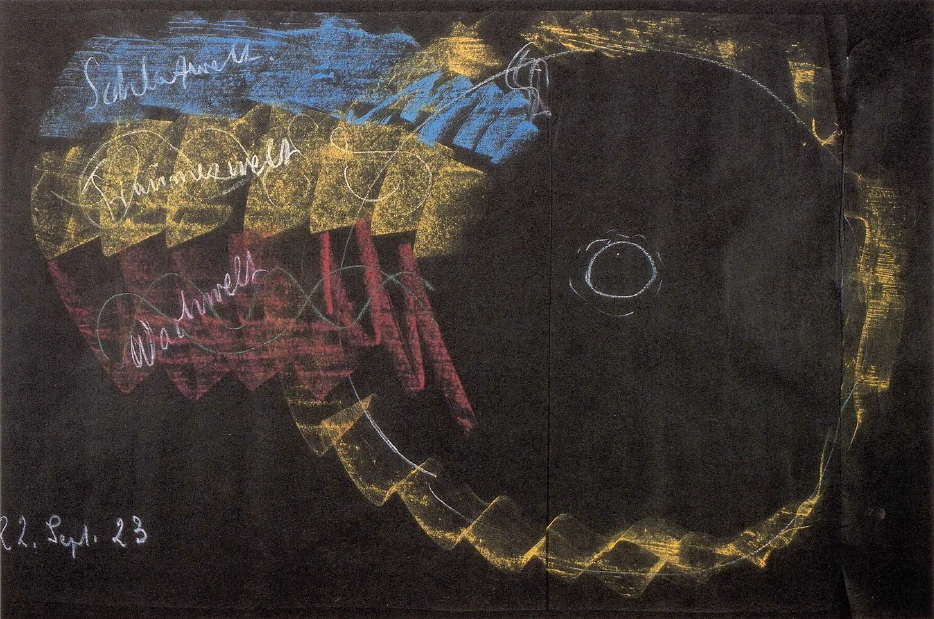
[ 38 ] It can be said that people once knew a great deal about such things, and traces of that knowledge have remained for later times, especially among thinkers who were able to concentrate quite well.
[ 39 ] One such naturalist—who, incidentally, lived not in the second but in the first half of the 19th century (he was Haeckel’s teacher)—was Johannes Müller. He was the kind of man who could truly concentrate at all times. He was completely absorbed in whatever he was doing at the moment. The fact that one can truly live this way—fully focused on whatever one is currently doing—sometimes leads to greater insights; though, as I will mention shortly, it may have its downsides in some respects. Johannes Müller, for example, was once asked about something during a summer course he was teaching. He replied: “That is something I only know during the winter lectures, not in the summer.” — He was so focused on the material for his summer lectures during the summer that he freely admitted he only knew the other things in the winter.
[ 40 ] But this Johannes Müller, for example, once admitted something very interesting: that he can dissect corpses for a very long time in an attempt to figure something out; he doesn’t figure it out—he doesn’t get to the heart of what he actually wants to understand. But sometimes he manages to dream about what he has experimented with, and then he sees much more deeply into the matter; then things become clear to him. — This was in the first half of the 19th century. Back then, someone could still afford such extravagances, even if he was a famous naturalist.
[ 41 ] So when a person dreams, they enter a completely different world, a world governed by entirely different laws. And upon careful consideration, one must assume that, in fact, if one were to do as Johannes Müller did—that is, not to think about the Orion Nebula as one does in observatories or astronomical institutions, but rather to dream about it—one would know more about it than by simply thinking about it. I would say that this is connected to the fact that in the age of shepherds, when shepherds slept out in the pastures at night, they actually dreamed about the stars, and in doing so they knew more than later generations do. It is truly true; that is how it is.
[ 42 ] In short, whether we venture into the inner world of the human being and approach the world of dreams, or whether we go out into the vast universe, we encounter—as the ancients said—a world of dreams beyond the zodiac.
[ 43 ] And here we are at the point where we can understand what the Greeks—who still knew something about such things—meant when they used the term “chaos.” I have read all sorts of explanations about chaos, but I have always found them to be far from the truth. For what did the Greeks mean when they spoke of chaos? They meant the order that one gets a sense of when one delves into a dream, or that one must assume exists at the very outer reaches of this universe. The Greeks attributed this order—which is not the order of nature, but a different one—to chaos. Yes, he said, chaos begins where the laws of nature can no longer be found, where a different order of laws prevails. For the Greeks, the world was born out of chaos—that is, out of a context that is not yet governed by the laws of nature, but is like a dream or, as is still the case today, the vastness of the cosmos, such as the constellation of Orion, the hunting dog, and so on. There, one first enters a world that at least still reveals itself to human beings in the fantastical yet vivid realm of dream images.
[ 44 ] Now, however, the fact is that while the physical, natural world lies here, we enter, as it were, into a second current as we immerse ourselves in dreams. But then we enter a third current that lies beyond the world of dreams, one that no longer has any direct connection to the laws of nature. The world of dreams, with its imagery, defies the laws of nature. In this third world, it would be completely nonsensical to say that it is governed by the laws of nature. It completely—even boldly—contradicts the laws of nature, for it also approaches human beings. While the dream still manifests itself in the living world of images, this third world first comes to light through the voice of conscience in the moral worldview.
[ 45 ] When you have the world of nature on one side and the world of morality on the other, there is no transition between them. But the transition lies in the world of dreams or in the world that the experimenter has experienced in the realm of magic, where things have revealed something entirely different to him than what the laws of nature dictate.
[ 46 ] For ordinary consciousness, the world of dreams lies between the world interwoven with the laws of nature and the world from which our conscience speaks to us as it flows into us. But this leads directly—because this is at once the waking world, that the dream world, and this the world of sleep—to the idea that, in fact, during sleep the gods speak to human beings about what is not natural but moral, which then remains with the person as the voice of God within, when they wake up, as conscience.
[ 47 ] In this way, the three worlds come together, and one comes to understand two things: on the one hand, why the world of dreams protests against the natural order, and on the other hand, to what extent this world of dreams is a transition to a world whose reality remains hidden from ordinary consciousness—the world from which moral views also originate.
[ 48 ] Once one finds oneself in this world, one discovers there the broader spiritual world, which can no longer be understood according to the laws of nature but rather according to the laws of the spirit; whereas in dreams, the laws of nature and the laws of the spirit intermingle in a colorful jumble—the laws of nature with the laws of the spirit, and the laws of the spirit with the laws of nature—because the dream world is a transitional current between the two worlds.
[ 49 ] In this way, we have examined from a different perspective how human beings are integrated into the three worlds.