Three Perspectives on Anthroposophy
Cultural Phenomena
from the Perspective of Spiritual Science
GA 225
23 September 1923, Dornach
Translated by Steiner Online Library
12. Jakob Böhme, Paracelsus, Swedenborg
[ 1 ] Our examination of the world of dreams, as we undertook it yesterday, has drawn our attention to how, at the very moment one enters from the world that lies before our senses—the world of natural laws—into another world, the natural laws actually cease to apply. I would say that they cease gradually; they cease little by little. In a dream, one can still clearly observe how, on the one hand, it is still governed by what is subject to the laws of nature, while on the other hand, moral and ethical relationships come into play in the dream; how the one is connected to the other in such a way that something is expressed within that context—such as, let us say, the moral value of the dreamer or the like. The dream is, in fact, a gentle transition from the physical-sensory world into entirely different worlds—worlds that then have absolutely nothing to do with the mere laws of nature.
[ 2 ] Now, however, through such ideas and sensations—which can be aroused by directing one’s soul toward the kinds of transitions found in dreams—one must bring about, I would say, a human understanding of the interconnections of the world, which otherwise would simply remain as unopened mysteries before the human soul. You will soon sense what I actually mean. After all, the intellectual conceptualization of these things matters very little indeed. What matters is gaining a wholly human understanding, establishing a human connection to the things with which human beings are inherently connected—connected throughout their entire lives and by virtue of their belonging to humanity. And it is impossible to say anything about certain aspects of life, or to imagine them, unless one has allowed one’s sensibilities, one’s feelings, to be touched by something like what was discussed yesterday regarding the dream. It is precisely on this coloring that the feelings acquire through this experience that these things depend. And that is why today I wish to build upon what was said yesterday about dreams and the remarkable statements of the experimental magician, focusing more specifically on phenomena of life that should actually be perceived as far greater mysteries than is usually the case. In connection with yesterday’s reflections, and from a certain point of view, we shall first consider those people who are collectively referred to as “somnambulists”—people who exhibit all manner of deviations in their lives, which, for my part, even go so far as to cause them to get out of bed at night, climb around on rooftops without falling, and so on, that is, those who are somnambulists.
[ 3 ] And second, I would like to discuss today—from a certain perspective—a phenomenon that we have already discussed on several occasions from other perspectives: a phenomenon such as that of Jakob Böhme or, if you will, Paracelsus. And third, in connection with this, I would like to discuss the phenomenon of Swedenborg. One could certainly say: In fact, humanity today has become indifferent to everything, because the kind of interest—which I would call “feuilletonistic”—has spread so immensely. Fundamentally, figures such as the somnambulists, Jakob Böhme, or Swedenborg should be gnawing at people’s souls, for they are, after all, entirely different kinds of human figures introduced into human life than ordinary citizens are.
[ 4 ] Let us now try to understand such phenomena. Let’s take the ordinary somnambulists. You know, of course, that in a certain way what they represent is connected to the manifestations of the Moon. We have been discussing this very recently—and that is why this belongs in the context of the Moon’s significance in the universe. I have told you that those beings who were once on Earth and brought primordial wisdom to humanity—wisdom that has gradually faded away, but which we find when we look back through history—that these beings have withdrawn to the Moon, as it were, into a kind of cosmic colony, and that they inhabit the Moon from within. It is indeed the case that only the last remnants of what is characteristic of these beings have remained on Earth in a coarsened form. People were quite different back then, when these present-day lunar beings were still on Earth as the great teachers or guides of humanity.
[ 5 ] What these beings left behind on Earth are physical phenomena—the facts of reproductive life. These facts of reproductive life, in their present form, did not exist on Earth during the time when these beings imparted primordial wisdom to humankind. It is much like when you dissolve a substance in a liquid: the liquid may appear completely clear and uniform, but if the substance settles as a sediment, then the substance is coarse and the liquid is even finer than it was before—that is roughly what I mean here. What exists today on Earth as reproductive life is coarse in comparison to what it once was. And what these beings took with them into the lunar sphere has been infinitely refined; it has become infinitely more spiritual. But both belong together, yet both are differentiated from one another. And what the Moon truly exerts as a force upon the Earth—what still acts upon the Earth today as the Moon’s force—is, as I told you back then when I discussed the Moon’s position in the cosmos, that the Moon actually reflects back everything that exists in the cosmos, not merely the light of the Sun, but truly everything. So we have a twofold aspect to the Moon: the inner part of the Moon, which at present does not project outward at all but has closed itself off and been given a different cosmic task, and that which is reflected back from it.
[ 6 ] Now, with regard to his physical body, man is subject to the most prominent earthly force, gravity—whether he is moving or, for that matter, sitting. After all, it is always gravity to which he appeals. If his physical body were not subject to gravity, he simply would not have these various positions of equilibrium when walking, sitting, standing, and so on.
[ 7 ] But with his etheric body, the human being is not so much subject to the force of the Earth as to the force of the Moon. He is subject to this force, which is reflected back from the cosmos, and it draws him outward. While Earth’s gravity pulls him downward, this lunar force draws him out into the cosmos. And this lunar force becomes temporarily dominant in somnambulistic personalities. For moments, the lunar force overcomes the Earth’s force, and these personalities behave as if they had only an etheric body with which they can freely follow the lunar force. They drag their physical bodies along with them, climbing—as I said—in the most daring ways that only the etheric body can manage, ways the physical body simply cannot, yet the physical body is swept along in such moments. So it is essentially, I would say, an irruption of special lunar influences that occur in these somnambulistic personalities.
[ 8 ] But now we must ask further, for everything is part of the great cosmic context, which ultimately traces back to beings alone. For the phenomena outside of beings are merely an illusion; only the beings in the universe are truly real. Thus, the beings in the mineral kingdom, the plant kingdom, and the animal kingdom are truly real; human beings, the angels, the archangels, and so on are truly real. These are the realities; individualized beings—these are the realities. The other is something that takes place between beings; the other is, after all, an illusion, not reality. So when we speak of realities, we are dealing precisely with beings.
[ 9 ] The question now is this: when such beings—that is, individualized human beings, or somnambulists—appear, how does the phenomenon of such somnambulists fit into the entire universe? How is it possible, in the context of the universe, that somnambulists exist at all?
[ 10 ] Now, you really must grasp what I am about to say not in a logical, intellectual context, but rather in an emotional context, for that is the true logic in this field. Let this idea permeate your feelings: that one must—I would say—move beyond the world of natural laws and the currents of the dreamlike realm into entirely different worlds, where natural laws no longer apply but where other relationships prevail. Try to truly feel your way into this, and then you will also sense that one can speak of: What is the situation, then, for such people who, in some earthly life, act as somnambulists—with regard to what is not earthly life, let us say, in pre-earthly existence or in post-earthly existence?
[ 11 ] Isn’t it true that such somnambulists—we could, of course, point out all the shortcomings and dark sides of the somnambulist nature, and even include the mediumistic aspect in that, but you already know all of that, or at least you can know it—such somnambulists are, after all, different from the average person. They behave differently in life, they present themselves differently—they are, after all, different. Well, if they are different in earthly life, then one would have to ask—if one can, so to speak, step so tangibly beyond the dream into the spiritual world with its sensations—whether they might also be different in the adjacent extraterrestrial life, in pre-earthly existence. What are they like there?
[ 12 ] You see, such beings—who are somnambulists during their earthly incarnation—reveal that in their pre-earthly existence they were, in fact, extraordinarily hostile toward everything spiritual in the spiritual world.
[ 13 ] If, using the methods that already exist—and which I have often spoken to you about—one investigates a somnambulist to find out what their pre-earthly existence was like—since the French course, we have often spoken of this pre-earthly existence, including its concrete details—if, then, one investigates: What were such somnambulists like before they descended into their earthly existence? — As grotesque as it may seem, it must be said: They were completely out of place in their pre-earthly existence—but in their pre-earthly existence in the spiritual world, they were materialists.
[ 14 ] Of course, people there are not so materialistic that they formulate theoretical views on materialism. After all, one moves initially in the world of sympathies and antipathies; not in the world of concepts and judgments, but in the world of sympathies and antipathies. These somnambulists lived in the spiritual world, but most of what they experienced there was unsympathetic to them. Everywhere, whatever approached them in the spiritual realm appeared to them in such a way that, in a certain sense, they actually hated it. And as a result, when they descended into earthly existence, they were unable to properly anchor their astral body within themselves. One must, after all, consolidate the astral body when descending into earthly life. This consolidation suffers because these beings have constantly absorbed these forces of antipathy toward the spiritual. And this then gives rise to what I would call cosmically directed karma: that these beings, in their earthly life—by virtue of having a physical body—must be connected to this physical body in the same way that only a not fully consolidated astral body can be connected to the physical body.
[ 15 ] Now I have also explained to you how, upon descending back to Earth, one passes through the lunar sphere and how one absorbs the lunar forces into oneself. Such beings lack sufficient independence from the lunar forces. They are simply not sufficiently consolidated within themselves; therefore, a connection to the lunar forces remains within them when they take on their physical body. The consequence of this is that such beings actually pay less attention to their physical body than the average person pays to their own. And it is precisely this—their continued subjection to the lunar sphere—that serves as the educational means within the overall world plan to wean these people of their hostile attitude toward the spiritual. Thus, in the case of those afflicted by the moon, we are dealing with people who, in this earthly life—precisely because they are afflicted by the moon—are to be educated to overcome their hostility toward the spiritual. Because they do not fully grasp the physical body, they experience the spiritual on Earth, even though they themselves have not sufficiently experienced the spiritual in the spiritual world.
[ 16 ] The average person is now firmly bound within his physical body—today much more firmly than is in any way desirable for the welfare of humanity; he is terribly bound within it. But somnambulists pay very little attention to this physical body. Therefore, there may be moments—under certain circumstances—when they are more attuned to the forces of the moon than to those of the earth.
[ 17 ] Let us now move from these figures to one who, I would say, stood out in a certain way—such as Jakob Böhme or Paracelsus. Such figures do, however, appear in history in a less grandiose manner—not in the present day, but it was not so long ago that such figures existed; I would say there have always been, to a greater or lesser extent, “little Jakob Böhmes.” Until just a few decades ago, one could still find such “little Jakob Böhmes”—these individuals who, when viewed from the outside in everyday life, are distinguished by the fact that they perceive nature in a different way than the average person does.
[ 18 ] Consider a characteristic trait of Jakob Böhme. The essence of his entire human character was already evident in his youth. Consider this characteristic episode: He is tending animals like everyone else when he suddenly feels the urge to leave the animals, the herd, and the others who are there, and to go to a place high up in the mountains. Driven by instinct, he looks closely at one spot in particular. There he finds a hole in the ground; the earth is open there. He looks down and finds a treasure down there. It glitters up at him. He is struck by this sight, but he walks away in contemplation. It does not even occur to him to take anything from it. He went back there many times afterward to look again. The hole was no longer there; the treasure must have been covered up, and so on. He should have thoroughly convinced himself that what he had seen there did not exist in the physical world, but given his entire mental constitution, it naturally never occurred to him to believe that he had not, in fact, seen something.
[ 19 ] This is how the foundation was laid within him for what would later emerge as his distinctive way of thinking: to look deeply into the boundary processes of things, into the very essence of things. Anyone who reads Jakob Böhme’s writings with even a little understanding will notice: This man viewed salt and sulfur differently than even a typical chemist of that time would have, of course. He speaks from entirely different insights. He even speaks from insights that are not entirely familiar even to himself, to the extent that language does not always capture what he perceives; for his language is indeed sometimes convoluted and chaotic, and one must immerse oneself in it if one wishes to grasp what this Jakob Böhme actually perceived.
[ 20 ] Now, to help you understand the whole phenomenon of Jakob Böhme, I would like to remind you of what I told you about the Druids. Through their cromlechs, they dimmed the physical sunlight, looked into the shadows, and in the shadows they saw the spiritual light radiating from the sun. For other people, the shadow is simply a shadow—it is not light; it is something negative. For the Druids, however, it was something very real. And to them, the shadow differed not only in its direction—depending on whether it appeared in March or October—but also in its inner quality, its coloration, its hue, and especially in the spiritual essence it contained. If one were to push back the physical rays of the sun, so to speak, then it is precisely in the shadow that the spiritual essence radiated by the sun appears. But for Jakob Böhme, this was what flowed from his entire human being. He could—if he gave himself an inner jolt, so to speak, in a certain direction—it is a crude way of putting it, but that is how it was—if he gave himself an inner jolt, then he could extinguish the physical sunlight, and he actually saw into the darkness.
[ 21 ] And what happens when you look through something where you’re not, so to speak, following the light, but where you have something like a boundary in front of you? Something like a mirror emerges. But if, let’s say, you look that way—I’m drawing the physical eye, but it doesn’t really depend on the physical eye—light is everywhere. Well, then you simply see physical things. But if you can extinguish this physical sunlight through your own power, then what actually occurs behind you is looking into the darkness. You don’t even need the shadow; the act of looking into the darkness occurs. But when this looking into the darkness occurs, it acts like a mirror. And because Jakob Böhme was able to look in this way, he saw things reflected as if in darkness, and they reflected back to his soul’s eye what they possessed inwardly and spiritually. Thus, when he attuned himself to them—especially the characteristic objects he speaks of, such as salt, sulfur, mercury, and so on—he did not see them as one sees them under ordinary circumstances, but rather he saw their essence, that which underlies them spiritually, reflected in the darkness.
[ 22 ] That was the unique nature of his perception: he saw what lies at the spiritual core of things, reflected in the darkness. He saw them in the radiance of the sun’s effects, though the physical effects of light and heat were excluded. While somnambulists project their will into the effects of the moon and, by being less subject to earthly gravity for a few moments, are more exposed to the effects of the moon—in other words, while ordinary somnambulists follow the effects of the moon more with their organs of will—Böhme was able to follow the effects of the sun with his organ of knowledge; he was thus a “sun-person,” in a sense a “sun-addict” in contrast to the “moon-addicts.” And in such people—of whom Jakob Böhme was a particularly striking example—we again find human individualities who, through a special relationship to the spiritual, stand out from ordinary humanity: “sun-people.”
[ 23 ] Once again, we must ask about these “solar beings”: What were they like in their pre-earthly existence? Yes, you see, the pre-earthly existence of such people is actually extraordinarily interesting. I have often reminded you how, in the early stages of human development, people actually always looked back on their pre-earthly existence. Something arose in their consciousness that gave them something like a memory of their pre-earthly existence. They knew: I have descended from the spiritual worlds into the earthly world.
[ 24 ] Something like this—not a personal looking back, but a looking back at the way one perceived things in the spiritual world before earthly existence—emerged in an atavistic manner in Jakob Böhme and Paracelsus. As a result, such people have a closer connection to the elemental spirits of nature than to what natural objects outwardly present on their surface. They perceive more of the spiritual beings that dwell within nature. For what we call sulfur on Earth, for example, is not perceived in pre-earthly existence; but—if I may put it this way—the elemental spirit underlying sulfur is perceived. It is this that is perceived in pre-earthly existence.
[ 25 ] Yellow sulfur or sulfur of any other color—this concept does not exist in pre-earthly existence. In pre-earthly existence, there is not even a concept of the “sulfur” that people on Earth speak of. There is simply nothing of physical sulfur, but there is certainly a concept in pre-earthly existence of the spiritual substance of a completely different nature—the spiritual essences that underlie sulfur. It is precisely these that people like Jakob Böhme and Paracelsus bring with them.
[ 26 ] This is precisely what gives them the power to block out physical sunlight and, in physical darkness—I cannot say that they see the spiritual effects of the sun, for just as one does not see the light or its color, so too one does not see the spiritual effects of the sun—with a vision, I would say, that breaks through this physical darkness, but in a state of spiritual elevation that then precisely reflects the spiritual present in natural beings and natural forces. |
[ 27 ] And when it comes down to it, the truth is this: If it weren’t for the occasional people who provide such inspiration—the channels through which such inspiration enters humanity are usually overlooked—people would know very little about nature at all, for this inspiration is essential even for the most abstract knowledge of nature. Others are the ones who then translate all of this into intellectual terms. But this insight into the living essence of nature comes precisely from such “sun-people.”
[ 28 ] You see, as the 19th century drew nearer, it became increasingly difficult to even express such things in the world. Most of you are familiar with the biography of Jakob Böhme. You know how he was persecuted. If he had appeared in the last third of the 19th century—or if someone like Jakob Böhme, especially with the particular way Jakob Böhme spoke, had appeared in the last third of the 19th century—he would probably have been locked up in a mental asylum. He would have fared even worse than he did in his own time, but it was already difficult to speak out back then. After all, Jakob Böhme was still able, in a certain sense, to experience the benefits of that era, and one such benefit was, for example, that he was not subjected to the kind of treatment we are forced to endure even in schools today. After all, school education—elementary school education—was not very advanced back then. Please do not think that I am speaking out against elementary school education now, but it must be said: things must also be judged from a different perspective. Perhaps not many of you have lived in places where a retired shoemaker happened to be the teacher. In such places, even in the days when people of today were still young, the children did not learn all that much of the “wisdom” they are taught now; they remained much more unspoiled. But what one is exposed to in today’s standard school system not only shapes something but also kills something. Jakob Böhme had the good fortune of not yet having been subjected to such a school education, and therefore what was within him as a “sun-man” was able to push its way to the surface.
[ 29 ] Yes, it’s already there within a person; but sometimes it has to come out in a completely different way. I could cite several compositions from the last third of the 19th century in which I could show you how people—because they had gone through the school system of the late 19th century—naturally could not speak like Jakob Böhme—but in some musical compositions it does come through after all. There is also a similar underlying tone and mood as in the writings of Jakob Böhme. It breaks through somewhere, especially in music, but not in what has reached the highest levels. Don’t think that I would have to mention a Wagnerian composition—nor, of course, Hansel and Gretel—when I tell you these things. I would have to name entirely different compositions. But there are such musical achievements where something like this breaks through. Well, as I said, it is precisely such impulses—which are then realized—that have a certain significance for earthly life.
[ 30 ] Now we can consider the third type, which emerged so characteristically in Swedenborg. Swedenborg does indeed present a rather peculiar picture when one considers the outward appearances. Swedenborg had already reached his forties during his earthly life; by then he was a recognized great scholar of his time, having mastered the entire body of knowledge of his era—as much as it was even possible to master it at that time. Some of his works have been published. But there is an immense number of manuscripts that were written entirely within the framework of the scholarship of that time, so deeply rooted in the scholarship of that era—they remained manuscripts —that, some time ago, a Swedish society of the country’s leading scholars was formed to publish these works by Swedenborg, which he wrote in the spirit of conventional science well into his forties.
[ 31 ] But then something like this starts to happen with Swedenborg, where people say: That’s when he went crazy. He just went crazy! — His works are published as those of one of the greatest men of his time, and it’s said that no single person is capable of publishing them; rather, today entire academies are needed to make Swedenborg’s work—up to his forty-fourth year or so—accessible to the world. No one cares about what came afterward! But it is significant that Swedenborg lived, up to a certain age, within the intellectual, even scholarly, education of his time—which was already quite intellectualistic back then—and that a certain spiritual insight then suddenly dawned upon him.
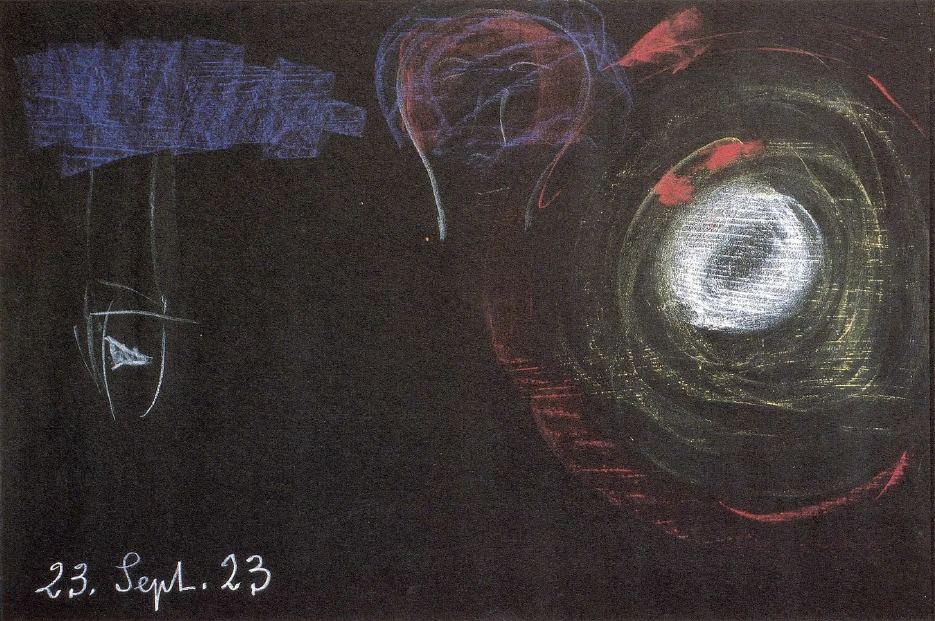
[ 32 ] Such a spiritual insight, as it appeared specifically in Swedenborg, has very distinctive characteristics. It is as follows: When you imagine a human being and what a human being has as a brain, for the average person the etheric body fills the brain in a certain way. What I have indicated here in red would be the physical brain. The etheric body fills the physical brain and extends slightly beyond it.
[ 33 ] Well, Swedenborg had developed his etheric body in such a normal, proper—I might even say conventional—way, and his brain and mental constitution in such a normal way, right up into his forties. Then a force came over him that contracted this etheric body somewhat—not, of course, beneath the skin, but contracted it, drew it inward, so that it became denser and, as a result, more independent of the brain, while still retaining all its intelligence. For it is not true that he became more foolish then; he was just as intelligent as before.
[ 34 ] When one walks around as a somnambulist, one’s astral body is in such a state that it is very strongly subject to the power of the moon. The organs of the will then often attune themselves to the lunar force. If one is like Jakob Böhme, then the faculty of cognition is directed toward the solar forces, repelling the physical effects of the sun. If one becomes like Swedenborg, when such a contraction of the etheric body takes place, the force that brings this about is the Saturn force—that force of Saturn—which, as I recently described to you in cosmic terms, actually embodies something like a kind of inner essence of our entire planetary system; one might also say that Saturn contains the forces of memory of our planetary system. What had passed over into Swedenborg was precisely this Saturn force, this inner essence of the entire planetary system. This enabled him to see things in the kinds of visions he has just described. He saw angels, archangels, and interactions between angels and archangels, just as he has described. But what was that, actually? What did he enter into through this contraction of the etheric body of his head? He did not arrive at seeing, for example, the actual events within the hierarchies. You must imagine what he saw in this way: If the Earth is here, then let us draw the etheric sphere of the Earth. This sphere now extends out into the cosmic expanses, about which I told you yesterday that we would encounter the Orion Nebula and so on there, and that there is a regularity there—not a natural law, but a regularity such as exists in a dream. Only where space would end would we encounter the events within the hierarchies. Swedenborg did not see into that realm with his visionary powers, but all the processes that actually take place outside the etheric sphere are not merely reflected in the ether; rather, they evoke—I would say—real image-processes in the ether. So that up there in the hierarchies, something is taking place that would have to be described quite differently, but which exerts an influence into the Earth’s etheric sphere, so that the etheric forms act within the Earth’s ether. Beings are active all around us; these are not the actual angels, but rather the etheric beings—beings formed out of the ether—who now carry out their actions in a way that is comprehensible to human beings.
[ 35 ] These—one cannot call them reflections, but perhaps “real reflections”—these real reflections of the higher hierarchies in the earthly ether were what Swedenborg saw. So he did not see what the angels were doing, but he saw what one can see when, up there, one has the angels’ deeds—not seeing them as such, but rather what is taking place down here in the earthly ether within the sphere of human beings. What the angels do up there cannot, of course, have a direct effect on people on earth; it is precisely these real reflections that then have an effect among human beings. The reflections in the ether—which have an effect among human beings—move about among us. Swedenborg saw these; they caught his attention.
[ 36 ] So if those people we call “moonstruck” prompt us, above all else, to look toward their pre-earthly existence, and if, in the case of people like Jakob Böhme or Paracelsus, we look toward their present earthly existence, then we have every reason, in the case of people like Swedenborg, to look toward the post-earthly existence. Earthly existence actually only gains meaning when we look toward life after death. For it is primarily these individuals who, even after death, are still able to exert a instructive influence on others who have passed through the gate of death, telling them much of what must remain incomprehensible in the higher worlds unless one has already become acquainted with something of the higher worlds in the earthly world.
[ 37 ] And one might say: It is part of the general spiritual plan of the worlds that human personalities of the kind represented by Swedenborg are introduced here on Earth to the “real shadows”—the real reflections of the events in the higher hierarchies—so that they may then ascend there well-prepared, because they will need this precisely in their post-earthly existence. While for somnambulists, their earthly existence—precisely because they are somnambulists—has something of the character of a reformatory in relation to the spiritual worlds, the life of personalities such as Swedenborg serves as preparation for the tasks they must accomplish after death. And so we can already say: Human beings differ in their individualities, and it is precisely in those who are very different from the others that we can see how human beings can be understood at all—not only by considering their relationship to the earthly environment, but by recognizing that at every moment of their lives they also have a relationship to the spiritual worlds, even here in earthly existence. Everything that happens here in earthly existence—even in the case of people in whom “it manifests itself so strikingly, as with Böhme and the others”—is related to pre-earthly existence, to the spirit that also lives in earthly existence, or to post-earthly existence. It is only in these particular types—somnambulists, the Jakob Böhme type, the Swedenborg type—that we strongly perceive what is present to some extent in every human being: an alignment, an orientation of earthly existence toward pre-earthly existence, or toward simultaneous earthly-spiritual existence, or toward post-earthly spiritual existence. In particular, those beings who—I might say—behave in the cosmos as I described to you back then—that is, the lunar beings, solar beings, and Saturnian beings—require, in order to carry out their tasks, the forces at work within certain individuals.
[ 38 ] And here—let me just mention this at the end of these reflections—a new perspective may open up for us. I will speak about what this perspective reveals when I give my next lecture here. But a very specific perspective may indeed open up for us. We really must consider that the human inner being—even the physical human inner being, the ordinary physical human inner being that lies within the human skin—actually falls outside of what we usually call the cosmos.
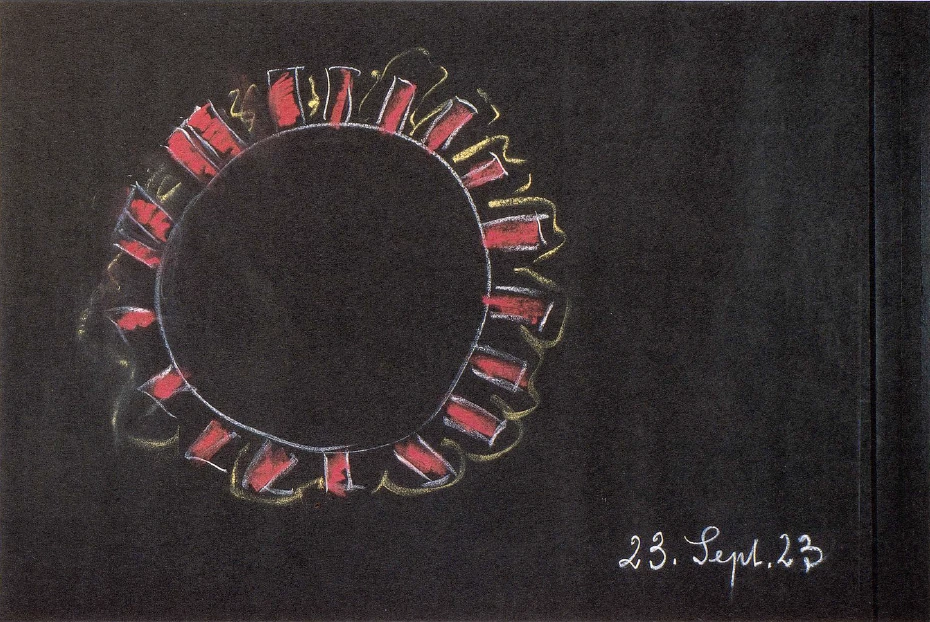
[ 39 ] Roughly speaking, we can say something like this: If we have the Earth here, then the mineral, plant, animal, and physical-human phenomena occur on it, and so on; and thus what takes place here is what can be observed with the senses and comprehended by the intellect. So there are people on this Earth. But within people there is also a world; it is not the same world as the one outside. I could illustrate this by drawing many people schematically, always depicting their inner selves. What goes on inside people—let’s call that the red—and the white surrounding it would then represent the natural phenomena that can be perceived by the senses, and so on. Now, of course, one can make an abstraction. Imagine: I’m now erasing all natural phenomena; I’m leaving only the red; I’m erasing everything so that only the inner world of human beings remains, and everything else is gone. So imagine, I were to first remove all minerals from the Earth, remove all plants, and remove all animals—everything else that constitutes natural phenomena—but if you remove the three kingdoms of nature, then everything is already gone—and then remove the skins as well, so that you no longer have the physical skin, but not only the skins, but also all the physical matter within you. I would take all of that away, and then something would remain of the entire globe: these are divine forces. We would still have the hierarchies within it—Angels, Archangels, and so on. Only then would we have truly removed the Earth and preserved Heaven.
[ 40 ] And if you follow this feeling, you will come to understand how to properly attune your inner being to the truly spiritual, supersensible world and to envision in a comprehensive way what one might call heaven. It is actually within the human being, in what remains when everything I have described is gone.
[ 41 ] When one describes somnambulists, Jakob Böhme, and Swedenborg in the way I have described today, who is one actually talking about? Then one is not standing on Earth, but is standing within the cosmos. It is necessary in our time that we no longer, as has been done in recent centuries, talk about human beings as if they were merely a combination of the laws of nature and natural phenomena that exist outside of us; rather, we must now turn our attention to what would remain if we were to remove all of that—I do not wish to repeat that gruesome image again— if one were to remove all that I have just mentioned—and leave only the inner being of the human being—then one would not merely arrive at the spiritual world in a general, vague, abstract-pantheistic sense, but one would arrive at the concrete spiritual world of the supersensible beings. These beings have their dwellings within human beings. And humanity must gradually become aware once again that the human body is indeed the dwelling place of the gods.
[ 42 ] Only when this is incorporated into our sense of time will the right ingredient be present in that sense of time, enabling culture to rise rather than decline. This is a truth that can be expressed from a wide variety of perspectives. Today I wanted to present it to you as a follow-up to what I said yesterday about dreams and today about these so-called abnormal states of the soul.