

Insight from Initiation
GA 227
27 August 1923, Penmaenmawr
Translated by Steiner Online Library
Experiences Between Death and a New Birth
[ 1 ] Yesterday I began by outlining human sleep experiences, which are, in a sense, foreshadowings of experiences after death. These experiences, which a person undergoes during sleep, lie entirely beyond the so-called threshold that we have mentioned so often these days. And what I am about to describe are real experiences that every human being has during sleep, except that, as experiences during earthly life, they do not rise into ordinary consciousness but only into the imagination, inspiration, and intuition. But we must by no means believe that these experiences—even though they do not enter consciousness—do not exist. They are there. A person goes through them. It is, if I may use an analogy, as if a person were being led through a room while blindfolded: they do not see things, but they must walk, must make the effort to walk; they can experience all sorts of things in the room that they simply do not see. In a sense, this is what I am about to describe regarding the time between falling asleep and waking up: for consciousness, it is shrouded in darkness because consciousness is blind to it. But, as I said, it is certainly lived through and experienced by the person, and the effects of what is experienced during sleep certainly manifest themselves during waking life. Thus, we can only truly understand what a person goes through from waking until falling asleep if we view it as an interplay between what arises as the aftereffects of the previous sleep and what then takes place through the physical body and the etheric body during the day.
[ 2 ] When a person falls asleep, a kind of vague fear first comes over them. This fear is not brought up into consciousness in ordinary earthly life, nor is it imagined, but it exists as a process in the human astral body and in the human “I,” and a person certainly carries the consequences of this fear from sleep into the waking state. If they did not carry this anxiety over with them, if this anxiety did not act as a force during waking life in the physical and etheric bodies, then the person would not be able to maintain their physical constitution—to maintain it in such a way that, for example, it secretes salts and similar substances properly. The secretion that is necessary for the organism is entirely an effect of subconscious anxiety during sleep. Thus, when we fall asleep, we first enter a sphere—I would say—of anxiety.
[ 3 ] Then a state of mind sets in that is like a constant oscillation back and forth between a state of inner calm and a state of inner unrest—an oscillation such that, were a person to consciously experience this state at every moment, they might believe that they were sinking into a kind of powerlessness and then awakening from it again. In other words, a swinging back and forth between holding oneself together and being powerless—that is what permeates anxiety.
[ 4 ] And the third is the feeling of standing on the edge of an abyss, of having no ground beneath your feet, and of being able to sink at any moment.
[ 5 ] You see that even here, at the very moment when a person falls asleep, things begin to rise out of the physical realm and plunge into the moral realm within the universe. For the second state into which we enter when we sleep can really only be understood if we acknowledge cosmic-moral laws just as we acknowledge the natural laws that otherwise operate on Earth—if we perceive them with the same certainty with which we say that a stone falls to the ground or that a steam engine is propelled forward by steam—if we perceive them with the same sense of reality. Yet in his present earthly life—precisely because he possesses only a certain degree of strength in this life—humanity is protected by the benevolent guidance of the universe from experiencing, even now in this earthly existence and with full consciousness, what he actually undergoes unconsciously every night.
[ 6 ] It is simply the way of the cosmos that even those things that shine upon us with the utmost beauty, in the most magnificent splendor, must be founded on pain, suffering, and deprivation; and, in a sense, behind everything that appears beautiful in the foreground lie pain and deprivation. This is as necessary in the universe as it is necessary, when we draw a triangle, for the sum of its angles to be 180 degrees. And anyone who asks the question in response—Why did the gods not arrange the cosmos so that it appears solely for human pleasure?—is actually naive. Existence itself brings about necessities. This was already sensed, for example, within the Egyptian mystery teachings, which referred to the conscious perception of what occurred during sleep—the fear of oscillating between self-control and powerlessness, of standing on the brink of the abyss—as the world of the three iron necessities. The Egyptian mystery teachings, which—drawing on ancient, instinctive clairvoyant arts—still knew of such things, therefore stated: When a person consciously enters the world into which they unconsciously enter every night during sleep, they must be immersed in the sphere of the three ironclad necessities.
[ 7 ] What a person experiences there in turn unconsciously gives rise within them to a deep longing—a longing for the Divine—which they then experience as filling, permeating, and penetrating the entire cosmos as they now perceive it, for the cosmos itself dissolves into a kind of floating, weaving, moving cloud-like formations—one might say—in which one lives, in which one could feel alive at every moment, but just as easily could be lost at any moment in all this weaving and life. There, the human being feels his or her interwoven-ness with the Divine that weaves through, ripples through, and moves through the world. And that pantheistic sense of God, which arises in every healthy person during waking daily life, is an aftereffect, a consequence of what is unconsciously experienced in sleep as this pantheistic sense of God. And there, in fact, a person feels their soul filled with an inner, unconscious conviction—one might say born of fear and powerlessness—but at the same time with that which gives them an inner center of gravity in place of the external center of gravity of physical effects.
[ 8 ] Within the Rosicrucian esoteric teachings, what befalls a person when they enter the sphere of the three iron necessities was articulated. It was explained to the students what they actually experience immediately after falling asleep. They were made aware of the following: There, your daily experiences sink into moving, yet ethereal, floating cloud formations that reveal the essence of things. You yourselves become interwoven with these cloud formations, standing within them above an abyss, in a state of fear and potential powerlessness. But you have found that which you must now bring to your consciousness in three words, words that are to permeate your entire soul: Ex Deo nascimur.
[ 9 ] This “Ex Deo nascimur,” which remains undefined in ordinary consciousness but is brought into consciousness by the initiates of the new mysteries, is what a person first experiences when they pass from the waking state into the sleeping state.
[ 10 ] As these lectures proceed, we will see how this Ex Deo nascimur simultaneously plays a historical role in the development of humanity. However, the role I am describing to you here is the personal, individual one that it plays in the life of every single human being here on Earth.
[ 11 ] When a person continues to sleep, the first thing that happens is that the familiar view of the cosmos that they have here on Earth ceases; while a person standing here on Earth sees the stars shining and glowing down at night, sees the moon, and during the day sees the sun, whose effects are perceived by the senses—at a certain point during sleep, they see this entire world of stars as if it were disappearing. The stars cease to be physical entities. But where the stars were physical entities to the senses, the star spirits—the spirits of the stars, the gods of the stars—emerge, as it were, from the starlight—the starlight itself disappears. And the cosmos transforms into that which is then perceptible to conscious inspiration—into a speaking universe, a universe that reveals itself through the music of the spheres and through the Word of the World. Spirit-living beings constitute the cosmos, in place of the sensory cosmos that can be seen here from the Earth’s perspective.
[ 12 ] Here, a person passes through in such a way that, if they could bring what they are experiencing to consciousness, they would indeed feel as if the world were passing judgment on them—as a human being shaped by their good and evil deeds—from every corner of the spiritual realm. In this way, a person also feels at one with the cosmos in terms of their human worth.
[ 13 ] But at first, what comes over him—if he could experience it consciously, as inspiration experiences it, he would realize this—is confusing. Human beings need a guide. In the present age of human development, this guide steps forward when a person, in this earthly life, has woven connections in their soul and in their heart to the Mystery of Golgotha; when, within this earthly life, they have established a relationship with the Christ who, as Jesus, passed through the Mystery of Golgotha. And the feeling that seizes people in the present age—I will speak tomorrow about the feelings that have seized people in other ages— the feeling that grips people in the present age is that their bewildered soul would have to dissolve into the sphere they are now entering, were it not for the Christ-being—who has taken root in their thoughts, feelings, and heartfelt impulses—to serve as their guide in this sphere.
[ 14 ] And it is also the case that the sense of Christ’s approach—who becomes the guide, and whom one must imagine in this sphere as being just as intimately connected to the life of the Sun as human beings themselves are to life on Earth—that this approach of Christ is perceived in the same way that a medieval school, a medieval mystery school, once brought it vividly before the souls of its students in the words: In Christo morimur. For it is the feeling that the soul would have to die first if it did not die in Christ, and thereby the death of the soul would become cosmic life for it.
[ 15 ] And so a person drifts into sleep and lives through it. And because they have perceived the cosmic stars as beings, because they were in this unfamiliar environment, a longing now arises within them—since they cannot awaken with consciousness in this sphere—to return once more to the sphere of consciousness. That is the reason for waking up. That is the force that causes us to wake up. And one has the sensation—which, again, does not reach consciousness—that through what one has drawn from the stars, actually from the star beings, the star gods, one does not awaken spiritless, but rather brings the spirit that dwells in the soul with one into the physical existence of the day.
[ 16 ] This feeling, which constitutes the third link in the chain of nocturnal experiences in a person’s personal life on Earth, was in turn brought to the students’ awareness in a medieval mystery school through the third saying: Per Spiritum Sanctum reviviscimus.
[ 17 ] Thus, this threefold experience of the spiritual world beyond the Keeper of the Threshold—which is simply ignored by modern humanity—can be understood as three steps that simultaneously imprint upon the human soul what can truly be called the Trinity, which is the spiritual
[ 18 ] Life is permeated, interwoven, and lived through. What I have described to you here is what a person experiences every night in a dream. And the experiences they have gone through during the day are woven into this dream, moving backward in time. Just as we find our experiences here on Earth interwoven into the events of natural processes during our waking hours on Earth, so too, during this backward reliving at night, we find what we are re-enacting—moving backward—interwoven into the memories of the world of the stars. But all of this is, for the time being, a vision.
[ 19 ] It can only be realized after a person has passed through the gate of death. Here on this earth, experienced in retrospect, it is a vision. It is realized when, after three or four days, we have completed that retrospective review I described yesterday and now enter the spiritual world in reality—not merely as an image, as happens every night.
[ 20 ] If one wishes to truly and comprehensively bring to mind the processes that a human being consciously experiences after passing through the gate of death, one must take the following into account. The gods—that is, the spiritual beings we encounter—I would say from the transformed, metamorphosed stars—live in a completely different cosmic direction than we earthlings do during our earthly existence. In saying this, I am stating a very significant truth about the spiritual worlds—a truth that is usually overlooked, even when discussions of the spiritual worlds are more theoretical and less concrete. We earthly human beings, during our earthly existence and when we are conscious, possess a physical body and an etheric body. These physical and etheric bodies are structured in such a way that our experience unfolds from the earlier to the later, meaning that we are thus situated within a certain flow of time. I will indicate this flow with a red arrow (see diagram a). This is the characteristic of our physical and etheric bodies: they have this direction in the cosmos (red arrow from left to right). If this (see diagram b) is our physical body (red circle) and this is our etheric body (yellow circle), then the physical body and the etheric body move in this direction (arrow b from left to right). And our entire experience of the world, insofar as we are human beings, takes place in this direction.
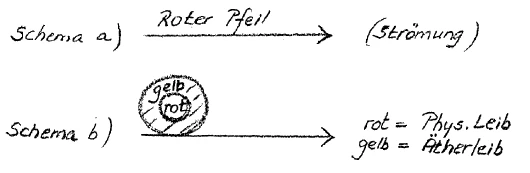
[ 21 ] The beings we encounter as we ascend into existence between death and a new birth—where we experience what we experience here in images during sleep—move in the opposite direction. They are constantly coming toward us. So, in relation to what we call “time” in earthly life, we must say: The gods possess spiritual bodies—or, for my part, bodies of light—with which, however, they move from the most distant future toward the past. Thus, the gods move in this direction (arrow from right to left, Diagram C).
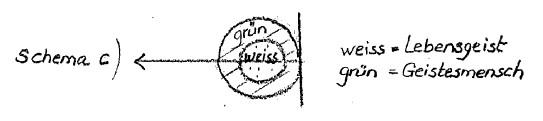
[ 22 ] And when we enter the period we spend between death and a new birth, just as we take on our physical body here on Earth from physical substances, so too do we take on divine bodies as we pass through the time between death and a new birth. There we clothe ourselves in the divine bodies; there we clothe ourselves in the divine body of that which I have called in my Theosophy the “spiritual human being” and the “spirit of life.” Thus, as we ourselves pass through the gate of death, we don a Life Spirit (white) and a Spiritual Man (green), but thereby take the opposite direction in the cosmos and, after death, initially relive our lives back to the birth, or rather, to the moment of conception.
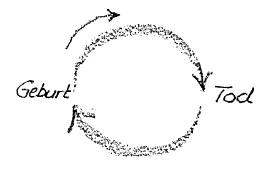
[ 23 ] So, in our life here on Earth, we have come from birth or conception—if I were to draw a circle to illustrate this— we have moved in this direction during our earthly existence (upper half of the circle) and, after our earthly existence, we return in this direction (lower half of the circle) to the place of our temporal birth or conception. Just as when we set out from our home, go to some place, and then return, we then, so to speak, describe a circular path in space, so, in terms of time—for in this world into which we enter, there is no longer any space, but time still exists—we describe a back-and-forth journey, so that we travel between birth and death, and initially, after having gone through this between birth and death, we retrace our steps through the nocturnal earthly experiences as spiritual realities until we return to our point of departure. We have completed the first cycle of those cycles we must complete after death. You see, in this age of materialistic thinking, little is said today about these cycles in life, in the totality of life, and we must go back some way in the development of humanity on Earth if we are to find a language that truly corresponds to these genuine processes of human life. If we go back to Eastern wisdom—which recognized these things not through the kind of conscious insight we are capable of today, but rather through a somewhat dreamlike form of clairvoyance—we encounter a wonderful expression within Eastern-Indian wisdom. And we realize that this wonderful expression stems from the insight that we can once again acquire today if we truly cross the threshold with understanding, consciously pass by the Guardian of the Threshold, and consciously enter the spiritual world.
[ 24 ] If the spiritual world is described on the basis of theories that are at least partly constructed by the intellect, it is depicted in much the same way that the materialistic conception imagines the universe in which human beings live: It begins with birth; then one becomes a child, a youth, or a maiden; grows older; then the journey continues until death; then it goes on, on, on—and one draws a line like this, the end of which, of course, one never reaches—not at all. For anyone familiar with initiation knows that it is simply nonsense to speak of this “end,” because this path does not exist all the way to the end. There are paths that return to themselves. And the wonderful expression with which the Eastern initiates once described this fact is called the “Wheel of Births.”
[ 25 ] There is, of course, much talk about this “Wheel of Births,” but little attention is paid to its reality these days. We have, in fact, completed the first wheel of births when we reach the end of our stellar journey, which we cover in one-third of our total life—that is, in as much time as we spent sleeping during our time on Earth. We have then completed the first wheel of births, and we can then wait in the life we experience between death and a new birth—the cycles of the subsequent wheels of births.
[ 26 ] This is what happens when one, through that awakening that occurs in human cognition via imagination, inspiration, and intuition, one penetrates into those worlds that lie beyond the veil of the sensory world—for the very knowledge that people once possessed in an ancient era of historical world development as a legacy of that past in which they had the contact with the divine spiritual beings that has already been described to you. When one returns in this way—from some insight into the spiritual worlds—to what people in ancient times knew from those spiritual worlds, only then does one encounter the possibility of understanding what has come down to us from the ancient wisdom. And that is when one begins to feel immense admiration for humanity’s primordial wisdom. So that, in fact, anyone who undergoes initiation in the present day cannot help but look back with admiration and reverence to the very earliest times of human existence on Earth.
[ 27 ] But you also see something else in this. You see that one can actually only arrive at the true nature of these ancient views if one rediscovers them through modern spiritual science. That is why those who wish to exclude modern spiritual science do not at all understand the language spoken by those who possessed humanity’s ancient primordial wisdom; consequently, they are fundamentally incapable of providing a historical account. It is sometimes naive to see how those who know nothing of the spiritual world interpret the ancient records of the indigenous peoples. In these writings, which may otherwise contain ancient wisdom that has already been obscured, one finds such wondrous phrases as the “Wheel of Births.” One must understand these by rediscovering that which they point to as a reality. If, then, one truly wishes to describe the history of humanity on Earth in accordance with the truth, one must not shy away from first familiarizing oneself with the linguistic meanings that existed in ancient times.
[ 28 ] I could well have begun right away by describing the historical development of humanity and using the terms found in the ancient documents; but then one ends up with words—nothing but words—such as those that flutter about the world today whenever people speak of the ancient documents. Therefore, in order to describe even that part of the world of reality that humanity has experienced throughout its historical existence, one must first describe humanity’s relationship to the spiritual worlds; for only through this does one gain the ability to understand this language and all that was done in ancient times to maintain a connection with the spiritual worlds. Yesterday I described to you what the Druid priests once did in erecting and covering the stones, in order to discern—by looking through the stones—the will of the spiritual world penetrating into the physical world from the shadow that arose within such a structure.
[ 29 ] But this was also connected to something else. In the spiritual world, everything is not merely a process of moving away; rather, everything also has a process of coming into being. While the forces of time that carry us through our physical existence on Earth carry us back again after death, there are also forces that move from top to bottom within these structures, as well as those that move from bottom to top. Thus, the Druid priests observed both a downward and an upward current within these structures. And when the Druid priests had placed these structures at the right spot on the earth’s surface, they could not only perceive within them the will of the divine spirits descending from the cosmos, but—because one-dimensionality prevailed in the upward movement, provided the structure stood in the correct location—they could also perceive the goodness or wickedness of the people who belonged to their communities, which spoke out into the universe. Thus, these stones also served as an observatory for the Druid priests, allowing them to peer into the innermost depths of the souls that were in communication with the cosmos—the souls that belonged to the respective communities.
[ 30 ] All these secrets, all these mysteries are linked to that which has survived from ancient times in such a decadent state. One can only understand it when one once again raises the spiritual world, through the power of one’s own imagination, inspiration, and intuition, ‘lifts it out of its hidden existence and into human consciousness.’
[ 31 ] Such circular movements—which, of course, are meant figuratively as I have drawn them, since we are, after all, operating within the realm of one-dimensionality—are repeatedly experienced by human beings in the course of their lives between death and a new birth. And just as this cycle—moving from birth to death, and back from death to birth—so too do cycles of going forth and returning unfold throughout the entire life between death and a new birth, but in such a way that there is always a difference in degree of experience between the going forth and the returning. Here, with this first wheel of birth, the difference lies in the fact that we experience the outward phase up to physical death and then the other, the return phase, immediately in the time that follows physical death—a period that, if measured by earthly standards, lasts one-third of an earthly lifetime. Then this first wheel of birth is completed. Then others follow, and we complete such wheels, or cycles, until we have reached a very specific point from which we can begin the return journey, the return migration, in the manner I will describe tomorrow. We complete such cycles until we reach that point in our entire cosmic experience which signifies the last death we experienced in our previous earthly incarnation.
[ 32 ] In such cycles, therefore—but in the early stages of our experience after death, looking back and reliving—we experience what we went through between our last death and the birth that was our final earthly existence, from which we have just passed away. And each such cycle corresponds, in its course, I might say, to a cosmic life of sleep.
[ 33 ] If I were to continue drawing these circles—that is, extending them from here—their trajectory would always correspond to life after death, in which a person, with their entire being, becomes more fully absorbed into the cosmos, aware that they are actually living in the cosmic world and are one with it.
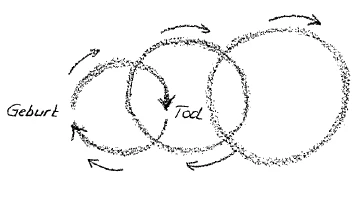
[ 34 ] The process always corresponds to what happens when a human being, as it were, returns from the cosmic world to within themselves, so that they now process within themselves what they have just experienced in the cosmos and experience it as connected to their own self. Just as we must experience the alternation between sleep and wakefulness here in earthly life in order to lead a healthy earthly existence, so too must we, in the time between death and a new birth, repeatedly experience, as it were, such an outflow into the cosmos, where we feel ourselves to be as vast, as the cosmos itself, where we perceive the forms and realities of the cosmos as our own forms and realities, where we identify so completely with the universe that we say: That which you beheld with your physical eyes when you were still an earthly being—that which gazed back at you in its physical reflection as the cosmos of the physical stars—you now live within it. But these are not the physical stars; they are the divine-spiritual beings who link their existence to yours. You are, so to speak, dissolved into cosmic existence. The divine-spiritual beings of the cosmos live within you. It is with them that you must identify.
[ 35 ] In a sense, this is one aspect of the experiences between death and a new birth—whether you call what you go through there “cosmic night” or “cosmic day,” the earthly terms we use are, of course, of no consequence whatsoever to the gods who live in the spiritual world. We simply need to use our earthly terms to bring to mind what we experience out there. But we must also describe it in an appropriate way.
[ 36 ] Then, following such times when we, so to speak, grow into the universe and identify with it, there are other times when we withdraw into our own self—withdraw, so to speak, to a single point, the point of our self—where, as in a cosmic memory, we now perceive all that we had previously experienced as poured out into the entire cosmos as now united within us, with us, and in our self. We perceive this “wheel of birth,” so to speak, as essentially always a vortex: we experience what we share with the cosmos as if it were out there, but then we withdraw into our own self and experience within ourselves the smaller third; then it goes out again; then the contraction within the spiral follows once more. Thus, this “wheel of births” can also be described as a spiral movement that withdraws into itself again and again.
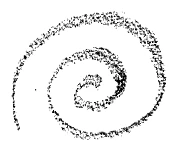
[ 37 ] Such is the progression in self-experience and self-renunciation between death and a new birth. Just as one would describe earthly events in cycles of twenty-four hours, and within that would simply describe: people sleep and wake—so one has thereby described what is now experienced in the spiritual world during a person’s passage from death to a new birth. This self-renunciation, this withdrawal of the self, is to the spiritual world what sleeping and waking are to human life on earth. And just as human earthly existence is first filled with the events that one experiences, so too is this completion of the cycle of births and deaths filled with those spiritual events that a person experiences between death and a new birth. To understand these events, one must form a sound conception of how a person actually stands here in earthly existence.
[ 38 ] In fact, he is only truly awake in relation to his world of imagination and a part of his emotional world that is connected to that imagination. What happens when a person intends to do this or that—even just to pick up a piece of chalk? What happens is that the intention, living within the imagination, rushes down into the will; the will engages the muscles, until we become aware once again of how the hand has grasped the chalk — which is, after all, a mental image again — that which thus becomes integrated into earthly life as an expression of the will, as an expression of desire, remains shrouded in darkness for earthly life just as much as a person’s life of sleep, even though it takes place during the day. We are awake to ordinary consciousness only in relation to our mental imagery and a part of our feeling. With regard to the other part of feeling, which is linked to the will—where we approve or disapprove of what we want to do—and with regard to the will itself, we are asleep.
[ 39 ] But we do not take our thoughts with us into the afterlife, any more than we take them with us into the night. Nor do we take the thoughts we have cherished here on Earth with us into the life between death and rebirth. There, we must form our own thoughts, appropriate to that other world.
[ 40 ] But what we take with us is what remains here in the subconscious: the will and a portion of the feelings associated with the will. It is precisely that of which we are unaware here in our earthly life—that is, what lives in our instincts, in our desires, in our entire sensuous, volitional nature, and everything that lives as the spiritual within this volitional nature— with all of this we live through the time between death and a new birth, and there we consciously transform what we experience unconsciously here into cosmic thoughts.
[ 41 ] For example, if we wish to understand even just the time we experience in the immediate vicinity of the gates of death, we must realize that what we already experience here on earth in relation to the physical body takes on a different character at the moment when we no longer have a physical body and have passed through death. Your physical body—the substances listed by chemistry—does not experience thirst or hunger. The inner experience of thirst and hunger is a soul experience. But the fulfillment of these desires—thirst and hunger—is brought about here in earthly life through the physical body. Hunger lives in the soul; the satisfaction of hunger here in earthly life is experienced through the body; thirst lives in the soul; the satisfaction of thirst is experienced here on earth through the body. When you pass through the gate of death, you no longer have a physical body. Yet you still feel thirst and hunger. You carry your ordinary thirst and hunger through the gate of death, and you have the time—which, after all, constitutes one-third of earthly life, the “reverse life” of the night—to use to, so to speak, wean yourself from being thirsty, from being hungry, and from experiencing the other desires that can be fulfilled only through the body. This is the inner experience of this third of life in relation to earthly life after death: that which can be satisfied only through the body or only here on earth is weaned from the soul, so that the soul frees itself from those desires which, though they must live within it, can be satisfied only through the body and earthly events. We will see what comes next later.
[ 42 ] I have thus described to you part of what a human being first experiences after passing through the gate of death, based on what we have seen today. Tomorrow we will continue our examination of this life between death and a new birth and its connection to the overall development of humanity on Earth.
[ 43 ] But we must become aware of the events that unfold within this earthly life. What can be explored today through imagination, inspiration, and intuition was once accessible to humanity through a kind of instinctive insight. The night was not so closed off to people. The day had a more dreamlike quality and revealed more of the spiritual world through dream images.
[ 44 ] We are living right now in an age—and I would like to draw attention to this today; the connection will become clearly evident to us in the coming days—in which humanity is most at risk of losing its connection with the spiritual world altogether. And perhaps it is precisely here—where the sites of ancient European Druidic memories are still so close at hand—that we should point to certain symptoms which are not in themselves harmful, but which, as symptoms, indicate what is now taking place not only physically in our earthly existence, but also, in a sense, spiritually behind the scenes of existence.
[ 45 ] Consider the people of the Middle Ages with all their dark sides—what we today call the “Dark Ages”—and compare them with humanity today. Today I would like to highlight just two of the symptoms that can draw our attention to how we should view the world from a spiritual perspective.
[ 46 ] Take a look at a medieval book. Every single letter looks as if it were painted. You can see how the eye rested on that letter. The entire state of mind of the person—which thus rested upon the written letter—was even more suited to attuning itself to whatever might come to them as revelations from the spiritual world.
[ 47 ] And just look at some of what’s written today—it’s practically unreadable! These aren’t letters that one perceives as something from which one derives artistic pleasure; they’re something scrawled out of a mechanical hand movement: [the word “Penmaenmawr” is written very carelessly on the blackboard]—that’s almost exactly what one sees now and then on this or that piece of paper!
[ 48 ] In addition, we no longer begin to write by being present with people, but by setting typewriters in motion, even though we no longer have any experiential connection to what we encounter.
[ 49 ] This, together with the cars, constitutes roughly the symptoms from which we can see today what is going on behind the scenes of existence—how human beings are being driven further and further out of the spiritual world.
[ 50 ] Now, don’t think that I want to come across as a die-hard reactionary and advocate for the banishment of cars, typewriters, and even these dreadful written characters! Anyone who understands the workings of the world already knows that all these things must come and are justified. So what I am saying is not aimed at eradicating them, but rather at nurturing them. They must come; one must accept them, just as one must accept day and night, even though enthusiasm for these things can become very one-sided among people who are strongly inclined toward the materialistic world. But what appears in the world in this way—what rumbles so terribly in the illegible characters, what rumbles so terribly in the typewriters, and what races through the world so horribly in cars—must be countered so that humanity can develop in a healthy way: a strong immersion into spiritual knowledge, into spiritual feeling, into spiritual will.
[ 51 ] The point is not to fight against the material world in any way, but rather to come to know and grasp it precisely in its reality, in its necessity; but also to recognize how necessary it is that what otherwise crushes humanity in physical existence be countered by a strong spiritual force. Then, through the back-and-forth between cars and typewriters on the one hand, and the imaginations and insights into the spiritual world developed through spiritual scientific work on the other, the healthy development of humanity will be promoted, whereas otherwise it might only be hindered.
[ 52 ] This is especially true here in Penmaenmawr, for it is here that, on the one hand, one senses—as a legacy from the ancient Druidic era—how these images—as I have already described—seem to stand still, as it were; but one also experiences the sheer force with which these frozen images are utterly destroyed by the cars whizzing through the atmosphere.