

Insight from Initiation
GA 227
28 August 1923, Penmaenmawr
Translated by Steiner Online Library
The Spiritual and Cosmic Existence of Human Beings After Death
[ 1 ] If we wish to envision the nature of the experience between death and a new birth, then we must, above all, recognize the enormous difference that exists between our experience here in earthly life and the existence we undergo between death and a new birth. Here in earthly life, we accomplish what we do in such a way, so to speak, that it detaches itself from us—that it ceases to belong to us once we have done it. Here in earthly life, for example, we produce all kinds of things. These things detach themselves from us. Most people, in fact, detach these things here in earthly life even in their external social lives: they sell them. So what is produced by a person in earthly life—what flows forth from their will—passes into earthly life in such a way that the person feels relatively—and I say explicitly relatively—little connection to it. And the thoughts from which human beings have created things in earthly life withdraw into the human inner being. They either remain mere passive thoughts or become memories, habits, and skills.
[ 2 ] In the state of existence between death and a new birth, things are different. In this state, everything a person accomplishes there returns to them, in a certain sense.
[ 3 ] Now we must consider: Here on Earth, we direct our impulses of will toward the elements of the natural kingdoms—the mineral, plant, and animal kingdoms. We shape them. We set them in motion; or indeed, we also set other human beings—insofar as they are earthly human beings—in motion.
[ 4 ] In the spiritual world between death and a new birth, we find ourselves among purely spiritual beings—some of whom exist entirely in the spiritual world, whom one might call divine-spiritual beings, and who never incarnate in earthly matter. These beings include the higher beings of the hierarchies, the angelic beings, the Exusiai beings, and the Seraphim and Cherubim beings. One could also choose other names—one should not be put off by the terminology—but these are time-honored names, and we can apply them to what we are rediscovering in the spiritual realm.
[ 5 ] In part, therefore, the human being lives between death and a new birth among such beings; in part, he lives among the disembodied human souls endowed with spirit bodies—that is, among those with whom he lived here during his earthly existence, or among those who are just awaiting their earthly existence, and will thus soon descend once more to Earth. This coexistence does, of course, depend to some extent on whether we are karmically connected to the human souls in question, on whether we have formed bonds with them here in our earthly existence. For those who were less close to us during our earthly existence also have fewer connections with us in the spiritual world. We will discuss this further later.
[ 6 ] Then human beings are in relationship with such beings who never incarnate so directly in earthly existence as human beings themselves do, because they are of a lower order than human beings, because they do not take on a human form. These are beings that live in the various kingdoms of nature—elemental beings that live in the plant kingdom, the stone kingdom, the mineral kingdom, or even the animal kingdom. Thus, between death and a new birth, human beings grow together with this entire spirit-filled world.
[ 7 ] I would also like to add that these beings are revealed precisely to the inspired, intuitive, and imaginative consciousness, and that through this consciousness one can look into the world that a person experiences between death and a new birth.
[ 8 ] Since human beings now live in this entirely different way, their entire human constitution—their entire human condition—is also different. If we here—I’ll return once more to this important point—if we here, for example, build a machine, then what we do—the manual movements, the assembly of the parts—flows from our will and from our thoughts. But it detaches itself from us. Now, when we are in the spiritual world between death and a new birth—where we, too, are constantly acting, constantly active as souls—when we do something there, something shines forth from what we do that we recognize as thoughts living in radiance, in light. Whereas here on Earth the thought remains with us, there the thought does not remain within the human being, but rather shines forth in the things one does; it shines forth as a luminous entity from everything we do. So that there in the spiritual world we are never able to do anything other than in such a way that a thought springs forth from it. And this thought is not like an earthly-human thought. An earthly-human thought can sometimes—even though it is actually a harmful thought—remain hidden within the human being, for it is a human-individual, even a human-personal thought; but the thought that springs forth from things in the life between death and a new birth—that is a cosmic thought. It expresses what the cosmos—that is, essentially the very nature of the entire spiritual-cosmic world—says to us regarding what we do.
[ 9 ] So imagine vividly—I’ll even try to illustrate this with a diagram [not preserved]—: A human being is active in the life between death and a new birth. As the person is active, every—I must now say: every soul-gesture, every soul-act—one might say every soul-stroke—is immediately transformed into a cosmic thought. So that when we do something, we, as it were, imprint it into the spiritual world. The cosmos responds from all sides, and what the cosmos says shines back from what we do, and the thing then becomes as the cosmos has judged it to be. But that is not the only thing; rather, in this radiance of the cosmos’s world of thought, something else flickers into view. Thoughts flicker in that we cannot say originate from the cosmos, so that we find the thoughts blazing brightly for the cosmos—not for earthly life—interwoven with all manner of dark thoughts. These now flicker out from within things.
[ 10 ] While these bright, radiant thoughts originating from the cosmos fill us with a deep sense of well-being during the life between death and a new birth, very often—not always, but very often—these shimmering thoughts have something extraordinarily unsettling about them, for these shimmering thoughts are the thoughts that linger from our own earthly life. So if we have acquired good thoughts about any matter during our own earthly life, then these good thoughts shimmer out of the cosmically radiant structure after death. If we have acquired bad thoughts, if we have harbored terrible, evil thoughts, then these evil thoughts shimmer out of the thought-radiant cosmic judgment—one might say—toward us. And so, along with what the cosmos says to us, we also perceive what we ourselves have brought into the cosmos.
[ 11 ] And this is not a world that detaches itself from human beings; it is a world that remains intimately connected to them. After death, the human being carries his cosmic existence within himself. But he also carries within himself, as a memory, his past—his very recent—earthly existence. And his next task is precisely this: to shed his earthly existence, to wean himself from it, so that he may become capable of being a truly cosmic being. As long as we are in that region of spiritual experience which I have described in my book Theosophy as the world of souls, we are always dealing primarily with these lingering earthly thoughts, earthly habits, and earthly tendencies. Because of these, we transform what we sense—which could be beautiful cosmic forms—into all manner of grotesque figures; so that during this passage through the world of souls, we continue our journey through the cosmos, uncomfortably judging and being judged by these cosmic forms distorted into grotesque figures, until we are freed from everything that still binds us to the earthly realm and can find the transition into what I have described in the book Theosophy as the “Land of Spirits,” where we will then have left behind the state of mind we acquired in our physical bodies on Earth and will be able to act solely in accordance with the instructions of the spiritual beings into whose realm we must now enter.
[ 12 ] You see, when a person enters the world they experience after death, they do not take with them what lives in their physical and etheric bodies. Those are cast off; they are returned to the cosmos. Human beings take with them only what they have experienced as the “I” and as the astral body within the physical and etheric bodies. |
[ 13 ] However, something extraordinarily significant and important can be gleaned from this. When a person walks around on Earth, they actually refer to their physical body and their etheric body—about which they don’t know much, but insofar as they live within the forces of growth and so on, they at least sense it—they call that their body. But a person has no right to call that their body. For what belongs to them is only what is present in the “I” and in the astral body. What is present in the physical body and the etheric body is, even while a person lives on Earth, the property of the divine-spiritual beings. Within them, the divine-spiritual beings live and weave while the person lives on Earth. Within them, these divine-spiritual beings continue to work, even when the person is not at all present during sleep. In fact, a person would fare quite poorly if he had to sustain his own etheric and physical bodies himself in a constant state of wakefulness between birth and death. Human beings are compelled, time and again—most of all in childhood, for a child’s sleep is the most important; later sleep serves only a corrective function, but the truly nourishing sleep is that of childhood, in the very first years of life—human beings are thus compelled to continually entrust their physical and etheric bodies to the gods.
[ 14 ] Ancient times in the development of humanity recognized this by calling the human body a temple of the gods, and in this marvelous structure of the human body they also sensed the temple of the gods, and in their architectural works everywhere—this can best be seen in Oriental architecture, but also in Egyptian and Greek architecture—they imitated the laws of the physical and etheric bodies. In the way the cherubim are placed on the temples of the East, in the way the sphinxes stand, in the way the columns stand, there lies, brought to life within them, what was perceived as divine-spiritual activity in the human physical and etheric body. Awareness of this has been lost to humankind in the course of its evolution. And today, though unconsciously—and therefore quite incorrectly—humanity calls its physical body “its body,” whereas this physical body is in fact the property of the gods within the creation of the Earth. Thus, when people today utter the words “my body,” when they describe what takes place within their body in a healthy state as their own property, this represents an immense arrogance on the part of humanity in the present civilization; admittedly an arrogance committed in ignorance, a subconscious arrogance, but a terrible arrogance nonetheless, in that when people say “your body,” “my body,” they are in fact laying claim to the property of the gods, thus embodying this arrogance even in their language.
[ 15 ] Spiritual science must once again draw attention to all these things. It must point out that moral considerations are already intertwined with ordinary, naturalistic life—and, as we have seen, in this particular case, not a good moral life, but rather a bad one. These things show how our entire emotional life, too, can be transformed through a proper spiritual understanding to such an extent that even the way a person speaks will change once they have truly understood spiritual science, as opposed to how they speak today under the influence of a purely materialistic-naturalistic way of thinking.
[ 16 ] In order to understand the further experiences between death and a new birth, we must be able to bring to mind what was said yesterday: that as a person becomes attuned to the spiritual world, the physical aspect of the stars disappears, and in place of the physical aspect of the stars comes an immersion into that which, spiritually, corresponds to what physically shines down upon the eye in the radiance of the stars. Just as the Earth is the dwelling place of human beings—and human beings, as spiritual beings with an “I” and an astral body, are in fact inhabitants of the Earth—so, too, is every single star the dwelling place of certain spiritual beings. And during their physical existence, human beings are connected to the elemental beings that dwell in the mineral, plant, and animal kingdoms, and so on; they are connected to other human souls through life in the outer physical body. Between death and a new birth, they now come into contact with the inhabitants of other stars. Life between death and a new birth is in fact a journey through the world of the stars, but specifically through the spirit of the starry world, through living together with the other divine-spiritual beings of the starry worlds. As we have seen, immediately following earthly life we spend that existence which takes place in the soul world—which is essentially a life lived in reverse, translated into reality, of what the human being has figuratively and unconsciously slept through during all the nights that are interwoven into his earthly life. A third of their earthly life is spent by human beings in the process of weaning themselves off what they—I might say through these fleeting thoughts—introduce into the cosmic thoughts. A person who has, for example, reached the age of sixty during their earthly life spends twenty years in the soul world. They spend this time working their way out of everything that connects them to their physical earthly existence. They have an inner experience of how they come into relationship with the worlds of the stars after death. And so, while in the soul world—spending this third of their earthly life there—human beings have the inner experience that, in this experience, they are particularly connected to the lunar realm. When I told you yesterday that the human being, so to speak, completes the cycle—that is, traces half a circle between birth and death—and then returns more quickly because he covers this distance in one-third of the time, he has the feeling that this circuit has taken place around lunar existence, around the spirits of lunar existence. And I already hinted at this yesterday: Human beings are not conscious of the fact that they return to their birth. So it is not actually a circle; it is a spiral. Human beings are actually moving forward. And I would have to draw this as a spiral.
[ 17 ] What has brought about the fact that we do not simply orbit the Moon in a circle, but move forward, drawing closer to another form of existence immediately after death—what is at work here is, in part, the forward-driving force of the Mercury beings, and in part, the backward-radiating force of the Venus beings. The Mercury beings are somewhat stronger than the Venus beings. Existence moves forward through the Mercury beings and is gathered within itself by the Venus beings, endowed, as it were, with abundance, so that this passage through the soul world essentially proceeds in such a way that the human being feels embraced by the activity of the Moon, Mercury, and Venus.
[ 18 ] We simply have to visualize this existence very clearly. Here on Earth, we say: I, as a human being, have a head (this is depicted here), which is primarily animated by that [organ] which one might call the center of the brain, located in the pineal gland. So that is the most important organ of the head. In the center: I, as a human being, have—drawn here very schematically—the heart in my middle section. I, as a human being, have what belongs to the entire renal system within the metabolic-locomotor organism.
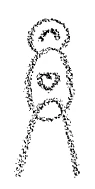
[ 19 ] You cannot speak that way once you are in the world of souls after death. There, you do not say: “I, a human being, consist of a head, a chest with a heart, and limbs with metabolic organs.” That makes no sense at all. We have shed all of that. But after death we say: “I, as a human being, consist of that which comes from the spirits of the moon.” And this statement—“I, as a human being, consist of that which comes from the spirits of the moon”—is the equivalent of what we say here on Earth when we say, “I have a head.” So here on Earth we must say, “I have a head.” After death, in the soul world, we must say: “I have that which comes from the spirits of the Moon.” And here on Earth we say: “I have a heart in my chest, which drives my entire respiratory and circulatory system.” This way of speaking, in turn, has meaning only here on Earth, for of course, the heart is also cast off. After death, in the soul world, we must say: “I carry within me the forces of Venus”; and that is the corresponding reality after death. And while here on Earth we say: “I have a limb-metabolic system with all the organs that belong to it, primarily the renal system,” after death we must say, correspondingly: “Within me live the forces that emanate from the Mercury beings.” So here on Earth we say: “As a human being, I am head, chest, abdomen, and limbs.” After death, we say: “As a human being, I am Moon, Venus, and Mercury.”
[ 20 ] This also corresponds entirely to the true inner nature of life. For here on earth, our entire existence as physical human beings depends on how the head, the heart, and the digestive system work together. Everything depends on this. We need only make the slightest movement of the hand; in that slightest movement, the workings of the head, the heart, and the digestive system are all at work, for the substances we take in are constantly being transformed as I move my hand. Our entire earthly existence unfolds in the head, heart, and limbs—to put it simply, in abbreviated terms. In the same way, our entire existence in the soul world unfolds through the workings of the lunar, Mercury, and Venus forces present within us. Just as we are “the other” on Earth, so are we the Moon, Mercury, and Venus in the soul world. And through this, we are in fact, in a certain sense, transported back to a time that humanity experienced through its natural existence in epochs far older than our own. I have, after all, referred to these older epochs of human development quite often in these lectures.
[ 21 ] Back then, human beings were in a kind of instinctive state of perception, traces of which remain in the types of people I have spoken of during these lectures. Even here on Earth, they sensed how they were connected in extraterrestrial life, for example, to the Moon, Mercury, and Venus. This awareness of earthly life has, after all, been lost to people today. And how was it lost? When one speaks of these things—which actually lie with profound significance behind the veil of the physical world and can only be articulated by speaking from the realm that lies beyond the threshold—one naturally provokes a strong sense of aversion, or to put it more elegantly: the criticism of the present. For it is actually particularly difficult today to articulate precisely what the truth of initiation is. One must either express it so abstractly that people today do not even realize what is meant. One must clothe it in abstract terms. Or one must express it in terms of what truly characterizes these things. Then many people today become downright furious when they hear this. One can understand why they become furious, for they are being told of a world they want to be rid of, a world they actually fear, a world they hate. But that cannot prevent us from once again speaking honestly about these things within the civilized world. If, therefore, one were to show great consideration—even though it wouldn’t help much—for these people, who are of course not sitting here but are outsiders who hate the science of initiation, one would simply say: By living one’s way into the soul world, a person enters a state that is, in turn, somewhat similar to an earlier state on Earth, when human beings still possessed an instinctive spiritual truth. And within this originally instinctive spiritual truth, the lunar forces lived. If one had expressed this in a manner at least somewhat in line with the materialistic concepts of the present, one might have spoken reasonably well. But the matter has been stated far too abstractly. If one does not shy away from what will naturally become the criticism of materialistically minded people, one must put it differently. One must say: When humanity passed through a very distant epoch in Earth’s evolution—I will describe it more precisely later—a very ancient epoch that naturally predates the historical epoch, humanity was, even on Earth, in the company of spiritual beings who were not directly connected to the Earth itself, but who were connected to the cosmos even in their earthly lives. One can say: Divine teachers, not earthly teachers, were the leaders of the mysteries at that time and instructed earthly human beings.
[ 22 ] These teachers of the most ancient times did not assume a solid, dense, physical body, but worked upon human beings in their etheric bodies. Thus, the earliest teachers of humanity in the mysteries—the highest teachers, those whose servants were only physically incarnated human beings—were ethereal, divine teachers. In an earlier epoch of human development, these beings lived on Earth among humanity. Thus, we can truly say in every real sense: There was an ancient epoch in the development of the earthly world in which divine-spiritual beings dwelt on Earth alongside human beings; though they did not reveal themselves when one, well, let’s say, went for a walk, they did reveal themselves when one was properly introduced to these divine-spiritual beings by the temple servants in the Mysteries. They revealed themselves only in the Mysteries; but there they did reveal themselves. And through these Mysteries they became fellow inhabitants of humanity on Earth. These beings have since withdrawn from Earth, have migrated from Earth to the Moon, and now live, as it were, in a cosmic fortress—imperceptible to earthly existence—within the inner being of the Moon. So that when we contemplate the innermost essence of the Moon’s existence, we must regard this inner essence as the assembly of those beings who were once the great teachers of humanity on Earth in their etheric bodies. And in fact, we should never look up at the Moon without telling ourselves: There are gathered those who were once the teachers on Earth. For what comes to people on Earth from the Moon is not what lives within it, but only what it reflects back from the rest of the cosmos. Just as it reflects light, so too does the Moon reflect back all cosmic influences.
[ 23 ] So when we look up at the Moon, we see the light, and we see it most clearly; but of course that is not the only part, but rather the smallest part. We see a reflection of cosmic forces; we do not see what lives within the Moon. Within the Moon lives that which once lived on Earth. And only in the state immediately following death, in the world of souls, does the human being once again come under the influence of these beings who were once on Earth. And it is these beings who, through the judgment of the pre-earthly world, exert a corrective influence after death upon what the human being has done on Earth. Thus, after death in our present Earth epoch, the human being truly enters into a relationship once more with those beings who once, as divine-spiritual beings, educated and instructed him within the whole of humanity on Earth. The Moon must therefore be regarded spiritually as a cosmic fortress into which those beings who were once with humankind have withdrawn, and with whom we once again come into a relationship immediately after we begin our journey through the soul world after death.
[ 24 ] Once a human being has gone through what, in a certain sense, belongs to the realm of lunar existence, they are then assigned the task within the cosmos of transitioning into solar existence. So while the first circle that has been traversed—or the first spiral, so to speak—has lunar existence as its center, this spiral movement, this circular movement of the human being, must now develop further outward and pass from the lunar realm into the solar realm.
[ 25 ] Spatial representations can only be illusory here, for all these processes take place in the one-dimensional, supersensible realm. But one can still say—since we must make use of earthly words—that once a person has already traversed the first circle in the realm of the Moon, they have entered the realm of the Sun, so that the Sun—but the spiritual Sun—now assumes the same relationship to them in the life between death and rebirth that the Moon previously had. Human beings must now become beings who, upon entering what I have called in my Theosophy the “land of spirits”—the spiritual realm of the Sun—metamorphose this very existence—Moon, Venus, Mercury—that they have had up to now. In fact, human beings must become entirely different beings. During earthly life, he said: “I am a head being, a heart being, a chest being, a metabolic being, a limb being.” Immediately after death, he says: “I am a being—Moon, Mercury, Venus.” He cannot say more than this, for doing so would bring his existence to a standstill in the spiritual world between the world of the soul and the actual realm of the spirits. He must now undergo a significant metamorphosis, even for his spiritual-soul existence. He must become what I can characterize for you in the following way: The sun must become his skin. Sunlight must surround him everywhere. Just as we here on Earth are clothed in our skin with regard to our physical body, so must we now enter a spiritual existence that is clothed in a skin consisting everywhere of spiritual solar forces. It is not entirely easy to imagine this, because from your earthly perspective you think: there is the sun, and it shines down here. There, the sun is the center, and it shines out into the surrounding space. When one enters the spiritual solar realm, the sun is no longer in one specific place, but is everywhere within the surrounding space. One is inside the sun, and the sun shines in on one from the periphery. It is, in fact, the spiritual skin of the human being that one has now become. And not outside the sun, but within the spiritual realm of the sun, one now possesses what one must again refer to as organs: just as in earthly existence there are the head, heart, and limbs, and just as immediately after death there are the Moon, Mercury, and Venus, so one now has within oneself as organs what one must refer to as Mars, Jupiter, and Saturn. One is therefore now the Sun and possesses within oneself the organs: Mars, Jupiter, Saturn. These are the inner organs, just as here the heart, the pineal gland, or the kidneys. But all of this has been transformed into the spiritual realm. And these organs must first be developed gradually. They are not fully developed the moment one passes from the world of the soul into the realm of the spirit. They must first be developed gradually. To this end, now that we have entered the solar stage of existence, we describe not merely one circle, as we did during the lunar stage, but three circles, so that this solar stage of existence is initially described in three circles. In the first circle, which is the actual Mars circle, the spiritual Mars organ is developed. In the second circle, which is the actual Jupiter circle, the Jupiter organ is developed, and in the final circle, the Saturn organ is developed—three circles that are traversed much more slowly, when compared to Earth time, than the Moon circle. The lunar circle is traversed at a relatively rapid pace. These circles are traversed at a pace that is, as I will explain further tomorrow, approximately twelve times slower. Thus, one traverses a Mars circle, a Jupiter circle, and a Saturn circle. And throughout this entire passage through this region, in which the human being lives in the spiritual world of the spheres and participates in the spiritual forces of that world, the human being is constantly active—just as he is active here with the forces of nature, so there with the forces of the so-called higher hierarchies, the beings of the higher hierarchies, who have only their outer reflection—their physical manifestation—in the starry sky with the sun and moon, which surround us in the physical realm.
[ 26 ] However, in order to make the transition from the lunar realm to the solar realm, humankind must have a guiding force. I have already alluded to this guiding force. We have seen, after all, that in the very earliest epoch of humanity, those beings lived here on Earth who then withdrew into the cosmic lunar stronghold, as if entrenching themselves there. These beings themselves, then, are such that human beings only reestablish a connection with them after death. But successors to these beings have remained, who then appeared on Earth from time to time during the later epochs of human history. In the East, these beings were called the Bodhisattvas. They appeared incarnated in human form, yet were still the descendants of those beings who had subsequently entrenched themselves in the Moon. Thus, the lives of the Bodhisattvas actually flow in communion with the beings living in the cosmic lunar fortress. There lie the sources of their power; there lie the sources of their thoughts. And it was they who then served as guides to humanity, making the transition possible for them through what they taught on Earth, so that when humanity reached the end of the lunar region, they had the strength to pass into the solar region.
[ 27 ] In the next few lectures, we will see how this has become impossible in the course of human evolution on Earth, and how the Christ Being had to descend from the Solar Being itself in order to accomplish the Mystery of Golgotha, so that through His Christ teaching—through the teaching of the Mystery of Golgotha—humanity might receive on Earth the powerful force needed to make the transition from the world of souls to the realm of spirits, from the lunar region to the solar region.
[ 28 ] And while in the early stages of Earth’s evolution that which was intimately connected to the Earth from the lunar region actually provided for the spiritual life of the Earth, “when the time was fulfilled,” after the first third of the fourth post-Atlantean epoch had elapsed, the effect of the Mystery of Golgotha—the Christ-effect—took the place of the direct or indirect lunar influence in Earth’s evolution itself—at a time when the Bodhisattvas were still at work within the beings. The Christ-effect was surrounded by the twelvefold Bodhisattva-effect—which is implied, but is also a reality—through the twelve apostles in Christ’s entourage; thus Christ, incarnated in the body of Jesus, is the force that has now, emanating from the spiritual solar existence, united itself with the Earth.
[ 29 ] And just as one must look up at the moon—if one does not merely wish to stare at it with a materialistic soul and a materialistic mind, but rather wishes to understand it—just as one must look up at the moon as a gathering of spiritual beings who represent the past of the world’s development for the Earth, so too must we look up to the Sun as the assembly of those beings who represent the future of Earth’s development—and indeed, already its present—and whose great emissary is Christ, who passed through the Mystery of Golgotha. And through what human beings take in on Earth through their relationship to the Mystery of Golgotha, entry into the spiritual realm— that is, into the spiritual realm of the Sun, so that they may become capable of inwardly assimilating, in the Mars region, the Mars organs; in the Jupiter region, the Jupiter organs; and in the Saturn region, the Saturn organs—in a threefold orbit that proceeds much more slowly than the lunar orbit. Yet this, too, is subject to the course of world development. And in fact, the complete fulfillment of what I have just described—the becoming of a Mars, Jupiter, or Saturn human—will only occur for human beings in the future. In the epoch in which we currently live, it is only possible for human beings, through the action of the world forces, to complete a full circuit of the Mars region, so that after death they complete the Mars circuit but cannot yet fully enter the Jupiter region; rather, they can only touch upon it. Only in the course of further experiences between death and a new birth will they be able to fully enter the Jupiter region, and even later, the Saturn region.
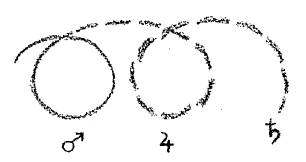
[ 30 ] However, since human beings cannot yet enter the Jupiter region, nevertheless already receives something of the forces of Jupiter and Saturn during the time between his death and a new birth, there are scattered between Mars and Jupiter the many asteroids that are thus continually rediscovered by astronomers based on their external existence, but which constitute the region that human beings also pass through after death in spiritual terms, because they cannot yet proceed toward Jupiter. And these asteroids have the peculiar characteristic that, in their spiritual essences, they are, so to speak, colonies of Jupiter and Saturn. Beings from Jupiter and Saturn have retreated to the asteroids. And so, before a human being is fully ready for earthly existence, they encounter, as it were, in the asteroid region scattered throughout our universe, that which can serve as a kind of substitute for the time being, before they can enter the Jupiter and Saturn regions. Thus, in essence, after having passed through death and a new birth—that is, after being reborn—human beings have undergone the Mars phase and absorbed from the Jupiter and Saturn forces that which is colonized in the asteroid region; with the aftereffects of this, which we will yet come to know, human beings now enter their new earthly existence when they are reborn.
[ 31 ] As for how this life between death and a new birth—which I have described to you in terms of its relationship to the world of the stars—can be further characterized, I will discuss that tomorrow.