

The Development of Human Consciousness
in the Past, Present, and Future
GA 228
27 July 1923, Dornach
Translated by Steiner Online Library
Planetary Spirits that Determine Destiny and Liberate Humanity I
[ 1 ] In the coming days, I would like to add a few more points to what I said earlier—points that offer the possibility of gaining insight into certain underlying aspects of the world’s mysteries that have been lost to modern civilization. We need only look at what modern civilization holds as its view, for example, of the planetary system. We know that this planetary system is conceived as having emerged from a kind of primordial nebula that was in rotational motion, and from which the individual planetary bodies broke away as a result of this rotational motion. Through the speculations devised to support this view, nothing has been gained except a kind of indifference among the individual celestial bodies as they are described, and also an indifference in the human gaze toward these celestial bodies.
[ 2 ] What is the major difference, say, between the Moon and Saturn, if all of this is to be understood within the concept of a rotating nebula from which these celestial bodies gradually separate? Admittedly, the 19th-century research—so significant for all earthly phenomena, and especially for the earthly-mineral realm—has had much to say about the material composition of the celestial bodies and has established a kind of physics and chemistry of the celestial bodies. This makes it possible for standard textbooks to provide specific information about Venus, Saturn, the Moon, and so on. Yet all of this is akin to creating, as it were, only a kind of image of the outer organism of a human being—who is animated by soul and spirit—without delving into the soul and spirit that animate and spiritualize them.
[ 3 ] We must once again, with the help of an initiatory science, penetrate into what we might initially call the “infusion of soul” and “infusion of spirit” of, let us say, our planetary system. And today I would simply like to characterize the individualities of the individual planets in this system.
[ 4 ] I would first like to draw attention to the planet that is closest to Earth, whose fate—albeit only in a certain respect—is linked to that of Earth, and which once played a very different role in Earth’s history than it does today. For you know from the descriptions in my Outline of Esoteric Science, as I have presented them, that this Moon was still connected to the Earth in relatively recent cosmic times, that it separated from the Earth, and that it now orbits it.
[ 5 ] When we speak of the moon as an external physical celestial body, the physical aspect of it is merely the outer, the outermost manifestation of the spiritual reality that lies behind it. When we observe the Moon today, it appears—to those who are able to understand it in terms of both its outer and inner aspects—as, in a sense, first and foremost a gathering of spiritual beings within our universe who possess a great degree of self-containment. Outwardly, the Moon essentially behaves like a mirror of the universe.
[ 6 ] [This is where we begin drawing on the board; see p. 25] So if we have the Earth here and move the Moon into the immediate vicinity of the Earth, then—from the most external point of view—the Moon reflects the sunlight with its appearance, so that we can say: What comes from the Moon is the sunlight that shines upon it and is reflected back. So, in a sense, it is first and foremost a mirror of sunlight. You know, of course, that it is the nature of a mirror that one sees what is outside it, in front of it, but that one does not see what is behind it. Now, the moon is not only, in a sense, a mirror of the sun’s radiance in the universe, but it is, in general, a mirror for everything that can shine upon it—only that sunlight is by far the strongest. But every celestial body in the universe radiates toward the moon, and the moon, like a mirror of the entire universe, reflects this universe back in a pictorial manner in all directions. So one can say: When you look at the universe, you actually have it before you twice—once as it reveals itself in the Earth’s surroundings, and once as it is reflected back from the moon. The sun’s rays are powerful. They are powerful even as they are reflected back by the Moon. But everything else in the universe that can reveal itself through spatial radiation is also reflected back by the Moon, and in addition to what is revealed in the universe, one also has this reflection of the universe from the Moon.
[ 7 ] Anyone who could observe all the details of the moon—in other words, anyone who had an eye for the reflections that the moon casts in every direction throughout the universe—would have seen the entire universe reflected from the moon. Only that which is within the Moon remains—if I may put it this way—the Moon’s mystery; it remains hidden, just as that which lies behind a mirror remains hidden. What lies behind the Moon’s surface—that is, within the Moon itself—is significant above all for its spiritual aspect.
[ 8 ] The spiritual beings that inhabit the interior of the Moon are beings who, in the strictest sense, isolate themselves from the rest of the universe. They live as if in a lunar fortress. And only for those who manage to develop such an affinity with the sunlight—to cultivate certain qualities of the human heart in such a way that they no longer perceive the moon’s reflection—does the moon become, in a sense, spiritually transparent, allowing them to penetrate this lunar fortress of the universe. And they then make a significant discovery. They discover that through the statements and teachings of those beings who have, as it were, withdrawn in complete seclusion into this lunar fortress of the universe, certain mysteries can once again be revealed—mysteries that the Earth once possessed in its most exalted spirits, but which it has since lost.
[ 9 ] And when we look back today at the evolution of the Earth, we find that the further back we go, the less we encounter the abstract truths that are the pride of present-day humanity, but we encounter more and more symbolic truths. We then work our way through the inwardly meaningful truths that have been recorded—truths that shine as a final echo of Eastern wisdom, for example, in the Vedas and the Vedanta— we work our way through to humanity’s primordial revelations, which lie even beyond the myths and legends, and initially come to acknowledge, filled with awe and wonder, how humanity once possessed a magnificent wisdom that it had received—without any effort of the intellect—as a grace from the spiritual beings of the higher worlds. And we are ultimately led back to all that these beings—who have now withdrawn to the lunar stronghold of the universe, having departed from the Earth along with the Moon—were once able to teach the primordial humans who already existed on Earth at that time. Humanity then preserved the memory of what these beings had once revealed to the most ancient peoples of humanity, who were still quite different in their nature from the human form of today.
[ 10 ] But when one penetrates this mystery—I would like to call it the lunar mystery of the universe — one becomes aware of how these beings, who have now anchored themselves in the lunar fortress of the universe, were once the great teachers of humanity on Earth, and how humanity on Earth has lost precisely that which today lies hidden in this cosmic fortress in terms of the spiritual and the soul. For what still comes to the Earth from the universe is, after all, nothing more than what the outer surface—the walls, so to speak, of this fortress—reflects back from the rest of the cosmos.
[ 11 ] This mystery of the Moon is one of the deepest mysteries of the ancient mystery traditions. For what the Moon contains within itself is, so to speak, primordial wisdom. But that which the Moon is able to reflect from the entire universe is the sum of the forces that sustain the animal world on Earth—namely, those forces connected with the sexuality of the animal world, which also sustain the animal-physical aspect of human beings and are connected with human physical-sensual sexuality. Thus, the lower nature of human beings is a creation of what the Moon radiates, and the highest essence that the Earth once possessed is inwardly preserved within the Moon’s fortress.
[ 12 ] In this way, through such contemplation, one gradually arrives at a knowledge of the Moon’s individuality—a knowledge of what it actually is—whereas all other knowledge is merely the kind one would gain from a human being if one found a papier-mâché cast of that person in a wax museum. One would know nothing of the individuality of the person by looking at this cast; similarly, a science that refuses to engage with initiation knows nothing of the individuality of the Moon.
[ 13 ] In a certain sense, the outermost planet—at least the outermost planet for the ancients; Uranus and Neptune were added later, but let us not consider these two for now—forms a certain contrast to this lunar individuality; the Saturnian individuality [green, drawing on p. 25] forms a certain contrast to this lunar individuality. The Saturn individuality is such that, although it is actually stimulated in the most manifold ways by the universe itself, it allows nothing of these stimulations from the universe to return to Earth, nor does it radiate anything toward it. Certainly, Saturn, too, is illuminated by the Sun, but what it reflects back from the Sun’s rays has no significance for earthly life; rather, Saturn is entirely the celestial body in our planetary system that is wholly absorbed in its own being. It radiates its own being out into the world. And when one observes Saturn, it actually always tells one what it is like. Whereas the Moon, when viewed from the outside, tells us what everything else in the world is like, Saturn tells us nothing at all about the impressions it receives from the rest of the world; rather, it speaks only of itself. It says only what it itself is. And what it itself is gradually reveals itself as a kind of memory of our planetary system.
[ 14 ] Saturn seems to be the celestial body that has faithfully participated in everything within our planetary system, but has also faithfully preserved everything in its memory—in this cosmic memory that it possesses. It remains silent about the present events of the universe. It takes in these present events of the universe and processes them within its inner soul-spiritual being. The entire sum of the beings dwelling within Saturn does indeed open itself to the outer world, but silently and wordlessly absorbs the events of the world into its soul-nature and speaks only of the past events of the cosmos. Therefore, when viewed from a cosmic perspective, Saturn is something like the living memory of our planetary system. And as a faithful chronicler of what has happened in the planetary system, it thus holds the secrets of the planetary system.
[ 15 ] So while we look in vain to the Moon when we wish to fathom the mysteries of the universe—and while we must, so to speak, make ourselves confidants of the lunar beings if we wish to learn anything from them about these mysteries—this is not necessary in the case of Saturn. With Saturn, all that is needed is an openness to the spiritual: then Saturn transforms before the spiritual eye, before the eye of the soul, into a living chronicler of the planetary system. Nor does he hold back at all with these narratives he has to offer about everything that has taken place within the planetary system. In this respect, he is the complete opposite of the Moon’s formation; he speaks ceaselessly. And he speaks of the solar system’s past with inner warmth and inner fervor, so that it is actually dangerous to become more intimately acquainted with what he speaks of in the cosmos, because he speaks of the past events of the cosmos with such devotion that one comes to love this past of the cosmos immensely. For those who listen in on its secrets, it is, so to speak, a constant seducer, urging them to regard earthly matters as insignificant and to immerse themselves completely in what the Earth once was.
[ 16 ] Specifically, it speaks clearly about everything that the Earth was before it became the Earth. Thus, it is the planet in our solar system that makes the past infinitely precious to us. And those people who now have an earthly affinity for Saturn are those who always like to look back to the past, who do not welcome progress, and who would like to return to the past again and again. In this way, one approaches the individuality of Saturn.
[ 17 ] A planet such as Jupiter [yellow, illustration on p. 25], for example, is of a different kind. Jupiter is the thinker of our planetary system, and thinking is preeminently the element cultivated by all beings who are, so to speak, united within its sphere of influence. Creative and received thoughts of the universe radiate toward us from Jupiter. Jupiter contains, in thought form, all the formative forces for the various beings of the universe. While Saturn recounts the past, Jupiter reveals—but in a living representation, in a living conception—what corresponds to it in the present reality of the universe. But it is necessary to engage meaningfully with what it presents to the spiritual eye. If one does not develop one’s own thinking, then one cannot—for example, let us use the term—approach the mysteries of Jupiter even as a clairvoyant, for the mysteries of Jupiter are such that they reveal themselves only in thought form, and only by thinking for oneself can one approach the mysteries of Jupiter, for he is the Thinker of the universe.
[ 18 ] When one attempts to grasp any significant mystery of existence through clear thinking, and one is unable to do so because of human-physical and etheric obstacles—and astral obstacles in particular—then the beings of Jupiter step in and help one. The beings of Jupiter are precisely the helpers of humanity in the development of human wisdom. And the person who has truly striven to unravel some mystery of existence through clear thinking but cannot get to the bottom of it will find—if they have patience and continue to work through this mystery in their mind—that the powers of Jupiter even help them during the night. And many a person who has solved a “daytime riddle” better at night—as if emerging from a dream—than they had the previous day would, if they could see the truth, actually have to admit to themselves: It is the powers of Jupiter that, if I may put it this way, set human thinking in motion, give it momentum, and infuse it with verve. So if Saturn is the keeper of the universe’s memory, then Jupiter is the thinker of the universe. To Jupiter, humanity owes everything it derives from the spiritual present of the universe. To Saturn, humanity owes everything it derives from the spiritual and soulful past of the universe.
[ 19 ] It was based on a certain intuition that Jupiter was particularly revered in Greece, where people lived so closely in the present.
[ 20 ] The influence that Jupiter exerts on the course of the year also provides inspiration for human beings throughout their entire development. As you know, if we closely observe Saturn’s apparent motion, it moves very, very slowly: it takes nearly thirty years. Jupiter moves faster: it takes about twelve years. Through the nature of its faster movement, Jupiter provides precisely the fulfillment of humanity’s need for wisdom. And when, according to that clock that in a sense expresses human destiny in the cosmos, there is a special relationship between Jupiter and Saturn, then those wonderful, luminous moments enter into this human destiny—moments in which, through present-day thinking, much is revealed about the past.
[ 21 ] And if we look at the history of humankind to identify the moments when Renaissance periods began—when there was a resurgence of ancient impulses, as was the case during the last Renaissance—we find that this renewal of ancient impulses is closely linked to a certain alignment between Jupiter and Saturn.
[ 22 ] But, as I said, in a certain sense Jupiter is already closed off, and its revelations remain in the unconscious unless the human being meets them with active, powerful, clear, and luminous thinking. That is why in ancient times, when active thinking was not very developed, the way humanity progressed was actually always dependent on the position of Jupiter relative to Saturn. In times when a certain constellation existed between Jupiter and Saturn, many things were revealed, especially to the people of antiquity. Modern humanity is more inclined to consider these aspects separately in its development—that is, to receive Saturn’s memory and Jupiter’s wisdom separately in its soul-spiritual evolution.
[ 23 ] If we then turn to Mars [orange, drawing on p. 25], we find in Mars the planet that one might actually—don’t you think? We do need some terminology, after all—call the most promising planet in our solar system. It is the one that, unlike Jupiter, does not hold back its wisdom in the form of thought, but rather always blurts out everything in the universe that is accessible to it—and not all things in the universe are accessible to it, I mean, to the souls that inhabit it. It is the most talkative planet in our solar system; it is always talking. And he is, for example, particularly influential when people speak from sleep or from a dream. For he is, in essence, the planet that has an immense longing to speak constantly, so that whenever anything in human nature is accessible to him that allows him to make people talkative, he stimulates that talkativeness. He is the planet that thinks little, has few thinkers, but many talkers. Its spirits are always on the lookout for whatever presents itself here and there in the universe, and then they speak of it with great devotion and great verve. It is the one that, in the most diverse ways throughout the course of human development, inspires people to make statements about the mysteries of the world. It has its good and less good sides. He has his genius and his demon. The genius works in such a way that people receive the very impulses for speech from the universe. His demon works in such a way that language is misused in the most diverse ways. He is—in a certain sense, one might say—the agitator of the universe. He seeks to persuade, whereas Jupiter seeks only to convince.
[ 24 ] Venus, for example, occupies yet another position [violet, drawing on p. 25]. Venus is, in a certain sense—well, how should I put it?—rejecting toward the entire universe. She is aloof toward the universe; she wants nothing to do with it. She views the universe in such a way that, if she were to expose herself to it, she would—precisely through the external universe, I might say—lose her virginity. She is terribly shocked whenever any impression from the outer universe tries to reach her. She does not like the universe; she rejects every suitor from the outer universe. This is difficult to express, because, of course, the relationships must be described in earthly terms, but that is precisely how it is. In contrast, she is immensely receptive to everything that comes specifically from the Earth. In a certain sense, the Earth is truly Venus’s lover. While the Moon reflects the entire universe all around it, Venus reflects nothing of the universe—she wants nothing to do with the universe—but she lovingly reflects back everything that comes from the Earth. One experiences the entire Earth, with all its spiritual mysteries, all over again when one listens to the mysteries of Venus with the eye of the soul.
[ 25 ] It is indeed true that people on Earth cannot, in essence, do anything truly right in the depths of their souls without it being reflected down from Venus to those who investigate the matter. She looks deep into the hearts of all people, for that is what interests her; that is what allows her to draw near to them. So everything that lives in the most intimate depths of life on Earth is present once more on Venus, in a reflection that is remarkable. In this reflection, she actually transforms everything in the same way that human dreams transform the external events of physical life. She takes earthly events and transforms them into dream images. So that, in fact, the entire orbit of Venus around the Earth—this entire sphere of Venus—is actually a reverie. And within the most manifold dream-like formations live the dreamlike transformations of earthly human mysteries. Venus even has a great deal to do with poets. Only, of course, the poets themselves do not know this, but it has a great deal to do with them.
[ 26 ] But now this is very strange: I said that she is dismissive of the rest of the universe; she certainly is. But she is not equally dismissive of everything that comes from the universe. So I would say that, in her heart, Venus rejects everything that comes from the universe, and only accepts what comes from Earth. “She rejects every dancer,” I said, “but she listens with rapt attention to what Mars has to say. She transforms and examines her dreamlike, earthly experiences in light of what she receives from the universe via Mars.”
[ 27 ] All such things also have a physical aspect. It is from these things that the impulses emanate for what is created in the world, for what comes into being in the world. And from what takes place there—admittedly, the Sun is in between, bringing order to it—as Venus absorbs everything that comes from the Earth and then constantly eavesdrops on Mars—she doesn’t want him to know it, but she wants to eavesdrop on him—well, from this arise the very forces that underlie the organs of human speech formation.
[ 28 ] If one wishes to understand the cosmic forces that shape human language, one must look to this remarkable interplay and vitality unfolding between Venus and Mars. Thus, when fate so dictates, the position of Venus relative to Mars holds great significance for the development of any people’s language: a language becomes inwardly profound and soulful when, for example, Venus is in square aspect to Mars. Conversely, a language becomes soulless and clanging when Venus and Mars are in conjunction, and this then influences the people in question. [See “List of Corrections,” p. 188.]
[ 29 ] This is how these things come about: they take shape as impulses in the universe and then exert their influence on the earthly realm.
[ 30 ] Then we have Mercury [blue, illustration on p. 25]. Mercury is the planet which, unlike the others, is actually interested in that which is not sensory but is of such a nature that it can be combined. Mercury is home to the masters of combinatory thinking, while Jupiter is home to the masters of wise thinking. And it is the case that when a human being passes from pre-earthly life into earthly existence, the lunar impulse is the one that provides the forces for their physical existence. Venus supplies the forces for all that pertains to emotional and temperamental dispositions. Mercury, however, supplies the forces for all that pertains to a person’s intellectual and rational faculties, namely the faculties of the intellect. It is precisely in Mercury that the masters of the combinatory powers of cognition are anchored.
[ 31 ] And once again, with regard to human beings, there is a remarkable relationship between these planets. The Moon, which contains the austere spirits who withdraw entirely into themselves—who merely reflect back what is radiated to them from the universe—actually builds up the outer form, the human body. Thus, in this building up of the physical body, the human being unites the forces of heredity. Within him reside precisely those spiritual beings who, in complete seclusion—I might say, cosmically—contemplate that which is passed down from generation to generation via the physical realm.
[ 32 ] That is why people in modern science know absolutely nothing about heredity, since the lunar beings have entrenched themselves so firmly in their stronghold. Strictly speaking, a deeper look reveals that nowadays, whenever heredity is discussed in a scientific context, one could actually say—if speaking in cosmic terms—that the person is “moon-forsaken”; on the other hand, he is “Mars-bewitched,” for he speaks of heredity under the influence of the demonic forces of Mars, yet he stands far removed from the true mysteries of heredity.
[ 33 ] Venus and Mercury instill the soul-spiritual aspect of karma more deeply within human beings and bring it to the fore in their disposition and temperament. In contrast, Mars and, in particular, Jupiter and Saturn—when a person has a proper relationship with them—have a liberating effect. They tear the person away from everything predetermined by fate and transform them into a truly free being.
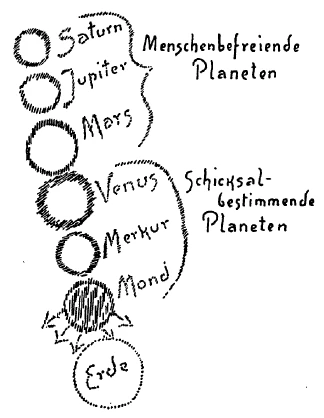
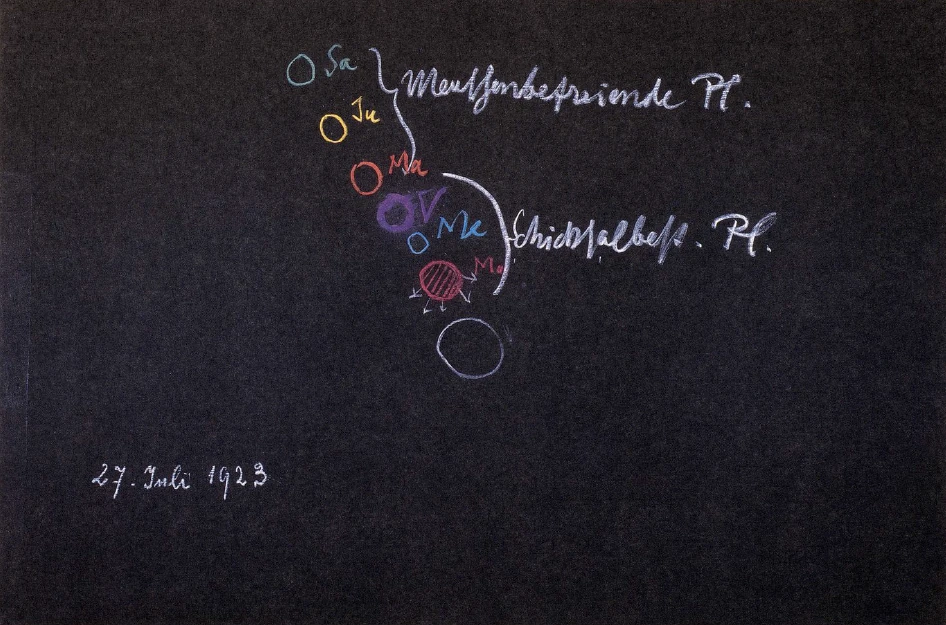
[ 34 ] One could use a biblical phrase in a slightly modified form. Saturn, who is the faithful keeper of the universe’s memory, said one day: “Let us set humanity free within its own memory.” — And so Saturn’s influence was pushed down into the unconscious; humankind gained its own memory and, with it, the foundation, the pledge of its personal freedom.
[ 35 ] Likewise, the inner impulse of will that lies at the heart of free thought is due to the grace of Jupiter. Jupiter could, in fact, control all human thoughts. He is the one in whom one finds the present thoughts of the entire universe, if one makes them accessible to oneself. But he, too, has withdrawn; he allows human beings to think as free beings.
[ 36 ] And the element of freedom inherent in language lies in the fact that even Mars has become merciful. Because he had to, so to speak, submit to the decision of the other planets far from the sun—and was no longer allowed to impose things on humans—humans are also free in language in a certain way; not entirely free, but free in a certain way.
[ 37 ] Thus, from another perspective, Mars, Jupiter, and Saturn can be called the planets that liberate humanity, whereas Venus, Mercury, and the Moon must be called the planets that determine destiny [illustration on p. 25).
[ 38 ] The Sun then interposes itself between these actions and impulses of the planetary individualities, creating, as it were, harmony between that which liberates humanity and that which determines destiny. Thus, in the Sun we find the individuality in which the necessity that determines destiny and that which liberates humanity interact in a wondrous way. And only those who gaze upon this interweaving and coexistence of fate and freedom—in the light that spreads throughout the world and yet remains warmly united within the Sun—can truly understand what is actually contained in the radiant, blazing sunlight.
[ 39 ] We cannot even come to terms with the sun itself if we view it solely in terms of what physicists know about it. We can only come to terms with the sun if we view it in terms of what it is spiritually and soulfully. There it is that which, in warmth, causes the necessity of fate to glow, and in the flame, resolves fate into freedom; and, in turn, when freedom is abused, condenses it into the active, substantial essence of the sun. The sun is, in a sense, the flame in which freedom appears phosphorescently throughout the universe, and at the same time it is the substance in which—like ash clumping together—abused freedom coagulates as destiny in order to continue to act, until this destiny, in turn, can pass phosphorescently into the flame of freedom.