

Experiencing the Course of the Year
in Four Cosmic Imaginations
GA 229
12 October 1923, Dornach
Translated by Steiner Online Library
Fourth Lecture
[ 1 ] As we now move on from the reflection on the Easter season—the season of spring festivals—that we undertook here last time, to the summer season, we find it necessary to approach our reflections in a much more spiritual way than we did for the previous seasons. This might seem like a contradiction, but it is not. During the Christmas season, we had to begin with how earthly rock—limestone—gradually transforms, and we then led that reflection on to the Easter season. We had structured the reflection in such a way that we, so to speak, focused on the influence of the spiritual within the material. During the summer, especially in midsummer, human beings are actually woven into the fabric of nature. From spring through summer, nature becomes increasingly active and inwardly rich, and human beings themselves, with their entire being, are woven into this natural existence. So one can say: During midsummer, human beings experience a kind of awareness of nature. During spring, when they have a feeling and sense for it, they become one with everything that grows, sprouts, and shoots forth. They bloom with the flower, germinate with the plant, and bear fruit with the plant as well; they immerse themselves in everything that grows and lives outside. Through this, they expand their existence beyond the existence of nature, and a kind of natural consciousness arises. Then, because nature dies in the fall—that is, carries death within itself—the human being, as he lives in harmony with nature as fall approaches, toward the time of St. Michael, must also experience this death within himself; but he must not participate in it within his own self. He must rise above this death. It is precisely in place of this awareness of nature that the strengthening and invigoration of self-consciousness must take its place. But because it is precisely in the heat of summer that this awareness of nature reaches its peak in human beings, it is all the more necessary for the universe that—if only the human being wills it—the universe then brings the spiritual to the human being.
[ 2 ] So we may actually say: Human beings are entwined with nature during the summer season. But if they have the right sensibilities, the right feelings for it, then the objective spirituality comes to meet them from the weaving fabric of nature. Thus, for what is truly human during the St. John’s season, the outer, objective spirituality must be sought. And this is certainly present in nature. Nature is only outwardly the sprouting, budding—one might say, the sleeping—entity that draws forth from the forces of sleep the powers of plant growth, which form a kind of sleeping natural existence. But from this sleeping nature, if a person has a sense for it, the spiritual reveals itself—the spiritual that weaves through and lives within all of nature.
[ 3 ] And so it is that when, with spiritual depth in our souls and a contemplative gaze, we observe the natural world during the height of summer, we find our gaze directed down into the very depths of the earth. We find that, more so than at any other time of year, the rocks in the depths of the earth convey to us their inner, crystal-forming nature. In fact, when one looks into the depths of the earth with an imaginative gaze around the time of St. John’s Day, one gets the impression: Down there, life is weaving and thriving in crystalline forms in which the solid earth consolidates—all crystalline forms, crystalline forms that are just coming into their own during the height of summer. Everything down there takes shape during the height of summer in lines, angles, and planes. And if one wishes to grasp the overall impression, it is this self-contained solidity of the Earth’s crystalline nature that weaves itself into a dark-bluish pattern.
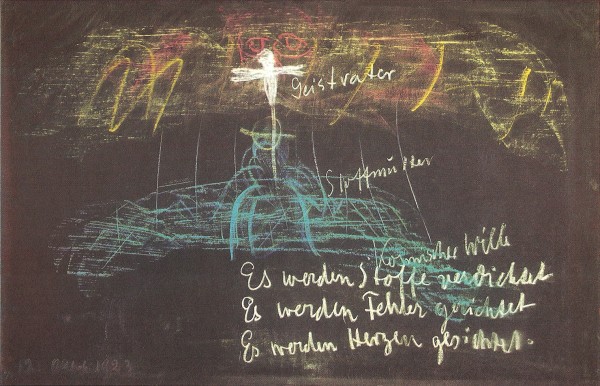
[ 4 ] Although such a drawing can, of course, only be very sketchy and imaginative, perhaps I may illustrate the entire situation on the plate (see Plate V). One might say: When you look down, you get the impression of linear forms, but with a bluish hue poured over the whole, and this blue is crisscrossed everywhere by those lines that actually gleam silver, so that everywhere within that bluish hue there is something silver-gleaming and crystallizing (white). It is as if earthly nature were seeking to present its creative power to you in a wondrous sculpture—but a sculpture that is not meant to be seen in the way one normally sees with the eyes; rather, it is as though you actually feel yourself dissolved within this natural sculpture, as though you actually feel every line down there—every silvery, gleaming line—within yourself. One feels, as it were, to have grown out of the blue depths of the earth as a human being, and one feels inwardly empowered by the silvery, crystalline lines. One feels all of this as one’s own being. And when one then comes to one’s senses and asks oneself: How, exactly, do these silvery, crystalline lines—these crystalline waves—work within you? What is it that weaves and lives there in the earth, shining silver against the blue of the earth? — then one knows: That is cosmic will. And one then has the feeling that one is standing upon cosmic will. That is when one directs one’s gaze downward. And when one directs one’s gaze upward?
[ 5 ] When you look up toward the heavens, you get the impression of a vast, expanding cosmic intelligence. In human beings, at the present stage, intelligence—as I have often described—is not yet worth all that much. But in the height of summer, up in the mountains, you get the feeling: There is weaving intelligence everywhere, but not the weaving intelligence of a single being, rather that of many beings who live within one another, who live together. So that up above we have this expanding, weaving intelligence through which the light flows—the luminous, weaving, living intelligence (yellowish) as the opposite of the will. And while down below one has the feeling: “It is bluish and dark there; everything there can really only be experienced as forces”—up above one has the feeling: “Everything there is actually such that it illuminates one when one perceives it, that it permeates one with a sense of intelligence.”
[ 6 ] And now, within this radiant weaving—I cannot put it any other way—a figure appears. I had to present Michael to you for the autumn season as the most essential figure who steps forth from the fabric of nature before our souls. We will speak later about the extent to which Gabriel, according to the old designations, steps forward into the Christmas season. Last time, I showed you how the figure of Raphael stands before us during the Easter season, during spring. In a sense, this Raphael most recently appeared to us as the dramatic mediator who brings us the necessary adoration and reverence for what is the Easter imagination—the cosmic Easter imagination. Now, for the season of St. John, if I were to describe it in human terms—though of course all this is only an approximation—we are immediately met by an extraordinarily serious face, a solemn countenance that stands out, as if warmly glowing, from the general radiant intelligence (red head in yellow, Plate V).
[ 7 ] One gets the impression that this figure forms its luminous body out of this radiant intelligence. And for this figure to form its luminous body during midsummer, what I have described to you must occur: the elemental spirits of earthly beings must ascend. As they ascend, they interweave with the radiant intelligence above. This radiant intelligence absorbs them. And out of what shines there—what glows with light within the radiant intelligence—this figure takes on a physical form; a figure that was, after all, already sensed by the ancient instinctive power of clairvoyance, and which we can still designate by the same name by which it was named back then. We can therefore say: During the summer, Uriel appears in the radiant intelligence.
Fall: Michael
Winter: Gabriel
Spring: Raphael
Summer: Uriel.
[ 8 ] There is profound seriousness in what, emerging from the weaving of light in search of its physical form, confronts one as a representative of the cosmically weaving forces during the summer season. These are the things we can now continue to observe—such as the deeds accomplished in the light by Uriel, Uriel, whose own intelligence is, in essence, composed of the interplay of the forces of the planets in our solar system, supported by the influences of the fixed stars in the zodiacal constellations; Uriel, who, in his own thinking, actually embodies the thinking of the world. So that one immediately has the feeling: You luminous, intelligent summer clouds, in which the bluish crystalline formations of the earth’s surface below are reflected upward, just as the luminous, intelligent cloud formations are in turn reflected downward in the bluish crystalline formations of the earth’s surface—in you, you luminous cloud formations, appears in midsummer with a solemn countenance, imaginatively concentrated, the World Mind.
[ 9 ] Well, the deeds, I say, of this incarnating World Mind, this embodied cosmic intelligence—they are deeds woven in the light. They consist in the fact that, through the force of attraction inherent in this concentrated world intelligence of Uriel, the silver forces make their way upward (white), and that in the light of this intelligence—which also shines from within, as seen from Earth—it appears like spreading sunlight, which, however, condenses into a golden radiance. And one immediately has the feeling: that silvery substance, which flows from below upward, is absorbed by that which weaves and lives up there, bathed in sunlight, and the Earth’s silver—it is a perfectly accurate expression that I am using now—the Earth’s silver is transformed, through cosmic alchemy, into the cosmic gold that weaves and lives up there. And there is a continuous spraying upward of the silvery radiance, and above, a continuous transformation of the silvery radiance into golden radiance.
[ 10 ] And then, if you continue to follow this through the month of August, you get the impression of a complement to the figure of Michael, as I have described it to you. I have described to you what Michael’s sword is made of, and from what the dragon then weaves its life. But one wonders, amid all this radiant beauty that appears spiritually from the weaving cosmos at the height of summer: Where does Michael—who then ushers in the Michaelmas season, the time of autumn—where does Michael obtain his distinctive garment, this garment that at times glows in the golden light of the sun, at other times shines from within as if in a silvery radiance springing forth from within the golden folds? Where does this golden-woven, silvery-shining Michael—garment come from? It is that which is formed up there by the silver radiating upward, by the gold flowing down from above over the radiant silver—into which, through the power of the sun’s influence, the silvery radiance emanating from the earth is actually transformed. And as we approach autumn, we gradually see the silver that the Earth has given to the cosmos returning as gold; and in this power of the silver transformed into gold lies what then takes place within the Earth during the winter months, as I have described to you: The solar gold that has formed in the heights during midsummer within the realm of Uriel descends into the depths of the earth, spiritually interweaving and surging through the depths of the earth, enlivening there that which seeks life for the coming year during the depths of winter.
[ 11 ] So you see that now, as we enter the season of burgeoning, sprouting life, we can no longer speak of matter interwoven with spirit—as we do in winter with regard to the earth—but rather we must speak of spirit interwoven with matter, namely, spirit interwoven with silver and gold. Of course, you should not imagine all this in crude terms; rather, you must conceive of the effects of silver and gold in a form so subtle that it transcends all human comprehension.
[ 12 ] And once one has this impression, it seems as if all of this were actually just a kind of backdrop, as if it were all cosmic acts of light—cosmic acts of light performed by Uriel. For one gets a clear impression of this figure of Uriel. One also gets a clear impression of his gaze. One feels a profound longing to understand this strangely downward-directed gaze of Uriel. One gets the impression that one must look around to discover what this gaze means. And one only begins to grasp what this gaze means when, as a human being, one learns to look even deeper spiritually into the blue, silvery-shimmering depths of the Soemmererdboden. There, I would say, in a somewhat unsettling way, forms that dissolve and then coalesce again weave themselves around these silvery, shimmering crystal rays—forms that sometimes clump together and sometimes dissolve once more.
[ 13 ] Now one realizes: These are—though the sight must be different for each person—the human flaws that stand out here below in their contrast to the natural crystal forms, which are regular and internally consistent. And Uriel’s serious gaze is directed at this contrast between the natural crystallization in its regular beauty and the human flaws woven over it. Here, in the height of summer, one sees through what is still imperfect in the human race compared to the regularly structured crystal forms. It is there that one, I would say, receives the impression from Uriel’s serious gaze: the natural is interwoven with the moral. There stands not merely the moral world order within ourselves as abstract impulses, but we now see—whereas otherwise we observe natural existence and do not ask: Does morality live in plant growth? Is there morality in crystallization? — just as human failings and regular, internally consistent, and internally consolidated natural crystallization naturally intertwine in the height of summer.
[ 14 ] In contrast, everything that constitutes human virtue and human competence ascends along the gleaming silver lines and appears like the enveloping clouds of Uriel (red); human virtue, transformed, as it were, into works of art—into sculptural clouds—enters into the radiant intelligence.
[ 15 ] One cannot merely gaze upon the solemn face—the eye of Uriel—which takes on a solemn expression as it looks into the depths of the earth; rather, one can also gaze upon something that, I would say, is present like wing-like arms or arm-like wings in solemn admonition, and which acts precisely as a gesture of Uriel, introducing into the human race what I would like to call the historical conscience. Here, in the height of summer, the historical conscience appears—one that is exceptionally underdeveloped, especially in the present. This appears as in the admonishing gesture of Uriel.
[ 16 ] Of course, you have to imagine all of this as a mental image. These things are very real, but I obviously can’t talk to you about them the way a physicist talks about positive and negative charges, energy potential, and so on. I have to speak to you in images that are alive. But what is expressed in these living images is, after all, reality; it is there.
[ 17 ] And once one has gained an impression of the connection between human morality and the lower, crystalline realm, as well as the higher, human virtue that shines in beauty—once one has taken this connection into one’s inner experience—then the true St. John’s Imagination comes to meet one; that which is the St. John’s Imagination stands there, just as the Michael Imagination I have described to you, just as the Christmas Imagination and the Easter Imagination.
[ 18 ] Then, as a kind of summary, this image appears, revealing itself to the observing mind: at the top, illuminated, as it were, by the power of Uriel’s gaze, the dove (white). That which below is a silvery-shimmering blue—representing the depths of the earth, linked to human failings and errors—coalesces into an image; it consolidates into the image of the Earth Mother (blue), whether you call her Demeter or Mary. So that when one directs one’s gaze downward, one cannot help but, in one’s imagination, synthesize all these mysteries of the depths into that which is the material mother of all existence, while in what is concentrated above—in the flowing form—one perceives all that which is the spiritual father of all existence around us.
[ 19 ] And now we see the result of the interaction between the Spirit Father and the Material Mother; that which embodies, in the most beautiful way, the harmony between the silver—earthly influence and the golden—heavenly influence: between the Father and the Mother, the Son (see Plate V). Thus this image of the Trinity emerges, which is the true Johannine image. The background is Uriel, the creator, the beholder, and the admonisher.
[ 20 ] That which actually constitutes the Trinity should not simply be presented to the soul in a dogmatic manner. This gives the impression that such an idea of the Trinity, such an image of the Trinity, is detached from the cosmic weaving and life. It is not. It is the Trinity revealing itself in midsummer through cosmic action, through cosmic life and weaving. It emerges with an inwardly compelling power once one has penetrated—I would say—the mysteries of Uriel.
[ 21 ] And if one were to place the Feast of St. John before one’s mind’s eye, there would have to be the arched background, the vaulted background with Uriel, functioning in the way I have described to you. And, in a sense, it would have to stand out from that—which would require very special arrangements to depict it—it would have to stand out from that, I would say, in a vivid, momentarily evoked image, which could indeed be achieved through a particularly artful use of smoke or the like; the imagination of the Trinity would have to stand out from that. This would have to be evoked at the time of St. John’s Day if the true imagery of this matter is to be revealed to people. Just as at Easter we only have the full picture when we enter into the dramatic, when we enter so deeply into the dramatic that, at the center of the mystery drama that must unfold there, we have the teaching Raphael alongside the human being who initiates us into the mysteries of healing nature, into the mysteries of the healing cosmos, so what one sees there—what one can see, albeit in a woven, pictorial form—must be transformed at the time of St. John’s into a powerful musical expression. But from this powerful musical expression, the mystery of the world, as experienced by human beings precisely at the time of St. John’s, must speak to us directly.
[ 22 ] And one might think that everything I have described to you, in terms of artistic training, would, on the one hand, be oriented toward the visual arts. But the very same things that are sensed and felt in the visual arts must draw their life from the weaving tones that embody that poetic motif which interweaves and permeates our soul as we immerse ourselves in this Uriel, who works and acts in the light, and who evokes within us the powerful impression of the Trinity.
[ 23 ] And what shines up from below with a silvery radiance, what reveals itself above in the formative beauty of the light’s workings—all of that must be shaped into music through appropriate instrumentation, especially at the time of St. John’s Day, so that human beings may find their own shared experience with the cosmos in the weaving of the tones. And it must resound—for embodied in these weaving tones is the mystery of humanity’s oneness with the cosmos at the time of St. John. All of this must be contained within it. When a person looks up, they should behold the world-weaving gold, and emerging from that radiant gold, the warm, reddish form of Uriel—all of this not a fixed form, all of this immediate life—and directed toward the earth, the gaze I have described to you, the gaze of Uriel, the admonishing gesture. That is the one motif. Through this one motif, which is in the heights, a person feels connected to that one side, connected to the radiant cosmic intelligence.
[ 24 ] On the other hand, looking downward, he feels connected to that which strives toward solid form, that which is bathed in a bluish darkness from which a silvery light radiates. There, down below, he senses that which is the material foundation of the weaving, living spiritual existence. The heights become mysteries, the depths become mysteries, and human beings become a mystery within the cosmic mysteries. Human beings feel the crystal-forming power right down to their very bones. But they also feel how the crystal-forming power, which penetrates them to their very bones, is united in the cosmos with the luminous power that manifests itself up there in the heights. Humanity feels how everything moral that takes place through the human race lives and weaves within these mysteries of the Upper, within these mysteries of the Lower, and in their union. Human beings no longer feel separated from the world; they feel themselves placed within the world; they feel bound upward to the luminous intelligence, in which they experience their own best thoughts as if in the womb of the world; humanity feels bound downward—down to the very marrow of its bones—to the world’s crystallizing power, and with both united once more, feels its death bound to the spiritual life of the universe, the spiritual life of the universe yearning to awaken and create, in earthly death, crystallizing forces and a life that shines like silver.
[ 25 ] All of this would simply have to be expressed in sounds—sounds that carry these motifs, which humans are meant to experience, on their wings. These motifs are already there. There is no need to invent them. These motifs can be discerned from Uriel’s cosmic activity. In these motifs, that which is imagination takes shape as inspiration.
[ 26 ] But human beings themselves live, in a sense, as an embodied inspiration, as beings consisting of inspiration, within these mysteries of Above and Below and within these mysteries of connection in the middle, in these mysteries to which the Spirit-Father points upward, in these mysteries to which the Material Mother points downward, in these mysteries whose union arises from the fact that Christ, born of the interaction between the Spirit-Father and the Earth-Mother, stands directly before the human soul as the sustaining Spirit of the worlds.
[ 27 ] What emerges from all these cosmic mysteries—I might present it to you in the following way. It is as if a person, placed within the weaving of midsummer, were to feel something like the following. The first words would be like the vision of Uriel condensing into inspiration, combined with the spiritual tones of the entire choir:
Behold our weaving,
The radiant stirring, } Heights
The warming life.Live what sustains the earth
And what is shaped by breath } Depths
As an essential force at work.Feel your human bones
With heavenly radiance } At the center of the human inner being
In the unifying force of the world.
[ 28 ] In these nine lines here, one finds the mysteries of the heights, the mysteries of the depths, and the mysteries of the middle—or of the human inner self. And we have a summary of the whole, in which these mysteries of the heights, the depths, and the center resound throughout the whole like a cosmic affirmation, as if with the sounds of an organ and trumpets:
Fabrics are compressed,
Mistakes are corrected,
Hearts are examined.
[ 29 ] And you have that which—sustaining, uplifting, and strengthening people—can permeate the St. John’s season precisely as St. John’s imagination filled with inspiration, or St. John’s inspiration filled with imagination:
Behold our weaving,
The radiant stirring,
The warming life.Experience that which sustains the earthly realm
And that which is shaped by breath
As an essential, governing force.Feel your human bones
With heavenly radiance
In the ruling unity of the worlds.Matter is condensed,
Errors are corrected,
Hearts are examined.
