

Humanity as the Harmony of the creative, formative, and shaping Word of the WorldGA 230
19 October 1923, Dornach
Translated by Steiner Online Library
First Lecture
[ 1 ] It has often been stated in our reflections—and it also played a certain role in the recent lectures on the course of the year and the Michael problem—that human beings, in their entire constitution, in their living conditions, indeed in everything they are, represent a small world, a microcosm in contrast to the macrocosm; that they truly contain within themselves all the laws of the world, all the mysteries of the world. However, you must not imagine that fully understanding this—admittedly quite abstract—statement is a simple matter. One must, so to speak, penetrate the diversity of the world’s mysteries in order to then rediscover these mysteries within the human being.
[ 2 ] Today, let’s look at this matter from the perspective of first examining the world from certain starting points and then looking at human beings, to discover how human beings, as a small world, exist within the larger world. Of course, what one can say about the larger world is always just a small fragment. It can never represent the whole; otherwise, one would have to traverse the entire world in one’s contemplation. Let us first look at what presents itself to us at the very nearest level above, if I may put it that way.
[ 3 ] Let us consider that human environment which, in the animal kingdom, lives—so to speak—in the air, and specifically that class which lives in the air in the most striking way: the bird genus.
[ 4 ] It cannot escape one’s notice that the bird, which dwells in the air and derives its means of existence from the air, is structurally quite different as an animal from those that live directly above the ground, or even those that live beneath the ground. And when we look at the bird kingdom, we naturally find ourselves compelled, according to common human perspectives, to speak of the bird in terms of head, limbs, and the like. But this is actually, at its core, a rather unartistic way of looking at things. And I have pointed out on more than one occasion that if one truly wishes to come to know the world, one cannot stop at intellectual understanding; rather, the intellectual must gradually give way to an artistic perception of the world.
[ 5 ] Well, surely you wouldn’t consider the so-called bird’s head—which is, after all, extraordinarily stunted in comparison to the heads of other animals—to be a real head. Certainly, from an external, intellectual standpoint, one could say: The bird has a head, a torso, and limbs. But consider how stunted a bird’s legs are—compared, for example, to those of a camel or an elephant—and how stunted the bird’s head is compared, say, to the head of a lion or a dog. There is almost nothing substantial inside such a bird’s head; in fact, there is really hardly more inside it than what constitutes the front part of the mouth in a dog, or—for that matter—in an elephant or a cat. I would say the bird’s head is a slightly more complex version of a mammal’s mouth. And what constitutes the limbs of a mammal is completely atrophied in the bird. Certainly, an unartistic way of looking at it simply states that the front limbs have been transformed into wings. But all of that is precisely an unartistic, unimaginative view. If one truly wants to understand nature, if one truly wants to penetrate the cosmos, one must look at things more deeply, above all in terms of their formative and generative forces.
[ 6 ] The notion that a bird simply has a head, a torso, and limbs will never lead one, for example, to truly comprehend the etheric body of a bird. For if one moves, through imaginative perception, from seeing what is physical in the bird to what is etheric in the bird, one finds that in the etheric bird there is only a head. From the perspective of the etheric bird, the bird is nothing but a head; from the perspective of the etheric bird, one immediately grasps that the bird cannot be compared to the head, torso, and limbs of other animals, but must be understood as a mere head that has been transformed—transformed into a head. Thus, the actual bird’s head consists only of the palate and the front parts—the mouth region—and what extends further back—all the rib-like and spine-like parts of the skeleton—must be regarded as a head, albeit a metamorphosed, transformed one. The entire bird is, in fact, a head. This stems from the fact that, indeed, if we want to understand a bird, we must go back very, very far in the Earth’s—in the planetary Earth’s—evolution.
[ 7 ] The bird has a long planetary history behind it. The bird has a much longer planetary history than, for example, the camel. The camel is an animal that evolved much later than any bird. Those birds that are confined to the ground, such as the ostrich, are the most recently evolved birds. Those birds that dwell freely in the air—eagles, vultures—are very ancient Earth creatures. While in earlier Earth periods, Moon periods, and Sun periods they still possessed everything that later passed into them from the inside out to the skin, what you see today in their feathers and in their horny beaks essentially developed later within the bird species. The bird’s external form is of later origin; it arose because the bird developed its head nature relatively early, and under the conditions into which it then entered during later stages of Earth’s evolution, it could only add to its exterior what is found in its plumage. This plumage, for example, was given to the bird by the Moon and the Earth, while the rest of its nature dates back to much earlier times.
[ 8 ] But there is a much deeper side to this matter. Let us take a look at the bird in the skies—let us say, the eagle soaring majestically through the air, to which the sun’s rays, as it were, have bestowed its plumage as an external gift of grace—I will mention the other effects later—and have given it its horny beak; let us look at this eagle as it flies through the skies. Certain forces are at work upon it. The sun possesses not only those physical forces of light and heat of which we usually speak. I drew your attention to this back when I spoke about the Druidic mysteries: spiritual forces also emanate from the sun. We must look to these spiritual forces. It is they that give the various species of birds their multicolored plumage and the distinctive form of their feathers. When we spiritually comprehend the nature of the sun’s effects, we understand why the eagle has its particular plumage.
[ 9 ] Then, when we truly immerse ourselves in this eagle-like nature, when we understand how to develop an inner, artistic understanding of nature that encompasses the spiritual, when we can observe how the artistic form is shaped from the solar impulses—which are intensified by other impulses I will mention later—when we see how, as it were, these solar impulses flood over the eagle even before it has hatched from the egg, how they conjure up the plumage—or rather, conjure it into its physical form—and then ask ourselves: What does this mean for human beings? — Yes, for human beings, this signifies precisely what makes the brain the bearer of thoughts. And you are looking correctly into the macrocosm, into the great natural world, when you observe the eagle in such a way that you say: The eagle has its plumage, its multicolored, vibrant feathers; within them lives the same force that lives within you, making your brain the bearer of thought. That which folds your brain, that which enables your brain to absorb that inner salt-like force that is the foundation of thought—that which makes your brain capable of shaping you into a thinker in the first place—is the same force that gives the eagle its plumage in the skies. — Thus we feel a kinship through our thinking, sensing, as it were, the human substitute within us for the eagle’s plumage; our thoughts flow out from the brain just as the feathers flow out from the eagle.
[ 10 ] When we ascend from the physical plane to the astral plane, we must state the following paradox: On the physical plane, the same forces that cause the formation of feathers are the ones that cause the formation of thoughts on the astral plane. They give the eagle its feathers; that is the physical aspect of thought formation. They give humans their thoughts; that is the astral aspect of feather formation. Such things are sometimes expressed in a marvelous way in the genius of the vernacular. If one cuts off the tip of a feather and removes what is inside, the common people call that the soul. Certainly, some will see an external designation in this name “soul.” It is not an external designation, but rather, for those who see through the matter, a feather contains something immense: it contains the secret of thought formation.
[ 11 ] Let us now turn our attention away from the eagle, which dwells in the skies, and, to find another representative, consider a mammal such as the lion. One can truly understand the lion only by developing a sense of the joy and inner satisfaction the lion derives from living in harmony with its surroundings. There is, in fact, no animal that is not related to the lion that possesses such a wonderful, mysterious way of breathing. In all animal beings, the rhythms of breathing must harmonize with the rhythms of circulation; however, the rhythms of circulation are weighed down by the digestive system attached to them, while the rhythms of breathing become light because they strive to rise up into the lightness of the brain’s structures. In the case of the bird, what lives in its breathing actually lives in its head at the same time. The bird is entirely head, and it carries its head, so to speak, outwardly toward the world. Its thoughts are the forms of its plumage. For a true sense of nature—one that can live in beauty—there is actually nothing more moving than to feel the intimate kinship between human thought, when it becomes so concrete, when it comes so vividly alive within, and a bird’s plumage. Anyone who has cultivated an inner practice in such matters knows exactly when they are thinking like a peacock, when like an eagle, and when like a sparrow. The reality is such that—apart from the fact that one is astral and the other physical—these things correspond to one another in a wondrous way. It is so. So much so that one can say: The bird’s life is so overwhelmingly centered on breathing that everything else—blood circulation and so on—almost disappears. All the heaviness of digestion, indeed even the heaviness of blood circulation, is actually swept away by the bird’s sense of being within itself; it is not there. In the case of the lion, there is a kind of balance between breathing and blood circulation. However, blood circulation is also made difficult in the lion, though not as much as, say, in the camel or the cow. There, digestion is something that places an immense strain on blood circulation.
[ 12 ] In the case of the lion, which has a relatively short digestive tract and is built in such a way that digestion takes place as quickly as possible, digestion does not place a heavy burden on the circulatory system. On the other hand, however, there is such a development of the head-related aspects in the lion’s head that breathing is kept in balance with the rhythm of circulation. The lion is the animal that, more than any other, possesses an inner rhythm of breathing and a rhythm of the heartbeat that are internally balanced and harmonized. The lion therefore also has—if we, I might say, consider its subjective life—this peculiar way of devouring its food with an almost boundless greed, because it is actually glad when it has it inside. It is greedy for food because, naturally, hunger causes it much more distress than it does other animals; he is greedy for food, but he is not obsessed with being a particular gourmet. He is not at all obsessed with savoring a variety of flavors, because he is an animal that derives his inner satisfaction from the balance of breathing and blood circulation. Only when the food has passed into the lion’s bloodstream, which regulates the heartbeat, and this heartbeat enters into a reciprocal relationship with the breathing—from which the lion derives pleasure once more by drawing the flow of breath into himself with deep inner satisfaction—only then, when he feels within himself the effect of the meal, this inner balance between breathing and blood circulation, does the lion live in his element. He truly lives as a lion when he feels that deep inner satisfaction—the blood surging upward, his breath pulsing downward. And in this interplay of two waves, the lion lives.
[ 13 ] Look at him, this lion—how he runs, how he leaps, how he holds his head, even how he gazes—and you will see that all of this stems from a continuous, rhythmic interplay between losing balance and regaining it. There is perhaps hardly anything that can seem as mysterious as this peculiar lion’s gaze, which reveals so much of its inner self—a sense of inner mastery, of overcoming opposing forces. That is what the lion’s gaze reveals to the outside world: this mastery of the heartbeat through the rhythm of breathing in an almost perfectly complete manner.
[ 14 ] And again, anyone with a sense of the artistic conception of forms should look at the lion’s mouth—this structure within the lion’s mouth—which reveals that the heartbeat pulses upward toward this mouth, but the breath holds it back. If you imagine this mutual interplay between the heartbeat and breathing, you’ll arrive at the lion’s mouth.
[ 15 ] The lion is, in essence, an organ of the chest. It is truly the animal whose outward form and way of life fully express the rhythmic system. The lion is organized in such a way that this interplay of heartbeat and breathing is also expressed in the mutual relationship between its heart and lungs.
[ 16 ] So we really have to say: If we look for something in the human being that most resembles a bird—something that has merely undergone metamorphosis—it is the human head; if we look for something in the human being that most resembles a lion, it is the human chest region, where the rhythms meet—the rhythms of circulation and respiration.
[ 17 ] And now let us turn our attention away from all that presents itself to us high up in the skies as the bird kingdom—which, because it lives in the air immediately surrounding the Earth, is actually part of the air cycle, just as the lion is—and let us look at the cattle. I have often pointed out in other contexts how delightful it is to gaze upon a well-fed herd lying in the pasture, to observe the process of digestion, which is expressed in their posture, in the look in their eyes, and in every movement. Try it sometime: look at a cow lying in the pasture when—for my sake—some sound is made here or there. It is truly wonderful to see how the cow raises its head, how this lifting conveys the sense that it is all difficult, that one cannot raise one’s head easily, and how something quite special still lies within. When you see a cow raise its head like that in response to a disturbance in the pasture, you can’t help but think: This cow is surprised that it’s supposed to raise its head for something other than grazing. Why am I actually raising my head right now? I’m not grazing, and there’s no point in raising my head if I’m not grazing. — Just look at how it is! That is contained within the animal’s raising of its head. But it is not only contained within the animal’s raising of its head. You cannot imagine the lion raising its head the way the cow does. That is contained within the shape of the head. And if you go further, you consider the animal’s entire form—it is, after all, the entire animal that is, I would say, a fully developed digestive system! The burden of digestion weighs so heavily on the blood circulation that it overwhelms the head and the breathing. The animal is entirely digestion. It is truly, when you look at it spiritually, infinitely wonderful—to turn your gaze upward to the bird, and then look down at the cow.
[ 18 ] Of course, no matter how high you physically lift the cow, she will not become a bird. But if one could at the same time cause the physical aspect of the cow to transform—first by lifting her into the air immediately adjacent to the earth, into the air-moist, and if one could simultaneously bring about a transformation of her etheric form that would now be appropriate to the moist, and then lift her further and bring her up to the astral, then high above, the cow would become a bird. Astrally, she would become a bird.
[ 19 ] You see, that’s when the wonder of it all really strikes you—once you understand it: What the bird up there possesses astrally from its astral body—what, as I have said, works to shape its plumage—the cow has incorporated into its flesh, muscles, and bones. What is astral in the bird has become physical in the cow. Of course, it looks different in the astral realm, but that is how it is.
[ 20 ] Conversely, if I were to let that which belongs to the astral nature of a bird fall down, thereby effecting its transformation into the ethereal and physical, then the eagle would become a cow, because what is astral in the eagle is embodied in the cow lying on the ground as she digests; for part of the cow’s digestion is the development of a wondrous astral quality. The cow becomes beautiful in the act of digestion. Viewed from an astral perspective, there is something immensely beautiful in this process of digestion. And if, based on ordinary philistine notions—and thus within philistine idealism—one says to oneself: “The process of digestion is the lowest thing”—then one is proven wrong when, from a higher vantage point and through spiritual contemplation, one observes this process of digestion in the cow. It is beautiful, it is magnificent, it is something immensely spiritual.
[ 21 ] The lion does not attain this level of spirituality; the bird certainly does not. In the case of the bird, the digestive process is almost entirely a physical matter. Of course, one finds the etheric body in the bird’s digestive system, but one finds very little—almost nothing—of the astral in the bird’s digestive processes. In contrast, in the cow’s digestive processes there is something that, viewed from an astral perspective, is truly magnificent—it is a whole world. And there, if one now wishes to observe the corresponding process in humans, one finds once again this correspondence between what the cow develops in a one-sided way—the physical embodiment of a certain astral quality—and what, in humans, is harmoniously interwoven with the other in their digestive organs and in their extension, the limbs. So that what I see high up in the skies in the eagle, what I see where the animal takes direct delight in the air, as with the lion, and what I see when the animal is connected to the subterranean earth forces that continue to work in its digestive organs—in other words, when instead of looking upward, look down into the depths and, from there, penetrate the essence of the cow with understanding—then I have the three forms that are united in harmony within the human being and thereby balance one another: the metamorphosis of the bird in the human head, the metamorphosis of the lion in the human chest, the metamorphosis of the cow in the human digestive and limb systems—naturally, in the limb systems, colossally metamorphosed and colossally transformed.
[ 22 ] When one looks at these things today and once again considers how human beings are actually born out of the whole of nature and in turn carry the whole of nature within themselves—just as I have described, how they carry within themselves the realm of birds, the realm of lions, and the essence of the cow—then one grasps the individual components of what the abstract statement says: “Man is a microcosm.” — He is indeed a microcosm, and the macrocosm is within him; and all the creatures that dwell in the air, and the creatures whose primary element is the air circling around the earth, and the creatures whose primary element is the forces of gravity beneath the earth—they all work together within man to form a harmonious whole. And man is thus the synthesis of the eagle, the lion, the bull, or the cow.
[ 23 ] When one explores and comes to understand this from the perspective of modern spiritual science, one develops that deep respect—which I have often spoken of—for the ancient, instinctive, clairvoyant insights into the cosmos; then one develops a deep respect, for example, for something like the powerful image of human beings as consisting of an eagle, a lion, a cow, or a bull—which, harmonizing with one another, form the human being as a whole.
[ 24 ] But before I move on to that—which may also be tomorrow—to discuss the individual impulses found, for example, in the forces surrounding the eagle, the forces surrounding the lion, and those surrounding the cow, I would like to discuss yet another correspondence between the inner human being and what exists out there in the cosmos.
[ 25 ] Based on what we already know, we are now beginning to grasp this idea. The human mind seeks what corresponds to its nature: it must turn its gaze upward toward the bird kingdom. The human chest, the heartbeat, and the breath—if they are to understand themselves as a mystery within the mysteries of nature—must turn their gaze toward something like the lion. Human beings must try to understand their metabolic system through the constitution and organization of the cow. But in his head, man has the bearers of his thoughts; in his chest, the bearers of his feelings; and in his metabolic system, the bearers of his will. Thus, even in his soul, man is a reflection of the ideas that, together with the bird kingdom, interweave the world—ideas expressed in the plumage of birds; the world of feeling that encircles the Earth, which is found in the inner balance between the lion’s heartbeat and breathing, which is tempered in human beings, but which in human beings represents precisely that inner courage—the Greek language had coined the word “courageous” to describe the qualities of the heart and the qualities of the chest. And when he seeks to find his impulses of will, which are primarily located in his metabolism, and when he gives these an outward form, he looks to that which is embodied in the cow.
[ 26 ] What sounds grotesque and paradoxical today—what may seem insane to an age that no longer has any understanding of the spiritual interconnections of the world—nevertheless contains a truth to which ancient customs point. You see, it is indeed a striking phenomenon that Mahatma Gandhi—whom Romain Rolland has now described to the world, rather poorly, in a less-than-flattering work—that Mahatma Gandhi, who, while directing his activities entirely outward, nevertheless, within the Indian people, I would say, stood in relation to the ancient Hindu religion much like an 18th-century Enlightenment thinker transplanted to India—that in his Enlightenment-inspired Hinduism he nevertheless preserved one thing: the veneration of the cow. One cannot depart from this, says Mahatma Gandhi, who, as you know, was sentenced by the British to six years of harsh imprisonment for his political activities in India. He maintains the veneration of the cow.
[ 27 ] Such things, which have persisted with tenacity in more spiritual cultures, can only be understood if one is familiar with these connections, if one truly knows what immense mysteries dwell within the ruminant, the cow, and how one can revere—I would say—a highly astral entity that has become earthly and is therefore only lowly, a highly astral entity that has become earthly in the cow. It is from such things that one also comes to understand the religious veneration accorded to the cow in Hinduism, whereas it can never be understood from all the rationalistic and intellectualistic tangle of concepts that people attach to it.
[ 28 ] And so we see how will, feeling, and thought can be sought out in the cosmos, and can be sought out in the microcosm in their correspondence.
[ 29 ] But you see, we also have many other forces within human beings, and there are many other things in nature out there. So I ask you to consider the following. Consider the metamorphosis undergone by the animal that eventually becomes a butterfly.
[ 30 ] You know that the butterfly lays its egg. The caterpillar emerges from the egg. So the caterpillar has emerged from the egg; the egg contains, enclosed within itself, everything that constitutes the potential for the future animal. Now the caterpillar emerges from the egg. It enters the light-filled air. That is the environment into which the caterpillar enters. Here you must consider how this caterpillar actually lives in the sunlit air. You must study this when, say, you are lying in bed at night, have the lamp lit, and a moth flies toward the lamp, flies toward the light, and meets its death in the light. This light affects the moth in such a way that it submits to the quest for death. This already shows us the effect of light on living beings.
[ 31 ] Now, the caterpillar—I’m only hinting at these things aphoristically; we’ll examine them in a bit more detail tomorrow and the day after—cannot climb up to the source of light to throw itself into it, namely the sun, but it wants to; it wants it just as much as the moth that throws itself into the flame beside your bed and perishes there. The moth throws itself into the flame and meets its death in the physical fire. The caterpillar likewise seeks the flame—that flame which comes toward it from the sun. But it cannot throw itself into the sun; for it, the transition into light and warmth remains a spiritual one. The entire effect of the sun is experienced by it as a spiritual one. This caterpillar follows every ray of sunlight; by day, it moves along with the sun’s rays. Just as the moth once hurls itself into the light and surrenders its entire mothly substance to the light, so the caterpillar slowly weaves its caterpillar-like substance into the light, pausing at night, continuing to weave by day, and spinning and weaving the entire cocoon around itself. And within the cocoon, in the cocoon threads, we find that which the caterpillar weaves from its own substance—as it continues to spin in the streaming sunlight—drawing it out of itself. Now the caterpillar, which has become a pupa, has woven the sunbeams—which it had merely embodied—around itself from its own caterpillar substance. The moth burns quickly in the physical fire. The caterpillar throws itself sacrificially into the sunlight and weaves around itself, in the direction of the sunlight that pursues it, the threads of sunlight. If you take the silkworm’s cocoon and look at it: it is woven sunlight, only that the sunlight is embodied by the substance of the silkworm itself. But with this, the space is internally sealed off. The external sunlight is, so to speak, overcome. But that which, as I have told you, enters the cromlechs from the sunlight—I mentioned this to you during our discussions of the Druidic mysteries—is now present within. And now the sun, whereas it formerly exerted physical force and caused the caterpillar to spin its own cocoon, has power over the inner being; it creates from within the butterfly that now emerges. And the cycle begins anew. You have laid out before you that which is compressed within the bird’s egg.
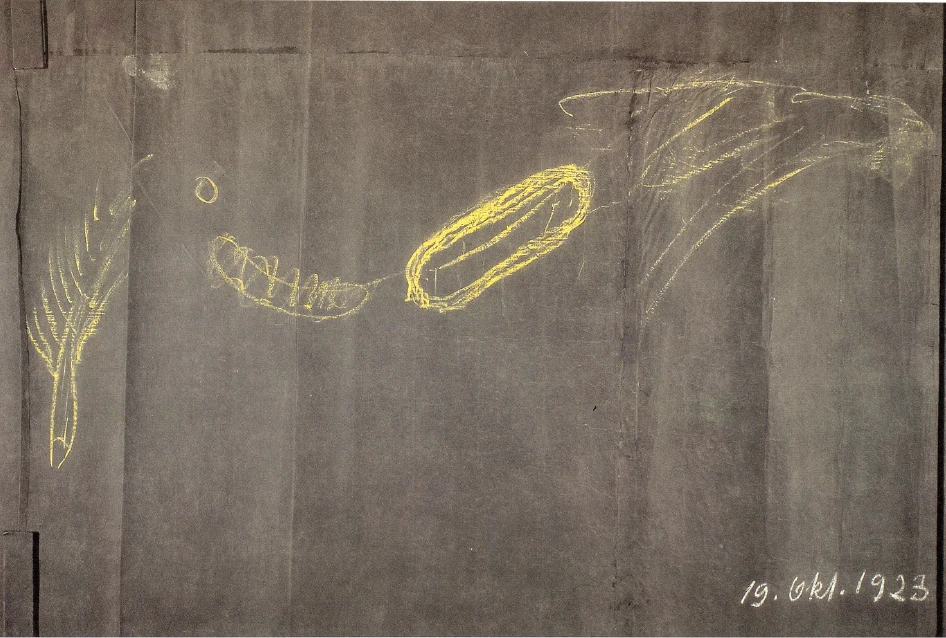
[ 32 ] Compare this entire process with what happens in a bird that lays eggs. There, within the bird itself, the calcareous shell is formed through a process that has undergone metamorphosis. There, the substance of the calcium is utilized by the forces of sunlight to bring together the entire process of what is here laid out in the egg, caterpillar, and cocoon. All of this is brought together where, as in the bird’s egg, for example, the hard shell forms directly around it. There, through this consolidation of a process that has been broken down, the entire embryonic process in the bird is, in fact, different. In the case of the butterfly, you have broken down what takes place in the bird up to this point—up to the third stage—into the formation of the egg, the caterpillar, the pupa, and the cocoon. There, you can observe it externally. And then the butterfly emerges.
[ 33 ] If we now observe the entire process from an astral perspective, what do we see? Yes, the bird, in its entirety, represents a human head. It represents the organ of thought formation. What does the butterfly represent—which also dwells in the air, but is, in its embryonic development, something immensely more complex? One comes to the conclusion that the butterfly represents, so to speak, the continuation of the head’s function—the powers of the head, as it were, extended to the whole human being. Something then takes place within the whole human being that corresponds to a different process in nature than the formation of the bird.
[ 34 ] In the human head, when we include the etheric and astral bodies, we have something very similar to what occurs in the formation of an image, only in a metamorphosed form. But if we had only the function of the head, we would form only fleeting thoughts. Thoughts would no longer settle within us, engage the whole person, and then resurface as memories. When I look at my fleeting thoughts—which I form in response to the external world—and gaze up at the eagle, I say: In the eagle’s plumage I see, outside of myself, thoughts made visible; within me they become thoughts, but they are fleeting thoughts. When I look at what I carry within me as my memories, a more complex process takes place. Down in the physical body, in a spiritual sense, a kind of egg formation takes place—which is, however, something entirely different in the etheric body, something that outwardly resembles the formation of a caterpillar; in the astral body, it is inwardly similar to the formation of a chrysalis or a cocoon; and what, when I have a perception, triggers a thought within me and pushes it downward—that is like a butterfly laying an egg. The transformation is similar to what happens with the caterpillar: life in the etheric body sacrifices itself to the spiritual light, weaving the thought, as it were, with an inner, astral cocoon-like fabric, and from there the memories emerge. When we see the bird’s plumage in our fleeting thoughts, we must see the butterfly’s wing—the iridescent butterfly’s wing—as having come into being in a spiritual way within our memories.
[ 35 ] So we look out and feel a profound kinship with nature. So we think and see the world of thought in the flying birds. And so we remember—this is how we have memory—and see the world of the images of memory living within us in the butterflies fluttering and shimmering in the sunlight. Yes, the human being is a microcosm and contains the mysteries of the great world outside. And it is true that what we observe from within—our thoughts, our feelings, our will, our mental images—we recognize again in the realm of nature when we view it from the other side, from the outside, in a macrocosmic sense.
[ 36 ] This means looking closely at reality. This reality cannot be grasped by mere thought, for reality is indifferent to mere thought; it relies solely on logic. But using that same logic, one can substantiate the most diverse aspects of reality. To illustrate this, let me conclude with an image that will serve as a bridge to tomorrow’s discussions.
[ 37 ] Among an African tribe, the Fellatas, there is a very beautiful story that conveys many things. Once upon a time, a lion, a wolf, and a hyena set out on a journey. They came across an antelope. The antelope was torn apart by one of the animals. The three animals were good friends, and now the question was how to divide the torn-apart antelope among the lion, the wolf, and the hyena. So the lion first said to the hyena: “You divide it.” — The hyena had her own logic. She is the animal that does not cling to the living, but to the dead. Her logic is likely determined by this kind of courage—or rather, cowardice. Depending on whether this courage is one way or the other, it affects reality in one way or another. The hyena said: “We’ll divide the antelope into three equal parts. One part goes to the lion, one part goes to the wolf, and one part goes to the hyena—myself.” — Then the lion tore the hyena apart and killed her. Now she was gone. And now it was time to divide the spoils. So the lion said to the wolf: “Look here, my dear wolf, now we’ll have to divide things differently. You divide it now. How would you divide it?” — Then the wolf said: “Yes, we have to divide it differently now; we can’t all get the same as before, and since you’ve rid us of the hyena, you, as the lion, must of course get the first third. You would have gotten the second third anyway, as the hyena said, and you must get the third third because you are the wisest and bravest of all the animals.” — So the wolf divided the prey. Then the lion said, “Who taught you to divide it that way?” — The wolf replied, “The hyena taught me to divide it that way!” — And the lion did not eat the wolf but took the three portions according to the wolf’s logic.
[ 38 ] Yes, mathematics—that intellectual aspect—was present in both the hyena and the wolf. They made a tripartite division; they divided. But they applied this intellect, this mathematics, to reality in different ways. As a result, their fates also changed significantly. The hyena was eaten because, in the relationship between its principle of division and reality, it offered something different from the wolf, who was not eaten because—in the relationship between his hyena logic (as he himself says, the hyena taught him this)—he applied this logic to a completely different reality. He applied it to reality in such a way that the lion no longer needed to eat him as well.
[ 39 ] As you can see: hyena logic here, hyena logic there—even with the wolf; but when applied to reality, the intellectual and the logical take on an entirely different character.
[ 40 ] This is true of all abstractions. You can do anything in the world with abstractions, depending on how you apply them to reality in one way or another. Therefore, one must be able to look at something like reality in terms of the correspondence between human beings as a microcosm and the macrocosm. One must be able to view human beings not only logically, but in a way that can never be achieved without transforming intellectualism into the artistic dimension of the world. But then, when you can, so to speak, effect a metamorphosis from the intellectual to artistic comprehension and develop the artistic as a principle of knowledge, then you will find what lives within the human being in a human way—not in a natural way—out there in the macrocosm, in the greater world. Then you will find the kinship between the human being and the greater world in a true sense.