

Humanity as the Harmony of the creative, formative, and shaping Word of the WorldGA 230
11 November 1923, Dornach
Translated by Steiner Online Library
Twelfth Lecture
[ 1 ] When one observes how the external-natural is transformed within the human organism—for example, as radically as the mineral, which must progress all the way to the warmth-etheric—one will also discover how that which lives within the natural, organized human being connects to the spiritual. If one imagines—as is so often the case based on the illustrations found in standard textbooks on anatomy and physiology—that that the human being is a solid structure that takes in the external natural elements and retains them almost unchanged within itself, then one will naturally always suffer from the lack of a bridge that must be built from what is in the natural human being to that with which the human being is connected in terms of its true soul.
[ 2 ] At first, one will not be able to find a connection between the skeletal system and the muscular system—which one tends to think of as solid bodies—and, for example, the moral order of the world. One will say: one is simply nature, while the other is something radically different from nature. But once one realizes that all kinds of substantiality are present in human beings, and that everything must pass through forms of substantiality even more ephemeral than muscles and bones, one will find that what is more ephemeral and ethereal can indeed enter into a connection with the impulses of the moral world order.
[ 3 ] We must build on this thought if we wish to connect the considerations we have already made to the connection that human beings have upward, toward the spiritual realm of the cosmos, toward those beings we have referred to as the beings of the higher hierarchies. And so, just as in our previous lectures we focused more on the natural realm, today we will focus—let us say—on what works spiritually and morally among human beings.
[ 4 ] Intellectual, moral: for modern civilization, these have actually become, more or less, conventional terms. The original, elemental sense of the moral and intellectual in the human being has diminished more and more. Modern civilization, for example, through the very nature of a person’s upbringing, increasingly prompts people to ask: What is customary? What has become established as convention? What is a commandment? What is law? And so on. — It pays less attention to what arises spontaneously from within the human being as impulses rooted in that place which is very often, in a vague sense, referred to as the conscience, for example. This inner process of setting one’s own direction and goals is something that has declined more and more in modern civilization. Consequently, the spiritual-moral realm has ultimately become something that today exists more or less within the realm of convention and tradition.
[ 5 ] Older worldviews—namely those that were still sustained by instinctive clairvoyance—drew moral impulses from within the human being, which in turn gave rise to moral impulses. These moral impulses are still present; but today they have become traditional. One need only be clear about just how deeply moral principles, for example, have become traditional. This is, of course, not meant to say anything against the traditional aspect of morality—but just consider: how old are the Ten Commandments? They are taught as something recorded from ancient times. Can we say that today it is common for something similar to what once was the case with the Decalogue—the Ten Commandments—to well up from original, elemental human nature? And from what, then, does the moral-spiritual—which unites people socially, which weaves the social threads from person to person—well up among human beings?
[ 6 ] The only true sources of the moral-spiritual in humanity are what can be called human understanding—mutual human understanding—and the love of humanity built upon this understanding. No matter how closely we examine the origins of humanity’s moral-spiritual impulses—insofar as they play a role in social life—we will find everywhere that, where these moral impulses have arisen in a fundamental way from humanity, they have emerged from human understanding and love for humanity. These latter qualities are the true driving force behind the social, spiritual, and moral life within humanity. And fundamentally, insofar as human beings are spiritual beings, they live among other human beings solely by developing an understanding of humanity and love for humanity.
[ 7 ] Now you may raise a significant question—one that, while not always raised, should actually be on everyone’s mind in light of what has just been said: If love and understanding for others are the true driving forces of human coexistence, how is it that the opposite—misunderstanding and hatred of others—occurs within our social order?
[ 8 ] This is a question that has preoccupied the Initiates more than anyone else. In its original form, the science of initiation has always regarded this as one of its most important questions. But in its original form, the science of initiation also possessed certain means for arriving at the solution to this question. When one looks at conventional science today, one is actually led—when observing human beings (for the soul created by God is, after all, naturally inclined toward understanding and love of humanity)—to ask: Why do these qualities not manifest as a matter of course within the social order? Where, then, do hatred of others and a lack of understanding of others come from? And if we cannot find this lack of understanding and this hatred of others in the spiritual or the soul, we must naturally seek them in the physical-bodily realm.
[ 9 ] Yes, but modern mainstream science tells us what constitutes the physical, bodily aspect of a human being: blood, nerves, muscles, bones. No matter how long one looks at a bone, if one views it solely through the lens of modern natural science, one will not be able to say: “This bone is what incites humans to hatred.” — Or no matter how thoroughly one examines blood according to the principles by which it is examined today, one will not be able to determine in this way: “This blood is what incites humans to inhumanity.”
[ 10 ] However, things were quite different in the early days of the science of initiation. Back then, attention was focused on the physical and corporeal aspects of the human being, and these served as a counterpoint to what was perceived in the spiritual realm through instinctive clairvoyance. When people today speak of the spiritual, they are at most referring to abstract thoughts; for them, these are the spiritual. And if these thoughts seem too insubstantial to them, then all that remains are words, and they write a “Critique of Language,” as Fritz Mauthner did. Through such a “Critique of Language,” one opens the door to allowing the spirit—which has already become thin enough—to evaporate completely into mere abstract thoughts. The science of initiation, interwoven with instinctive clairvoyance, did not see the spiritual in abstract thoughts. It saw the spiritual in forms, in that which was pictorial, in that which could speak and sound on its own. It saw the spiritual in liveliness. Because the spiritual was seen in liveliness, even the physical—the bones, the blood—could be seen as spiritual. In this initiatory science, there were none of the ideas, none of the conceptions of the skeleton that we have today. Today, the skeleton is something that is regarded as having been constructed by a calculating architect for the anatomist or the physiologist. But that is not what it is. As you have seen, this skeleton is formed by the mineral element being driven all the way up into the warmth ether, by the forces of the spiritual hierarchies intervening in the warmth ether, and then the bone forms being shaped from it.
[ 11 ] So anyone who can look at the skeleton correctly will find that it reveals its spiritual origin. And it is truly the case that anyone who looks at the skeleton in its present form—I mean, in the way modern science views it—resembles a person who says: Here I have a printed page; there are letter forms. — He describes these letter forms, but he does not read, because he cannot read. He does not relate what is expressed in the letter forms to what underlies them; he merely describes the letter forms. In the same way, today’s anatomist and natural scientist describe the bones as if they pointed to nothing at all; yet they point to their origin in the spiritual realm.
[ 12 ] This is true of everything that constitutes the physical laws of nature and the ethereal laws of nature. Everything is like a symbol of the spiritual world. And one can only understand these things when one is able to perceive them as symbols from the spiritual worlds.
[ 13 ] But when one is able to look at the human physical organism in this way, one becomes aware of something that belongs to that realm of which the initiates of all times—that is, those who truly were initiates—have said: When one crosses the threshold into the spiritual world, one first becomes aware of something terrifying, something that is not at all easy to bear at first. After all, people generally want to be pleasantly moved by what seems desirable to them. Yet it is simply a fact that one must pass through this terror if one wishes to come to know spiritual reality—that is, true reality itself. For when we consider the human form as it presents itself to us anatomically and physiologically, we realize that it is composed, from within the spiritual world, of two elements: moral coldness and hatred.
[ 14 ] We truly carry within our souls the capacity for love of humanity and for that warmth—that moral warmth—that understands other people. But we also carry moral coldness within the fixed components of our organism. This is the force that, so to speak, binds our physical organization together from the spiritual world. And we carry within us the impulse of hatred. This is what causes the circulation of blood from the spiritual world. And while we may go through the world with a very loving soul—a soul that thirsts for human understanding—we must become aware that in the depths of the subconscious, down there where the soul flows into and impels the physical so that we can have a body at all, coldness resides. I will always speak of coldness; I mean moral coldness, which, however, can indeed, via a detour through the warmth ether, transform into physical coldness. Down there within us, in the subconscious, lies moral coldness and hatred, and a person easily brings into their soul what resides in their body, so that their soul can, as it were, be infected by a lack of understanding of others; but this is the result of moral coldness and hatred of humanity. Because this is the case, human beings must first cultivate moral warmth—that is, understanding of others and love—within themselves, for these must overcome what arises from the physical realm.
[ 15 ] Now, it simply cannot be denied—this presents itself to the spiritual gaze with complete clarity—that our era, our civilization, which began in the 15th century and has become intellectualistic on the one hand and materialistic on the other, is linked to the fact that deep within people’s souls there is a great deal of misunderstanding and hatred toward others. This is more true than one might think. For one only truly becomes aware of how much misunderstanding and hatred of humanity exists in the human unconscious once a person has passed through the gate of death. There, the person draws its soul-spiritual essence out of the physical-bodily. They shed the physical body. The impulses of coldness and the impulses of hatred then reveal themselves as mere natural forces; they are then mere natural forces.
[ 16 ] Let us look at the corpse. Let us look at the ethereal corpse with our spiritual ‘eye’ ourselves at the etheric corpse. We must look upon something that no longer evokes a moral judgment, any more than a plant or a stone does. Whatever moral substance was contained within it has been transformed into natural forces. But the human being has drawn much out of it during his or her life; this is what he or she takes with them through the gate of death. And so the “I” and the astral body withdraw, taking with them—as they draw it out—what went unnoticed during life because it was always completely submerged in the physical and etheric bodies. The “I” and the astral body take with them into the spiritual world all the impulses of hatred toward humanity and coldness toward people that have taken root in the soul. I said that one only realizes how much—especially in our civilization—is instilled in people through various things, which we will discuss later, in the form of hostility toward others and hatred of humanity, when one sees a person pass through the gate of death. For modern human beings carry much of these two impulses through the gate of death—an immense amount.
[ 17 ] But what he carries with him there is, after all, the spiritual remnant of that which is meant to exist in the physical realm—that which is meant to constitute the physical and etheric bodies. Through human ignorance and human hatred, a person carries into the spiritual world the remnants of that which actually belongs to the physical world; and he carries it into that world in a spiritual way. It could never be of any benefit to a person to continue carrying this through the course of time between death and a new birth, for he would be unable to make any progress; with every further step in his development between death and a new birth, he would stumble if he were forced to carry this human folly and this hatred of humanity with him. In the supersensible world, into which the so-called dead enter, one actually sees today a constant flow of currents which, if they were to act as they truly are, would hinder human beings in their progress. These currents—where do they come from?
[ 18 ] If you want to know where they come from, you need only look at life today. People pass each other by, paying little attention to the unique qualities of others. Aren’t most people today of such a nature that each considers their own way of being to be right and good? And when someone else is different, they do not respond to that person with love, but simply come to the conclusion that the other person should be different—which ultimately usually stems from telling themselves: “That person should be like me.” — We don’t always realize this, but it is precisely embedded in social interaction, in the way people relate to one another. In what is brought to light today—I would say in the form of human language—there is so little of what constitutes understanding of another person. People shout out into the world how they imagine a person should be, though most of the time there is nothing behind it other than this: just as one is oneself, so should all people be. When someone comes along who is completely different, then—even if one does not fully realize it—that person is immediately an enemy, someone toward whom one develops antipathy. There is a lack of human understanding, a lack of moral warmth, a lack of love. And to the same extent that this is lacking, moral coldness and hatred of humanity accompany a person through the gates of death, holding them back there.
[ 19 ] But there, since a person’s further development is not merely an end in itself but is the goal of the entire cosmic order—the wise cosmic order—there he first encounters the beings of the third hierarchy: the Angeloi, Archangeloi, and Archai. In the early stages, after a human being has passed through the gate of death into the world that lies between death and a new birth, these beings turn toward the human being and graciously relieve him of the coldness that stems from human ignorance. And we see how the beings of the third hierarchy take upon themselves what the human being carries into the spiritual world in the manner described, as he passes through the gate of death.
[ 20 ] He must continue to bear the remnants of hatred for humanity, for they can only be taken from him through the grace of the second hierarchy—the Exusiai, the Kyriotetes, and the Dynamis. They will then take from him all that remains of his hatred for humanity.
[ 21 ] But by then, the human being has reached, more or less, that region between death and a new birth where the beings of the first hierarchy—the Seraphim, Cherubim, and Thrones—reside: what I have called, in my Mysteries, the midnight hour of spiritual existence. Human beings could not possibly pass through this region of the Seraphim, Cherubim, and Thrones without being completely destroyed inwardly—that is, annihilated—unless they had first been graciously relieved by the beings of the third and second hierarchies of human incomprehension, that is, moral coldness and hatred of humanity. Thus we see how, in order to connect with those impulses that can contribute to his further development, man must first burden the beings of the higher hierarchies with what he carries upward from his physical and etheric nature—where it belongs—into the spiritual worlds.
[ 22 ] However, when one sees through all of this, when one sees how this moral coldness reigns in the spiritual world, then one is also able to assess the connection between this spiritual coldness and what physical coldness is down here. This physical coldness, found in snow and ice, is, after all, merely the physical reflection of that moral-spiritual coldness that exists up there. When one has both before one’s eyes, one can compare them. As a person is thus afflicted with a lack of human understanding and hatred of humanity, one can observe with the spiritual eye how he gradually loses his form, so to speak—how this form more or less melts away, one might say.
[ 23 ] To the spiritual eye of the imagination, a person who has passed through the gate of death actually still looks much the same as they did here on Earth. For what a person carries within them here on Earth are the substances that reside within them in a more or less granular form—let us say, in an atomistic form—but the human form itself is, of course, spiritual. We must be clear about this: it is simply nonsense to imagine a person’s form in physical terms; we must imagine a person’s form spiritually. The physical aspect within it is, so to speak, present everywhere in tiny particles. The form, which is merely a body of force, holds together—in a formative way—what would otherwise fall apart into a heap. If one could grab each of you by the scruff of the neck and pull the form away from you, then the physical and also the etheric would fall down like a pile of sand. The fact that this is not a pile of sand—that it is distributed and takes on form—does not stem from anything physical; it stems from the spiritual. After all, human beings walk about here in the physical world as spiritual beings. It is nonsense to say that a human being is merely a physical being; their form is purely spiritual. The physical, to put it roughly, is a heap of crumbs.
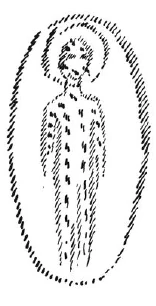
[ 24 ] But this form is still retained by the human being after he has passed through the gate of death. One sees it shimmering, iridescent, glowing with color. Except that a person first loses what constitutes the form of their head; then the rest gradually melts away. And the person is completely transformed, as if into a kind of ‘image of the cosmos,’ during the time when, between death and a new birth, they enter the realm of the Seraphim, Cherubim, and Thrones.
[ 25 ] So, when one follows a human being as they pass between death and a new birth, one sees them, I would say, continuing to weave, as they gradually lose their form from top to bottom. But as the “last” part, so to speak, is lost from below, something has already taken shape—a wondrous spiritual form that is, in itself, like a reflection of the entire world sphere and, at the same time, the prototype of the future head that the human being will bear within themselves. There the human being is woven into an activity in which not only the beings of the lower hierarchies but also the beings of the highest hierarchies—the Seraphim, Cherubim, and Thrones—take part.
[ 26 ] What happens there? What happens there is actually the most wonderful thing a human being can possibly imagine. For what a person has been as a lower human being here in life is transformed into the formation of the head. When we walk around here on Earth, we have only our poor head as the organ of imagination, as the organ that carries thoughts. But thoughts are also the companions of our chest; thoughts are the companions, in particular, of our limbs. But at the very moment when we no longer think merely with our head, but begin to think with our limbs, for example—at that very moment, the full reality of karma dawns upon us. We know nothing of our karma because we always think only with this organ, which is actually the most superficial of all—the brain. The moment we begin to think with our fingers—and one can think much more clearly with the fingers and toes, once one has risen to that level, than with the nerves of the head—the moment we begin to think with that which has not yet fully become matter, with the lower human being, our thoughts are the thoughts of our karma. When we use our hands not merely to grasp but to think, then, thinking with our hands, we trace our karma. And especially with the feet—when we do not merely walk but think with our feet—we pursue our karma with particular clarity. The fact that human beings on Earth are so narrow-minded—forgive me, but I simply cannot think of another word—stems from the fact that they confine all their thinking to this region of the head. But one can think with the whole human being. And when one thinks with the whole human being, the middle region holds a whole cosmology, a wonderful wisdom of the worlds, that is our own. And for the lower regions and for the limbs in general, karma is our own.
[ 27 ] We are already doing a great deal when, here on earth, we observe a person walking—and are not entirely insensitive—but instead follow the beauty of the stride, the distinctive character of the stride; and when, for example, we allow their hands to affect us, interpret those hands, and discover that the most wonderful testimonies to the human inner life lie in every movement of the fingers. But that is only the smallest part of what moves along with the person who walks, who grasps, who moves his fingers. For his entire moral being moves there; his destiny moves along with it; everything that constitutes his spiritual essence moves along with it. And when, after a human being has passed through the gate of death, we can observe how the form there begins to dissolve—first, that which recalls the physical form melts away—then what comes into view is something that, while more similar in appearance to the physical form, announces through its inner nature, through its inner essence, that it is in fact the form of the moral being. And so the human being, as he approaches the midnight hour of existence, enters the sphere of the Seraphim, Cherubim, and Thrones. Then we see how the wondrous metamorphosis takes place there, how, I might say, the form melts away. But that is not what is truly important. It looks as if it were melting away, but in truth the spiritual beings of the higher worlds are working together with the human being—with those who are working on themselves, but also with those who are karmically connected—one human being working on another—to extract from the human being’s former form, from the form of the previous earthly life, that which will then become the form of of the next incarnation, initially in a spiritual form,
[ 28 ] This spiritual form is only then united with what is given to the human being in physical life as an embryo. But up there in the spiritual world, the foot and leg are transformed into the jaw of the head. The arm and hand are transformed into the zygomatic bone of the head. The entire lower part of the human being is transformed into what now becomes the spiritual foundation for the future head. This, I say, is the most wondrous thing one can experience through insight into the world—how this metamorphosis takes place: how, in a sense, an image of the entire world is first created, and how this is differentiated into the form to which all that is moral is attached—but after everything I have mentioned has been stripped away—how what was there is transformed into what will become. And then one sees the human being, as a spiritual form, continuing its journey, back again into the region of the second hierarchy, into the region of the third hierarchy. Now, to this transformed spiritual form—which is, in essence, merely the rudiment of the future head—must be added, so to speak, what will become the organs of the chest, the limbs, and the organs of metabolism. This must be added. Where do the spiritual impulses for this addition come from?
[ 29 ] Yes, the beings of the second and third hierarchies graciously gathered them up when the human being was in the first half of the path. They took them from the human being’s moral nature; they are now bringing them down again and using them to form the foundation for the rhythmic and metabolic-limb human being. Then, during this later phase of existence between death and a new birth, the human being receives the ingredients—the spiritual ingredients—for the physical organism. This spiritual form enters the embryo and carries into it what will now become physical and etheric forces—forces that are, however, merely the physical reflection of what we carry over from our previous life as human incomprehension and hatred of humanity, from which our limbs were spiritually formed.
[ 30 ] If one wishes to have such insights, one must actually acquire a completely different kind of perception than the one required for the physical world. For one must be able to look at what in human beings becomes physical in the way described, emerging from the spirit, and one must be able to bear the fact that coldness—moral coldness—lives in the physical form of the bones, and that moral hatred lives in the physical form of the blood. One must, so to speak, learn once again to look at these things entirely objectively.
[ 31 ] However, when you look closely at these things, that is when you truly begin to realize the difference between the inner being of a human being and what constitutes external nature.
[ 32 ] Do recall the fact I mentioned—that in the flowers of the plant kingdom we see something like the human conscience laid bare. What is out there is, in a sense, the image of our inner life. What we initially have within us are forces that merely appear unrelated to external nature. A bone can only be a bone by hating carbonic and phosphoric calcium—when they occur in mineral form—by withdrawing from them, contracting within itself, and becoming something other than what carbonic and phosphoric calcium are out in nature. One must be able to rise to the realization that, in order for a human being to have a physical form, there must be hatred and coldness within their physical being.
[ 33 ] That is when our words—I would say—take on an inner meaning. If our bones possess a certain hardness, it is good for them; they possess this hardness as a physical reflection of spiritual coldness. If our soul possesses a certain hardness, it is not good for social life. The physical nature of human beings must simply be different from their spiritual nature. It is precisely in this difference that the possibility lies for a human being to be human—that their physical nature is distinct from their spiritual nature. This physical nature of human beings is also different from the surrounding physical world. This is the basis for the necessity of transformation that I have spoken to you about.
[ 34 ] But you see, this important addition to what I once said in the course on cosmology, philosophy, and religion—this necessary addition regarding humanity’s connection to the hierarchies—was something we simply had to include. But we could only introduce it once we had arrived at starting points such as those presented in the most recent lectures. Just as one uses the spiritual gaze to perceive the nature of the individual beings of the mineral, animal, and plant kingdoms here on Earth, so too does one look into the work of the Hierarchies, which proceeds from time to time in the same way that physical natural processes and human labor proceed from time to time down here.
[ 35 ] When one considers life between death and a new birth—that is, life in the spiritual world—one can describe in detail, in just the same way, what a person experiences between death and a new birth, just as one can describe biographically what a person experiences here on Earth between birth and death. And so, I would say, we should actually hope that all the human ignorance and hatred that people carry with them as they pass through the gate of death into the spiritual world will, in turn, be given back to them—that is, that human forms will be created from it, through a process of refinement.
[ 36 ] Over the course of many centuries, however, something very peculiar has emerged in the current development of humanity on Earth. Not all the forces of human misunderstanding and hatred in the spiritual world could be exhausted in the formation of new human beings, in the creation of new human forms. A remnant remained. Over the course of the last few centuries, this remnant has flowed down to Earth, so that in the spiritual atmosphere of the Earth—I would say in the astral light of the Earth—there is an impact consisting of a sum of impulses of hatred and contempt for humanity that exist outside of human beings. These have not become human forms; they flow around the Earth in the astral light. They influence human beings, but not now in what the individual human being is; they influence what human beings form together on Earth. They influence civilization. And within civilization, they have wrought such damage that it compelled me, in the spring of 1914 in Vienna, to speak of how our present civilization is permeated by a spiritual carcinoma, by a spiritual cancer, by spiritual ulcers.
[ 37 ] At that time, people were reluctant to listen to what was said in Vienna during the lecture series that dealt with the phenomena between death and a new birth. But since then, people have already experienced some of what was true in that statement made back then. At that time, people simply lived in a state of thoughtlessness regarding what flows through civilization. They did not see that there were actual ulcers forming within civilization; these only began to break out starting in 1914. Today they manifest as thoroughly corrupted spiritual substances of civilization. One can, however, also view what lives within civilization as a unified spiritual entity. Indeed, it becomes clear precisely for this modern civilization—into which have flowed currents of hatred and coldness toward humanity that were not utilized in the formation of human beings—that what has flowed in there manifests itself as the parasitic element of modern civilization.
[ 38 ] Modern civilization has something deeply parasitic about it; it is like a part of an organism that is riddled with parasites and germs. The ideas that people have accumulated exist without being in a living connection with them. Just think for a moment how this manifests itself in the most everyday occurrences. A person who has to learn something—not because the content of what is to be learned is already there, but because he must sit down and simply learn in order to pass an exam, or to present himself as a proper civil servant, or the like: well, for such a person there is no fundamental connection between what they take in and what actually lives in their soul as a capacity for desire to absorb the spiritual. It is just as if a person who is not predisposed to feeling hunger were constantly stuffing food into themselves. The food does not undergo the transformations I have spoken of; it becomes a burden on their being, and ultimately becomes something that actually attracts parasites.
[ 39 ] Much in our modern civilization that remains as it were separate from human beings—that, I might say, is conceived spiritually as nothing but mistletoe—lives off what human beings bring forth from the original impulses of their hearts and minds; much of it lives in such a way that it manifests as a parasitic existence within our civilization. And for anyone who views this with a spiritual gaze—who, so to speak, sees our civilization in the astral light—it was already evident as early as 1914 that a highly advanced cancerous, carcinomatous formation was present; for such a person, the entire civilization was permeated by something parasitic. But now something else is added to this parasitic element.
[ 40 ] I have, so to speak, described to you in spiritual-physiological terms how the nature of the gnomes and undines, which act from below, gives rise within the human being to the organic possibility of having parasitic impulses. But then, I said, the opposite process occurs. Then the toxic elements are carried down from above by sylphs and warmth elemental beings. And so, in a civilization that bears a parasitic character, such as ours, that which comes from above—that is, what flows in as spiritual truth—is not poisonous in and of itself, but is transformed into poison within the human being, so that, as I described in *The Goetheanum*, the human being rejects it in fear and invents all sorts of reasons to reject it. These two things belong together: a parasitic culture at the bottom, not springing from elemental laws and therefore containing parasites within itself, and a descending poison—a descending spirituality from above—which, as it penetrates civilization, is received by people in such a way that it becomes poison. If you consider this, you have the most important symptom of our present-day civilization. And when one sees through these things, the cultural-pedagogical approach that must act as a remedy simply emerges of its own accord. Just as rational therapy follows from the true diagnosis, the true pathology, so too does therapy follow from the diagnosis of the cultural illness, in that one thing leads to the other. (Plate 20, top right.)
[ 41 ] It is quite clear that humanity today once again needs a form of civilization that comes very close to the human mind and heart—one that springs directly from the human mind and heart. When a child enters elementary school today and is introduced to these letter forms—which, after all, belong to a highly advanced civilization—that it is now supposed to learn as A, B, C, there is absolutely nothing in its heart or mind that relates to them. It has no connection to them whatsoever. What the child develops in its head and mind by having to learn A, B, C is, in spiritual and psychological terms, a parasite on human nature.
[ 42 ] Indeed, throughout our entire educational journey, much of what today parasitically encroaches upon people from civilization is present. Therefore, when a child enters school, we must develop a pedagogical art that draws from the child’s own inner world. We must let the child form colors, and then let them put these color forms—which arise from joy, from disappointment, from all kinds of feelings—onto paper: joy—pain! What the child puts down on paper simply by allowing their mind to unfold is connected to the human being; it produces nothing parasitic. It produces something that grows out of the human being like their fingers, like their nose, whereas what the human being adopts—by being guided toward the products of a highly developed civilization in the form of letters—leads to the parasitic.
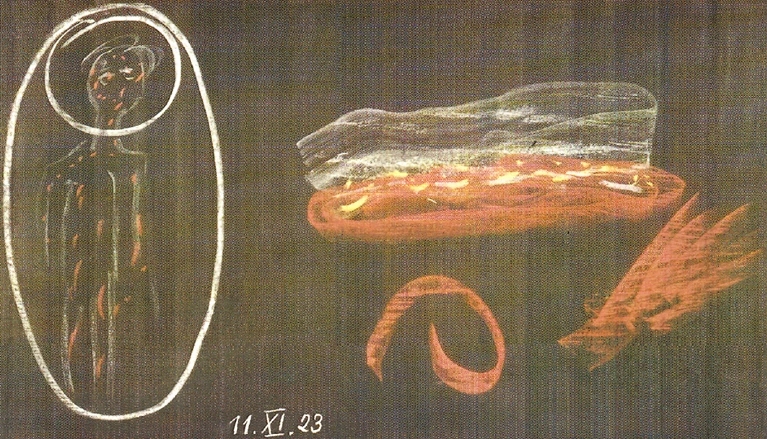
[ 43 ] And the moment we connect the art of education to what lies closest to the human mind and heart, we also bring the spiritual to people without it becoming a poison within them. And there you have, first, the diagnosis: our civilization is riddled with carcinomas; and then the therapy—well, Waldorf education!
[ 44 ] Waldorf education is structured in no different way, my dear friends. It is based on the very same way of thinking that underlies medical thought, but applied to culture. And so you see here, applied to this specific case, what I said a few days ago: that the human being actually progresses from the bottom up—from nutrition through healing—toward spiritual development, and that pedagogy must be regarded as medicine translated into the spiritual realm. But this becomes particularly clear to us when we seek to understand cultural therapy. For we can conceive of this cultural therapy only as Waldorf school pedagogy.
[ 45 ] Of course, you can imagine how one feels when one not only sees through this connection but has also tried to develop Waldorf school pedagogy in practice within this context, and now—amid the general consequences of the “civilizational carcinoma” in Central Europe—conditions are arising that, as you yourself will likely already realize today, are likely to seriously endanger—if not render impossible—what practical Waldorf school pedagogy actually is.
[ 46 ] We should not dismiss such thoughts. We should allow them to remain within us as impulses, so that wherever we still can, we may contribute to the healing of our culture. In many cases, however, this is indeed the reality today: Just as I spoke of the inferiority of Woodrow Wilson—based on a certain spiritual insight—during my Helsinki Cycle in 1913, a man who then became a sort of secular God for many people of civilization, and about whom people are only now—because they have no other choice—beginning to gain some clarity— just as that happened, so too has it happened with what was said back then about the “cancer of civilization.” Well, that is simply how things went back then; today, the same is true of the matters relevant to our time: people are asleep. But it is fitting for us to awaken. And anthroposophy contains within itself all the impulses for a true cultural awakening—for a true cultural awakening of humanity!
[ 47 ] That is what I wanted to tell you in this final lecture.