

The Composition of the Mysteries
GA 232
23 November 1923, Dornach
Translated by Steiner Online Library
First Lecture
[ 1 ] Now, my dear friends, let us use the time we have left here at the Goetheanum for lectures before the Christmas weeks in such a way that those of you here in Dornach who can live in anticipation of the coming Christmas week may take in as much as possible of what the anthroposophical movement can bring into people’s hearts. So that, in particular, those of you who will be sitting here until Christmas will have something to say in your thoughts about precisely what can still happen now—I would say, at the very last hour. Not that I will be speaking about the International Anthroposophical Society—that will be addressed in a few hours at the VersammJung itself—but I will now nevertheless try to structure these reflections in such a way that they can also contribute to the mood that is to prevail then. And so, my dear friends, I will seek to approach what I have already expounded here in recent weeks from a different starting point; today I will begin by leading you, starting from the inner life of the human being itself, to an understanding of the mysteries of the world.
[ 2 ] Let’s start today with something as simple as possible. Let us consider the human soul life as it presents itself when a person engages in inner self-reflection a little further than the point I had primarily in mind when I wrote the articles in The Goetheanum on “The Soul Life.” So let us now go a little deeper into the inner life of the soul in our reflections than was the case in the Goetheanum. To that end, what is written in the Goetheanum in these four articles on the inner life of the soul serves as a kind of introduction, a preparation for what we now wish to consider.
[ 3 ] When we practice self-reflection in a way that is, at first, broad and comprehensive, we come to realize how, in a certain sense, this inner life can intensify. It begins, after all, with allowing the external world to influence us—something we’ve been doing since childhood—and with experiencing what the inner world brings about within us, which is thought. It is precisely this that makes us human: that we allow what the external world brings about within us to live on in our thoughts, to bring it to life inwardly in our thoughts, creating a world of ideas that, in a certain way, mirrors what makes an impression on us from the outside. We may not be doing our inner life any particular good if we dwell too much on how the external world is reflected in our soul. After all, this leads us to nothing more than—I would say—a dimmed image of the world of ideas within ourselves. We practice better self-reflection, however, when we focus more—I would say—on the dynamic aspect, so that we try, for once, to live out our own selves within the elements of thought without looking to the external world; that we continue to pursue in thought what has been before us as impressions of the external world. Depending on their disposition, one person may thus delve more deeply into abstract thoughts. They may or may not construct world systems; they create schemas about all manner of things in the world and the like. Another person, having reflected on the things that have made an impression on them and then spinning those thoughts further, may follow more closely certain imaginative concepts. We will not go into further detail here about how this inner thinking—devoid of external impressions—proceeds according to a person’s temperament, character, or other predispositions, but we want to realize that it is indeed something special for us when we withdraw from the external world with regard to our senses and live for a time in our thoughts and imaginings, spinning them out further, perhaps sometimes merely in the direction of possibilities.
[ 4 ] Some people consider it unnecessary, for example, to further develop one’s existence in thought along the lines of what is possible. Even today, in these difficult times, one often encounters people who have spent the entire day going about their business—doing all sorts of things that are, of course, necessary for the world—and who then gather in small groups to play cards, dominoes, or similar games, in order, as is so often said, to pass the time. However, it is not very common for people to gather in such groups and, for example, exchange thoughts on what might have come of the very same events that took place during the day—in which they were immersed—if this or that had been slightly different. People would not be having as much fun as they do playing cards; but it would be a process of spinning out ideas in their minds. And as long as one retains enough common sense to stay grounded in reality, such mental speculation need not turn into anything fantastical at all.
[ 5 ] This life in thought ultimately leads to what you encounter when you seek to read the Philosophy of Freedom in the right way. If you wish to read the Philosophy of Freedom in the right way, you must be familiar with this feeling: living in thought. The Philosophy of Freedom is something that is experienced directly from reality; but at the same time, it is something that has emerged entirely from genuine thinking. And that is why you find a fundamental feeling precisely in this Philosophy of Freedom. I conceived this Philosophy of Freedom in the 1880s, wrote it down in the early 1890s, and I can safely say: among those people who, at that time, actually had the very task of at least somehow grasping the fundamental essence of this Philosophy of Freedom, I encountered nothing but incomprehension everywhere. And this is due to a specific point. It is due to the following: People—even the so-called thinking people of the present—actually manage, through their thinking, only to experience in it a reflection of the sensory external world. And then they say: Perhaps something from a superphysical world might also come to us through thinking; but it would then have to be the case that, just as the chair and the table are out there—and thought presupposes that they are out there—so this thinking, which is here within, would also have to be able to experience in some way a supersensible reality that can be grasped outside of the human being, just as the table and the chair are outside. — This is roughly how Eduard von Hartmann conceived of the task of thought.
[ 6 ] Now this book, The Philosophy of Freedom, came before him. In it, thinking is experienced in such a way that, within the experience of thinking, one comes to the point where one cannot imagine it any other way than this: If you truly live within thinking, you live—albeit initially in an indefinite way—in the universe. This connection, within the innermost experience of thinking, to the mysteries of the world—that is the very essence of The Philosophy of Freedom. And that is why The Philosophy of Freedom contains the following sentence: “In thinking, one grasps the mystery of the world by the hem.”
[ 7 ] It may be put simply, but the point is that when one truly experiences thinking, one cannot help but feel that one is no longer outside the mystery of the world, but within it; that one is no longer outside the divine, but within it. If one grasps thinking within oneself, one grasps the divine within oneself.
[ 8 ] This point could not be grasped. For if one truly grasps it—if one has made the effort to have that experience of thinking—then one is no longer standing within the world in which one previously stood, but rather one is standing within the etheric world. One stands within a world of which one knows: it is not conditioned by this or that point in physical earthly space, but is conditioned by the entire world sphere. One stands within the etheric world sphere. One can no longer doubt the lawfulness of the world-etheric sphere once one has grasped thinking as it is described in The Philosophy of Freedom. Thus, one attains what can be called an etheric experience. Therefore, when one enters into this experience, one takes a unique step in one’s entire life.
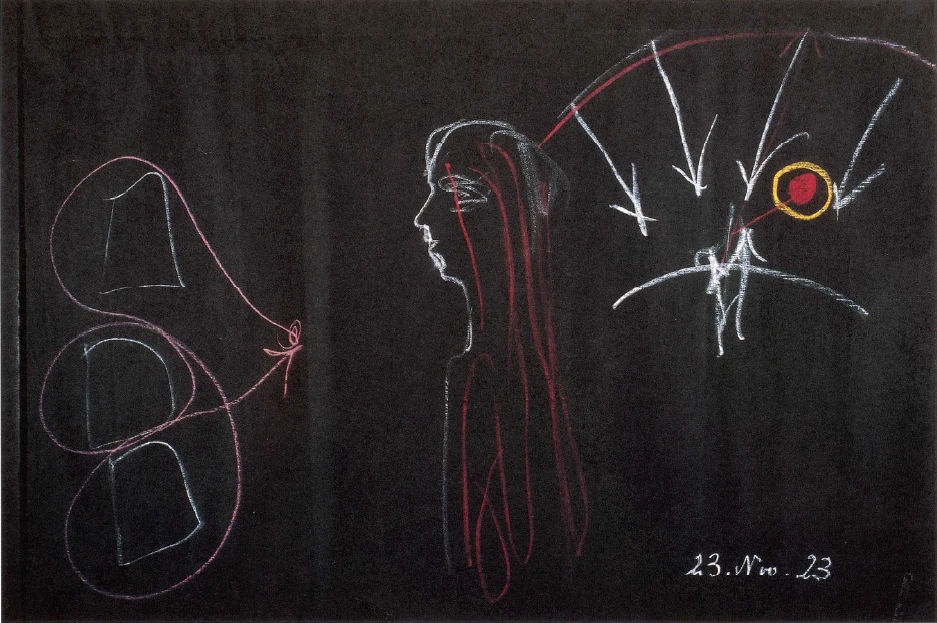
[ 9 ] I would like to describe this step as follows: When one thinks in ordinary consciousness—when one is here in this room—one thinks of tables, chairs, people, of course, and so on; one might also think of something else, but one thinks of the things that are outside. So let’s say—there are various things outside—one encompasses these things, as it were, with one’s thinking from the center of one’s being. Every person is aware of this: one wants to encompass the things of the world with one’s thinking.
[ 10 ] But when one comes to have this experience of thinking that has just been described, one does not grasp the world; nor, I would say, does one merely remain confined within one’s “I-point”—rather, something entirely different happens. One gets the feeling—the very right emotional experience—that with one’s thinking, which is not actually located anywhere, one grasps the inner essence of everything. One feels: one is probing the inner human being. Just as with ordinary thinking—I would say—one extends mental feelers outward, so with one’s thinking—with this thinking that experiences itself within itself—one continually extends inward into oneself. One becomes an object; one becomes an object to oneself.
[ 11 ] This is precisely a very important experience one can have—the realization that: you used to always grasp the world; now, through this experience of thinking, you must grasp yourself. In the course of this quite intense process of grasping oneself, one breaks through one’s own skin. And just as one comprehends oneself inwardly, so too does one comprehend, from within, the entire world-ether—not in its details, of course—but one arrives at the certainty that this ether is spread out over the sphere of the world in which one is situated, in which one is situated together with the stars, the sun, the moon, and so on.
[ 12 ] Now, a second thing that a person can develop in their inner spiritual life is this: instead of initially spinning out and weaving together thoughts that are stimulated from the outside, they allow themselves to be carried away by their memories. When a person surrenders to their memories and does so truly from within, this in turn results in a very specific experience. The experience of thinking that I have just described actually leads one, at first, back to oneself; one comes to understand oneself. And one derives a certain satisfaction from this self-understanding. When one moves on to the experience of memory, however—if one proceeds with true inner depth—it ultimately turns out that the most important emotional experience is not that of coming to oneself. That is the case with thinking; that is why, in the course of this thinking, one finds the freedom that depends entirely on the individuality of the human being. And that is why a philosophy of freedom must proceed from the experience of thinking, for through the experience of thinking, the human being approaches oneself and finds oneself as a free personality. This is not the case with the experience of memory. With the experience of memory, if one is able to take it completely seriously and fully immerse oneself in it, one ultimately comes to feel as though one is actually letting go of oneself, getting away from oneself. That is why those memories that make one forget the present are the most satisfying. I do not mean to say that they are always the best, but in many cases they are the most satisfying.
[ 13 ] One really gets a sense of the value of memory when one can have memories that carry one out into the world, even though one might be completely dissatisfied with the present and actually want to escape from it. If one can develop memories that make one feel more alive by immersing oneself in them, this provides—I would say—a sense of preparation for what memory can become when it grows even more real.
[ 14 ] You see, a memory can become more real by bringing to mind, as realistically as possible, something you actually experienced years or decades ago. I just want to put it as it is. Suppose you go through your old belongings and try to find, say, letters you wrote in connection with a particular matter. You lay these letters out in front of you and, using them as a guide, immerse yourself in the past. Or even better, don’t use letters that you wrote yourself or that others wrote to you, because there’s still too much subjectivity involved; it would be even better if you were able, for example, to take your old schoolbooks and look into them just as you did back then, when you were still actually sitting over those schoolbooks as a schoolboy; that is, if you can truly bring back into your life something that once was. It’s actually quite remarkable: when you do something like this, you change your entire state of mind—the way that state of mind is in the present. It’s very remarkable. And you see, you just have to be a little bit creative in this regard; anything can serve this purpose. Perhaps a lady finds a dress somewhere in a corner that she wore twenty years ago, or something similar, and she puts it on and thereby transports herself entirely back to the situation she was in at that time; in other words, something that brings the past into the present as realistically as possible. This enables you to strongly separate yourself from your present experience.
[ 15 ] When one experiences things with ordinary consciousness, one is actually too close to the experience to make anything of it, I would say. One must be able to stand further away from oneself. Well, a person is more detached from themselves when they sleep than when they are awake; for then they are outside their physical body and their etheric body, together with their “I” and their astral body. You come close to this astral body—which is outside the physical body during sleep—when you recall past experiences into the present as vividly as I have described. At first, of course, you won’t believe this, because you wouldn’t attribute such a powerful effect to something as insignificant as reenacting past experiences—using, for my sake, an old piece of clothing as an example. But the point is really that you should try this out for yourself. And if you try it, and you truly conjure up past experiences into the present so that you can live within them and completely forget the present, you will see that you are drawing close to your astral body, your sleeping astral body.
[ 16 ] But if you expect this to happen in such a way that you simply need to look to the right or left and see a shadowy figure there as your astral body, then you will be mistaken; that is not how things work. Instead, you must pay attention to what actually happens. Something that actually happens in such a case, for example, is that through such experiences you will gradually come to see the dawn in a completely different way than you did before, and you will perceive a sunrise quite differently than you did before. In this way, you will gradually come to perceive the warmth of the dawn as something that heralds the future—something that, in a sense, possesses a prophetic, a naturally prophetic power. You will begin to perceive the dawn as something spiritually powerful, and you will be able to connect an inner meaning with this prophetic power by coming to feel—even though you may at first regard it as an illusion—that the dawn has something in common with you yourself. It is precisely through experiences such as those I have described that you will be able to feel, when you gaze upon the dawn: yes, this dawn does not leave me alone. It is not merely there, and I am not merely here. I am intimately connected with this dawn. It is a quality of my own spirit; in this moment, I myself am the dawn. — And when you have connected with the dawn in such a way that you, so to speak, experience the colorful radiance and glow—the unfolding of the sun from that colorful radiance and glow—in such a way that a sun of dawn arises in your heart as a living sensation, then you also get the impression that you are moving across the vault of heaven with the sun, that the sun does not leave you alone, that the sun is not there and you are here, but that your existence extends in a certain way all the way to the sun’s existence; that you walk through the day with the light.
[ 17 ] But if you develop this feeling—which, as I said, does not come from thinking (for that is how one approaches human beings)—but which can be developed from memory in the manner described; if you develop these experiences from memory, or rather from the power of memory, then the things you would otherwise have perceived with your physical senses begin to take on a different aspect: things begin to become spiritually and soulfully transparent. It is as if, once you have attained the sensation of walking with the sun—having gained the strength in the dawn to walk with the sun—you then see all the flowers in the meadow differently. The blossoms do not merely stand there showing you their yellow or red colors on their surface; rather, the blossoms begin to speak, to speak in a spiritual way to our soul. The blossom becomes transparent. A spiritual aspect of the plant stirs within, and the blooming becomes something like speech. And in this way, one truly connects one’s soul with the outer natural world. In this way, one gains the impression that there is something behind this natural existence, that the light with which one has connected is carried by spiritual beings. And in these spiritual beings, one gradually recognizes the characteristics of what is described in anthroposophy.
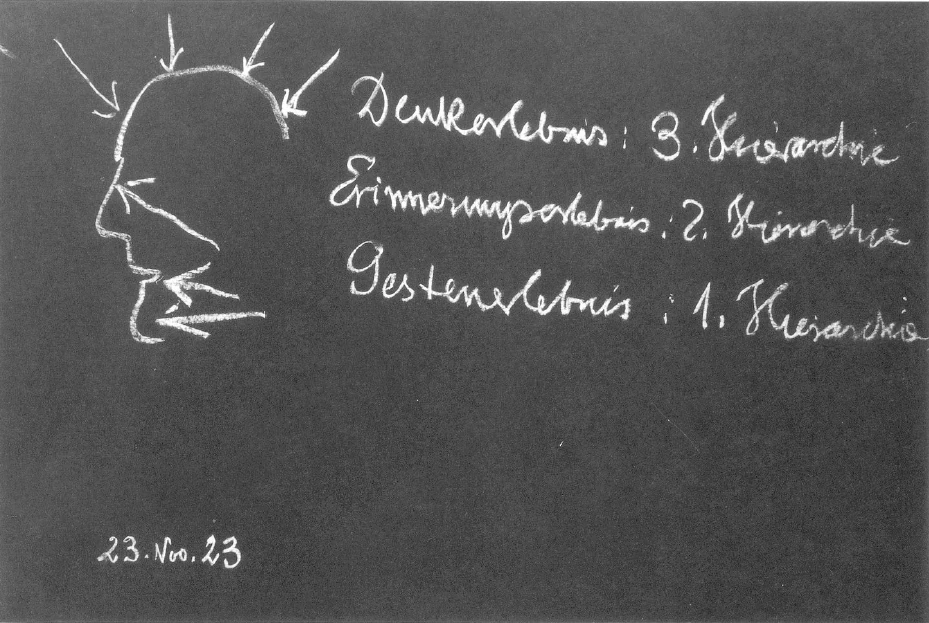
[ 18 ] Let us now consider the two stages of sensations that I have just described. Take the first sensation—the one one can experience as an inner experience through thinking—and this experience expands it; the feeling of being confined to a narrow space ceases entirely. A person’s experience expands; one feels quite distinctly: within us there is a point that reaches out into the entire world, that is of the same substance as the entire world. One feels at one with the entire world, with the ethereal aspect of the world. But one also feels, when standing here on Earth, that one’s foot and leg are pulled downward by Earth’s gravity; one feels bound to this Earth with one’s whole being. At the moment one has this experience of thinking, one no longer feels this connection to the Earth, but rather feels dependent on the vastness of the world sphere. Everything comes in from the vastness (drawing: arrows); not from below, so to speak, upward from the center of the Earth—everything comes in from the vastness. And one already senses this in the human being: especially if one wants to understand the human being, this feeling of “coming in from the vastness” must also be present. (See drawing)
[ 19 ] This extends precisely to the depiction of the human form. If I want to capture the human form through sculpture or painting, I can really only capture this lower part of the human head in such a way that I imagine it emerging from the inner spatial reality, from the inner physical reality of the human being. I will not be able to infuse the right spirit into the work if I am not able to shape the upper part in such a way that I conceive of it as being brought in from the outside. All of this proceeds from the inside out (see arrows); but that (the upper part of the head) is formed from the outside in.
[ 20 ] Our forehead, the top of our head, is actually always positioned there. Anyone who has viewed the paintings in the small dome of the destroyed Goetheanum with an artistic eye will have always seen how this was carried out throughout: the lower part of the face, as it were, as something that has grown out of the human being, and the upper part of the head as something given to him by the cosmos. In times when people felt such things, this was particularly vivid. You will never truly understand a genuine Greek sculptural head form unless you can imbue it with this feeling, for the Greeks created out of such feelings.
[ 21 ] And that's how one feels connected to one's surroundings in the experience of thought.
[ 22 ] And now one might think that this would simply continue in this way—that one would simply go even further out if one were to proceed from thinking, from the experience of thinking, to the experience of memory. But that is not the case; it is different. If you truly develop this experience of thinking within yourself, you will ultimately gain, through the experience of thinking, an impression of the third hierarchy: Angeloi, Archangeloi, Archai. Just as you can imagine the human physical experience here on Earth—in terms of heaviness, the processing of food through digestion, and so on—so too can you imagine the conditions under which the beings of the third hierarchy live, when, through this experience of thinking, instead of walking around on Earth, you feel yourself carried by forces approaching you from the end of the world.
[ 23 ] Thought Experiment: 3. Hierarchy
[ 24 ] Now, when one moves from the experience of thinking to the experience of memory, it is not the case that—if this were the end of the world sphere (see drawing, upper arc)—one could experience all the way up to that point. One can reach such an end of the world when one enters into the reality of this experience of thinking; then one does not go any further out, but rather the situation presents itself differently. Then, for example, there is some object here: a crystal, a flower, an animal. When one moves from the experience of thinking to all that the experience of memory can bring, one looks into this thing.
[ 25 ] The gaze that has reached as far as the expanses of the worlds, when it continues through the experience of memory, sees into things. So it is not that you venture even further out into indefinite, abstract expanses, but rather that the continued gaze sees into things; it sees the spiritual in all things. For example, in the light it sees the spiritual beings active in the light, and so on; in the darkness it sees the spiritual beings active in the darkness. So that we can say: the experience of remembrance leads into the second hierarchy.
[ 26 ] Memory Experience: 2. Hierarchy
[ 27 ] And yet there is indeed something in the life of the human soul that goes beyond memory. Let’s take a moment to understand what goes beyond memories. You see, memory gives our soul its character. You can know with absolute certainty when you encounter a person who judges everything disparagingly, who pours his sour attitude over everything you say to him, who, when you tell him something quite beautiful, responds by telling something quite ugly of his own—and so on—you can know with absolute certainty: in his case, this is connected to his memory. Memory gives the soul its character.
[ 28 ] But, you see: there is something else besides this emotional tinge. We approach a person. He always presents us with ironically downturned corners of his mouth—especially when we say something to him—or he furrows his brow, or he puts on a tragic expression. Or else he looks at us kindly, so that we find inspiration not only in what he says to us, but also in the way he looks at us. Yes, you see, it is interesting to take in all the faces at once with a single glance during some important moment in the course of a lecture: to observe the corners of the mouths in response to something, to look at the foreheads, the stiffness of some faces, the expressiveness of others, and so on. This expresses not only what has remained in the soul as memory and has given the soul a certain nuance of color, but also what has passed from memory into physiognomy, into nuances of gesture, and into the person’s entire demeanor. Well, it is also true that when nothing is transferred in a person—when they display a face that has absorbed nothing at all of the suffering, pain, and joys that have passed through their life—that, too, is characteristic. If their face has remained as smooth as glass, it is just as characteristic as when their face, in its deep furrows, expresses the tragedy of life, the seriousness of life, or indeed some of life’s satisfactions. There, what otherwise remains in the soul and spirit as a result of the power of memory is transformed into the physical form. And this transformation is so profound that, later on, a person’s outward gestures and physiognomy—and inwardly, their temperament—are actually shaped by it. For we do not always have the same temperament in old age as we did as children. The temperament of old age is often a result of what we have gone through in life and what has become an inner, psychological memory.
[ 29 ] What goes on deep within a person can, in turn—although this is more difficult—be brought into reality. It is still relatively easy to bring something to the forefront of our inner vision—something we experienced in childhood or years ago—in order, so to speak, to bring the memory to life. It is, however, more difficult to put oneself in the mindset of one’s childhood, for example, or even to reconnect with one’s former temperament. But the realization of precisely such an exercise can bring immense significance to a person. And in fact, more is achieved when we can deepen this process inwardly in the soul than when we do it outwardly.
[ 30 ] A person has indeed achieved something when, let’s say at the age of forty or fifty—within the limits that are naturally necessary in such matters—he outwardly engages in the games of his childhood; jumping as he did as a child, and so on, when he tries to make the same kind of face he used to make when his aunt gave him a piece of candy when he was eight years old, and the like. This act of transporting oneself back—right down to the gesture, right down to the attitude—in turn brings something into our lives that leads us to the full realization: the outer world is the inner world, and the inner world is the outer world.
[ 31 ] We then enter into the flower, for example, with our whole being, and experience what I would now like to call—in addition to the experience of thought and the experience of memory—the experience of gesture, in the best sense of the word. And through this, we arrive at a conception of how the spiritual acts directly throughout the physical world.
[ 32 ] You cannot fully grasp within yourself, with full consciousness, how you behaved twenty years ago for my sake—in a gesture prompted by some external occasion—without, if you truly take the matter deeply, seriously, and energetically within yourself, also coming to perceive the unity of the spiritual and the physical in all your . Then, however, you will have arrived at the experience of the first hierarchy.
[ 33 ] Gestural Experience: 1. Hierarchy
[ 34 ] The experience of memory allows us to become the dawn itself when we stand before the dawn. It allows us to feel all the warmth of the dawn, to experience it inwardly. But when we ascend to the experience of gesture, then that which meets us in the dawn will unite with everything in the objective world that allows us to experience color and sound.
[ 35 ] When we simply look at the objects around us that are illuminated by the sun, we see them exactly as they appear in the light. We do not see the dawn in this way, especially as we gradually transition from a memory experience to a sensory experience: for what constitutes the experience of color detaches itself from all material existence. The experience of color comes alive, becomes soulful, becomes spiritual; it leaves the space in which the outer, physical dawn appears to us, and the dawn begins to speak to us of the mystery of the connection between the sun and the earth. And we come to understand how the beings of the first hierarchy work.
[ 36 ] We learn to recognize—when we still turn our gaze toward the dawn, when it still appears to us almost as it did before in the mere experience of memory—what the thrones are like. And then the dawn fades away. The colors become beings, come to life, become soulful, become spiritual—they become beings—and speak to us of the relationship between the sun and the earth, as it once was in the ancient Sun Age; they speak to us in such a way that we come to know what cherubim are. And then, when we continue to live in our souls, filled with enthusiasm and awe, enraptured by this twofold revelation of the dawn—the revelation of the Thrones and the revelation of the Cherubim—then, from this dawn that has become a living essence, that which constitutes the essence of the Seraphim penetrates into our very innermost being.
Thought Experience: 3rd Hierarchy
Memory Experience: 2nd Hierarchy
Gesture Experience: 1st Hierarchy
[ 37 ] Well, I have described all of this to you today in order to suggest how, simply by following the soul—from thought to the thoughtful, soul-imbued gesture—a person can also gain within themselves sensations—at first, merely sensations—regarding the spiritual foundations of the world, all the way up to the sphere of the seraphim.
[ 38 ] I just wanted to preface today’s reflections with this as a sort of introduction—reflections that will then lead us from the life of the soul out into the vastness of the spiritual cosmos.