Mystery Sites of the Middle Ages
Rosicrucianism and the Modern Principle of Initiation
GA 233a
6 January 1924, Dornach
Translated by Steiner Online Library
Third Lecture
[ 1 ] Yesterday I spoke to you about the unique form that the communication of spiritual-scientific findings took in the Middle Ages. And this form was, in essence, a final stage that took place before a gate was closed to human spiritual development—a gate that had, after all, been open for centuries: the gate of a certain entry into the spiritual world through natural endowment. This gateway was closed at the time when human beings were, so to speak, to be brought out of the realm of the divine-spiritual will that governed them through their involuntary faculties, and were to find within their innermost being—in their own will—the possibility of developing freedom in the soul, conscious freedom. But all evolutionary processes occur slowly and gradually, step by step. And so it came to pass that what could be attained—not in the form of the ancient mysteries, but in the form of ascending to etheric heights or descending into earthly chasms, directly in connection with the human experience of nature, even if not on the Earth’s surface itself—has now, in the subsequent era, approached humanity in a more unconscious form. Just imagine for a moment what it was like for those individuals who strove for knowledge around the year 1200 and in the following 13th century—who, of course, had heard that students had, until recently, been able to find teachers such as the one I spoke of yesterday— just imagine how those who had this knowledge—and who were now, in a sense, dependent on finding insight solely through human thought—must have fared.
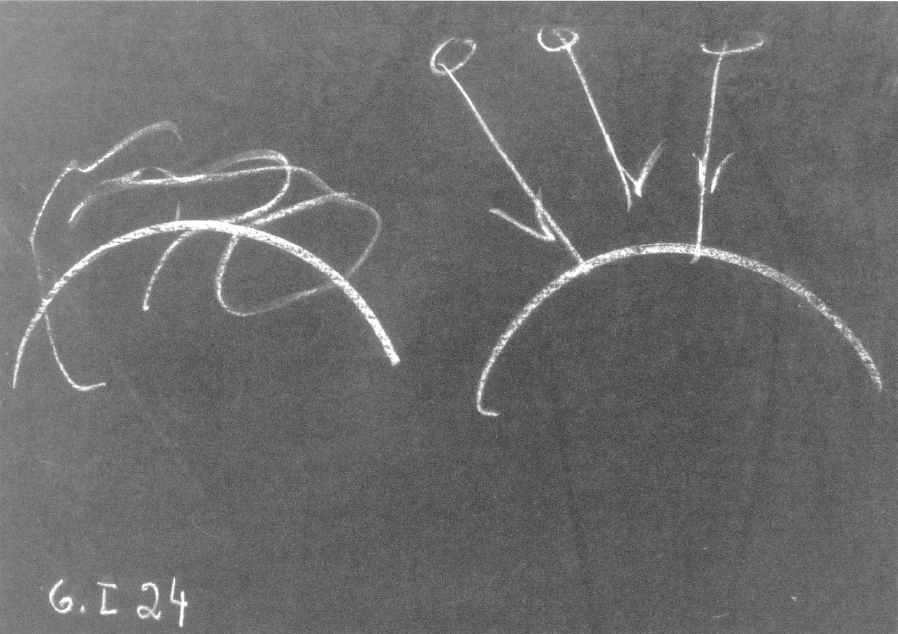
[ 2 ] In the period following the Middle Ages, we see this human way of thinking develop on a much larger scale in a truly impressive manner. We see this human thinking taking paths that sprang from the innermost zeal, from a genuine devotion of the whole human soul. These were, for the most part, the paths taken by the larger circles of people seeking knowledge. But the actual work of spiritual science also continued. And as we move forward a few centuries, we enter the era in which Rosicrucianism itself was founded. But this Rosicrucianism is connected precisely to a transformation in the entire spiritual world as it relates to human beings. And I will best describe this transformation to you by presenting another image here as well.
[ 3 ] Mysteries in the ancient sense of the word were no longer possible from the point in time I have spoken to you about; but people who yearned for knowledge in the spirit of these ancient mysteries—and who experienced profound inner struggles when they heard of the ascent to the mountain or the descent into the earth’s caverns—these people developed within their souls all manner of inner methods and efforts to summon the soul to find the path nonetheless. And the one who can see such things looks, as I said, not into places of mystery, but into gathering places—warmed by an atmosphere of piety—where people seeking knowledge come together. And in fact, what later became both the true Rosicrucian movement and its degenerate, charlatanic offshoot originated with such people who, in their gatherings—in unpretentious gatherings—sought to cultivate their souls in such a way that genuine spiritual insights might still have come to pass. And at one such gathering—which took place in a truly unpretentious setting, in the simple living quarters of a castle-like house—among this small group of people, it happened once that, through shared spiritual exercises that were half contemplative and meditative, and partly prayer-like, they collectively developed a kind of mystical atmosphere—that mystical atmosphere which was later widely cultivated by the so-called “Brothers of the Common Life,” and later still by the followers of Comenius and many other brotherhoods, but which once manifested itself with particular intensity in such a small circle. And while these few people were gathered together with a genuine surrender of their ordinary consciousness—a surrender of their entire intellect in an intensely mystical mood—it came to pass that a being approached them, but this time a being that was not of flesh and blood like that teacher whom the disciple had encountered on the way to the mountain and into the earth’s caverns, but rather a being that could appear in this small community only in its etheric body. And this being revealed itself to be the very same one who had guided that disciple around the year 1200. But it was in a postmortem state. It had descended from the spiritual world to these people, whom it had been drawn to by their devout, mystical, and meditative-contemplative disposition.
[ 4 ] To avoid any misunderstanding, I wish to emphasize explicitly: No mediumistic powers were at play here, for precisely that small community that was gathered there would have regarded any use of mediumistic powers—or even any hint of such powers—as something deeply sinful, based on certain principles that were part of a time-honored tradition. Precisely in the societies of which I am speaking, mediumship and everything related to it was regarded not only as something harmful, but as something deeply, deeply sinful—sinful for the reason that these people knew that mediumship is connected to a particular constitution of the physical body as well, and that the physical body provides the medium with its powers, its spiritual powers. However, those people regarded the physical body as having fallen into sin, and under any circumstances they would have viewed manifestations brought about by mediumistic forces as Ahrimanic or Luciferic forces. These things were still precisely understood at that time, and so nothing of a mediumistic nature had been employed in any way. Instead, it was purely the mystical-meditative mood; and it was that intensification of the mystical-meditative mood—brought about by the unity of souls—that, through its own volition, conjured up that disembodied human being, that purely spiritual yet human being, into this circle.
[ 5 ] And this being said in a very solemn manner: “You are not yet prepared for my appearance, but I am among you, disembodied, without a physical body, because the time has come when initiates of the old order cannot appear for a brief period of earthly existence in a physical body.” That time will come again when the Michael period dawns. I have come to you to reveal that the inner being of humanity has remained unchanged, that the inner being of humanity, if it behaves in the right way, can find the path to divine-spiritual existence. But for a time, the human mind will be such that it must be suppressed so that the spiritual may speak to the human soul. Therefore, remain in your mystical and devout state of mind. By giving you this shared image, this shared vision, I could only point you toward what is to take place within you, but you will continue to experience the continuation of what you have already experienced.
[ 6 ] And lo and behold, three members of the circle that had gathered there were indeed chosen to establish a special connection with the spiritual world—not through any mediumistic powers, but through the continuation of that mystical, meditative, and devout atmosphere. And with these three, who were then especially protected by the others in this circle and truly cherished, it turned out that from time to time they experienced a kind of mental absence. In terms of their outward physical appearance, they became radiant, taking on something like a glowing countenance and sunlit eyes, and during this time they wrote down symbolic revelations they received from the spiritual world. These symbolic revelations were the first images through which the Rosicrucians were revealed what they were to know about the spiritual world. These symbolic revelations contained a kind of philosophy, a kind of theology, and a kind of medicine.
[ 7 ] And this remarkable thing turned out to be true: The others—it seems to me that there were four of them, so that the group as a whole consisted of seven—the others were able, through what they had experienced in the sun-drenched eyes and the radiant countenance of their three brothers, to express in ordinary language what was contained in the symbols. The brothers who were destined to bring these symbols out of the spiritual world could only write down these symbols, and when they returned to their ordinary state of consciousness, they could only say: “We have walked among the stars and the star spirits and have found there the ancient teachers of the secret knowledge.” — They themselves could not translate the symbolic images they recorded into ordinary human language. The others could, and did so. And much of what then found its way, in part, into philosophical-theological—but no longer ecclesiastical-theological, rather secular-theological—and into medical literature, originally sprang from the very source just described. And in smaller circles organized by the first Rosicrucians, what had been preserved from the spiritual world in the form of such symbols was then disseminated.
[ 8 ] Time and again, between the 13th and 15th centuries, opportunities arose to experience such things within very small circles. Much from the spiritual world was revealed to people in this or a similar way between the 13th and 15th centuries. Those who were then tasked with interpreting what was revealed in images were not always able to render it truly faithfully. Consequently, some of what you can still find today in the philosophy of that era has a character that is not entirely clear in itself, and one must then seek out its true meaning for oneself from within the spiritual world. But at least the possibility existed for those who were aware of this kind of revelation from the spiritual world to build upon such revelations.
[ 9 ] But you can imagine how strange the mood of these people must have gradually become—those who received these highest insights — for that is how what was given to them was recognized —, who had to receive such supreme insights from a source that was actually becoming increasingly unsettling to them, because they did not look into the world from which these mysteries came, since ordinary consciousness did not extend that far. That is why it was so obvious that such things could very easily lead to charlatanism, indeed to fraud. And at no other time in human development have charlatanism and the highest truths in revelation been so close to one another as in this era. It is difficult in this era to distinguish the genuine from the false, which is why many regard the entire Rosicrucian movement as a form of charlatanism. One can understand why this happens, for the true Rosicrucians are exceedingly difficult to find among the charlatans, and the whole matter becomes particularly questionable because one has always had to assume that spiritual revelation originates from sources that, by their very nature, remain hidden at first.
[ 10 ] And it was the case that those who were gradually, so to speak, gathered by the first Rosicrucians into a larger brotherhood always appeared, in a sense, as unknown figures, showing up here and there in the world—mostly, at that time, as physicians— healed the sick, and on these occasions, while practicing medicine, simultaneously disseminated insights. It was indeed the case that a great deal of knowledge was disseminated at that time, about which one must say: Its dissemination had a somewhat awkward character, because the people who carried it out could not at all explain the connection they had with the spiritual world.
[ 11 ] But something else took shape within this endeavor of spiritual research and spiritual insight. It is, after all, something incredibly beautiful when you look at it this way: There are three brothers and four others—three brothers who, in what they can offer the world, can only achieve their purpose if the other four work together with them. They are absolutely dependent on one another. The three receive their revelations from the spiritual world; the four are able to translate them into ordinary human language. What the three provide would be completely incomprehensible images if the other four were unable to translate them. And conversely, the other four would have nothing at all to translate if the three did not receive their revelations in the form of images from the spiritual world.
[ 12 ] As a result, what emerged within such communities was precisely what, during these centuries, was regarded in certain circles as the very essence of humanity: inner spiritual brotherhood, brotherhood in knowledge, and brotherhood in spiritual life. It was precisely through their striving that these small circles came to know the true value of brotherhood. And they gradually felt more and more that humanity’s development toward freedom is such that the bond between human beings and the gods would be completely severed if it were not sustained by such brotherhood, in which people are truly dependent on one another.
[ 13 ] What is to be described here is something of extraordinary spiritual beauty. And there is a certain magic about much of what was written back then that can only be understood once one realizes that this atmosphere of human brotherhood—which permeated the spiritual life of many circles in Europe at that time—shone brilliantly through in these writings. But the whole thing was—and this became increasingly apparent—immersed, among those who strove for knowledge in this way, in a mood that made people anxious. Because one could not access the sources of spiritual revelation, in the end one could no longer know at all whether these revelations were of a good or evil nature. And alongside all the good in these movements of that time, a certain anxiety about certain influences made itself particularly felt. This anxiety then spread to large segments of the population, who were afraid—deeply afraid—of all knowledge.
[ 14 ] This mindset can be studied particularly well in the lives of two individuals. One is Raimund von Sabunda, who lived in the 15th century and was born around 1430. Raimund von Sabunda is a remarkable figure. When one delves into his thoughts and the legacy he left behind, one gets the feeling that it is almost the same revelation that the teacher of the mountains and the earth’s fissures imparted to his student around the year 1200—imparted with full awareness. — And yet, at the same time, the whole is steeped in more vague and impersonal expressions—of a philosophical, theological, and medical nature—in the work of Raimund von Sabunda in the 15th century. But this stems from the fact that Raimund von Sabunda, too, had received his revelations indirectly through the true Rosicrucianism—that is, along the path opened up by the great initiate of the 12th century, whose influence I have described to you, who continued to exert an inspiring influence from the spiritual world on everything I have outlined today. For, in essence, it was from him and those who were with him in the spiritual world that all those revelations emanated, which then flowed through the Rosicrucian movement in the way I have often described for the Rosicrucian movement. He set the tone. But fear now took hold of such spirits. Raimund von Sabunda was a courageous, bold spirit—one of those people who are capable of appreciating ideas and who know how to live within them. Therefore, while one does sense in him something of the vagueness that stems from the fact that the revelations do indeed originate from the spiritual world, one detects in him no trace of any anxiety, no fear of knowledge. All the more, what emerged in this way from that spiritual current appears particularly characteristic in another thinker, Pico de Mirandola in the 15th century.
[ 15 ] Pico de Mirandola, who died young, was a truly remarkable mind. If one delves into what he conceived and devised, one sees at work throughout his thinking and his reflections the very same inspiration I have just characterized: the continuation of the wisdom of that ancient initiate, via the detour through the Rosicrucian movement. But one observes a kind of retreat in Pico de Mirandola, a retreat from this insight. He asserts, for example: Everything that happens on Earth—that stones are formed on Earth, that plants live, grow, and bear fruit on Earth, that animals live on Earth—none of this stems from the forces of the Earth. — If anyone were to believe that the Earth exists and that the forces of the Earth bring about what is on Earth, they would hold a false view. The correct view, according to Pico de Mirandola, is that it is the stars, and that everything that happens on Earth depends on the stars. According to Pico de Mirandola, even the smallest thing that happens on Earth depends on the stars. One must look up to the heavens if one wishes to understand what happens on Earth. And it is already in the spirit of Pico de Mirandola to say: “You shake my hand, my fellow human being, but it is not merely your own feeling that causes you to shake my hand; rather, it is the star above you that gives you the impulse to shake my hand.” — Ultimately, everything is brought about by that which is rooted in the heavenly and the cosmic, and only its reflection occurs on Earth.
[ 16 ] Pico de Mirandola expresses this as a firm conviction, and at the same time he says: But human beings are obligated not to look to these celestial causes, but to consider only the immediate cause on earth. — From this perspective, Pico de Mirandola—and this is exceptionally characteristic—opposes the astrology he inherited. He knows that ancient, true, authentic astrology finds expression in human destinies. He knows this; he regards it as a truth. Yet he says that one should not practice astrology; one should seek only the proximate causes.
[ 17 ] Do you see what is actually at work here? For the first time, we encounter—in a very peculiar way—the idea of the limits of knowledge, but, I would say, in a form that is entirely human. If you later look at Kart or Du Bois-Reymond, you’ll be told: Human beings cannot transcend the limits of knowledge; this is based on an inner necessity. — That is not the case with Pico della Mirandola in the 15th century; rather, he says: Yes, what exists here on Earth is brought about by cosmic causes, but human beings should refrain from seeking to understand these cosmic causes. Human beings should confine themselves to the Earth.—And so, in the 15th century, we encounter the voluntary renunciation of the highest knowledge in a figure as distinctive as Pico de Mirandola. This is a cultural-historical spiritual fact of the most far-reaching significance imaginable. At that time, it simply came to pass that people said to themselves: We want to renounce knowledge. — And indeed, what unfolds outwardly in a personality such as Pico de Mirandola has its counterpart in the spiritual realm.
[ 18 ] Once again, it was in one of those unassuming meeting places of the Rosicrucians where, during a ritual performed specifically for this purpose, the sacrifice was offered in the most solemn manner in the 15th century—in the second half of the 15th century—to the knowledge of the stars. And one might say: What took place during that ritual—performed once, with special solemnity—was this. People stood before a kind of altar and said: We now wish to feel responsible not only for ourselves, or our community, or our people, or the humanity of the present, but we wish to feel responsible for all human beings who have ever lived on Earth. We want to feel that we belong to all of humanity. And we feel that humanity has undergone something that constitutes a departure from the rank of the fourth hierarchy, a descent too deep into matter—this is how the Fall was understood. Therefore, so that humanity may return once more to its rank within the fourth hierarchy and, through free will, may find what the gods once sought for it and with it, let higher knowledge be sacrificed for a certain time. — And certain beings of the spiritual world, who are not of the human kind and do not descend to Earth in human incarnation, have accepted this sacrifice in order to achieve certain goals in the spiritual world—goals that would take us too far afield to discuss here, a topic to be addressed another time. In return, however, the impulse toward freedom from the spiritual world was made possible for human beings.
[ 19 ] I cite this ritual scene because I want to use it to tell you that, in fact, everything that happens in external, physical, and sensory life has spiritual counterparts—we simply have to look for them where they are. For sometimes a single ritual act—performed not by what I would call “those in the know” in this context, but by individuals who are connected to the spiritual world—sometimes such an act carries significance from which impulses radiate out to an entire culture or civilizational movement. Anyone who wishes to understand the fundamental character of an epoch must seek the corresponding spiritual source of the forces that permeated that period.
[ 20 ] What followed—that which was produced in the spiritual realm, in the truly spiritual-spiritual sense—was an echo of such creative activity emanating from unknown spiritual worlds. And well into the 19th century, alongside the development of external materialism, it was always possible to encounter individual spirits who lived under the aftereffects of that renunciation of higher knowledge.
[ 21 ] I’d like to sketch out, at least in a few broad strokes, a type of person who lived from the 15th century through the 16th, 17th, and 18th centuries. A type of person whom one might have found somewhere out in the village gathering herbs for pharmacies, or engaged in some other unassuming occupation. We must imagine a personality of this sort. One encounters her when one has an interest in the unique manifestations of the human being in this or that individual; one encounters her, this personality. At first, they are extremely reserved, speak little, or divert one’s attention from what one might be seeking in them by using insignificant, deliberately trivial phrases, through which they seek to create the impression that it is not worth the trouble to converse with them. But if one understands not to focus always on the content of the words a person speaks, but rather on the sound of their words, on the way they come from them, then one would continue to listen to such a person nonetheless. And when, out of some karmic connection, they gained the impression that they should speak, they began to speak cautiously, and one discovered that one was in the presence of a kind of sage. But what he said was not, however, stellar wisdom. Nor was what he said earthly wisdom. There was not much in him at all of what is now called spiritual science, but there were warm, heartfelt words—moral instructions of a far-reaching nature—which were, however, presented unsentimentally, in the form of proverbial sayings.
[ 22 ] You could hear something like: “Let’s go to that tree. My soul can creep into the needles, creep into the pinecones, for my soul is everywhere.” When it creeps into the pine cones and the needles, it looks out through the pine cones and needles into the depths and distances of the world, and then one becomes one with the whole world. And that is true piety—when one becomes one with the whole world in this way. Where is God? God is in every pine cone. And whoever does not recognize God in every pine cone, whoever seeks God anywhere other than in every pine cone, does not recognize the true God. — I simply want to describe how people like those I have described spoke. That is how such people spoke. They also said, for example: “Yes, and then, when you crawl into the pinecones and the needles, you discover how God rejoices over the people of the world.” But if one descends very deeply into one’s own heart, into the abysses of the innermost being of human nature, then one also finds God—but then one learns to recognize how He grieves over the sins of humankind. This is the sort of language these unassuming sages spoke. A large number of these unassuming sages possessed certain—I would say in today’s language—editions of the old Rosicrucian illustrations. They showed them to precisely those people who approached them in such a way that they opened up. But precisely when these illustrations—which circulated among these people in unpretentious, rather poor-quality prints—were discussed, the conversations took a curious turn. Some people, even though they took an interest in the unassuming sages, were seized by a certain curiosity about what these strange Rosicrucian images actually meant; they asked questions, and they received no real, precise answer from these individual sages—who were regarded as eccentrics—but only the hint: “If you really immerse yourself in them, you can look into the spiritual world through these figures, as if through a window.” — They described more what they could experience emotionally through them than they offered any interpretations or explanations of the figures. And sometimes, after hearing such expressions of the individuals’ emotional responses to these figures, one could not quite make sense of it with thoughts, for they were not offering thoughts. But it had an immensely significant aftereffect. One did not merely walk away with a warm heart, but with the feeling: You have gained an insight that lives within you, one that you cannot even put into words.
[ 23 ] And that was one of the ways—alongside the others I have described to you—in which, in an emotional sense, humanity and divinity were proclaimed and spread far and wide during this era, from the 14th and 15th centuries through the end of the 18th century. One cannot quite say it was wordless, but one can say it was without ideas—though not, for that reason, without substance. Much was accomplished in this era through the silence of thought among people. And no one can truly grasp the character of this era without realizing how much was achieved through the silence of thought—as people exchanged their souls, not merely their words.
[ 24 ] With this, I wanted to describe to you yet another aspect of that transitional era in which freedom flourished among people. In the near future, I will have the opportunity to discuss various aspects of this topic in a variety of ways. Here, I simply wanted to follow up—and add a few additional points—on what took place during the conference, and to elaborate on a few other matters.