Anthroposophy
A Summary After Twenty-one Years
GA 234
10 February 1924, Dornach
Translated by Steiner Online Library
Ninth Lecture
[ 1 ] You saw yesterday—and no doubt also in the preceding lectures—what significant perspectives open up regarding the whole of human existence and its connection to the world when one considers the human capacity for memory. Let us therefore consider today the capacity for memory in and of itself, as it appears to us in its various phases throughout human life; first, the capacity for memory prior to the ordinary consciousness that a person possesses between birth and death.
[ 2 ] Human beings transform what they experience, so to speak, in the course of their everyday lives—what they go through with all their thinking, feeling, and willing, and through the development of their physical powers as well—into memories; and from time to time, in their inner life, they return to the mental images of what they have experienced.
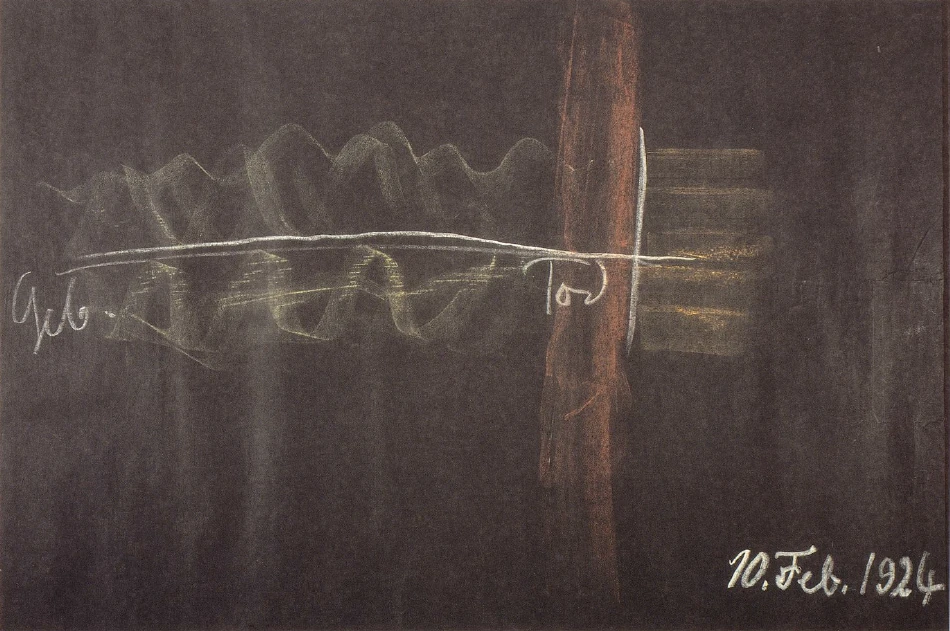
[ 3 ] But if you compare these images of memory—whether they arise spontaneously or are deliberately sought out—in their shadowy nature, in their mere existence as thoughts and ideas, with the robustness of the experiences to which they refer, you will say to yourself: Memories are, after all, just images. But as images, they are what we retain within our “I” from our experiences in the external world. We carry these memories with us, so to speak, as the treasure we have accumulated from our experiences. And if, in cases of illness—as I have also mentioned—we lose any of these memories, then this constitutes a deterioration of our “I” itself. We feel that our innermost being, our “I,” has been impaired when, in cases of illness, it must omit this or that from the treasure trove of memories that makes our life a whole. One could also point to the terrible conditions that sometimes arise in other contexts—such as with strokes—when certain parts of one’s past life are erased from memory. — When we look back from a certain point in our lives at the existence that has passed since our last birth, we must already sense and perceive the interconnectedness of our memories in order to truly regard ourselves as spiritual beings.
[ 4 ] These are a few characteristics that shed light on what the capacity for memory is during our physical life on Earth. It is, of course, much more than that. What would the external world mean to us, with its ever-renewing impressions, with all the vividness it offers—what would it mean to us if we were not able to connect these new impressions to what we already remember! And last but not least, one may say: Yes, all learning ultimately consists in linking the new material presented to a person to what they already carry in their memories. A large part of school methodology is based, after all, on finding the most rational way to link the new material we must teach children to what we can draw from the treasure trove of their memories.
[ 5 ] In short, wherever it is important to bring the external world into contact with the inner life, to awaken the inner life itself so that it can feel and inwardly experience one’s own existence—all of this ultimately appeals to memory. So we must conclude that memory constitutes the most important and by far the most comprehensive part of a person’s inner life during their earthly existence.
[ 6 ] But now let us consider this memory from yet another perspective. It is easy to see that this memory—the sum of the memories we carry within us—is actually a fragment. We have forgotten many things in the course of our lives, but there are moments in life—sometimes even morbid moments—when things long forgotten resurface. And in particular, it is in those moments when a person is approaching death that all sorts of things—which had already drifted far from their conscious memory—resurface. Dying elderly people suddenly recall things that had long since faded from their conscious memory. And if one studies dreams—which, after all, are also linked to memory—in real depth, one certainly finds that things emerge in dreams that one has most certainly experienced, but which one passed by without paying attention to—things one, so to speak, did not take note of—and which are nevertheless present in the life of the soul and surface precisely when the obstacles of the physical and etheric organisms are not at work, when the astral body and the “I” are alone in sleep. People usually do not pay attention to this. And so it does not occur to them that conscious memory is only a fragment of what we take in, and that we actually take in much of life in the same way—only directly into the subconscious—and then process it internally.
[ 7 ] Well, as long as we live our earthly lives, we regard whatever may emerge from the depths of the soul in the form of memories as the essence of memory. Thoughts of past experiences come and go; we seek them out. We regard this as the essence of memory.
[ 8 ] When we pass through the gate of death, our earthly existence is followed by days in which, as in a vast panorama, the images of the earthly life that has just passed appear. They are suddenly there. What happened many years ago is present at the same time as what happened just a few days ago. Just as spatial elements exist side by side and have only a spatial perspective, so too does the temporal aspect of our experience now exist side by side and has an inner temporal perspective; but it is suddenly there. Yet, in the brief time that it is there, it becomes ever more shadowy and faint, ever more subdued. Whereas in our physical earthly life we look within ourselves and feel that the images of our experiences lie there as memories, as if rolled up within us; now these images grow larger and more powerful. We feel as if the images of our memory are being absorbed by the world. What, after death, initially encompasses only a narrowly defined area within this tableau of memories grows ever larger, but in doing so also becomes ever more shadowy, until we find it expanded into a universe—yet it has grown faint, so that we can scarcely even sense what we once saw clearly. We sense it. And then it vanishes into the vastness; it is no longer there.
[ 9 ] This is the second form that memory takes on—in a sense, the second metamorphosis—immediately in the days following death. This is the phase in which we can say that our memories fly away into the vastness of the universe. Everything with which we have so closely linked our existence between birth and death—just as we have with memory—all of that expands, grows vast, becomes ever more shadowy, and finally vanishes into the vastness of the universe.
[ 10 ] It is as if we were to see that “I”—which we have actually referred to as our “I” during our earthly life—fade away into the vastness of the universe. And the end result of the few days in which we experience this is that we must say to ourselves, in the face of our fading memories: We ourselves are being scattered, expanding into the universe—expanding so far into the universe that we experience the moment when we feel, in that which we have felt ourselves to be between birth and death, as if we were being taken away by the vastness of the universe.
[ 11 ] After we have, so to speak, gone through this supersensible numbness, this supersensible powerlessness that has robbed us of our inner awareness of earthly existence within the sum total of our memories, we then come to life again in the third phase of memory. And this third phase of memory teaches us: Yes, that which we designated as our “self” during our earthly existence with the help of memories has dispersed into the vastness of the universe; it has, so to speak, proven its nothingness to us and for us. And if we were only what could be preserved in our memories between birth and death, we would be nothing within a few days of our death.
[ 12 ] There we plunge into something entirely different. There we realize: we cannot hold on to our memories. What exists within us as our memories—we cannot hold on to it; the world takes it away from us after death.
[ 13 ] But behind all the memories we have cherished during our earthly life lies an objective reality. The spiritual counterpart I spoke of yesterday is inscribed in the world. And we now immerse ourselves in this spiritual counterpart to our memories. As we have gone through our experiences from birth to death, we have experienced this and that with this person, with that plant, with that spring, with everything we have encountered during our lives. Nothing of all that we have experienced remains uninscribed in its spiritual counterpart within the spiritual reality, in which we always exist alongside physical reality. Every handshake we have exchanged with any person has its spiritual counterpart. This is inscribed in the spiritual world; it is there. Only during the first few days after death, as we look back on our lives, do we have the images of that life before us. In a sense, they obscure from us what has been inscribed in the world itself through our actions, our thoughts, and our feelings.
[ 14 ] At the very moment we pass through the gate of death into what we might call the “other life,” we are filled with what presents itself to us in that tableau of life, which contains images—images that, in perspective, extend back to birth and even beyond it. But what appears there as images simply fades away into the vastness of the universe. And then the spiritual counterparts of all the deeds we have undergone up to the time of birth become visible. Everything we have experienced becomes visible in the form of spiritual counterparts, but in such a way that we now receive the immediate impulse to truly retrace our steps, to go through all these experiences once again. After all, when a person walks from Dornach to Basel, they usually know that they can also walk from Basel to Dornach, because here in the physical world, people have a corresponding sense of space. But in their ordinary consciousness, people do not realize that just as they journey from birth to death, they can also journey from death back to birth. In exactly the same way that, when one walks from Dornach to Basel in the physical world, one can also walk back from Basel to Dornach, so too, just as one walks from birth to death during one’s physical earthly life, one can now walk from death to birth.
[ 15 ] And this is done in the spiritual world by retracing the spiritual counterparts of all the experiences one has gone through here during one’s earthly life. You’ve had an experience with something in the non-human realm of nature; let’s say you’ve had an experience with a tree. You’ve looked at this tree, or you’ve cut it down as a lumberjack. All of this has a spiritual counterpart. Above all, it has significance for the entire universe, for the spiritual world, whether one merely observed a tree, whether one cut it down, or whether one did anything else with it; whatever one can experience with the physical tree, one has experienced it in physical earthly life; whatever this experience has as a spiritual counterpart, one now experiences in reverse, from death back to birth.
[ 16 ] If one has had an experience with another person—say, if one has caused that person pain—there is already a spiritual counterpart in the physical world; only, it is not our experience; it is the pain that the other person is experiencing. For us, the cause of this pain may even have been a certain sense of satisfaction derived from the fact that we caused them pain. Revenge or something of that sort filled us. As we now retrace our life, we are not reliving our own experience, but theirs—what they experienced as a result of our action. This, too, is part of the spiritual counterpart and is inscribed in the spiritual world. In short, a person relives their experiences in a spiritual way, moving backward from death to birth.
[ 17 ] This experience is connected—as I already said yesterday—with the fact that we sense, in this experience, how beings that are, at first, superhuman participate in it. As we work our way through these spiritual counter-images of our experiences, it is as if the sympathies and antipathies of the spiritual beings—who have precisely these sympathies and antipathies toward our actions and thoughts in this retrospective experience—were constantly trickling down from above. And in this retrospective experience, we feel—for each and every thing we have accomplished on Earth from within ourselves, whether in thoughts, feelings, impulses of will, or deeds—we experience for each and every one how much it is worth for existence oriented toward the spiritual in general. We experience, with bitter pain, the harmfulness of any deed we have committed. We experience, with a burning thirst, the passions we have harbored in our souls. We experience these passions with such burning thirst until we have sufficiently experienced the worthlessness of being driven by passion for the spiritual world and have transcended this passion, as it is dependent on the physical personality on Earth.
[ 18 ] When we consider this, the nature of the boundary between the spiritual and the physical may become very clear. You see, people tend to view things like thirst or hunger as purely physical phenomena. Certainly, because thirst and hunger are certain physical changes within the organism. But just imagine for a moment that the same physical changes that occur in a human body when a person is thirsty were to occur in any body that is not animated by a soul. The same changes might be present, but the unanimated body would not experience thirst. As a chemist, you can investigate what changes occur within you when you are thirsty. If you were to somehow bring about the same changes in the same substances and within the same interplay of forces in a body that is not human and not animated, it would not feel thirst. Thirst is simply not something that lives in the physical body; thirst is something that lives in the soul and astral realms through changes in the physical body. The same is true of hunger. And when someone in their soul takes great pleasure in something that is satisfied through physical activities in physical life, it is as if they were thirsty here in physical life: the soul feels thirst, a burning thirst for those things that a person has become accustomed to satisfying here through physical activities. For physical activities cannot be performed once one has shed the physical body. A large part of life after death, during this process of transition that I have indicated here, consists of the human being first having to accustom their spiritual-soul life to living without their physical body. At first, they have a constant, burning thirst for what can be satisfied only through the physical body. Just as a child must get used to using its organs, just as it must learn to speak, so too must a person, in the life between death and rebirth, get used to no longer having their physical body as the foundation of their soul experiences; they must grow into the spiritual world.
[ 19 ] There are descriptions of this experience during the third part of the period that physical life lasted; there are descriptions that portray this experience as nothing short of hell. And when you read descriptions—such as those found in the literature of the Theosophical Society—of this life, which is called Kamaloka there according to Eastern custom, when you read such descriptions, you are sure to get goosebumps. Well, that is not how things are. It is true that, when compared directly with earthly life, they may appear that way—because they are something quite unusual, and because one must immediately come to terms with the spiritual counterparts and equivalents of what one has experienced on Earth: so that everything one experienced on Earth as a good life is deprivation there—bitter deprivation—and, in fact, the only things that offer any satisfaction are those that one experienced on Earth as unsatisfying, painful, or sorrowful. In many respects, compared to earthly life, what one goes through there does have something eerie about it; but one simply cannot compare it directly to earthly life, because one does not experience it during earthly life, but rather after earthly life, and because after earthly life one does not judge things using earthly concepts.
[ 20 ] So, for example, if—by having caused pain to another person—you experience that other person’s pain, you say to yourself at the same time—I must put it this way—in this experience after death, you say to yourself: If I did not experience this pain, I would remain an imperfect human soul, for that would constantly have to take something away from me—something I have caused as harm in the universe. I will only become a whole human being when I experience this compensation.
[ 21 ] Depending on one’s inner state of mind, it may be difficult to bring oneself to the conclusion—the post-mortem judgment, the judgment after death—that it is actually a blessing to feel pain for having inflicted pain on someone else. It can be difficult to bring oneself to this judgment; but there is a certain state of mind that makes it easier, and that will be precisely the one that has already gained some insight into this supersensible life here in earthly existence. There is a state of mind that perceives what is experienced as a painful compensation for many things endured in earthly life as a source of bliss, because it is precisely through this painful compensation that one progresses toward the perfection of one’s humanity. Otherwise, one would lag behind in the perfection of one’s humanity. If you have caused suffering to another, you are, after all, worth less than you were before you caused that suffering. And if you judge the matter rationally, you will say: I am a lesser human soul for the universe after I have caused suffering to another than I was before I caused it. I was worth more before I caused them that suffering. And you will experience it as a blessing if, after death, you can find balance by experiencing that suffering yourself in turn.
[ 22 ] You see, my dear friends, this is the third phase of what lives within us as memory. First, a few days after death, the memories we have carried within us are condensed into images, but then they are scattered out into the universe. Our inner life in the form of thought returns to the universe. But what we have experienced is inscribed in a spiritual way within the world itself. And as we have lost the memories we kept locked within us during our earthly life—as these locked-away memories have sought the vastness of the universe—the world gives them back to us from its own inscriptions, from the objective realm.
[ 23 ] There is scarcely any stronger proof of humanity’s connection to the world than that which arises after death, in that we are first taken in relation to our inner life, only to be given back to us by the world. And even in the face of painful events after death, one experiences this as something that actually belongs to humanity in its entirety. One might even say that one has the feeling: what one possessed as an inner reality during one’s earthly life, the world takes upon itself. And what one has imprinted upon the world is returned to us. It is precisely what one has not paid attention to, what one has passed by, but which one has imprinted with clear strokes into spiritual existence—that is what one’s own self gives back to us. And one then, in the reverse course of life through birth, emerges into the vastness of spiritual existence.
[ 24 ] The very fact that we have gone through all this is what actually gives us the kind of existence that allows us to be in the spiritual world. It is only through everything we have gone through that we enter the spiritual world. And the capacity for memory undergoes its fourth metamorphosis. We now feel that, during our earthly life, something was actually alive within us behind our ordinary memory; but what was alive there did not come into our consciousness. It has inscribed itself into the world; now we ourselves become that. We have taken in our earthly life in its spiritual significance; we ourselves become this spiritual significance. Now that we have entered the spiritual world by retracing our steps back through birth, we stand before the spiritual world in a very peculiar way. We stand, so to speak, before the world in our own spiritual counterpart. By having passed through that process and experienced the suffering we inflicted on another; by having experienced the spiritual counterpart of an encounter with a tree, for example—it was indeed an experience, but it had not yet been a personal experience. It can really be compared to the embryonic state of a human being before birth. Everything they experience has not yet awakened into self-consciousness—not even during the first years of their physical life on earth. Self-consciousness only gradually awakens.
[ 25 ] Thus, everything we experience in retrospect becomes, little by little, as we enter into the world, our self, our spiritual self-awareness, and we are now what we have experienced. We are our own spiritual counterpart. And with this existence, which truly represents the other side of our earthly existence, we enter that world in which there is absolutely nothing of the ordinary realms of external nature—the mineral, plant, and animal kingdoms —these are things that belong to earthly existence—but in which we immediately encounter, first of all, those souls who have gone before us and with whom we had some connection, and the individualities of higher spiritual beings.
[ 26 ] We live as spirits among human spirits and among other spirits, and this environment of spiritual individualities is now our world; and the relationship of these spiritual individualities—whether they are other human beings or beings that do not belong to humanity—the relationship of these beings to ourselves, into which we enter in our spiritual existence in the spiritual world—this relationship is now our experience, our lived reality. Just as we have our experiences here on Earth with the beings of the outer natural realms, we now have experiences with spiritual beings—spiritual beings of various levels. And what is particularly significant is this: During our passage through life between death and birth—during this retrograde life—we have sensed the sympathies and antipathies that—as I said yesterday by way of comparison—trickle through these experiences like rain, like a spiritual rain. Now we become spiritually aware of the beings of whom we previously perceived only the sympathies and antipathies, while we lived through the spiritual counterpart of our earthly life; now we live among them, having arrived in the spiritual world. And now, little by little, we feel something like an inner filling with strength, with impulses emanating from these spiritual beings around us. Everything we have previously gone through becomes more real as our own self becomes more real to us in a spiritual sense. We gradually feel, as it were, that we are standing in the light or shadow of these spiritual beings, into whose presence we are settling. Before, we sensed something through the fact that we were living through the spiritual counterpart of our earthly experiences: it is valuable or harmful in the universe. Now we feel: there is something we have accomplished in our earthly life—in thought or deed—that has its spiritual counterpart, that is inscribed in the spiritual universe. The beings we encounter may or may not be able to make use of it. It may align with the direction of their development or the development they are striving for, or it may not align with that development. We feel ourselves standing before the beings of the spiritual world, telling ourselves: we have acted in accordance with their will, or we have acted against their will. We have added something to what they intended for the development of the world, or we have taken something away from what they intended for the development of the world.
[ 27 ] Above all, we do not feel merely judged in an ideal sense; we feel truly assessed, and this assessment is itself the reality of our existence when we emerge into the spiritual world after death.
[ 28 ] When we are here as human beings in the physical world, and we have done something wrong—well, if we possess the conscience and reason to do so—we condemn it ourselves, or the law condemns it, the judge condemns it, and other people condemn it by despising us. But these judgments do not make us suffer—at least not significantly—unless we are of a particularly wicked nature; we usually suffer only from the consequences of the judgment. Yet when we enter the world of spiritual beings, there is not merely an abstract judgment—that we are of little worth—but rather we feel the gaze of the spiritual beings resting upon us in relation to our worthlessness, our shamefulness, as if this gaze were to obliterate us in our very existence. For everything of value that we have accomplished, that gaze meets us as if it were only through these deeds that we would truly gain our reality as genuine spiritual-soul beings. Our reality depends on our worth. It is as if darkness were to rob us of our existence when we have hindered the development intended in the spiritual world. It is as if light were calling us into a fresh spiritual existence when we have accomplished something that now has a lasting effect and is in line with the development of the spiritual world.
[ 29 ] We go through everything I have described and enter the world of spiritual beings. This heightens our consciousness in the spiritual world. It keeps us alert in the spiritual world. And through what we experience there, we tell ourselves—as a kind of affirmation—that we have gained something in the universe in relation to our own reality.
[ 30 ] Let us suppose we have done something that hinders the development of the world, something that can only arouse the antipathy of the spiritual beings into whose realm we are entering; we feel this as the aftereffects unfold in the manner I have described: our consciousness becomes clouded; a numbness sets in, sometimes to the point of complete extinction. We must emerge from this state; we must awaken again. And when we awaken, we feel toward our spiritual existence in a much more real way—and here in the physical world that is already real enough—as if our flesh were being cut in the physical world: that is how we feel toward our spiritual existence. In short, what we are in the spiritual world proves to be the consequence of what we ourselves have brought about as the cause. And you can see from this that there is sufficient reason for human beings to return once more to earthly existence.
[ 31 ] Return—why? Well, in the spiritual world, a person has now experienced for themselves what they have done—for better or for worse—during their earthly existence. But in reality, they can only make amends for what they have, after all, only come to know through this experience if they return once more to earthly life. And indeed, when a person—this is, of course, only a figurative expression—perceives from the faces of spiritual beings what he is worth to the world, then this perception gives him sufficient motivation to return to the physical world once he has become capable of doing so, in order to live life in a different way than he has just lived it. However, certain limitations remain that prevent them from living it fully, and only after many earthly lives can this balance truly be achieved.
[ 32 ] When we look within ourselves during our earthly life, we first encounter memories—those memories from which we initially build our soul life when we shut ourselves off from the outer world, those memories from which even our creative and artistic imagination draws its inspiration. This is the first form of memory. Behind this memory lie those powerful images that become vivid to us immediately after we have passed through the gate of death. They are taken from us. They go out into the vastness of the universe. We can say to ourselves, when we look back on our memories: Behind them lies that which, as soon as our body is taken from us, makes its way out into the vastness of the universe. We hold together through our body what actually seeks to become an ideal in the cosmos. But while we have walked through life, while memories of everything remain with us, we have left something behind in the world that now lies further beyond the memories—merely in the sequence of time. We must relive it in retrospect. This lies as a third entity behind memory. First, we are dealing with the tapestry of memory; behind it lies what we have rolled up like a mighty image of the cosmos, for what lies behind that is what is inscribed in the world. And once we have lived through this, we ourselves sit behind it: spiritually naked before the spiritual cosmos, which clothes us with its garments as we now enter into it.
[ 33 ] We must indeed turn our attention to our memories if we wish to gradually move beyond the transitory nature of human life. The memories we have during our earthly life are fleeting; they dissipate into the world. But behind these memories lies our true self—that which is given to us from the spiritual world so that we may find the path from time into eternity.