Anthroposophy
A Summary After Twenty-one Years
GA 234
9 February 1924, Dornach
Translated by Steiner Online Library
Eighth Lecture
[ 1 ] Yesterday I attempted to show how a closer observation of “human dream life” can bring one closer to the science of initiation. My task now will be to hint at what I attempted yesterday, so to speak, from the standpoint of ordinary consciousness, and to deepen that understanding today by approaching the same subject from the perspective of imaginative insight—that is, by showing how the things we considered yesterday appear to someone who has developed the ability to survey the world through imaginative visions. Let us first set aside the difference between the two types of dreams discussed yesterday; let us simply consider dreams as such. We arrive at a valid perspective when we describe how the imaginative life—imaginative vision—manifests itself in relation to a dream experienced by someone gifted with the power of imagination. Now let us compare this with that self-perception to which the imaginative person arrives when he looks back on his own human being, when he contemplates the human organs imaginatively—whether in himself or in other people—or even the organic connection, that is, the whole human being as an organism. You see, both the dream world and the physical and etheric human organism appear quite differently to the imaginative consciousness than they do to ordinary consciousness. The imaginative person can also dream, and under certain circumstances, their dreams may be just as chaotic as those of other people. They are quite capable of assessing the dream world based on their own experiences, for alongside the imaginative life—which is inwardly ordered and filled with inner light—the dream world unfolds just as it does in ordinary consciousness, just as it does in relation to outer waking life. I have often emphasized that the person who attains true spiritual vision does not become some kind of dreamer or dreamer; that is, he does not live constantly only in higher worlds and fail to see external reality. Anyone who lives constantly only in higher worlds or dreams of higher worlds and does not see external reality is not an initiate; rather, such a person is—even if perhaps only in a psychopathological sense—nevertheless pathological. True initiatic knowledge does not lead away from ordinary physical life and its individual circumstances; on the contrary, it makes one a more careful, more conscientious observer than one would be without the ability to see. And one can certainly say that if someone has no sense of ordinary realities, no interest in the details of life, no interest in the details of other people’s lives—if he is so “sublime” —though I say this in quotation marks—if they float so “sublimely” above life and do not care about its details, that alone can be a sign that they lack true insight. So the imaginative person—I’m speaking only of him now, though he may of course also be an inspired or intuitive person—knows the dream life very well from his own experience. But there is still a difference in perspective when it comes to the dream. The imaginative person experiences the dream as something with which he connects, with which he becomes one to a much greater degree than is possible through ordinary consciousness. He is able to take the dream more seriously. And in fact, it is imagination alone that justifies taking the dream seriously, for it enables one, so to speak, to see beyond the dreaming and to perceive in the dream—above all—its dramatic progression, its tensions and resolutions, its catastrophes, its crises, rather than the individual content of the dream. With imagination, one even begins to take less interest in the individual content of the dream. One is much more interested in whether the dream leads to a crisis, to joy, whether it leads to something that becomes easy or difficult for one, and the like.
[ 2 ] This process—I can only keep saying—the drama of the dream begins to interest one in a special way; that is, precisely what ordinary consciousness often does not find interesting. One looks behind the scenes of the dream. And when one looks behind the scenes of the dream in this way, one becomes aware that in the dream one is faced with something that relates to the spiritual human being in a very specific way. One says to oneself: The dream is truly the human being in a spiritual sense, just as the seed of a plant is that plant. Above all, one learns to perceive the spiritual human being in a germinal form within the content of the dream, within this dream drama. And one learns to grasp, within this germinal human being, that which is actually foreign to one’s present life; foreign like the plant seed that is taken from the plant in the fall of a particular year—foreign to that year’s plant growth and only becoming native to the plant growth of the following year. And it is precisely this contemplation of the dream that provides the strongest impressions for the imaginative consciousness, because within one’s own dreaming being one senses more and more how one carries within oneself something that passes over into the next earthly life—something that develops between death and a new birth and grows into the next earthly life. One learns to sense the seed of the next earthly life in the dream. This is extraordinarily important and is further confirmed when one compares this particular experience—which is a powerful sensory experience—with the view one can have of the physical human being standing before one with his individual organs. Even before the imaginative consciousness, the human being changes in such a way that one now gets a feeling similar to the one one has when a plant—which one has come to know as a green, fresh, blooming plant—begins to wither. In the context of imaginative consciousness, when one considers these lungs, this liver, this stomach, and especially this human brain as physical organs, one might say: in relation to the spiritual, this is something that is withering.
[ 3 ] You will say that it is no pleasant experience to confront, through the power of imagination, the physical human being as a withering entity. Nor will anyone who becomes acquainted with the science of initiation ever claim that it exists merely to offer people comfort. Its purpose is to reveal the truth, not to offer people comfort. But on the other hand, one must also point out that, by coming to know the physical human being as a withering being, one sees in him precisely the spiritual human being. You cannot, so to speak, see the spiritual human being come to life unless you learn to recognize the physical human being, in a certain sense, as a decaying, withering being.
[ 4 ] This does not make a person’s appearance any uglier; on the contrary, it makes it more beautiful and also more true. And when one can observe the spiritual withering of the human organs in this way, these physical organs, with their ethereal content, appear as something that has come over from the past of the previous earthly life and is now withering away in the present earthly life. And so one truly comes to the idea that in the development of the withering human being—withering from the essence of their previous earthly life—the seed is formed for the future earthly life. The human head withers the most, after all. And it is precisely as an outflow from the human head that the “dream” appears to the imaginative observer.
[ 5 ] In contrast, the human organism’s metabolic-limb system—which withers the least, almost like the ordinary ‘dream’—appears before the imaginative gaze, and thus, being the least withered, is most closely connected in form and content to humanity’s future; while the rhythmic organism—that which is hidden within the chest cavity—serves as the link between the two. This is what maintains the balance.
[ 6 ] It is precisely in the face of spiritual contemplation that the human heart becomes a remarkable organ. In the face of spiritual contemplation, the physical heart withers away, but it remains—almost, I say, not quite—it remains, appearing in a spiritual-imaginative way, merely beautified and ennobled in the form it possesses as a physical heart.
[ 7 ] Therefore, there may be some truth in depicting the spiritual image of a human being in such a way that a face appearing relatively wise—perhaps even elderly—is combined with childlike feet and hands, and wings, to suggest a detachment from the earth; but that the heart would be implied in a way that still somewhat recalls the physical organ.
[ 8 ] For if one has an imaginative view of the human being, then something one has attempted to paint will not be symbolic in the negative sense that the symbolic has in today’s civilization—where it is more superficial—but will contain elements of physical being, elements that at the same time transcend physical being. And one could also say the following—for one must begin to speak in paradoxes a bit when discussing the spiritual world, since the spiritual world does indeed appear quite different from the physical world, and therefore appears paradoxical—one might say that when one begins to view the human being through imaginative insight, one has the following feeling in relation to the head: Oh, how sharply you must think now to hold your own in the face of this human head. When one contemplates the human head with imaginative consciousness, one gradually begins to feel quite feeble-minded, because even with the most acute thoughts one has grown accustomed to in life, it is not easy to approach this wondrous structure of the human head as a physical form.
[ 9 ] Now it transforms into something spiritual; its withering is all the more wondrous when it reveals its form so powerfully; for indeed, the convolutions of the brain wither away like something that contains within itself the deep mysteries of the structure of the worlds. One really does look so deeply into the mysteries of the structure of the worlds when one begins to understand the human head, and one feels constantly “struck on the head” when one wants to understand the head.
[ 10 ] On the other hand, if one wants to understand the human limbs and the metabolic system through imaginative consciousness, one tells oneself: Your sharp intellect won’t help you here; you actually have to sleep and dream about the human being. For when it comes to this organization, the human being is best understood when one dreams of him—when one dreams while awake.
[ 11 ] So you see, one must adopt a very nuanced perspective when one begins to view the human being imaginatively in terms of his physical organization. One must become wise—terribly wise—when one looks at his head. One must become a dreamer when one looks at his metabolic-limb system. When it comes to the rhythmic system, one really must oscillate back and forth between dreaming and waking if one wants to grasp this marvelous structure of the human rhythmic system through imaginative observation. But all of this presents itself precisely as a remnant of a previous earthly life. So that what a person experiences in themselves while awake is a remnant of a previous earthly life. This merely plays a role in the present earthly life, contributing to it only as much as I attributed to it yesterday in the context of action, for example, where I said: Only to the extent that a person dreams of their actions do they actually carry them out themselves; the rest is done to them by the gods. — That is the extent to which the present plays a role. Everything else comes from previous earthly lives. One can see this in a person when one observes their physical body withering away before one’s eyes. And if one looks at what the person knows about themselves through their dreams—the dreams they have while asleep—then one has before one what they are preparing for their next earthly life. One can distinguish these things from one another very clearly.
[ 12 ] Thus, the imagination leads directly from this contemplation of the human being—the waking and sleeping human being—to the vision of that development that extends from one earthly life to the next.
[ 13 ] But that element of the soul which we call memory—that which is preserved in the mind—occupies a very special place in this human being, whether awake or asleep. Consider your ordinary memories. You know that what you remember, you draw from within yourself as thoughts, as mental images. You form mental images of past experiences. You know that in these memories, the experiences lose their liveliness, their power to make an impression, their colors, and so on. The experiences have faded in memory. But on the other hand, this memory must nevertheless appear to us as something very closely connected to the essence of the human being—indeed, more than that, as the essence of the human being itself. It is just that people are usually not honest enough to admit to themselves what is necessary in this regard.
[ 14 ] But I ask you: When you look within yourself to truly grasp what you actually are—that which you call your “self”—is that anything other than memories? You will hardly find anything within yourself other than memories of your life if you wish to go back to your “I.” You will, however, find these memories permeated by a kind of activity, but it remains very shadowy and obscure. What appears to be alive as the “I” is, for earthly life, precisely these memories.
[ 15 ] This world of memories—which you need only call to mind to see it before you, at first in all its shadowy, ghostly form—this world of memories: what does it become before the imagining consciousness? It immediately expands; it becomes a powerful tableau before the imagination, through which one surveys in images everything one has experienced in one’s present earthly life. One might say (it is depicted): if this is the human being, this is the memory within him—through the imagination, this memory is immediately extended all the way back to birth. One feels as if standing outside in space; there, everything has taken place. One looks into a tableau in this way, surveying one’s entire earthly life up to this point. Time becomes space. It is as if one were looking down an avenue. One surveys this entire past in a tableau, in a panorama, and one can say: the memory broadens, expands. It is as if it were a single moment in time when we experience it in ordinary consciousness. It is extended in time when we experience it through the imagining consciousness. In ordinary consciousness, it is truly like this: If, for example, you have reached the age of forty and you remember something you experienced twenty years ago—but you are not imagining it, you are merely recalling it—then it is as if it were far away, far away in space, yet still there. When one imagines it, one now knows: it has remained there; it has not disappeared any more than the distant trees of an avenue. It is there. Just as one looks into an avenue, so one looks into this tableau. And one realizes that this memory, which one carries within oneself in ordinary consciousness, is a terrible illusion.
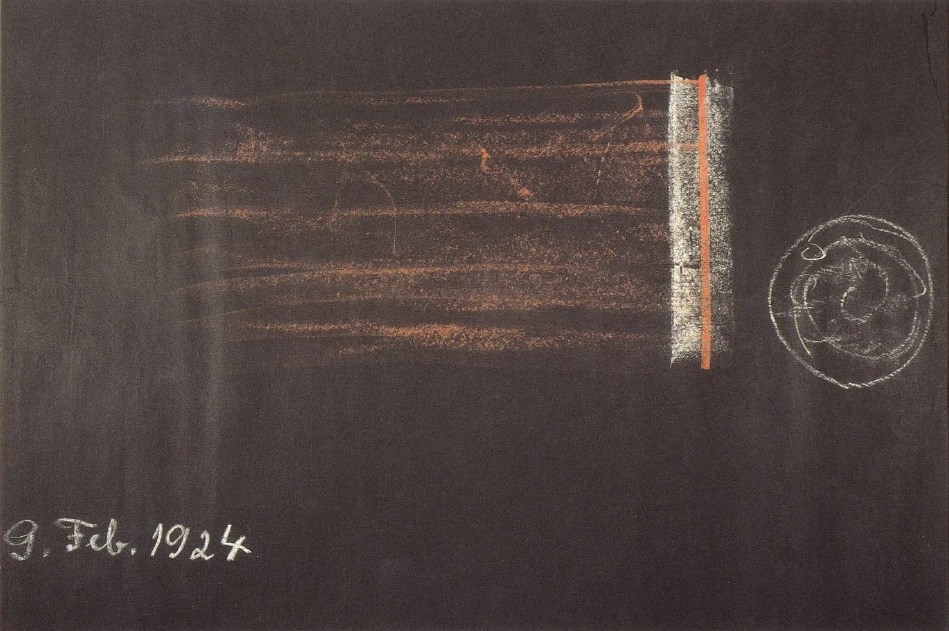
[ 16 ] It is truly the case that if one regards what one carries within oneself as a memory in ordinary consciousness as reality, it is as if one were to make a cross-section of a tree and consider what one sees inside—as shown in Plate 11—to be the reality of the tree trunk. That single cross-section is actually nothing. It is, after all, only an image that emerges there; the tree trunk extends above and below the cross-section. And this is truly the case when one grasps memories through imagination. There one perceives the utter insignificance of the individual contents of memory; there the whole is extended back nearly to birth, and under certain circumstances even beyond birth. There, everything past becomes present. It is there; it may appear distant in perspective, but it is there.
[ 17 ] And once one has grasped this, once one has such an insight, then that very insight sets in—one capable of continuous observation—which tells us that when a person leaves their physical body at death, shortly after death—for a few days—they experience this retrospection as their natural state of being. As a person passes through the gate of death, they initially experience—for several days—this: looking back into the panorama of their life; viewing their life in powerful images, in luminous, dazzling, and striking images.
[ 18 ] The point now, however, is to proceed further with imaginative insight. When one proceeds further with imaginative insight, life is enriched in a certain way; then, naturally, one also perceives in a corresponding way what one would otherwise have perceived differently. Let’s say, for example, that one reflects on one’s behavior toward other people—one’s conduct toward them. One reflects on the intentions one had in this behavior, the actions one carried out, and the way one treated people. In ordinary life, one might reflect on this to a greater or lesser extent in individual cases, depending on how thoughtless one is; but now it is simply there. One has an idea of the nature of one’s own behavior. But what one perceives there is, in fact, only part of the picture. Let’s suppose, for example, that one does a good deed or a bad deed for another person. One will see the results of the good deed—the other person’s contentment, their satisfaction—and perhaps they will also be helped in one way or another. So one will see those consequences of such an action that can occur in the physical world. If one has committed a wrong deed, one will be able to see how one has harmed the person, how the person has become dissatisfied, how they may even have suffered physical pain, and so on. All of this—provided one does not shy away from it, provided one is not uncomfortable observing the consequences of one’s actions in another person—all of this can be observed within physical life. But that is only one side of the matter. Every action we perform toward other people—indeed, even actions we perform toward the other kingdoms of nature—has another side as well. Let’s suppose, for example, that you do a good deed for someone. This good deed has an existence in the spiritual worlds, a certain significance. It brings warmth, so to speak, to the spiritual worlds; it is like the source of spiritual warmth. Spiritual warmth in the spiritual world flows from a good deed done for another person. Spiritual coldness flows from an evil deed done to another person. And so it is truly as if one were bringing spiritual warmth and spiritual coldness into the spiritual world in accordance with the way one behaves toward other people. Other human actions, in turn, are as if they were shining like bright rays in one direction or another in the spiritual world; others have a darkening effect in the spiritual world; in short, one could say that one actually experiences only half of what one accomplishes in life on Earth.
[ 19 ] When one approaches imaginative consciousness, what the other form of consciousness already knows actually fades away in the face of this imaginative consciousness. Whether a person is helped or harmed is a matter for ordinary consciousness to discern; but what an action—be it good, evil, wise, or foolish—brings about in the spiritual world in terms of warmth of soul, coldness of soul, radiance of soul, darkness of soul, and so on—there is a great diversity there—this rises up before the imaginative consciousness, which begins to emerge there. And one says to oneself: It is precisely because you did not know this when you allowed your ordinary consciousness to guide your actions that it was not, as it were, absent. You tell yourself, don’t even think for a moment that what you were unaware of in your actions—that they are sources of soul radiations of a luminous and warming nature—might not have been there simply because you didn’t see it or experience it. Don’t even think that. You lived through it, but in your subconscious. You have gone through all of this. Just as your eyes—the eyes of your soul in higher consciousness—now see it: when you performed a good deed for another and helped them, or when you committed a wicked act and harmed someone, your subconscious mind experienced, in parallel with those events, what the deed meant in the spiritual world.
[ 20 ] And at the very moment when a person has reached a stage in their imaginative consciousness where that consciousness has intensified sufficiently, then he does not merely gaze upon it as if it were a panorama of his experiences; rather, he is compelled to realize that he is not a complete human being unless he lives through what he has left unlived—that other side of his actions, that other side of his earthly life. One begins to feel utterly crippled in the face of this panorama of life, which extends back to birth or even beyond it, as if something had been cut off. One keeps telling oneself: You really should have experienced that; you are, in fact, as if your eye had been gouged out, your leg had been cut off; you are not a whole human being. In reality, you haven’t had half of your experiences. This must occur in the course of imaginative consciousness—that one feels mutilated with regard to one’s experiences, that one feels, above all, how ordinary life obscures something from one.
[ 21 ] In our present-day materialistic age, this is particularly acute, for this materialistic age does not believe at all that human actions have any more value or significance than they have for immediate life, which unfolds externally in the physical world. The idea that something special is still taking place in the spiritual world is more or less regarded as folly when it is asserted; yet it is indeed there. And this feeling of incompleteness arises in the imaginative consciousness. One tells oneself: You really must give yourself the opportunity to experience all that you have not yet experienced. But that is almost impossible; it is possible only in details, to a very limited extent.
[ 22 ] That is precisely what will weigh heavily on the mind of anyone who looks more deeply into life: that, fundamentally speaking, there are many things in this life that he cannot fulfill during his time on earth; that, in a sense, he must issue a promissory note to the future; that he must say: Life presents tasks for experience that one cannot possibly complete in this earthly life. One must remain indebted to the universe and say: I will only be able to live through this once I have passed through death. This is a profound, if often quite tragic, enrichment of life, bestowed by the wisdom of initiation: the realization that one inevitably becomes indebted to life and the recognition of the necessity to issue an IOU to the gods, to say: “I can only experience this once I have died; only then can I enter into the kind of experience to which I have become indebted to the universe.”
[ 23 ] This awareness—that inner life must, in part, take place in a kind of transition toward the future after death—this inner awareness profoundly deepens human life. — Spiritual science is not merely a means of learning one thing or another in a theoretical sense. Anyone who studies spiritual science the same way one studies other subjects would actually be better off studying a cookbook. At least there, one is compelled not to view the matter merely theoretically. For life itself—primarily the life of the stomach and everything connected with it—ensures that one takes a cookbook more seriously than mere theory. It is indeed necessary that spiritual science, when it approaches human beings, deepen life in a way that resonates with feeling and the heart.
[ 24 ] There is a tremendous deepening of life when one becomes aware of this sense of guilt toward the gods and says to oneself: One cannot truly live through half of life on earth, because it lies hidden beneath the surface of existence. If, through initiation, one comes to know what is otherwise hidden from ordinary consciousness, then one can already glimpse a little of what one has become indebted for. And one might then say: With ordinary consciousness, one sees that one is becoming indebted, but one cannot read the debt note that one ought to issue oneself. With an initiated consciousness, one can indeed read the debt note, but one cannot pay it off in ordinary life. One must wait until death comes. And once one has attained this consciousness—once one has deepened one’s human conscience to such an extent that this awareness of having become guilty is fully alive within one—then one has become ripe to continue the human life beyond that retrospective tableau I spoke of, where one goes back all the way to birth. And then one sees how, after a few days, this begins: that one must experience what one has left unexperienced.
[ 25 ] For every single deed one has committed toward other people or toward the world, one must now experience what one failed to experience. The last deeds one performed before death appear first; then the process moves further back in one’s life. First, one becomes aware of the significance for the world of the evil or good deeds one most recently performed. What one experienced of them on earth is set aside; what they mean for the world is now lived through.
[ 26 ] And the journey continues further back. One relives one’s life in reverse. One knows that during this time—while reliving one’s life in reverse—one experiences the world significance of that life; during this time, one is still connected to the Earth, for it is only the other side of one’s earthly deeds that one experiences there.
[ 27 ] You see, at that moment a person feels as if their future life were now being carried in the womb of the universe. What a person experiences there is a kind of embryonic life for the life that lies ahead between death and a new birth—only that they are not carried embryonically by a mother, but by the world, namely by the world of what they have not experienced here in physical existence. They relive their physical existence once more, but in a cosmic context. There they experience it with a consciousness that is strongly divided. When we live here in the physical world and look at the beings around us, we as human beings feel, quite rightly, like kings in relation to the other beings. Even when we call the lion the king of the animals, we as human beings still feel superior to him. Human beings perceive the beings of the other kingdoms as inferior to themselves. They can judge others; yet they do not attribute to others the ability to judge them. They stand above the other beings of nature’s other kingdoms. Indeed, a human being has a different feeling when, after death, he passes through the experience I have just described. There he does not feel himself to be facing the realms of nature, over which he is exalted, but rather he feels himself to be facing the realms of the spiritual world, in relation to which he is subordinate. He now feels himself to be the lowest, with the others standing above him.
[ 28 ] And as he passes through this previously unexperienced realm, he senses everywhere the beings who are now superior to him, to whom he is subordinate. These beings express their sympathies and antipathies toward what he is experiencing as a result of his earthly life. In this experience immediately after death, one is everywhere as if immersed in a rain—a spiritual rain. One relives one’s deeds once more—namely, their spiritual aspects—but as one relives these deeds, the sympathies and antipathies of the exalted beings who stand above one drip down. There, one is showered and drenched by these sympathies and antipathies. And then, as a spiritual being, one is overcome by the realization: that which is illuminated by the sympathies of the exalted beings of the higher hierarchies is absorbed into the universe and, in the distant future, will have a positive impact on the universe; that which is met with the antipathies of the exalted beings is rejected. One senses that this would have a terrible impact on the universe if one did not keep it to oneself.
[ 29 ] An evil deed committed against a human being is overwhelmed by the antipathies of the sublime beings. And one senses: This connection with the antipathies of the exalted beings would mean something extraordinarily terrible for the entire universe if one were not to grasp, in and of itself, what an evil deed means for the entire universe—if one were to let it flow out of oneself. And for this reason, one gathers toward that which receives the antipathies of the exalted beings.
[ 30 ] And in this way, one lays the foundation for karma—for that which then carries over into the next earthly life, so that it may be balanced through other actions.
[ 31 ] One can, I would say, describe this passage of the human being through the realm of the soul after death more from an external perspective, as I have done in my book Theosophy. There, the description follows the lines of thought to which we have become accustomed in our age. Now that I am, in a sense, summarizing and describing once again within the General Anthroposophical Society what the system of Anthroposophy is, I would like to describe these things from a more inner perspective, so that you can sense how the human being experiences this with his human nature and his human individuality in the state after death.
[ 32 ] But once one has come to understand this, one can look back once more at the world of dreams, and then that world of dreams appears in a new light. When one considers how a person, after death, experiences the spiritual aspects of their earthly deeds, their earthly existence, and even their earthly thoughts, then one can look back again at the dreaming person, at everything the person experienced during sleep, and then one says to oneself: During sleep, the person has already lived through this once before, but only completely unconsciously. And that is where the difference lies between the experience of sleep and the experience one now has after death. Consider human life on Earth. There are waking states, always interrupted by sleep. Now, let’s assume that someone isn’t a heavy sleeper; in that case, they spend about one-third of their life asleep. During this third of their life, they are in fact experiencing—though they are unaware of it—this other spiritual aspect of their actions. Dreams, after all, create only a very slight ripple. One may notice some aspects of this other side in a dream, but it is merely a faint ripple on the surface. Deep sleep, however, allows one to unconsciously experience everything that constitutes the spiritual aspect of daily life.
[ 33 ] One could certainly say: In our conscious daily life, we experience what people think and feel, and how they are—or are not—encouraged by us. In sleep, one unconsciously experiences what the gods think about our deeds and our thoughts during waking life; but one is simply unaware of it. That is why the person who glimpses into the mysteries of existence feels so mutilated, as I have described to you, so burdened with guilt. All of this has remained in the subconscious. After death, it is truly relived consciously. And that is why the part of life that was slept through is relived once more—that is, roughly one-third of one’s earthly life—afterward. So when someone has passed through death, they relive it night after night; only now, what they lived unconsciously night after night is now lived through consciously. One might even say—though it almost seems as if one were mocking these extraordinarily serious matters—that if a person sleeps through most of their life, this reliving after death lasts longer; if they are a light sleeper, it lasts shorter; on average, exactly one-third, because they sleep through one-third of it. Thus, if a person reaches the age of sixty in their physical earthly life, this reliving after death lasts twenty years. And during this reliving, one undergoes a sort of embryonic state for the spiritual world.
[ 34 ] Only then, once you’ve gone through that, do you truly break free from the earth. Then the Earth no longer envelops you. Only then are you truly born into the spiritual world that you experience between death and a new birth. After death, you feel this as a birth into the spiritual world, as you slip out of the shells of earthly existence that you have carried within you—albeit spiritually—up to that point.