

Esoteric Considerations of Karmic Connections
Volume I
GA 235
16 February 1924, Dornach
Translated by Steiner Online Library
First Lecture
[ 1 ] I would now like to begin speaking to you about the conditions and laws of human destiny, which we have come to call karma. However, this karma can only be understood and grasped if one first sets out to learn to recognize the various kinds of universal laws. And so today I would like—as is necessary—to speak to you in a somewhat more abstract form about the various types of universal laws, in order to then, so to speak, crystallize the specific form that can be referred to as human destiny, as karma.
[ 2 ] We speak of causes and effects both when we wish to encompass the phenomena of the world and when we wish to consider the phenomena of human life itself. And today, especially in science, people are accustomed to speaking of causes and effects in very general terms. But it is precisely this that leads to the greatest difficulties when confronting true reality. For the various ways in which causes and effects manifest in the world are not taken into account.
[ 3 ] First, let us consider what is called inanimate nature, which appears most clearly to us in the mineral kingdom—in all that we encounter in rocks, often in such wondrous forms, but also in all that, one might say, has been ground to powder and then baked back together into formless rock. Let us first look at this, my dear friends—at what appears in the world as “inanimate” in this sense.
[ 4 ] When we consider the inanimate—and I mean the inanimate without exception—we find that the causes of which one can speak in the realm of the inanimate can be sought entirely within the inanimate itself. Where the inanimate exists as an effect, there we can also seek the causes within the same realm of the inanimate. And one is truly proceeding in accordance with knowledge only when one does this—that is, when one seeks the causes of the processes of the inanimate within the realm of the inanimate itself.
[ 5 ] No matter how beautifully formed a crystal may be, you must seek the [causes of] its forms within the inanimate realm itself. And thus this inanimate realm proves to be a self-contained entity. At first, we cannot say where the boundaries of this inanimate realm lie. Under certain circumstances, they may lie very far away in the vastness of the universe. But even if, for any inanimate object standing before us, we are to seek causes for its effects, we will in turn seek these causes within the realm of the inanimate itself. In doing so, however, we are already placing the inanimate alongside something else. And this, at the same time, opens up a certain perspective for us.
[ 6 ] Consider the human being himself. Consider him as he passes through the gate of death. Everything that has acted and existed within him before he passed through this gate of death—all of that has vanished from the visible, tangible form that remains once the human soul has passed through the gate of death; it has vanished from this form that now remains, and we also say of this form: it is lifeless. And just as we speak of the lifeless when we look upon the rock of the mountains with its crystalline forms, so must we speak of the lifeless when we look upon the soulless, spiritless corpse of a human being. And only now does the very same thing occur for the human corpse that has existed from the very beginning for the rest of lifeless nature.
[ 7 ] We could not find the cause of what happens to the human form as an effect during life—before the soul has passed through the gate of death—in the inanimate itself. Not only will we search in vain among the inanimate physical laws of the human form for the causes of, say, an arm being raised, but we will also search in vain among the chemical and physical forces present in the human form for the causes of, say, the heartbeat, blood circulation, or any process that is not at all subject to the will.
[ 8 ] But at the very moment when the human form has become a corpse, when the soul has passed through the gate of death, we also observe an effect on the human organism. We see, for my part: the skin color changes, the limbs wither—in short, everything that one is accustomed to seeing in a corpse occurs. Where do we look for the cause? In the corpse itself, in the chemical, physical, and lifeless forces of the corpse itself.
[ 9 ] Now, if you take what I am hinting at here—I need only hint at it—and think it through to its logical conclusion in every direction, you will say to yourself: Once the soul has passed through the gate of death, the human being, in relation to his physical body, has become like lifeless nature. This means that we must now seek the causes of effects in the same realm where the effects themselves lie. This is very important.
[ 10 ] But precisely when we look at this particular form of the human corpse, we find something else that is extraordinarily significant. You see, with death, the human being, so to speak, casts off his physical body. And if one observes—with the kind of perceptive faculty capable of doing so—what the true human being, the spiritual-soul being, has now become, after it has passed through the gate of death, one must simply say that the fact is that the physical body has been cast off, and that for this true spiritual-soul being, which has arrived beyond the gate of death, this physical body no longer has any significance. It is something that has been cast off.
[ 11 ] The situation is different with lifeless, external nature. And even when one looks at it—I would say—superficially, this difference becomes apparent. Consider a human corpse. You can best observe it where it is, so to speak, buried in the open air. In underground vaults—which certain communities in the past used as burial sites—one finds, for example, human corpses simply suspended. They dry out, and as they dry out, they become so brittle that one need only touch them lightly, and they crumble into dust.
[ 12 ] What we have received here as inanimate matter is different from what we find out there in our surroundings as inanimate nature. This inanimate nature takes shape; it forms crystalline structures. It is, in fact, undergoing a remarkable transformation. If we look beyond the actual earthly realm and consider what is also inanimate—water and air—we find that a dynamic transformation and metamorphosis is taking place within this inanimate realm.
[ 13 ] Let us first bring this to mind; let us allow the similarity between the human body—once the soul has departed from it—in its lifelessness, and lifeless nature outside of humanity, to come before our minds.
[ 14 ] And now let’s move on. Let’s consider the plant kingdom. There we enter the realm of the living. If we study a plant thoroughly, we will never find that we are able to trace the effects that occur in the plant solely to causes that lie within the plant kingdom itself—that is, within the very same kingdom where the effects occur. Certainly, there is a science today that attempts to do this. But this science is simply on the wrong track, for it ultimately comes to the conclusion: Yes, one can investigate the physical forces and laws at work in the plant; one can investigate the chemically active forces and laws; and something remains. — At that point, people split into two camps. Some say: What remains is merely a combination, a kind of form or shape; the active factors are only the physical and chemical laws. — The others say: No, there is something else in there; science just hasn’t researched it yet; it will get there eventually. — Science will keep saying that for a long time. But that’s not how it is; rather, if one wants to study the plant kingdom, one cannot understand it unless one draws on the entire universe, unless one looks at plants in such a way that one says to oneself: The forces behind plant activity lie in the vast universe. Everything that happens within the plant is an effect of the vast universe. The sun must first reach a specific position in the vast universe for any effects to occur in the plant kingdom. Other forces from the vast universe must be at work for the plant to acquire its form, its inner driving forces, and so on.
[ 15 ] And the thing is: If we were able, my dear friends, to travel—not merely as Jules Verne did, but to actually travel, say, to the Moon, to the Sun, and so on—we would not become any wiser in this search for causes than we are here on Earth itself, if we did not acquire any powers of cognition other than those we already possess. We wouldn’t get anywhere if, for example, we were to say: “Well then, in the plant kingdom of Earth itself, the causes for the effects that occur in plant life are not to be found, so let’s travel to the Sun—there we will find the causes.” — We wouldn’t find them there either. On the other hand, we do find them when we rise to imaginative cognition, when we have a completely different kind of insight. But then we do not need to journey to the sun; we find them within the earthly realm itself. We simply find that we need to transition from the ordinary physical world into an etheric world, and that throughout the vastness of the world, the world ether with its forces is at work everywhere, and that it is precisely from this vastness that it exerts its influence. The ether exerts its influence everywhere from the vastness.
[ 16 ] We must therefore indeed move on to a second kingdom of the world if we wish to seek the causes of the effects in the plant kingdom.
[ 17 ] Well, human beings share in the same forces that plants share in. The forces that act upon plants from the etheric world also act upon human beings. Human beings carry these etheric forces within themselves, and we call the sum of these etheric forces that they carry within themselves the etheric body. And I have already explained to you how, a few days after death, this etheric body grows larger and larger and is ultimately lost, so that the human being is left with only his astral body and his I-being. Thus, what the human being has carried within himself in the etheric form grows larger and larger and is lost in the vastness of the worlds.
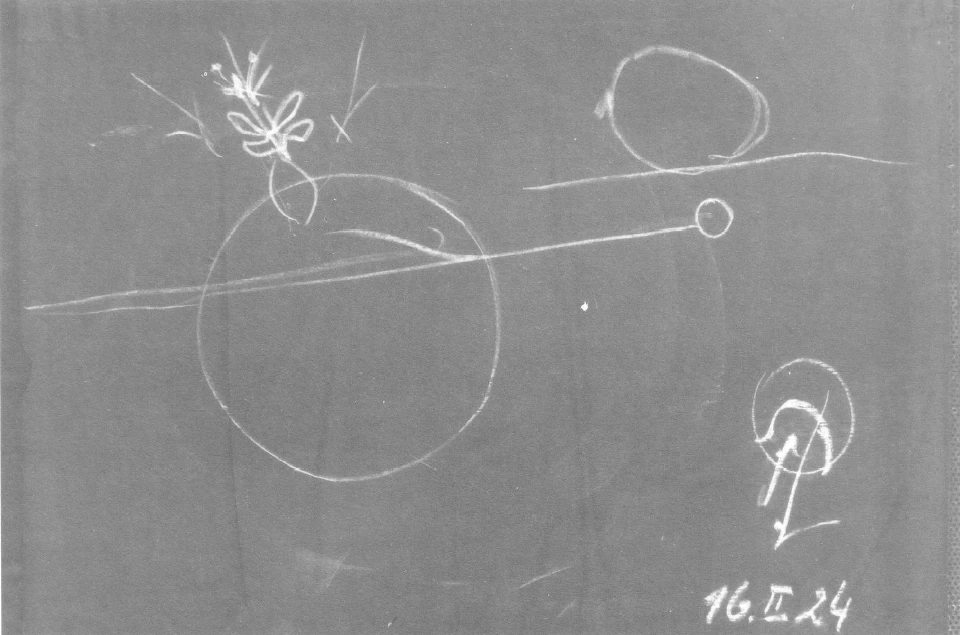
[ 18 ] Now compare once again what we can observe in a human being who has passed through the gate of death with what we see in the plant kingdom. We must say of the plant kingdom: its causal forces enter the Earth from the vastness of space. We must say of the human etheric body: the forces of this etheric body extend out into the vastness of space—that is, they go to the place from which the forces of plant growth come once a human being has passed through the gate of death. Here the matter already becomes, I would say, clearer. If we merely look at the physical corpse and say that it becomes lifeless, then it becomes difficult for us to make the connection to the rest of lifeless nature. But when we look at the living—the plant kingdom—and realize: The causes and forces for the plant kingdom come from the ether of the vastness of the world—then, as we immerse ourselves imaginatively in the human being, we see that the human etheric body goes to the very place from which the forces—the etheric forces—for the plant kingdom originate, once a human being has passed through the gate of death.
[ 19 ] But there is something else that is characteristic. I would like to say: The forces that act on plants as causal forces work relatively quickly, because the sun from the day before yesterday does not have much influence on the plant that grows out of the ground, blooms, and bears fruit. It cannot exert much of an effect with its causal forces in that case. It must shine today; it must truly shine today. That is important. And you will see in our subsequent reflections that it is important for us to keep this in mind.
[ 20 ] Plants, with their etheric causes, do indeed have their true fundamental forces within the earthly realm, but they possess them in that which exists in the universe alongside the Earth. And when the human etheric body dissolves after the human being, as a spiritual-soul being, has passed through the gate of death, this process lasts only a very short time—merely a few days. Here again, simultaneity is at work, for the days it takes are, in the grand scheme of world events, a mere trifle.
[ 21 ] Once again, when the etheric body returns to that from which the forces of plant growth—as etheric forces—arise, we can say: As soon as the human being lives in the ether, his etheric activity is not limited to the Earth—it does, after all, extend beyond the Earth—but it develops simultaneously.
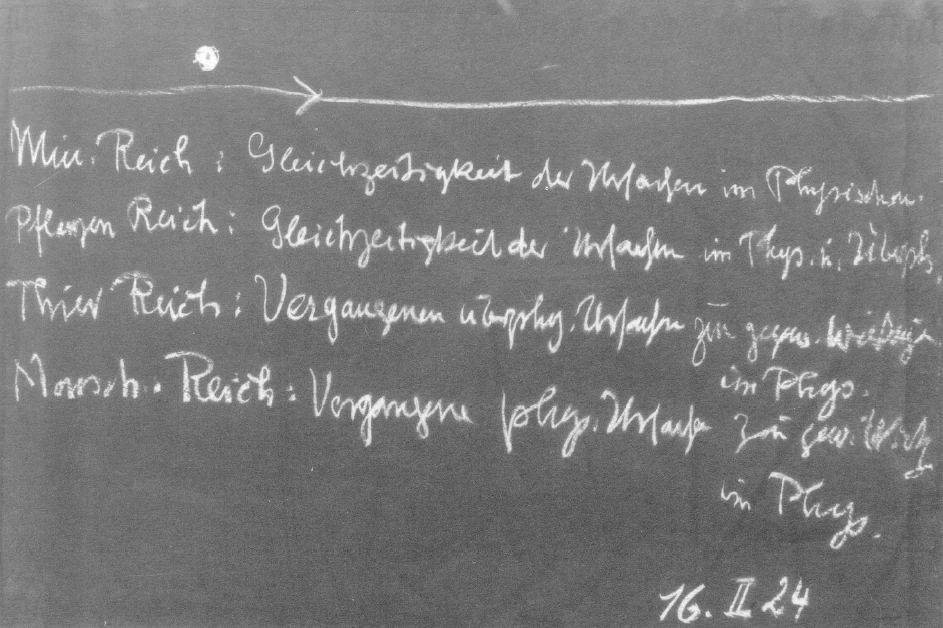
[ 22 ] I’ll write out a diagram for you to illustrate this. We can say: The mineral kingdom: simultaneity of physical causes and effects. So essentially, we are dealing with the simultaneity of causes in the physical realm. You might say: Yes, for some things that happen in the physical realm, the causes are, chronologically speaking, earlier in time. — That is not actually the case. If effects are to arise in the physical realm, the causes must persist; they must continue to have an effect. When the causes cease, no further effects occur. So we can certainly write down this dictum: Mineral Kingdom: Simultaneity of causes in the physical realm.
[ 23 ] But when we enter the plant kingdom—and in doing so, we also enter into what can be traced as the plant-like aspect within human beings themselves—we are dealing with simultaneity in the physical and supraphysical realms. The plant kingdom; simultaneity of causes in the physical and supraphysical realms.
[ 24 ] Now let us turn to the animal kingdom. In the animal kingdom, we will search in vain within the animal itself for that which manifests as effects while the animal is alive. Even if the animal merely crawls to seek out its food, we will search in vain for the causes within the chemical and physical processes taking place inside the animal’s body. We will also search in vain in the vastness of the etheric realm—where we find the causes for the plant kingdom—for the causes of animal movement and animal sensation. For everything that takes place within the animal in relation to its plant-like nature, however, we do find the causes within the etheric realm; and when the animal dies, its etheric body, too, goes out into the vastness of the world ether. But for what constitutes sensation, we can never find the causes within what is earthly, physical, or supersensible-etheric; we simply cannot find them.
[ 25 ] Here, however, we encounter an area where modern thinking is once again very much on the wrong track. After all, when it comes to many phenomena that occur in an animal—sensory phenomena, motor phenomena—this modern way of thinking must say: If I examine the animal internally for its physical and chemical forces, I will not find the causes there. Nor will I find the causes in the vastness of the universe, in the etheric expanses of the universe. If I want to explain a flower, I must go into the vast universe, into the etheric universe, and I will be able to explain the flower from the etheric universe. I will also be able to explain many things in the animal that are plant-like from the etheric universe, but never what occurs in the animal as movements, and never what occurs in the animal as sensation.
[ 26 ] If, on June 20, I consider an animal in terms of its sensations, then I will not find the causes of those sensations on June 20 in anything that is earthly or extraterrestrial in space. If I go further back in time, I will not find them there either. I will not find them in May, nor in April, and so on.
[ 27 ] Modern thinking recognizes this as well. That is why modern thinking explains what cannot be explained in this way—or at least much of it—through heredity; in other words, with a single phrase: It is “inherited”; it comes from our ancestors. — Not everything, of course, because that would be too grotesque, but a great deal. It is inherited.
[ 28 ] What does “inherited” mean? Ultimately, the concept of inheritance boils down to the idea that what we perceive as a multifaceted animal was contained within the mother’s germ. And that is precisely the aim of the modern view: to observe an ox externally in its diverse form and then to say, “Well, the ox comes from the germ; the forces were contained within it that, once fully developed, produce the ox.” Therefore, the germ is an extraordinarily complex entity. This germ of the ox must indeed be terribly complex, for, after all, everything is contained within it that pushes, shapes, forms, and acts in many ways so that the small germ can become the multifaceted ox.
[ 29 ] And no matter how one tries to wriggle out of it—there are, after all, many theories: theories of evolution, theories of epigenesis, and so on—it always boils down to the fact that one must ultimately imagine: this germ, this tiny egg, is something terribly complicated. Just as everything is traced back to molecules that are composed of atoms in complex ways, some people portray the initial structure of this embryo as a complex molecule. But that doesn’t even agree with physical observations, my dear friends.
[ 30 ] The question arises: Is this germ really such a complex molecule, or even such a complex organism? The peculiar thing about the germ is not that it is complex, but that it throws all of matter back into chaos. The germ, in particular, is not a complex structure within the mother organism, but rather a completely pulverized, jumbled mass of matter. Nothing is organized at all. It is precisely something that falls back into the absolutely unorganized, into a dust-like state. And reproduction would never arise if the unorganized, lifeless matter—which strives toward the crystalline, toward form—did not fall back into chaos within itself, precisely within the egg. The egg white is not the most complex substance, but the simplest of all, possessing no purpose whatsoever. And from this small chaos, which initially exists as an egg germ, an ox could never emerge—truly not—for this egg germ is, after all, chaos.
[ 31 ] Why, then, does it still develop into an ox? Because within the mother’s organism, the entire world now acts upon this single germ. Precisely because it has become indeterminate, because it has become chaos, the entire world can act upon it. And fertilization has no other purpose in the world than to return matter to chaos, to the indeterminate, to the undetermined. So that it is not something else, but only the universe itself that acts.
[ 32 ] But now, when we look within the mother, the causes are not there; when we look outward into the ether, the causes are not there either, even in the simultaneous events. We must go back to before the animal came into being if we want to find the causes for what is germinating there as the predisposition for a being capable of sensation and movement. We must go back to before life began! This means that for a being capable of sensation and movement, the world of causes does not lie in the present moment, but rather before the emergence of this being.
[ 33 ] This is what is peculiar: When I look at a plant, I must go out into that which is simultaneous; then I find the cause—albeit in the vast universe. But if I want to find the cause of what manifests as sensation or the ability to move in an animal, I cannot go into the simultaneous; rather, I must go into that which precedes life; in other words, the constellation of stars must have changed, must have become something else. It is not the constellation of stars in the universe that is simultaneous with the animal that exerts its influence on what is truly animal, but rather the constellation of stars that precedes life.
[ 34 ] And now let us turn our attention to the human being once he has passed through the gate of death. Once a person has passed through the gate of death, once they have shed their etheric body—which travels into the vastness of the cosmos to those realms from which the forces of plant growth, the etheric forces, originate—that person must return, as I have explained to you, all the way back to their birth. There, in his astral body, he experiences in reverse everything he went through during his life as he moved forward. In other words: After death, a human being does not enter the realm of the present with his astral body; he must return to the pre-birth realm; he must go to the place from which the forces emerge that give rise to animal sensibility and motor ability. These do not come from the realm of space, nor from the constellations of the stars that exist simultaneously; they come from the constellations that preceded them. — So when we speak of the animal kingdom (see diagram on page 27), we cannot speak of the simultaneity of causes in the physical and supraphysical realms; rather, we must speak of past supraphysical causes leading to present effects in the physical realm. Animal kingdom: Past supraphysical causes leading to present effects.
[ 35 ] And here, too, we come back to the concept of time. We must—if I may put it simply—take a walk through time. If we want to find the causes of anything that happens in the physical world, we take a walk through the physical world; we do not need to step outside the physical world. If we want to find the cause of something that takes place in the living plant kingdom, we have to go quite far. We must search the etheric world, and only there, where the etheric world ends, where—to put it in fairy-tale terms—“the world is boarded up,” only there do we find the cause of plant growth.
[ 36 ] But no matter how much we go around in circles there, we will not find the cause of our ability to feel, nor of our ability to move. That is where we must begin to take a walk through time. That is where we must step back in time. That is where we must step out of space and walk into time.
[ 37 ] You see, with regard to this process of causation, we can draw a parallel between the human physical body in its lifeless state and lifeless nature; the human etheric body, in its life and in its passing into the etheric realms after death, with the etheric life of plants, which also comes from the etheric realms but from the corresponding constellations of the supraphysical, the supraterrestrial; and we can compare the human astral organization with what exists in the animal kingdom.
[ 38 ] And we then proceed from the mineral kingdom to the plant kingdom, to the animal kingdom, and ascend to the human kingdom proper. You will say: We have always taken that into account. Yes, but not entirely. We have considered the human kingdom first insofar as the human being has a physical body, then insofar as he has an etheric body, and then insofar as he has an astral body. But you see, if human beings had only their physical body, they would be—a complex one, to be sure, but still—a crystal. If human beings had only their etheric body in addition to that, they might be a beautiful plant, but still merely a plant. If human beings also had an astral body, they would walk on all fours, perhaps have horns and the like; they would simply be an animal. Human beings are none of these things. The form they possess as upright beings—this form—they have precisely because, in addition to the physical, etheric, and astral organizations, they also possess the “I” organization. And it is only of this being—which also possesses the “I” organization—that we can speak as the human being, the human kingdom.
[ 39 ] Let us now take another look at what we have already examined. If we want to seek the causes of the physical realm, we can remain within the physical realm. If we are to seek the causes of the plant realm, we must venture out into the vastness of the etheric realm, but we can still remain within space—only, as I said, space becomes somewhat hypothetical there, for one must even take refuge in fairy-tale concepts, such as “where the world is boarded up.” And yet, the fact is that even people who think purely in terms of contemporary natural science have already come to realize that one can indeed speak of something like “the world is boarded up.” It is, of course, a trivial, crude expression. But one need only think of how childlike people’s thinking can be: there is the sun, sending its rays out farther and farther; they do grow weaker and weaker—the light goes on and on and on, farther and farther, into infinity.
[ 40 ] For those who have been listening to these lectures for years, I have long since explained that it is absurd to imagine that light extends into infinity. I have always said that the propagation of light is governed by elasticity. If you have a rubber ball and press into it, you can press it in up to a certain point, then it springs back; that is, the pressure exerted on the elasticity has a limit, and then it returns. So, I said, it is the same with light: it does not extend into infinity, but when it reaches a certain limit, it comes back.
[ 41 ] The idea that light does not extend to infinity, but only up to a certain limit and then turns back, has now also been advocated, for example, in England by the physicist Oliver Lodge; so that even today, physical science has come to support what spiritual science teaches, just as it will eventually arrive, in every detail, at what spiritual science says.
[ 42 ] And so one can indeed say that out there, if one thinks far enough out, one must think back again; one must not simply assume the existence of endless space, which is a fantasy—and, moreover, a fantasy that cannot be grasped. Perhaps some of you will recall how, in the account of my life’s journey in the last chapter, which appeared last week, I said that it made a particularly significant impression on me when, while studying modern synthetic geometry, I was first made aware by geometry itself that a straight line must not be conceived as extending into infinity and never ending, but rather that the straight line extending outward truly returns from the other side. Geometry expresses this as follows: The synthesis—the infinitely distant point to the right—is the same as the infinitely distant point to the left. This can be calculated. This is not merely based on the analogy that, if you have a circle and start from here, you end up back there; nor is it the idea that, if a semicircle were infinitely long, it would be a straight line. That is not the case; that would be an analogy that anyone capable of precise thinking would dismiss. What made an impression on me was not this trivial analogy, but the ability to prove, through actual calculation, that the infinitely distant point on one side to the left is the same as the one that is infinitely distant here on the right—that is, that someone who starts running here and keeps running along the line does not run into infinity, but that, if one simply waits the right amount of time, one will meet them again coming from the other side. This looks grotesque to all physical thinking. The moment one sets aside physical thinking, it is indeed a reality, because the world is not endless but, as it exists as a physical world, is limited. So that one can say: One reaches the boundary of the etheric when speaking of the plant realm and of what is etheric in the human being. — But one must step outside of everything that exists in space at all if one wants to explain the animal realm and, in the human being, the astral realm. There one must take a walk through time; there one must go beyond simultaneity. There, then, one must move forward in time.
[ 43 ] And now we come to the human aspect. You see, when one enters into time, one is actually already transcending the physical in two ways. By understanding the animal, one must already move further into time. Now, one must not continue this line of thought abstractly, but rather concretely. Pay close attention now to how one continues this concretely.
[ 44 ] Isn’t it true that people think: When the sun emits light, that light travels endlessly. Oliver Lodge, however, shows that we are already moving away from this way of thinking—that we know it comes to an end and returns. The sun receives its light back from all sides, albeit in a different form, in a transformed form; but it does receive it back. Let us now apply this way of thinking to what we have just considered. We begin by standing in space. Earthly space remains behind us; we step out into outer space. That is not enough for us yet; we step out into time. Now someone might say: Well, now we’re just going on and on. — No, now we’re coming back! We must continue this line of thought. We come back again. We come back in exactly the same way that, when we keep moving further and further into space, we reach the boundary and then return; in the same way, we return here as well. That is to say, once we have sought out the past supraphysical causes in the expanse of time, we must return to the physical realm.
[ 45 ] But what does that mean? It means we have to come down from time again—back down to Earth from time. So if we want to look for the causes for human beings, we have to look for them on Earth again. Now we have moved backward in time. When we move backward in time and return to Earth, we naturally enter a previous human life. We enter a previous human life. With animals, we go further; in terms of time, this dissolves just as our etheric body dissolves right up to the boundary. The human being does not dissolve there, but we return to Earth to his previous earthly life.
[ 46 ] So that we can say of human beings: Past physical causes lead to present physical effects.
Mineral Kingdom: Simultaneity of causes in the physical realm.
Plant Kingdom: Simultaneity of causes in the physical and supraphysical realms.
Animal Kingdom: Past supraphysical causes leading to present effects.
Human Kingdom: Past physical causes leading to present effects in the physical realm.
[ 47 ] As you can see, it took—I would say—some effort today to put myself in the mindset of abstractions as part of my preparation. But that was necessary, my dear friends. It was necessary because I wanted to show you that there is a logic even for those realms that must be regarded as spiritual. It’s just that this logic does not correspond to the crude logic that is derived solely from physical phenomena and in which people usually believe exclusively.
[ 48 ] If one proceeds purely logically and traces the chains of causality, one arrives—even in a mere train of thought—at past earthly lives. And it is necessary to point out that thinking itself must also change if one wishes to comprehend the spiritual.
[ 49 ] Isn’t it true that people think one cannot comprehend what is revealed from the spiritual world? One can comprehend it, but one must expand one’s logic. After all, if one wants to comprehend a piece of music or another work of art, it is also necessary to possess within oneself the conditions that are conducive to understanding it. If one lacks these conditions, then one simply does not understand any of it. Then the thing passes by as mere noise. Or one sees nothing in a work of art but an incomprehensible form. Similarly, one must approach what is communicated from the spiritual world with a way of thinking that is appropriate to the spiritual world. But this becomes evident even in mere logical thinking. By examining the diversity of causes, one does indeed come to understand past earthly lives in a logical sequence.
[ 50 ] Now we are left with the big question that arises when we look at the corpse. It has become lifeless. The lifeless natural world outside stands there in its crystalline forms, in its various shapes. The big question lies before us: How does the lifeless natural world relate to the human corpse?
[ 51 ] Perhaps you will already find, my dear friends, that something is contributed toward an understanding that points toward the answer to this question if you approach the matter in a second stage, if you say: When I look at the plant world around me, I see that it carries within itself, from the vastness of the etheric universe, the forces to which my etheric body returns. Out there in the etheric expanses, there is that which, from above, is the causal source of the plants; there is that to which my etheric body goes when it has served its purpose in my life. I go to the place from which plant life springs forth in the vastness of the ether. I go there—that is to say, I am connected to it. Yes, I can even say: Up there is something; my etheric body goes there; the greening, sprouting, springing plant world comes from there. — But there is a difference: I give up my etheric body; the plants receive the ether to grow. They receive the ether for life; I surrender my etheric body after death. I surrender it as something that remains; they—the plants—receive this etheric body as something that gives them life. They have their beginning in the very place where I arrive at my end. The beginning of the plant is linked to the end of the human etheric body.
[ 52 ] This leads you to ask: Could it perhaps also be the case that, when considering minerals—with their crystals of the most varied forms—I might ask: Is this, too, perhaps a beginning in relation to what I leave behind as a physical corpse, as the end of myself? Do beginning and end perhaps merge together there?
[ 53 ] Let us conclude today with this question, my dear friends, and begin tomorrow to delve thoroughly into the question of human destiny, or what is known as karma. I will therefore continue speaking about karma in the following lecture. You will then no longer have to wade through such a thicket of abstractions, but you will also realize that this was necessary for a certain development of thought.