

Esoteric Considerations of Karmic Connections
Volume I
GA 235
23 February 1924, Dornach
Translated by Steiner Online Library
Third Lecture
[ 1 ] The best way to understand karma is to contrast it with the other impulse in human life—the impulse we call “freedom.” Let us first consider, I would say, in very broad terms, the question of karma. What does it mean? In human life, we have a succession of earthly lives. As we immerse ourselves in a particular earthly life, we can first—at least in thought—look back on how this present earthly life is a repetition of a number of preceding ones. This earthly life was preceded by another, and that by yet another, until we return to those times when it is impossible, in the way it is the case in the present earthly era, to speak of repeated earthly lives, because then, moving backward in time, a period begins in which life between birth and death and life between death and a new birth gradually become so similar to one another that the enormous difference that exists today is no longer present. Today, in our earthly bodies, we live between birth and death in such a way that, with our ordinary consciousness, we feel strongly cut off from the spiritual world. From this ordinary consciousness, people speak of this spiritual world as if it were something in the hereafter. People come to speak of this spiritual world as if they could cast doubt on it, as if they could deny it entirely, and so on.
[ 2 ] All of this stems from the fact that life on Earth confines human beings to the external sensory world and to the intellect, which does not look beyond what is truly connected to this earthly existence. This is the source of all manner of disputes, all of which are actually rooted in the unknown. You have surely often witnessed and experienced how people argue about monism, dualism, and so on. It is, of course, utter nonsense to argue over such buzzwords. When people argue in this way, it strikes one as if, say, some primitive person had never heard of the existence of air. It would never occur to someone who knows that air exists—and what functions air serves—to speak of air as something otherworldly. Nor would it occur to him to say: “I am a monist; air, water, and earth are one; and you are a dualist because you still see something in the air that goes beyond the earthly and the aqueous.”
[ 3 ] All these things are simply nonsense, just as all arguments over concepts are mostly nonsense. So, the point is not to go into these things in detail, but simply to draw attention to them. For just as, for someone who does not yet know air, air is not actually there but is something of the beyond, so too, for those who do not yet know the spiritual world—which is everywhere just like air—this spiritual world is something of the beyond; for the one who engages with these things, it is something of this world. So the point is simply to acknowledge that, in the present earthly era, between birth and death, human beings live in their physical bodies and in their entire physical constitution in such a way that this constitution gives them a consciousness through which they are, in a certain sense, cut off from a certain world of causes—which, however, as such, exerts its influence on this physical earthly existence.
[ 4 ] Then, between death and a new birth, he lives in another world—one that might be called a spiritual world as opposed to our physical world—in which he does not have a physical body that can be made visible to human senses, but rather lives as a spiritual being; and in this life between death and a new birth, the world one experiences between birth and death is, in turn, as foreign as the spiritual world now is to ordinary consciousness.
[ 5 ] The dead look down upon the physical world, just as the living—that is, those who are physically alive—look up into the spiritual world, and it is only the feelings that are, so to speak, reversed. While a person, between birth and death here in the physical world, has a certain sense of looking up toward another world that fulfills him in many ways—for things that are either lacking here in this world or fail to satisfy him—between death and a new birth, because of the immense abundance of events, precisely because so much is happening in relation to what a person can bear, feel a constant longing to return once more to earthly life—to what is then, for them, the life beyond—and in the second half of life, between death and a new birth, they await with great longing the passage through birth into earthly existence. Just as he fears death during his earthly life because he is uncertain about what lies beyond death—for there is indeed great uncertainty in earthly life for the ordinary consciousness—so, in the life between death and a new birth, there prevails regarding . earthly life—a certainty that numbs, a certainty that renders one downright powerless. As a result, the human being experiences states of powerlessness akin to dreams, which instill in them a longing to descend to earth once more.
[ 6 ] These are just a few hints at the great difference that exists between life on Earth and the life between death and a new birth. But if we now go back—let’s say, just to the Egyptian period, from the 3rd to the 1st millennium before the founding of Christianity— we are, after all, going back to those people we ourselves were in a previous earthly life; when we go back to that time, life during earthly existence was, compared to our present brutally clear consciousness—and nowadays people do have a brutally clear consciousness; they’re all so smart, these people, I don’t mean that ironically at all; people really are all very intelligent—compared to this brutally clear consciousness, the consciousness of people in ancient Egyptian times was more dreamlike, one that did not collide with external objects in the same way as it does today, but rather passed through the world without colliding, but was instead filled with images that at the same time revealed something of the spiritual that is present in our surroundings. The spiritual still reached into physical earthly existence.
[ 7 ] Don’t say: How could a person, if he has such a dreamlike, rather than brutally clear, consciousness, have been able to perform the great works that were accomplished, for example, during the Egyptian or Chaldean periods? You need only recall that sometimes madmen, precisely in certain states of insanity, experience a tremendous increase in their physical strength and begin to carry things they could not carry while in a state of full, clear consciousness. Indeed, it was also the physical strength of these people—who were perhaps even more slight in appearance than people today (though it is not always the case that the fat are strong and the thin are weak)—that was correspondingly greater. However, they did not use this existence in such a way that they observed every single physical action they performed; rather, these physical actions were accompanied by experiences into which the spiritual world still extended.
[ 8 ] And again, when these people were in the life between death and a new birth, much more of this earthly life ascended into that life—if I may use the expression “ascended.” Today, it is extremely difficult to communicate with people who are in the life between death and a new birth, for languages have gradually taken on a form that is no longer understood by the dead. Our nouns, for example, represent absolute gaps in the dead’s perception of the earthly realm shortly after death. They understand only verbs—the words of action—that which is in motion, that which is active. And while here on Earth we are constantly reminded by materialistically minded people that everything must be properly defined, that every concept must be sharply defined and delimited, the dead no longer recognize definitions at all; for they know only that which is in motion, not that which has contours and is bounded.
[ 9 ] But in earlier times, what existed on earth as language—what existed as a way of thinking, as a habit of thought—was such that it reached up into the life between death and a new birth, so that the dead person continued to resonate long after his death with what he had experienced here on earth, and also of what continued to take place on Earth after his death.
[ 10 ] And if we go back even further, to the time after the Atlantean catastrophe, to the 8th and 9th millennia before the Christian era, then the differences between life on Earth and life—if we may put it that way—in the afterlife become even smaller. And then we gradually return to those times when the two lives are quite similar to one another. Then one can no longer speak of repeated earthly lives.
[ 11 ] So, repeated earthly lives have their limit when one looks backward. Likewise, they will have a limit when one looks forward into the future. For what begins quite consciously with anthroposophy—namely, that the spiritual world should penetrate into ordinary consciousness—will have the consequence that, in turn, this earthly world will penetrate more deeply into the world one experiences between death and a new birth; yet consciousness will not become dreamlike, but rather clearer, becoming ever clearer and clearer. The difference will, in turn, become smaller. So that this life—within the cycle of repeated earthly lives—will be bounded by outer limits that then lead into a completely different kind of human existence, where it makes no sense to speak of repeated earthly lives, precisely because the difference between earthly life and spiritual life is not as great as it is now.
[ 12 ] But if we assume—for the sake of argument—that over the vast span of Earth’s history, there have been many other lives beyond this one—we must not say “countless” others, for they can in fact be counted through precise spiritual-scientific investigation—then we have had certain experiences in these earlier Earth lives that represented relationships between human beings. And the effects of these relationships between people—which were lived out at that time precisely in what we went through—are present in this earthly life just as the effects of what we do in this present earthly life extend into our next earthly lives. We must therefore look for the causes of much of what now enters our lives in our past earthly lives. People will easily say to themselves: So what they are now experiencing is conditioned, caused. How, then, can they be free human beings?
[ 13 ] Well, when viewed in this way, the question is indeed a rather significant one; for all spiritual observation shows that, in this sense, one’s next earthly life is determined by one’s previous ones. On the other hand, the consciousness of freedom is absolutely present. And if you read my Philosophy of Freedom, you will see that one cannot understand human beings at all unless one is clear about the fact that their entire inner life tends toward, is directed toward, and is oriented toward freedom—but toward a freedom that must be understood correctly.
[ 14 ] Now, in my Philosophy of Freedom in particular, you will find a concept of freedom that is extraordinarily important to understand in the proper sense. It concerns the fact that freedom is first developed in thought. The source of freedom springs from thought. Human beings simply have an immediate awareness that, in thought, they are free beings.
[ 15 ] You might say: But there are many people today who doubt freedom. — That is merely proof that people’s theoretical fanaticism today is greater than what they directly experience in reality. People no longer believe in their own experiences because they are stuffed full of theoretical views. Today, people form the idea from their observation of natural processes that everything is necessarily conditioned, every effect has a cause, and everything that exists has its cause. So, when I form a thought, that, too, has a cause. One does not immediately think of repeated earthly lives, but rather of the fact that what springs from a thought is just as causally determined as what emerges from a machine.
[ 16 ] Through this theory of general causality—as it is called—of general causation, people today often blind themselves to the fact that they clearly possess within themselves an awareness of freedom. Freedom is a fact that is experienced as soon as one truly comes to self-reflection.
[ 17 ] Now there are also people who hold the view that the nervous system is simply a nervous system and conjures up thoughts on its own. In that case, thoughts would, of course, be—let’s say—just like a flame burning under the influence of fuel: necessary outcomes, and there could be no question of freedom.
[ 18 ] But these people contradict themselves just by speaking at all. I’ve mentioned this here before: I had a friend from my youth who, for a certain period, was fanatically committed to a rather materialistic way of thinking, and so he would say, for example, “When I walk, it’s my brain nerves—which are influenced by certain causes—that produce the effect of walking.” — That could sometimes lead to a long debate with this friend from my youth. Finally, I said to him: “Yes, but look—you say, ‘I walk.’ Why don’t you say, ‘My brain walks’? If you really believe in your ‘theory,’ you must never say, ‘I walk,’ ‘I reach out,’ but rather, ‘My brain reaches out,’ ‘My brain walks.’ So why are you lying?”
[ 19 ] Those are mostly the theorists. There are also practitioners. When they notice some kind of nonsense in themselves that they don’t want to stop, they say: “Yes, I can’t stop that; that’s just my nature.” It just happens on its own; I’m powerless against it.” — There are many people like this. They cite the unchangeable nature of their being as the cause. They usually become inconsistent, however, when they put on display something they’d like to have in themselves—something for which they need no excuse but for which they desire praise; then they depart from this view.
[ 20 ] The fundamental fact of human freedom is precisely such a fact—it can be experienced directly. Now, even in ordinary earthly life, the situation is such that we do many things in complete freedom, and yet these things are such that we cannot very well leave them undone. Nevertheless, we do not feel that our freedom is impaired by this.
[ 21 ] Suppose you decide right now to build a house. Let’s say it takes a year to build the house. After a year, you’ll be living in it. Will you feel that your freedom is restricted because you’ll then have to tell yourself: Now the house is there, I have to go in, I have to live there—that’s coercion!—You won’t feel that your freedom is restricted simply because you’ve built yourself a house.
[ 22 ] These two things certainly coexist even in everyday life: that one has, so to speak, committed oneself to something that has then become a reality in life—one that one must reckon with.
[ 23 ] Now take everything that stems from previous earthly lives—everything you simply have to reckon with because it originates from you, just as building a house originates from you—and you will not feel that your freedom is impaired by the fact that your present earthly life is determined by previous earthly lives.
[ 24 ] Now you might say: “Yes, well, I’ll build myself a house, but I still want to remain a free person; I don’t want to be constrained by it.” If I don’t like it, I simply won’t move into this house after a year; I’ll sell it. — Fine! One could also take a different view on this; one could argue that you don’t really know what you actually want in life if you do that. Certainly, one could take that view as well; but let’s set that view aside for now. Let’s set aside the fact that someone is a fanatic for freedom and constantly sets out to do things that he then refrains from doing out of a sense of freedom. One might then say: This man doesn’t even have the freedom to follow through on what he has set out to do. He is under the constant pressure of wanting to be free and is downright hounded by this fanaticism for freedom.
[ 25 ] The point is really that these things should not be understood in a rigidly theoretical way, but rather in a way that is full of life. And let us now, I would say, move on to a more complex concept. If we attribute freedom to human beings, then we must—when we consider other beings whose freedom is not limited by the constraints of human nature—when we turn to beings belonging to the higher hierarchies, who are not subject to the constraints of human nature—we must seek freedom in them to an even greater degree. Now, someone might put forward a peculiar theological theory and say: But God must surely be free! And yet He has, in a certain way, established the world. But by doing so, He is bound; He cannot change the order of the world every day; thus, He would not be free.
[ 26 ] You see, if you contrast in this way the inner karmic necessity and the freedom that is a fact of our consciousness—which is simply the result of self-observation—you will never escape a vicious circle. In this way, you will never escape a vicious circle. For the matter is this: Take—I don’t want to overuse this example, but it can still lead us further down the trail—take once again the example of building a house. So someone is building a house. I don’t mean to say that I’m building a house—I’ll probably never build one myself—but let’s say someone is building a house. Well, by making this decision, they determine their future in a certain way. Now, once the house is finished and they act in accordance with their earlier decision, they seemingly have no freedom left for how they live inside it. Of course, they have limited this freedom themselves; but it seems as though they have no freedom left.
[ 27 ] But just think how much freedom you still have within this house! You are even free to be foolish or wise within it. You are free to be repulsive or loving toward your fellow human beings within it. You are free to get up early or late within it. Perhaps there are other necessities that dictate otherwise, but in any case, as far as building a house is concerned, you are free to get up early or late. You are free to be an anthroposophist or a materialist within it. In short, there are countless things that you are still free to do.
[ 28 ] Similarly, in the life of each individual—despite the existence of karmic necessity—there are countless things, far more than in a house, countless things that one is free to choose, that truly lie entirely within the realm of freedom.
[ 29 ] Now you might go on to say: Well, so we do have a certain degree of freedom in life. I’ll highlight that area here in the drawing, because people like it, and all around it is karmic necessity (see drawing, red). Yes, that’s there too! So, a certain enclosed area of freedom, surrounded by karmic necessity.
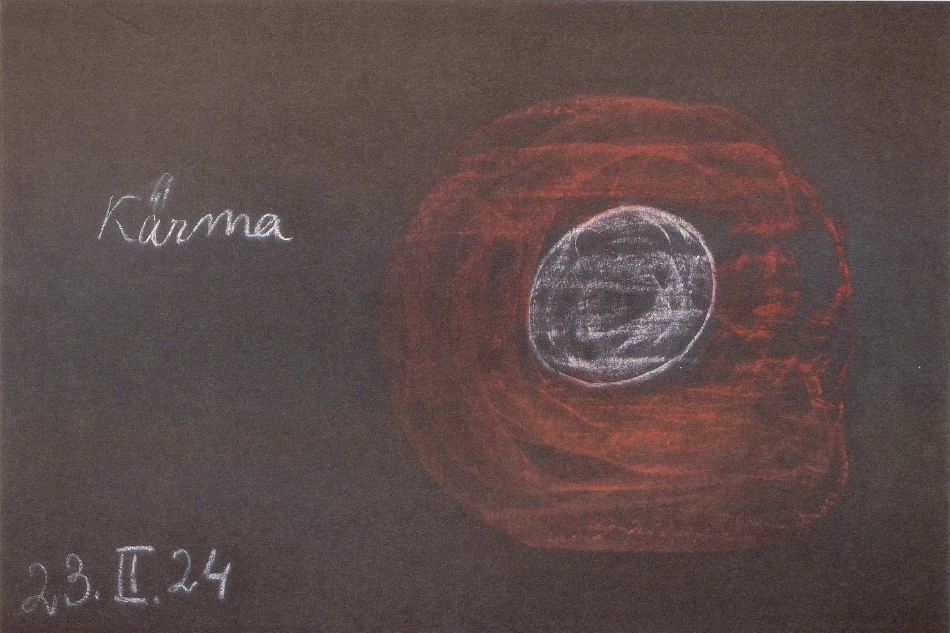
[ 30 ] Well, looking at this, you can make the following argument. You can say: Well, yes, I am now free within a certain sphere; but now I am reaching the limits of my freedom. There, I feel the karmic necessity everywhere. I walk around in my room of freedom, but everywhere at the boundaries I encounter my karmic necessity and feel this karmic necessity.
[ 31 ] Yes, my dear friends, if the fish thought that way, it would be utterly miserable in the water, for when it swims in the water, it reaches the boundary of the water. It cannot live outside that water. Therefore, it refrains from going outside the water. It never goes outside the water at all. It stays in the water, swims around in the water, and regards whatever is outside the water—be it air or whatever else it may be—as something else entirely. And for that very reason—because the fish does this—I can assure you that the fish is not at all unhappy about not being able to breathe with lungs. It doesn’t even occur to it to be unhappy. But if the fish were to occur it to be unhappy about the fact that it breathes only with gills and not with lungs, then it would have to have lungs in reserve, and it would have to compare what it’s like to live underwater with what it’s like to live in the air. And then the whole way the fish feels inside would be different. Everything would be different.
[ 32 ] If we apply this comparison to human life in terms of freedom and karmic necessity, the situation is this: in the present earthly life, human beings possess ordinary consciousness. With this ordinary consciousness, they live within the realm of freedom, just as a fish lives in water, and they do not enter the realm of karmic necessity at all with this consciousness. Only when a person begins to truly perceive the spiritual world—which would be like a fish having lungs in reserve—and only then, when a person truly becomes attuned to the spiritual world, does he gain an insight into the impulses that live within him as karmic necessity. And then he looks back on his past earthly lives and does not feel, nor does he say—since the causes of his present experiences stem from those past lives— “I am now under the compulsion of an iron necessity, and my freedom is impaired”—but rather, they look back to see how they themselves have pieced together what now lies before them, just as someone who has built a house looks back on the decision that led to the construction of that house. And then one usually finds it wiser to ask: Was the decision to build the house back then a reasonable one, or an unreasonable one? — Well, of course, one can form all sorts of opinions about it later, once things have played out; but at most—if one finds that building the house was a colossal folly—one can at most say that one was foolish.
[ 33 ] Well, in earthly life, it’s a bit of a thing when, with regard to something you’ve set in motion, you have to admit to yourself that it was foolish. You don’t like that. People don’t like to suffer because of their follies. They wish they hadn’t made that decision. But this applies only to that one earthly life, because between the folly of the decision and the punishment one receives for it—by having to experience the consequences of that folly—there is the corresponding earthly life in between. It always remains that way.
[ 34 ] But that is not the case between individual earthly lives. There are always lives in between—between death and a new birth—and these lives between death and a new birth change many things that would not change if earthly life were to continue in the same way. Just suppose you look back on a previous earthly life. There, you did something good or something bad to someone. The life between death and a new birth took place between that previous earthly life and your current one. In that life—that spiritual life—you cannot help but think: You have become imperfect by inflicting some harm on another person. This diminishes your human worth; it cripples you spiritually. You must, in turn, make amends for this crippling, and you resolve to achieve, in your new earthly life, whatever will rectify the mistake. Between death and a new birth, you take upon yourself, through your own will, whatever will compensate for the mistake. If you have done something good for another person, then you realize that the entire human earthly life—as is particularly evident in the life between death and a new birth—exists for the benefit of all humanity. And then you come to understand that when you have helped another person, they have in fact achieved certain things through your help that they would not have achieved without you in a previous earthly life. But this, in turn, makes you feel united with them in the life between death and a new birth, so that you may now continue to live out what you have achieved together with them in terms of human perfection. You seek them out again in the new earthly life in order to continue working in that new life precisely through the way in which you have helped them to perfect themselves.
[ 35 ] So it is not at all a matter of, for example, being able to abhor these karmic necessities once one perceives the realm of karmic necessities all around through a genuine insight into the spiritual world; rather, it is a matter of then looking back on these necessities—on the things one has done oneself—and viewing them in such a way that one says to oneself: What happens out of an inner necessity must happen—and it must happen out of complete freedom as well.
[ 36 ] You will simply never find yourself in a situation where, having truly understood karma, you disagree with that karma. When things happen in your karma that you do not like, you should simply view them in light of the general laws of the world. And then one comes to realize more and more that, in the end, what is karmically determined is better than if we had to start anew with every new earthly life, with every new earthly life full of blank pages. For we are, in fact, our own karma. What comes over from previous earthly lives—that is actually who we are, and it makes no sense at all to speak of anything in our karma—besides which the realm of freedom certainly exists—as needing to be different from what it is, because within a lawfully interconnected whole, the individual part cannot be criticized at all. Someone may not like their nose; but it makes no sense at all to criticize the nose in and of itself, because the nose one has must in fact be as it is if the whole person is as they are. And anyone who says, “I would like to have a different nose,” is actually saying that they would like to be a completely different person. But in doing so, they eliminate themselves in their own thoughts. One simply cannot do that.
[ 37 ] Thus, we cannot eliminate our karma either, for we ourselves are what our karma is. However, it does not mislead us at all, for it runs entirely parallel to the actions of our free will and in no way impairs those actions.
[ 38 ] I’d like to use another analogy to make this clear. We walk as human beings; but the ground is there, after all, upon which we walk. No one feels hindered in their walking by the fact that the ground is beneath them. Indeed, they should even realize that if the ground weren’t there, they couldn’t walk—they would fall down everywhere. So it is with our freedom. It needs the ground of necessity. It must rise up from a foundation.
[ 39 ] We ourselves are that foundation. As soon as one grasps the concept of freedom and the concept of karma in the right way, one will be able to reconcile them completely. And then one no longer needs to shy away from examining this karmic necessity thoroughly. Indeed, in certain cases one may even find oneself saying the following: Let us assume that someone is able to look back on past earthly lives through the insight gained from initiation. When he looks back on past earthly lives, he thereby knows with complete certainty that this or that happened to him—events that have carried over into this earthly life. If they had not come to the science of initiation, an objective necessity would compel them to do certain things. They would inevitably do them. They would not feel that their freedom was thereby impaired, for their freedom lies within ordinary consciousness. With that level of consciousness, he does not even enter the realm where this necessity operates, just as a fish cannot come up to the surface air. But when he has the science of initiation within him, he looks back, sees how things were in a previous earthly life, and regards what is there as a task consciously assigned to him for this earthly life. That is indeed the case.
[ 40 ] You see, someone who has no knowledge of the science of initiation actually always knows—and I’m about to say something that will seem somewhat paradoxical to you, but it is nevertheless true—through a certain inner urge, through an impulse, what they should do. Oh, people always do, always know what they’re supposed to do, always feel compelled to do this or that! For those who begin to study the science of initiation, however, things in the world become somewhat different. When life approaches them, very strange questions arise in response to individual experiences. When they feel compelled to do something, they are immediately compelled not to do it. The dark impulse that drives most people toward one thing or another falls away. And indeed, at a certain stage of initiatory insight, a person might—even if nothing else were to approach them—come to say to themselves: “Now that I have come to this insight—I am forty years old, and that matters not to me at all—I would prefer to spend the rest of my life sitting in a chair and doing absolutely nothing; for there are no such pronounced impulses to do this or that.”
[ 41 ] Do not think, my dear friends, that initiation lacks real reality. It is remarkable, in this regard, how people sometimes think. When eating a roasted chicken, everyone believes it is a tangible reality. When it comes to the science of initiation, most people believe it has only theoretical effects. It has effects on life. And one such effect on life is the one I have just alluded to. Before a person has the science of initiation, one thing is always important to them and another unimportant, driven by a dark impulse. The initiate would most like to sit down in a chair and let the world run its course, for it does not matter—so it might seem to him—whether one thing happens and another does not, and so on. In that case, there is only one corrective measure—it will not remain that way, of course, because the science of initiation also brings something else—there is only one corrective measure to prevent the initiate in question from sitting down in a chair, letting the world run its course, and saying, “I am indifferent to everything”—there is only one corrective measure: to look back on past earthly lives. There he then discerns from his karma the task for his earthly life. There he then consciously does what his past earthly lives require of him. He does not refrain from doing so because he believes it would infringe upon his freedom; rather, he does it because, by reflecting on what he experienced in his past earthly lives, he simultaneously becomes aware of what transpired in the life between death and a new birth—and, as he reasonably understood it then, he recognizes the need to carry out the corresponding actions. He would feel unfree if he were unable to fulfill the task set before him from his previous earthly life.
[ 42 ] I’d just like to make a brief aside here. You see, the word “karma” made its way to Europe via English. Well, because it’s spelled “karma,” people very often say “karma.” That’s pronounced incorrectly. “Karma” should be pronounced exactly as if it were spelled with an “ä.” Ever since I’ve been leading the Anthroposophical Society, I’ve always said “Ka(=ä)rma,” and I regret that so many people have gotten into the habit of constantly saying that awful word “Kirma.” These people always misunderstand me—when I say “Karma,” they hear “Kirma.” That’s terrible. You’ve probably already heard that even some very faithful students have been saying “Kirma” for some time now.
[ 43 ] Thus, neither before nor after the advent of the science of initiation is there a contradiction between karmic necessity and freedom. Before the advent of the science of initiation, this is not the case because, with ordinary consciousness, the human being remains within the realm of freedom, while karmic necessity unfolds outside of it as a natural process; they have no sense of anything other than what their nature dictates. And afterward, the reason is that they have come to be fully at peace with their karma and simply regard acting in accordance with karma as reasonable. Just as one does not say, after building a house: “Moving in there now impairs my freedom”—but rather says to oneself: “Well, it was quite reasonable of you to build a house in this neighborhood, in this spot; now be free in this house”—in exactly the same way, the person who, through the science of initiation, looks back on previous earthly lives knows that he becomes free by fulfilling his karmic task, that is, by moving into the house he built for himself in previous earthly lives.
[ 44 ] So today, my dear friends, I wanted to explain to you how freedom and karmic necessity are compatible in human life. Tomorrow, as we continue our discussion of karma, we will delve into the details of karma.