

Esoteric Considerations of Karmic Connections
Volume I
GA 235
24 February 1924, Dornach
Translated by Steiner Online Library
Fourth Lecture
[ 1 ] Today I would like to begin by presenting some broader perspectives regarding the development of karma, so that I can then gradually delve deeper and deeper into those matters that can really only be illustrated—if I may put it that way—through specific explanations, If we wish to gain insight into the workings of karma, we must be able to imagine how a human being actually assembles their entire constitution as they descend from the spiritual world into the physical world.
[ 2 ] You will understand, of course, that in our current language there are no truly appropriate terms for processes that are largely unknown in our present-day civilization, and that therefore the terms used to describe what is happening there can only be imprecise. When we descend from the spiritual world into the physical world to live an earthly life, we have first prepared our physical body through the current of heredity. We shall see how this physical body is nevertheless connected, in a certain sense, to what a human being experiences between death and a new birth. For today, it is enough for us to be clear that this physical body is actually given to us from the Earth. The members of the human being, on the other hand, that can be referred to as higher members—the etheric body, the astral body, and the I—come down from the spiritual world.
[ 3 ] In a sense, the human being draws the etheric body from the entire world ether before uniting it with the physical body given to him through heredity. The union of the soul-spiritual human being—comprising the I, the astral body, and the etheric body—with the physical human embryo can only take place as the etheric body of the mother’s organism gradually withdraws from the physical human embryo.
[ 4 ] The human being thus unites with the physical human germ after having drawn its etheric body from the universal world ether. We will examine these processes in greater detail later. For now, we should focus primarily on the origin of the individual members of the human being that a person possesses during their earthly life, between birth and death.
[ 5 ] The physical organism, then, originates from the stream of descent, while the etheric organism originates from the world ether, from which it is drawn. The astral organism—which, one might say, remains in every respect unconscious or subconscious to the human being during earthly life—contains everything that results from life between death and a new birth.
[ 6 ] And between death and a new birth, it is indeed the case that, depending on what a person has become through their previous earthly lives, they come into contact in the most diverse ways with other human souls who are also between death and a new birth, or to other spiritual beings of a higher world order, who do not descend to Earth in a human body but exist in the spiritual world.
[ 7 ] Everything that a person brings with them from previous earthly lives—based on who they were and what they did—meets with the sympathy or antipathy of the beings they encounter as they pass through the world between death and a new birth. For karma, it is not only of great significance which sympathies and antipathies a person encounters among higher beings as a result of what they did in their previous earthly life; above all, it is of great significance that the person comes into contact with those human souls with whom they were connected on Earth, and that a peculiar reflection takes place between his being and the being of those souls with whom he was connected on Earth. Let us suppose that someone had a good relationship with a soul whom he now meets again between death and a new birth. Everything that accompanies a good relationship has lived within him during earlier earthly lives. Then this good relationship is reflected in that soul when it is encountered between death and a new birth. And it is truly the case that during this passage through life between death and a new birth, a person sees himself reflected everywhere in the souls with whom he now lives, because he lived with them on Earth. If you have done something good for a person, something is reflected back from the soul; if you have done something bad to them, something is reflected back from the soul. And you have the feeling—if I may use the term “feeling” here with the qualification I made at the beginning of my remarks—that you have supported this human soul. What you experienced through that fostering, what you felt for that human soul, what led to your behavior out of those feelings, your own inner experiences during the act of fostering—these come back from that soul. They are reflected from that soul. Another soul—you have harmed it; whatever lived within you during that harm is reflected.
[ 8 ] And, just as in a powerful, vast reflecting apparatus, one’s previous earthly lives—especially the last one—are reflected before one’s eyes through the souls with whom one was associated. And one gets the impression, particularly with regard to one’s life of deeds, that all of this is moving away from one. Between death and a new birth, one loses—or has, in fact, long since lost—the sense of self that one had in the body on Earth; but one gains a sense of self from this entire reflection. One lives on in all those souls through the reflections of one’s deeds, with whom one was associated during one’s earthly life.
[ 9 ] On Earth, the self was, in a sense, a single point. Here, between death and a new birth, it is reflected everywhere in the surrounding space. It is an intimate communion with the other souls, but a communion determined by the relationships one has formed with them.
[ 10 ] And all of this is a reality in the spiritual world. When we walk through a room with many mirrors, we see ourselves reflected in each one. But we also know that—in ordinary human terms—it isn’t really there; when we walk away, it doesn’t remain, and we are no longer reflected. But what is reflected in human souls—that remains; it continues to exist. And there comes a time in the final third of the period between death and a new birth when we form our astral body from these mirror images. There we bring these together to form our astral body, so that when we descend from the spiritual world into the physical world, we carry within our astral body what we have taken back into ourselves following the reflection that our deeds in our previous earthly life found in other souls between death and a new birth.
[ 11 ] But this gives us the impulses that draw us toward human souls—or push us away from them—and with which we are then reborn at the same time in a physical body. "
[ 12 ] And in this way—I will have to describe the process in greater detail shortly, as I will also have to take the “I” into account later on—but in this way, the impulse toward karma in the new earthly life takes shape between death and a new birth.
[ 13 ] And there we can see how an impulse from one life extends into other lives. Take, for example, the impulse of love. We can perform our actions toward other people out of what we call love. There is a difference between performing our actions out of a mere sense of duty, convention, propriety, and so on, and performing them out of a greater or lesser degree of love.
[ 14 ] Let us suppose that a person manages to perform actions in an earthly life that are sustained by love, that are warmed by love. Yes, that remains as a force within their soul. And what they now take with them as the result of their deeds—and what is reflected in the souls of others—returns to them precisely as a reflection. And as the person forms their astral body from this—with which they descend to Earth—the love from their previous earthly life, which flowed out from them and returns from other people, is transformed into joy. So that when a person does something toward their fellow human beings in an earthly life that is sustained by love—whereby love flows out from them and accompanies the actions that benefit others— then the metamorphosis that occurs during the passage through life between death and a new birth is such that what was radiating love in one earthly life is metamorphosed in the next earthly life, transformed into joy flowing toward the person.
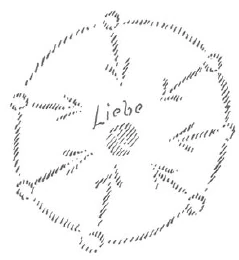
[ 15 ] If you experience joy through another person, my dear friends, during an earthly life, you can be certain that this joy is the result of the love you showed toward that person in a previous earthly life. This joy now flows back into your soul during your earthly life. You know that inner warmth of joy. You know what joy means in life—especially joy that comes from other people. It warms life, it sustains life, and, we might say, it gives life its vibrancy. Karmically, it is the result of love that has been given.
[ 16 ] But through joy, we in turn experience a connection with the other person who brings us joy. Thus, in our earlier earthly lives, we possessed something within us that caused love to radiate outward; in our subsequent earthly lives, as a result of this inner experience, we already feel the warmth of joy. This, in turn, is something that radiates outward from us. A person who is able to experience joy in life is, in turn, a source of warmth and meaning for others. A person who has reasons to go through life without joy is different to others than a person who is able to go through life with joy.
[ 17 ] But what is experienced in joy between birth and death is, in turn, reflected in the most diverse souls with whom one was together on Earth, and who are now also in the life between death and a new birth. And this reflection, which comes in many ways from the souls of people we have known, in turn has a reciprocal effect. We carry it with us in our astral body when we descend into the next—that is, we are now in our third earthly life—into the next earthly life. And once again, it is integrated into and imprinted upon our astral body. And now, in its effect, it becomes the foundation, the impulse for an easy understanding of people and the world. It becomes the foundation of that state of soul that sustains us through our understanding of the world. When we can take joy in the fascinating behavior of human beings and understand that behavior in an earthly incarnation, this points us back to the joy of the previous incarnation and to the love of the one that preceded it. People who can go through the world with a free, open mind—allowing the world to flow into them so that they have an understanding of the world—are people who have attained this relationship to the world through love and joy.
[ 18 ] The deeds we do out of love are something entirely different from those we do out of a rigid, dry sense of duty. As you know, I have always emphasized in my writings that deeds that come from love should be regarded as the truly ethical and truly moral ones.
[ 19 ] I have often had to point out the great contrast that exists in this regard between Kant and Schiller. Kant, after all, has essentially distorted everything in life and in knowledge. Everything has become angular and jagged in Kant’s conception of knowledge, and so too has human action: “Duty, you sublime, great name, which encompasses nothing beloved, nothing that carries flattery within it...” and so on. I quoted this passage in my Philosophy of Freedom—much to the feigned annoyance of many opponents—not to their real annoyance, but to their feigned annoyance—and contrasted it with what I myself must acknowledge as my own view: Love, you impulse that speaks warmly to the soul—and so on.
[ 20 ] Schiller, in contrast to Kant’s rigid, dry concept of duty, coined the following words: “I gladly serve my friends, but unfortunately I do so out of inclination, and so it often gnaws at me that I am not virtuous.” For according to Kant’s ethics, what one does out of inclination is not virtuous; rather, what one does is virtuous only when it stems from the rigid concept of duty.
[ 21 ] Well, there are simply some people—who don’t start out by loving. But because they cannot tell the truth to another person out of love—when you love someone, you tell them the truth and not a lie— but because they cannot love, they tell the truth out of a sense of duty; because they cannot love, they refrain—out of a sense of duty—from immediately beating the other person or slapping them, shoving them, and the like, when they do something that displeases them. There is simply a difference between acting out of a rigid sense of duty—which is, however, absolutely necessary in social life and necessary for many things—and between acts of love.
[ 22 ] Well, the deeds that are done out of a rigid sense of duty or out of convention—“because that’s the way it’s done”—do not bring joy in the next earthly life; rather, as I have just described, by passing through the souls as a reflection, they bring about in the next earthly life something that one might call: One senses that one is more or less indifferent to others. And what some people carry through life—the fact that they are indifferent to others and suffer because of it—one suffers rightly from this if one is indifferent to others, for people are there for one another, and a person depends on not being a source of indifference to others—what one suffers in this regard is precisely the result of a lack of love in a previous earthly life, where one behaved as a decent person only because rigid duty hung over one like the Sword of Damocles, I won’t say like a steel one, for that would be unsettling for most duty-bound people, but rather like a wooden one.
[ 23 ] But now we come to the second earthly life. As we have seen, what comes from love as joy becomes, in the third earthly life, an open, free heart that brings us closer to the world and gives us a free, discerning mind for all that is beautiful, true, and good. What flows toward us as indifference from other people—and what we experience as a result in one earthly life—turns us, in the third, that is, the next earthly life, into a person who doesn’t know what to do with himself. When he starts school, he doesn’t know what to make of what the teachers are doing with him. As they get a little older, they don’t know whether to become a locksmith or a court councilor. They don’t know what to do with themselves in life. They actually go through life without direction, adrift. When it comes to perceiving the external world, they aren’t exactly dull. They can, for example, already understand music, but they take no pleasure in it. Ultimately, he is indifferent to whether the music is more or less good or more or less bad. He does perceive the beauty of a painting or some other work of art, but it always gnaws at his soul: “What’s the point of all this, anyway?” and so on. These are things that, in turn, arise in the third earthly life within the karmic context.
[ 24 ] But let us assume that a person inflicts certain harms on his fellow human beings out of hatred or a tendency toward antipathy. One can consider all the degrees that may occur in this context. Someone might, let’s say, harm others out of a criminal sense of hatred. But they might also—I’ll skip the intermediate stages—be a critic. To be a critic, one must always harbor a bit of hatred, unless one is a laudatory critic, and those are rare today, since it’s not interesting to acknowledge things. It only becomes interesting when one makes jokes about things. Now, there are all sorts of intermediate stages. But what we’re dealing with here are those human actions that arise from cold antipathy—from a certain antipathy that one often isn’t even aware of—all the way up to hatred. Everything that is brought about in this way by human beings toward other human beings—or even toward subhuman entities—all of this, in turn, is deposited in states of the soul that are then reflected in the life between death and a new birth. And then, in the next earthly life, what emerges from this hatred is what flows toward us from the world as a painful existence, as external distress, as the opposite of joy.
[ 25 ] You will say: Yes, but we experience so much suffering—can all of this really stem from greater or lesser hatred in our previous earthly life? I simply cannot believe that I was such a bad person—as people are quick to say—that I could be experiencing so much misery just because I hated so much! Yes, if one wants to think without prejudice in this area, then one must realize just how great the illusion is—an illusion that is comforting and to which one therefore very easily succumbs when it comes to convincing oneself of feelings of antipathy toward other people. People actually go through life with far more hatred than they realize—or at least with far more antipathy. And the fact is this: hatred, because it gives the soul satisfaction, is usually not even experienced at first. It is masked by that satisfaction. When it returns as suffering that flows toward us from the outside, then it is the suffering that is noticed.
[ 26 ] But just think for a moment, my dear friends, to—I’d say—imagine in a very trivial way what possibilities exist here; just think for a moment of a coffee party, a real coffee party, where half a dozen—that’s enough! — of aunts or uncles—it could just as well be uncles—are sitting together and letting loose on their fellow human beings! Just think how much antipathy is unloaded onto people in an hour and a half—sometimes it takes longer! As it flows out, people don’t notice it; but when it comes back in the next earthly life, it will certainly be noticed. And it inevitably comes back.
[ 27 ] So that, in fact, a part—not all of it; we will learn about other karmic connections later—so that a part of what we experience as suffering inflicted from outside during an earthly life may indeed stem from feelings of antipathy in previous earthly lives.
[ 28 ] In all of this, of course, one must always be aware that karma—that some karmic current—must begin somewhere. So that, for example, if you have successive earthly lives here
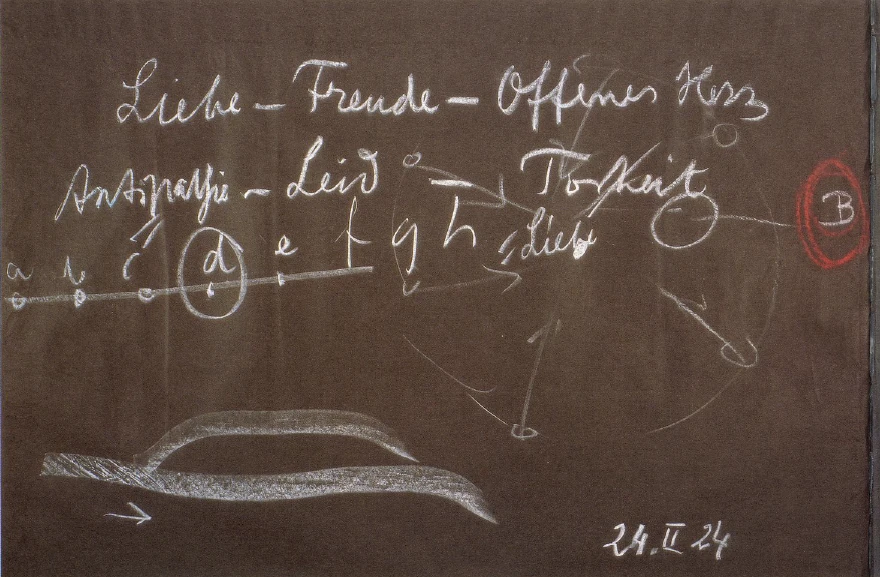
[ 29 ] a b c (d) e f g h
[ 30 ] And since this “d” refers to the present earthly life, it naturally follows that not all suffering that comes to us from outside must have its roots in a previous earthly life. It may also be an original suffering that will only be karmically worked through in the next earthly life. But that is why I say: A large part of the suffering that comes to us from outside is the result of hatred that was harbored in previous earthly lives.
[ 31 ] When we now return to our third earthly life, the result of what comes to us as suffering—but only the result of that suffering which comes to us, so to speak, from stored-up hatred—the result of this suffering, which then unloads itself into the soul, is initially a kind of dullness of the spirit, a kind of dullness of insight toward the world. And those who face the world with indifference and apathy, who do not approach things or people with an open heart, have often acquired this dullness through the suffering caused by their own karma in a previous earthly life; yet this suffering must recede if it expresses itself in this way as a dull state of soul, to feelings of hatred, at least in the third-to-last earthly life. For one can always be certain: being foolish in any earthly life is always the consequence of hatred in a specific earlier earthly life.
[ 32 ] But you see, my dear friends, our understanding of karma should not be based solely on viewing it as a means of comprehending life, but also on recognizing it as a driving force of life—so that we are aware that life is not merely an “a, b, c, d” (see diagram), but also an “e, f, g, h”—that future earthly lives also exist, and that what we develop in our soul in the present earthly life will have effects and consequences in the next earthly life. If someone wants to be particularly foolish in the third-next earthly life, all they need to do is hate a great deal in the present earthly life. But if someone wants to have a free, open mind in the third-next earthly life, they need only love a great deal in this earthly life. And it is only through this that the insight into karma—the understanding of karma—gains its value: by flowing into our will for the future and playing a role in that will. It is certainly true that we have now reached a point in human development where the unconscious can no longer continue to exert its influence in the same way it did in the past, as our souls passed through earlier earthly lives; rather, human beings are becoming ever freer and more conscious. Since the first third of the 15th century, we have been in an age in which people are becoming increasingly free and conscious. And so, for people living in the present, a future earthly life will already carry a vague sense of their past earthly lives. And just as people today, when they realize that they are not particularly intelligent, attribute this not to themselves but to their disposition—usually seeking the cause in their physical nature according to the view of contemporary materialism—so too will the people who are destined to return from among those living today have at least a vague sense that will trouble them: If they are not particularly intelligent, then there must have been something connected with feelings of hatred and antipathy.
[ 33 ] And when we speak today of Waldorf education, we must, of course, take the current civilization on Earth into account. We cannot yet educate with complete openness in such a way that we, so to speak, prepare students for consciousness in repeated earthly lives, because people today do not even have a vague sense of repeated earthly lives. But the approaches currently being developed in Waldorf education—if they are embraced—will evolve over the coming centuries to the point where they will be incorporated into ethical and moral education: A child with limited abilities traces back to previous earthly lives in which he or she hated intensely, and one will then, with the help of spiritual science, seek out whom the child might have hated. For those who have been hated—and against whom acts of hatred have been committed—must be found again in some environment. And in the coming centuries, education will gradually have to be integrated much more deeply into human life. One will have to observe in a child where, in the life between death and a new birth, the source lies—or lay—of that which manifests itself in earthly life as a metamorphosis of the lack of understanding. And then one will be able to take steps to ensure that, during childhood, a special love develops toward those people toward whom a particular hatred existed in earlier earthly lives. And we will see that through such concretely applied love, the intellect—indeed, the entire state of the soul—will be brightened. What can help education will not lie in general theories about karma, but in concretely looking into life to discern how karmic connections work. One will surely notice: the fact that children are ultimately brought together in a class by fate is, after all, not entirely insignificant. And when one overcomes that appalling carelessness that prevails today regarding such matters—where what is often referred to as “human material”—as it is so frequently called — has been thrown together in a class is truly viewed as if it were thrown together by chance, rather than brought together by fate; if one can rise above this appalling carelessness, then one will be able, precisely as an educator, to perceive what remarkable karmic threads have been spun from one child to another through past lives. And then one will incorporate into the children’s development whatever can have a balancing effect. For karma is, in a certain sense, something subject to an ironclad necessity. Out of this ironclad necessity, we can unequivocally establish the sequence:
Love — Joy — An Open Heart.
Antipathy or Hate — Suffering — Folly.
[ 34 ] These are absolute connections. But it is also true that just as one is faced with an absolute necessity when a river flows—and yet rivers have already been regulated, their course altered—it is also possible to, so to speak, regulate the karmic current, to influence it. That is possible.
[ 35 ] So if you notice that in childhood there is a predisposition toward folly, and you set out to guide the child to develop love especially in his or her heart, and if you—and this would already be possible today for people who are keen observers of life—discover which other children the child is karmically related to, and encourage the child to love precisely those children and to perform acts of love toward them, then you will see that you can counterbalance antipathy with love, and thereby correct that folly in a future incarnation, in a future earthly life.
[ 36 ] There really are—I would say—educators guided by instinct who often act on instinct to help children with difficult dispositions learn to love, thereby gradually nurturing them into more receptive human beings. It is these things that actually make an understanding of karmic connections truly beneficial to life.
[ 37 ] Well, before we proceed to examine the details of karma, there is still one question that must be posed to our soul. Let us ask ourselves: What kind of person is it with whom one can, at least generally speaking, recognize a karmic connection? I must use a term that is often employed today in a somewhat derisive sense: such a person is a contemporary. He or she is simply on Earth at the same time as we are. And when you consider this, you will say to yourself: If you are together with certain people in one earthly life, then you were also together with them in a previous earthly life—at least generally speaking, though things can shift somewhat—and likewise again in an earlier earthly life.
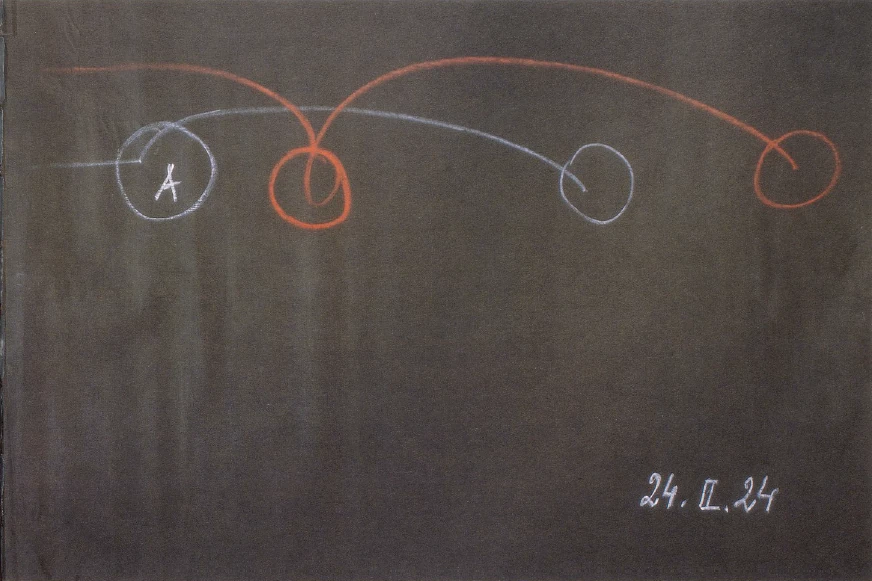
[ 38 ] Yes, but those who live fifty years after you—they, in turn, were together with people in their previous earthly lives! In general, according to the idea we have developed here, people—I mean those of the B series—will not be reunited with those of the A series. That is a distressing thought, but a true one.
[ 39 ] I will speak later about other questions of doubt that arise from the fact that people often say: “Humanity is multiplying on Earth,” and so on. But I would like to suggest this thought to you now; it may be a distressing thought, but it is a true one: It is indeed the case that the continuous life of human beings on Earth unfolds in rhythms. I would say that one wave of human beings generally moves from one earthly life to another, while another wave moves from one earthly life to another, and these are, in a certain sense, separated from one another; they do not come together in earthly life. In the long life between death and a new birth, people do come together; but in earthly life, it is indeed the case that one always returns to Earth with a limited circle of people. It is precisely for these repeated earthly lives that contemporaneity has an inner meaning, an inner importance.
[ 40 ] And why is that? I can tell you that this question—which at first might seem like a purely intellectual concern—has actually caused me the greatest possible anguish from a spiritual-scientific perspective, because it is indeed necessary to uncover the truth behind this question, to bring the inner reality to light. And so one might ask—forgive me for using an example that, I would say, is truly significant to me, though only in relation to this investigation—: Why weren’t you a contemporary of Goethe? Since you are not a contemporary of Goethe, you can generally infer from this that you have never lived on Earth together with Goethe. He belongs to a different wave of humanity.
[ 41 ] What is actually behind this? One must turn the question around. But to turn such a question around, one must have an open, free sense of human coexistence. One must be able to ask oneself—and I will have a great deal to say about this question here in the near future: What is it actually like to be a contemporary of another person, and what is it like to know about a person’s earthly life only through history? What is that like?
[ 42 ] Well, you see, one simply has to have an open, free mind to answer this intimate question: What happens to all the inner experiences of the soul when a contemporary speaks to you or performs actions that affect you—what is that like? And one must then be able to compare that—after having acquired the necessary insight—with what it would be like to encounter a personality who is not a contemporary, who perhaps was never a contemporary in any earthly life at all—a personality whom one can nevertheless revere to the highest degree, far more than any contemporary—what it would be like to meet that person as a contemporary? So, what would it be like if—forgive me for getting personal—I had been a contemporary of Goethe? Yes, if one is not an indifferent person—of course, if one is an indifferent person and simply lacks an understanding of what it means to be a contemporary, then one cannot really answer that question—then one might ask: What would it be like if I had walked down Schillergasse in Weimar toward Frauenplan and “the fat Privy Councilor” had come toward me—let’s say in 1826 or 1827?—Well, we know full well that we wouldn’t have been able to tolerate that! One can tolerate the “contemporary.” One cannot tolerate the one with whom one cannot be a contemporary; he would, in a certain way, have a poisonous effect on one’s inner life. One tolerates him because one is not a contemporary, but rather a successor or a predecessor. Certainly, if one has no sensitivity to these things, they remain in the subconscious. One can imagine that someone with a keen sensitivity to spiritual matters knows: If he were to walk down Schillerstraße in Weimar toward the Frauenplan and were to encounter, as a contemporary, the portly Privy Councilor Goethe with his double chin, he would have felt as if something were fundamentally wrong within himself. But the one who has no sensitivity to such things—well, he might have simply said hello.
[ 43 ] Yes, you see, these things simply do not stem from earthly life, because the reasons why we cannot be contemporaries of any particular person do not lie within earthly life—one must look into spiritual contexts; that is why they sometimes seem paradoxical in the context of earthly life. But that is how it is; that is absolutely how it is.
[ 44 ] I can assure you that I wrote an introduction to Jean Paul out of genuine love, which was published in Cottas’s “Library of World Literature.” If I had ever had to sit with Jean Paul himself in Bayreuth—I would most certainly have gotten stomach cramps. That does not prevent one from having the highest reverence. But this is the case for every human being; it’s just that for most people, it remains in the subconscious, in the astral or etheric body, and does not affect the physical body. For the soul experience that must affect the physical body must first come into consciousness. But you must also be clear about this, my dear friends: If you want to gain insights into the spiritual world, there’s no way around it—you will hear things that seem grotesque or paradoxical to you, precisely because the spiritual world is different from the physical world.
[ 45 ] Of course, it’s easy for someone to scoff at any claim along the lines of: “If I had been a contemporary of Jean Paul, I would have gotten stomach cramps just sitting with him.” — That is, of course, entirely true for the ordinary, banal, philistine world of earthly life; but the laws of that banal, philistine world do not apply to spiritual contexts. One must get used to thinking in different ways if one wants to understand the spiritual world. One must get used to experiencing the truly surprising. When ordinary consciousness reads about Goethe, it may naturally feel compelled to say: “I would have liked to have known him personally, to have shaken his hand, and so on.” That is thoughtlessness, for there are laws according to which we are predestined for a specific earthly age and can live only in that age. Just as we are predestined for a certain atmospheric pressure for our physical bodies, and cannot rise above the Earth to an atmospheric pressure that is not suitable for us, so too can a person who is destined for the 20th century not live in Goethe’s era.
[ 46 ] That is what I wanted to say first about karma.