

Esoteric Considerations of Karmic Connections
Volume I
GA 235
1 March 1924, Dornach
Translated by Steiner Online Library
Fifth Lecture
[ 1 ] When discussing karma in detail, one must, of course, first distinguish between karmic events that come to a person more from the outside during human life and those that, so to speak, arise from within the person.
[ 2 ] A person’s destiny is, after all, shaped by a wide variety of factors. A person’s destiny depends on their physical and etheric constitution; it depends on the sympathy and antipathy that a person, based on their astral and ego nature, can direct toward the outside world—and, in turn, on the sympathy and antipathy that others can direct toward them based on their own nature; a person’s destiny, in turn, depends on the most diverse entanglements and complications into which they become woven on their life’s journey. All of this results, at any given moment or, taken as a whole, over the course of a person’s entire life, in their particular fate.
[ 3 ] Now I will attempt to piece together a person’s overall destiny from these individual factors. To this end, let us take as our starting point today certain inner factors within the human being; let us look at the factor that is truly decisive in many respects—the state of a person’s health or illness—and that which, as the foundation for this state of health or illness, then comes into play in the person’s physical and spiritual strength, with which they can fulfill their tasks, and so on.
[ 4 ] But if one is to assess these factors properly, one must be able to look beyond much of what is contained in the prejudices of today’s civilization. One must be able to delve more deeply into the original nature of the human being and truly gain insight into what it actually means for a human being, in terms of their deeper nature, to descend from spiritual worlds into physical life on Earth.
[ 5 ] Now you know that even in art and poetry, for example, the concept of heredity has already found its way in. And when someone with certain characteristics appears in the world, the first question people ask is about heredity. When someone shows a predisposition to illness, people ask: What is the family history of that condition?
[ 6 ] It is certainly a perfectly legitimate question at first glance. But the way people approach these matters today, they actually fail to see the person. They completely overlook the person. One does not see what is actually the true essence of the human being, and how this essence unfolds. Of course, one says that the human being is first and foremost the child of his parents, the descendant of his ancestors. Certainly, one sees that as well. One sees it manifesting itself already in the outward physiognomy, perhaps even more so in the gestures; one sees the resemblance to the ancestors emerging. But that is not all. One also sees how a person’s physical organism is, in fact, a product of what their ancestors have given them. They carry this physical organism within themselves. And today, great—indeed, very great—emphasis is placed on the fact that a person carries this physical organism within themselves.
[ 7 ] People fail to take the following into account. When a human being is born, he certainly inherits his physical organism from his parents at first. But what is this physical organism that he inherits from his parents? In today’s civilization, people’s understanding of this is, fundamentally, quite wrong.
[ 8 ] When a person is going through the process of losing their baby teeth and getting permanent ones, they are not only replacing their first set of teeth with new ones; rather, this is the point in human life when the entire human being, as an organism, renews itself for the first time.
[ 9 ] Now there really is a fundamental difference between what a person becomes in their eighth or ninth year and what they were, for example, in their third or fourth year. It is a profound difference. The physical constitution a child had in their third or fourth year was inherited; it was given to them by their parents. What emerges and first appears in the eighth or ninth year of life stems, to the highest degree, from what the human being has brought down from the spiritual world.
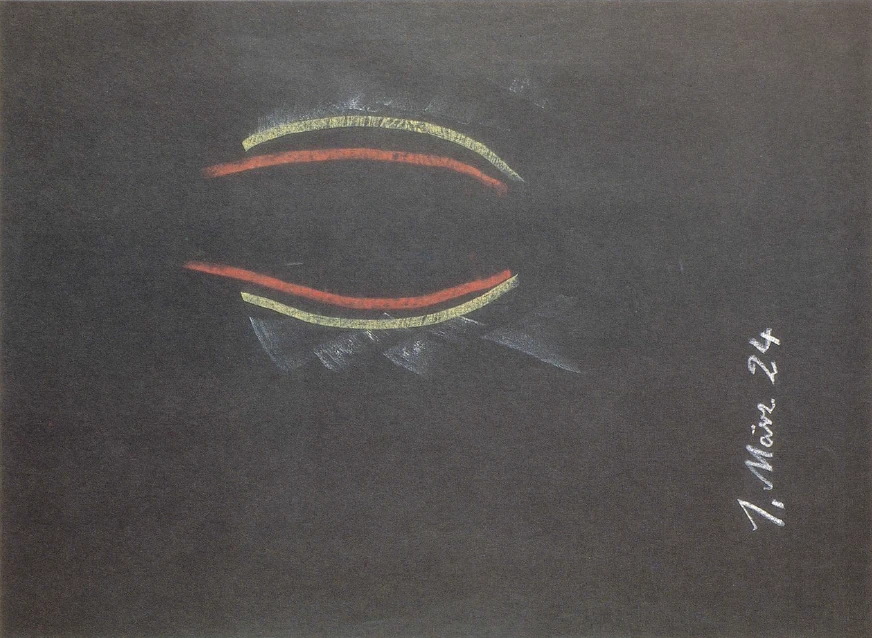
[ 10 ] If one wishes to sketch out schematically what actually underlies this, one must do so in the following manner, which would certainly shock humanity today. One must say: Upon being born, a human being receives something like a model for his human form (see drawing on page 87, green). He receives this model from his ancestors. They provide him with a model. And based on this model, the human being develops into what he will later become (red). But what he develops there is the result of what he brings down from the spiritual worlds.
[ 11 ] As shocking as it may be to a person today who is fully immersed in contemporary education, one must nevertheless say: The first teeth a person gets are entirely inherited; they are products of heredity. They serve as a model according to which he develops—but now in accordance with the powers he brings down from the spiritual world—his second set of teeth; these he develops himself.
[ 12 ] Just as it is with the teeth, so it is with the entire organism. And the question naturally arises: Yes, why do we, as human beings, need a model? Why can’t we simply—as was the case in earlier phases of Earth’s evolution—why can’t we simply, by descending and drawing our etheric body toward us—which we draw near through our own powers, which we bring down from the spiritual world—why can’t we also draw physical matter toward us in this way and form our physical body without physical descent?
[ 13 ] Of course, from the perspective of a modern person, this is a colossally foolish question—a crazy question, naturally. But isn’t it true that one has to say: As far as madness is concerned, the theory of relativity certainly applies—even if, for now, we apply the theory of relativity only to motion and say that, to the eye, one cannot tell whether one is moving along with the body one is on, or whether the body nearby is moving. This became clearly evident in the transition from the old theory of the world to the Copernican one. But even if one applies the theory of relativity today only to motion, it still applies—it does, after all, have a certain scope of validity—and it applies even with regard to this suggested absurdity: namely, there are two people standing apart from one another, and one is “crazy” compared to the other. It all depends, doesn’t it, on who is absolutely “crazy.”
[ 14 ] Well, the question must nevertheless be raised in light of the facts of the spiritual world: Why does humanity need a model? — Older worldviews provided their own answers to this question. Only in today’s world, where morality is no longer considered part of the cosmic order at all but is regarded merely as a human convention, are such questions not asked. Older worldviews did indeed ask these questions and even answered them for themselves. Earlier worldviews have stated: Originally, human beings were predisposed to adapt themselves to the Earth in such a way that, just as they draw their etheric body from the general cosmic etheric substance, so too do they form their physical body from the substances of the Earth. However, human beings have fallen prey to the Luciferic and Ahrimanic influences, and as a result, they have lost the ability to build their physical body from within their own being and must instead derive it from their lineage.
[ 15 ] For human beings, this way of coming into a physical body is the result of original sin. This is what older worldviews have taught; this is the true, fundamental meaning of original sin: having to place oneself within the conditions of inheritance.
[ 16 ] In our time, we must first reestablish the concepts necessary, first, to take such questions seriously, and second, to find answers to them. Indeed, within the course of human evolution on Earth, human beings have not remained as strong as they were by nature before the Luciferic and Ahrimanic influences arose. And so the human being is not able to form his physical body on his own immediately upon entering earthly conditions; rather, he needs a model—the model that develops during the first seven years of life. Since he models himself after this model, it is natural that something of this model remains with him, to a greater or lesser extent, even in later life. The person who, as a human being acting upon himself, is entirely dependent on the model will, if I may put it that way, forget what he has actually brought down with him and will orient himself entirely according to the model. Those who possess greater inner strength, acquired through their previous earthly lives, will be less guided by the model, and one will then be able to see how they change significantly, particularly during the second stage of life between the change of teeth and sexual maturity.
[ 17 ] If it is a true school, it will even have the task of bringing to fruition within the human being that which he has brought down from the spiritual worlds into physical life on Earth. Thus, what a person carries with them throughout their life contains, to a greater or lesser extent, these inherited traits, depending on whether they are able to overcome them or not.
[ 18 ] Well, you see, my dear friends, all things have a spiritual aspect. What a person has as their body during the first seven years of life is simply a model by which they orient themselves. Either their spiritual powers are, to a certain degree, subsumed into what is imposed on them by the model, and they remain entirely dependent on the model, or they work through—during those first seven years—what the model seeks to transform. This work, this process of working through, finds its outward expression. For it is not merely a matter of work being done and of this being the original model; rather, the original model breaks away, flakes off, so to speak, falls off, just as the first teeth fall out; everything falls off. (See drawing, light.) What is really at stake here is that, on the one hand, the forms and forces are pressing down on the model; on the other hand, the human being wants to express what he has brought down. This results in a struggle during the first seven years of life. Viewed from a spiritual perspective, this struggle is what is then expressed outwardly and symptomatically in childhood illnesses. Childhood illnesses are the expression of this inner struggle.
[ 19 ] Of course, similar forms of illness also occur in people later in life. This is the case, for example, when someone has not been very successful in overcoming the model during the first seven years of life. Then, at a later age, an inner urge may arise to finally rid themselves of what has remained within them karmically. At the age of twenty-eight or twenty-nine, they may suddenly be shaken to the core, rebel against the model even more strongly, and then develop a childhood illness.
[ 20 ] Now, if one has an eye for it, one can see how strongly this manifests in some human children: after the seventh or eighth year, they change significantly—in their facial features and in their gestures. We don’t know where certain things come from. Today, when the general view of civilization places such extraordinary emphasis on heredity, this has even found its way into common sayings. Suddenly, around the eighth or ninth year of life, something occurs in a child that has very organic roots. The father says, “Well, he didn’t get that from me.” — The mother says, “Well, certainly not from me!” — This, of course, stems from the common belief today—which has become ingrained in parental consciousness—that children must get everything from their parents.
[ 21 ] On the other hand, there is also the fact that one can then see how, under certain circumstances, children in this second stage of life may even come to resemble their parents more than they did before. Yes, but you simply have to take very seriously how human beings descend into the physical world.
[ 22 ] You see, psychoanalysis has produced some truly dreadful nonsense; among other things, for example—as you can read everywhere today—the idea that, secretly, in the subconscious, every son is in love with his mother, or every daughter is in love with her father, and that this gives rise to life conflicts in the subconscious provinces of the soul.
[ 23 ] Well, all of these are, of course, amateurish interpretations of life. But what is true is that, even before a person descends into earthly existence, he is in love with his parents; he descends because he is drawn to them. Of course, one must distinguish between the judgment that people here on Earth have about life and the judgment that people have about life outside of earthly existence—between death and a new birth.
[ 24 ] In the early days of the anthroposophical movement, a woman once came forward who, upon hearing about repeated earthly lives, declared: “No, I do like the other aspects of anthroposophy, but I don’t want to go through repeated earthly lives—this one is enough for me; she didn’t want to go through with the repeated earthly lives. — Well, even back then there were some very well-meaning followers who tried in every possible way to make it clear to the lady that this was, after all, a valid idea, and that every human being simply has to go through repeated earthly lives. She couldn’t bring herself to accept it. One person tried to persuade her from the left, another from the right. She then left. But she wrote me a postcard two days later, saying she didn’t want to be born on Earth again after all!
[ 25 ] In such a case, the one who simply wishes to speak the truth based on spiritual insight must say the following to people: Certainly, it may be that while you are here on Earth, you find no desire at all to descend to Earth again in a future life. But that is not the deciding factor. Here on Earth, you first pass through the gate of death into the spiritual world. That is what you want. Whether you wish to descend again depends on your judgment at that time, when you no longer have a physical body. You will then form a different judgment. — The judgments a person makes here in physical existence are quite different from those made between death and a new birth. Every perspective changes there.
[ 26 ] And that is indeed the case. If you were to tell a person—a young person here on Earth—that he chose his father, he might, under certain circumstances, object: “But how could I have chosen a father who beat me so badly?” — He really did choose him, because he had a different perspective before he descended to Earth. At that time, he held the view that the beatings would do him a great deal of good. This is actually not a ridiculous notion at all; it is meant to be taken absolutely seriously. And in the same way, a person also chooses his parents according to their form. He has the image before him of becoming like his parents. He does not become like them through heredity, but through his inner spiritual and soul forces, which he brings down from the spiritual world. That is why, when one judges the matter comprehensively—drawing on both spiritual and physical science—it is no longer possible to make sweeping generalizations such as: “I have also seen children who only began to resemble their parents in their second year of life.” Certainly, in such cases, the opposite is true: these children have set themselves the ideal of taking on their parents’ physical form.
[ 27 ] The point is that, essentially, during the entire period between death and a new birth, a person works—in union with other departed souls and with the beings of the higher worlds—on that which enables him to build his body.
[ 28 ] You see, people greatly underestimate what a person carries in their subconscious. As an earthly human being, one is far wiser in the subconscious than in the conscious mind. Drawing on a vast, universal wisdom of the worlds, one already works out what will then, within the model, develop during the second stage of life into what one now carries within oneself as one’s true, inherent human nature. Once one realizes how little a human being actually absorbs into their physical body from what they eat—and how much more they derive from what they take in from air, light, and so on in an extraordinarily finely dispersed state— then one will also be more inclined to believe that, quite independently of all hereditary factors, a person builds up their second body for the second stage of life entirely from the environment. The first body is in fact only a model, and that which originates from the parents—both in substance and in terms of external physical forces—is no longer present in the second stage of life.
[ 29 ] The relationship with one's parents becomes a moral and emotional one in the second stage of life, and it is a physical, hereditary relationship only in the first stage of life, up to the age of seven.
[ 30 ] Well, even in this earthly life there are people who have a keen interest in everything in the visible cosmos around them. These are people who observe plants, observe the animal world; they take an interest in this and that within the visible environment. They are fascinated by the grandeur of the starry sky. Their souls, so to speak, are fully engaged with the entire physical cosmos. The inner life of a person who has such a warm interest in the physical cosmos is, of course, different from that of a person who passes through the world with a certain indifference, with a kind of spiritual apathy.
[ 31 ] There really is a whole spectrum of human personalities in this regard. On the one hand, you see, someone has taken a very short trip. You talk to them afterward. They describe the city they visited with boundless affection, down to the smallest details. Because he was so deeply interested, you might even get a complete picture of what the city he visited looked like. From this extreme, it goes all the way to the other—as in the case, for example, of two elderly ladies I once met who had traveled from Vienna to Bratislava. Bratislava is a beautiful city. They had returned. I asked them what Bratislava was like and how they liked it. They had nothing to say except that they’d seen two cute little dachshunds on the beach! — They could have seen those in Vienna, too; they didn’t need to travel all the way to Bratislava for that. But they simply hadn’t seen anything else.
[ 32 ] This is how some people go through life. Between these two extremes on the spectrum lies every kind of interest a person can have in the physically visible world.
[ 33 ] Let us suppose that a person has little interest in the surrounding physical world. For my sake, he is interested only in what directly concerns his physical being—for my sake, in whether the food in a particular region is good or bad, or the like—but his interests do not extend beyond that. His soul remains impoverished. He does not carry the world within himself. And he carries little of what the phenomena of the world have revealed to him through the gateway of death, carrying it within himself into the spiritual world. As a result, it becomes difficult for him to work there with the spiritual beings with whom he is now united. Consequently, he brings with him not strength or energy, but weakness—a kind of powerlessness in his soul—for the building of his physical body. The model already exerts a strong influence on him. The struggle with the model manifests itself in all sorts of childhood illnesses, but the weakness remains with him. He develops, so to speak, a fragile body that is susceptible to all manner of illnesses. Thus, karmic soul-spiritual interest from one earthly life is transformed into the state of health in the next earthly life. Those people who are brimming with health had, to begin with, a lively interest in the visible world in a previous earthly life. And in this regard, the individual facts of life really do have an extraordinarily strong effect.
[ 34 ] Certainly, it is—I would say—more or less risky today to speak about these things; but one can only understand the interrelationships of karma if one is willing to take in the details of karma. After all, even in the time, for example, when the human souls who are here today lived in a previous earthly life, there was already painting, and there were people who had no interest in this painting. There are also people today who are completely indifferent as to whether they have some monstrous piece of art hanging on the wall or a very well-painted picture. So, back when the souls living today existed in earlier earthly lives, there were people like that as well. Yes, you see, my dear friends, I have never met a person who has a pleasant face, a pleasant facial expression, who did not take pleasure in painting in an earlier earthly life. People with unsympathetic facial expressions—which, of course, also plays a role in a person’s karma and has significance for their destiny—have always been those who passed by works of art in a dull, indifferent, and phlegmatic manner.
[ 35 ] But things go much further than that. There are people who, throughout their entire lives—and this was already the case in earlier Earth ages—have never looked up at the stars, who do not know where Leo, Aries, or Taurus are, and who have absolutely no interest in anything of this nature. In their next earthly life, these people will be born with a somewhat flaccid body; or, if the strength of their parents still provides them with the physical framework to overcome this, they will become flaccid and weak in the body they then build up for themselves.
[ 36 ] And so one could trace a person’s entire state of health—as it exists in any given earthly life—back to the interests he or she held in the visible world, in its broadest sense, during a previous earthly life.
[ 37 ] People who, for example, have absolutely no interest in music in our present time—those who are indifferent to music—will most certainly be reborn in their next earthly life either with asthma or with lung diseases, or will be born predisposed to lung diseases or asthma. It is indeed the case that the aspect of the soul that develops during an earthly life through an interest in the visible world finds expression in the state of health or illness of the body in the next earthly life.
[ 38 ] Perhaps someone might say: Knowing this could take away one’s enjoyment of the earthly life that follows. — But that, in turn, is the kind of judgment one makes from an earthly perspective, which is certainly not the only one, for life between death and a new birth lasts longer than earthly life. If someone is insensitive to anything visible in their surroundings, then they remain unable to work in certain areas between death and a new birth, and they have now passed through the gate of death, so to speak, with the consequences of indifference. They continue on after death. They cannot approach certain beings. Certain beings keep their distance from him because he cannot approach them. Other human souls with whom he was together on Earth remain strangers to him. This would last forever; there would be a kind of eternal hellish torment if it could not be changed. The fact that a person now decides, between death and a new birth, to descend into earthly life and to experience—through a sick body—that which is an inability in the spiritual world: that is the only compensation, that is the only cure. One desires this cure between death and a new birth, for between death and a new birth one has only this: there is something one cannot do; but one does not feel it. So that later on, when one dies again and once more passes through the time between death and a new birth, what was earthly pain becomes the impetus to now enter into that which one has missed. Thus, one can say that human beings essentially carry health and illness with their karma from the spiritual world down into the physical world.
[ 39 ] And if one takes into account that there is not only karma that is being fulfilled but also karma that is in the process of coming to be—that certain things can also occur for the first time—then, of course, one will not attribute everything that a person has to endure in physical life, say, in terms of health or illness, to previous earthly lives. But one will know that what arises, particularly from within, in terms of health and illness, is indeed karmically determined through the indirect path I have just described. The world becomes understandable only when one is able to see beyond earthly life. Before that, it cannot be understood. The world cannot be understood from the perspective of earthly life.
[ 40 ] And if, from these inner conditions of karma that arise from the organization, we turn more toward the external, toward the outward, then we can again—I would say, just to introduce the topic for now—start from a realm of facts that closely touches human beings. Let us take, for example, that which can be very strongly connected, on a psychological level, to the general psychological climate of health and illness in relation to other people.
[ 41 ] Let me posit the following scenario: someone reunites with a childhood friend. A close childhood friendship develops. The two are very attached to one another. Life drives them apart, so that perhaps both of them—or perhaps one in particular—look back on that childhood friendship with a certain wistfulness. But it cannot be restored; no matter how often they meet in life, that childhood friendship does not return. When you consider how much of a person’s fate may depend on such a broken childhood friendship, you will surely conclude that a person’s destiny can be profoundly influenced by such a broken childhood friendship.
[ 42 ] One should really talk as little as possible about such things from a theoretical standpoint. Talking about them from a theoretical standpoint has no particular value. Basically, one should only talk about these things either based on direct insight or on the basis of what one has heard, either verbally or in writing, from someone who can have such direct insight—and what seems plausible and comprehensible to one. Theorizing about these things has no value. That is why I want to say that when one endeavors, through spiritual insight, to get to the bottom of something like a broken childhood friendship, the following becomes apparent.
[ 43 ] If one looks back at a previous earthly life, one generally finds that two people who were childhood friends in one life—a friendship that later broke down—were friends in their later years in a previous earthly life.
[ 44 ] So let’s assume that two people are childhood friends until they reach the age of twenty, at which point their childhood friendship ends. If one now uses spiritual insight to look back into a previous earthly life, one finds that a friendship between the two people also existed there, but it began around the age of twenty and continued into later life. This is a very interesting case that is often encountered when one investigates these matters from a spiritual-scientific perspective.
[ 45 ] Upon closer examination of these cases, it becomes clear that the urge to get to know a person with whom one had a friendship in later years—to see what he was like in his youth—leads one, in the next life, to actually get to know him as a friend from one’s youth. One knew him as an older person in a previous earthly life; this has kindled the urge in one’s soul to now also get to know him in his youth. Since this is no longer possible in this life, one will do so in the next life.
[ 46 ] But this has a major influence when, in one or both of them, this urge arises—an urge that passes through death and then plays itself out in the spiritual world between death and a new birth. For then there is something in the spiritual world akin to a fixation on youth. One has this very special longing to gaze longingly at youth, and one does not develop the urge to get to know the person again in old age. And so the friendship of youth—which was predestined by the life one lived before descending to Earth—is shattered.
[ 47 ] Well, this is indeed a real-life story I’m telling you. What I’m telling you is definitely something that really happened. But now the question arises: Yes, what was this long-standing friendship actually like in the previous life, that it gave rise to this urge to have that person back in one’s life again in a new earthly existence?
[ 48 ] Well, to prevent this urge—which people have in their youth—from developing into a desire to remain with one’s childhood friend in old age, something else must happen in life. In all the cases I am aware of, it has always been the case that if these people had remained together in a later life—if the friendship from their youth had not been broken—they would have grown weary of one another, because they had developed the friendship from an earlier life, which was a friendship of old age, in too selfish a way. The selfishness of friendships in one earthly life takes its karmic toll in the loss of these friendships in other earthly lives. That is how complicated things are. But one always finds a guiding principle when one observes: In many cases, two people in one earthly life—let’s say, up to the age of twenty—live their lives separately and then continue as friends (see Figure I). In a subsequent earthly life, this pattern is usually mirrored by the other (II); this other pattern corresponds to the friendship of youth, and then their paths diverge. This is very often the case. How, then, is it that individual earthly lives—I would say, when viewed in terms of their configuration—complement one another?
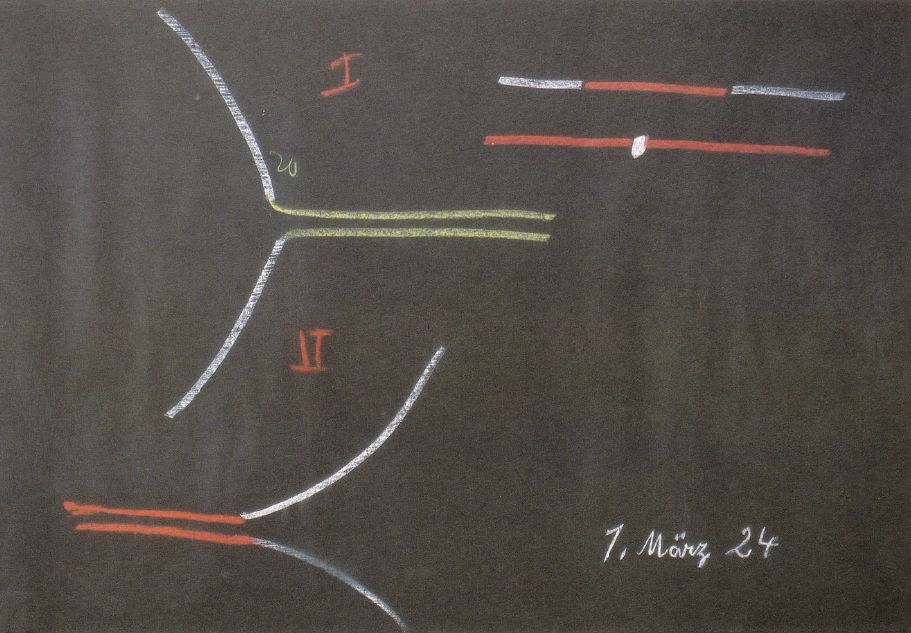
[ 49 ] This, in particular, is often observed: If you meet a person who has a strong influence on destiny—of course, this generally applies only as a rule and is not valid in all cases—but if you meet a person of middle age in one incarnation, then under certain circumstances you may have had that person by your side at the beginning and end of your life in a previous incarnation, as a matter of destiny. The picture is then as follows: In one incarnation, you experience the beginning and end together with that other person, and in another incarnation, you do not experience the beginning and end with them, but you meet them precisely in the middle of life.
[ 50 ] Or it may turn out that, as a child, one is bound to a certain person by fate. In a previous earthly life, just before one died, one was connected to that same person. Such parallels occur extremely frequently in the context of fate.