

Esoteric Considerations of Karmic Connections
Volume I
GA 235
2 March 1924, Dornach
Translated by Steiner Online Library
Sixth Lecture
[ 1 ] As we proceed in our considerations of karma, we must first take a look at the way in which karma intervenes in human development; how fate, which is interwoven with human free will, is actually shaped from the spiritual world into its physical reflection.
[ 2 ] Today I will have a few things to say to you about what pertains to the human being insofar as he lives on Earth. We have, after all, considered this earthly human being in terms of his structure in these lectures. We have distinguished the physical body, the etheric body, the astral body, and the ego organization within him. However, by turning our gaze to the human being simply as he stands before us in the physical world, we can gain yet another insight into the structure of the human being.
[ 3 ] Today, regardless of what we’ve already discussed, we want to examine a classification of human beings and then try to draw a connection between what we’re discussing today and what we already know.
[ 4 ] If we simply consider the human being—as he stands before us on Earth—in terms of his physical form, we see that this physical form has three distinct parts. Usually, however, this structure of the human being is not recognized, because everything that claims to be science today actually looks only superficially at things and facts and has no sense for what is revealed when one observes things and facts with an inner, enlightened gaze.
[ 5 ] First of all, we have the head in the human being. Even when viewed from the outside, this human head can appear to us as something entirely different from the rest of the human form. One need only turn one’s gaze to the development of the human being from the human embryo. The very first thing one can actually see forming in the mother’s womb as a human embryo is, in fact, only the organization of the head.
[ 6 ] The entire human organism originates in the head, and everything else that later contributes to the human form is, in fact, an accessory organ of the human embryo. At its core, the human being is essentially the head as a physical form; the rest is an accessory organ. And what these accessory organs then take over in later life—nutrition, respiration, and so on—is not at all provided during the earliest embryonic stage of the human being as a respiratory or circulatory process, etc., from within the human embryo itself, but rather comes from outside, from the mother’s body, through organs that later fall away and are no longer present in the human being at all.
[ 7 ] What a human being is first and foremost is, in fact, the head; it is, in fact, the mind. The rest is merely an appendage. It is no exaggeration to state outright: A human being is, at the outset, a head; the rest is, in essence, an accessory organ. And since what is initially an accessory organ later develops and gains importance for the human being, in later life one no longer strictly distinguishes the head from the rest of the organism.
[ 8 ] But this provides only a superficial description of the human being. In reality, the human being—even in his physical form—is a threefold being. And everything that actually constitutes his primary form—the head—remains a more or less individual part of the human being throughout his entire earthly life. People simply don’t pay attention to this, but it is true.
[ 9 ] You will say: Yes, one should not divide human beings in such a way that one, so to speak, beheads them, cuts off their heads. — That this happens in anthroposophy was merely the belief of the professor who accused anthroposophy of dividing human beings into head, chest organs, and limb organs. But that is not true; it is not so. Rather, what outwardly appears as the form of the head is merely the most prominent expression of the head’s form. The human being remains entirely head throughout his or her entire life. The most important sense organs—the eyes, ears, sense of smell, and sense of taste—are indeed located in the head; but, for example, the sense of warmth, the sense of pressure, and the sense of touch are distributed throughout the entire human being. This is because one should not distinguish the three members from one another spatially, but only in the sense that the head formation appears primarily in the externally shaped head, yet actually permeates the entire human being. And so it is with the other members as well. Throughout one’s entire earthly life, the head is also present in the big toe, insofar as the big toe has a sense of touch or a sense of warmth.
[ 10 ] You see, we have thus initially characterized one aspect of the human being—that human being who stands before us as a sensory being. In my writings, I have also referred to this organization as the nervous-sensory organization, in order to characterize it more from within. This is one aspect of the human being: the nervous-sensory organization.
[ 11 ] The second aspect of the human being is everything that expresses itself through rhythmic activity. You cannot say of the nervous-sensory system that it expresses itself through rhythmic activity; otherwise, for example, in visual perception, you would have to perceive one thing at a certain moment, then another, then a third, then a fourth, then return to the first, and so on. There would have to be a rhythm inherent in your sensory perception. That is not the case. On the other hand, if you turn your attention to the most fundamental aspects of your thoracic system, you will find there the rhythm of breathing, the rhythm of circulation, the rhythm of digestion, and so on. All of this is rhythm.
[ 12 ] And rhythm, with its rhythmic organs, is the second aspect to develop within the human being; this, in turn, spreads throughout the entire human being, but finds its primary outward expression in the chest organs. The whole human being is, in a sense, the heart and the lungs; but the lungs and the heart are, so to speak, localized in the organs that are commonly referred to by those names. After all, the whole human being breathes. You breathe at every point in your organism. We speak of skin respiration. It is just that breathing is primarily concentrated in the activity of the lungs.
[ 13 ] And the third is what constitutes the human limb organism. The limbs terminate in the chest organism. They appear as appendages during the embryonic stage. They are the last to develop. However, they are the organs most closely connected to metabolism. It is through the movement of these organs—and through the fact that they primarily perform the work in the human body—that metabolism receives its greatest stimulation. In this way, we have characterized the three members that appear to us in the human form.
[ 14 ] But these three aspects are intimately connected with the human soul life. The human soul life is divided into thinking, feeling, and willing. Thinking finds its physical organization primarily in the structure of the head. However, it also finds its physical organization in the whole human being, because the head, in the way I have just described to you, is present in the whole human being.
[ 15 ] Feeling is connected to rhythmic organization. It is a prejudice—indeed, a veritable superstition—of modern science to believe that the nervous system has anything to do with feeling. The nervous system has nothing to do with feeling directly. Feeling has as its organs the rhythms of respiration and circulation, and the nerves merely convey the idea that we have our feelings. Feelings are organized within the rhythmic organism, but we would know nothing of our feelings if the nerves did not provide us with ideas about them. And because the nerves provide us with ideas about our feelings, modern intellectualism has developed the superstition that the nerves are also the organs of feeling. That is not the case.
[ 16 ] But when we observe in our consciousness the feelings as they arise from our rhythmic organism and compare them with our thoughts—which are bound to our head and to our nervous-sensory organization—then we will perceive exactly the same difference between our thoughts and our feelings—if we are able to observe at all—as between our waking thoughts and our dreams. Feelings have no greater intensity in consciousness than dreams do. They simply take a different form. They merely manifest themselves in a different way. When you dream in images, your consciousness exists precisely in images. But these images, in their pictorial form, signify exactly the same thing that feelings signify in a different form. So we can say: the clearest consciousness, the most luminous consciousness, we have in our mental images, in our thoughts. We have a kind of dream-like consciousness when it comes to our feelings. We merely believe that we have a clear consciousness of our feelings. We have no clearer consciousness of our feelings than we have of our dreams. When, upon waking, we recall our dreams and form waking mental images of them, we have not grasped the dream itself. The dream is far richer than what we then imagine it to be. Likewise, the world of feelings is in itself infinitely richer than what we bring to mind as mental images of this world of feelings within us.
[ 17 ] And the will is completely immersed in sleep. This will is bound to the metabolic system of the limbs and to the motor system. Of this will, we know only the thoughts. I form the idea: “I will pick up this watch.” Try to admit to yourself honestly: you form the idea “I will pick up this watch,” and then you pick it up: What takes place there—from your thought down into the muscles and ultimately leads to the emergence of another thought, the act of grasping the watch, which continues the first thought—that which lies between the thought of intention and the thought of realization, what goes on within your organism—remains as unconscious as life itself remains unconscious in the deepest sleep, in dreamless sleep.
[ 18 ] At least we dream about our feelings. As for our impulses of will, we have nothing more of them than we do of our sleep. You might say: I get nothing at all from sleep. — Well, I’m not speaking from a physical standpoint here. From that perspective, it’s of course nonsense from the outset to say, “I get nothing at all from sleep”; but you also gain a great deal from sleep on a psychological level. If you never slept, you would never attain self-awareness.
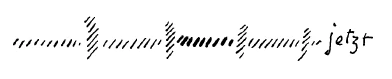
[ 19 ] You just need to keep the following in mind. When you recall the experiences you’ve had, go back—further back from the present moment. Yes, you might think that’s how it works: you go further back. — But that’s not actually the case. You only go back to the moment when you last woke up (see diagram). Then you were asleep—everything in between is blocked out—and then the memory really does pick up again from the last time you fell asleep to the time before that when you woke up. And so it goes back. And as you look back, you actually always have to factor in the periods of unconsciousness. As we look back, we have to factor in unconsciousness for a third of our lives. We don’t pay attention to that. But it’s just like having a white surface with a black hole in the middle. You see the black hole, even though there are no forces there. So it is with recollection: even though there are no traces of life’s memories inside, you still see the blackness—the nights you slept through. That is where your consciousness always stumbles. That is what makes you call yourself “I.”
[ 20 ] If that were to continue indefinitely without ever encountering any obstacles, you would never develop a sense of self. So one can certainly say: One benefits from sleep. And just as one benefits from sleep in ordinary earthly life, so one benefits from that sleep which reigns within our will.
[ 21 ] We fail to notice what is actually going on within us during an act of will. But therein lies, once again, the true self. Just as one gains self-consciousness through the black (see drawing), so too does the self—the self that has emerged through previous earthly lives—lie within what lies dormant within us during the act of will.
[ 22 ] Yes, you see, that is where karma reigns. Karma reigns in the will. All the impulses from the previous earthly life reign in the will. Only, even in a waking person, they are submerged in sleep.
[ 23 ] So when we imagine the human being as he appears to us in earthly life, we perceive a threefold structure within him: the head organization, the rhythmic organization, and the motor organization. This is a schematic division; each part belongs, in turn, to the whole human being. Linked to the head organization is thinking; linked to the rhythmic organization is feeling; linked to the motor organization is willing. The state in which thoughts reside is wakefulness. The state in which feelings reside is dreaming. The state in which willing—the impulses of the will—resides is sleep, even while awake.
[ 24 ] Now we must distinguish between two aspects of the mind, or rather, of perception. We must once again—I would say, more intimately—break down the “main.” This more intimate breakdown leads us to distinguish between what we have as an immediate representation as we engage with the world, and what we have as memory.
[ 25 ] You move through the world. You are constantly forming mental images based on the impressions you receive from the world. But you retain the ability to recall these impressions later from memory. Inwardly, the ideas you currently form as you interact with the world are no different from the ideas that arise when memory is at work. In one case, the ideas come from the outside; in the other, they come from within. It is, in fact, a thoroughly naive notion to think that memory works like this: I am now confronted with an object or event, form an idea, and this idea then somehow sinks down into me, into some sort of cabinet, and when I recall it, I take it out of the cabinet again. There are entire philosophies that describe how these images, which sink below the threshold of consciousness, are then fished back out during the act of remembering. These are naive notions.
[ 26 ] Of course, there is no such box at all in which these ideas are stored when we recall them. Nor is there anything within us where they wander around and then wander back up into our minds when we remember. None of that exists. And none of that has any explanation in and of itself. The reality is rather as follows.
[ 27 ] Just think about it: if you want to work on your memory, you often don’t just rely on visualization—you use something else entirely to help you. I’ve seen people memorize who visualized as little as possible, but who performed vigorous, outward speech gestures over and over again [arm movements]: “and it surges and swells and roars and hisses.” That’s how many people memorize, using as little thought as possible. And to add another suggestion: “and it surges and swells and roars and hisses”—they’d pound their fists against their foreheads. That happens, too. It is indeed quite true: the mental images we form when we engage with the world vanish like dreams. In contrast, what surfaces from memory are not mental images that fade away, but something else entirely. If I were to help you form a mental image of this, I would have to do it like this (see drawing on page 106). This is, of course, only a kind of symbolic drawing. Imagine for a moment that a person is a being capable of seeing. He sees something. Well, I don’t want to describe the process in more detail—I could, of course, but we don’t need to do that now. He sees something. This passes through his eye, through the optic nerve into the organs into which the optic nerve then merges.
[ 28 ] We have two distinctly different parts of our brain: the more external brain, the gray matter, and beneath it, the white matter. The white matter then extends into the sensory organs; the gray matter lies within them and is much less developed than the white matter. It is, after all, only roughly gray and white. But even from a very general anatomical perspective, the situation is as follows: Objects make an impression on us, enter through the eye, and proceed to processes in the white matter of the brain.
[ 29 ] In contrast, our ideas have their seat in the gray matter (see illustration), which has a completely different cellular structure. Inside it, ideas flicker and vanish like dreams. They flicker because what is happening down there are the impressions themselves.
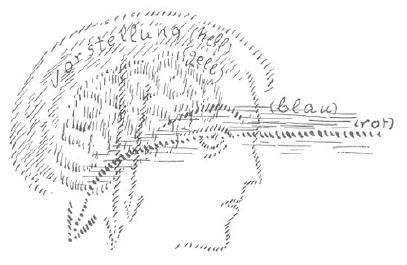
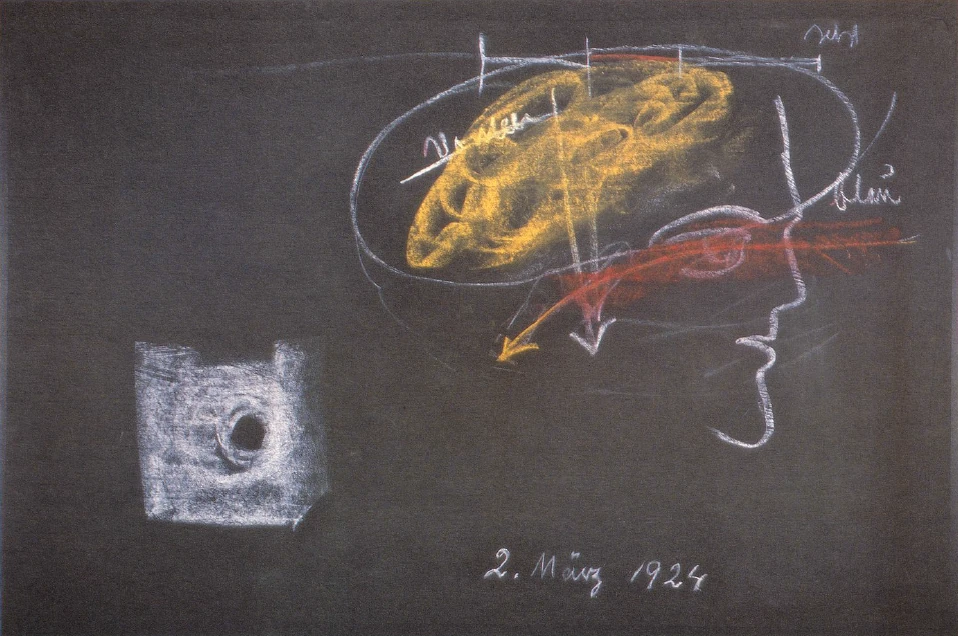
[ 30 ] If you were dependent on these ideas descending into your mind, and you had to retrieve them from memory, then you wouldn’t remember anything at all; you wouldn’t have any memory at all. The way it works is this: At this very moment, let’s say, I see something. The impression of that something enters me, mediated by the white matter of the brain. The gray matter of the brain functions by, in turn, dreaming about the impressions and forming images from them. These pass by. What remains—we do not even imagine it at that moment—but it goes down into our organism. And when we remember, we look inside: the impression remains down there.
[ 31 ] So when you have seen blue, an impression of that blue enters you (see drawing, below); here (above), you form the mental image of blue. That image passes. After three days, you observe the impression that has remained in your brain. And now, by looking inward, you imagine the blue. The first time you see the blue from the outside, you are stimulated from the outside by the object that is blue. The second time, when you recall it, you are stimulated from the inside, because the blueness has been imprinted within you. The process is the same in both cases. It is always a form of perception; memory, too, is a form of perception. So, in fact, our everyday consciousness lies in imagination; but beneath imagination, there are certain processes that arise for us only through imagination—namely, through the images of memory. Beneath this imagination lies perception—actual perception—and only beneath that does feeling arise. Thus, we can more closely distinguish between imagination and perception within the organization of the mind, the thinking organization. What we have perceived is what we can then recall. But it actually remains largely unconscious. It only rises into consciousness in the form of memory. What is actually taking place within a person is something the person no longer actually experiences. When a person perceives, they experience the mental image. The effect of perception penetrates into them. From this effect, they can evoke the memory. But that is where the unconscious already begins.
[ 32 ] Well, you see: It is only when we imagine things in our waking, daytime consciousness that we are truly ourselves as human beings; that is where we experience ourselves as human beings. (See illustration on page 109.) Where our consciousness does not extend—where it does not even reach the causes of our memories—there we do not exist as human beings; there we are integrated into the world. Just as it is in physical life: You breathe in; the air you now hold within you was outside just a moment ago, it was the air of the world; now it is your air. After a short time, you release it back into the world: you are one with the world. The air is now outside, now inside, now outside, now inside. You would not be human if you were not connected to the world in such a way that you possess not only what is within your skin, but also that which connects you to the entire atmosphere. Just as you are connected in the physical sense, so too are you connected in the spiritual sense—at the very moment you descend into the next level of the subconscious, into that region from which memory arises—you are connected there with what is called the third hierarchy: Angeloi, Archangeloi, Archai. Just as you are connected to the air through your breathing, you are connected—through your cranial organization, that is, the lower cranial organization, which is covered only by the outer lobes of the brain—which belongs solely to the Earth—to what lies beneath it, to the third hierarchy, to the Angeloi, Archangeloi, and Archai.
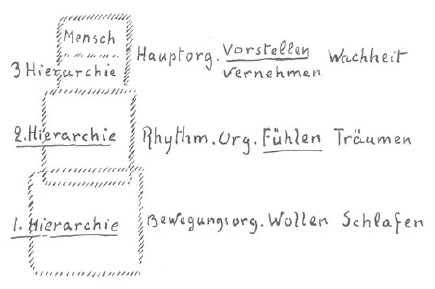
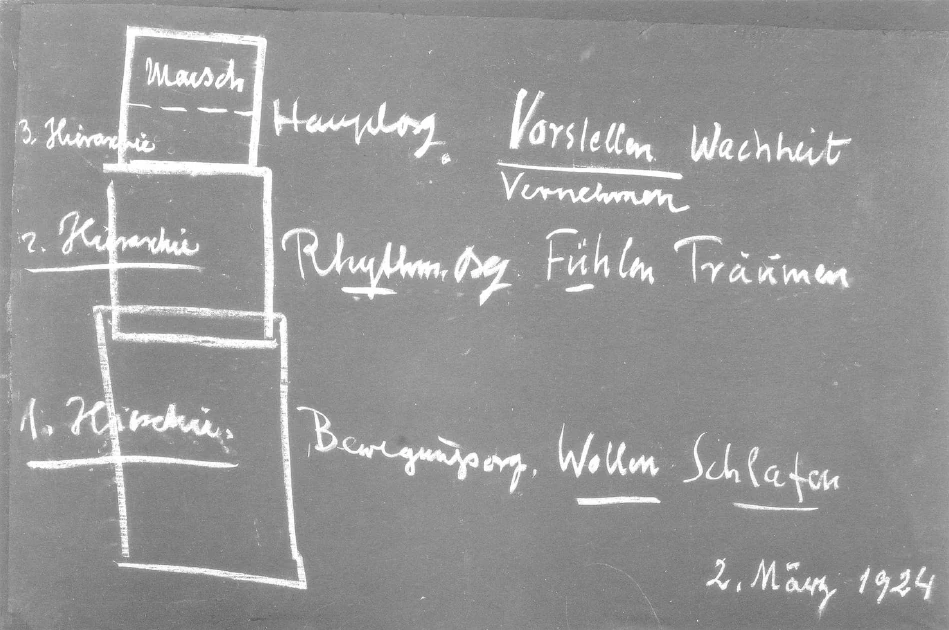
[ 33 ] Let us now descend into the region—spiritually speaking, that of feeling; physically speaking, that of rhythmic organization—from which, after all, only the dreams of feeling arise; there we are certainly not human. There we are connected to what is known as the second hierarchy: spiritual beings who do not incarnate in any earthly body but remain in the spiritual world, yet who ceaselessly send their currents, their impulses—that which emanates from them as forces—into the rhythmic organization of the human being. Exusiai, Dynamis, Kyriotetes—these are the beings we carry within our hearts.
[ 34 ] Just as we actually carry our human “I” only in the outer lobes of our brain, we carry the Angeloi, Archangeloi, and so on immediately beneath that, within our central nervous system. That is the arena of their activity on Earth. That is where their activity takes effect.
[ 35 ] Within our hearts we carry the second hierarchy—the Exusiai and so on. It is within our hearts that the focal points of their activity lie. And when we turn to our motor sphere, to our motor organism, the beings of the first hierarchy—the Seraphim, Cherubim, and Thrones—are at work within it.
[ 36 ] The transformed nutrients from the food we eat circulate through our limbs, where they undergo a process that is a living combustion process. For when we take a step, a living combustion takes place within us. What is outside is within us. We are thus connected to it. As physical human beings, we are connected to the lowest realm through the metabolic system of our limbs. We are connected to the highest realm precisely through our limb system. We are connected to the first hierarchy—the Seraphim, Cherubim, and Thrones—through that which has spiritualized us.
[ 37 ] Now the big question arises—it may seem trivial when I put this question into earthly terms, but I must do so—the question: What do these beings of the three successive hierarchies do while they are among us? What do they do?
[ 38 ] Now, the third hierarchy—the angels, archangels, and so on—is concerned with what is primarily located in the head; it is concerned with our thinking. If it were not concerned with our thinking, with what takes place in our head, we would have no memory in ordinary earthly life. The beings of this hierarchy hold within us the impulses we receive through our perceptions; they underlie the activity that manifests itself in our recollection, in our memory. They guide us through earthly life in the first realm, which we experience as the subconscious and unconscious realm.
[ 39 ] Let us turn to the beings of the second hierarchy—the Exusiai and so on. We encounter these beings once we have passed through the gate of death, in the life between death and a new birth. There we meet the souls of departed human beings who lived with us on Earth, but above all we meet the spiritual beings of this second hierarchy; we also encounter the third hierarchy, but the second hierarchy is more important. Together with them, in the time between death and a new birth, we work on everything we felt during our earthly life—everything we incorporated into our being. Together with the beings of this second hierarchy, we work out the details of our next earthly life.
[ 40 ] When we stand here on Earth, we have the feeling that the spiritual beings of the divine world are above us. When we are over there in the sphere between death and a new birth, we have the opposite impression. The angels, archangels, and so on—who guide us through our earthly life in the manner described—live with us, so to speak, on the same level after death; immediately below them are the beings of the second hierarchy. It is with them that we work on the formation and shaping of our inner karma. And what I told you yesterday about the karma of health and illness—we work this out with these beings, with these beings of the second hierarchy.
[ 41 ] And when we look even deeper into the time between death and a new birth—that is, when we look through, as it were, the beings of the second hierarchy—we discover below the beings of the first hierarchy: the Seraphim, the Cherubim, and the Thrones. As earthly human beings, we seek the highest gods above. The highest Divine that is initially accessible to us is sought by human beings between death and a new birth, deep below. And while one works through one’s inner karma with the beings of the second hierarchy between death and a new birth—karma that then manifests in the healthy or diseased state of the next earthly life—while one is engaged in this work, while one is thus working with oneself and other human beings on the bodies that will then appear in the next earthly life, the beings of the first hierarchy are active below in a peculiar way. One can see this. With regard to their activity—or rather, with regard to a part, a small part of their activity—they are bound by a necessity. They must recreate—for they are the creators of the earthly realm—that which the human being has shaped during their earthly life, but they must recreate it in a very specific way.
[ 42 ] Consider this: During their earthly life, human beings perform certain actions through their will—which belongs to the first hierarchy. These actions are good or evil, wise or foolish. The beings of the first hierarchy—the Seraphim, Cherubim, and Thrones—must shape the corresponding images in their own sphere.
[ 43 ] You see, my dear friends, we live together. Whether what we do together is good or evil: for everything good, for everything evil, the beings of the first hierarchy must create counter-images. Everything is judged under the first hierarchy, but it is also shaped there. And while one works on inner karma with the second hierarchy and with departed human souls, one observes, between death and a new birth, what the Seraphim, Cherubim, and “Thrones” have experienced through our earthly deeds.
[ 44 ] Yes, my dear friends, here on Earth the blue sky arches above us with its cloud formations, the sunshine, and so on; at night, it arches above us as a starry sky. Between death and a new birth, the activity of the Seraphim, Cherubim, and Thrones arches out beneath us. And we look up at these Seraphim, Cherubim, and Thrones, just as we look up here at the clouds, at the blue sky, at the star-studded sky. We see the heaven beneath us, formed by the activity of the Seraphim, Cherubim, and Thrones. But what kind of activity is this? As we exist between death and a new birth, we see in the seraphim, cherubim, and thrones the very activity that arises as the just, balancing force from our own earthly deeds and those we have lived through with other human beings. The gods must carry out this balancing activity, and we behold it as our heaven, which is now below. We see the consequences of our earthly deeds—whether anything is good or evil, wise or foolish—in the deeds of the gods. We relate to the mirror image of our deeds between death and a new birth by looking down, just as we relate here in earthly life to the heaven arching above us. We carry our inner karma into our inner constitution. We bring it with us to Earth as our abilities, our talents, our genius, our folly. What the gods shape down there—what they must experience as a result of our earthly lives—comes to meet us in our next earthly life as the facts of destiny that befall us. And we can say: That which we actually sleep through carries us into our destiny during our earthly life. But within that lives what the corresponding gods of the first hierarchy had to experience as the consequences of our deeds in the time between our “death” and a new birth.
[ 45 ] One always feels the need to express such things through images. We are standing somewhere in the physical world. The sky is overcast. We see the overcast sky. Immediately afterward, rain begins to fall. Rain falls. What was still hovering above us—we see it in the rain-drenched fields, in the rain-drenched trees, right afterward. If one looks back with the eye of one initiated into human life at the time one went through before descending into earthly life—the time one went through between the last death and the last birth—one sees there, first of all, the taking shape of divine deeds, the consequence of our actions in the last earthly life; then one sees how this trickles in spiritually and becomes our destiny.
[ 46 ] Whether I meet a person who is significant to me in this earthly life, who shapes my destiny: what happens as a result of this encounter with another person—the gods have exemplified it as the outcome of what we experienced with this person in a previous earthly life. Whether I am led during my earthly life to a place that is important to me, or to a profession that is important to me—everything that comes to me as external fate is the reflection of what the gods, the gods of the first hierarchy, experienced as the consequences of my previous earthly life during the time when I myself stood between death and a new birth,
[ 47 ] Yes, you see, when one thinks abstractly, one thinks: There are the past earthly lives; the deeds of those past earthly lives have an effect here; back then were the causes, now are the effects. You can’t really think much about it; you don’t really have much more than words when you say it. But behind what is described as the law of karma lie divine deeds and divine experiences. And behind all of that lies the other.
[ 48 ] If we humans approach our destiny based solely on our feelings, then—depending on our beliefs—we look up to the gods or to some form of providence, and feel that the course of our earthly lives depends on them. But the gods—specifically those we recognize as the beings of the first hierarchy: the Seraphim, Cherubim, and Thrones—have, so to speak, a reversed religious belief. They perceive their necessity in relation to human beings on Earth, of whom they are, after all, the creators. The errors and obstacles that these human beings encounter must be balanced out by the gods. And what the gods then prepare for us in later life as our destiny—they have first exemplified this for us.
[ 49 ] These things, in turn, must be discovered through anthroposophy. From a state of consciousness that was not yet fully developed, this was evident in humanity’s former instinctive clairvoyance. Ancient wisdom contained such things. Then only a vague sense remained. And in much of what we encounter in humanity’s spiritual life, a vague sense of these things still persists. Just recall the verse by Angelus Silesius, which you will also find in my writings, and which appears to a limited religious consciousness as nothing short of impertinence:
I know that without me, God cannot live even for a moment,
If I were to perish, He would be forced to give up His spirit.
[ 50 ] And Angelus Silesius converted to Catholicism and wrote such sayings as a Catholic. He was still clearly aware that the gods are dependent on the world, just as the world is dependent on the gods; that this dependence is mutual; and that the gods must model their lives on the lives of human beings. But divine life acts creatively, in turn influencing the fate of human beings. Sensing this vaguely, without knowing the exact details, Angelus Silesius said:
I know that without me, God cannot live for even a moment,
If I were to perish, He would be forced to give up His spirit.
[ 51 ] The world and divinity are interdependent and influence one another.
[ 52 ] Today we have seen this interplay using the example of human destiny, karma. I had to include these reflections in the discussion of karma.