Esoteric Considerations of Karmic Connections
Volume I
GA 235
8 March 1924, Dornach
Translated by Steiner Online Library
Seventh Lecture
[ 1 ] In today’s reflections on karma—following my previous discussion, which focused more on the formation of karmic forces—I would like, in a sense, to lay the groundwork for an understanding of karma by examining individual destinies in people’s lives, in order to grasp the karmic determinism—or, let us say, the destiny—of these individual human lives.
[ 2 ] Such fates can, of course, serve only as examples; but by drawing on specific human fates and considering karma in this context, one can, starting from there, gain insights into the way karma works in human beings in general.
[ 3 ] Of course, its effects are as varied as the number of people on Earth. Karmic patterns are entirely individual. So one can only speak in terms of examples by addressing each individual case.
[ 4 ] Today I would like to cite examples that I have examined and whose karmic course has become clear to me. It is, however, quite a daring undertaking to speak in detail about karmic connections—even if they are more distant ones—because it is actually customary, when speaking of karma, to use general expressions: “This or that is caused in this or that way”—or: “One must attribute this or that stroke of fate to something, as the person deserves it”—and the like. Well, things aren’t that simple! It is precisely when people talk about karma that the subject is often trivialized.
[ 5 ] Today, let us examine certain—albeit more distant—karmic examples; indeed, I would say, let us truly carry out this daring undertaking of discussing individual instances of karma, to the extent that this is possible based on the research I have conducted. These, then, will be examples.
[ 6 ] I would like to begin by speaking about a famous aesthetician and philosopher, Friedrich Theodor Vischer—whom I have mentioned several times in the course of my lectures. Today, I would like to highlight precisely those aspects of his life that I can then use as the basis for a karmic discussion.
[ 7 ] Friedrich Theodor Vischer’s education took place during the era when so-called German idealist philosophy—Hegelianism—was flourishing in Germany. And Friedrich Theodor Vischer, who was young and pursuing his studies at a time when everyone’s minds were filled with Hegelian thought, adopted this way of thinking. He was receptive to this lofty Hegelian immersion in thought. It seemed self-evident to him that thought—as Hegel indeed asserts—is in fact the divine essence of the world; that, therefore, when we think as human beings, we live in the divine substance by living in thought.
[ 8 ] Hegel was, in fact, thoroughly convinced that all earthly development actually depends on life in thought. The rest follows from this. The plans for the world are made as thinkers reflect on the world. — Certainly, there is much truth in this. But in Hegel’s view, all of this takes on a very abstract character.
[ 9 ] But Friedrich Theodor Vischer had fully immersed himself in Hegel’s philosophy. At the same time, however, he was also a figure who had emerged from a particular ethnic group and who embodied the distinctive traits of that group with great clarity. He possessed all the characteristics of a Swabian—all the stubbornness, all the dogmatism, and all the Swabian sense of independence! He also had the Swabian tendency to be quick-tempered. And because he embodied this Swabian character, he in turn possessed strong personal traits: a beautiful blue eye—if one considers his appearance—and a somewhat shaggy reddish-brown full beard, which he nevertheless wore with a certain aesthetic enthusiasm. I say he wore it with a certain aesthetic enthusiasm because, after all, he speaks out sufficiently in his writings about the ill-manneredness of those men who do not wear a full beard. He calls them “beardless monkey faces”; so he was by no means reserved. He did all this with the peculiar, brusque decisiveness characteristic of the Swabian.
[ 10 ] He was of average height, not fat, but rather slight; yet he walked through the streets holding his arms as if he were constantly clearing a path for himself with his elbows. And indeed, as a man of intellectual individuality, that is exactly what he did! — Such was his appearance.
[ 11 ] He had a very strong, even personal, drive for independence and did not hold back from saying what he wanted to say. So it happened by chance that, after he had been — which, of course, happens very often with friends — had been denounced to the Stuttgart government and received a severe reprimand from them — on the very same day that his son, Robert, was born (who later made a name for himself as an aesthetician) — he announced this in the auditorium, saying: “Gentlemen, today I’ve received a big Vischer and a little Vischer!”
[ 12 ] It was quite characteristic of him to speak very decisively about things. One of his delightful essays, for example, is titled “On Foot-Stretching on the Railroad.” He observed with great displeasure how passengers sitting on one side of a compartment would sometimes dangle their feet across to the other side of the bench. He couldn’t stand that at all! There is a delightful essay of his on foot-dangling on trains.
[ 13 ] I’d rather not comment today on everything he wrote in his book Fashion and Cynicism about all sorts of bad manners and inappropriate attire at balls and other social gatherings. He was certainly a strong individual.
[ 14 ] A friend of mine once visited him and knocked politely on the door. I don’t know if this is customary in Swabia, but he didn’t say “Come in!” or whatever one usually says in such a situation; instead, he bellowed, “Glei!”—meaning he’d be ready right away.
[ 15 ] Well, Friedrich Theodor Vischer set out at a relatively young age to tackle a major undertaking: to write a treatise on aesthetics in the spirit of Hegel’s philosophy. And these five volumes he wrote are, in fact, a remarkable work. There is a strict division into paragraphs, as was customary with Hegel; there are the usual definitions. If I were to read a passage to you, you would all yawn immediately, for it is written in a style that is by no means popular Hegelianism, but rather contains definitions such as this: “The Beautiful is the manifestation of the Idea in sensuous form.” The sublime is the manifestation of the Idea in sensuous form in such a way that the Idea predominates over the sensuous form. The comic is the manifestation of the Idea in sensuous form in such a way that the sensuous form predominates—and so on. These are things that are still relatively interesting, but it goes much further! But then, set against these “definitions” and “declarations,” is what is known as the “fine print.” Most people read this book, Aesthetics by Friedrich Theodor Vischer, in such a way that they skip the “large print” and read only the “fine print.” And this “fine print” does indeed contain the most profound insights into aesthetics that have been put forward in a wide variety of fields. There is no pedantry, no Hegelianism in it; rather, there is the Swabian Vischer with all his witty conscientiousness, but also with his refined sensibility for everything beautiful, magnificent, and sublime. At the same time, natural phenomena are described in an incomparable manner, in a free style that is nothing short of exemplary. He truly brought this work to completion over many years with ironclad consistency.
[ 16 ] At the time this work was published, when Hegelianism was still, in a certain sense, dominant, it actually received a great deal of recognition; there were opponents, of course, but still a great deal of recognition. Over time, however, a major opponent of this work emerged—an opponent who criticized it devastatingly, who left “not a single good hair” on it, who criticized it in a grand, witty manner, and did so in an exemplary way: that was Friedrich Theodor Vischer himself in his later years!
[ 17 ] And once again, I would say, it is delightful—truly delightful—to read this self-criticism in the Kritische Gänge. And yet there is so much that Friedrich Theodor Vischer, as an aesthetician, a philosopher, and a writer of general fiction, published in his Kritische Gänge or later in the beautiful collection Altes und Neues. — When he was still a student, he wrote lyrical-ironic pieces. Despite all the great admiration I’ve always had for Friedrich Theodor Vischer, I could never help but regard what he produced as a student not even as “student-like,” but as thoroughly philistine! But that resurfaced when, in his seventies, he wrote his collection of poems under the pseudonym “Schartenmayer”—philistine stuff!
[ 18 ] He became a true philistine when it came to Goethe’s Faust. As for the first part of Goethe’s Faust, well, he still had some good things to say about it. But in any case, he was of the opinion that the second part was a cobbled-together, patched-up piece of work from old age, because the second part of Faust should have been completely different! — And he didn’t just write his Faust, the Third Part of the Tragedy, in which he satirized the second part of Goethe’s Faust; he actually drew up a plan for how Goethe’s Faust should have turned out. It’s philistine drivel. It’s about as philistine as what Du Bois-Reymond, the great naturalist, said in his speech: “Goethe and No End”: “Faust” is actually flawed; it would be correct if Faust didn’t engage in all sorts of nonsense like conjuring spirits and summoning the Earth Spirit, but instead had simply and honestly invented the electrostatic machine and the air pump and made Gretchen virtuous. — In much the same way, everything that Friedrich Theodor Vischer has now spouted in connection with Goethe’s Faust is actually just as philistine.
[ 19 ] It was just as people say—perhaps not in Württemberg, but in my homeland of Austria: what he did with regard to Goethe’s Faust was a “Schwabenstreich”! Such words always have a different meaning depending on the region where they are used.
[ 20 ] Well, you see, what makes this man significant are these individual traits. They essentially make up his life. One could, of course, recount individual facts, but I don’t want to do that. I want to present him to you as a personality, and then, on that basis, I’d like to offer a karmic perspective on him. For now, I’d just like to provide you with the background information.
[ 21 ] A second figure whom I would like to consider from a karmic perspective—as I said, it is a risk to give such specific examples, but they must be given, and I would like to lay the groundwork for this—a second figure is Franz Schubert, the song composer, the composer par excellence.
[ 22 ] I also want to highlight those aspects that I will need for the karmic account. Franz Schubert was actually poor for pretty much his entire life. Some time after Schubert had died, there were indeed a great many people in Vienna who were not just “acquaintances” but “friends” of Franz Schubert. A whole lot of people claimed he had borrowed money from them, referring to him as “Franzl Schubert” and so on. Yes, but that wasn’t the case during his lifetime!
[ 23 ] But he had found a true friend. This friend, Baron von Spaun, was an extraordinarily noble man. From Schubert’s earliest youth onward, he had looked after him in a tender way. They had been schoolmates. Back then, he had to take care of him, and that continued from then on. And from a karmic perspective, it seems to me to be of particular importance—we will see this later in our karmic analysis—that Spaun was engaged in a profession that was actually quite foreign to him. Spaun was a highly cultured man who loved every form of art, who was close friends not only with Schubert but also with Moritz von Schwind—a man on whom everything artistic made a profound impression in a very tender way. Admittedly, all sorts of things happen in Austria—Grillparzer, after all, was a tax official, too—but Spaun, too, despite having not the slightest inclination for it, spent his entire life in tax offices. He was a tax official, responsible for managing money—or rather, managing numbers—and when he reached a certain age, he even became the director of the lottery. So he was in charge of running the lottery in Austria. He found it extremely distasteful. But just think for a moment about what a lottery director actually manages in reality! You only have to consider this: a lottery director manages the passions, hopes, shattered hopes, and disappointments of countless people. A lottery director manages people’s superstitions on a grand scale; a lottery director manages people’s dreams on a grand scale! Just think about everything that actually comes into play when a lottery director—a top lottery director—takes his administrative measures! Of course, when you walk into the office and walk out again, you don’t really notice it; but the reality is there. And anyone who views the world as real must certainly take such things into account.
[ 24 ] Well, this man, who had absolutely nothing to do with the superstitions that were being perpetuated in his name, nor with those disappointments, longings, and hopes—he was Schubert’s close friend and contributed immensely to both his material and spiritual well-being. Outwardly, one can sometimes be astonished at what the world is capable of. There is a biography of Schubert that describes his appearance as if he had looked something like a Black man. There was absolutely no mention of that! He even had a very likable face! But he was simply poor. Even his evening meal, which he usually shared with Baron von Spaun, was most often graciously paid for by von Spaun. And he didn’t have the money to rent a piano, for example, for his musical needs. In his outward demeanor—as Baron von Spaun also describes very faithfully—he was actually reserved, almost phlegmatic. But in a remarkable way, an inner volcanic force could erupt from his nature.
[ 25 ] It is certainly interesting that he usually wrote down his most beautiful musical motifs in the morning, after getting out of bed. Straight out of bed, he would sit down and jot down his most beautiful musical motifs in this way. Baron von Spaun himself often witnessed this firsthand. For, as is so often the case in intellectual Vienna: both gentlemen, Schubert and Spaun, enjoyed a good drink in the evening as well, and then it would get late, very late. Then Schubert, who lived far away, could no longer be allowed to go home. So he stayed the night in a very modest bed at Spaun’s. And there, Baron von Spaun was often a witness to how, upon waking, Schubert would simply sit down and write down his most beautiful musical motifs right after waking up.
[ 26 ] His relatively calm facial features give no indication of just how volcanic things actually were beneath the surface of Schubert’s soul. But it was volcanic, and it is precisely this particular kind of personality that I must describe to you as the basis for our consideration of karma. For, you see, it was once like this: Schubert was able to go to the opera. He saw Gluck’s Iphigenia and was utterly captivated by it. His enthusiasm poured out toward his friend Spaun during and after the performance—strongly, magnificently, yet in a measured way. He became, so to speak, tenderly emotional, not volcanically emotional—I am specifically choosing the traits we will need. It was such that, at the very moment he became acquainted with Gluck’s Iphigenia, he considered it the most wonderful musical work of art. He found the performance by the singer Milder enchanting. And regarding the singer Vogl, he said he wanted to meet him just so he could fall at his feet, so enchanted was he by his performance. Well, then the performance of Iphigenia came to an end. Schubert and Spaun went to the so-called Bürgerstübl in Vienna. I believe there was a third person with them, whose name escapes me at the moment. They sat quite quietly, but from time to time they spoke enthusiastically about what they had experienced that evening at the opera. — There was a neighboring table; among those seated there was a professor known to the group, a university professor. At first, he blushed slightly as he listened in on this enthusiastic conversation. The flush grew stronger and stronger. Then he began to grumble. After he had grumbled for a while—and they hadn’t let themselves be disturbed—he began to rage and rant terribly and declared across the table to this group: “And anyway, the whole Iphigenia is rubbish; that’s not real music, and Milder isn’t a singer at all—she has neither runs nor trills; she can’t sing at all. And Vogl—he walks as if he were shuffling along the floor with elephant feet!”
[ 27 ] Now there was no holding Schubert back. At any moment, the worst possible consequence of the physical altercation threatened to unfold. Schubert, who was otherwise completely calm, unleashed all his volcanic temper, and the others really had their hands full just trying to calm him down.
[ 28 ] Yes, you see, what’s important for this life is that we’re dealing with a man whose friend is a tax official—even a lottery director—and that he is karmically brought together with this person in life. What is important in the karmic context is that Schubert was as poor as his circumstances dictated; it is important that Schubert otherwise could not act on his impulses. Naturally, because he was poor, he lived within limited social circumstances; he did not always have the opportunity to have such a table companion, so that his volcanic nature could not always find an outlet.
[ 29 ] But if one truly imagines what actually happened there, while also being aware of the tribal characteristics from which Schubert emerged, then one might well ask oneself—such negative things are, of course, meaningless, but they sometimes shed light on the matter—one might well ask oneself: If circumstances had been different—of course they could not have been different, but I mean, one can consider the matter this way for the sake of clarity—if Schubert had not had the opportunity to channel the musical talent within him, if he had not found this devoted Spaun as a friend, might he not also have become a brawler in a subordinate position? One might well ask: Wasn’t what came to such explosive expression that evening at the Bürgerstübl already latent within him? And human life is not transparent unless one can answer the question: How does this metamorphosis actually take place—that in one lifetime, one does not act out one’s combative nature karmically, but instead becomes a refined musician, and that combative nature is transformed into a refined musical imagination?
[ 30 ] It sounds paradoxical; it sounds grotesque, but it is a question that, when one considers life on a larger scale, must certainly be raised, for it is only through contemplating such things that the deeper questions of karma actually arise.
[ 31 ] A third figure I wish to examine is Eugen Dühring, who was widely hated but also loved by a small community. I have also studied this character from a karmic perspective and would like to begin, so to speak, by presenting the biographical material.
[ 32 ] Eugen Dühring was an extraordinarily gifted man who, in his youth, studied a wide range of disciplines, particularly from a mathematical perspective, but also a wide range of other fields, including economics, philosophy, mechanics, physics, and so on.
[ 33 ] Eugen Dühring had already earned his doctorate with an interesting dissertation and then, in a book that has long been out of print, wrote about this subject quite clearly—and, above all, forcefully. I would like—even though the subject is almost as difficult as the theory of relativity—but then again, for a while everyone who didn’t understand a thing about the theory of relativity was talking about it, and they still found it magnificent and continue to do so today—I would like, despite its difficulty, to say a few things about these ideas from Dühring’s early works in a way that might be understandable.
[ 34 ] You see, the point is that people usually imagine it this way: There is space, which is infinite, and that space is filled with matter. Matter consists of minute particles. Their number is also infinitely large. An infinite number of these minute particles of matter are concentrated in outer space, somehow crystallized together, and so on. Then there is infinite time. The world did not have a beginning at all; nor can one say that it will come to an end.
[ 35 ] These vague concepts of infinity had captivated the young Dühring, and he spoke with remarkable acumen about how this talk of concepts of infinity actually had no meaning at all—that even if one were to speak of a number as large as possible, for example, of world atoms or world molecules, it would still have to be a countable, definite number. No matter how vast one imagines the universe to be, it must be a measurable quantity; likewise, cosmic time must be a measurable quantity—a point which, as mentioned, was presented with great insight.
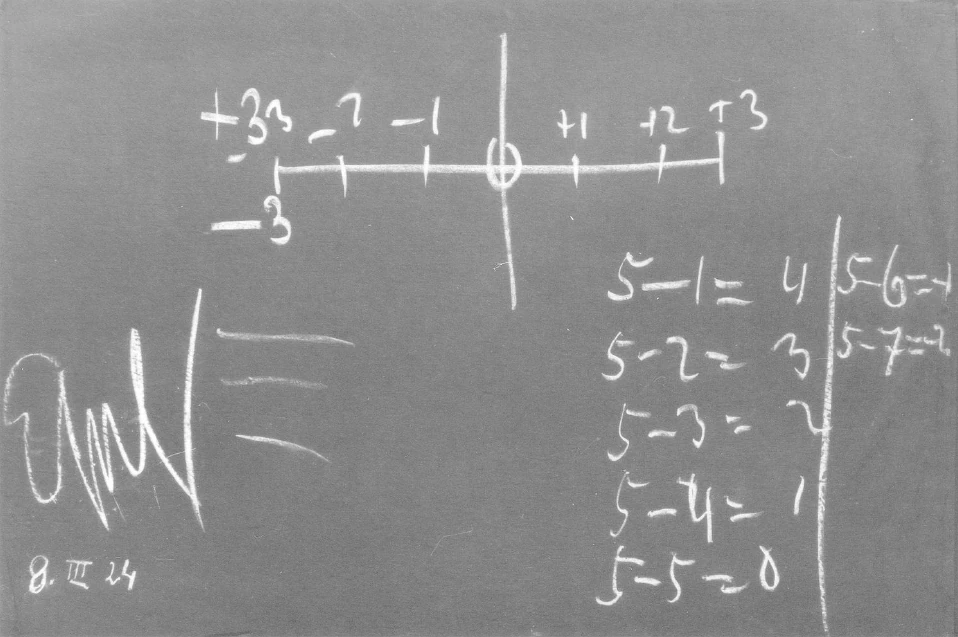
[ 36 ] There is a psychological basis for this. Dühring wanted clear thinking in everything, and yet, fundamentally speaking, even today there is still no clear thinking to be found anywhere in the concepts of infinity. Dühring then extended this to other considerations, for example, to so-called negative quantities—such as when one has the capacity to deal with negative quantities, which are denoted by a minus sign. One then distinguishes between the following number sequences: zero, plus one in one direction, etc., and minus one in the other direction, etc.
[ 37 ] Dühring has now put forward the view that all this talk of negative numbers is actually nonsense. What does a negative number mean? He says: If I have five and subtract one, I get four; if I have five and subtract two, I get three; if I have five and subtract three, I get two; if I have five and subtract four, I get one; if I have five and subtract five, I get zero. Now the proponents of negative numbers say: If I have five and subtract six, I have minus one; if I have five and subtract seven, I have minus two.
[ 38 ] Dühring says: This is a muddled way of thinking; there’s no clear thought behind it! What does “minus one” mean? It means I’m supposed to subtract six from five; but I’m one short. What does minus two mean? I’m supposed to subtract seven from five; I’m two short. What does “minus three” mean? It means I’m supposed to subtract eight from five; I’m one short. Negative numbers, then, are not numbers different from positive numbers at all. They simply always mean that, when subtracting, I’m short by a certain number. — Dühring then extended this to the most diverse mathematical concepts.
[ 39 ] I know from my own experience that, as a young man, this made an immensely strong impression on me, because Dühring’s work was truly brimming with intellectual clarity on these matters.
[ 40 ] He applied this same intellectual acuity to political economy and, for example, to the history of philosophy. He became a lecturer at the University of Berlin, where he taught in the most well-attended lecture hall on a wide variety of subjects, including political economy, philosophy, and mathematics.
[ 41 ] It so happened that the Göttingen Academy of Sciences had announced a prize for the best book on the history of mechanics. — In such a contest, it is customary for the works of those competing for the prize to be submitted anonymously; instead, a motto is chosen and written on the envelope. The author’s name is enclosed inside; then a motto is written on the outside. This is placed at the top, and the judges do not know the author.
[ 42 ] Well, the Göttingen Academy of Sciences awarded the prize for Eugen Dühring’s History of Mechanics and even sent the author a letter expressing its high regard. Thus, Eugen Dühring was not only recognized as a capable lecturer by his audience, but he was also acknowledged by a body of scholars in the most eminent sense.
[ 43 ] This same Dühring, in addition to all the talents that are already clear to you from what I have just told you, also—one really cannot put it any other way—had a sharp tongue. There was something of a malicious critic in him when it came to everything in the world. In this regard, he actually imposed fewer and fewer restraints on himself. And when he was awarded a prize by such a learned body as the Göttingen Academy of Sciences, that really spurred him on. It was, of course, a natural inclination, but it spurred him on. And that’s when he began to truly combine two things: an extraordinarily strong sense of justice—which cannot be denied—but on the other hand—one tends to adopt the way of speaking of the people one is describing—he developed an extraordinarily strong penchant for ranting. He ranted terribly. He became a “ranting critic.”
[ 44 ] Now he also had the misfortune of going blind just at the time when he was so eager to rail against the world. He continued to give lectures in Berlin even after he had gone blind. He lost his sight completely. That never in any way prevented him from giving his all. He continued his work as a writer and was always able to take care of his own affairs—to a certain extent, of course—even though he was completely blind. But first, he became acquainted with a truly tragic fate in the history of 19th-century scholarship: the fate of Julius Robert Mayer, the actual discoverer of the mechanical equivalent of heat, who—as one can certainly assert—was innocently locked up in an insane asylum, put in a straitjacket, and treated horribly by his family, colleagues, and “friends.” Dühring then wrote his treatise: “Robert Mayer, the Galileo of the Nineteenth Century.” Julius Robert Mayer truly suffered a fate akin to that of Galileo.
[ 45 ] On the one hand, Dühring wrote this with extraordinary expertise and a truly profound sense of justice, but also with a relentless, flail-like assault on all the ills that were present. He never held his tongue. For example, when he heard and read about the erection of the Julius Robert Mayer monument in Heilbronn—which many of you are familiar with—and about the unveiling ceremony: This lifeless statue standing there on Heilbronn’s market square is the ultimate insult inflicted upon this Galileo of the 19th century. There sits the great man with his legs crossed. If one really wanted to depict him as he would likely have been had he been able to look down at the keynote speaker and all the good friends who erected this monument for him down there, one would have to depict him not with his legs crossed, but with his hands clasped above his head!
[ 46 ] Since he had experienced a great deal of suffering through the newspapers, he also became a rabid anti-Semite. And in that regard, too, he was consistent. For example, he wrote the pamphlet “The Overestimation of Lessing and His Advocacy for the Jews,” in which he rants furiously about Lessing! But that was actually the starting point for his unique approach to literary criticism.
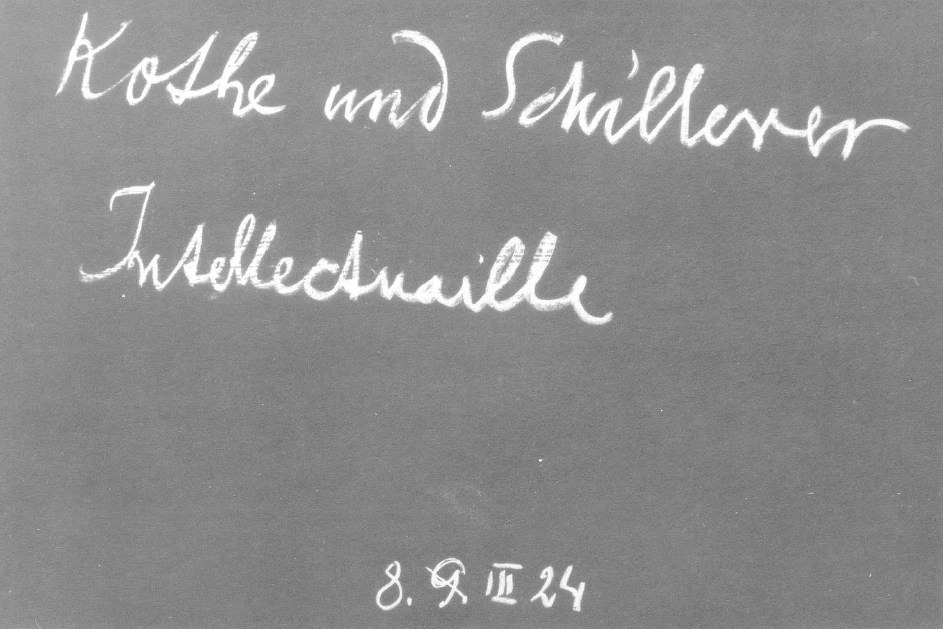
[ 47 ] If you would be so kind, my dear friends, as to read something about German literature that you would not otherwise be able to read—something quite different from the usual treatises on German literature—then read Dühring’s two volumes: The Great Figures of Modern Literature. There you’ll find what was characteristic of Dühring—that strictly mathematical way of thinking, that sharp intellect—applied to belles-lettres. And in order to demonstrate how his thinking differs from that of other people, he even goes so far as to rename the great figures of German intellectual life. For example, in one chapter he speaks of “Kothe” and “Schillerer,” which in Dühring’s language means “Goethe” and “Schiller.” Dühring writes “Kothe” and “Schillerer” and sticks to this throughout the entire work. He is sometimes grotesque in his inventions of new word forms. “Intellektuaille”—for example, this is how he always refers to people who are intellectualistic. “Intellektuaille”—a play on “Kanaille”—he consistently uses similar word formations. Well, some of it is extraordinarily interesting.
[ 48 ] You see, for example, the following once happened to me. I was working on some of Nietzsche’s unpublished writings when I came across the essay on the recurrence of the same—which, of course, has long since been published. Nietzsche’s manuscripts aren’t very legible, so when I came to a certain passage, I said to myself: This “eternal recurrence” in Nietzsche has a curious origin! Well, let’s go to the Nietzsche Archive, where his notebooks are kept—I was friends with Mrs. Elisabeth Förster-Nietzsche at the time—let’s take this manuscript and search the library; let’s open Dühring’s Philosophy of Reality, and there we’ll find the “eternal recurrence”! For Nietzsche formulated many ideas as “counter-ideas.” I was able to look it up very quickly. I took out The Philosophy of Reality, which was available in the Nietzsche Library, and opened it: On the relevant page was the passage—I knew it, so I found it right away—stating that it is impossible, based on a real, objective understanding of the material facts of the world, to speak of a return of things, of constellations that have already existed!
[ 49 ] Dühring attempted to prove the impossibility of the return of the same. At the point where Dühring explains this, there is a word on the page that Nietzsche often jotted in the margins of the writings he used to formulate the counter-idea: donkey.
[ 50 ] This note was also found on this page. And it is indeed true that, particularly in Dühring’s work, one can find certain ideas that were later incorporated into Nietzsche’s thought—albeit in a brilliant way. I am not raising this to make any kind of objection against Nietzsche, but that is simply how things are.
[ 51 ] Now, what is striking about Dühring in a karmic sense is that he is actually capable of thinking only mathematically. He thinks mathematically in philosophy, in political economy, and even in mathematics itself—but with mathematical precision and clarity. He also thinks with precision and clarity in the natural sciences, but in a mathematical way. He is not a materialist, but he is a mechanistic thinker; he conceives of the world according to the schema of mechanism. And he had the courage to truly follow through on the logical consequences of such thinking—which, in all honesty, is the right thing to do. For it is actually true: anyone who thinks this way cannot write about Goethe and Schiller in any other way, if one sets aside the name-calling and focuses on the facts.
[ 52 ] So that is the distinctive nature of his thinking. He went blind at an early age and was also treated quite unfairly on a personal level. After all, he was expelled from the University of Berlin. Well, there were reasons, of course. For example, when the second edition of his Critical History of the General Principles of Mechanics was published, he no longer held back. The first edition was, after all, quite tame in its treatment of the quantities of mechanics, so much so that someone remarked: “He wrote it that way precisely because he thought it might still be awarded a prize by a learned body!” But when the second edition appeared—by which time it had already been awarded a prize—he no longer held back; he expanded upon it! Now someone said—and Dühring has often repeated this—that the Göttingen Academy had awarded a prize for the claws without knowing the lion that went with them! But the lion came to light when the second edition was published.
[ 53 ] There were some strange things in there. For example, specifically in connection with Julius Robert Mayer—and his “Galileo-like fate” in the 19th century, about which he was so indignant—he called someone he considered a plagiarist of Julius Robert Mayer—namely Hermann Helmholtz—a “university rack,” a wooden “university rack”! He later expanded on this, publishing a newspaper: “Der Personalist.” ” The content there was very strongly personal in tone. For example, there is an elaboration on the passage about Helmholtz. There he doesn’t just talk about the “university rack”; rather, since it had turned out, when the corpse was dissected, that Helmholtz had water on the brain, he said: “But the empty head was already noticeable while the man was still alive; that didn’t need to be established only after his death.”
[ 54 ] Dühring certainly wasn’t refined. One cannot say that he ranted like a shrew, for there is nothing philistine about the way he rants, nor is it exactly brilliant; but it is simply no longer just ranting: it is “ranting.” It is something quite peculiar.
[ 55 ] Well, the blindness, this entire mechanistic way of thinking, the persecution—for he was indeed persecuted; he was expelled from the university, and injustices occurred in the process, just as countless injustices were inflicted upon him throughout his life—all of these are aspects of a person’s destiny that become all the more interesting when viewed from a karmic perspective.
[ 56 ] I have now introduced you to these three figures: Friedrich Theodor Vischer; the song composer Schubert; and Eugen Dühring. Tomorrow I will describe to you—from a karmic perspective—the very subject for which I wanted to provide you with the material today; that is, I will trace how things actually fit together in their karmic context.