Esoteric Considerations of Karmic Connections
Volume II
GA 236
18 May 1924, Dornach
Translated by Steiner Online Library
Eleventh Lecture
[ 1 ] If one wishes to understand the nature of karma, it is above all a matter of being able to look at everything in human development that is influenced by the cosmos.
[ 2 ] In order to be able to consider the beings from the spiritual universe who are involved in human development, let us first take a brief look at the relationship between human beings and earthly beings to aid our understanding.
[ 3 ] We see human beings on Earth surrounded by the beings of the mineral, plant, and animal kingdoms, and we know, of course, that we must view human beings in such a way that all three kingdoms of nature actually live within them and take on a higher form there. In a sense, human beings are related to the mineral kingdom through their physical organism. However, they process what is otherwise found in the mineral kingdom in a higher way. They are related to the plant kingdom through their etheric body. Again, they process within themselves, in a higher way, what is otherwise found in the plant kingdom. And the same is true of the relationship that human beings have, through their astral body, with the beings of the animal kingdom. We can therefore say: If we consider the space surrounding the human being, we find that the human being carries within themselves the mineral, plant, and animal kingdoms.
[ 4 ] Just as human beings carry within themselves these outer natural realms of space, so too do they carry within themselves—only in terms of time, not space—the realms of the higher hierarchies. And one can understand the entire workings of karma in human beings only by considering how the various realms of the hierarchies act upon the human being in the course of earthly life.
[ 5 ] When we consider how the mineral kingdom affects human beings, we are confronted with the processes through which human beings take in their food. For everything that human beings take in from the higher kingdoms—as opposed to the mineral kingdom—is first mineralized. When we look at the plant kingdom, we see how human beings possess vital forces—the forces of life—within themselves. Again, when we look at the animal kingdom, we see how human beings, through their astral body, elevate mere life into a higher sphere—the realm of sensations. In short, we can trace the sequence of natural processes in the three kingdoms just as we can trace the sequence of processes within the human organism.
[ 6 ] Likewise, however, we can trace what happens to human beings in a soul-spiritual sense as it emanates from the higher hierarchies. We understand the human being’s own mineral, plant, and animal aspects through the influence of the three kingdoms of nature in space. Likewise, we must understand what reigns within the human being—let us first consider what reigns within the human being as destiny—through the influence of the realms of the hierarchies. However, we need not now consider what is present in the human being simultaneously—for the physical body, the etheric body, and the astral body are, after all, present in the human being at the same time—but rather, for the sake of the realms of the hierarchies, we must consider what is present in the human being successively during earthly life, and we must view it in the way that this succession can be grasped in a spiritual perspective.
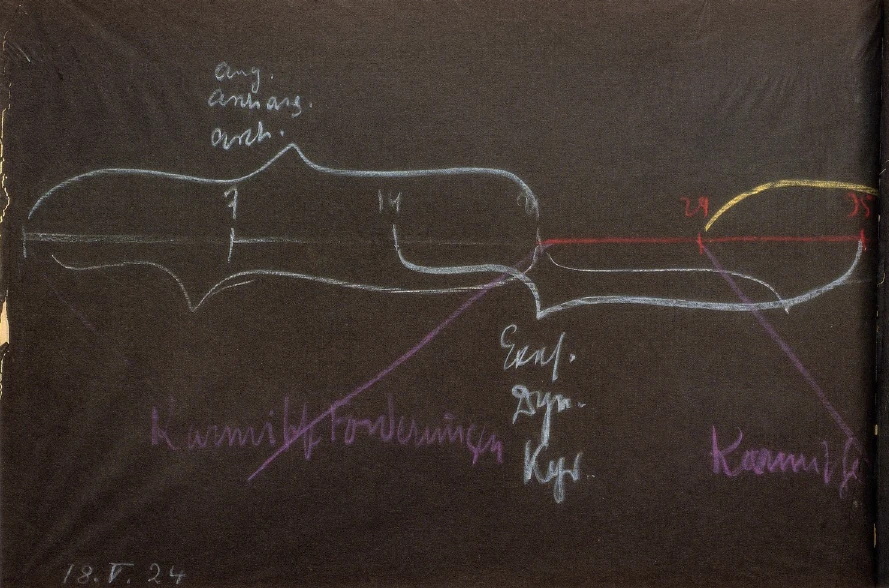
[ 7 ] Well, we have, I would say, throughout all our anthroposophical reflections, always considered the structure of the human being according to the course of their life: from birth until around the age of 7, when the teeth begin to change; from the change of teeth until sexual maturity; from sexual maturity until the age of 21, when the distinctions are no longer so visible; then from the age of 21 to age 28, from age 28 to 35, from age 35 to 42, from age 42 to 49, from age 49 to 56, and so on (see diagram on page 193). I will discuss what lies beyond the age of 56 next time; for now, I will focus on the course of human life up to the age of 56.
[ 8 ] Here we clearly see a division into three stages of life up to the age of 21, followed by three more stages, and then what comes after that. I would like to refer to the final stages of life in this way (see diagram on page 193).
[ 9 ] Human beings say to themselves, “I.” But this “I” is, after all, embedded within a totality of influences. Viewed from the outside, these are the effects of the mineral, plant, and animal realms; viewed from the inside, from the spiritual-soul perspective, they are the effects of the third hierarchy—the Angeloi, Archangeloi, and Archai—the effects of the second hierarchy—the Exusiai, Dynamis, and Kyriotetes—and the effects of the first hierarchy—the Seraphim, Cherubim, and Thrones.
[ 10 ] Yet these entities do not influence the course of his life in the same way. We can already say that even the outer aspect of the human being is, in a certain way, permeated by various influences in accordance with the course of life. If we consider, for example, a child at the very beginning of its earthly life, we must say that what we otherwise find in the animal kingdom is particularly pronounced there: a growing, sprouting, building life.
[ 11 ] When we consider the final stage of life, as it begins to enter old age, then we find in the sclerosis, in the fragility of the organism, a process of mineralization—one that is much more intense, because it is a more intimate form of mineralization—than is present in animals, with the exception of higher animals, in which this is based on conditions that need not be discussed further here but can be addressed on another occasion. Whereas in animals the cessation of vital forces actually begins immediately once the process of building up is no longer present, human beings carry important aspects—important phases—of their development right into the period of decline, which actually begins as early as one’s thirties. And much of human development would not exist if people developed in the same way as animals: that is, by carrying nothing into old age. Animals carry nothing into old age. Humans, however, can carry a great deal into old age, and important achievements in the development of human culture are indeed due to what humans are able to carry into old age, into the phase of decline.
[ 12 ] So there is the mineral aspect. We can therefore say: Outwardly, it is clearly evident that the animal aspect predominates at the beginning of earthly life, the mineral aspect at the end, and the plant aspect in between.
[ 13 ] However, this difference becomes much clearer and more pronounced when the higher hierarchies influence human beings. It can be said that early childhood is subject to particularly strong influences on the soul-spiritual life from the third hierarchy—the Angeloi, Archangeloi, and Archai. This influence of the third hierarchy (see illustration) actually encompasses the first three stages of life.
[ 14 ] In the first three stages of life, we see the influence of angels, archangels, and archai. In children and young people, in everything that has a constructive effect on their organism from the soul-spiritual realm—and that is indeed a great deal, indeed almost everything—the forces that can act upon them come from the world of the third hierarchy: the angels, archangels, and archai.
[ 15 ] At the age of 14, the second hierarchy begins to take effect: Exusiai, Dynamis, Kyriotetes. So here (see diagram), I must again note three phases—that is, between the ages of 14 and 35—namely: Exusiai, Dynamis, Kyriotetes. You see, my dear friends, during the period from the age of 14 to 21, the third and second hierarchies work together decisively on the human being. It is only at the age of 21 that what is the sole effect of the second hierarchy begins to take effect.
[ 16 ] At the onset of sexual maturity, something of the processes of the world—of cosmic processes—begins to take hold in human beings; these processes are not present in human beings until this age of sexual maturity.
[ 17 ] And you need only consider that, as a person becomes capable of reproduction, they become able to absorb those forces from the cosmos that are involved in the physical regeneration of the human being. Until reaching sexual maturity, the human being lacked these forces from the cosmos. Thus, a change takes place in the human physical organism that, so to speak, infuses it with more powerful forces than were present before. The child does not yet possess these more powerful, stronger forces. It still has the weaker forces that initially act only upon the soul in earthly life, not upon the body.
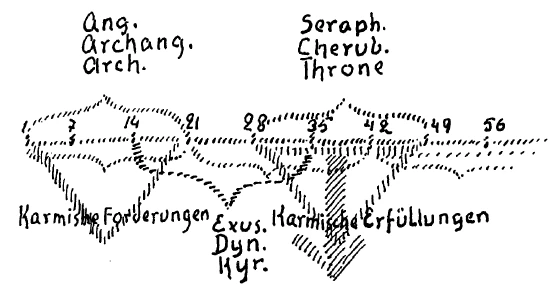
[ 18 ] But at the age of 35, a period begins for a person in which, essentially, they become inwardly and emotionally weaker than they were before—one might say, in the face of the onslaught of their organism’s degenerative forces. Before the age of 35, our organism provides us with essential support as human beings. It tends to be constructive. And this constructive tendency actually lasts well into our thirties. But then a very strong, predominant tendency toward decay begins. Even the forces that arise from the nature of the second hierarchy cannot counter this overwhelming tendency toward decay. Our soul must therefore continue to be supported from the cosmos in such a way that we do not die at the age of 35 in the course of normal life. For if the beings of the third hierarchy were to act only until the age of 21, and those of the second hierarchy from the ages of 14 to 35, then we would actually be ripe for death in the middle of our real earthly life—unless, I might say, the physical body were to hold on out of inertia. This is not the case because, in fact—and not only from the age of 35 onward, but already from the age of 28 onward—the beings of the first hierarchy—Seraphim, Cherubim, and Thrones—once again influence human beings through three epochs, up to the age of 49.
[ 19 ] Once again, there is a period between the ages of 28 and 35 during which the second and first hierarchies interact. Thus, the second hierarchy’s sole influence is present from age 21 to 28.
[ 20 ] As I said, I will examine what follows next time. You might ask, however: If someone is over 49 years old, are they then abandoned by all hierarchies? — But as I said, we will still examine what happens then. Therefore, what needs to be said today will not only apply to those under 49 years of age, but also to the others. First, however, we must indeed recognize that the course of human life is such that the hierarchies instill their special power and strength into it in this way.
[ 21 ] Of course, when considering something like this, you must not think that things can now be viewed merely in a schematic way. That must never happen when one enters the realm of even a somewhat higher form of life.
[ 22 ] For a number of years now, I have had to speak of the threefold division of the human being into nervous-sensory human beings, rhythmic human beings, and metabolic-limb human beings. From this, a professor—what won’t professors do!—concluded that I had divided the human being into head, chest, and abdominal systems, because he had presented the matter schematically side by side. Well, I have always emphasized: although the nervous-sensory system is mainly concentrated in the head, it in turn permeates the entire human being. The same is true of the rhythmic system. These things are not to be placed side by side in a spatial sense. And so you must also view this sequence in the same way: the influence of the Angeloi, Archangeloi, and Archai is primarily limited to the first three epochs of life, but they are, in turn, present throughout the entire course of life, just as the nervous-sensory system is primarily contained in the head but is, in turn, present throughout the entire human organism. After all, we also feel with our big toe; there is nervous-sensory life there as well. Nevertheless, this threefold division is valid. And the threefold division I am speaking to you about today is also valid.
[ 23 ] But now, when you look at the structure of the human life course in this way, you can say to yourself: The human “I” is, on the spiritual side, just as embedded in a series of influences descending from the spiritual realm as it is, on the physical side, embedded in the series of influences emanating from animals, plants, and minerals. As human beings, we are truly such that our “I” is situated right in the midst of what happens to us from the cosmos in a complex manner. And in this mode of action—which extends spiritually from the cosmos, from the hierarchies, to the human being—lies the shaping of karma during physical life on Earth.
[ 24 ] In fact, it is the angels, archangels, and archai who bring us from the spiritual world into the physical world, and they accompany us primarily through the first three epochs of life. The system upon which they exert their strongest influence is, in turn, our nervous and sensory system. And in all that takes shape in such a complex, wondrous way up to the age of 21—the development of our sensory and intellectual life, our head life—the beings of the angels, archangels, and archai are involved.
[ 25 ] An infinite amount is happening, so to speak, behind the scenes of ordinary consciousness. And it is precisely in what happens behind these scenes of ordinary consciousness that these entities are involved.
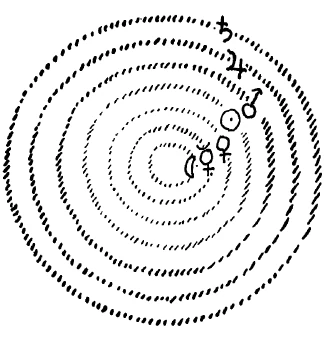
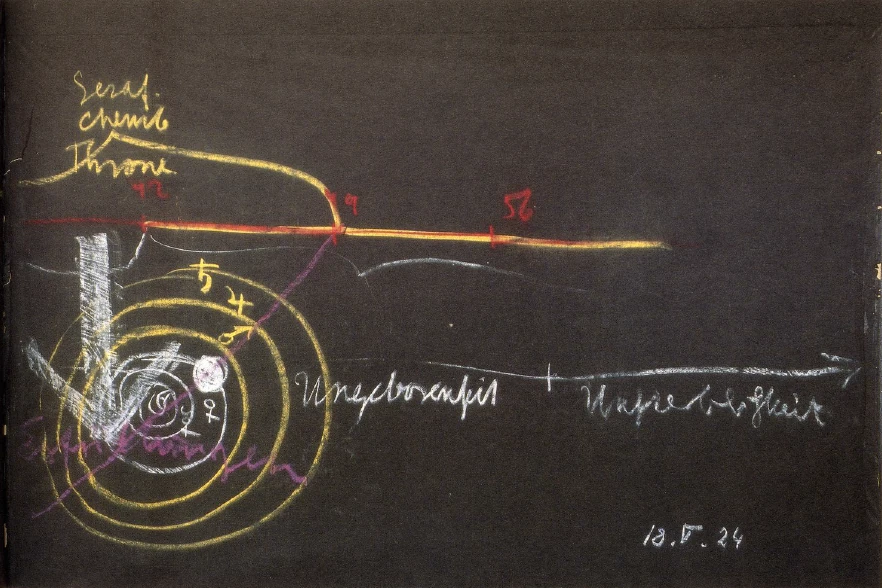
[ 26 ] And once again, beginning with sexual maturity—roughly from the age of 14 onward—those forces that are more powerful than the Angeloi, Archangeloi, and Archai begin to intervene in the rhythmic system. The beings of the third hierarchy—Angels, Archangels, and Archai—are actually dependent on engaging with our soul life. We bring with us from our pre-earthly existence such strong forces from the first three epochs of life that they continue to exert an influence, enabling the soul to act intensively upon the body. Thus, only the weaker forces of the third hierarchy are needed to come to the aid of human beings. But you see, the forces that the Angels, Archangels, and Archai need in order to properly guide and direct our human life up to the age of 21—these forces flow to these beings from the spiritual radiance of Saturn, Jupiter, and Mars (see diagram). It is indeed true that the celestial bodies radiate not only those effects of which physical science speaks. This physical science is, in fact, quite simplistic when it comes to describing the nature of the universe. Forces radiate from Saturn, Jupiter, and Mars that are best understood by the angels, archangels, and archai. And when a human being now passes through the life between death and a new birth—as we have described—he first enters the lunar region to those beings who were once on Earth and who are strict judges of the good and evil he brings with him. There, they must first leave behind whatever evil is united with them. They cannot carry it into the solar region. They then pass through the solar region and on out into the cosmos. The forces of Mars, Jupiter, and Saturn then act upon them. Then he passes through the entire life between death and a new birth, returns once more, and only when he enters the lunar region fully again do the angels, archangels, and archai come to meet him and say to him, as it were: “Saturn, Jupiter, and Mars have told us that you have atrophied in certain respects”—just as was described here in the last lecture. I said that evil must be left behind, but in doing so, the human being leaves something of himself behind. He enters the solar region—and also ascends into the outer region—as an atrophied human being. There, Saturn, Jupiter, and Mars look upon him.
[ 27 ] Oh, my dear friends, this life between death and a new birth is quite complicated! We begin this life between death and a new birth by passing through the gate of death. What I have described regarding the lunar region takes place here. Human beings must leave behind everything in themselves—in their very being—that has identified with evil. It is as if the physical body had to leave behind its limbs. Human beings arrive, so to speak, mutilated by what they had to leave behind—because it had identified with evil—in the solar region and in the rest of the vastness of the universe. And when the human being then passes through the solar region into the realm of Mars, Jupiter, and Saturn, he feels: they are looking at him with the penetrating gaze of their web of justice, their cosmic web of justice; they are looking at him to see how much of his human nature he is permitted to carry up there. There they look at him. Then each of us senses how much of the good has united with us—what we are permitted to carry up there—and what is lacking in us: what we have left behind, what we had to leave behind, and how deeply we identified with evil. That is what is missing in us. And from the way the beings of Mars, Saturn, and Jupiter look upon us, we sense just how flawed a human being we are.
[ 28 ] And then, when he returns, Saturn, Jupiter, and Mars—having in the meantime experienced and perceived what they observed in the human being who passed them by imperfectly—have cosmically communicated this to the third hierarchy: the Angeloi, Archangeloi, and Archai. These beings now weave this together with the human being, so that he carries within himself what he must do and what he must balance.
[ 29 ] And one might say: During these first three epochs of life, when angels, archangels, and archai exert a particular influence on human beings, karmic demands are inscribed into the human nervous-sensory system and into the human head system.
[ 30 ] Once we have passed the age of 21—I will also address the situation of people who die earlier in later lectures—then everything that constitutes the karmic demands of life has been imprinted within us. If one can read within a twenty-one-year-old, one can see what karmic demands are inscribed within them. It is during this time, then, that the karmic demands become imprinted in the human being (see illustration on page 193). We carry these primarily in the occult, hidden depths of our nervous-sensory system—in that which, spiritually and psychically, underlies our nervous-sensory system.
[ 31 ] On the other hand, when we look further ahead in the course of life—when we consider a person from the age of 28 to 49—we are dealing less with the imprinting of karmic demands and more with what is now the fulfillment of karma, the unloading of karma. It is precisely during this period of life that what is known as karmic fulfillment occurs—that which we must discharge because of what has been imprinted during the first three stages of life.
[ 32 ] So that I can write here (see illustration on page 193): From the age of 28 to the age of 49, “Karmic Fulfillments.” In between lie the years from 21 to 28, when the two are in balance—karmic demands and karmic fulfillments.
[ 33 ] However, there is something peculiar here that must be taken into account, especially in our age. In the current epoch of human development, there are a great many people who experienced their last decisive incarnation—not that none followed it, but those were less decisive—during the first centuries after the founding of Christianity up through the 8th and 9th centuries. If we look around at the vast majority of people living today who participate in culture, we find that the majority of these people had their defining incarnation during the first seven to eight centuries following the founding of Christianity.
[ 34 ] But that was a time that had a peculiar effect on people in the following way—one realizes this today when looking at certain people from a karmic perspective. Time and again, I have made it my task to view many people from a karmic perspective, particularly from this angle—people who have attained a certain level of education, which today is primarily an intellectual education, people who have actually learned a great deal.
[ 35 ] You need only consider how large the ranks are today of those who have become high school teachers, civil servants, and so on. They’ve acquired a relatively great deal of knowledge, having attended high school or secondary school, even university—really, I don’t mean this ironically, but rather in the context of everything I’ve already said about such concepts—they’ve actually become incredibly intelligent.
[ 36 ] There are truly an extraordinary number of intelligent people today who think along these lines. Just consider that most people today are so intelligent that you can hardly tell them anything; they already know everything. Everyone has a point of view. Everyone passes judgment on what they are told.
[ 37 ] That’s just the way it is in our time; it certainly wasn’t like that in earlier eras. Back then, there were a few people who knew something; the others listened to those who did know something. It wasn’t at all common for so many people to be smart as they are today. Isn’t that right? People become intelligent at a very early age these days; just think how many people under the age of 21 today—I won’t even say they write poetry, which they’ve always done—but they even write feature articles, and even reviews.
[ 38 ] So the development of intellectuality is extraordinarily strong today. But for most people today, it is essentially influenced by those incarnations that took place during the first seven to eight centuries since the founding of Christianity. During that time, the human soul’s sense of what flows into earthly life from pre-earthly existence grew weaker and weaker. People actually began to take more and more interest only in what follows death, and less and less interest in what preceded earthly life. I have often expressed this by saying: We do not have a comprehensive term for eternity, but only for half of eternity, which actually begins and never ends. For this part of eternity (see drawing, arrow) pertaining to human beings, we have the word “immortality”; but we do not have a word for the other half of eternity—the half that has never begun—a word for “unbornness,” as older languages did. We do not have that. Yet the whole of eternity encompasses both immortality and unbornness.

[ 39 ] We have entered the world as beings for whom birth signifies only a transformation, just as we leave the earthly world by undergoing death, which signifies not an end but only a transformation.
[ 40 ] So we can say: This strong awareness, which was active in people right up into the early Christian centuries—namely, “I have descended from the spiritual realm into physical existence”—gradually diminished, and people increasingly confined themselves to the thought: “I am here now; what came before does not interest me—that much is certain to me. What came before does not interest me; what interests me is what follows death.”—This awareness gained ground more and more. And this development took place during the first centuries of Christianity. There, so to speak, this subdued sense of pre-earthly life was instilled in those people who were undergoing their decisive incarnation. And intellectuality therefore takes on a focus on the merely earthly. This intellectuality is a great one, but it takes on a focus on the merely earthly. When one engages in karmic reflections, one encounters something tremendously striking and immensely significant in this realm.
[ 41 ] I would like to highlight two cases: a man who was a history teacher at a high school, a very intelligent person who, as a history teacher, was able to make an impression right from the start simply through his character. When I consider his life up to the point where the karmic demands were at work through this neutral zone here (see diagram on page 193)—that is, up to the early 1930s—one could say that his intelligence shone through. He was one of the many intelligent people, indeed exceptionally intelligent people, of the present day. But the moment he entered this region here, his intelligence was of no further help to him; his moral impulses became cause for concern. It remained mere intellectuality, which was then undermined. When the forces came into play—forces that are not bound to the nervous-sensory system but, toward the end of life, to the metabolic-limb system—the lower nature of the metabolic-limb system suppressed what had previously come through quite beautifully in the nervous-sensory system.
[ 42 ] The person in question, who had actually gotten off to a good start in life intellectually, essentially ended up in moral depravity—a moral debacle. That is one example.
[ 43 ] Another example: A person who was actually even smarter than the first one I just described—who was even considered exceptionally intelligent—but who had only one intelligent trait: he developed great intelligence from an incredibly short-sighted perspective.
[ 44 ] This individual, in turn, exerted a strong influence on those around her through her intelligence, at least up until around the age of 30. Once she was past the age of 30, or even 35—when the nervous-sensory system was no longer as active, but the metabolic-limb system began to take over toward the end of her life—this individual, who had previously been considered quite intelligent, became above all trivial and banal, and eventually lost herself in a mundane, partisan existence. I have followed the course of this person’s life. I must say, it was quite remarkable to me—since I had known this person in her younger years—that I later encountered her again among people who were absorbed in a very trivial, party-oriented existence. The path from karmic demands to karmic fulfillment has turned out to be such that the intellectual faculties of people today—which had been developed through a previous earthly life spanning the early Christian centuries up to the 8th 9th centuries, were not strong enough to reach up into the First Hierarchy at a time when the soul is growing weaker and the body offers greater resistance.
[ 45 ] And then this occurred to me: Those numerous people of the present who are so intelligent—who, above all, can be made so intelligent through school education—develop in this first phase of life the potential to extend their intellectual powers all the way up to the third hierarchy: the Angels, Archangels, and Archai. They attain this. They are promising individuals.
[ 46 ] As they enter the second hierarchy, they become more devoted to it. After all, this hierarchy descends to humanity; almost all of them become capable of procreation. This cosmic hierarchy descends. There is, so to speak, no real gulf between humanity and the higher hierarchy.
[ 47 ] But when, at the age of 28, a person must now establish a connection with the higher hierarchy—the first hierarchy—this must take place through their entire being, right down into the metabolic and limb systems. This requires stronger inner forces of stability in the spiritual realm. What was sown in the human being during earlier earthly lives—from that era when thoughts of pre-earthly life had ceased—is simply not sufficient.
[ 48 ] When one wishes to point specifically to karmic development, one might say: The call to the true educator of humanity, to the true pedagogue, must be strong: to instill so much of what is spiritually powerful into intellectuality that, when a person then goes through the later stages of life, what has been imbued with morality in their intellect can counterbalance those forces that pull downward (see illustration on page 193, downward-pointing arrow), away from the First Hierarchy.
[ 49 ] It is indeed of no small interest, especially in our time, to compare the second half of human life with the first. People who have a flair for observing life should actually engage in genuine observation of life along these lines. For this, my dear friends, is what stands out in everyday life. The examples I have just cited are taken from ordinary life—examples that can be multiplied a hundredfold or a thousandfold, examples that can be found everywhere. But one could also find other instances where the same phenomenon manifests itself, though, I would say, in a higher sphere of life. When I—who have always been interested in the spiritual development of human beings—look at a number of such people who entered life productively, who even made a great impression on their fellow human beings, let’s say, as young poets or otherwise as young artists, and then look at the very same people of whom it was said, when they were 24, 25, 26, or 27 years old: “What a magnificent, formidable talent!”—they grew older, everything dried up, and they remained stuck in their youthful poetry and youthful artistry. Later, everything dried up. They were no longer anything in the field in which they had once been significant.
[ 50 ] Especially when you go through the names of those who became known only as young poets or artists, and then removed themselves from the living history of literature or art, you will find that what I say is true. But what I am saying also points out to you how the various stages of human life reveal, in the most diverse ways, how karma—how karmic impulses—intervene in human life.
[ 51 ] Anything that is purely intellectual and materialistic can really only take hold of a person’s inner being during youth. Only that which is blended with the intellectual as something spiritual can endure throughout a person’s entire life—I mean, karmically, throughout their earthly lives.
[ 52 ] So when we see fates such as those described occurring, we must look back to earlier earthly lives, in which the individual was not granted the perspective on what is truly spiritual—a perspective that can only be properly attained by looking to life before birth, not merely to life after death.
[ 53 ] In our age, this tragedy of life is actually all too common, and we have so many things that do not last a lifetime. In our age, we have many youthful ideals, but few of the old ones. The elderly rely much more on the state and on their pensions than on life itself, because they need external support and cannot find what connects them to the primary hierarchy.
[ 54 ] And so it is that, if we wish to view things correctly from a karmic perspective, we must take into account these various aspects of the human being, which are, however, interlinked. I do not mean to say that life is granted beyond the age of 49; as I said, we will consider that later. But once a person has passed through the epochs of life (see diagram on page 193)—the first three, the second three, and then these—they initially live in such a way that they have connections to the third hierarchy. They then establish connections, inwardly and unconsciously, to the second hierarchy, and then to the first hierarchy. Only then can one assess to what extent a person allows the karmic impulses within them the opportunity to take shape. For it is this—this knowledge of the relationships to the higher hierarchies—that gives concrete form to human life.
[ 55 ] The Angeloi, Archangelo, and Archai tell us, as it were, in our subconscious during the first three epochs of life: “You have carried all of this over from earlier epochs, from a previous earthly existence; you must take this upon yourself.” — This is what is told to us in the unconscious part of our experience of destiny. And it actually always resounds within us as a matter of destiny during these three epochs of life, specifically from the hierarchy of the Angeloi: Saturn, Jupiter, and Mars have decreed this or that upon you. We have read it from their powers.
[ 56 ] Then comes everything that originates from the second hierarchy, from the realm of the Sun. And finally comes that which originates from the first hierarchy in this way, from the realms of Venus, Mercury, and the Moon. And just as the Angeloi, in particular, call out to us in the subconscious during the first three epochs of our lives—saying, “This is what Saturn, Jupiter, and Mars have told us: this is what you are destined to work through in life”—so, from the age of 28 onward, the Seraphim are found in our unconscious, speaking there as well: “And all of this remains with you because you cannot fulfill it, because you do not reach up to us; it remains with you, and you must carry it into your next earthly life; you cannot balance it out—you do not have the strength to do so.”
[ 57 ] The karmic forces—the forces that shape destiny—speak through human consciousness. They speak from all three higher hierarchies. And when we are sensitive to what intervenes in our lives as a matter of destiny, then—beyond this mere view of our destiny—we can also sense, with sacred awe, how the beings of all three hierarchies weave at the fabric of our destiny throughout the course of our lives. Only then do we truly contemplate our lives.
[ 58 ] For you see, who would be satisfied if someone asked us about a person—about whom he wants to know something regarding his earthly life, because he assumes that we know something about him—and we told him: “His name is Josef Müller.”—We have nothing to tell him but the name. He was expecting to learn something about this person that is truly more than just a name: events from his earthly life, insight into the forces and impulses that influenced him during his earthly life. If one wants to know something about a person in relation to his earthly life, one cannot be satisfied with just the name. But in our present-day materialistic age, people unfortunately content themselves—with regard to what lies beyond ordinary consciousness and in which Angeloi, Archangeloi, Archai, Exusiai, Dynamis, Kyriotetes, Cherubim, Seraphim, and Thrones are at work—with the name “human being,” and moreover with the general term “human being.” They do not look at the concrete. But it must happen that people learn to look once again at the concrete.