

Esoteric Considerations of Karmic Connections
Volume II
GA 237
11 July 1924, Dornach
Translated by Steiner Online Library
Fifth Lecture
[ 1 ] Members of the Anthroposophical Society join this Society—as is, of course, entirely natural—for reasons related to their inner spiritual disposition. So when we speak of the karma of the Anthroposophical Society, as we are doing now—or of the karma of the anthroposophical movement in general, based on the karmic development of individual members and groups of members—then we must naturally also seek the foundations of this karma in the state of mind of those who seek anthroposophy. And we have already begun to do so. We would like to learn a little more about this state of mind so that we can then go on to discuss further aspects of the karma of the anthroposophical movement.
[ 2 ] As you have seen, when referring to the most important aspect of the anthroposophists’ spiritual constitution, I pointed to what they experienced in those incarnations they went through during, for example, the first centuries of the founding of Christianity. I said that there may be other incarnations in between, but what is important is the one that falls within the 4th to 8th centuries A.D. A consideration of this incarnation has shown us that we must distinguish between two groups of personalities who come to the anthroposophical movement. We have characterized these two groups. But let us now consider something they have in common—something that lies, so to speak, as an important commonality at the core of the souls that have undergone the kind of development I characterized in my last lecture to members.
[ 3 ] When we look back at those first Christian centuries, we find ourselves in a time when people were still very different from what they are today. We can say: When a person today awakens, it happens in such a way that they actually slip into their physical body with great speed—of course, with the reservation I have discussed here. As I have already said, the process of slipping in and expanding within it takes the whole day; but the perception that the “I” and the astral body are approaching happens extraordinarily quickly. For the person waking up today, there is, so to speak, no interval between becoming aware of the etheric body and becoming aware of the physical body. One passes quickly through the perception of the etheric body, does not notice the etheric body at all, and immediately plunges into the physical body upon waking. This is the distinctive feature of modern human beings.
[ 4 ] The distinctive feature of those people who lived during those early Christian centuries—whom I have described—was that upon waking they clearly perceived: “I am entering into two bodies—the etheric body and the physical body.” And they knew: One passes through the perception of the etheric body and only then enters the physical body. And it was the case that at the very moment they awoke, these people had before them—if not an entire tableau of their life, then at least many images from their earthly life up to that point. And they had something else before them as well, which I will describe shortly. For the fact that one enters—I might say, in stages—into what remains in bed, into the etheric and physical bodies, had a different effect on the entire waking state than what our experiences during wakefulness are today.
[ 5 ] Again, when we consider the process of falling asleep today, what is peculiar is that when the ego and the astral body leave the physical body and the etheric body, the ego very quickly absorbs the astral body. And since the ego is completely defenseless against the cosmos and cannot yet perceive anything at all, the person ceases to perceive when falling asleep. What emerges as dreams is, after all, only sporadic.
[ 6 ] Again, this was not the case in those times I have been speaking of. Back then, the “I” did not immediately absorb the astral body; rather, the astral body continued to exist independently in its own substance after people had fallen asleep. And it actually persisted to a certain extent throughout the entire night. So that in the morning, a person did not wake up as if emerging from the darkness of unconsciousness, but rather woke up with the sensation: “You have indeed lived there in a world full of light, in which all sorts of things took place; they were images, to be sure, but all sorts of things took place.” — So it was certainly the case that people in those days had an intermediate state of consciousness between waking and sleeping. It was subtle, it was intimate, but it was there. Among truly civilized humanity, this did not cease completely until the beginning of the 14th century. As a result, however, all the souls I spoke of recently experienced the world differently than people do today. Let’s try to picture how people—that is, all of you, my dear friends—experienced the world back then.
[ 7 ] Because there was a stage of immersion in the etheric and physical bodies, human beings, throughout their entire waking lives, did not look out into nature in such a way that they saw only the sober, prosaic sensory world that people see today—a world that, if they wish to supplement it, they can do so only through their imagination. Instead, they looked out—let us say, into the world of plants, for example, at a flower-filled meadow—as if a soft, bluish-reddish cloud-like glow—especially when the sun shone more gently during the day, when it was not exactly noon—as if a bluish-reddish, richly undulating and cloud-like glow, a misty glow, were spreading over the flower-filled meadow. What one might see today, for example, when a light mist hangs over the meadow—though that is caused by evaporated water—is what people saw in the spiritual-astral realm back then. And so one actually saw every tree crown shrouded in such a cloud; one saw the fields of grain as if reddish-bluish rays, sprouting like mist, were descending from the cosmos into the earth.
[ 8 ] And when one looked at the animals, one had the impression that these animals not only had their physical form, but that this physical form was enveloped in an astral aura. One perceived this aura faintly and intimately, though really only when the sunlight was shining in a certain gentle way. But one did perceive it. Thus, one saw the spiritual realm at work and weaving its way throughout the outer world of nature.
[ 9 ] And when one died, what one experienced in the first few days after passing through the gate of death—a retrospective view of one’s earthly life—was something that was, in essence, familiar; for one had a very specific sensation regarding this retrospective view of one’s earthly life that arose after death. One had the sensation of saying to oneself: Now I am releasing from my organism that auric element which is going to what I have seen of the auric in nature. My etheric body is going to its own home—that is how one felt.
[ 10 ] All these feelings were, of course, much stronger in even earlier times. But they were still present, albeit in a more subdued form, during the time I am speaking of here. And when one saw this after passing through the gate of death, one felt: In all the spiritual weaving and life that I have beheld above natural things and natural processes, the Word of God the Father speaks, and my etheric body goes to the Father.
[ 11 ] When human beings perceived the external world in this way through a different kind of awakening, they also perceived their own outer appearance differently than was later the case. When a person fell asleep, the astral body was not immediately absorbed by the “I.” In such a state, the astral body “resonates.” And all manner of things that cannot be heard in the waking state resounded from spiritual worlds into the sleeping human “I”—if not as clearly as in ancient times, then at least in a soft, intimate form. And upon waking, the person certainly had the sensation: “From the moment I fell asleep until I awoke, I was partaking in a spiritual language in luminous cosmic spaces.”
[ 12 ] And when, a few days after passing through the gate of death, a person had shed the etheric body and was now living in his astral body, he would once again have the feeling: In this astral body, I am reliving everything I thought and did on Earth. But in this astral body—in which I have lived every night while asleep—I am reliving everything I thought and did on Earth. — And while the person had taken only vague impressions with them upon waking, they now felt, as they relived their earthly life in their astral body during the time between death and a new birth: Christ lives in this astral body of mine. I simply hadn’t noticed it, but every night my astral body lived in the essence of Christ. Now the person knew: As long as he has to relive this past earthly life, Christ does not leave him, because he is with his astral body.
[ 13 ] No matter how one may have related to Christianity in those early Christian centuries—whether like the first group of people I discussed, or like the second group, or whether one lived, so to speak, with even more pagan vigor or with a weariness of paganism— they certainly experienced—albeit not on earth—after death the great reality of the Mystery of Golgotha: that the Christ, the being who formerly governed the sun, had united with that which lives as human beings on earth. All those who had drawn near to Christianity in the early centuries of Christian development experienced this. For the others, what they experienced after death remained more or less incomprehensible. But these were the fundamental differences in the experiences of souls during the first Christian centuries and later.
[ 14 ] But all of this brought about something else as well. It meant that when a person observed nature while awake, he perceived that nature entirely as the domain of God the Father. For all that which was spiritual—which he perceived as weaving and living there—was to him the expression, the revelation, of God the Father. And he sensed that there is a world which, at the time when Christ appeared on earth, needed something: namely, the incorporation of Christ into the substance of the earth for the sake of humanity. People still sensed something like a living Christ-principle in contrast to natural processes and the workings of nature. For there was indeed something connected with this contemplation of nature, so that one perceived a spiritual weaving and working within it.
[ 15 ] What was perceived there as spiritual weaving and activity—what, in a sense, hovered in the form of ever-changing spiritual figures above all plant life and around all animal life—was experienced in such a way that the person who felt with an open heart expressed this sensation in the words: “This is the innocence of natural existence.” Yes, my dear friends, what could be spiritually perceived there was called, quite simply, the innocence of nature’s workings, and people spoke of the innocent spirituality in nature’s workings. But what was felt inwardly upon waking—that from the moment of falling asleep until waking one had been in a world of bright, resonant spirituality—this was experienced in such a way that one sensed the good and the evil could reign within it; that within it, when it resounds thus from the depths of the spiritual, good spirits and evil spirits speak; that the good spirits seek only to elevate the innocence of nature and preserve it, while the evil spirits, on the other hand, attribute guilt to the innocence of nature. And wherever such Christians lived, as I describe them here, one sensed the reign of good and the reign of evil precisely because, in the sleeping state, the human ego did not draw the astral body into itself.
[ 16 ] Not everyone who called themselves Christians at that time—or who was in any way close to Christianity—shared this state of mind. But there was a large number of people living in the southern and central regions of Europe who said: Yes, my inner self, which lives out its own life independently between falling asleep and waking up, belongs to the realm of a good world and the realm of an evil world.” And much, much thought and reflection went into the depths of the forces that trigger good and evil in the human soul. It was deeply felt that the human soul was placed within a world in which the forces of good and evil struggle against one another. In the very earliest centuries, these feelings were not yet present in the southern and central regions of Europe, but in the 5th and 6th centuries they became increasingly common; and especially among those people who received more news from the East—for this news came from the East in the most varied ways—this mood of the soul arose. And because this spiritual disposition spread particularly strongly in those regions for which the name “Bulgaria” eventually came to be used—in a remarkable way, the name persisted even when entirely different peoples later inhabited these regions—people in Europe were, for the longest time in later centuries, called Bulgarians if they had developed this spiritual disposition particularly strongly. In the later Christian centuries of the first half of the Middle Ages, Western and Central Europeans regarded Bulgarians as people who were particularly deeply affected by the contrast between the good and evil cosmic-spiritual forces. The name “Bulgarians” is found throughout Europe to refer to such people as I have characterized them.
[ 17 ] But the souls I am speaking of here were more or less in precisely this state of mind: the souls who, in the course of their further development, came to behold those powerful images in the supernatural cult and to participate in its practices—souls who then lived during the first half of the 19th century. Everything that these souls were able to experience in this inner awareness of the struggle between good and evil was carried through the period between death and a new birth. And this shaped and colored the souls who then stood before the powerful images described.
[ 18 ] But there was something else as well. These souls were, so to speak, the last ones within European civilization who had still retained something of this distinct perception of the etheric and astral bodies during waking and sleeping. They lived in communities, recognizing one another through these peculiarities of soul life. Among those Christians who were increasingly aligning themselves with Rome, they were regarded as heretics. At that time, people had not yet reached the point of condemning heretics as strictly as they would later, but they were still viewed as heretics. People generally had an eerie impression of them. They simply had the impression that these people saw more than others, that they also related to the divine in a different way through their perception of the state of sleep. For the other people among whom they lived had long since lost this ability; they had long since moved closer to the state of mind that then became common in Europe in the 14th century.
[ 19 ] But when these people I am speaking of—those with a distinct perception of the astral and etheric bodies—passed through the gate of death, they also differed from those who were otherwise. And one must not believe that between death and a new birth, a human being has no part whatsoever in what happens on Earth through human beings. Just as we, so to speak, look up from here into the heavenly-spiritual world, so between death and a new birth one looks down from the heavenly-spiritual world onto the Earth. Just as one participates in the spiritual beings from here, so from the spiritual world one participates in what earthly beings experience on Earth.
[ 20 ] The period I am describing here was followed by one in which Christianity here in Europe adapted to the reality of existing even under the premise that human beings no longer know anything about their astral body or their etheric body. Christianity adapted itself to speaking about the spiritual world without being able to assume that people possessed this knowledge. For just consider, my dear friends: When the early Christian teachers spoke to their followers in the first centuries, they indeed found a large number of people who could accept their words as true solely on the basis of external authority; but the even more naive spirit of that time allowed precisely these words to be accepted when they were spoken from a warm, enthusiastic heart. And just how warmly and enthusiastically hearts preached Christianity in the first centuries—that is something we can no longer conceive of today, when so much has degenerated into mere preaching of words.
[ 21 ] But those who could speak to souls such as I have described here—what words could they utter? Yes, my dear friends, they could say: Look at that which shimmers in rainbow-like splendor above the plants, at that which manifests as desire in the animals—look: that is the reflection, that is the revelation of the spiritual world of which we, too, speak, the spiritual world from which Christ originates. In a sense, when speaking to such people about spiritual wisdom, one was not speaking of something unknown; one spoke to them by reminding them of what they could see under certain circumstances in the gentle sunlight as the Spirit in nature.
[ 22 ] And again, when one spoke to them about the Gospel—which proclaims the spiritual world and its mysteries—and when one spoke to them about the mysteries of the Old Testament, one was not speaking to them about something unknown; rather, one could say to them: “Here is the Word of the Testament; this Word of the Testament was written down by those human beings who, though they heard the murmurings of that spiritual realm—in which your souls dwell between falling asleep and waking up—more clearly than you did, you yourselves know of these murmurings, for you remember them when you wake up in the morning.” And so one could speak of this to these people as something familiar. Thus, in a certain sense, the conversations that the priests—the preachers of that time—had with these people contained something of what was taking place within the souls of these people themselves. And so, in that era, the Word was still alive and could be nurtured as a living reality.
[ 23 ] And when these souls—to whom one could speak as to something living—looked down upon the earth after they had passed through the gate of death, they beheld the twilight of that living Word down below, and they had the sensation: the Logos is dawning. That was the fundamental feeling of such souls, as I have described them—those who passed through the gate of death after the 7th, 8th, and 9th centuries, or even somewhat earlier—that as they looked down upon the earth, they sensed: Down here on earth is the twilight of the living Logos. And the words “And the Word became flesh and dwelt among us” surely lived within these souls, and they felt: But people have less and less of a home for the Word, which is to live in the flesh and continue to live on Earth.
[ 24 ] This, in turn, created a prevailing mood—the prevailing mood among the souls who lived in the spiritual world between the 7th, 8th, 19th, and 20th centuries, even if they had experienced an interruption during some earthly existence—this set the prevailing mood: Christ does indeed live for the Earth, for He died for the Earth, but the Earth cannot receive Him; and the power must arise on Earth so that souls may be able to receive Christ! Alongside everything else I have described, this was what lived within these souls—who were regarded as heretics during their earthly lives—between death and a new birth: the need for a new, renewed revelation of Christ, a proclamation of Christ.
[ 25 ] In this state of mind, these disembodied human beings witnessed events unfolding on Earth that must have been entirely unknown to them while they were still there. They came to understand what was taking place down there on Earth. They saw how fewer and fewer souls on Earth were being touched by the Spirit, how there were no longer any people to whom one could say: “We proclaim to you the Spirit, which you yourselves can still see hovering over the plant world and shimmering among the animals.” We teach you the Testament, which is written from those sounds that you still hear murmuring when you relive your nocturnal experiences. — All of that was no longer there.
[ 26 ] From above, where things looked quite different, they saw how, in the course of Christian development, a substitute had emerged for the old language. For after all, even though preachers had to speak this way to the vast majority of people—since they had no awareness of the spiritual in earthly life—the entire tradition, the entire usage of language, still stemmed from times when one could assume that, when speaking of the spirit, people still felt something of the spirit.
[ 27 ] All of this did not actually disappear completely until around the 9th, 10th, and 11th centuries. A completely different state of being emerged then—even in the way one listened. In the past, when one heard a person speaking from the spirit—someone who was enthusiastic and filled with God—one had the feeling that, while listening, one was actually stepping somewhat outside of oneself, entering one’s etheric body to some extent, and leaving the physical body behind. And in turn, one had the feeling of drawing closer to the astral body. One still had, at the very least, a faint sense of rapture while listening. People did not place so much importance on mere hearing; they placed far more importance on what they experienced inwardly in a state of quiet rapture. They lived along with the words spoken by people filled with divine enthusiasm.
[ 28 ] This disappeared completely between the 9th, 10th, and 11th centuries and into the 14th century. Simply listening became more and more commonplace. This gave rise to the need to appeal to something else when speaking of the spiritual realm. It gave rise to the need to draw out of the listener the perspective they should hold regarding the spiritual world. There arose the need, so to speak, to work on them in such a way that they would still feel compelled, even from within this hardened body, to say something about the spiritual world. And from this arose the need to impart instruction about the spiritual world through a question-and-answer format. By asking—questions always have a suggestive quality—: “What is baptism?”—and preparing the person for a specific answer, or: “What is confirmation? What is the Holy Spirit?” What is death? What are the seven deadly sins?—by preparing this question-and-answer format, one replaces the natural, elementary act of listening. And during this time—initially among those who attended schools where this was possible—a method of teaching through questions and answers emerged for what needed to be said about the spiritual world: the catechism came into being.
[ 29 ] You see, one must pay attention to such events. That is what the souls saw who were present in a particularly powerful way up there in the spiritual world and were now looking down: Something must be reaching out to people that we could not possibly have known about, that was completely beyond our comprehension! And it was a powerful impression that the Catechism was coming into being down here on Earth. There is nothing special to be gained when historians describe the external origins of the Catechism; but there is much to be gained when one considers the origins of the Catechism as they appeared from the perspective of the supersensible: Down there, people must undergo something entirely new in the depths of their souls; they must learn, in the manner of the Catechism, what they are to believe.
[ 30 ] With this, I am describing a feeling to you. I have another one to describe to you in the following way. If we go back to the first centuries of Christianity, it was not yet possible for a Christian to go into a church, sit down or kneel, and listen to the Mass from the very beginning—from the Introit to the prayers that follow Communion. It was not possible for everyone to hear an entire Mass; rather, those who had become Christians were divided into two groups: the catechumens, who were allowed to remain at the Mass until the Gospel had been read to the end; after the Gospel, the Offertory was prepared, and at that point they had to leave. And only those who had long been prepared for that sacred and devout state of mind in which one was permitted to perceive the mystery of transubstantiation—the transsubstantiates—were allowed to remain inside; they listened to the Mass until the end.
[ 31 ] That was a completely different way of participating in Mass. The people I’ve been telling you about—who were experiencing in their souls the states I’ve described, who looked down and were already perceiving that strange event of catechetical instruction, which still seemed impossible to them—these people had, to a greater or lesser extent, preserved the old Christian custom for their worship: allowing people to attend and participate in the entire Mass only after a long period of preparation. These people I have spoken of were well aware of both the exoteric and the esoteric aspects of the Mass. They regarded as esoteric everything that takes place after transubstantiation, after the consecration.
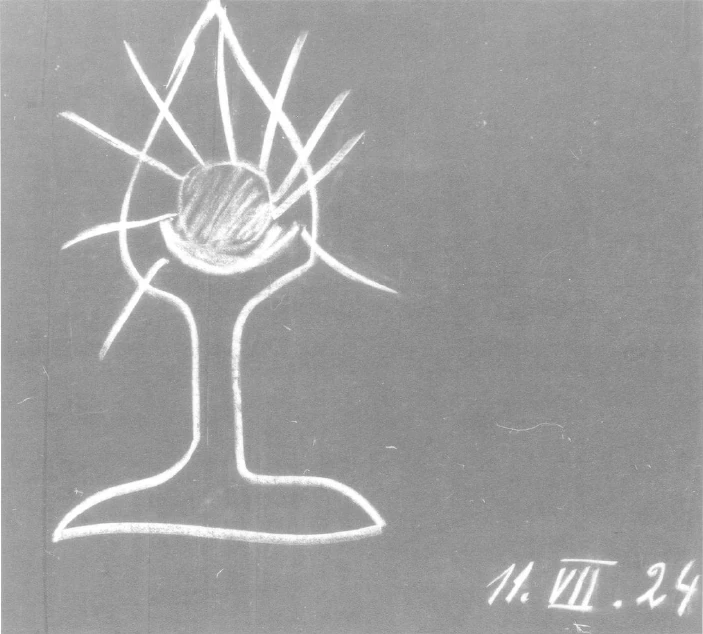
[ 32 ] Now they looked down once more upon what was taking place in the outward rituals of Christianity. They saw that the entire Mass had become exoteric; the entire Mass takes place even in the presence of those who have not yet entered into a special state of mind through special preparation. Indeed, can a person on earth truly attain the Mystery of Golgotha if they perceive transubstantiation in an unholy frame of mind? — This is how these souls perceived it from the life that flows between death and a new birth. But whoever does not understand transubstantiation does not understand the mystery of Golgotha. Thus these souls, in their state between death and a new birth, thought: Christ is no longer recognized in his essence; the worship is no longer understood.
[ 33 ] This took root within the souls I have described. And when these souls looked down upon what took shape as a symbol during the reading of the Mass—the so-called Santissimum, in which the Host rests on a crescent-shaped base—they felt: This is indeed the living symbol of the fact that people once sought the solar being in Christ; for on every Most Holy Sacrament, on every monstrance, the rays of the sun are depicted. But the connection between Christ and the sun has been lost; it remains only in the symbol. It has remained there to this very day in the symbol, but the symbol itself is not understood! — That was the second insight, from which then sprang a deepening of the sense that a new understanding of Christ must come.
[ 34 ] We will then continue discussing the karma of the Anthroposophical Society in the next lecture the day after tomorrow.