

Esoteric Considerations of Karmic Connections
Volume III
GA 237
11 July 1924, Dornach
Translate the original German text into any language:
Versions Available:
Esoteric Considerations of Karmic Connections, tr. SOL
Fünfter Vortrag
Fifth Lecture
[ 1 ] Die Mitglieder der Anthroposophischen Gesellschaft kommen zu dieser Gesellschaft, wie es ja durchaus selbstverständlich ist, aus Gründen der inneren Seelenverfassung. Wenn also über das Karma der Anthroposophischen Gesellschaft gesprochen wird, wie wir es jetzt tun, über das Karma der anthroposophischen Bewegung überhaupt, aus der karmischen Entwickelung von Mitgliedern und Mitgliedergruppen heraus, dann muß es sich natürlich auch darum handeln, die Grundlagen zu diesem Karma in der Seelenverfassung der Menschen, die Anthroposophie suchen, zu sehen. Und das haben wir ja bereits begonnen. Wir wollen noch einiges zu dieser Seelenverfassung kennenlernen, um dann auch auf das weitere im Karma der anthroposophischen Bewegung eingehen zu können.
[ 1 ] Members of the Anthroposophical Society join this Society—as is, of course, entirely natural—for reasons related to their inner spiritual disposition. So when we speak of the karma of the Anthroposophical Society, as we are doing now—or of the karma of the anthroposophical movement in general, based on the karmic development of individual members and groups of members—then we must naturally also seek the foundations of this karma in the state of mind of those who seek anthroposophy. And we have already begun to do so. We would like to learn a little more about this state of mind so that we can then go on to discuss further aspects of the karma of the anthroposophical movement.
[ 2 ] Sie haben ja gesehen, ich habe als auf das Wichtigste in der Seelenverfassung der Anthroposophen auf dasjenige hingewiesen, was diese in jenen Inkarnationen erlebt haben, die sie etwa in den ersten Jahrhunderten der Begründung des Christentums durchmachten, erlebt haben. Ich sagte, es können Inkarnationen dazwischen liegen, wichtig ist aber diejenige Inkarnation, die so in das 4. bis 8. nachchristliche Jahrhundert fällt. Diese Inkarnation hat uns durch ihre Betrachtung ergeben, daß wir zwei Gruppen von Persönlichkeiten zu unterscheiden haben, die zur anthroposophischen Bewegung kommen. Diese zwei Gruppen haben wir charakterisiert. Wir wollen aber jetzt etwas Gemeinsames ins Auge fassen, etwas, was sozusagen als wichtiges Gemeinsames auf dem Grunde der Seelen liegt, die eine solche Entwickelung durchgemacht haben, wie ich sie im letzten Mitgliedervortrag charakterisiert habe.
[ 2 ] As you have seen, when referring to the most important aspect of the anthroposophists’ spiritual constitution, I pointed to what they experienced in those incarnations they went through during, for example, the first centuries of the founding of Christianity. I said that there may be other incarnations in between, but what is important is the one that falls within the 4th to 8th centuries A.D. A consideration of this incarnation has shown us that we must distinguish between two groups of personalities who come to the anthroposophical movement. We have characterized these two groups. But let us now consider something they have in common—something that lies, so to speak, as an important commonality at the core of the souls that have undergone the kind of development I characterized in my last lecture to members.
[ 3 ] Wir stehen da durchaus, wenn wir auf diese ersten christlichen Jahrhunderte hinschauen, in einer Zeit, in der die Menschen noch ganz anders waren als jetzt. Wir können sagen: Wenn der heutige Mensch aufwacht, so geschieht das so, daß er eigentlich mit großer Schnelligkeit hineinschlüpft in seinen physischen Leib, natürlich mit der Reserve, die ich hier besprochen habe. Ich sagte schon, das Hineinschlüpfen und das Sich-Ausdehnen darinnen dauert ja den ganzen Tag; aber die Wahrnehmung, daß das Ich und der astralische Leib herankommen, das geschieht außerordentlich schnell. Es ist heute für den aufwachenden Menschen sozusagen keine Zwischenzeit vorhanden zwischen dem Gewahrwerden des ätherischen Leibes und dem Gewahrwerden des physischen Leibes. Man geht schnell durch die Wahrnehmung des ätherischen Leibes hindurch, bemerkt den ätherischen Leib gar nicht und taucht sogleich in den physischen Leib hinein beim Aufwachen. Das ist die Eigentümlichkeit des heutigen Menschen.
[ 3 ] When we look back at those first Christian centuries, we find ourselves in a time when people were still very different from what they are today. We can say: When a person today awakens, it happens in such a way that they actually slip into their physical body with great speed—of course, with the reservation I have discussed here. As I have already said, the process of slipping in and expanding within it takes the whole day; but the perception that the “I” and the astral body are approaching happens extraordinarily quickly. For the person waking up today, there is, so to speak, no interval between becoming aware of the etheric body and becoming aware of the physical body. One passes quickly through the perception of the etheric body, does not notice the etheric body at all, and immediately plunges into the physical body upon waking. This is the distinctive feature of modern human beings.
[ 4 ] Die Eigentümlichkeit jener Menschen, die noch in diesen ersten christlichen Jahrhunderten gelebt haben, die ich charakterisiert habe, bestand darin, daß sie im Aufwachen deutlich wahrnahmen: Ich komme in ein Zweifaches hinein, in den ätherischen Leib und in den physischen Leib. Und sie wußten: Man geht durch die Wahrnehmung des ätherischen Leibes durch und gelangt dann erst in den physischen Leib hinein. Und es war so, daß die Leute eigentlich in diesem Augenblicke, wo sie aufwachten, vor sich hatten, wenn auch nicht ein ganzes Lebenstableau, so doch viele Bilder aus ihrem bisherigen Erdenleben. Und noch etwas anderes hatten sie vor sich, was ich gleich nachher charakterisieren werde. Denn daß man so, ich möchte sagen, etappenweise in dasjenige hineingelangt, was im Bette liegenbleibt, in den ätherischen und in den physischen Leib, das bewirkte für die ganze Zeit des Wachseins etwas anderes, als was heute unsere Erlebnisse während des Wachseins sind.
[ 4 ] The distinctive feature of those people who lived during those early Christian centuries—whom I have described—was that upon waking they clearly perceived: “I am entering into two bodies—the etheric body and the physical body.” And they knew: One passes through the perception of the etheric body and only then enters the physical body. And it was the case that at the very moment they awoke, these people had before them—if not an entire tableau of their life, then at least many images from their earthly life up to that point. And they had something else before them as well, which I will describe shortly. For the fact that one enters—I might say, in stages—into what remains in bed, into the etheric and physical bodies, had a different effect on the entire waking state than what our experiences during wakefulness are today.
[ 5 ] Wiederum, wenn wir das Einschlafen heute betrachten, so ist das Eigentümliche, daß wenn das Ich und der astralische Leib aus dem physischen Leib und AÄtherleib herausgehen, so saugt das Ich sehr schnell den astralischen Leib auf. Und da das Ich ganz haltlos ist gegenüber dem Kosmos, noch gar nichts wahrnehmen kann, so hört der Mensch beim Einschlafen auf, wahrzunehmen. Was da herausdringt als Träume, ist ja nur sporadisch.
[ 5 ] Again, when we consider the process of falling asleep today, what is peculiar is that when the ego and the astral body leave the physical body and the etheric body, the ego very quickly absorbs the astral body. And since the ego is completely defenseless against the cosmos and cannot yet perceive anything at all, the person ceases to perceive when falling asleep. What emerges as dreams is, after all, only sporadic.
[ 6 ] Wiederum war das nicht so in jenen Zeiten, von denen ich gesprochen habe. Da sog das Ich nicht sogleich den astralischen Leib auf, sondern der astralische Leib blieb in seiner eigenen Substanz selbständig bestehen, nachdem die Menschen eingeschlafen waren. Und er blieb eigentlich bis zu einem gewissen Grade die ganze Nacht hindurch bestehen. So daß der Mensch am Morgen nicht so aufwachte, daß er aus der Bewußtseinsfinsternis aufwachte, sondern er wachte so auf, daß er die Empfindung hatte: Du hast ja da in einer lichtvollen Welt gelebt, in der allerlei vorgegangen ist; Bilder waren es zwar, aber es ist allerlei vorgegangen. — Es war also durchaus so, daß der Mensch in der damaligen Zeit eine Zwischenempfindung hatte zwischen dem Wachen und Schlafen. Sie war leise, sie war intim, aber sie war da. Das hörte bei der eigentlich zivilisierten Menschheit erst vollständig auf mit dem Beginn des 14. Jahrhunderts. Dadurch aber erlebten ja alle die Seelen, von denen ich neulich gesprochen habe, die Welt anders, als sie die heutigen Menschen erleben. Stellen wir uns einmal vor das Auge, wie die Menschen, also Sie alle, meine lieben Freunde, dazumal die Welt erlebten.
[ 6 ] Again, this was not the case in those times I have been speaking of. Back then, the “I” did not immediately absorb the astral body; rather, the astral body continued to exist independently in its own substance after people had fallen asleep. And it actually persisted to a certain extent throughout the entire night. So that in the morning, a person did not wake up as if emerging from the darkness of unconsciousness, but rather woke up with the sensation: “You have indeed lived there in a world full of light, in which all sorts of things took place; they were images, to be sure, but all sorts of things took place.” — So it was certainly the case that people in those days had an intermediate state of consciousness between waking and sleeping. It was subtle, it was intimate, but it was there. Among truly civilized humanity, this did not cease completely until the beginning of the 14th century. As a result, however, all the souls I spoke of recently experienced the world differently than people do today. Let’s try to picture how people—that is, all of you, my dear friends—experienced the world back then.
[ 7 ] Dadurch, daß eine Etappe war im Untertauchen in den ätherischen und physischen Leib, dadurch schaute der Mensch während seines ganzen Wachseins nicht so in die Natur hinaus, daß er nur die nüchterne prosaische Sinneswelt sah, die der Mensch heute sieht und die er, wenn er sie sich ergänzen will, nur durch seine Phantasie ergänzen kann. Sondern er schaute hinaus, sagen wir in die Welt der Pflanzen, zum Beispiel auf ein blumiges Wiesengebiet so, als ob ein leiser, bläulich-rötlicher Wolkenschein — namentlich dann, wenn die Sonne milder schien am Tag, wenn es nicht gerade Mittagszeit war —, wie wenn ein bläulich-rötlicher, mannigfaltig gewellter und gewolkter Schein, Nebelschein, sich ausbreitete über der blumigen Wiese. Was man etwa heute sieht, wenn leichter Nebel über der Wiese ist, was dann aber herrührt von dem verdunsteten Wasser, das sah man im Geistig-Astralischen dazumal. Und so sah man eigentlich jede Baumkrone gehüllt in eine solche Wolke, so sah man Saatfelder so, wie wenn rötlich-bläuliche Strahlungen, nebelhaft sprießend, aus dem Kosmos in den Erdboden sich heruntersenkten.
[ 7 ] Because there was a stage of immersion in the etheric and physical bodies, human beings, throughout their entire waking lives, did not look out into nature in such a way that they saw only the sober, prosaic sensory world that people see today—a world that, if they wish to supplement it, they can do so only through their imagination. Instead, they looked out—let us say, into the world of plants, for example, at a flower-filled meadow—as if a soft, bluish-reddish cloud-like glow—especially when the sun shone more gently during the day, when it was not exactly noon—as if a bluish-reddish, richly undulating and cloud-like glow, a misty glow, were spreading over the flower-filled meadow. What one might see today, for example, when a light mist hangs over the meadow—though that is caused by evaporated water—is what people saw in the spiritual-astral realm back then. And so one actually saw every tree crown shrouded in such a cloud; one saw the fields of grain as if reddish-bluish rays, sprouting like mist, were descending from the cosmos into the earth.
[ 8 ] Und schaute man die Tiere an, dann hatte man den Eindruck, daß diese Tiere nicht nur ihre physische Gestalt haben, sondern daß diese physische Gestalt in einer astralischen Aura sich befindet. Leise, intim nahm man diese Aura wahr, eigentlich aber nur, wenn die Lichtverhältnisse des Sonnenscheins in einer bestimmten milden Weise tätig waren. Aber man nahm sie eben wahr. Man sah also überall in der äußeren Natur Geistiges walten und weben.
[ 8 ] And when one looked at the animals, one had the impression that these animals not only had their physical form, but that this physical form was enveloped in an astral aura. One perceived this aura faintly and intimately, though really only when the sunlight was shining in a certain gentle way. But one did perceive it. Thus, one saw the spiritual realm at work and weaving its way throughout the outer world of nature.
[ 9 ] Und starb man, dann war einem dasjenige, was man in den ersten Tagen, nachdem man durch die Pforte des Todes geschritten war, als eine Rückschau auf das Erdenleben hatte, etwas, was einem im Grunde vertraut war; denn man hatte eine ganz bestimmte Empfindung gegenüber dieser nach dem Tode auftretenden Rückschau auf das Erdenleben. Man hatte die Empfindung, daß man sich sagte: Jetzt entlasse ich aus meinem Organismus dasjenige Aurische, das hingeht zu dem, was ich in der Natur an Aurischem gesehen habe. In seine eigene Heimat geht mein Ätherleib — so empfand man.
[ 9 ] And when one died, what one experienced in the first few days after passing through the gate of death—a retrospective view of one’s earthly life—was something that was, in essence, familiar; for one had a very specific sensation regarding this retrospective view of one’s earthly life that arose after death. One had the sensation of saying to oneself: Now I am releasing from my organism that auric element which is going to what I have seen of the auric in nature. My etheric body is going to its own home—that is how one felt.
[ 10 ] Alle diese Empfindungen waren in noch älteren Zeiten natürlich wesentlich stärker. Aber sie waren auch noch, wenn auch in leiser Art, vorhanden in der Zeit, von der ich hier spreche. Und man empfand dann, wenn man dies sah, nachdem man durch die Pforte des Todes gegangen war: In all dem geistigen Weben und Leben, das ich geschaut habe über den natürlichen Dingen und natürlichen Vorgängen, spricht das Wort des Vatergottes, und zum Vater gehet mein Ätherleib.
[ 10 ] All these feelings were, of course, much stronger in even earlier times. But they were still present, albeit in a more subdued form, during the time I am speaking of here. And when one saw this after passing through the gate of death, one felt: In all the spiritual weaving and life that I have beheld above natural things and natural processes, the Word of God the Father speaks, and my etheric body goes to the Father.
[ 11 ] Wenn der Mensch so durch die andere Art des Aufwachens die äußere Natur sah, so sah er auch sein eigenes Äußeres anders, als das später der Fall war. Wenn der Mensch einschlief, wurde der astralische Leib nicht gleich aufgesogen von dem Ich. In einem solchen Verhältnisse «tönt» der astralische Leib. Und es tönte aus geistigen Welten in das schlafende Menschen-Ich herein — wenn auch nicht mehr so deutlich wie in uralten Zeiten, so doch eben in leiser, intimer Form — allerlei, was man nicht hören kann im wachenden Zustande. Und der Mensch hatte beim Aufwachen durchaus die Empfindung: einer Geistersprache in lichten kosmischen Räumen war ich teilhaftig vom Einschlafen bis zum Aufwachen.
[ 11 ] When human beings perceived the external world in this way through a different kind of awakening, they also perceived their own outer appearance differently than was later the case. When a person fell asleep, the astral body was not immediately absorbed by the “I.” In such a state, the astral body “resonates.” And all manner of things that cannot be heard in the waking state resounded from spiritual worlds into the sleeping human “I”—if not as clearly as in ancient times, then at least in a soft, intimate form. And upon waking, the person certainly had the sensation: “From the moment I fell asleep until I awoke, I was partaking in a spiritual language in luminous cosmic spaces.”
[ 12 ] Und wenn dann der Mensch, einige Tage nachdem er durch die Pforte des Todes geschritten war, den Ätherleib abgelegt hatte und nun in seinem astralischen Leibe lebte, dann hatte er wiederum das Gefühl: In diesem astralischen Leibe erlebe ich alles das im Rücklauf, was ich auf der Erde gedacht, getan habe. Aber ich erlebe in diesem astralischen Leibe, in dem ich jede Nacht im Schlafe gelebt habe, dasjenige, was ich auf Erden gedacht und getan habe. — Und während der Mensch nur Unbestimmtes mitnahm in das Aufwachen hinein, fühlte er jetzt, indem er in der Zeit zwischen dem Tode und einer neuen Geburt in seinem Astralleib sein Erdenleben zurücklebte: In diesem meinem astralischen Leibe lebt der Christus. Ich habe es nur nicht bemerkt, aber jede Nacht lebte mein astralischer Leib in der Wesenhaftigkeit des Christus. Jetzt wußte der Mensch: Solange er zu erleben hat dieses rücklaufende Erdenleben, verläßt ihn, weil er bei seinem astralischen Leibe ist, der Christus nicht.
[ 12 ] And when, a few days after passing through the gate of death, a person had shed the etheric body and was now living in his astral body, he would once again have the feeling: In this astral body, I am reliving everything I thought and did on Earth. But in this astral body—in which I have lived every night while asleep—I am reliving everything I thought and did on Earth. — And while the person had taken only vague impressions with them upon waking, they now felt, as they relived their earthly life in their astral body during the time between death and a new birth: Christ lives in this astral body of mine. I simply hadn’t noticed it, but every night my astral body lived in the essence of Christ. Now the person knew: As long as he has to relive this past earthly life, Christ does not leave him, because he is with his astral body.
[ 13 ] Sehen Sie, wie man auch zum Christentum gestanden haben mag in diesen ersten christlichen Jahrhunderten, ob so wie die erste Gruppe der Menschen, die ich besprochen habe, ob so wie die zweite Gruppe, ob man gewissermaßen noch mit mehr heidnischer Kraft oder mit Heidentumsmüdigkeit lebte, man erlebte ganz gewiß — wenn auch nicht auf der Erde- nach dem Tode die große Tatsache des Mysteriums von Golgatha: daß sich der Christus, das früher dirigierende Wesen der Sonne, vereinigt hat mit dem, was als Menschen auf der Erde lebt. Das haben alle diejenigen erlebt, welche in den ersten Jahrhunderten der christlichen Entwickelung dem Christentum nahegetreten waren. Für die anderen ist es mehr oder weniger unverständlich geblieben, was sie da nach dem Tode erlebten. Das aber waren die Grundunterschiede im Erleben der Seelen in den ersten christlichen Jahrhunderten und später.
[ 13 ] No matter how one may have related to Christianity in those early Christian centuries—whether like the first group of people I discussed, or like the second group, or whether one lived, so to speak, with even more pagan vigor or with a weariness of paganism— they certainly experienced—albeit not on earth—after death the great reality of the Mystery of Golgotha: that the Christ, the being who formerly governed the sun, had united with that which lives as human beings on earth. All those who had drawn near to Christianity in the early centuries of Christian development experienced this. For the others, what they experienced after death remained more or less incomprehensible. But these were the fundamental differences in the experiences of souls during the first Christian centuries and later.
[ 14 ] Aber das alles bewirkte noch etwas anderes. Das alles bewirkte, daß der Mensch, wenn er im wachenden Zustande die Natur schaute, diese Natur durchaus als die Domäne des Vatergottes empfand. Denn all das Geistige, was er da webend und lebend bemerkte, war ihm der Ausdruck, die Offenbarung des Vatergottes. Und er empfand, daß eine Welt da ist, die in der Zeit, in der der Christus auf der Erde erschien, etwas brauchte: nämlich die Aufnahme des Christus in die Erdensubstanz für die Menschheit. Es empfand der Mensch noch etwas wie lebendiges Christus-Prinzip gegenüber dem Naturgeschehen und Naturwalten. Denn es war ja etwas verbunden mit diesem Anschauen der Natur, so daß man in ihr ein geistiges Weben und Walten schaute.
[ 14 ] But all of this brought about something else as well. It meant that when a person observed nature while awake, he perceived that nature entirely as the domain of God the Father. For all that which was spiritual—which he perceived as weaving and living there—was to him the expression, the revelation, of God the Father. And he sensed that there is a world which, at the time when Christ appeared on earth, needed something: namely, the incorporation of Christ into the substance of the earth for the sake of humanity. People still sensed something like a living Christ-principle in contrast to natural processes and the workings of nature. For there was indeed something connected with this contemplation of nature, so that one perceived a spiritual weaving and working within it.
[ 15 ] Was da empfunden wurde als geistiges Weben und Walten, was da gewissermaßen in sich wandelnden Geistgestalten über allem Pflanzlichen und um alles Tierische schwebte, das wurde so empfunden, daß der unbefangen fühlende Mensch diese Empfindung zusammenbrachte in die Worte: Das ist Unschuld des Naturdaseins. Ja, meine lieben Freunde, was da geistig zu schauen war, nannte man geradezu die Unschuld im Naturwalten, und man sprach von der unschuldigen Geistigkeit im Naturwalten. Dasjenige aber, was innerlich gefühlt wurde, wenn man aufwachte: daß man vom Einschlafen bis zum Aufwachen in einer Welt heller, tönender Geistigkeit war, das empfand man so, daß darinnen das Gute und das Böse walten kann, daß in ihm, wenn es so heraustönt aus den Tiefen des Geistigen, gute Geister und böse Geister sprechen, daß die guten Geister die Unschuld der Natur nur höher bringen wollen, sie bewahren wollen, daß die bösen Geister aber der Unschuld der Natur die Schuld beigeben. Und man empfand überall, wo solche Christen lebten, wie ich sie hier schildere, das Walten des Guten und das Walten des Bösen gerade durch den Umstand, daß im schlafenden Zustande beim Menschen das Ich nicht in sich hineinsog den astralischen Leib.
[ 15 ] What was perceived there as spiritual weaving and activity—what, in a sense, hovered in the form of ever-changing spiritual figures above all plant life and around all animal life—was experienced in such a way that the person who felt with an open heart expressed this sensation in the words: “This is the innocence of natural existence.” Yes, my dear friends, what could be spiritually perceived there was called, quite simply, the innocence of nature’s workings, and people spoke of the innocent spirituality in nature’s workings. But what was felt inwardly upon waking—that from the moment of falling asleep until waking one had been in a world of bright, resonant spirituality—this was experienced in such a way that one sensed the good and the evil could reign within it; that within it, when it resounds thus from the depths of the spiritual, good spirits and evil spirits speak; that the good spirits seek only to elevate the innocence of nature and preserve it, while the evil spirits, on the other hand, attribute guilt to the innocence of nature. And wherever such Christians lived, as I describe them here, one sensed the reign of good and the reign of evil precisely because, in the sleeping state, the human ego did not draw the astral body into itself.
[ 16 ] Es waren nicht alle diejenigen, die sich damals Christen nannten, oder irgendwie dem Christentum nahestanden, von dieser Seelenverfassung. Aber es war eine große Anzahl von Menschen, die in den südlichen und mittleren Gegenden Europas lebten, die sagten: Ja, mein Inneres, das sich da selbständig auslebt zwischen Einschlafen und Aufwachen, das gehört der Region einer guten und der Region einer bösen Welt an. Und viel, viel wurde nachgedacht und nachgesonnen über die Tiefe der Kräfte, die das Gute und Böse in der Menschenseele auslösen. Schwer wurde empfunden das Hineingestelltsein der Menschenseele in eine Welt, in der die guten und die bösen Mächte miteinander kämpfen. In den allerersten Jahrhunderten waren diese Empfindungen in den südlichen und mittleren Gegenden Europas noch nicht vorhanden, aber im 5., 6. Jahrhundert wurden sie immer häufiger; und namentlich unter denjenigen Menschen, die mehr Kunde erhielten vom Osten herüber — in der mannigfaltigsten Weise kam ja diese Kunde vom Osten herüber —, entstand diese Seelenstimmung. Und weil sich diese Seelenstimmung besonders stark in denjenigen Gegenden ausbreitete, für die sich der Name «Bulgarien» dann herausbildete — auf eine merkwürdige Weise blieb ja der Name auch, als später ganz andere Völkerschaften diese Gegenden bewohnten —, nannte man in späteren Jahrhunderten die längste Zeit hindurch in Europa Menschen, welche diese Seelenstimmung besonders stark ausgebildet hatten, Bulgaren. Bulgaren waren in den späteren christlichen Jahrhunderten der ersten Hälfte des Mittelalters für die West- und Mitteleuropäer Menschen, welche besonders stark berührt wurden von dem Gegensatze der guten und der bösen kosmisch-geistigen Mächte. Man findet den Namen Bulgaren in ganz Europa für solche Menschen, wie ich sie charakterisiert habe.
[ 16 ] Not everyone who called themselves Christians at that time—or who was in any way close to Christianity—shared this state of mind. But there was a large number of people living in the southern and central regions of Europe who said: Yes, my inner self, which lives out its own life independently between falling asleep and waking up, belongs to the realm of a good world and the realm of an evil world.” And much, much thought and reflection went into the depths of the forces that trigger good and evil in the human soul. It was deeply felt that the human soul was placed within a world in which the forces of good and evil struggle against one another. In the very earliest centuries, these feelings were not yet present in the southern and central regions of Europe, but in the 5th and 6th centuries they became increasingly common; and especially among those people who received more news from the East—for this news came from the East in the most varied ways—this mood of the soul arose. And because this spiritual disposition spread particularly strongly in those regions for which the name “Bulgaria” eventually came to be used—in a remarkable way, the name persisted even when entirely different peoples later inhabited these regions—people in Europe were, for the longest time in later centuries, called Bulgarians if they had developed this spiritual disposition particularly strongly. In the later Christian centuries of the first half of the Middle Ages, Western and Central Europeans regarded Bulgarians as people who were particularly deeply affected by the contrast between the good and evil cosmic-spiritual forces. The name “Bulgarians” is found throughout Europe to refer to such people as I have characterized them.
[ 17 ] Aber mehr oder weniger gerade in solcher Seelenverfassung waren die Seelen, von denen ich hier spreche: die Seelen, die dann in ihrer weiteren Entwickelung dazu kamen, jene mächtigen Bilder im überirdischen Kultus zu schauen, an ihrer Betätigung mitzumachen, die dann in die erste Hälfte des 19. Jahrhunderts fielen. All das, was die Seelen durchleben konnten in diesem Sich-drinnen-Wissen in dem Kampfe zwischen Gut und Böse, das wurde durch das Leben zwischen dem Tod und einer neuen Geburt hindurchgetragen. Und das nuancierte, das färbte die Seelen, die dann vor den geschilderten mächtigen Bildern standen.
[ 17 ] But the souls I am speaking of here were more or less in precisely this state of mind: the souls who, in the course of their further development, came to behold those powerful images in the supernatural cult and to participate in its practices—souls who then lived during the first half of the 19th century. Everything that these souls were able to experience in this inner awareness of the struggle between good and evil was carried through the period between death and a new birth. And this shaped and colored the souls who then stood before the powerful images described.
[ 18 ] Dazu kam aber noch etwas anderes. Diese Seelen waren sozusagen die letzten, die innerhalb der europäischen Zivilisation sich noch etwas bewahrt hatten von diesem gesonderten Wahrnehmen des ätherischen und astralischen Leibes im Wachen und Schlafen. Sie lebten durchaus, indem sie sich an diesen Eigentümlichkeiten des Seelenlebens erkannten, in Gemeinschaften. Man sah sie innerhalb derjenigen Christen, die sich immer mehr und mehr an Rom anschlossen, als Ketzer an. Man war ja dazumal noch nicht so weit, daß man die Ketzer in derselben strengen Form verdammte wie später, aber man sah sie als Ketzer an. Man hatte überhaupt von ihnen einen unheimlichen Eindruck. Man hatte eben den Eindruck, daß sie mehr sahen als die anderen Leute, daß sie auch zu dem Göttlichen in einer anderen Weise standen durch das Wahrnehmen des Schlafzustandes. Denn die anderen Menschen, unter denen sie wohnten, die hatten eben längst dieses verloren, hatten sich längst mehr der Seelenverfassung genähert, die dann im 14. Jahrhundert in Europa allgemein wurde.
[ 18 ] But there was something else as well. These souls were, so to speak, the last ones within European civilization who had still retained something of this distinct perception of the etheric and astral bodies during waking and sleeping. They lived in communities, recognizing one another through these peculiarities of soul life. Among those Christians who were increasingly aligning themselves with Rome, they were regarded as heretics. At that time, people had not yet reached the point of condemning heretics as strictly as they would later, but they were still viewed as heretics. People generally had an eerie impression of them. They simply had the impression that these people saw more than others, that they also related to the divine in a different way through their perception of the state of sleep. For the other people among whom they lived had long since lost this ability; they had long since moved closer to the state of mind that then became common in Europe in the 14th century.
[ 19 ] Aber wenn dann diese Menschen, von denen ich da spreche, diese Menschen mit der gesonderten Wahrnehmung des astralischen und des Ätherleibes, durch die Pforte des Todes gingen, dann unterschieden sie sich auch von denjenigen, die anders waren. Und man darf nicht glauben, daß der Mensch zwischen dem Tode und einer neuen Geburt ohne allen Anteil ist an dem, was auf der Erde durch Menschen geschieht. Wie wir gewissermaßen von hier aus in die himmlisch-geistige Welt hinaufschauen, schaut man zwischen dem Tode und einer neuen Geburt von der himmlisch-geistigen Welt auf die Erde herunter. Wie man von hier aus teilnimmt an den Geistwesen, nimmt man von der geistigen Welt aus teil an dem, was die Erdwesen auf Erden erleben.
[ 19 ] But when these people I am speaking of—those with a distinct perception of the astral and etheric bodies—passed through the gate of death, they also differed from those who were otherwise. And one must not believe that between death and a new birth, a human being has no part whatsoever in what happens on Earth through human beings. Just as we, so to speak, look up from here into the heavenly-spiritual world, so between death and a new birth one looks down from the heavenly-spiritual world onto the Earth. Just as one participates in the spiritual beings from here, so from the spiritual world one participates in what earthly beings experience on Earth.
[ 20 ] Nun folgte auf die Zeit, die ich hier schildere, jene, in der hier in Europa das Christentum sich darauf einrichtete, etwas zu sein auch unter der Voraussetzung, daß der Mensch nichts mehr weiß von seinem astralischen Leib und von seinem ätherischen Leib. Es richtete sich das Christentum darauf ein, über die geistige Welt zu reden, ohne daß beim Menschen diese Voraussetzungen gemacht werden konnten. Denn bedenken Sie nur, meine lieben Freunde: Wenn die alten christlichen Lehrer in den ersten Jahrhunderten zu ihren Christen sprachen, so fanden sie in der Tat schon eine große Zahl von solchen, die nur auf die äußere Autorität hin die Worte als wahr hinnehmen konnten; aber die noch naivere Stimmung der damaligen Zeit ließ eben diese Worte hinnehmen, wenn sie aus warmem, enthusiastischem Herzen gesprochen waren. Und wie warm und enthusiastisch Herzen in den ersten Jahrhunderten das Christentum predigten, davon macht man sich heute, wo so vieles in eine bloße Wortpredigt übergegangen ist, keinen Begriff mehr.
[ 20 ] The period I am describing here was followed by one in which Christianity here in Europe adapted to the reality of existing even under the premise that human beings no longer know anything about their astral body or their etheric body. Christianity adapted itself to speaking about the spiritual world without being able to assume that people possessed this knowledge. For just consider, my dear friends: When the early Christian teachers spoke to their followers in the first centuries, they indeed found a large number of people who could accept their words as true solely on the basis of external authority; but the even more naive spirit of that time allowed precisely these words to be accepted when they were spoken from a warm, enthusiastic heart. And just how warmly and enthusiastically hearts preached Christianity in the first centuries—that is something we can no longer conceive of today, when so much has degenerated into mere preaching of words.
[ 21 ] Aber diejenigen, die sprechen konnten zu solchen Seelen, wie ich sie hier geschildert habe, was konnten die für Worte sprechen? Ja, meine lieben Freunde, die konnten sagen: Schaut hin auf dasjenige, was sich in regenbogenschillerndem Scheine über den Pflanzen, was sich an Begierdenhaftem an den Tieren zeigt, schaut hin: das ist der Abglanz, das ist die Offenbarung der geistigen Welt, von der auch wir sprechen, der geistigen Welt, aus der heraus der Christus stammt. Man sprach gewissermaßen, indem man zu solchen Menschen von den geistigen Weistümern sprach, nicht von etwas Unbekanntem; man sprach zu ihnen, indem man sie erinnern konnte an dasjenige, was sie unter gewissen Umständen in der milden Sonnenbeleuchtung schauen konnten als den Geist in der Natur.
[ 21 ] But those who could speak to souls such as I have described here—what words could they utter? Yes, my dear friends, they could say: Look at that which shimmers in rainbow-like splendor above the plants, at that which manifests as desire in the animals—look: that is the reflection, that is the revelation of the spiritual world of which we, too, speak, the spiritual world from which Christ originates. In a sense, when speaking to such people about spiritual wisdom, one was not speaking of something unknown; one spoke to them by reminding them of what they could see under certain circumstances in the gentle sunlight as the Spirit in nature.
[ 22 ] Und wiederum, wenn man ihnen davon sprach, daß das Evangelium da ist, welches von der geistigen Welt, von den geistigen Geheimnissen verkündet, wenn man ihnen sprach von den Geheimnissen des Alten Testamentes, dann sprach man ihnen wieder nicht von etwas Unbekanntem, sondern man konnte ihnen sagen: Hier ist das Wort des Testamentes; dieses Wort des Testamentes ist von jenen Menschenwesen aufgeschrieben, die zwar deutlicher als ihr vernommen haben das Raunen jener Geistigkeit, in der eure Seelen zwischen dem Einschlafen und Aufwachen sind, aber ihr wißt von diesem Raunen, denn ihr erinnert euch daran, wenn ihr am Morgen aufgewacht seid. Und so konnte man davon zu diesen Menschen als von etwas Bekanntem sprechen. So war in gewisser Weise in dem Gespräche, das die Priester, das die Prediger der damaligen Zeit mit diesen Menschen führten, etwas darinnen von dem, was in den Seelen dieser Menschen selber sich abspielte. Und so war in dieser Zeit das Wort noch lebendig und konnte als Lebendiges gepflegt werden.
[ 22 ] And again, when one spoke to them about the Gospel—which proclaims the spiritual world and its mysteries—and when one spoke to them about the mysteries of the Old Testament, one was not speaking to them about something unknown; rather, one could say to them: “Here is the Word of the Testament; this Word of the Testament was written down by those human beings who, though they heard the murmurings of that spiritual realm—in which your souls dwell between falling asleep and waking up—more clearly than you did, you yourselves know of these murmurings, for you remember them when you wake up in the morning.” And so one could speak of this to these people as something familiar. Thus, in a certain sense, the conversations that the priests—the preachers of that time—had with these people contained something of what was taking place within the souls of these people themselves. And so, in that era, the Word was still alive and could be nurtured as a living reality.
[ 23 ] Und wenn dann diese Seelen, zu denen man im Worte sprechen konnte als in etwas Lebendigem, hinunterschauten auf die Erde, nachdem sie durch die Pforte des Todes geschritten waren, dann sahen sie auf die Abenddämmerung dieses lebendigen Wortes da unten, und sie hatten die Empfindung: der Logos dämmert. Das war die Grundempfindung solcher Seelen, wie ich sie geschildert habe, die nach dem 7., 8., 9. Jahrhundert oder schon etwas früher durch die Pforte des Todes gegangen sind, daß sie beim Hinunterschauen auf die Erde empfunden haben: Hier unten auf Erden ist die Abenddämmerung des lebendigen Logos. Und es lebte wohl in diesen Seelen das Wort: «Und das Wort ist Fleisch geworden und hat unter uns gewohnet», und sie empfanden: Aber die Menschen haben immer weniger ein Haus für das Wort, das im Fleische leben soll, fortleben soll auf der Erde.
[ 23 ] And when these souls—to whom one could speak as to something living—looked down upon the earth after they had passed through the gate of death, they beheld the twilight of that living Word down below, and they had the sensation: the Logos is dawning. That was the fundamental feeling of such souls, as I have described them—those who passed through the gate of death after the 7th, 8th, and 9th centuries, or even somewhat earlier—that as they looked down upon the earth, they sensed: Down here on earth is the twilight of the living Logos. And the words “And the Word became flesh and dwelt among us” surely lived within these souls, and they felt: But people have less and less of a home for the Word, which is to live in the flesh and continue to live on Earth.
[ 24 ] Das gab wiederum eine Grundstimmung, die Grundstimmung bei den Seelen, die zwischen dem 7., 8. und dem 19., 20. Jahrhundert in der geistigen Welt lebten, auch wenn sie in irgendeinem Erdendasein eine Unterbrechung hatten, das gab die Grundstimmung ab: Der Christus lebt zwar für die Erde, denn er ist für die Erde gestorben, aber die Erde kann ihn nicht aufnehmen; und es muß werden die Kraft auf der Erde, daß Seelen den Christus aufnehmen können! Das lebte sich neben allem anderen, was ich geschildert habe, gerade in diese in ihrer Erdenzeit als ketzerisch angesehenen Seelen hinein zwischen dem Tode und einer neuen Geburt: Das Bedürfnis nach einer neuen, nach einer erneuerten Christus-Offenbarung, Christus-Verkündigung.
[ 24 ] This, in turn, created a prevailing mood—the prevailing mood among the souls who lived in the spiritual world between the 7th, 8th, 19th, and 20th centuries, even if they had experienced an interruption during some earthly existence—this set the prevailing mood: Christ does indeed live for the Earth, for He died for the Earth, but the Earth cannot receive Him; and the power must arise on Earth so that souls may be able to receive Christ! Alongside everything else I have described, this was what lived within these souls—who were regarded as heretics during their earthly lives—between death and a new birth: the need for a new, renewed revelation of Christ, a proclamation of Christ.
[ 25 ] Unter solcher Seelenverfassung erlebten diese entkörperten Menschen, wie auf Erden dasjenige geschah, was ihnen auf der Erde eigentlich noch gänzlich unbekannt sein mußte. Sie lernten verstehen, was da unten auf Erden sich abspielte. Sie sahen, wie immer weniger und weniger die Seelen auf der Erde vom Geiste ergriffen waren, wie gar keine Menschen mehr da waren, denen man sagen konnte: Wir verkündigen euch den Geist, den ihr selber noch schwebend über der Pflanzenwelt, schimmernd an den Tieren schauen könnt. Wir lehren euch das Testament, das herausgeschrieben ist aus jenen Tönen, die ihr noch raunen hört, wenn ihr das Nachfühlen der nächtlichen Erlebnisse habt. — Alles das war nicht mehr da.
[ 25 ] In this state of mind, these disembodied human beings witnessed events unfolding on Earth that must have been entirely unknown to them while they were still there. They came to understand what was taking place down there on Earth. They saw how fewer and fewer souls on Earth were being touched by the Spirit, how there were no longer any people to whom one could say: “We proclaim to you the Spirit, which you yourselves can still see hovering over the plant world and shimmering among the animals.” We teach you the Testament, which is written from those sounds that you still hear murmuring when you relive your nocturnal experiences. — All of that was no longer there.
[ 26 ] Sie sahen von oben, wo sich die Dinge ganz anders ausnahmen, wie in der christlichen Entwickelung ein Ersatz eintrat für die alte Sprache. Denn schließlich, wenn auch die Prediger zu den weitaus meisten Menschen schon so sprechen mußten, da diese kein Bewußtsein des Geistigen im Erdenleben hatten, es war die ganze Tradition, der ganze Gebrauch der Rede noch aus Zeiten heraus, in denen man voraussetzen konnte, daß, wenn man vom Geiste redete, die Menschen noch etwas fühlten vom Geiste.
[ 26 ] From above, where things looked quite different, they saw how, in the course of Christian development, a substitute had emerged for the old language. For after all, even though preachers had to speak this way to the vast majority of people—since they had no awareness of the spiritual in earthly life—the entire tradition, the entire usage of language, still stemmed from times when one could assume that, when speaking of the spirit, people still felt something of the spirit.
[ 27 ] Das alles verschwand eigentlich erst vollständig um das 9., 10., 11. Jahrhundert herum. Da entstand eine ganz andere Verfassung sogar im Anhören. Wenn man früher einen Menschen, der aus dem Geiste heraus sprach, der eben enthusiastisch-gotterfüllt war, reden hörte, da hatte man das Gefühl, beim Zuhören gehe man eigentlich etwas aus sich heraus, man gehe etwas in seinen ätherischen Leib hinein, den physischen Leib verlasse man etwas. Und wiederum hatte man das Gefühl, man nähere sich da dem astralischen Leibe. Man hatte wirklich immerhin noch ein leises Gefühl des Entrücktseins beim Zuhören. Man gab noch nicht so viel auf das bloße Nur-Hören, man gab viel mehr auf das, was man innerlich in einer leisen Entrücktheit erlebte. Man lebte mit die Worte, die gesprochen wurden von gottbegeisterten Menschen.
[ 27 ] All of this did not actually disappear completely until around the 9th, 10th, and 11th centuries. A completely different state of being emerged then—even in the way one listened. In the past, when one heard a person speaking from the spirit—someone who was enthusiastic and filled with God—one had the feeling that, while listening, one was actually stepping somewhat outside of oneself, entering one’s etheric body to some extent, and leaving the physical body behind. And in turn, one had the feeling of drawing closer to the astral body. One still had, at the very least, a faint sense of rapture while listening. People did not place so much importance on mere hearing; they placed far more importance on what they experienced inwardly in a state of quiet rapture. They lived along with the words spoken by people filled with divine enthusiasm.
[ 28 ] Das verschwand im 9., 10., 11. Jahrhundert gegen das 14. Jahrhundert hinüber vollständig. Das Nur-Hören wurde immer mehr gang und gäbe. Da entstand denn das Bedürfnis, an etwas anderes zu appellieren, wenn man von dem Geistigen sprach. Da entstand das Bedürfnis, aus dem, der zuhören sollte, herauszuziehen dasjenige, was er als Ansicht haben sollte über die geistige Welt. Es entstand das Bedürfnis, ihn gewissermaßen so zu bearbeiten, daß er sich aus diesem verhärteten Körper heraus doch noch gedrängt fühle, etwas über die geistige Welt zu sagen. Und daraus entstand das Bedürfnis, in Frage- und Antwortspiel die Unterweisung über die geistige Welt zu geben. Indem man fragt — Fragen haben immer etwas Suggestives —: Was ist die Taufe? — und den Menschen auf eine bestimmte Antwort präpariert, oder: Was ist die Firmung? Was ist der Heilige Geist? Was ist der Tod? Welches sind die sieben Hauptsünden? — indem man dieses Frage- und Antwortspiel präpariert, ersetzt man das selbstverständliche elementare Zuhören. Und es kam in dieser Zeit — zuerst an diejenigen Menschen, die in solche Schulen kamen, wo man das tun konnte — herauf, was ein Einlernen in Frage und Antwort war dessen, was über die geistige Welt zu sagen war: der Katechismus entstand.
[ 28 ] This disappeared completely between the 9th, 10th, and 11th centuries and into the 14th century. Simply listening became more and more commonplace. This gave rise to the need to appeal to something else when speaking of the spiritual realm. It gave rise to the need to draw out of the listener the perspective they should hold regarding the spiritual world. There arose the need, so to speak, to work on them in such a way that they would still feel compelled, even from within this hardened body, to say something about the spiritual world. And from this arose the need to impart instruction about the spiritual world through a question-and-answer format. By asking—questions always have a suggestive quality—: “What is baptism?”—and preparing the person for a specific answer, or: “What is confirmation? What is the Holy Spirit?” What is death? What are the seven deadly sins?—by preparing this question-and-answer format, one replaces the natural, elementary act of listening. And during this time—initially among those who attended schools where this was possible—a method of teaching through questions and answers emerged for what needed to be said about the spiritual world: the catechism came into being.
[ 29 ] Sehen Sie, man muß auf solche Ereignisse hinschauen. Das sahen die Seelen, die in besonders starker Weise da oben waren in der geistigen Welt und jetzt herunterschauten: Da muß etwas an die Menschen herankommen, was wir ja gar nicht kennen konnten, was uns gar nicht nahelag! Und das war ein mächtiger Eindruck, daß da unten auf der Erde der Katechismus entstand. Es ist nichts Besonderes damit gegeben, wenn die Historiker äußerlich die Entstehung des Katechismus zeigen; aber es ist viel gegeben, wenn man die Entstehung des Katechismus anschaut, wie sie sich von seiten der Übersinnlichkeit ausnahm: Da unten müssen die Menschen ganz Neues in dem Tiefsten ihrer Seele durchmachen, müssen auf Katechismusart lernen, was sie glauben sollen.
[ 29 ] You see, one must pay attention to such events. That is what the souls saw who were present in a particularly powerful way up there in the spiritual world and were now looking down: Something must be reaching out to people that we could not possibly have known about, that was completely beyond our comprehension! And it was a powerful impression that the Catechism was coming into being down here on Earth. There is nothing special to be gained when historians describe the external origins of the Catechism; but there is much to be gained when one considers the origins of the Catechism as they appeared from the perspective of the supersensible: Down there, people must undergo something entirely new in the depths of their souls; they must learn, in the manner of the Catechism, what they are to believe.
[ 30 ] Damit schildere ich Ihnen eine Empfindung. Eine andere habe ich Ihnen in der folgenden Weise zu schildern. Wenn wir zurückgehen in die ersten Jahrhunderte des Christentums, so war noch nicht eine Möglichkeit vorhanden, daß man als Christ in eine Kirche ging, sich hinsetzte oder hinkniete und nun die Messe von Anfang an, vom Introitus bis zu den Gebeten, die da folgen auf die Kommunion, anhörte. Das war nicht möglich für alle, eine ganze Messe zu hören, sondern diejenigen, die Christen wurden, wurden in zwei Gruppen geteilt: die Katechumenen, welche bleiben durften bei der Messe, bis das Evangelium zu Ende gelesen war; nach dem Evangelium bereitet sich das Offertorium vor, da mußten sie hinausgehen. Und nur diejenigen, die schon längere Zeit für jene heilig-innige Gemütsstimmung vorbereitet waren, in der man das Mysterium der Transsubstantiation, die Wandlung wahrnehmen durfte: die Transsubstanten, die durften drinnenbleiben, die hörten die Messe zu Ende.
[ 30 ] With this, I am describing a feeling to you. I have another one to describe to you in the following way. If we go back to the first centuries of Christianity, it was not yet possible for a Christian to go into a church, sit down or kneel, and listen to the Mass from the very beginning—from the Introit to the prayers that follow Communion. It was not possible for everyone to hear an entire Mass; rather, those who had become Christians were divided into two groups: the catechumens, who were allowed to remain at the Mass until the Gospel had been read to the end; after the Gospel, the Offertory was prepared, and at that point they had to leave. And only those who had long been prepared for that sacred and devout state of mind in which one was permitted to perceive the mystery of transubstantiation—the transsubstantiates—were allowed to remain inside; they listened to the Mass until the end.
[ 31 ] Das war ein ganz anderes Teilnehmen an der Messe. Die Menschen, von denen ich Ihnen da gesprochen habe, daß sie in ihren Seelen die Zustände durchmachten, die ich geschildert habe, die hinunterschauten und nun schon jenes merkwürdige, ihnen noch unmöglich erscheinende Ereignis des katechetischen Unterrichtes wahrnehmen, diese Menschen hatten sich mehr oder weniger für ihren Kultus die alte christliche Sitte bewahrt: den Menschen erst nach langer Vorbereitung die ganze Messe anhören zu lassen, mitmachen zu lassen. Diese Menschen, von denen ich da gesprochen habe, kannten durchaus ein Exoterisches und ein Esoterisches an der Messe. Als esoterisch wurde von ihnen angesehen, was von der Transsubstantiation, von der Wandlung ab geschieht.
[ 31 ] That was a completely different way of participating in Mass. The people I’ve been telling you about—who were experiencing in their souls the states I’ve described, who looked down and were already perceiving that strange event of catechetical instruction, which still seemed impossible to them—these people had, to a greater or lesser extent, preserved the old Christian custom for their worship: allowing people to attend and participate in the entire Mass only after a long period of preparation. These people I have spoken of were well aware of both the exoteric and the esoteric aspects of the Mass. They regarded as esoteric everything that takes place after transubstantiation, after the consecration.
[ 32 ] Nun sahen sie wiederum herunter auf das, was sich im äußeren Kultus des Christentums zutrug. Sie sahen: Die ganze Messe ist exoterisch geworden, die ganze Messe spielt sich auch vor demjenigen ab, der noch nicht durch eine besondere Vorbereitung in eine besondere Seelenstimmung hineingekommen ist. Ja, kann denn da der Mensch auf der Erde wirklich zu dem Mysterium von Golgatha hinkommen, wenn er in unheiliger Stimmung die Transsubstantiation empfindet? — So empfanden diese Seelen von dem Leben aus, das zwischen dem Tode und einer neuen Geburt verfließt. Wer aber die Transsubstantiation nicht versteht, versteht nicht das Geheimnis von Golgatha. So dachten wiederum diese Seelen in ihrem Zustande zwischen dem Tode und einer neuen Geburt: Der Christus wird nicht mehr in seiner Wesenheit erkannt; der Kultus wird nicht mehr verstanden.
[ 32 ] Now they looked down once more upon what was taking place in the outward rituals of Christianity. They saw that the entire Mass had become exoteric; the entire Mass takes place even in the presence of those who have not yet entered into a special state of mind through special preparation. Indeed, can a person on earth truly attain the Mystery of Golgotha if they perceive transubstantiation in an unholy frame of mind? — This is how these souls perceived it from the life that flows between death and a new birth. But whoever does not understand transubstantiation does not understand the mystery of Golgotha. Thus these souls, in their state between death and a new birth, thought: Christ is no longer recognized in his essence; the worship is no longer understood.
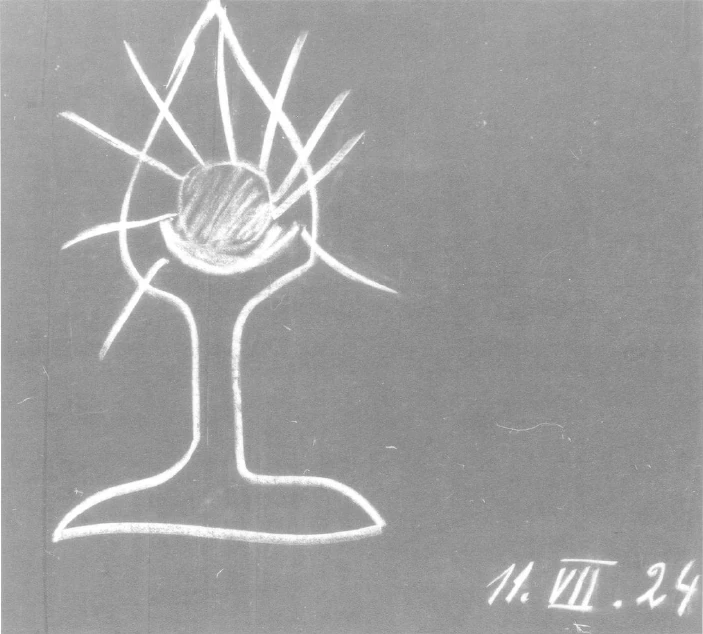
[ 33 ] Das lud sich ab im Inneren der Seelen, die ich geschildert habe. Und wenn so diese Seelen auf dasjenige hinunterschauten, was sich ausbildete als ein Symbolum beim Messelesen — das sogenante Sanktissimum, worinnen die Hostie auf einem halbmondförmigen Untersatze ist -, dann empfanden sie: Das ist ja das lebendige Symbolum dafür, daß man einstmals in dem Christus das Sonnenwesen gesucht hat; denn auf jedem Sanktissimum, auf jeder Monstranz sind die Strahlen der Sonne darauf. Aber verlorengegangen ist der Zusammenhang des Christus mit der Sonne; nur noch im Symbolum ist er da. Er ist da geblieben bis zum heutigen Tage im Symbolum, aber das Symbolum selber wird nicht verstanden! - Das war die zweite Empfindung, aus der dann aufsprießte eine Verstärkung des Sinnes dafür, daß eine neue Christus-Empfindung kommen müsse.
[ 33 ] This took root within the souls I have described. And when these souls looked down upon what took shape as a symbol during the reading of the Mass—the so-called Santissimum, in which the Host rests on a crescent-shaped base—they felt: This is indeed the living symbol of the fact that people once sought the solar being in Christ; for on every Most Holy Sacrament, on every monstrance, the rays of the sun are depicted. But the connection between Christ and the sun has been lost; it remains only in the symbol. It has remained there to this very day in the symbol, but the symbol itself is not understood! — That was the second insight, from which then sprang a deepening of the sense that a new understanding of Christ must come.
[ 34 ] Wir wollen dann übermorgen in dem nächsten Vortrag weitersprechen über das Karma der Anthroposophischen Gesellschaft.
[ 34 ] We will then continue discussing the karma of the Anthroposophical Society in the next lecture the day after tomorrow.