

Esoteric Considerations of Karmic Connections
Volume II
GA 237
1 August 1924, Dornach
Translated by Steiner Online Library
Eighth Lecture
[ 1 ] The task now will be to describe how the individual anthroposophist experiences his or her karma simply by having placed himself or herself—based on the preconditions that have already been discussed—within the Anthroposophical Society or at least within the anthroposophical movement. To this end, it will be necessary for me to add some explanatory remarks today to what I discussed here last Monday. I referred to the significant supersensible school of teaching at the beginning of the 15th century, which may be characterized by saying: In it, Michael himself was the great teacher. And multitudes of human souls who at that time stood between death and a new birth, but also multitudes of such spiritual beings who are not destined to pass into an earthly incarnation, but who spend the eons in which we live in an etheric or other higher existence—all of them, these beings, that is, human, superhuman, and subhuman beings, belonged, so to speak, to the comprehensive body of students of the Michaelic Power at that time. And last Monday I already outlined for you some of what constituted the content of that teaching at the time.
[ 2 ] Today we would like to begin by highlighting one point: the Michaelic reign, which was the penultimate one—that is, actually the last one preceding the present one—which lasted for three centuries and came to an end during the Age of Alexander in pre-Christian times; this Michaelic reign then withdrew; other archangelic reigns came to Earth. At the time when the Mystery of Golgotha took place on Earth, the Michaelic community was united precisely with the spiritual and human-spiritual beings who belonged to them. They perceived the Mystery of Golgotha in such a way that Christ left their realm—the solar realm—at that time, whereas the people living on Earth at that time had to perceive the Mystery of Golgotha as Christ coming down to them on Earth.
[ 3 ] This is a tremendous—I would even say vast—contrast in the experience of these two types of souls, and we must immerse ourselves wholeheartedly in this contrast.
[ 4 ] Then began the era in which cosmic intelligence—that is, the intelligent being that is spread throughout the entire world and which had been under Michael’s unlimited administration until the end of the Alexandrian era—gradually passed into the possession of the people on Earth; Michael, so to speak, ceased to exist.
[ 5 ] You see, my dear friends, the development of humanity proceeded in the following manner with regard to these matters. Until the end of the Alexandrian era—indeed, into the post-Alexandrian era, and for certain groups of people long beyond that—there was always the awareness that if someone was intelligent, they did not develop that intelligence within themselves, but rather that it was bestowed upon them from the spiritual worlds. If one thought something clever, one attributed the fact that it was clever to the inspiration of spiritual beings. It is only a recent development that people attribute cleverness and intelligence to themselves. And this is because the administration of intelligence has passed from the hands of Michael into the hands of human beings.
[ 6 ] When Michael resumed his reign as the guide of Earth’s destiny in the late 1870s, he found that the cosmic intelligence, which had been completely lost to him since the 8th or 9th century A.D., was present among the people below.
[ 7 ] This was already the case in the last third of the 19th century, when Michael’s dominion once again spread following Gabriel’s dominion. Michael came, so to speak, by reaching out to intelligent people, to that which he could say: “Here I find again what had slipped away from me, what I once administered.” And indeed, the great dispute in the Middle Ages between the leading figures of the Dominican Order and those who had migrated to Spain as part of the continuation of Asian Alexandrianism—such as Averroes and his followers—centered on the fact that Averroes and his followers, that is, the Muslim post-Aristotelians, asserted: “Intelligence is something universal.” They spoke only of a pan-intellect, not of an individual human intellect. For Averroes, what constitutes individual human intellect was merely a kind of reflection in the individual human mind of that which, in reality, exists only in a general sense.
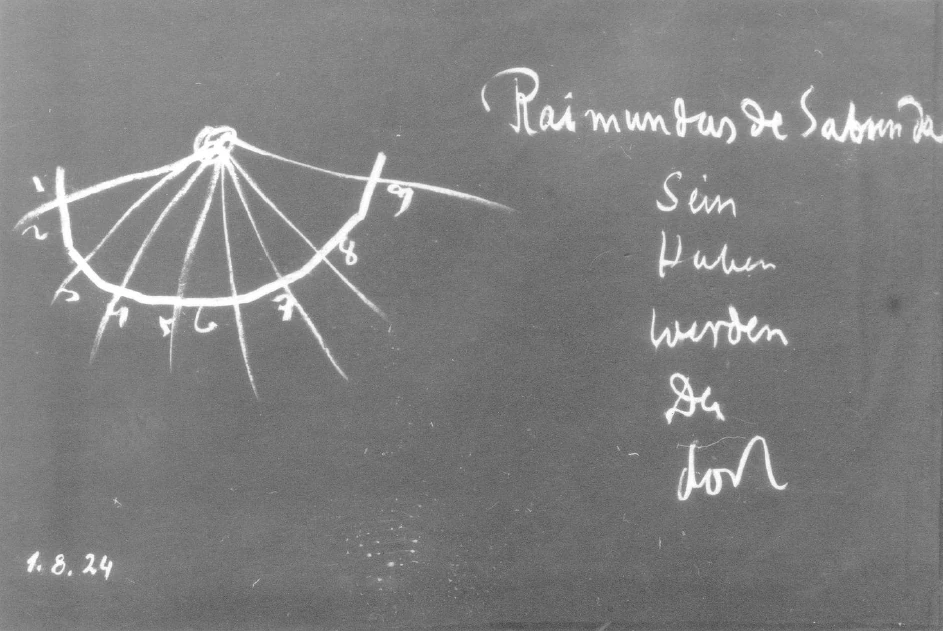
[ 8 ] Just imagine: someone has a mirror that looks like this (see drawing), and instead of these nine parts of the mirror, I could of course draw a hundred, a thousand, or even a million parts. Here would be an object that is reflected. That was the case for Averroes, who was vigorously opposed by Thomas Aquinas: For him, in the tradition of the ancient Michaelic era, the mind—or intelligence—was a pan-intelligence, an intelligence that was one and the same; individual human minds merely reflected it, so that if the human mind ceased to function, there would be no individual intelligence. So what was actually the case?
[ 9 ] Yes, you see, what Averroes envisioned was true until the end of the Alexandrian era; it was simply a cosmic-human fact until the end of the Alexandrian era; he recorded it. The Dominicans took up the evolution of humanity and said: That’s not how it is! — Of course, they could also have said: “It used to be that way, but it’s no longer the case today!” — But they didn’t do that; they simply took the reality as it was in the 13th century, which then became particularly pronounced in the 14th and 15th centuries. They said: “Now everyone has their own mind.” — That was precisely what was happening.
[ 10 ] And to bring this into complete clarity—that was the task of that supersensible school I spoke about last Monday. This was emphasized again and again in all the metamorphoses within this supersensible school, as the fundamental character of the ancient mysteries was described time and again. In a magnificent and vivid way—not through imaginations, which did not appear until the beginning of the 19th century, but through supersensible inspirations—that which I have been able to reflect here on several occasions was described, as I depicted the essence of the ancient mysteries.
[ 11 ] But then attention was also drawn to the future—to what was to become the new mystery tradition, to all that which, unlike the old mystery tradition, did not enter into people who lacked intelligence on Earth and who could therefore experience the supersensible worlds in a dreamlike manner, but rather to that mystery tradition that we must begin to understand in the field of anthroposophy—one that is absolutely compatible with human intelligence in its entirety, with clear, luminous intelligence.
[ 12 ] But let us delve a little into the inner workings of the teachings of that supersensible school. These inner aspects led, after all, to the recognition of that which, in the worldviews of people on Earth since ancient Hebrew times and again during the Christian era, has been reflected only as a kind of faint echo—and of which, even today, when deeper insights should already prevail, only a traditional echo remains among the vast majority of people: It is the doctrine of sin, of the sinful human being, of the human being who, at the very outset of human evolution, was actually destined not to descend so deeply into the material realm as he has now descended.
[ 13 ] A certain version of this doctrine that is still sound can be found, for example, in Saint-Martin, the “Unknown Philosopher,” who indeed still teaches his disciples that humankind did in fact originally stand at a certain height before human evolution began on Earth, and that it fell through an original sin, which Saint-Martin calls “cosmic adultery.” Through original sin, humankind has fallen to the state in which it finds itself today. Now, in doing so, Saint-Martin has also pointed to what has been present in the doctrine of sin throughout human development: the view that humankind does not stand at the level at which it could stand. All teachings on original sin were rightly linked to this view that humanity has, in fact, originally fallen from its former height.
[ 14 ] However, by drawing the consequences of this view, a very specific nuance of the worldview had been elaborated—the nuance that stated: Since human beings have, after all, become sinful—and to become sinful means precisely to sink from their original height—they cannot perceive the world as they could have perceived it before their fall, when they were sinless. Human beings therefore see the world through a haze. They do not see it in its true form; they see it as full of illusions and phantoms. He sees precisely what he observes out in nature, but does not see it in light of its spiritual background; he sees it in a material form that in reality does not exist at all. This means that, from the perspective of ancient times and tradition, human beings are still, in many ways, sinful even today. Thus, even among those on earth who preserved the tradition of the Mysteries, it was certainly taught: Human beings cannot view the world in this way; they cannot feel in the world in this way; they cannot act in the world as they would think, feel, and act if they had not become sinful—that is, if they had not fallen from the heights to which the gods belonging to them had originally destined them.
[ 15 ] If we now look at all the leading spirits from the ranks of the Archangels, who succeed one another in earthly dominion in such a way that this dominion is always exercised for about three to three and a half centuries—as it has been for the last three to four centuries by Gabriel, and now by Michael for the next three centuries to come—if we look at the entire series of these Archangeloi beings—Gabriel, Raphael, Zachariel, Anael, Oriphiel, Samael, and Michael—we can characterize the relationship that exists between them and the higher spirits of the higher hierarchies in roughly the following way.
[ 16 ] Please do not take the words that sound trivial—but we have only human words, after all—please do not take the words used to describe these sublime things lightly; they are not meant lightly. Of all these angels, seven in number, six have—though not entirely (most of all Gabriel, though not even he entirely)—but still, six have come to terms, relatively very strongly, with the fact that human beings stand before Maja, before the great illusion, because, through their nature—which does not correspond to what they were originally intended for—they have descended from their original form. Michael alone is the one who—I must, I might say, put it in banal terms—simply did not want to give in and who, together with those who are Michael spirits even among human beings, takes the stance: “I am the steward of intelligence.” Intelligence must be stewarded in such a way that it is not infiltrated by illusion, fantasy, or that which causes people to view the world only in a dark and nebulous manner.
[ 17 ] My dear friends, to see Michael standing there as the greatest adversary among the archangels—that is an immensely uplifting sight; it is something overwhelmingly magnificent. And every time a Michael era arrived, this also occurred on Earth: intelligence, as a means of knowledge, not only became cosmopolitan, as I have already described, but also led people to be imbued with the awareness: We can indeed ascend to the Divine.
[ 18 ] This idea—“We can, after all, ascend to the Deity”—played an immensely important role at the end of the last ancient Michael era. At that time, starting from Greece, the sites of the ancient mysteries were such that an atmosphere of discouragement hung over them. Those who were the successors of the ancient Pythagorean school in Southern Italy and Sicily were discouraged; they were discouraged because the magical splendor that had once reigned over the Pythagorean school in the 6th century B.C. had faded. At the same time, even those initiated into the Pythagorean mysteries could see how the illusory—the materialistic illusion—was spreading throughout the world.
[ 19 ] The daughters and sons of the ancient Egyptian mysteries were disheartened. Oh, those Egyptian mysteries—even in Alexander’s time they were already so discredited that, I might say, they perpetuated such profound teachings—as expressed in the Osiris legend or in the reverence for Serapis—only as the dross of ancient, wondrous streams of metal. Over in Asia, where were those courageous, mighty ascents into the spiritual world, such as those that emanated from the Diana Mysteries in Ephesus? Even the Samothracian Mysteries, the wisdom of the Cabiri—they could now be deciphered only by those who carried within themselves the impulse toward ascent, toward the Great; only those whose souls were so disposed could still decipher the clouds of smoke rising from Axieros, Axiokersos, Axiokersa—the Cabiri.
[ 20 ] Discouragement had set in everywhere! Everywhere, I would say, there was a sense of precisely what the ancient mysteries sought to overcome by turning to the mystery of the Sun—which is, in fact, the mystery of Michael—everywhere there was a sense that: human beings cannot!
[ 21 ] This Michaelic era was a time of great trial. Plato was, in essence, nothing more than a kind of watered-down extract of the ancient mystery tradition. Aristotelianism then extracted the most intellectual elements from this extract, and Alexander took them upon his shoulders.
[ 22 ] That was Michael’s message at the time: Humanity must attain Pan-Intelligence—the ability to perceive the Divine on Earth in a sinless form. The best of what has been attained must be spread far and wide, to the disheartened mystery centers, with Alexandria as the focal point. That was Michael’s impulse. And this is precisely Michael’s relationship to the other Archangels: that he protested most vehemently against the Fall of humanity.
[ 23 ] But that is also the very essence of his teaching, as he imparted it to his followers in that supersensible school of which I spoke last Monday. This most important aspect is this: When intelligence is to be among human beings—when intelligence, having fallen from the bosom of the Michaelites, is down on Earth, then people in this Michaelic Age must sense—they must feel—that they must save themselves there, because intelligence must not be afflicted by sinfulness, because this Age of Intelligence must be used to ascend to spiritual life in pure intelligence, free from illusion.
[ 24 ] This is the difference between the atmosphere on the Michael side and that on the Ahriman side. For I already characterized this contrast last Monday: just as Ahriman is already making—and will continue to make—the strongest, the very strongest efforts to appropriate this intelligence that has found its way among human beings, to make human beings possessed by him, so that Ahriman would possess this intelligence within human minds.
[ 25 ] You see, my dear friends, one must—I would say—simply know this Ahriman, that is, these hosts of Ahriman. It is not enough simply to regard the name “Ahriman” with contempt and to apply the name “Ahriman” to a host of contemptible beings. That accomplishes absolutely nothing. What matters is that, in Ahriman, we are faced above all with a cosmic being of the highest conceivable intelligence—a cosmic being that has already fully incorporated intelligence into the individual. Ahriman is, in every respect, highly super-intelligent; he possesses a dazzling intelligence that emanates from the entire human being—just not from that part of the human being that takes human form specifically in the human forehead.
[ 26 ] If we were to depict Ahriman in the human imagination, we would have to give him a receding forehead and a frivolous, cynical expression, because everything in him stems from these lower forces—yet it is precisely from these lower forces that the highest intelligence arises. To engage in a discussion with Ahriman, for example, would mean being utterly overwhelmed by the logical consistency and the magnificent precision with which he handles his arguments. As far as the human world is concerned, Ahriman believes, it must first decide whether wisdom or folly will prevail. And Ahriman calls everything foolish that does not encompass intelligence within itself in full personal individuality. For every Ahrimanic being is personally super-intelligent, just as I have just described to you—critical in its rejection of all that is illogical, mocking, and contemptuous in its thinking.
[ 27 ] You see, when one has Ahriman standing before one like this, one naturally senses the complete contrast between Ahriman and Michael. For Michael, the personal aspect of intelligence is of no consequence at all; for human beings, there is always the temptation to make intelligence personal as well, following Ahriman’s model. Ahriman actually holds a very contemptuous view of Michael; Ahriman judges Michael to be stupid and foolish. Of course, this is in relation to himself: because Michael does not wish to appropriate intelligence for himself personally, but rather because Michael has sought—and continues to seek—through millennia, through eons, to administer Pan-Intelligence, and now, once again, by ensuring that human beings possess intelligence, he wishes to administer it as something shared by all humanity, as something that benefits all human beings as such in the form of general intelligence.
[ 28 ] Certainly, we would be right, as human beings, to tell ourselves: the belief that we alone can possess wisdom is foolish. For we cannot be wise only for ourselves. If we want to prove something logically to someone, we assume that the same logic applies to them, and the same logic applies to a third person as well. If someone could have their own logic, then we certainly could not attempt to prove anything to them using our logic. It is precisely the peculiarity of this Michael Age that this must also extend to our feelings, which is ultimately something we must come to understand.
[ 29 ] And so, behind the scenes of existence, the struggle between Ahriman and Michaelism is actually raging. And that is, as I said last Monday, something that is part of the anthroposophist’s task: to have a sense that this is how things are now, that the cosmos, so to speak, is caught up in this struggle.
[ 30 ] You see, this struggle—which had already been taking place in the cosmos since the 8th, 9th centuries, when, little by little, the cosmic intelligence descended from Michael and his hosts down to the people of Earth, only became relevant when the consciousness soul—at that point in time to which I have so often alluded, at the beginning of the 15th century—began to develop within humanity. There we also see on Earth, in individual souls who lived on Earth at that time, something like a reflection of what took place in the great supersensible school of which I spoke last Monday; there we see that something of this was reflected in individual human beings on Earth.
[ 31 ] We have, after all, discussed so much lately about heavenly reflections in earthly schools and institutions. We have spoken of the great school of Chartres; we have spoken of others. But we can also speak of individual human beings in this context. And here we have the remarkable phenomenon that precisely where the soul of consciousness begins to develop within civilized humanity—where true Rosicrucianism must take hold of this dawn, this beginning of the impulse toward the soul of consciousness—something of this supermundane impulse struck the spirit of that age like a bolt of lightning. This occurred in Raimundus de Sabunda in the 15th century. And what Raimundus de Sabunda taught at the beginning of the 15th century is almost like an earthly reflection of the great supersensible Michael teaching that I have now described to you.
[ 32 ] He said: Human beings have fallen from the station originally bestowed upon them by the gods to whom they belong. Had they remained in that station, they would have seen all that surrounds them—what exists in the wondrous crystal forms of the mineral kingdom, what lives in the unformed mineral kingdom, what lives in the hundreds and thousands of forms of the plant kingdom, what lives in the forms of the animal kingdom, what stirs and moves in water and air, and what stirs and moves in the warm and earthly realms—they would have seen all of this as it truly is.
[ 33 ] Raimundus of Sabunda recalled how, in the Tree of Sephirot, in the Aristotelian Categories, and in those general concepts that seem so strange to those who do not understand them, all of these contain that which is meant to lead us upward through the intellect into the spiritual world. How dry, how terribly dry what is contained in the Aristotelian Categories seems to people when they are taught in logic: Being, Behavior, Action, here, there—ten such categories, ten such general concepts. Then people say: That’s enough to make you run away—learning such general concepts is enough to make you run away! Why on earth should one get worked up over ten such general concepts: Being, Having, Becoming, and so on? — But that is just like someone saying: There’s Goethe’s Faust—people make a big deal out of Goethe’s Faust! It consists only of a, b, c, d, e, f through z! There’s nothing else in that book—just a, b, c, d, e, f through z in various combinations. And someone who can’t read and picks up Goethe’s Faust won’t realize what immense greatness lies within it, but will always see only a, b, c, d, e, f through z. Someone who doesn’t know how to combine a, b, c, and d—who doesn’t know how they relate to one another—simply cannot read Faust.
[ 34 ] You see, the same is true when it comes to reading the words of Aristotle’s Categories; there are ten of them: Being, Quantity—Amount, Quality—Property, Relation, Space, Time, Position, Behavior, Action, Suffering—there are not as many of them as there are letters. They are the spiritual letters. Whoever knows how to handle Being, Behavior, Action, and so on in the right way—just as one knows how to handle the individual letters so that they form “Faust”—can still sense something of what Aristotle said about these things, for example, in The Education of Alexander.
[ 35 ] Raimundus of Sabunda drew attention to such things; he was still aware of them. He said: If one looks at what remained, for example, in Aristotelianism, it is something that has survived from that ancient standpoint from which humanity had fallen at the beginning of human development on Earth. They still remembered this in the beginning: that was ‘reading the Book of Nature.’ But human beings have fallen so far that they can no longer truly read the ‘Book of Nature.’ Therefore, God, who took pity on them, gave them the Bible—or the ‘Book of Revelation’—so that they might not stray entirely from what is divine and spiritual.
[ 36 ] Raimundus of Sabunda taught as late as the 15th century: The “Book of Revelation” exists for sinful human beings because they do not know how to read the “Book of Nature”; but he taught this in such a way that he had already conceived the idea: People must once again find the ability to read the “Book of Nature.” And this is Michael’s impulse: to lead people—now that the intelligence he administers has come among them—to open the great Book of Nature once more and to read the “Book of Nature.”
[ 37 ] In fact, everyone in the anthroposophical movement should feel that they can only understand their karma once they know: The call is directed personally to them to once again read spiritually in the “Book of Nature” and to discover the spiritual background of nature, now that God has given revelation for the interim period.
[ 38 ] Please take to heart the meaning contained in my book Mysticism at the Dawn of Modern Spiritual Life. On the last page of this book, you will see—though only in the form in which I was able and had to write it at the time—that the aim was to guide the anthroposophical movement in such a way that people might once again be able to read not only the “Book of Revelation,” which, as I said, Jakob Böhme had already read, but also the “Book of Nature” . The amateurish, inadequate, and often appalling beginnings of modern natural science must be transformed, metamorphosed through a spiritual worldview into a true reading of the Book of Nature. I believe, too, that the expression “Book of Nature” is used at the end of the book Mysticism at the Dawn of Modern Spiritual Life. From the very beginning, the anthroposophical movement had this “shibboleth.” From the very beginning, it was an appeal to those people who were now to listen to the voice of their karma, who were to perceive, more or less subconsciously and obscurely, the call: My karma is being affected and stirred by what resounds into the world as the Michael Message; through my karma, I have something to do with it.
[ 39 ] After all, there are people who have been there, who are always there, who came there, who keep coming back and will continue to come, who are willing, in a certain sense, to turn away from the world and gather within what is known as the Anthroposophical Society. In what sense—to a greater or lesser extent—this “turning away” from the world is to be understood—as real, as formal, and so on—is a matter in itself, but for the individual souls it is a kind of turning away, a kind of moving toward something that is different from that from which they have outgrown. The most diverse karmic consequences do, after all, come to bear on the individual human being. One person experiences this or that by having to tear oneself away from certain connections, by uniting with those who wish to uphold the Michael Message. There are those who experience this connection to the Michael Message as a kind of salvation. But then there are those who feel as if they have been placed in a situation such as: I am drawn to Michael on the one hand, to Ahrimanism on the other; I cannot choose—I am caught up in this through my life! — There are those who summon their courage but still have an external connection. There are those who easily find that external connection; that, too, is possible, and perhaps even the very best thing for the current state of the Anthroposophical Society. But people within the anthroposophical movement are always confronted with others who are not part of it, including those with whom they are deeply connected karmically from previous earthly lives. There we gain insight into the most remarkable karmic threads.
[ 40 ] We can only understand these strange karmic threads if we recall the premises we have just discussed, in which we have truly seen how the souls who today feel, from within the unconscious, an urge toward the anthroposophical movement, have gone through certain experiences together in earlier earthly lives—experiences in which they, for the most part, belonged to the multitudes who heard the Michael message in the supersensible realm during the 15th, 16th, and 17th centuries, and who then, at the beginning of the 19th century, underwent the powerful imaginative cult of which I have spoken here. We see a powerful cosmic-terrestrial call approaching the karmic connections of the members of the Anthroposophical Society. We heard last Monday, after all, how this call will extend throughout the entire 20th century, and how the culmination will occur at the end of the 20th century.
[ 41 ] That, my dear friends, is what I would like to talk about next Sunday.