Esoteric Considerations of Karmic Connections
Volume IV
GA 238
10 September 1924, Dornach
Translated by Steiner Online Library
Third Lecture
[ 1 ] The course of human history and of our own lives is understood only to a very small extent when we view it from the outside—that outer aspect we can survey when we draw upon what unfolds in the perspective of our earthly life between birth and death. And it is impossible to grasp the inner motives of history and life unless our gaze is turned toward that which, as the spiritual background, underlies the outer physical events. After all, we depict world history—and within this world history, the events that unfold in the physical world—and we say that this world history presents causes and effects. We approach the events of the second decade of the twentieth century, presenting them as effects of the events of the first decade, and so on. But how much illusion is possible here! It is as if we were to see, for example, a flowing stream that creates waves, and we were to regard each wave merely as the consequence of the preceding one; whereas, from below, the forces that create the waves are surging upward. So it is: whatever happens at any point in historical development or in human life in general is shaped from within the spiritual world, and only to a very small extent can we speak of causes and effects in relation to these events.
[ 2 ] I would now like to use a few consecutive examples to show you how, in order to gain a true picture of what underlies these events, one must take spiritual events into account. The present time is, after all, spiritually connected to what can be called the Michael Reign in spiritual life. This Michael Reign, however, is in turn linked to what the anthroposophical movement also seeks in the deepest sense—namely, its very purpose. Thus, the events I will speak of are also connected to the destiny—the karma, as it will become clear to us next time—of the Anthroposophical Society and, with it, to the karma of the vast majority of the individual personalities who are members of this Anthroposophical Society. Some of what I will touch upon this evening is already familiar to many of you from previous lectures. However, today I would like to consider the familiar alongside the less familiar from a certain perspective.
[ 3 ] We see, my dear friends, how a continuous Christian development has been taking place throughout the civilized world since the Mystery of Golgotha. And I have, in fact, often described in the past the direction this Christian development has taken over the successive centuries. But it cannot be denied that many other factors have played a role in this Christian development. For if that were not the case, our present-day culture could not be permeated by the strong materialism that indeed permeates it.
[ 4 ] While it cannot be denied that Christian creeds have made significant contributions to this materialism, they did so not strictly from Christian impulses, but rather from other impulses that flowed into Christian development from other sources.
[ 5 ] We see how in the West—if we focus on a specific period, the eighth and early ninth centuries—we see how, in a manner with which we may not always agree from the perspective of our modern humanitarian ideals, Christianity was spread far and wide by a figure such as Charlemagne among the people living in Europe at that time who were not yet Christian. Among these non-Christian peoples, however, those who were influenced by the traits that came from Asia through North Africa to Europe—and which stem from Arab culture and Islam—are particularly noteworthy. In this context, we must understand Islam in the broader sense of the word.
[ 6 ] Half a millennium or more after the Mystery of Golgotha, we see all the ancient worldview elements of Arabism emerging from within Arabism itself in Islam, much that is connected with it—much, in particular, from a rich but unchristian form of scholarship—and we see this scholarship spreading from Asia through North Africa to the west and south of Europe via penetrating military campaigns. We see this stream gradually drying up for the more external world, but it does not dry up within the development of spiritual life. Just as the more external form of spreading Arabism to Europe had already dried up, we see—and here we come to one of those cases where we must now look beyond external history to the spiritual background—how Arabism spreads in an inner way. And I did tell you in the last reflection on karma that I presented here that, when we consider the successive earthly lives of individual human beings, we cannot draw any conclusions from the external, from outward behavior, about what a previous earthly life was like, for it depends on much more inner impulses. The same is true for historical figures: much depends on far more inner impulses. And we see the results of earlier cultural epochs carried over into later ones by individuals—transmitted by the people themselves—but we also see them transformed in the process of this transmission, so that we cannot readily recognize them by observing the outward appearance in the new form in which a personality embodies them in a new incarnation. And so let us now consider such an inner current.
[ 7 ] At the same time that Charlemagne—one might say, in a somewhat primitive manner linked to the primitive education of Europe at that time—was spreading Christianity, there lived in the East a figure who was actually on a much higher level than Charlemagne: Harun al-Rashid. Harun al-Rashid gathered the most eminent intellectual figures of his time at his court in the Near East. And it was a brilliant court—one that was even greatly admired by Charlemagne in many ways—this court of Harun al-Rashid. We see architecture, poetry, astronomy, geography, history, and anthropology, all represented in the most brilliant manner by the most brilliant personalities, some of whom still carried within them much of the knowledge of the ancient science of initiation.
[ 8 ] In particular, we see that Harun al-Rashid—who was himself a master organizer on a grand scale—was able to create, right from his court, I might say, a universal academy, where the individual elements of what the Orient had to offer in art and science at that time worked together within a great organic whole—we see, alongside Harun al-Rashid, another personality, a personality who literally embodied the elements of ancient initiation.
[ 9 ] It is not the case that a person who was an initiate in a previous incarnation must necessarily appear as an initiate again in a later incarnation. You may well, my dear friends, raise the question that naturally follows from some of the assertions made in these lectures: Yes, there are said to have been ancient initiates—where have they gone? Have they not reincarnated? Where are they today? Where have they been over the past few centuries? — Well, they have been here all along, but one must take into account that someone who was an initiate in a previous incarnation must, above all, make use of the physical body available to them in a new incarnation—the very body that the current age can provide. Recent human evolution does not produce bodies that are so inwardly pliable, flexible, and supple that what lived within the individuality in a previous incarnation can immediately enter them. And so the initiates are then given different tasks in which—already unconsciously, in the driving force of the impulses—that which was present during their initiation is at work, though it does not manifest in the form of the initiatory process.
[ 10 ] Thus, at the court of Harun al-Rashid, there lived a second organizer—who also possessed extraordinarily deep insight, though not exactly in the form of initiatic insight as it was understood at that time—an advisor who rendered the greatest possible services to Harun al-Rashid.
[ 11 ] These two figures, Harun al-Rashid and his advisor, passed through the gate of death. And, in a sense, after they had arrived in the spiritual realm, they still witnessed the final phases of the spread of Arabism—on the one hand across Africa into Spain, deep into Europe, and on the other hand also into Central Europe. They were both powerful forces, and Harun al-Rashid had done much during his lifetime to contribute to the spread of Arabism in the physical world.
[ 12 ] This Arabism did indeed take on a distinctive form at the court of Harun al-Rashid: a form that had just emerged from various other forms that had long been present in Asian thought and art. The last great wave of development toward Asia had, after all, originated in the preceding Michaelic Age as that which embodied Greek intellectual life, Greek spirituality, and the Greek artistic sensibility—a synthesis embodied by the partnership of Aristotle and Alexander the Great and carried over to Asia and Africa as the flowering of Greek intellectual life through the conquests of Alexander the Great, in an extraordinarily energetic, yet also exemplary for the dissemination of the spirit, through Alexander the Great’s conquests into Asia and Africa, imbued with the mindset that found its scientific expression in Aristotelianism in the Near East and Africa. And thus, Arabism and Orientalism were shaped in spirit by those impulses that Aristotelian Hellenism had adopted and which then found such brilliant dissemination through Alexander’s conquests and the founding of new cities.
[ 13 ] If we look back a few centuries before the Mystery of Golgotha, all the way to Alexander’s campaigns, to the dissemination of those treasures of wisdom I just alluded to by Alexander the Great, we see, throughout all those centuries up to Harun al-Rashid—who lived in the eighth century CE—over in Asia a mindset and receptivity to Greek intellectual life in its Aristotelian form. But it had taken on peculiar forms. Although all of this flourished at the court of Harun al-Rashid—spiritual, magnificently compelling, and imbued with Arab culture—and although it was cultivated by Harun al-Rashid, his advisor, and the others present, and was even interwoven with ancient Oriental initiatory wisdom, what flourished as Aristotelianism at the court of Harun al-Rashid was not the authentic form that had been cultivated, for example, between Aristotle and Alexander. It had taken on forms that paid little heed to Christianity.
[ 14 ] And so, over there, brilliantly cultivated particularly under the aegis of Harun al-Rashid and his advisor, we have an Aristotelianism, an Alexandrian tradition that represents a pole opposed to Christianity, one that has adopted a spiritual form—namely, a kind of pantheism—that never sought to unite with Christianity and, by its very essence, could not unite with it.
[ 15 ] With this mindset—a mindset rooted in an ancient spiritual life that did not wish to be absorbed into Christianity—Harun al-Rashid and his advisor passed through the gate of death. All their efforts, all their longing, all their strength, after they had passed through the gate of death, were directed toward intervening—from the spiritual world, as it were, continuing the historical development—in what had taken place in terms of the spread of the spiritual life of Arabism from Asia into Europe—earlier during times of war and the like. After their death, they sent down from the spiritual world the spiritual rays that, in a sense, sought to permeate Europe’s spiritual life with Arabism.
[ 16 ] And so we see how one of them, Harun al-Rashid, undergoes the following development after his death: From the Near East, across southern Europe, and through Spain, he observes from the spiritual world the events leading to the spread of Arab culture and carries them forward. The other, who lives in the spiritual world, observes accordingly and, in a certain sense, shares in what is happening down below in the physical world; in the spiritual world, he takes a path that, if projected, would roughly look like this: from north of the Black Sea into Central Europe.
[ 17 ] So let us turn our gaze upward toward these individualities, in a sense through spiritual journeys, which can be projected down onto the physical plane in the manner just described. You already know from history how Aristotelianism and the legend of Alexander the Great had spread into Christianity. As late as the ninth, tenth, eleventh, twelfth, and thirteenth centuries, the stories connected with Alexander the Great were still among the most popular subjects, recounted everywhere in Europe. And we have there the wonderful poem by the priest Lamprecht, the Alexanderlied, which throughout links Alexander’s deeds to the spiritual world. Alexander’s upbringing and life are described, as are his campaigns into Asia. But throughout, the emphasis is on what lives spiritually within Alexander’s earthly life. And the spiritual is, of course, connected to all earthly life; it is just that ordinary consciousness fails to see this. All of this was present in the medieval treatment of the subject matter. And so Aristotelianism spread all the way into Scholasticism: Aristotelian concepts everywhere. But it is merely the other pole: over there, across in Asia, in an Arab form; here, in a Christian form; the Song of Alexander entirely imbued with a Christian spirit, Aristotelianism in Europe thoroughly in a Christian guise.
[ 18 ] Yes, there is even the curious phenomenon that the Christian Church Fathers, whose minds were shaped by Aristotle, fought against those who had brought the “other” Aristotle from Asia into Spain and were spreading a non-Christian doctrine there. And everywhere in the paintings that were created in later times, we see—I would say—Aristotelianism battling the Christian Church Fathers, who, armed with what they had taken from Aristotle, are trampling Averroes and the others underfoot—those who, in their own way, now also represent that Aristotelianism which had come to Europe via the Alexandrian school.
[ 19 ] This takes place on the outer plane. But from the perspective of spiritual research, we can say that Harun al-Rashid and his advisor continued to live in the manner described after they had passed through the gate of death. Of course, Alexander and Aristotle also lived on in this way. But they themselves—the true individualities who only once, I might say, briefly looked into earthly life during the early Christian centuries—even in a region of interest from an anthroposophical perspective— but then returned to the spiritual world—and were present in the spiritual world at the same time that Harun al-Rashid and his advisor had already left the physical plane for some time—Aristotle and Alexander followed other paths. Their true individualities moved along with Christian development, moving westward with Christian development.
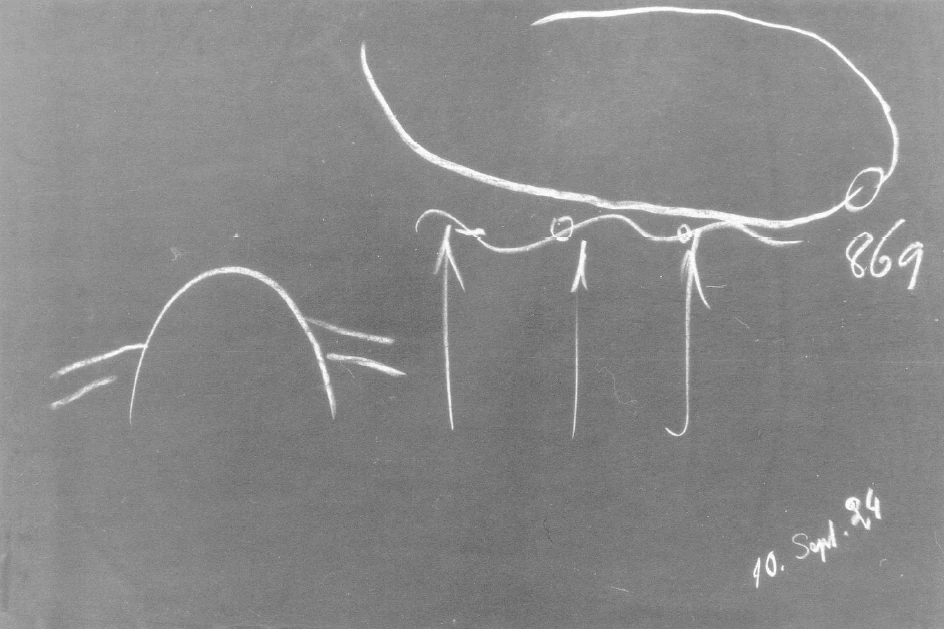
[ 20 ] Now, the most important, the most essential events also took place in the ninth century. But what is now, from the spiritual world, decisive for what is happening spiritually in Europe coincides in the supersensible worlds with an event that is not easily recognized—yet it does coincide with this event. And something immensely significant is taking place in the supersensible worlds in the very year 869. Above, something extraordinarily significant is taking place; below, the Eighth Ecumenical Council is being held in Constantinople, at which it is dogmatically declared that, if one wishes to be a Christian, one must not say that human beings consist of body, soul, and spirit. The trichotomy, as it was called, was declared heretical.
[ 21 ] I have often expressed this in the past by saying: At the Council of 869, the concept of the spirit was abolished; from then on, one had to say that human beings consist of body and soul, and that the soul possesses certain spiritual qualities. What took place in Constantinople in this way was an earthly projection in which, however, one does not recognize that of which it is a projection. It was the projection of a spiritual event—one of immense importance for European intellectual history—which, though it spanned many years, can nevertheless, so to speak, be dated to this point in time.
[ 22 ] By this time, in the ninth century, the European people and their spiritual life had completely forgotten what had still been well known to true Christians in the early Christian centuries: that Christ, as a being who had formerly dwelt in the sun, had a life intimately connected with the sun; that this Christ had incarnated in the body of Jesus of Nazareth, as has often been described here. Christ, the solar being—Christ connected to the cosmic world through his dwelling in the sun prior to the Mystery of Golgotha—and not only the solar being, but the being who was also connected to everything planetary associated with the sun: this was something familiar to the early Christians. But this cosmic origin of the Christ impulse had already disappeared by the ninth century. People had, so to speak, shed the grandeur of the Christ impulse. More and more, they moved toward what was called the purely human—that is, what takes place solely on the physical plane. They took the Gospels and, rather than explaining what pointed out into the cosmos, recounted the content of the Gospels as if it were an earthly epic.
[ 23 ] If one wants to truly understand what is actually happening here, one must be clear that, in the actual development of humanity, there was a Christianity that existed before Christ, before the Mystery of Golgotha. And one should take seriously words such as those of Saint Augustine, who said that Christianity had always existed; it was just that those who professed Christianity before the Mystery of Golgotha were not called Christians, but were referred to by other names. But this is only the outward, tangled expression of something that is extraordinarily profound. In the mysteries—the true mysteries—and even in those places where there were no mysteries per se, but where mystery knowledge and mystery impulses were at work, there was Christianity everywhere before the Mystery of Golgotha. It was simply that people spoke of the Christ Being as the Being who is on the sun—one whom one can then behold and with whom one can work—when, through the wisdom of initiation, one has progressed far enough that the reality of solar life, in its spiritual and actual content, can become present to one.
[ 24 ] This is how the Christ who is to come was spoken of in the ancient mysteries. They did not speak of an earthly Christ who had lived on Earth and was present there; rather, they spoke of the coming Christ, who would one day be present—a figure whom people at that time still sought on the sun. Such beliefs, however, persisted into later times in certain regions where Christianity had not yet taken hold, even in the centuries following Christ.
[ 25 ] And just recently, during our stay in England—when the summer course took place in Torquay, in western England, near the very site where Arthur and his companions once were (we were able to visit that site)—something came to light that pointed to such a belated influence within a form of Christianity that predated Christianity itself. There, what has simply been preserved into later times is what is often attributed in the Arthurian legend to a scholarship—which, however, is not very well-informed regarding the facts—as pertaining to later times. Yet this actually dates back to very early times. And it really is a profound experience to stand there on the site, looking down at the sea, just as the knights of King Arthur’s Round Table once looked down at the sea. And if you’re receptive to it, you can still get that very same impression today—one that tells you what these Knights of the Round Table, the Knights of Arthur, were actually doing up there in that gigantic castle, of which the last stones—the crumbling stones, the final witnesses—still stand.
[ 26 ] From this ruin, which, despite being completely crumbling, still makes a gigantic impression, one looks out over the sea. It is a mountaintop, with the sea on both sides. As you gaze out to sea from there—in a region where the weather changes almost hourly—you can, while standing there, behold the gleaming sunlight reflected in the sea; moments later, stormy weather sweeps in. If you survey what is still taking place there today with the occult eye, you gain a magnificent impression. Elemental spirits weave and live there, emerging from the effects of light, the effects of air, and the effects of the rippling sea waves crashing against the shore. The presence of those elemental spirits that live within all this, the interplay of the elemental spirits in the life and activity of these elemental spirits, is still quite vividly evident today: just as the sun, in its very nature, exerts an earthly influence by coming together with what grows upward from below—the elemental forces and spiritual elemental spirits emerging from the earth. This gives one the impression today that this was the immediate, original source of inspiration for the Twelve who belonged to the Order of Arthur.
[ 27 ] One sees them standing there, these knights of Arthur’s Round Table, observing this interplay of the forces of light, air, water, and earth—the elemental spirits. But one also sees how these elemental spirits served as messengers to them, conveying messages from the sun, moon, and stars—messages that then became part of their inner impulses, especially in earlier times. Much of this had been preserved through the centuries of the post-Christian era up to that century—the ninth century—of which I am just speaking.
[ 28 ] It was, after all, the task of this Order of Arthur—which had been founded there under Merlin’s guidance—to cultivate Europe at a time when Europe’s spiritual life was still everywhere under the influence of the most remarkable elemental beings. And more than is generally believed today, the ancient life of Europe must be understood in such a way that one sees everywhere the interplay of elemental spiritual beings in immediate human life.
[ 29 ] But even before the news of Christianity had reached that region—and even in its earliest forms, for, as I said, the Arthurian legend dates back to pre-Christian times—even then there existed, at least in a practical, instinctive way, yet quite clearly in that practical, instinctive sense, the knowledge of Christ, the Sun Spirit, prior to the Mystery of Golgotha. And in what the knights of Arthur’s Round Table did, this same cosmic Christ lived on—who, though not under the name of Christ, was also contained in the impetus with which Alexander the Great carried Greek culture, with its spiritual life, across to Asia. There were, so to speak, later “campaigns of Alexander,” which were carried out by the Knights of the Round Table in Europe in much the same way as Alexander’s campaign from Macedonia into Asia.
[ 30 ] I mention this because it illustrates, through an example that has recently been studied, how the service to the Sun—that is, the ancient service to Christ—was actually practiced there; but, of course, with this Christ as He was for humanity before the Mystery of Golgotha: Everything was cosmic there, even in the earthly-elemental transition of the cosmos. The cosmic principle lived within the elemental spirits that dwelt in light, air, water, and earth; one could not deny the cosmic within them upon recognizing it. Thus, in European paganism during this ninth century, much pre-Christian Christianity was alive. That is what is peculiar—and that these stragglers of European paganism understood the cosmic Christ at all during this time, understood him far more worthily than those who accepted Christ within the officially spreading Christianity.,
[ 31 ] We see, after all, when we observe this life centered on King Arthur—this life of King Arthur—shining into the present, how strangely it continues when, through the force of karma, through the force of fate, it suddenly manifests itself in the present. Thus, as I observed, I came upon a member of Arthur’s Round Table who truly lived the life of the Round Table in a very intense way, somewhat apart from the others, who were more devoted to chivalry. He was a knight who led a somewhat contemplative life. Not like the knighthood of the Grail—that did not exist in Arthur’s time. What drove these knights, arising from their duties—which, for the most part, were military campaigns in keeping with the times—was called “adventures,” or “Aventiuren.” But the one who stood out to me from the other figures revealed, precisely through this way of life, many things that are indeed wondrous in their inspiration. These knights went out onto the protruding land, surveyed the marvelous play of clouds above, the rippling waves below—this interplay that still makes a majestic, magnificent impression today—and saw the spiritual within it, drawing inspiration from it. That was the source of their strength. But there was one among them who had a particularly keen eye for this rippling and these waves, for how the spiritual beings frolicked in these rippling waves, with their forms that seem grotesque to earthly eyes, he had a marvelous eye for the way in which this wonderfully pure effect of the sun interacted with the rest of nature, living and weaving within the spiritual activity and interplay of this agitated sea surface; he lived in what one also sees in this—through the watery atmosphere, I would say, carried by the sun’s luminous nature, which approaches trees and the spaces between them in a different way than in other regions. It shines forth again, at times playing with rainbow colors, from the spaces between the trees.
[ 32 ] Among them was a knight who had a keen eye for such things. It was very important to me to continue tracing his life, to look more deeply into his individuality, for it was precisely there that something of what I would call an almost primitive, pagan—yet only to a certain extent Christian—life, as I have described it, had to emerge in a later incarnation. And so it did: this very knight of Arthur’s Round Table was reborn as Arnold Böcklin. And this mystery, which has haunted me for an incredibly long time, can only be solved by connecting it to Arthur’s Round Table. You see, there we have a Christianity prior to the Mystery of Golgotha, one that can still be grasped with spiritual hands today, one that still shines into the era I have outlined here.
[ 33 ] The figures who had passed through the gates of death—those who knew well what Christianity was like before the Mystery of Golgotha—gathered together while the Eighth Ecumenical Council was taking place in Constantinople; I might say, at a heavenly council that was occurring at the same time; at which Aristotle, Alexander, Harun al-Rashid, his advisor, and some from the circle—much like Arthur’s Round Table—met.
[ 34 ] Aristotle and Alexander, who sought to work within the Christian tradition, expended great effort to overcome the Arab influence that lived on in the individualities of Harun al-Rashid and the others. It did not work. The individualities were not suited to it. But something else emerged: that even more deeply ingrained than it was in the rougher attitudes of the Knights of Arthur, the ancient cosmic Christianity lived on in the people descended from Arthur’s Round Table. And it was there, at this supermundane council, that—in view of what was now likely to happen in the future and what was foreseen—with the cooperation of the Michaelic power, so to speak, Alexander and Aristotle made the decisions regarding how spiritual life in Europe should receive new impulses in the spirit of a Christianized Alexandrianism, a Christianized Aristotelianism.
[ 35 ] But Harun al-Rashid and his advisor stuck to the old ways. And to continue tracing the course of events that unfolded through this—if I may say so—heavenly council in the history of European thought is of the utmost importance. For when we look at the further development of spiritual life, we find Harun al-Rashid—this marvelous organizer, this magnificent spirit from the time of Charlemagne—returning to earth. And he appears again later in the midst of Christianity, having carried his Arab identity through the life between death and new birth. Yet what such a personality embodies need not resemble the Arab element in the outer configuration that then appears in the physical world. It takes on new forms, yet in these new forms it remains, in essence, the old: Mohammedanism, Arabism.
[ 36 ] This manifests itself, exerting an influence on European intellectual life, when Harun al-Rashid reappears, reincarnated as Bacon, Baco of Verulam. And this manifests itself in another way—even in a remarkable way interwoven with Christianity—as his advisor appears in Central Europe and then exerts a wide influence throughout Europe as Amos Comenius. Much of European intellectual life is connected to what the resurrected spirits of Harun al-Rashid’s court established in these new human forms in Europe.
[ 37 ] We see how what first takes shape, then actually happens, but happens later, has an opposing effect. For what later emerged in Bacon of Verulam and in Amos Comenius had long been at work spiritually, descending from the spiritual world, because it had taken on particularly intense forms through this supersensible council of 869.
[ 38 ] In contrast, the other pole—the one that Alexandrianism and Aristotelianism have now adopted for Christianity—is also making its presence felt. This initially manifested itself in a wide variety of influences that took place in secluded centers of Christian spiritual life. In particular, we see such a center in the School of Chartres, which has already been mentioned here several times in reference to some, but not all, of those associated with it. The School of Chartres, which flourished particularly in the twelfth century, had a profound spiritual impact. Sylvester of Chartres, Alanus ab Insulis, and other thinkers who were in some way connected to the School of Chartres—or who, like Alanus ab Insulis or Sylvester, taught there—possessed much of the ancient wisdom of the initiates, even if they themselves cannot be called fully initiated in the true sense of the word. The books that originated from them resemble catalogs of words. But in those days, it was not possible to convey in books what one wished to impart to life in its fullness other than through elaborate rhetoric, as a kind of catalog of words. Yet anyone who knows how to read will find in these very books precisely what was taught in a brilliant, wonderfully spiritually imbued manner by the great teachers of Chartres to their numerous students.
[ 39 ] A spiritual star truly shone over European intellectual life at this school in Chartres, the place where, even today, the architecturally magnificent cathedrals stand, showcasing the work of centuries in their exquisite design.
[ 40 ] In some other places, too, what constituted spiritual life at that time was alive: an insight into nature, but a different kind of insight—a more spiritual one than the one that came later—a spiritual life that also exerted its influence through spiritual means. It is indeed interesting to see how this spiritual life radiated in the most diverse ways. We can trace, in various places in France—such as the universities, starting from Chartres, moving through France, into southern France, and even across to Italy—how the spirit of Chartres lived on in the teachings. But it also lived on in a spiritual way in its own right.
[ 41 ] It is indeed interesting that Brunetto Latini, who had served for a time as an envoy in Spain, suffered a severe emotional shock upon his return—having already heard from afar of the misfortune that had befallen his hometown of Florence—a shock that coincided with a mild case of sunstroke he had contracted. In such a physical state, a person is easily susceptible to spiritual influences that spread in a spiritual manner. It is well known how Brunetto Latini, on his way to Florence, experienced a kind of elemental initiation. He became Dante’s teacher. The spirituality of the Commedia stems from the teachings that Brunetto Latini imparted to Dante, his student.
[ 42 ] In all of this lives precisely that which, I might say, was defined as supersensible at the Supersensible Council of 869. For the inspiration behind the teachings of Chartres, the inspiration for Brunetto Latini, and also the inspiration for Dante—which allowed cosmic life to take root in Dante’s poetic works—all of this is connected to the impulse that emanated from this supersensible assembly in the ninth century A.D.
[ 43 ] When one looks into these things, one sees the whole of European spiritual life from the ancient Alexandrian era, through the time of the Mystery of Golgotha, right up to the present day, up to the School of Chartres, and if one traces it further into the subsequent era—we shall see this later—if one looks at the interplay between what is taking place on the supersensible plane and what is its shadow image here below in the physical world, then one begins to truly grasp what we should today call the Michael Current, to understand what the Michael Current intends.
[ 44 ] One can then gain insight into what the anthroposophical movement aims for in the spirit of the Michael Movement. — We will continue discussing this next time.