

Esoteric Considerations of Karmic Connections
Volume V
GA 239
13 June 1924, Wrocław
Translated by Steiner Online Library
Fourteenth Lecture
[ 1 ] We are coming closer and closer to understanding those elements of life within each individual that can give us a glimpse of the significance of karma in personal existence. Today, in order to gradually achieve this goal over the course of these lectures, my task will be, on the one hand, to point out how the science of initiation itself can examine karma—beginning with the experience of karma—and, on the other hand, to show how a person can gain an inkling of the workings of karma, initially without the science of initiation but by observing life with a certain inner sensitivity. Here we recall what I have said about memory and those masses of thoughts that well up from the depths of the soul, either summoned by our soul or rising freely without being summoned, and which give us an image—admittedly shadowy and more or less abstract, but an image nonetheless—of our earthly existence to date, which we have lived through since our last birth. In recent days, we have been able to direct our attention to what a person loses when they lose this memory. They may still act quite intelligently and sensibly, but they do not act out of the context of their entire life; he acts as if, so to speak, at the very moment he begins to act, he were without any memory of his life up to that point; as if he had indeed come into the world as a fully formed, sensible, and rational human being, but his previous life on this Earth had not passed for him at all—that is how he acts. From this we see how, in the experience of ordinary present-day consciousness, the “I” is anchored and grounded in memory. Through this path of memory, the “I” then can no longer find its bearings within itself in the course of this earthly life.
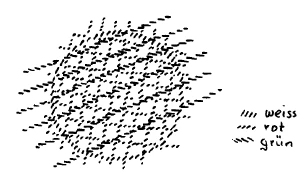
[ 2 ] But how do we actually have this memory? Let’s compare this memory with the fully lived reality from which it flows. We stand within it in life, experiencing it with both joy and sorrow, finding ourselves interwoven with our experiences through our entire being. But just compare this entire intense way of being interwoven with one’s own being to the shadowy memory we preserve in our soul. You need only take a truly significant life event—the death of a friend who was particularly dear to you, or the death of a father or mother—at a time when such an event is experienced particularly deeply due to the state of our soul. Let us compare the full intensity of the experience and the moment in which it is lived through with what we experience in the shadowy memories that come to us ten years later! And yet, we must have these shadowy memories in order to sense the continuity, the inner solidity, and the reality of our “I” in earthly life. But don’t you see from this—how the “I,” which for ordinary consciousness cannot exist at all in earthly life without memory—how the “I” actually experiences itself as a shadow, how this “I” is anchored in what, fundamentally, sinks into the unconscious every night? We do not, in fact, experience our “I” very intensely in ordinary earthly consciousness. This true “I” of the non-present life—which we do, however, know is connected to today’s “I”—becomes increasingly abstract and conceptual. This present experience is intense, but not the one that has already taken the form of memory. So that we can say (see diagram): If this is our perceiving soul, our spirit, which stands in living communion with everything that flows toward us from the outside world, then behind this “I” we experience, as a shadow in memory, what remains of it to us. And this is precisely what is characteristic of this memory: that more and more the feelings—and even the impulses of the will—are filtered out of it. No matter how intensely we may have felt at the time of what I have described—the death of a person who was extraordinarily dear to us—the image that remains in memory is gradually muted, becoming less and less intense in its emotional impact. And how little of what we undertook at that time out of our own volitional impulses in response to external impressions continues to live on within us! Emotion and will fade away; the calm image of memory, a shadow of what was experienced, usually remains. And we cannot help but be such on this earth that this shadow of an experience remains with us. We relate differently to memory; we relate differently to the present experience.
[ 3 ] But we can also approach this present experience in a different way than we are accustomed to in everyday life. We can raise new questions about our experiences. When we look back on life, however, it takes on a very strange form. Let’s ask ourselves: What are we, actually, in this very moment? What are we, with our knowledge, with the quality of our feelings, with the energy of our will? — And if we return to our experiences with these questions—these newly raised questions—we will discover how little we would be, having reached a certain age, if it weren’t for the experiences that came before! Let us look back specifically on certain experiences from our youth, relating them to the present in the manner of this recollection: how joyful they were! There, if we look back more often in life, we can tell ourselves something of the utmost significance for the present. The ease with which we navigate life—having adapted our soul, and perhaps even our physical being, more or less skillfully to life—we actually owe to the fact that in our youth we were allowed to live joyfully rather than in depression, and that we were introduced to many things with joy. It is these emotional impressions of joy that endow us with a certain cheerfulness—one that has, however, been drawn into deeper realms—in later life. Let us now ask ourselves how much of what life brings us in terms of depth—what deepens our soul—can be attributed to our sufferings and our pains, and let us ask ourselves: What can actually take place within the soul when we contemplate our lives through these questions? — We must not answer this question with our intellect; we must answer it with our feelings. And the feeling answers: I must be grateful for everything that has happened in life, because it is only through these experiences that I have become the person I am—the one with whom I identify, to a greater or lesser extent. I cannot know whether I would otherwise be even less than I am; because I have become who I am through the great and small sufferings and joys of my life, I can only be grateful for this life.
[ 4 ] The question posed must be answered with a sense of gratitude toward life. And it means a great deal to life when this gratitude for earthly existence takes root in the human soul. This gratitude always arises during certain moments of deep soul-searching, when one judges life not out of emotion but from the depths of the pure soul. While one may regret some of what life has brought, in many respects what gives rise to such regret is a genuine mistake. For if what one regrets were not part of life, one simply would not be who one is. Ultimately, however, the feeling one can have toward life boils down to this gratitude toward life. This gratitude can exist even when one does not entirely agree with life, even when one would have liked life to have given more. And one can also be grateful when someone gives us a small cake, even though we had actually expected the gift of a large one. The fact that one expected the large cake should by no means diminish that gratitude. And so it can certainly be said: No matter what life may have denied us in our opinion—which, incidentally, can also be mistaken—life has given us something under all circumstances. For what it has given us, we should cultivate a sense of gratitude. But if one develops a sense of gratitude in all seriousness, then—one need only reflect on it, and one will see it immediately—that gratitude must be directed toward something else. Whoever has ever developed gratitude for life will, precisely through that gratitude for life, be led to recognition and to the transformation of memory into loving devotion to the invisible spiritual givers of life.
[ 5 ] And the most beautiful way to be led from one’s own personality toward the supernatural is when this guidance comes through gratitude—through gratitude toward life. This gratitude is also a path to the supernatural, and it ultimately leads to reverence for and love of the life-giving spirit within human beings. Gratitude gives birth to love. When love is born of gratitude for life, it opens the heart to the spiritual forces that permeate life. And since life began with our birth—and since we cannot possibly begin this gratitude merely at birth, for we are evidently already placed into life with certain characteristics—it is, to this extent, quite beyond doubt that gratitude toward life also leads from this life out into pre-birth existence. To fully grasp what I am now saying, however, requires examination in the course of life. But let one examine—when one develops the gratitude that arises from an unbiased contemplation of life—let one examine whether spiritual love, imbued with insight, is not truly born of this gratitude, and one will find that this is indeed the case. The question raised here can only be answered by real life itself. But this real life answers in the way I have just explained. If, however, we approach our experiences in this manner—developing gratitude and love for the life-giving spiritual powers—then, when we look at our experiences in this way, we will have a completely different feeling than when we look at memories. With regard to memory, we must say: We experience things vividly, intensely, and realistically; in memory, there remains only a mere shadow of what we experience—what we experience becomes a pale shadow. Memory owes its existence to our experiences; but now we are approaching something that is more powerful than our ordinary self.
[ 6 ] For it is not merely our shadowy memories that we have in mind when we look back on the experiences that have surrounded us. We have something powerful in view: we have in view that which is not a shadow of our “I” flowing through time, but the creator of this earthly “I” flowing through time. Out there, everywhere, are the events to which we owe our existence, and when we look at these events, we must regard them as the powerful creators of our earthly “I.” Thus we stand right in the midst of it all with our present, immediate self: behind us, when we look into our soul, shadowy afterimages of experience; before us, the unfolding destiny—the successive experiences of fate that have powerfully shaped and formed our self. This powerful sense of the shaping of destiny involves precisely the transition from thinking to feeling, for gratitude and love can only be experienced through feeling. In this feeling of love, a sense of the prevailing destiny first reveals itself. And thus it begins: one senses the prevailing destiny; after passing through gratitude and love, one powerfully feels the events flowing by that have made us who we are. Anyone might find themselves at the age of forty. They are someone. Let’s say, to take a very extreme example: He has become a famous poet—there have indeed been such people; I could also say a famous physiologist or physicist, which would be a more obvious example, but I want to give a hypothetical one—who looks back to the age of eighteen. He reviews the events from his fortieth to his eighteenth year and, upon reaching his eighteenth, discovers that he failed his high school graduation exams. It caused him great pain at the time. But he had to reorganize his life differently, since he didn’t have enough money to repeat the year or to travel the wide world as a student who had failed his graduation exams. Everything had already been set in motion: Had he passed his high school graduation exams, he would have become a respectable financial inspector, would have achieved an extraordinary deal, and would not have had time to develop the abilities and strengths lying deep within his soul. Certainly, one might say: If these imaginative powers exist, they are so strong that they would assert themselves through financial work under any circumstances. — One can say that in the abstract, and indeed one always does; but it is not true. In reality, many a poet owes his very special temperament—the very person he has become—to the fact that something like what I have described happened to him. He will be grateful—if he attaches any value to the fact that he has become a famous poet—to those who let him fail and who did not hinder his career by giving him an “A” in every single subject. Thus, just as life was—if we view it realistically, not sentimentally—we can certainly develop this gratitude and say: We are forged by fate, which works with us and against us. — But we must still go through these feelings in order to see fate, as it were, unfolding and coming to life before us.
[ 7 ] Here I would like to describe the experiences of someone who has mastered the science of initiation—that is, someone who can look into the spiritual world. Such a person has the opportunity to experience the matter in the following way.
[ 8 ] He directs his gaze—which has already been sharpened by his imaginative, inspired insight (you can read about what this means in my book How Does One Attain Insights into the Higher Worlds?)—toward some experience. Those who have consolidated and strengthened their insight can direct this insight with particular intensity toward any experience they are having in the present moment. For when one possesses initiatory insights, one is not affected more weakly but rather more strongly by the experience than if one did not possess this insight. One must not conclude—simply because the person who possesses initiatory insight appears to pass through experiences with far greater composure than the one who does not—that he is less deeply affected by them. He is affected far more deeply than the other. It is simply that, precisely in the face of life’s harsh events, they have acquired the strength to view them outwardly with serenity; deep down, they feel them to be more significant than the other person does. Therefore, when the person gifted with imagination and inspiration faces these experiences, they take on intense and powerful shades of meaning; and because he has practiced this—having undergone exercises for it in this and his previous life—he is able to shape these events into images rich in content and transform them into imaginations himself.
[ 9 ] What does this transformation consist of? It consists precisely in the fact that, of the events and experiences, it is not only what one sees with the eyes that remains, but that the deeper spiritual aspects and the spiritual connections remain as well—that there is an image which one carries with oneself even when the experience itself is no longer present; yet the image remains there immediately. The experience is indeed intense, and through imagination the spiritual connections come into play; the soul is deeply moved, and it then becomes possible to look into the spiritual realm and retain the experience. When a night passes, the experience—which has been intensified by the astral body and the “I” leaving the physical body—is carried out into the spiritual world through sleep. What one has experienced in the physical world, together with the physical and etheric bodies, can be experienced anew in the spiritual world solely with the “I” and the astral body; but upon waking, one brings it back into the physical body. But one does not carry it back in the same way that ordinary consciousness does, which relies on a memory that gradually fades; one carries it back in such a way that it now permeates one’s entire being as if it were a phantom, that one carries it with oneself in full concreteness, in all its intensity, so that it surrounds one like the actual reality of another human being standing before one in the flesh. And then another two or three days or nights pass. And what then occurs after these two or three days and nights is the following: What one first carried up into the spiritual world with the “I” and the astral body, what one has brought back again so that it now works, lives, and vibrates within the physical body—that speaks—as it now turns out—and stands behind the experiences as the governing destiny. The experiences are not merely there; rather, these experiences are now permeated by what brought them about in earlier earthly lives, and by how they will continue to take effect in subsequent earthly lives. Just as we place memory behind us as a shadowy afterimage, so does the one who possesses the science of initiation place the experiences before himself, so that the experiences are immediately before him. But these become transparent as glass, and behind them stands, like a mighty cosmic memory, the karma-in-the-making—the objective memory. And one becomes aware that human beings not only carry within themselves the shadowy memories of their earthly lives, but that their karma is imprinted all around them in the world-ether, in the Akashic Records. Inside is the shadowy memory; outside is the cosmic memory of our destiny throughout our earthly lives, even if it remains unconscious to ordinary consciousness.
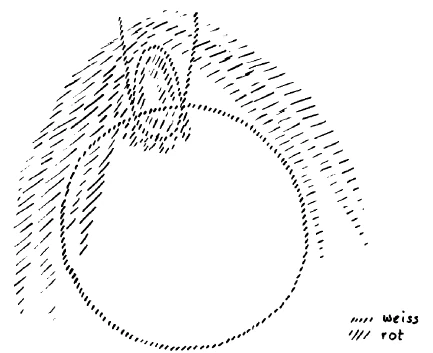
[ 10 ] We move through the world in such a way that we can schematically depict our path through the world (see illustration on p. 229). We walk across the earth, carrying within us these shadowy memories. If we were to imagine a human being and these shadowy memories within him, we would have to picture them as a small cloud in the region of his head—where the head gradually merges into the body—which becomes increasingly shadowy as it approaches the body. As a person walks through the world in this way, they are surrounded as if by an ethereal mist in which all experiences are inscribed, but also everything that is inscribed within them from their previous earthly life. We have an inner memory, and we have the memory of the world outside of us. Every human being is surrounded by this aura. Not only is the present earthly life engraved within us as a memory, but the earthly lives of human beings are also engraved around us. It is not always easy to decipher this memory, but it is there. The deciphering is difficult, and the cases in which I have spoken to you of such deciphering in recent days were not easy to bring to light. But everything is there. A person does not only have a memory within themselves; a person has an auric memory surrounding them. It is not possible to access this memory in a single moment—when one approaches what one has experienced in earthly life. This “memory” always takes days. The process of waking and falling asleep, as I have described it, must play a part. One can never simply say that a certain experience is there and that one should recall how it took shape from previous earthly lives. One must contemplate this experience clearly and imaginatively, with the inspiration that permeates it; then one must wait until it reveals itself. In one’s exploration of the spiritual world, one must never speculate, never invent anything, but only make the necessary preparations so that something from the spiritual world can reveal itself. Anyone who believes they can force the spiritual world to reveal this or that to them is greatly mistaken; they will only receive errors from it. One must prepare for what one can hope to have revealed, more or less graciously, from the spiritual world.
[ 11 ] You see, this is the path of knowledge that, through the science of initiation, can reveal karma. Through it, it is revealed that every human being carries karma around them like a kind of aura. But one can gain a sense of what a person carries within themselves through this path of gratitude in life, as I have described it. One can gain this sense of being enveloped in such a karmic-auric mantle. However, this will not happen over the course of a few days, as with initiatory knowledge, but will arise gradually through a more intimate self-observation—often in connection with events from the distant past to which we are currently turning our attention. But when a certain event from the past of our earthly life is ripe for us to assess it in such a way that we see the preparatory forces of earlier earthly lives at work within it, then we already gain a sense of it. Unfortunately, however, what delves so deeply into a person’s own soul that it leads to this understanding of one’s own experience—an understanding one can approach only through this feeling of gratitude—is quite rare in people’s spiritual lives today. People today take life far too superficially. They rush through life, failing to pause and truly feel the individual experiences. It is certainly true that if one has grown up with a certain sense of the cosmic significance of human life, it might sometimes seem quite strange in our time how little people actually are what they imagine themselves to be, and how strongly they are often simply swept along by life without being anything of individual significance within it.
[ 12 ] I’d also like to refer to specific individual cases here. You see, there was one history teacher in my life who really stood out—a history teacher who was a very intelligent man, who also gave his students the impression of being a very intelligent man, and who, one could say, when he wanted to, with a certain inner enthusiasm that he infused into the intonation of his speech as he presented history to his students—so that, when the right moment came, enthusiasm for this history teacher could indeed develop. There was something remarkable about this history teacher. I saw how he was indeed able to inspire enthusiasm among his students at first. Then life in the place where he was took hold of him; he became careless; he no longer mustered the enthusiasm he had once put into his lectures. He read aloud from books he believed the students did not know and would not have access to. Then one of the students once followed up on this and looked up which book the passage he had read aloud was from. All the students bought it, memorized everything, and became “excellent students.” He eventually became so superficial that he was no longer even present in what he was presenting to his students in class. After a relatively short time, this transformation had taken place, and one could not help but wonder how detached he had become, considering that only a short time before he had still inspired such enthusiasm. A few more years passed, and the same history teacher—about whom I had heard a number of students say, with the genuine enthusiasm of youth: “Now there’s a man who’s passionate about history—you can really learn something from him!”—ended up, quite strangely, mired in the most trivial of lives. Within a few years, he had become so deeply mired in the trivialities of life that he had to live outside the city where he taught, because he had so little standing that he simply could not live in the city.
[ 13 ] Such a twist of fate seems like a great mystery, and it is precisely at such turning points that one begins—if one understands life deeply enough—to ask karmic questions. For many other people—how shall I put it—simply muddle along, remaining as they are, without undergoing such radical changes. If one lives within true spiritual insight, then destinies such as the one I am describing to you become major problems. On the one hand, spiritual insight leads us to the great problems that Woodrow Wilson showed us yesterday at the end of a series of incarnations; but on the other hand, in the life that immediately surrounds us, we are led in our thinking to the great questions of human destiny. If one looks at such things with a completely open mind, one soon realizes: this cannot possibly stem from the life one is currently living! And there will be numerous other cases in a single earthly life that do not undergo such a twist of fate; in such cases, one must intervene with one’s whole being in the longing to understand these questions of destiny. And then, alongside such cases, others arise. I would like to cite one more example. It was precisely these examples that always seemed to me—in order to give my view of karma the necessary color—to have been placed in my path by my own karma.
[ 14 ] I personally met another figure, also a teacher. He was actually revered even more than the other one I mentioned; he was held in extraordinary esteem by his students. The students had this idea: He is the greatest sage currently living in the world. — That is the impression this person made on his students—not on all of them, for example not on me personally, but that is a private matter, it is not representative—but on numerous students. Now, something highly peculiar occurred. While one might have expected, given the nature of this gentleman’s relationship with his students—he had, after all, thrown himself into it with all his enthusiasm, with every fiber of his soul, so that teaching seemed to satisfy him— one suddenly discovered that he was extraordinarily glad to no longer have to teach, because he had been appointed principal of a school far inferior to the one where he had previously taught. He was glad to be able to carry out the duties of a principal, which were, after all, much more trivial than the actual teaching. And the most striking, the most astonishing thing was that this very same man, who could speak enthusiastically about Homer and Aeschylus, who explained geography to his students in a marvelous way—that this very same man ended up in trivial party politics. Downright incomprehensible!
[ 15 ] I am citing this example merely as an illustration, for I could add quite a few more to the two I have already mentioned. These would be figures from the broader contemporary scene who give one the distinct impression that life has had little hold on their sense of self. They stand out as individuals who have been little affected by life on a personal level; rather, life has touched them from the outside. If life touches them once—when they are still close to their seminar exam or their university education, where they listened with enthusiasm—then they are fully immersed in it with enthusiasm. If life touches them more through trivial matters, then they find themselves drawn into the trivial, and they are content with that as well; nothing touches their soul very deeply. If it were a matter of cleverness or intellectual understanding—well, how many people would be anthroposophists today! For millions upon millions of people today are clever enough for anthroposophy. What prevents people in our time from even approaching anthroposophy is precisely this: taking life superficially with one’s soul, failing to connect with life through one’s soul at all, letting life flow past in its depths, on its surface, and in its banalities. One goes from one phase of life to the next, might be a small-time school reformer for a while, then spend the whole day sitting in a coffeehouse playing billiards, without taking a single break all day long. Such things do indeed happen in our lives.
[ 16 ] You see, this raises the big question: How did this come about? — For many souls, it becomes clear just how remarkable the way this came about is. A whole number of such personalities, as I have described in the two examples, lead one back to the early Christian centuries, when these personalities lived their formative earlier earthly lives—to those Christian centuries when Christianity had taken on, in the south and to some extent already in central Europe, the form that it later largely retained for humanity; where that mystery wisdom had faded—the wisdom from which, as I have shown in my book Christianity as a Mystical Fact, Christianity grew forth: the cosmic experience of Christ, the knowledge that Christ had gone forth from the Sun—which is a spiritual entity in the cosmos—and had come to Earth to be for the Earth what it has become. This knowledge, which expands from the Earth into cosmic spirituality, was present among the leading Christian figures of the first century and faded away in the fourth, fifth, sixth, and seventh centuries A.D. It then faded to such an extent that we have reached the point we are at today—though it had already begun back then—that the greatest criticism leveled against the anthroposophical conception of Christ is that anthroposophy conceives of Christ as a cosmic being, as a solar being. You see this everywhere among its opponents: it is considered the greatest sin of anthroposophy that it conceives of Christ in cosmological terms. People say: This is a rehash of what once existed as Gnostic Christianity. — Well, people don’t actually know what Gnostic Christianity is at all. For apart from a few texts—from which little can be gleaned, such as the Pistis Sophia—Gnosticism has become known to posterity only through the writings of its opponents. Gnosticism is not really known. We know of it only through the writings of its opponents. Think about this question for a moment: If nothing were to remain known of anthroposophy except the writings of my current opponents—if everything were destroyed except the writings of my opponents—how would anthroposophy be portrayed to posterity? — That is what some people and some critics are striving for: to treat the anthroposophical books—which are, after all, numerous—in the same way as the Gnostic writings. Then only the writings of the opponents would remain; they would be the first thing people would look at: nothing but books by opponents! That would be highly interesting. With regard to Gnosticism, people could obtain nothing else for external research but the books written by opponents. Thus, the statement “Ancient Gnosticism is being revived” is sheer nonsense; for no one can do so who does not know Gnosticism itself from its own writings—and these have been lost! One cannot come to know it from writings that are mostly authored by opponents; but nothing else has survived for posterity. Still, even this shows that it is considered the greatest sin to associate Christ with the spirit of the cosmos. In a true understanding of the Gospels, every page, every sentence of the Gospels must point to the cosmic aspect of Christ. But this has gradually been eradicated. And during the period when this aspect was most thoroughly eradicated, it was mostly those people who were incarnated who, if they were to return today, would be unable to find their place in life—because in their previous incarnation, though they were already wise and intelligent, they could not possibly have known, given the limitations of their time, anything about the connection between the Earth and spiritual life in the cosmos. Because they stumbled through life, as it were, as if the Earth were entirely self-contained and there were nothing out there to see but physical stars, they turn—as it were, stumbling—toward the real life that acts upon them upon their reincarnation.
[ 17 ] This is how one gains insight into human destiny. One comes to understand how the development of the times has influenced a very large number of people in such a way that it has made them superficial, and they already appear in this life with a predisposition toward superficiality, as I have described to you. For this is how you experience these people, who once, in a previous incarnation, lost their connection with the spiritual powers in the cosmos: in the next incarnation—which was shaped by that previous one—they cannot find a connection with earthly life. But all cosmic thoughts should not merely bring contemplation into our lives, but will and action. And so we must consider: What will the future hold if, in addition to failing to grasp the spirit in the cosmos, we also fail to grasp earthly life—moving through trivialities in the same way as through the depths of life? — That is when the contemplation of karma becomes truly serious. It can only live among us in the most serious way. Today I wanted to offer a contemplation of karma from a more emotional perspective.