Initiate Consciousness
True and False Paths of Spiritual Research
GA 243
16 August 1924, Torquay
Translated by Steiner Online Library
6. Insights from Initiation
Waking and Dream Consciousness
[ 1 ] I have spoken to you about the various states of consciousness that can be developed from the powers of the human soul. And what is called initiatory knowledge depends on the fact that insights into the world are created through these various states of consciousness.
[ 2 ] Today, let us try to gain an understanding of how human beings can connect with the world through these various states of consciousness. Let us first imagine once again that, for modern civilization—for everything that humanity today recognizes as reality and existence—there is actually only one state of consciousness: that of waking daily life. Apart from this waking daytime life, we can say that there are, in fact, two other states of consciousness available to human beings today in our world cycle. However, these cannot initially be regarded as directly relevant to any kind of insight. There is the state of dream consciousness, in which human beings today experience only reminiscences of daytime life or small glimpses from the spiritual world. But in ordinary dream life, both the reminiscences of waking life and the insights—the revelations from the spiritual world—are so distorted, so immersed in individual, disparate images and symbols, that no insight can be gained from them.
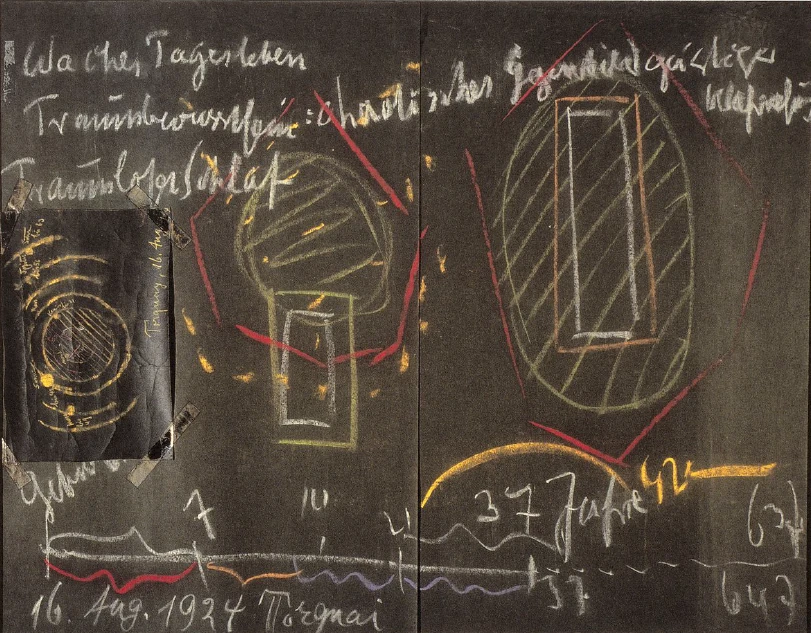
[ 3 ] If we wish to answer the question—with the help of the science of initiation—“Where, exactly, does a human being live when he dreams?”—the answer takes the following form: Human beings, as they exist in ordinary life, possess, first of all, their physical body—the one that the senses perceive today, the one studied by the sciences of anatomy, physiology, and biology (see illustration, light-colored). — This is the first aspect of human nature that everyone believes they know, but—as we shall yet see—is actually the one they know the least about today.
[ 4 ] As the second component of human nature—you can read about this in more detail in my books, particularly in Theosophy—as the second component, human beings possess the etheric body, the body of formative forces, a subtle organization that cannot be seen with the eyes, one that can only be perceived once a person develops the first stage of consciousness I have been speaking about these past few days—a consciousness that can follow the deceased into the years immediately following death. This etheric body or body of formative forces (orange) stands in a much more intimate connection with the cosmos than the physical body, which is more independent in its entire organization.
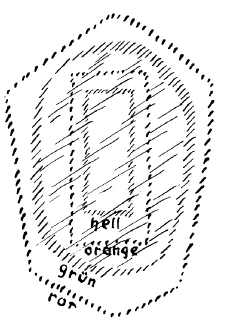
[ 5 ] But then the human being has a third component in his constitution, which one can, of course, call whatever one likes; but following old terminology, we call it the astral body (green). This is an organization that cannot be perceived by the senses, nor can it be perceived in the same way as the etheric body is perceived. When one perceives nature as it appears externally nature as we see it today, nor with the powers of perception I have described as belonging to the next higher level of consciousness—the one with which we follow the dead—if one were to attempt to perceive the astral body with all of these, one would perceive nothing but emptiness, nothingness, where the human astral body is.
[ 6 ] So one can say [turning to the blackboard]: The human being carries within himself his physical body; it is perceptible through the senses. The human being carries within himself his etheric body (orange); it is perceptible through the imagination; it is perceptible through the powers we can acquire in the manner described—through meditation and concentration. But when we approach a human being with all these powers, we perceive only emptiness in their astral body—a spatial nothingness, like a hole, a hole closed on all sides, set within space (green). Only then, when one reaches—as I have described—the empty, waking consciousness, that is, when one can face the world in a state of complete wakefulness in such a way that one perceives nothing of the sensory realm, that even thinking and memories are silent, yet one still perceives a world—only then does this emptiness fill, and we know we have within this emptiness the first spiritual element within us, the human astral body.
[ 7 ] Another component of the human organism is the true “I” (red). We perceive this “I” only when empty consciousness is developed further and further. Now, in the case of the dreamer, the physical body and the etheric or form-body lie in bed, separate from the dreamer; separate from these, in the spiritual world, are the astral body and the “I.” But we cannot perceive with the astral body or with the “I” when we possess only ordinary consciousness. How, then, do we perceive external impressions in the ordinary world that we experience between birth and death? By having eyes embedded in the physical body, and by having ears embedded in the physical body. As human beings stand today in the evolution of the world, they have no corresponding organs—no eyes, no ears—embedded in the astral body or in the “I” in ordinary life. He therefore steps out of his physical and etheric bodies to dream, just as if, in the physical body and in the physical world, he had no eyes or ears at all—so that it would be dark and silent around him. But it is not the case that this astral body and this “I” must always remain without organs—without, of course, eyes and ears in the soul-sense. It is precisely through that training of the soul, which I have discussed in my books, that organs—soul eyes, soul ears, and so on—can enter the astral body and the “I” organization. Then, through training and exercises, a person can achieve this. Then the possibility arises for them to look into the spiritual world through initiatory vision. Then they step out of their physical and etheric bodies and perceive the spiritual, just as they perceive the physical—and, in a certain sense, the etheric—within their physical and etheric bodies. This occurs in those who have undergone initiation.
[ 8 ] What about the ordinary dreamer? Well, try to vividly imagine what happens when you fall asleep. The physical body (see drawing, light-colored) and the etheric body (orange) remain in bed. The astral body (green) and the “I”-organization (red) step out. Of course, I have to draw this schematically. Now, at the very moment this takes place, there is still a complete resonance between the astral body and the physical body and the etheric body. You see, the astral body steps out. It has participated in everything that the eyes, ears, and the will have carried out in terms of inner activity—through movement in the physical body and the etheric body—from morning until evening. The astral body and the “I” have participated in all of this. Now they step out. Everything is still reverberating; it’s all still inside. But as the day’s experiences continue to reverberate here (see drawing $117: dots are plotted), they inevitably come into contact with the spiritual world that surrounds them—everywhere—and a chaotic, disordered interplay arises between the activity of the outer spiritual world and what is still reverberating within the astral body: a disordered chaos. This is a tautology; in other words, chaos arises. And the human being is still immersed in all that is arising and becomes aware of it. What he has brought with him makes an impression on him. It reverberates. It becomes a dream. But you surely realize that this has little to do with reality.
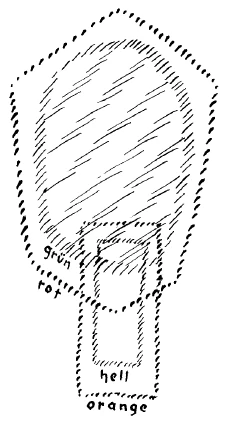
[ 9 ] What about the initiate? When the initiate emerges from there (pointing to the drawing), he is able to immediately suppress all the residual sensations and aftereffects from the physical body and the etheric body. So he suppresses whatever emanates from the physical and etheric bodies. Furthermore, through meditation, concentration, and the development of empty consciousness, he has the ability to possess the eyes and ears of the soul. He no longer perceives what is happening within himself, but rather what is happening externally in the spiritual world. Perceptions of the spiritual world take the place of dreams. Thus we can say: Dream consciousness is a chaotic counterimage of spiritual perceptions.
[ 10 ] Now, in the case of the initiate, once he has developed these inner astral organs—astral sight and astral hearing—on the first steps of the path, he then finds himself constantly engaged in a kind of struggle, a struggle that consists precisely in suppressing these reminiscences, these lingering tremors from the physical and etheric bodies. One must constantly fight against this—when entering the world of imagination, the contemplation of the spiritual—so that dreams do not assert themselves. There is a constant interplay between what seeks to become a dream, what seeks to deceive one, and that which represents the truth of the spiritual world.
[ 11 ] Every initiate eventually comes to know this struggle. They come to realize that, at the very moment they seek to enter the spiritual world with full awareness, the afterimages of the physical world appear again and again—as if something were rising up to stand, like disturbing images, before the pure images of the spiritual world. And only patience and perseverance can overcome what manifests there as a powerful inner struggle. If one is carelessly content with having one’s consciousness filled with mental images, then one can very easily drift into an illusory world instead of entering the world of spiritual reality. For those who are truly to be initiated, an extraordinarily strong and rational inner attitude is necessary. Just consider what all this requires. But if we are to speak of the paths into the spiritual world and of spiritual research, attention must certainly be drawn to such matters.
[ 12 ] On the one hand, if one wants to approach the spiritual world at all, it is necessary to be able to feel genuine enthusiasm and excitement about entering the spiritual world. Inner listlessness, inner indifference, and inner sluggishness prevent one from doing so. And so, on the one hand, it is necessary to have inner agility—true inner agility—and inner activity. On the other hand, this can lead one to drift into fantasy, to imagine all sorts of things. Thus, on the one hand, one must possess the predisposition that could carry one to the highest heights of imagination if one were to let oneself go; on the other hand, one must combine this with a sober sense of what constitutes inner activity and inner agility.
[ 13 ] As an initiate, one must possess both. If one simply lets oneself go, that is not good. If, in a philistine manner, one relies solely on one’s intellect and tries to figure everything out, that is not good either. One must be able to weave both together harmoniously. One must, so to speak, have the potential on the one hand to become a true dreamer, and at the same time always retain the possibility of not becoming one. In the status nascendi, one must always have the potential within one’s soul to rise to all manner of fluid, imaginative states. Yet whenever this state arises, one must also have the ability to maintain complete control over one’s inner attitude. One must possess both the capacity to be an imaginative poet and the capacity to resist yielding to that impulse. One must, so to speak, at every moment when one wishes to recognize something, also have the possibility of creating a drama, a lyric poem, or anything else imaginable. But one must be able to put a stop to this drift into the imagination and hold fast to those forces that otherwise have their significance only in the most sober of lives. Then one does not enter into the imagination, but into spiritual reality.
[ 14 ] This inner state of mind is of immense importance for true spiritual vision. Therefore, it is indeed the case that, while on the one hand one directs an understanding gaze toward dream consciousness and understands it as that which brings up chaotic images from the spiritual world, on the other hand one knows that the entire power of the personality must now be directed into that power of the soul which otherwise only dreams, in order to attain spiritual knowledge. Only then does one begin to grasp what it means to enter the spiritual world. I say that the dream consciousness brings the spiritual up. This might seem to contradict the fact that dream consciousness also brings up images from physical life. But the body is not merely physical; the body is permeated everywhere by spirituality. And if someone dreams that a wonderfully fragrant meal, promising a delicious taste, is set before them, and they just go ahead—in the dream, I mean— to eat this meal—even though they don’t have even a tenth of the money in their pocket that this meal would cost—then what happens is that, in the symbol of the meal, the actual spiritual-astral contents of the digestive organs are nevertheless presented to them in the image. After all, in a dream it is always the spirit, even if it is the spirit that resides within the physical body. The dream always brings forth the spiritual, but very often it is the spiritual that resides within the physical. One must recognize this.
[ 15 ] When one dreams of snakes, one must recognize that they symbolize the digestive organs in their coils, or that they symbolize the blood vessels inside the head. One must penetrate these mysteries. Thus, one can only gain an understanding of this subtle, intimate reality that must take root in the soul by engaging in spiritual research through the science of initiation, and by truly taking all of this into account in the most intimate sense.
[ 16 ] The Stages of Life as Organs of Perception
[ 17 ] The third state that a person experiences today in ordinary life is the state of dreamless sleep. Let us once again consider what a person is like during dreamless sleep. The physical body and the etheric body lie in bed. Outside the physical body and the etheric body are the astral body and the “I” organization—the “I.” The after-tremors, the reminiscences from the physical and etheric bodies, have ceased. The human being exists solely in the spiritual world within their I and their astral body. But they have no senses. They cannot perceive anything. All around them is darkness. They are asleep. This is the state of sleep: living in the I and the astral body without being able to perceive the rich, powerful world that surrounds them. Imagine a blind person. All the colors and all the shapes that you perceive around you through your eyes do not exist for him. He is asleep to colors and shapes. One cannot sleep in general; one can only sleep to something.
[ 18 ] And now imagine a person who is present in his astral body and in his “I,” but who has no organs at all. He is asleep to everything spiritual. This is the state of a person in dreamless sleep consciousness. The purpose of meditation and concentration is to place spiritual eyes and ears within this astral body and within this “I”-structure, and the person begins to see and perceive what is present there in abundance. They perceive spiritually. It is precisely through this that one spiritually perceives what the world sleeps through in ordinary consciousness. One must awaken this inwardly through meditation and concentration. What is unorganized—what one otherwise carries within—must be organized. Then one looks into the spiritual world. And then one is as fully immersed in this spiritual world as one is otherwise immersed in the physical world through one’s eyes and ears. And that is precisely the true, real knowledge of initiation. One cannot make a person capable of perceiving the spiritual through external measures. One can only make them capable by having them truly organize their inner self, which is otherwise disorganized.
[ 19 ] However, throughout the course of human development, there has always been an effort to lead certain individuals toward initiation. This effort suffered only a temporary interruption during the highly materialistic period from the 15th century to the present day. During that time, people had, so to speak, forgotten what true initiation really is and sought to attain everything they wanted to know without undergoing initiation, thereby gradually coming to believe that only the physical world was of any concern to them.
[ 20 ] But what is this physical world, really? One cannot truly come to know it if one knows it only as a physical world. One can only truly come to know it if one can also perceive its spirit—which it always carries within itself—with true insight. Humanity must return to this. This is the meaning of the great turning point in our time: that the world presents us with the image of destruction, and of descent into chaos; yet for those who are discerning, within this descent into chaos, within this terrible raging of human passions that obscure everything and ultimately seek to plunge everything into decadence—within all of this is revealed the impulse of spiritual powers standing behind it, striving to lead humanity into a new spirituality. And listening to this voice of the spirit, which resounds within our materialistic existence, is in fact the predisposition for anthroposophical spiritual science.
[ 21 ] I said that throughout history there has always been a striving to develop the human organism in such a way that it can look into the spiritual world. But conditions were different then. If we go back to the very early stages of human development—indeed, even to times such as those I have described to you in recent days as the Chaldean era, and to a certain extent even to the era to which Brunetto Latini belonged—we find that people were not as bound to their physical and etheric bodies as they are today. Today, people are thoroughly entrenched in their physical and etheric bodies. They must be, because that is how they are raised. After all, how are people supposed to commune with spirits when they often have to learn to read and write even before their baby teeth fall out! Reading and writing—which were only invented in the course of human evolution out of physical necessity—are things that angels cannot do, nor can spirits. And when one organizes one’s entire human being around what has been invented solely in the physical world, then one naturally finds it difficult to break free from the physical and etheric bodies.
[ 22 ] In a certain sense, our age takes pride in organizing all of culture in such a way that a person absolutely cannot experience anything at all if they separate from their physical and etheric bodies. I do not wish to rail against this culture. I do not wish to criticize it. It must be as it is. It was bound to emerge. I will also speak later about what this means, but that is simply how it is. In ancient times, even while awake during the day, the astral body and the “I” were much, much more independent of the physical and etheric bodies than they are today. However, the initiates were also dependent on possessing such independence by nature. However, in the very early stages of human development, almost anyone could be initiated into the Mysteries. One could select anyone from among humanity. But that was only in very ancient times, in the very earliest periods, such as those of the ancient Indian and ancient Persian cultures.
[ 23 ] Then came a time when it was necessary to select for initiation those individuals who could easily step out of their physical and etheric bodies—those who possessed a relatively high degree of independence for the “I” and for the astral body. One was therefore dependent on certain conditions. This did not prevent one from striving with each individual to bring them as far as possible in the initiation. This was indeed done. But success beyond a certain point often depended on whether the person in question possessed a greater or lesser degree of independence in their “I” and astral body. One was nevertheless dependent on the natural aspects of the human being, on one’s innate disposition. This is because human beings are, after all, placed in the world. Thus, they must also be dependent on the world in a certain way as long as they live between birth and death.
[ 24 ] Now you might ask whether human beings today are still subject to such dependencies when it comes to initiation. In a certain sense, they are. And because I wish to speak very clearly and exhaustively in these lectures about the paths—both right and wrong—into the spiritual world, I would also like to present to you the dependencies that exist today with regard to initiation. Let us bring all of this clearly before our souls.
[ 25 ] You see, the people of old were more dependent on their natural dispositions when they became initiates. People today can, in fact, always be brought to the point of initiation, and it is certainly true that, through appropriate training of the soul, one can shape the astral body and the “I” organization in such a way that they can look into the spiritual world and have spiritual perceptions. But with regard to the completeness and perfection of these perceptions, one is still dependent on something even today. Something very subtle and intimate comes into play here, and I ask you not to form a definitive judgment right away about what I am going to say today before you have heard the content of the next lectures. I can only describe what I have to say bit by bit.
[ 26 ] Today, initiation depends to a certain extent on one’s age. Let’s say, for the sake of argument, that you have reached the age of 37 by the time initiation comes your way. You have thus lived your life from birth up to the age of 37 and intend to continue living beyond that point. Now, usually under guidance or through self-study using written instructions, one applies the rules of meditation, concentration, or other forms of spiritual training to oneself. And by immersing oneself meditatively in a thought content over and over again, one first gains the ability to look back, initially on one’s earthly life. One’s earthly life is presented to the soul as if in a unified tableau.
[ 27 ] So you’ve turned 37. $o Just as you normally look around a room and see the people in the first and second rows, the table over there, and the wall in the back—and just as, when looking into the perspective, the whole scene is present at once—so, at a certain stage of initiation, you look into time. It is as if the passage of time were spatial. You look into it in this way. You see: Now you have turned 37; this is what you experienced at 36, at 35; and it continues all the way back to your birth. Now you look into it and have it all before you in a unified tableau. But suppose, for a moment, that you actually were to look back in this way at a certain stage of initiation. Then, when you have turned 37, you will be able to look back on the time you lived from your birth until about the age of 7, until your teeth began to fall out. It is far away. You look back there. One will then be able to look back on the time one lived from age 7 to 14, up to puberty. One can then look back on the period one lived through from age 14 to 21, and observe the events there. Then one can look back on the rest of one’s life, lived up to the age of 37.
[ 28 ] One can now see through this, I would say, from a spatiotemporal perspective. If one now adds to this insight into this time-space perspective the consciousness that arises from empty consciousness—from the waking state of empty consciousness—then a certain power of seeing flashes through one. One becomes inspired. But you see, one is now inspired in the most diverse ways. One realizes: What one has lived through between birth and the age of 7 inspires one differently; it conjures something different before one’s soul than what one experienced from the ages of 7 to 14, and again, what one experienced from the ages of 14 to 21, and again, what came later. Each of these stages of life imparts a different power. One can gain insight into different things.
[ 29 ] But of course, one can live past the age of 37. One can, let’s say, live to be 63 or 64 years old. Then one also looks back on the later stages of life. From that perspective, the period between the ages of 21 and 42 seems quite uniform. But then the picture breaks down again. You see distinct differences in what you perceive from age 42 to 49; in what you perceive from age 49 to 56; and again in what you perceive from age 56 to 63. There you look back on clear distinctions. But that is who you are; you are that spiritually in your earthly life. And if you are inspired by all of this, then everything you carry within you provides you with different kinds of inspiration. You carry your childhood up to age 7 within you; that gives you a different inspiration than the childhood you carry within you from ages 7 to 14, and than the childhood from ages 14 to 21. But one must not say that; what one carries within oneself during one’s youth—from age 14 to 21—provides a different kind of inspiration. Then a quite different inspiration emerges from what one carries within oneself between the ages of 21 and 42, and then, in turn, come the quite distinct forces that stem from the later stages of life.
[ 30 ] So suppose one has acquired the ability to look into one’s own experiences in a pictorial way, and has also attained the inspiration of empty consciousness, so that one has once again erased the [imaginative] consciousness and its forces, so that one no longer looks at the eyes, but looks through them. Suppose one has come this far—that is, through inspiration has come so far that one no longer sees one’s life stages with their facts, but rather sees and hears through these life stages; at one time through the life stage between the ages of 7 and 14, at another time through the life stage between the ages of 49 and 56, just as one at one time hears the world and at another time sees it. In one instance, one makes use of the eyes; in another, one makes use of the ears. In the inspired world, one draws upon what gives one strength from the 7th to the 14th year of life, or upon what gives one strength from the 42nd to the 49th year of life. There, the stages of life have become differentiated organs of perception. — So, in a certain sense, one is indeed dependent on one’s age today. One can speak quite well from the perspective of initiation at age 37, but one speaks differently from that same perspective at age 63, because by then one has developed different faculties. The stages of life are organs. — And suppose one wants to describe, not from books but from inspired insight, figures such as Brunetto Latini or Alanus ab Insulis—I’ll choose obvious examples, since these tasks have occupied us in recent days—suppose I want to describe them. If one tries to describe them at the age of 37, one has come to know the following about them: They stand there in the spiritual world. They stand there in the animated sleep-consciousness. One can speak with them—well, of course, with a grain of salt—just as one speaks with physical human beings. — That is certainly true, but the peculiar thing is that they can only make clear to you—when they communicate with you in the language of spiritual life—what they have attained at this very moment in terms of wisdom and inner spirituality. And then one comes to realize that one can learn a great deal from them. But one must then accept it from these spirits on good faith. One must hear it from them.
[ 31 ] Well, my esteemed audience, people do believe in it, for after all, it is no small matter, shall we say, to come face to face with a Brunetto Latini in the spiritual world. Once the necessary preparations have been made, one is then able to distinguish whether one is facing a delusional figment of the imagination or a spiritual reality. It is therefore possible, so to speak, to give some credence to what comes to one through these communications.
[ 32 ] But suppose one were to speak with Brunetto Latini in the spiritual world—if I may once again put it cum grano salis. You don’t have to imagine it as if we were having a conversation there in the hall, but one could certainly call it that. So suppose you were to speak with Brunetto Latini like that at the age of 37. He would tell you all sorts of things. But then you’d feel the urge to know certain things more precisely, to know them more accurately. And lo and behold, he says to you: “Yes, I’d have to go back with you—we’re in the 20th century now—I’d have to go back with you through the 19th and 18th centuries all the way to my own century. We’d have to retrace our steps. We’d have to stand where I stood when I was Dante’s teacher.” — Yes, then he tells you: “You’ll have to grow a little older if you want to travel this path with me; you’ll have to go a little beyond your current age. I can tell you everything. You can know everything. You can become a deeply initiated person, but you cannot come with me. You cannot truly retrace the path in reality through your spiritual will.”
[ 33 ] You see, one must have grown older. Above all, one must have passed the age of 42—in fact, one must have reached the age of 60—if one wishes to return to the spiritual world with the person in question without any hindrance.
[ 34 ] These are the things that show you what the human being is really like in a deeper sense, and what significance it has when a person grows old or when they are young. Only when one finally turns one’s attention to such things can one also understand—and I will have more to say about this—why some people die young, while others grow older in this or that earthly life, and so on.
[ 35 ] The nested celestial spheres
[ 36 ] We have seen how human spiritual life can expand into the perception of the spiritual world in line with human development. I have explained how, for example, one’s interaction with a being such as Brunetto Latini—who exists in the spiritual world as a disembodied human soul—changes; how this interaction varies depending on the initiate’s circumstances, whether one perceives with the faculties available in youth or with those available in old age. What can present itself to the soul in this way—as the human being’s outlook on the earthly world and its evolution—can be supplemented by raising the following question: In what other direction does human insight, human consciousness, expand? And I would like to hint at such a different direction for you today, so that I may elaborate on it further in the coming days.
[ 37 ] When we are in the ordinary consciousness of earthly life, between birth and death, we are surrounded by the earthly environment. We would no longer be surrounded by the mere earthly environment if the dream were not chaotic, if we were to perceive—in deep, dreamless sleep—what ordinary consciousness perceives. There, one experiences different states of perception or consciousness, not merely the ordinary ones. But one can visualize the following: Ordinary consciousness is surrounded by the earthly world. I would therefore like to indicate what constitutes the immediate surroundings of the Earth—since one cannot see into the Earth’s interior—as shown in Figure $130 (green). So this is what one initially has before oneself in ordinary consciousness. Everything else in the universe—the Sun, the Moon, and the other stars—shines into this sphere. One perceives, so to speak, their cosmic impressions more strongly in the case of the Sun and Moon, and more weakly in the case of the other stars. They cast these impressions into this physical world. And physicists would indeed be quite astonished if they could discover—in their own way, since they do not want to do it our way—what it really looks like where the Moon is, or where the Sun is. For it does not look at all like what is described in the textbooks of astronomy, astrophysics, and the like! What one sees are merely hints. And in everyday life, too, one generally doesn’t do it that way when a person you want to get to know is standing right in front of you and you can talk to them—saying: “What I’m learning about this person is imprecise; they have to go quite far away so that I can barely see them, then I’ll get to know them much more precisely; I’ll describe them then.”
[ 38 ] Certainly, it is brought about by cosmic necessity, but physicists can only describe the stars when they are quite far away. But expanded consciousness, transformed consciousness, transports one right into the starry worlds themselves. And the first thing one learns in doing so is actually to speak about these starry worlds in a completely different way than one speaks about them in ordinary life. In ordinary life, one says: I am standing here. When it is night, I see the moon over there. — That is, of course, correct. You have to slip into a different state of consciousness first if you’re going to say something different. That often takes a long time. But then, when you slip into a different state of consciousness and can do something like this: look back at what one has experienced with the first state of consciousness—the one that can follow the dead—look back at what one has experienced from birth to the age of seven, up to the time of the first set of teeth, which has then become part of one’s inspiration, so that it has become an inner power of perception—then one sees a different world around oneself. The ordinary world fades, becomes indistinct; one sees another world all around oneself.
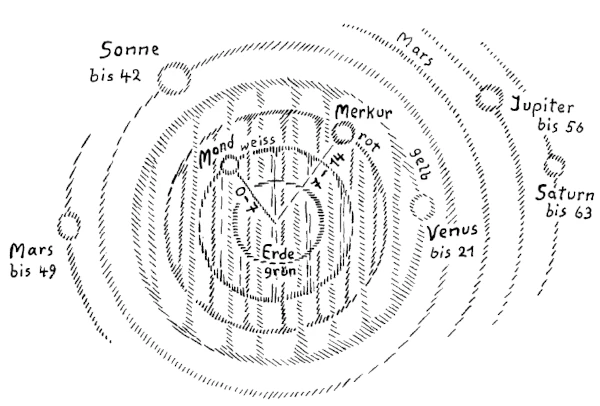
[ 39 ] This other world is what one might call the lunar sphere (drawing, white). But when one enters into this experience, one does not say, “Here I stand, and there, in turn, is the Moon”—rather, one says, “I am inside the Moon.” — And the moon is everything that lies within this circle it describes, or rather, within this sphere. What is known as the moon’s orbit is merely the outermost boundary of the moon. One experiences being right inside the moon. You see, even an 8-year-old child could be inside the moon like this if it were to look back on its first seven years of life—if it could be initiated. It would actually find it easiest to look into this lunar sphere, because it would not yet be misled by the life that follows. Of course, one cannot yet initiate a child at age 8; but theoretically, it is entirely possible.
[ 40 ] So this is how one looks into this lunar sphere when one looks with the power imparted by the first seven years of life. There, things are completely, completely different from how they are described by ordinary consciousness. I’d like to clarify this for you with a comparison. You see, when a biologist today studies the embryo during its development from the earliest stages onward, he studies the embryo at a certain stage. And at an eccentric location—that is, here on the outside—there is a thickening of the material substance. There is an inclusion. There one sees a kind of nucleus. But one cannot and must not say—even though one sees this quite clearly through the microscope—one must not say: “This is merely the germ, merely the embryo”—but rather, the other part is also part of it. And so it is, you see, with the Moon and also with the other stars. What one sees there as the Moon is merely a kind of core, and the whole of this area (hatched in white) belongs to the Moon. And the Earth is inside the Moon. And if the germ could rotate, then this core would also rotate here. The Moon rotates. The entire little body rotates. That is why the Moon rotates here.
[ 41 ] The ancients, who still knew something of these things, therefore did not speak of the Moon, but of the lunar sphere, and they saw in what we today call the Moon merely a point on the outermost boundary. One sees this point in a different place every day. Over the course of 28 days, one sees the entire boundary of the lunar sphere. The power to look into what remains as the lunar sphere when the Earth fades—this power is attained when a person’s inner experiences between birth and the age of seven become a source of inspiration. And when the experiences of the second phase of life—between the change of teeth and sexual maturity—become a source of inspiration, then one experiences the sphere of Mercury (red). Thus, one experiences the second sphere through this. This (white) stems from the power active from the beginning of life through the age of seven; this (red) stems from the power active from the age of seven through the age of fourteen.
[ 42 ] Once again, we find ourselves caught up in Mercury along with the Earth. What constitutes Mercury experiences becomes visible to us only through the eye we can acquire by consciously retreating—contemplatively retreating—into our Earthly experiences between the ages of 7 and 14. And when one then reaches sexual maturity—the period from the ages of 14 to 21—one enters into the sphere of Venus (yellow). The ancients were not so foolish after all; in their dreamlike insight into these matters, they knew a great deal, and they gave the planet into which one immerses oneself upon reaching sexual maturity a name connected to the life of love, for that is what begins during this time.
[ 43 ] Then, when one consciously looks back—with insight—on what one experiences between the ages of 21 and 42, one knows that one is within the solar sphere. Thus, when one transforms the individual stages of life into inner organs, they give one the power to expand one’s consciousness out into the cosmos, expanding it bit by bit. That said, it is not the case that one cannot know anything about the solar sphere before the age of 42. The Mercury beings, however, can tell you about it, for they already know it. So one learns of it indirectly, so to speak, through supersensible instruction. But in order to experience something in one’s own consciousness on the solar sphere—to enter the solar sphere and experience it there as one might take a walk in Torquay—one must not only be living between the ages of 21 and 42, but must also have already passed the age of 42 and be able to look back, for the mysteries are revealed only in retrospect. And again, if one can look back on one’s life up to the age of 49, the mysteries of Mars are revealed. If one can look back on one’s life up to the age of 56, the mysteries of Jupiter are revealed. And the deeply veiled yet immensely enlightening secrets of Saturn—these secrets which, as we shall see in the next lectures, veil, so to speak, the very depths of the cosmos—the secrets of Saturn are revealed when one looks back on what takes place from the age of 56 to 63.
[ 44 ] From this you can see, my esteemed audience, how the human being is truly a small world, a microcosm. He is connected to that which he himself never becomes aware of in ordinary earthly consciousness; but he would not be able to shape and organize his inner life if the lunar forces were not at work within him from birth until the age of seven. How they work during this time becomes apparent later on. He would not be able to bring about within himself what he experiences between the ages of seven and fourteen if the mysteries of Mercury were not alive within him. He would not be able to bring about within himself what he brings about from the ages of 14 to 21—that is, when, for example, the powerful creative artistic forces enter those individuals who are karmically predisposed to them—he would not be able to experience this if he were not inwardly connected to the sphere of Venus:
[ 45 ] And without his connection to the solar sphere, he would not be able to develop a mature, experiential understanding of the world between the ages of 21 and 42—the period when we move beyond our apprenticeship and enter our journey as journeymen. In ancient times, this process was also clearly defined. One was an apprentice until the age of 21, then became a journeyman, and only later a master. So everything that must take place inwardly within a person between the ages of 21 and 42 is connected to what lives in the solar existence, in the solar sphere. Thus, everything that takes place within a person during the waning phase of life, between the ages of 56 and 63, stems from the presence of the Saturn sphere.
[ 46 ] We are embedded within spheres that interlock with the Earth. Seven spheres are interlocked, and we grow into this interlocking structure over the course of our lives, thus becoming connected to it. Our life from birth to death unfolds from the original predisposition, as the celestial spheres, so to speak, draw us from birth to death. When we have reached Saturn, we have undergone everything that the planetary sphere—or rather, the beings of the planetary sphere—can bestow upon us in grace, and then, speaking in an occult sense, we receive the gifted life that moves freely throughout the universe, a life that looks back on planetary life from the initiate’s standpoint, and which, in a certain sense, can be emancipated from what are still necessities in earlier stages of life.
[ 47 ] But I'll talk more about all these things in the coming days.