Initiate Consciousness
True and False Paths of Spiritual Research
GA 243
15 August 1924, Torquay
Translated by Steiner Online Library
5. Revitalizing the Soul from Within Through the Qualities of Metal
Copper Status in Humans
[ 1 ] On the one hand, I have tried to show how human beings arrive at states of consciousness different from those they experience in their ordinary, everyday lives today. And I then tried to show how the historical course of human development demonstrates that humanity has not always lived, in terms of cognition and action, in the same state of consciousness in which it lives today. I then tried to direct your attention to the states of consciousness of the thinkers of the 10th, 11th, 12th centuries in connection with the way knowledge was cultivated at that time—for example, by the School of Chartres—and I pointed out how, in connection with this, insights arose that do not belong to today’s states of consciousness, as seen, for instance, in figures such as Dante’s great teacher, Brunetto Latini. Yesterday I then attempted to cast my gaze further back in time to the particular way in which human beings related to the world, for example, in the Mysteries of Ephesus. There we see how people lived in entirely different states of consciousness, even if these are quite closely related to present-day everyday and scientific consciousness.
[ 2 ] Today I would like to continue the reflection in which historical considerations initially introduced a sort of digression. I have noted how metallicity—the very substance of the mineral realm—relates to the human being and to the states of human consciousness. From the kinship between the human being and what is called the metal copper, I have elucidated that state of consciousness which can be attained as I have described it—a state that then leads to the possibility of following the experiences of the dead, the so-called dead, beyond the moment when they have passed through the gate of death.
[ 3 ] Now we must be clear that through that semi-pathological experience I have hinted at—a sort of sunstroke—Brunetto Latini entered into a state of insight similar to the one I described to you the day before yesterday. And in fact, what he describes—what came to him through the inspiration of the goddess Natura—can indeed be attained in this state of consciousness most closely related to our ordinary state—for it is very similar to our ordinary state of consciousness—which traces the experiences that the dead undergo immediately in the years following their passage through the gate of death. And I said, it is a much more real state. One stands there in a world that exerts a stronger pull, shines more brightly, and accomplishes everything more intensely than our ordinary physical world. It is only because this is so that one can share in what one who has recently passed through the gate of death is experiencing.
[ 4 ] But this world also reveals something quite special. When one finds oneself in this world, which I have described in this way, then, in the very moment one is in this state of consciousness, one cannot look upon one’s ordinary daily experiences—upon what one goes through in ordinary life—but rather one sees of one’s own life only what immediately preceded one’s entry into earthly life, what one experienced while still in the spiritual world before entering earthly life. So one must say: In this state of consciousness, one is not at all in the same world as human beings usually are.
[ 5 ] Imagine this visually. If you were born at this point in time (it is drawn) and continue living: At the moment when you, if I may call it that, enter the “copper state”—you understand this from the lecture the day before yesterday—you are not, for example, at the age of forty, in the present with your awareness. Nor, however, is one’s awareness situated, say, at the age of thirty-five or thirty; rather, one can only go back to what one directly experienced in the spiritual world before one’s birth. One can do this for oneself, one can do this for other people, but one cannot grasp that which one is immersed in during everyday life. But this, again, applies only to human beings.
[ 6 ] In the case of animals, although one does not perceive what they physically are in the physical world in the usual way, one looks up into the next world and perceives what I have called the “genus soul” or “species soul.” In a sense, one sees the aura of the animal genera. But when one looks out into the world, one sees that this world has changed, and one begins to recognize something that is actually quite important for humanity, yet is completely overlooked in the present, materialistically minded age.
[ 7 ] When one approaches, with all that one can learn today—right up to the highest levels of university scholarship across all faculties—that being which still exists as the Goddess Nature, of whom the teachers of the School of Chartres spoke in a living sense, of whom Bernardus Silvestris spoke, Alanus ab Insulis, and others—when one stands before this being, one feels, precisely with one’s present-day knowledge, in a state of profound ignorance. For one says to oneself: According to today’s knowledge and understanding, you actually know only what pertains to the world you experience between birth and death—and what is no longer true the moment you immerse your consciousness in the next spiritual world to such an extent that you can follow the dead even beyond death.
[ 8 ] We study chemistry. But what we learn in chemistry applies only to the world in which we live between birth and death. All of chemistry has no meaning in the world where the dead are pursued after death. Everything one learns here in the physical world has no meaning at all for that world; it is merely a memory once one is in that world. And this world—the one one then finds oneself in—immediately reveals itself, and one feels that the world in which one has learned so much—this everyday world—is fading away. The other world immediately reveals itself.
[ 9 ] Let’s suppose we have a mountain in this world, in which we exist between birth and death. The mountain appears quite close to us in this world. At first, we look at it from a distance. It reflects back to us the light that the sun casts upon it. We see it in its shapes, in its contours. We walk toward it. We get closer and closer to it. We feel that it offers resistance when we step onto it. It gives us the impression of being real. Now we are in a different world. Everything we said was solid seems to cease to have any meaning, and there is something that emerges from the mountain, growing larger and larger, which gives us the impression of a different reality.
[ 10 ] And furthermore, when we stand here in the everyday world, we see the cloud above the mountain. We are convinced that it is up there as a mass of mist. It, too, ceases to have its own reality. Once again, something entirely different emerges from this cloud. What emerges from it merges with this gradually disappearing cloud and the mountain, and something new emerges—a new reality is there, which is not merely a mist, but something that has form. And so it is with all things. We see a great many things here, for example, many people. The moment they enter the spiritual world, their sharp contours disappear. You must resign yourselves to the thought, ladies, that all your beautiful clothes will no longer be visible. In contrast, the soul-spiritual emerges from all that is seated there. But from the surroundings comes that which mysteriously reigns in the air and throughout the entire environment. That draws near. A fine new world comes into being. And in this world is the dead person after death.
[ 11 ] But now we become aware of something else. We notice something else. If this world—the one we have now entered—did not exist, if this world were not present everywhere that the world we perceive between birth and death is present, then we would have no eyes and no ears—no senses at all as human beings. For the world described by the chemist and the physicist cannot give us any senses. We would be completely without senses; we would be blind and deaf. Our senses would not develop within us.
[ 12 ] You see, that was the surprising thing: when Brunetto Latini came over from Spain, approached his hometown of Florence, and suffered this mild sunstroke that transported him into this other world. Then he realized: Your senses come from this other world. As a human being, you would be senseless if this other world did not permeate the ordinary world that you otherwise see. Thus, as a human being, you are connected to this second world through the fact that your senses are embedded in your body.
[ 13 ] And throughout history, this second world—we can stick with that term—has been called the world of the elements. Within it, it makes no sense to speak of oxygen, hydrogen, nitrogen, and so on. We can speak of those between birth and death. Within it, it makes sense only to speak of the elements earth, water, air, fire, and light, and so on. For the specific properties of hydrogen, oxygen, and so on have absolutely no relation to our senses. What the chemist finds in the scent of violets or of Asa foetida—that one has a very pleasant scent and the other a highly unpleasant one—what is discovered chemically and designated by the names of substances has no significance. In contrast, everything that acts as a scent there is spiritualized. In the sense of the world into which the dead enter immediately after death, one would have to describe it as air-like—but differentiated air, air that is spiritualized throughout. Thus, our senses are rooted in the world of the elements, in the world where it still makes sense to speak of earth, water, fire, and air.
[ 14 ] You see, when we encounter a false idea, the correct idea comes to us. How does the modern philosopher behave—one who, as he himself says, has become sensible and rational, and who has overcome the naivety of the views of earlier times? He says: Well, the views of earlier times were crude. They spoke only of the crude elements—earth, water, fire, and air. We know that there are seventy to eighty elements, not four or five.” —If a Greek were to rise from the dead—just as he was back then, not in reincarnation—and were forced to hear this, he would say: “Yes, certainly, you have oxygen, hydrogen, and so on; those are your elements. But you have forgotten what we had in our four elements. You no longer see that. You know nothing more about it. But with all your seventy-two or seventy-five elements, the senses would never arise, for they arise from the four elements. We therefore knew human beings better. We knew how this outer, peripheral aspect—which is permeated by the senses—forms within the human being.
[ 15 ] We can only truly appreciate the impressions received by such ancient individuals—who, like Brunetto Latini, had come close to initiation—if we consider them in terms of their emotional impact, if we take into account what is surprising, striking, and what stirs and captivates the soul. Of course, if someone has believed up to that point that what their eyes see here and their ears hear here is reality, and they then come to realize that this reality could not even be produced by the eye or the ear—but that there must be something behind this reality, something like what I have described here—then this naturally has a shattering effect at first.
[ 16 ] And that, in turn, is the crux of the matter: we cannot arrive at such an insight if we approach nature in the usual, lifeless way and remain as we otherwise do. Everything immediately comes to life when we enter this world. We say to ourselves: Yes, the mountain we know—it is dead. We had no idea that anything was alive within it. But something is alive within it. Now it is there. The cloud used to seem dead to us; now the life within it—which we did not see before—becomes apparent. Everything comes to life. But within this living movement, the essential nature of things is also revealed.
[ 17 ] There, we do not extract the laws of nature from our own minds, but rather we stand face to face with a spiritual being—the very being of Nature—who tells us this, shows us this, and conveys real messages to us. And it becomes a fact that we communicate with beings from a supersensible world through the facts that exist in our surroundings. In this way, one moves from the purely abstract realm of the world’s laws into the realm of essence, where, instead of deriving natural laws through experimentation and reflection, one senses the presence of beings from another world who convey knowledge to us because they know what we, as human beings, have yet to learn.
[ 18 ] And this is how one enters the spiritual worlds by the right path. One then realizes: If you had only your senses—if only the eye with its optic nerves, the nose with its olfactory nerves, and the ear with its auditory nerves were present—and if all these nerves were connected only backward, you would never even occur to think that oxygen, hydrogen, nitrogen, and so on exist, that all these things exist which one perceives as a human being between birth and death. You would look into the world of the elements. Everywhere you would see earth, water, air, and fire. And whatever further differentiation existed between the solid, earthy, and the liquid, watery would interest you as little as small change interests a millionaire. One would simply not be interested in it. Through our nerves, which extend from the senses, we as sensory beings know of the elemental world. And the moment we become aware of what I have described, we also become aware that, in us as human beings, the sensory nerves recede, become more differentiated, more perfected, as something within us—such as the brain—is still developing. As a result, we no longer turn inward but rather outward, and we add to the essence of the four elements—earth, fire, water, air—that other aspect which we otherwise learn between birth and death.
[ 19 ] But this entire brain, which protrudes from the backward-extending optic nerves, auditory nerves, and so on—this entire brain, which is so precious to us as human beings—has significance only between birth and death. What is particularly protruding inside the skull in human beings has significance only for earthly life. The brain is the most insignificant thing of all for the spiritual world. Therefore, one must switch off the brain again if one wishes to enter even the first world, the one adjacent to ours. One must switch off the brain. It is a terribly disruptive organ for higher perception. And with the brain switched off, one must immediately return to living through the senses, but now with the awakened spiritual imprinted upon the senses; then one attains imagination. Otherwise, the senses perceive sensory images in the outer physical world, and the brain transforms these into abstract thoughts—those dead, abstract thoughts. If one shuts down the brain, one lives once again in the senses, and then one perceives everything once again in images of the imagination. One becomes aware of this. Then one also knows that immersing oneself in deeper states of life is connected with the development of higher spiritual states of consciousness than we have in ordinary life.
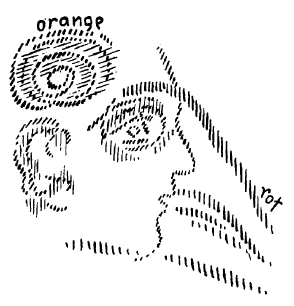
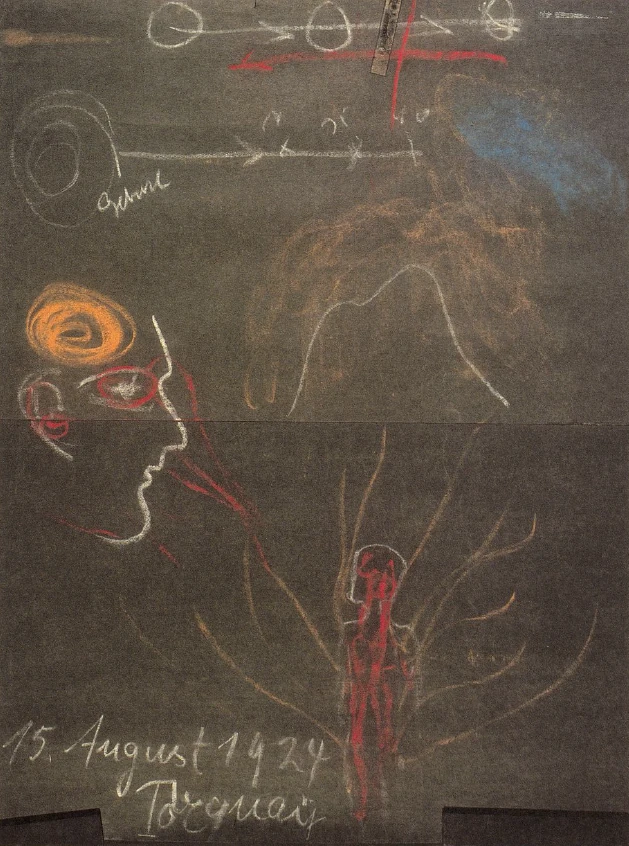
[ 20 ] Our senses, which are, of course, on our surface—the eye, the ear—constantly perceive this world (see drawing, red). That is where we stand, my esteemed audience. Our senses, which are located on our surface, perceive this elemental world. They also perceive the dead within it, years after they have died. The fact that all of this is erased stems from the fact that behind the senses lies the brain (orange). Now I stand here with my brain and my senses. This human being, who lies on my outer surface, perceives the spiritual world within it; he perceives the dead within it in the years following their death. But my brain erases all of that—it erases earth, water, fire, and air—and I look upon what is there in sharp contours as the physical world, which exists only for the world I experience between birth and death. There is a world there of a completely different kind. I erase it through my brain and look upon the world that is known to human beings as the world of ordinary consciousness.
[ 21 ] And so, for the modern person, there is that form of meditation I spoke of yesterday. For the older person, that meditation was followed by the enjoyment of such “metallic states,” as I explained yesterday. Thus, the transition into the next state of consciousness consists, first of all, in switching off brain consciousness and, with the spirit, immersing oneself in the consciousness of our eyes and ears. Animals have this as well, for they have not physically developed the brain behind the senses. However, they do not possess the soul endowed with the “I,” so they cannot immerse themselves in their senses with the spirit. They immerse themselves only with the gross-soul aspect and therefore do not see what a human being can see in their surroundings when they immerse themselves in their senses with the spirit. But animals see in the same way; they see at a low level, not at a high, individual level.
[ 22 ] The Mystery of Mercury
[ 23 ] What I am about to say next regarding metallicity—that is, the very essence of the mineral realm—I ask you, ladies and gentlemen, to consider with all the caution to which I drew your attention yesterday and which I summarized in the following sentence: The inner enlivening of the soul through the properties of the metallic—that is, the development, so to speak, of an inner coexistence with metallicity in a moral sense—is part of true spiritual development for people today. The introduction of metallic qualities into the human organism belongs to the realm of the physician. So, with this reservation in mind, I ask you to take in everything I am about to say regarding the mystery of metals other than those I have already discussed.
[ 24 ] Above all, the person who views the world spiritually—that is, who can also view the physical realm and physical substances in such a way as to perceive the spiritual forces at work behind them—stands before the mystery of Mercury in a way that is of great significance to him. The metal mercury is, after all, only a part of what is generally called the “Mercurial” in spiritual science; anything metallic and liquid—everything that is metallic and liquid—is the Mercurial, except that in our natural state, only the one metal, mercury, is metallic and liquid and is therefore Mercurial. But this is, of course, only one individual member of the Mercurial genus. When we speak of the Mercurial in spiritual science, we are referring to all that is Mercurial, viewing mercury merely as the representative of the Mercurial. This mercury—or rather, the element Mercury—does indeed present a significant mystery. Its effect on human beings is such that it completely eliminates everything that a person experiences as effects from the physical world—and also from the world I have just described, the elemental world.
[ 25 ] We humans exist in the world in such a way that we have formed organs such as our brain from the physical world. Many other organs in the human being are also formed from the physical world, namely a whole number of glandular organs that are important for physical life. Furthermore, a whole number of organs—I have just mentioned the senses—are formed from the world that I have described as that of the second consciousness. Copper and iron transport the human being into this second world.
[ 26 ] Mercury is different. Mercury must be present in the world. And it is present everywhere in minute quantities. We live, if I may use that expression, in an atmosphere of mercury. But the moment a person takes in more than this normal amount of Mercury, their organism strives to shut down all organs that originate from the physical world and the elemental world. The human astral body is, so to speak, stimulated to make use only of those organs within the person that have been formed from the world of the stars. Therefore, as soon as a person’s consciousness concentrates on the metallic nature of Mercury—on the properties of Mercury, on the metallic-liquid quality, on that which is peculiarly intangible and yet, at the same time, akin to humanity, which lies within the Mercurial—the person is inwardly filled with a third human being.
[ 27 ] I said that, through the connection with copper, a person is filled with a second human being who presses and urges from within, who can also leave the ordinary physical body and then, as I have described, follow the deceased in the years immediately following death. Mercury immediately draws to itself everything that gives rise to a much, much denser inner soul organism within the human being. The human being feels as if, through all that is now brought about by the mercury, he were grasping the entire metabolism of his organs. Just as the fluids flow through the various vessels in the human body, this suddenly engulfs the human being when he experiences the powerful influence of the metallic nature of mercury.
[ 28 ] At first, it is not something one can describe as wonderful or pleasant, for a person feels as if they had no brain, no senses—but as if everything within them were in a state of activity and movement, as if everything within them were tingling and crawling, in an inner stirring, activity, weaving, and life. Suddenly, everything within us is in a state of inner activity. And we feel this inner activity within us, connected to an activity on the outside.
[ 29 ] All of this, when consciously experienced through training of the soul as I have described, can be roughly schematized as follows (see Figure $102). Under the influence of mercury—through the impulse of mercury—a person does not feel their brain; it is a void. This is also beneficial for perceiving the spiritual world; the brain is not suited for this. Other organs are not yet perceived either. But what is perceived is the passage of movement through the entire organism (red). And at first, all these movements cause pain, just as if one were inwardly tired.
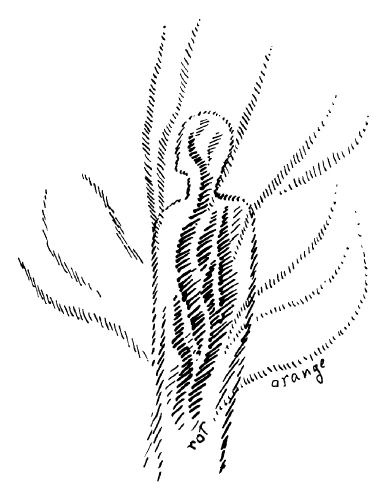
[ 30 ] These movements are connected everywhere with external movements (orange). Inner activity is linked to external activity. One gets the impression that the world of the Earth, the world of the elements, has been left behind—it is all down below. It smolders and steams. But within this smoldering, steaming, airy movement, there are spiritual beings. The divine nature, of which Brunetto Latini speaks so vividly, has turned away.
[ 31 ] She is, after all, the same as the Greek Persephone, as I explained yesterday. Before, she turned her face more toward the earth, explaining to us those things still connected to the earthly realm, such as the life that a person first experiences after death. Now she turns around, and one has the earthly and elemental realms below, and the world of the stars above. The starry worlds thus become one’s surroundings, just as one was previously surrounded by plants and animals on Earth. And one does not have the feeling: “What a tiny little speck you are compared to the vast starry world!” — but rather, one feels, in one’s own greatness, toward the vast starry world just as one feels toward one’s immediate surroundings on Earth. One has, after all, also grown great. One has grown into the starry worlds with one’s own greatness. But the stars are not the stars we saw when we stood on Earth and viewed them with our eyes; the stars reveal themselves as colonies of spiritual beings. We are once again in the world I have already described to you—the one I described as being evoked in the human being through their affinity with the metallic nature of tin. For there is an inner kinship between mercury and tin in the direction I have indicated. Mercury claims a certain part of our human being, lifts it out from the rest of our human being, and carries this part of our human being into that spiritual world whose outer physical manifestation is the world of the stars.
[ 32 ] But now we are somewhere else again, because our state of consciousness has changed; our state of consciousness no longer arises through the senses or the brain, but through that which has now been extracted from our organism—the metallic nature of Mercury. As a result, we are in a completely different world. We are now in the world of the stars. But I could also put it another way. “World of the stars” refers to the spatial aspect; in reality, however, with the development of this state of consciousness, we emerge from the world in which we exist spatially between birth and death, and are now in the world that we experience as human beings between death and a new birth.
[ 33 ] It is indeed the mystery of Mercury that Mercury carries the human being out of the world in which he exists as the physical-sensory world, and carries him into the world in which he exists between death and a new birth, because mercury, has an inner kinship with that part of the human being which is not at all of this earth, but which has been brought in from the world we pass through between death and a new birth. Our circulatory system—that which we now feel—is not of this world; it is determined by the world we pass through between death and a new birth.
[ 34 ] And now we become aware of something else—again, something that Brunetto Latini observed under the influence of the goddess Natura. We become aware: We live within our own circulation of vital fluids, which, however, is connected to the circulation of vital fluids of the entire cosmos; we are outside of ourselves, and we are in that realm we pass through between death and a new birth. But we are now coming to understand the nature of this circulation of humors and are learning to recognize how, within this inner activity—this circulation of humors emerging from the realm we traverse between death and a new birth—our temperament is formed; formed in such a way that we have become either a sanguine, a choleric, a melancholic, or a phlegmatic person. We now understand ourselves even more deeply than as sensory beings. When we go through the world as phlegmatic people, we must tell ourselves: Our phlegmatic nature is determined by what we have gone through between our last death and this birth. The same applies to the choleric, melancholic, and sanguine temperaments.
[ 35 ] But something else is mixed into this temperament—into that which finds its physical expression in the circulation of humors. Just consider what you have in this circulation of humors. If you approach this as an anatomist or physiologist, you are dealing first and foremost with something physical. The physical is merely the expression of something spiritual. But with regard to this circulation of bodily fluids, the spiritual is not of this world at all; rather, it is of the world that works within human beings between death and a new birth.
[ 36 ] So that, when we look back at our temperament—and this was also the most striking thing for Brunetto Latini when the goddess Natura explained the temperaments to him—we say to ourselves: There, in these temperaments, which lie within the circulation of the humors, life has imprinted its seal between death and new birth. — But if one now delves deeper, one finds mixed in with this what is called karma, what is called the trial of fate. If one observes this strange, metallically flowing mercury in its physical existence, one learns to recognize it properly only when one knows that this mystery lies within: In a single droplet of flowing mercury, a profound connection is revealed to the initiate. And this droplet of flowing mercury is capable of drawing together the human spirit with those organs whose forms and origins stem from the life between death and rebirth.
[ 37 ] Thus, everything in the world is interconnected, interwoven. The physical is merely an illusion—a physical illusion. The spiritual is merely an illusion for the physical—an abstract illusion. In truth, the physical is interwoven with the spiritual, and the spiritual with the physical. And if, in the case of a human organism that has become impaired, one observes that this human organism has become impaired because those organs have been affected which are actually formed from the realm we pass through between death and rebirth, then one must awaken forces within the human organism that will repair this damage.
[ 38 ] Suppose a person shows the doctor that the system—the circulation of vital fluids—which is actually driven by the life between death and rebirth, is impaired. I am thus faced with a patient whose circulation of vital fluids has become detached from the spiritual world. That is the phenomenon. One makes a spiritual diagnosis in this case. The spiritual aspect must always be understood in relation to the physical diagnosis, just as I indicated yesterday. I emphasize this again and again so that no misunderstandings arise. One diagnoses that the person has a circulatory system that has become too severely detached from the spiritual world we experience between death and rebirth. What must be done?
[ 39 ] Therapeutically, one must introduce into the body, in the most appropriate way, the metallic quality that restores the circulation of the humors to contact with the spiritual world. This is how Mercury acts on human beings. Mercury acts on the human organism in such a way that it restores contact with the spiritual world to those organs that can only be formed from the spiritual world once they have broken away from it. Here you can see the—I would say—dangerous, yet at the same time, of course, necessary relationship that exists between the understanding of states of consciousness in human beings and the understanding of diseases. The one flows into the other.
[ 40 ] These things played such a major role in the ancient mysteries. And they also shed light on matters such as what I described yesterday. Just imagine: at a time when humanity had long since lost such spiritual insight—when the goddess Natura was recognized for her instructive role in revealing the mysteries of nature—Dante’s teacher, Brunetto Latini, returns from his post as an envoy in Spain, approaches his hometown, and becomes even more agitated upon hearing what has befallen his own faction, the Guelphs. He experiences all of this in a state of mind in which something like a mild sunstroke takes hold of him. The metallic nature of Mercury has simply affected him from his surroundings.
[ 41 ] For what does it mean when we say, “We’re getting a mild case of sunstroke”? It means we are experiencing an effect from the mercury that is distributed in the most subtle way throughout our surroundings in the cosmos. Brunetto Latini experienced this effect. As a result, at a time when it was otherwise impossible for human beings to approach the spiritual world in the way he did, he was given the opportunity to approach this spiritual world.
[ 42 ] But this points out to you, my esteemed audience, that there is something in the human being, as he stands before us, that is related not only to what the natural scientist lays out before us—that is related not only to what he lays out before us, who can already follow the dead on their next step after death, but that the human being, as it is within us, has a connection, a relationship to something far higher, to the purely spiritual, as we experience it between death and a new birth. You may understand the form of the liver, understand the form of the lung, if you proceed according to conventional science. You may understand the structure of the sense organs if you draw on the next level of knowledge; but modern physics only addresses this in a very general way. However, you will never come to know the circulation of the upright human being in its true nature unless you approach it through the science of initiation. Nor will you ever come to know the mysteries of metallicity unless you, again, approach it through the science of initiation.
[ 43 ] This also means, however, that you will never come to understand the nature of diseases in the sense described above unless you approach them through the science of initiation, for you cannot help by relying on the physical properties of metals. With the physical properties of metals, you can heal the brain—once you understand them. You cannot heal the circulation of the humors. But what I am telling you here is also not entirely accurate, for you can only heal the coarsest substance of the brain. But there is also a circulation of humors in the brain. Therefore, in reality, you cannot heal the brain with metals either, but only with spiritual insight. You might say: “But why does modern medicine heal, then?” It heals with what remains of the tradition from ancient times. People still know what the ancients knew about the spirituality of metals. That is what is applied. It is applied as a bridge between what has been discovered purely physically and what does not help much. And if materialism were ever to prevail and everything were to be forgotten, then no remedy found solely through physical means would be of any help.
[ 44 ] We have already reached a point in human development where, because the old traditions rooted in original clairvoyance have gradually faded away, the spiritual must be rediscovered in a new way.
[ 45 ] The Mystery of Silver
[ 46 ] The mystery underlying the metallic nature of silver, in turn, is of a very special kind. If we can say that behind copper lies the cosmic impulsiveness that initially conjures the first higher human being into the human existence; and that behind mercury lies a second cosmic force that conjures a second human being connected to the world of the stars—and thus to the spiritual world we experience between death and rebirth—then we must say something entirely different about the metallic nature of silver.
[ 47 ] When a person deepens and expands his connection to silver in this way—as we have seen with regard to the metallic nature of copper and the metallic nature of mercury—he then turns his attention to an even deeper organization within himself. With mercury, he has turned to the vascular system, which connects him to a circulation throughout the entire cosmos and to the spirituality of the cosmos. By intensifying the silver relationship, the human being brings himself into direct contact with that which flows and impels him from earlier earthly lives.
[ 48 ] So we can say: If a person concentrates on the specific properties of silver—which takes a long time to take effect—that person draws into themselves the forces associated with the fact that now it is not only their vessels that circulate fluids and vital juices, but that warmth circulates through the circulation of the blood. Then the truth dawns on the person that what circulates as warmth in their blood—which is what makes them a human being in the first place, in that they feel within themselves a certain warmth and, through this, the materiality of blood, but also the spiritual nature of blood—is the result of forces acting from previous incarnations. — And in the connection with silver, that which can act upon the warmth and impulsiveness of the blood is directly expressed. But this also expresses what leads us spiritually back to earlier earthly lives.
[ 49 ] Do you think that silver possesses a certain metallic quality that, in a sense, draws a person’s attention to what remains within them in this earthly life from previous earthly lives? For our blood circulation, with its marvelous variations in temperature, does not originate from this physical world. Nor does it originate solely from the elemental world I have described to you. Nor does it originate solely from the world of the stars. The directions of the blood circulation originate from the world of the stars. But what actually pulses through our life in the proper way as warmth within the blood is the force that stems from previous earthly lives.
[ 50 ] This is precisely what one appeals to when one appeals to the powers of silver in their relationship to human beings. Thus, the mystery of silver is connected to repeated earthly lives. Silver is one of the most profound examples of the fact that spirituality is alive everywhere, even in the physical realm. Anyone who is able to view silver with the right eyes knows that silver is the outward divine sign of the cycles of human life on Earth. Therefore, the mystery of silver is also connected to procreation—to all those mysteries related to procreation—because through procreation, human beings carry their essence over into their previous earthly lives. The being that existed in previous earthly lives enters physical life through procreation. But this is the same mystery as the mystery of blood. And the mystery of blood, the mystery of blood, is the mystery of silver. One can say here: The mystery of the warmth of blood is the mystery, the mystery of silver.
[ 51 ] Once again, the current of cognition shifts from this normal course in human beings to the pathological one. Do you think that, in human beings, due to circumstances that lie specifically in the present world—from which the blood must not be warmed, for it must be warmed by the worlds we have passed through in earlier earthly lives—do you think that the warmth of the blood is impaired by the present world, rather than being stimulated by that to which we are bound through a spiritual link to our earlier earthly lives. Then those states of illness arise of which we can say they exist because everything connected with the warmth of our blood has been torn away from that with which it should actually be connected—from our earlier earthly lives.
[ 52 ] What is fever? Fever, understood in a spiritual sense, is the result of the human organism being torn away from its normal integration with the ongoing influences of previous earthly lives. If the physician can diagnose that this is the case in any given illness—that is, the person is here; the external world has affected him in such a way—through some cause—that he is in danger of having his organism torn away from previous earthly lives—then the physician proceeds with therapy using silver. And a very fine example of this can be recounted, one that took place not too long ago at Dr. Wegman’s Clinical-Therapeutic Institute in Arlesheim. Such a condition—which, as I have indicated, can arise spiritually, whereby external circumstances suddenly cause the human organism to threaten to tear itself away from the blood characteristics of previous earthly lives—can occur quite suddenly. And this is precisely what occurred quite recently in a specific medical case at Dr. Wegman’s Clinical-Therapeutic Institute—what materialistic medicine calls “occult fever”: a sudden high fever in a patient who was already recovering, something that was completely unexpected. Dr. Wegman was suddenly confronted with this case. Drawing on her inspired medical insight, she immediately administered a silver cure. When she told me this, the entire case stood before me in its beautiful cosmic context. From this, one can see how things interplay—on the one hand, what is connected to humanity’s development toward spirituality, and on the other hand, what leads into the pathological and then into the therapeutic.
[ 53 ] On what basis is it that the initiate can survey past earthly lives? As long as one is connected to them as in ordinary life—that is, as one simply moves through one’s karma and past earthly lives are simply at work—one cannot look back on those past earthly lives. Here you are in your present earthly life. You are connected to your past earthly lives; they exert their influence here. Yes, they exert such an influence that, under their influence, you carry out your karma, that you move through the world in accordance with your karma. But you cannot look back. After all, you cannot look back with ordinary consciousness. If you want to look back, you must first break the thread for a few moments; you must detach yourself. Once you have detached yourself, once your past earthly lives have become objective, then you can look back.
[ 54 ] Of course, you must acquire the ability—I will speak more about this later—to pick up the thread again afterward as if nothing had happened. If you do not pick up the thread again, you will become mentally disturbed, not an initiate.
[ 55 ] You see, here you have a phenomenon that occurs during spiritual development: the breaking away from the spiritual threads that bind one to previous earthly lives. Illness does this in an abnormal way. Illness does this in a pathological manner. Illness manifests as an abnormal occurrence of that which, in a higher sphere, must be brought about normally in order to attain spiritual vision and other states of consciousness. When the blood, separated from the rest of the human organism, surrenders to its own consciousness—for the blood possesses a distinct consciousness, as I have already told you regarding such distinct consciousnesses of certain bodily organs—when the blood emancipates itself from the rest of the organism, it then, in an abnormal state, looks back into past earthly lives. But this remains subconscious. For conscious looking back, the thread must first break. For pathological looking back, the thread need not break.
[ 56 ] Thus, when we consider something like the metallic nature of silver—which actually proves to be a wonderful remedy, especially for all illnesses that can be traced back in some way to karmic causes—the mystery of silver leads us deep into other mysteries of the world, and with this we have, for the time being, covered roughly those metallic qualities that are worth mentioning in relation to the other states of human consciousness.
[ 57 ] We will now continue our examination of these states of consciousness and the connection that human beings can establish with other worlds through them; in other words, in the next lectures we will continue our exploration of the true paths to spirituality.