

Initiate Consciousness
True and False Paths of Spiritual Research
GA 243
14 August 1924, Torquay
Translated by Steiner Online Library
4. The Secret of Exploring Other Worlds Through the Metamorphosis of Consciousness
The Relationship Between Metallicity and Other States of Human Consciousness
[ 1 ] I have spoken of the form and substantiality—the true metallic nature—of the mineral realm, insofar as these things, when they approach human beings, relate to their states of consciousness. Before I can continue this discussion, which must extend to certain metallic substances, I must interject a specific remark.
[ 2 ] One might easily believe that what I have said constitutes a recommendation to induce states of consciousness that differ from the ordinary human state of consciousness in today’s everyday life by, so to speak, physically ingesting these substances as a kind of food. And when people talk about the methods by which one finds the path to the spiritual world, and when they discuss the inner training—the kind of intimate discipline—one must undergo, people often say: Yes, I would very much like to learn about other worlds, about other states of consciousness, but it is so difficult to do these exercises that are recommended; it takes so long.
[ 3 ] Then people probably start doing these kinds of exercises. But then life takes over—a life so full of habits that one doesn’t want to break free from. Gradually, the exercises lose some of their inner enthusiasm and intensity. The practice gradually fades into the background of one’s spiritual life. And then people get nowhere; they find it incredibly inconvenient to have to practice in this spiritual way. When they then hear that certain—let’s say—metallic qualities are connected to other states of consciousness, people are quick to say: “Yes, that’s more convenient.” If, for example, in order to accompany a person after death, I merely needed to ingest a little copper, why shouldn’t I ingest copper to bring about the state of consciousness that enables me to accompany the deceased through their entire soul life?
[ 4 ] The matter becomes even more problematic when people learn that in the ancient mysteries, things were actually conducted in a not-at-all dissimilar way; that in the ancient mysteries—albeit under the strict, constant supervision of those who were initiates—such practices were already carried out. When people hear this as well, they say: Why shouldn’t these ancient methods be revived? But they fail to take into account that, right down to their innermost being, human bodies were something entirely different in ancient times than they are today. What, then, was present—or rather, absent—in human beings above all else in ancient times, even in those Chaldean times of which I have spoken in recent days?
[ 5 ] You see, the kind of intellectuality we have today did not exist back then. People did not think on their own the way we do today; rather, they received their thoughts as inspiration. Just as we are aware today that we do not create the red of the rose, but rather that the rose makes an impression on us, so too were the people of old clear that thoughts, too, come from things—that they are inspired by them. And that was because physicality was entirely different in those ancient times. Even down to the composition of the blood, physicality was different.
[ 6 ] And so it came to pass that in those ancient times, metals such as those I have spoken of were administered to people in an extraordinarily fine—what we would call today a homeopathic high potency—to support the soul’s exercises. But you see, the entire body was different back then. And let’s suppose that such a person in ancient times—that is, in those Chaldean times I’ve spoken of—received highly potentized copper and was then instructed that before receiving this copper—as was always the case—he should perform certain soul exercises; such a person did not have to train for days, but rather for years, before the highly potentized copper was administered to him. And then, once it had been administered to him, because his physical constitution was entirely different—having learned through the training to sense how this finely dispersed copper, pulsating in his blood as a very fine, highly potentized substance, was working in his upper regions— He had discovered that when, after this careful training, he received the copper, he experienced inwardly that the words he spoke became, so to speak, warmer—warmer because he himself became warm in his larynx and in the nerves that run from the larynx to the brain.
[ 7 ] Well, that was because, in those ancient times, human beings—due to their different physical constitution—were able to develop a keen sensitivity to what was going on within them. If you give a person of today, in the same situation, highly potentized copper, it will have an effect as well. Of course it will. But it causes them to develop laryngitis, and nothing else at first. One must simply be aware of this difference between the ancient and the more recent human constitution; then one will no longer develop the desire and longing—as was still common in ancient times, and indeed was still widely practiced in the Middle Ages—to induce other states of consciousness through external ingestion.
[ 8 ] You see, today the only correct way is for a person to first establish a spiritual connection—as I described yesterday—with nature, with the essence of copper, to develop a subtle sense of the color of copper as it is, when one finds copper in any form, of the color of copper as it is when one polishes it, and that one develops a sense of how copper acts within copper sulfate and acid, and so on. When a person develops this sense in this way, then this feeling—which they now meditate on and concentrate upon—has the proper effect on the modern human being.
[ 9 ] Now you might say: Yes, but you wrote your book How Does One Gain Insight into the Higher Worlds?, and there’s nothing in it at all about projecting oneself into copper in this way. — Well, it’s not in there. But there are other things in it. First and foremost, the principle is already laid out in my book—just not specifically for copper, but for other things. It describes how one should immerse oneself in the nature of crystals, plants, and so on. These elementary exercises are outlined. It does not, however, say that one should get to know the nature of copper; for that would require not just a book, but an entire library. But that isn’t necessary either; for exercises are provided there—for example, exercises in self-confidence, and concentration exercises relating to very specific subjects. Yes, these correspond to what I just described regarding the nature of copper. It is not said that one should have the nature of copper before one’s eyes, but rather: Try taking some simple subject matter and concentrating on it every morning and every evening. For this means—expressed in other words—concentrating on the nature of copper. What is given as the content of the soul is precisely what one could also provide by drawing on the metallic nature of copper.
[ 10 ] If I tell someone, “You should focus on a specific spiritual thought—for example, ‘Wisdom shines in the light’—every morning and every evening,” then, if they truly do so, it will have an effect on their soul. And it has exactly the same effect as if I had told them: “Get to know the nature of copper in every respect and concentrate on copper.” — The only difference is that in one case the approach is moral, and in the other, purely physical and chemical. And for someone who isn’t a chemist, it is much better to enter the spiritual world through the moral path.
[ 11 ] So you see how these things must be understood, because the path one would take into the spiritual worlds—based on the paths followed in the ancient mysteries—would be entirely wrong for modern people today. The correct path today is one that replaces the external, natural, physical aspect with a more moral, spiritual approach. For all of humanity’s connections with nature have indeed changed under the influence of the development of the human physical body. Blood composition, tissue fluid, constitution—they are all different today from those of the people of ancient Chaldea. Our body is different.
[ 12 ] The anatomist cannot prove this. First of all, anatomists today mostly work with corpses. And even though it was recently said at a meeting of natural scientists—as a kind of cry for help regarding the natural sciences—: “Give us corpses!”—for anatomists find that they have too few corpses to investigate all the mysteries—it will nevertheless be very difficult to obtain Chaldean corpses to investigate these matters! [And secondly, the anatomist would find nothing with his crude methods.] These matters must be investigated through spiritual means.
[ 13 ] So we have a different physical constitution than our ancestors. And for that reason, one must say something very specific. Even today, we can produce highly potentized substances—metallicity, for example. But why do we do that? Well, you see, it is precisely this deeper insight into the nature of the natural world that gives us the necessary orientation and direction. If one truly understands the human body, one knows that it is transformed by all the metals I have mentioned—tin, copper, lead, and so on—that it is transformed by all these metals. And I have already described this transformation to you, initially through the transformation of states of consciousness.
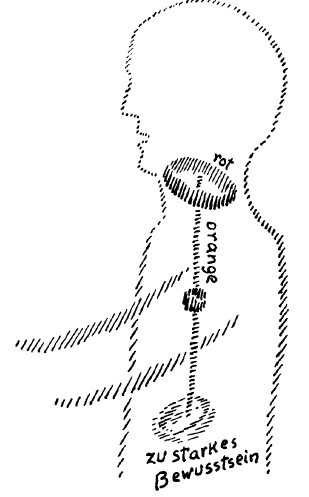
[ 14 ] Now, however, changes also occur in the human body even in everyday life—if I may use that somewhat philistine expression. Let’s say, for example, that we have a change in the area from which, as I mentioned yesterday, the copper effect radiates (see drawing p. 76). Well, such a change manifests itself in all sorts of disturbances of the digestive organs, in all sorts of disturbances of the metabolic-limb aspect of the human being—disturbances of that part of the human being that is primarily connected with metabolism, digestion, and the distribution of nutrients throughout the body. Every such disturbance in the human organism—which we call a disease—is, however, also connected with the induction of a different state of consciousness. You need only consider this in its full significance.
[ 15 ] If you have a diseased organ somewhere, what does that mean? Well, as I said yesterday: In the present, a person’s waking state of consciousness in ordinary life is centered in the heart; the other parts of the human organism have different states, but these simply do not rise up into consciousness. — The area of your larynx, along with everything connected to the brain from the larynx, continuously maintains the next state of consciousness that I described yesterday alongside the ordinary one. — This region here—the region of the digestive organs—continuously maintains the state of consciousness that guides one through the period the dead pass through after death (see diagram, p. 76). A person is always part of that process. Every person experiences the lives of those people they have known after they have passed through the gate of death. But they experience them beneath their heart, not in their heart. Therefore, they know nothing of it. Therefore, it remains in the subconscious, the unconscious.
[ 16 ] If, in the same realm where a person continually experiences the life of the dead in the years following death, a disturbance occurs—that is, if a digestive disorder manifests as an illness—then the state of consciousness down there is altered. An excessive sense of consciousness arises below the heart. What does it mean, for example, to have a certain type of stomach ailment? In physical life, it naturally means what the doctor describes in physical terms. And what I am advocating here does not in the least object to physical medicine. It is fully recognized and appreciated. In anthroposophy, we do not take the standpoint of dilettantism, layman-like attitudes, or charlatanism, which reject, criticize, or disparage physical medicine and the like. We fully recognize it. But in addition to the fact that a person possesses within themselves what is described in physical medicine—for example, when someone has a certain type of stomach ailment—such a stomach ailment makes that person better able to follow the lives of human beings after death, immediately after death. So what can be said from a spiritual standpoint?
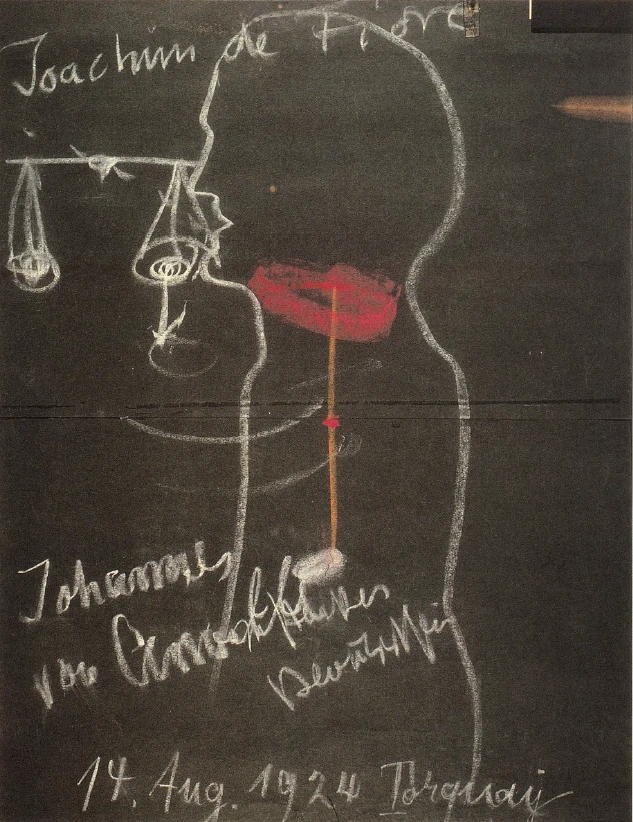
[ 17 ] Of course, one first describes the illness in the physical sense so that one can specify the treatment and so on. But from a spiritual perspective, one could say: The person has the urge to follow the dead whom they knew into the afterlife. But they lack the ability to descend into the consciousness that lies beneath their heart. They do not realize that they are entering the realm of the dead. That is the spiritual aspect of the illness. One suffers from a stomach ailment because one spends too much time with the dead. But during those moments when one spends too much time with the dead, the dead also exert too strong an influence. A great deal flows into us from the world I mentioned yesterday—the one that is more real than the physical world. And if you have a scale supported here (it is drawn), with the pans here, and the scale is tipping down too far, and you want to restore balance, you must place a heavier weight on the other side. When the scale is out of balance, you must place a heavier weight on the other pan.
[ 18 ] Now let’s assume that a person has developed such a sensitive awareness deep within their heart—though they remain unaware of it—that they become too deeply involved with the dead; this is like one pan of a scale being weighed down. It becomes too heavy. You have to place a weight on the other pan. How do you do that?
[ 19 ] If there is too much consciousness here (referring to Figure), you must weaken the consciousness here (red), because the center of the balance beam (orange) is in the heart. So you must weaken the consciousness here in this region. How do you do that? You give the person copper. As I’ve told you, the modern human body is organized in such a way that copper acts on the laryngeal organs. But the digestive organs and the laryngeal organs are as closely connected to one another as one beam of a balance scale is to the other. One can regulate one through the other. If a person is given copper in an appropriately dosed amount, they will, on their path to healing, once again pass more through the region of the dead, whereas otherwise they would remain increasingly in the region of the dead. This is the spiritual aspect of healing.
[ 20 ] Therefore, we must say today: All substances, all forms of substance, have a physical aspect and a moral aspect, as I described earlier. The physical aspect could be used by the ancient initiates for their students—after long training—in the way I described; it must no longer be used in that way today. Today, the moral substance belongs to the realm of spiritual development; the physical substance belongs to the physician. And with regard to the moral aspect, the point is simply that the one who knows the physical aspect also has the ability to penetrate deeply into the physical aspect of substances, and is further supported by an understanding of the moral aspect of substances.
[ 21 ] But this must be strictly observed in today’s understanding—in practical understanding—in the realm of spiritual paths. The physical aspect of substance belongs to the physician; the moral aspect belongs to the realm of spiritual development. For human organisms have, in principle, changed completely since ancient times. And just as intimate as the connection once was between the understanding of the moral aspect of substances and the physical aspect, so intimate must it become again after it has been lost. I will speak about this loss shortly. But the relationship that exists, for example, between physical medical science and moral science must nevertheless be different today than it was in ancient times. In both cases, this relationship must exist. But it is different today than it was in ancient times. And the insight into which paths are true and which are false on the way into the spiritual world is based on the understanding of such things.
[ 22 ] Changes in Humanity's Approach to Knowledge Throughout History
[ 23 ] Well, it will be helpful for us, in order to shed a little more light on what I have explained, to take a look at the changes that have taken place over a long period of time in humanity’s overall attitude toward knowledge. Let us start from the present and go back a little in the course of human development to see how differently people have spoken about things in the realm of knowledge and research. Today, when we look at the great, marvelous advances that have emerged in recent times in our understanding of thermal forces, electrical forces, and also the forces at work in living organisms, we speak of nature and of the knowledge of nature, of the natural sciences—and in England, of natural philosophy.
[ 24 ] If we take a look at what is referred to as “nature” in schools today—even in the very lowest grades, in ordinary elementary schools—it is something extraordinarily abstract. It is the sum of the laws of nature, as they say, which one must learn—something extraordinarily abstract. And the abstract nature of the subject is also reflected in everyday life. Just think how abstractly even the most enthusiastic student of the natural sciences feels and perceives things today. In botany, for example, he must memorize many names of plants and plant genera; in zoology, those of animals and animal genera. He forgets them again and must learn them over and over again if he wants to pass his exams. And after the exam, he forgets them even more completely. Then, when he needs them, he looks them up in the textbooks. And one cannot exactly say that the relationship of a person studying botany or zoology today to botany or zoology is anything like the relationship of a person to a beloved individual. One cannot say that. That is not the case today.
[ 25 ] Nature is something that fades into the mist. There are many laws: laws of gravity, laws of heat, laws of light, laws of electricity, laws of magnetism, laws of steam and water, and laws of equilibrium and the diversity of equilibrium; natural science, the knowledge of nature, is what we know about stones and plants. Natural science is also that which we say we do not know—about the life and internal constitution of the organs of plants, animals, and humans; in short, much of what we say today we know, and much of what we say we do not know. That is natural science today; that is natural philosophy.
[ 26 ] But it is something you can’t quite give a warm handshake to, because it’s all vague; it’s all conceived in a thin and abstract way. Today we are striving to master this abstraction called “nature.” Some, we can already say, have become somewhat indifferent to this abstract concept of nature. We maintain a benevolent neutrality—unless we belong to the very youngest generation, which today is strongly rebelling against what is taught as natural science in schools; we profess a benevolent neutrality. It was not always this way. And I would now like to begin by characterizing the intellectual climate of earlier centuries.
[ 27 ] If we go back, for example, to the 9th, 10th, and 11th centuries—and even to the 12th and 13th centuries, though there were very few at that point—we encounter people whom, if we were to use the term today, we would call scholars or scientists. We go back to those great scholars—in the sense of that era—who taught at the renowned School of Chartres in the 11th and 12th centuries; we go back to Bernardus Silvestris, to Bernard of Chartres, to Alanus ab Insulis. We then go back to such figures who, even in those days, I would say, walked among other people as the type of the initiate—the type of person who knows much about the mysteries of existence—such as that great figure, Joachim de Fiore, who was still considered an initiate in the medieval sense, or that great figure who was also active in that era and became known to the world as John of Auville. I mention these figures—to whom I could add many others—in order to set the scene and to characterize the spirit of the age with regard to knowledge.
[ 28 ] When one stands face to face with these people, with their souls, and they speak of nature, it is a completely different matter than when we speak of nature today. When one meets a botanist, a pathologist, or a histologist today—indeed, one rarely has the feeling that the expression on their face, as they face you, stems from the mysteries of pathological anatomy or zoology. Rather, when one encounters such a pathologist, histologist, or even a therapist today, one has the feeling that their expression stems more from the little dance they performed here or there the day before. Through these facial expressions, one sees more of these mundane circumstances than of what they have experienced from the mysteries of nature. This was certainly not the case when one looked into the eyes of a Joachim de Fiore, or an Alanus ab Insulis, or a Bernardus Silvestris—who lived in that era I have just spoken of. There was something of a tragic air about the faces of these people, something that seemed to say: We live in an age that has lost so much. — Something tragic and sorrowful, I would say, shone from their deep immersion in knowledge on the faces of those people.
[ 29 ] Moreover—if one had seen the fingers of these people, those fingers that today’s decadent man would call nervous fingers, but which bore within them the living testimony that these people wanted once again to delve into and work with the ancient mysteries—which their faces expressed as having been lost—then one would have noticed: something is at work within these people that seeks to bring back what existed in ancient times. Sometimes they succeeded. Sometimes they succeeded in conjuring up the ancient times—albeit as a shadow image—before their students.
[ 30 ] One can certainly imagine—this is not a poetic image I am presenting to you, but a reality, my esteemed audience— one can certainly imagine the school of Chartres, where the magnificent cathedral still stands today, with Alanus ab Insulis teaching, speaking to his students about nature, saying something like: Nature—a being we can no longer grasp, one that eludes us when we try to approach it. Humanity has developed powers that lead it toward other things, but which are no longer capable of grasping nature in the way that nature was grasped in ancient times by those who sought to understand it. For nature was a mighty, great spiritual being that was at work everywhere—where the stones in the mountains were formed, where the plants grew out of the earth, where the stars twinkled in the sky. Everywhere, an immeasurably great being was at work, manifesting itself in the form of a wondrous woman. This is what the ancients saw with their spiritual vision. Based on the descriptions provided by the ancients, we can still form ideas of what Nature was—this all-pervading weaving and working that lives and weaves in everything around us, in all warmth, in all manifestations of light, in all manifestations of color, and in all manifestations of life. But it eludes us when we try to approach it. For the goddess Natura is alive and weaving in all things. A goddess, a divine-spiritual being, of whom it was known that one can recognize her essence only if one can behold her.
[ 31 ] As early as the 12th century, a figure such as Alanus ab Insulis was already explaining such concepts to his students at the School of Chartres. But because they saw this goddess Natura dissolving into the mist—embodying the vitality of all that we today regard as abstract, lifeless laws of nature—and because she slipped away from them just as quickly, that is why there was this tragic, sad expression on these people’s faces.
[ 32 ] And then there were people such as Dante’s great teacher, Brunetto Latini, who, due to a particular karmic circumstance—he had suffered a sort of sunstroke while hiking — which was far more significant than the pain he had felt over the expulsion of the Guelphs from his hometown — and who, because his state of consciousness had consequently changed, was still able to perceive this Goddess Nature, as he describes in his book Tesoretto. And he describes quite vividly, with lively imagination, how, on his way home to his hometown of Florence, he passes through a desolate forest; how, in this desolate forest, he approaches a mountain; how, on this mountain, he sees the goddess Natura at work; how the goddess Natura now enlightens him as to what the human soul is in thought, feeling, and willing; how she also explains to him the nature of the four human temperaments; and how she further explains to him what the five human senses are.
[ 33 ] All of this was a genuine spiritual and psychological lesson, a reality he experienced under the influence of a pathological condition when he returned from Spain to his hometown of Florence. And after he had gone through all of this, he saw the interplay and nature of the four elements—fire, earth, water, and air—and the interplay and nature of the planets, as well as the human soul’s ascent into the starry heavens. He saw all of this under the influence of a spiritual teaching that came to him from the goddess Natura.
[ 34 ] A person from that time describes all of this as vividly as is still possible in today’s language. At the same time, however, one gets the sense that he feels: The others, the elders, knew it quite differently; today, it always slips away from us. One must even enter a subdued, pathological state if one still wishes to peer into these mysteries.
[ 35 ] But there was a tremendous urge within these people to conjure up once again something like the true form of Nature. And you see, when we retrace this path in human perception and human thought in relation to knowledge, we have the feeling: Well, we stand before nature today as well, but we designate it with a name that is something entirely abstract, a sum of laws. We take pride in being able to synthesize these laws into a certain harmony. Let’s go back a few centuries. We see a living relationship that human beings had with a divine being who wove and lived and brought about all the phenomena that occurred: the rising of the sun, the setting of the sun, the warming of the stones, the warming of the plants—all of this working within a living weaving and activity. Just think what a completely different kind of science that was! Science encompassed the deeds of the goddess Natura. There was certainly a difference between the spirit of the students who emerged from Chartres—most of whom were Cistercian monks—and the spirit of today’s students as they leave school; it was something different, something more alive, something more essential. And it is precisely in descriptions such as that of Brunetto Latini, Dante’s great teacher, that something truly alive and essential comes to life.
[ 36 ] One can certainly imagine that this was a living reality, for all the magnificent images and figures that Dante depicted in his Commedia sprang from the vivid descriptions of his teacher Brunetto Latini, who had been initiated through a karmic fall; just as much of what was later taught in schools such as Chartres and others stemmed from initiates such as Joachim de Fiore and others.
[ 37 ] Back then, people used the term “Natura,” but not in the abstract sense we do today; rather, they used it to refer to something that is present, something that acts within the external sensory phenomena, yet withdraws and eludes one. And then there was something else. Suppose—again, I am not painting a poetic picture, but describing something that was very much a reality—suppose one had been sitting in the college, as it is commonly called, of Alanus ab Insulis, as a somewhat older student. One would have taken part in what was happening there. The students would have been dismissed, and one would have continued on a solitary walk with Alanus ab Insulis, discussing what had taken place. What would one have learned there?
[ 38 ] Yes, such a conversation could have taken on a special form. One could have spoken of this Goddess Nature, who reveals herself to us in the phenomena of the external, physical-sensory world, yet who eludes us. Then Alanus ab Insulis, even if he had now warmed up to the spiritual conversation, would have patted you on the shoulder and said: Ah, if only we still had that state of sleep that the ancients had, then we would come to know the other side, the hidden side of the goddess Natura. But we sleep our way into the unconscious, where the other side of nature was precisely what revealed itself to the ancients. If we could still sleep like that—sleep with such clairvoyance as the ancients did—then we would know the Goddess Nature. — Speaking thus, Alanus ab Insulis would have patted you on the shoulder.
[ 39 ] And even if, in such a case, one had engaged in a confidential conversation with Joachim de Fiore, he would have said after a while: Yes, it is difficult for us, given our shallow sleep—which completely dulls our consciousness—to come to know the other side of Natura, the great goddess who creates and weaves within all that creates and weaves. The ancients knew her in both her aspects. And you know—he would have told you—the ancients did not use the word “Natura.” They did not say, of the being whom we today sense more than we know much about: she is the goddess Natura. They used a different word. They used the word “Proserpina.” That is the truth.
[ 40 ] People were already aware of this even back then. Our abstract nature, which we carry within our ideas, is the transformation of what I have just described to you. And what lived in the souls of figures such as Bernardus Silvestris, Alanus ab Insulis, Johannes von Auville, and above all in figures such as Brunetto Latini—what lived within them—is the transformation of what the ancients saw in Proserpina, the daughter of Demeter. Demeter, the entire universe, Proserpina! It is quite philistine to use the modern term [for] Proserpina: “nature.” Nature, which can remain in the upper world only half the time—that is, turning its physical, sensory side toward humanity—descends for the other half of its life into those regions that humans reach through sleep, but which, because sleep has become devoid of essence, they no longer reach in modern times.
[ 41 ] Our understanding of nature—though one might not recognize it today in its abstract form—is an imitation of what lived on in the myth of Proserpina in ancient Greece. The fact that this was felt by the figures with tragic countenances whose names I have mentioned to you—and that it could still be felt even in that era—already gives us an idea of how the paths of knowledge have changed.
[ 42 ] But the true character of such a thing—as I also said again today in the first part of my speech—can only be grasped by looking back at the way in which knowledge once was. I offer such descriptions not to conjure up old insights, but to evoke a sense of what knowledge once was.
[ 43 ] Pictures from the Past
[ 44 ] If one wishes to hold fast in one’s soul to the saying that Joachim de Fiore or John of Auville, for example, might have uttered in the Middle Ages while patting someone on the shoulder: What we regard today as nature—or what vanishes because we cannot reach it on the other side of life—was once Proserpina—and when the myth of Proserpina—for it has been preserved only as a myth—rises up in one’s soul, then images of even older conditions press in upon these impressions. These are images from that time when it was not abstract nature, nor the goddess Natura perceived in a tragic mood, that lived among people and in their souls, but rather the radiant goddess on the one hand and the tragic goddess on the other: Proserpina-Persephoneia.
[ 45 ] And how did it exist in certain eras of enlightenment, in those ancient times when it was still fully alive? These were not the times, my esteemed audience, when Plato wrote about philosophy, when Socrates spoke about philosophy—no, these were not those times. They were much older times, ancient times, when knowledge was something far more vibrant among people than it later became, even in the enlightened ages of Greek civilization.
[ 46 ] Let us try to conjure up a mental image of this, in order to recall through this image what was once considered knowledge in the course of human development, and to shed the proper light on what we have already discussed from the present perspective and will discuss further in these lectures. Let us try to conjure up a small—and, of course, only imperfectly depicted—image of the kind of mysteries into which the Greek philosopher Heraclitus was still initiated—he who is called “the Dark One,” “the Obscure One,” because by later times what he had received from those mysteries had already grown dark, spiritually dark. Let us try to paint a picture in our minds’ eye from the time of the development of the mysteries, from which Greek culture drew its inspiration above all else—drawing upon them in terms of its imagination and also in terms of the shaping of its myths. Let us try to conjure up an image in our minds of the Ephesian Mysteries, the Mysteries of Ephesus, into which Heraclitus, “the Dark One,” was also initiated.
[ 47 ] Ancient insights were indeed still prevalent in Ephesus, but they had also been preserved there right up to the time of Homer—indeed, right up to the time, albeit in a weaker form, when Heraclitus was initiated. Such ancient mysteries were present with the utmost vitality. And there were already strong, powerful currents of initiation flowing in that temple, which was adorned on its eastern side with that image that has indeed become known to the world—the image of the goddess Diana, the goddess of fertility, who, in her iconic form, expresses the fertility that abounds everywhere in nature. And great mysteries of existence—deeply spiritual mysteries—were already being woven into human words when conversations took place, for example, immediately after those participating in the Mysteries had received their powerful impulses during the rites and the details of the rites in the Temple of Ephesus. And these were profound conversations that continued once the participants in the rites had stepped out of the temple and, precisely at the time when the outer world is most receptive to such things—at twilight—set out on the path that led from the temple gate into a grove with wondrous winding paths, into that grove overgrown with blackish-green trees, where the paths disappeared in beautiful perspective toward the various sides of Ephesus. I would like to capture conversations of this kind in an imperfect picture.
[ 48 ] It was the case that whoever had been initiated from one side into the mysteries of that time would then likely strike up a conversation with a male or female student. For it must be noted that in those ancient times, the equality of the male and female sexes—precisely in those times, after which it immediately began to decline—was much more vibrant than it is in our own time. So that we can speak just as readily of female students in Ephesus as of male students, in the same way. And it was precisely the myth of Proserpina—the Persephoneia myth—in its spiritual form that was very much alive in those conversations.
[ 49 ] But how was such a discussion about the myth of Proserpina conducted? First, let us say, there was the teacher—the initiated priest—who, drawing on the impulses he had received, could speak about the events in the world of forms, could speak about the events unfolding between beings, and, drawing on this initiation, could say the following to his pupil: “Look, we are passing through twilight. Sleep, which makes the divine world visible, will soon begin. Look at yourself in your entire human form. Down there are the plants; all around us is the forest, casting shadows in the twilight, wondrous in its green twilight gloom. Already, the first twinkling stars are beginning to appear above. Take a look at all of this. Behold the majesty, the grandeur, but also the sprouting and budding of life above and below. And then look at yourself. Consider how an entire universe lives and weaves within you, how in everything that circulates within you, in everything that finds its existence in events within you, there is a wealth of realities, a wealth of transformations of being present in every moment. Feel how you yourself are a whole world—one that is more mysterious, more magnificent, even if smaller in spatial terms than the universe you survey from Earth to the stars. Feel that! Feel yourself, as a human being, as a world—a world that possesses a greater abundance than the world you see with your eyes and encompass with your thoughts. Feel the world within you, beneath your skin.
[ 50 ] And then feel how you are now looking out from your world into the world that stretches from the Earth to the stars. You will then be enveloped by sleep. Then you will not be in your body, not in your world; then you will be in the world that you now survey, from the Earth to the stars. Then you will have stepped outside of yourself with your soul-spiritual part. Then you will live in the radiance of the stars, in the earth’s emanations. Then you will walk with the wind. Then you will think with the rays of the stars. Then you will live in your outer world and look back upon that which you are as a world within yourself.
[ 51 ] And in those ancient times, a teacher could still speak in this way to a student, for external perception during waking hours was not yet so clearly defined, but rather as I have described it to you. And sleep was not yet permeated by complete darkness. Sleep was still permeated by experience upon experience, and people would refer to these experiences when describing the state of sleep: “Proserpina, or Persephoneia, Kore, is now around you. Kore lives in the stars. Kore lives in the rays of the sun and the moon. Kore lives in the growing plants.” Everywhere it is Persephoneia’s power that lives there, for she has woven the garment from which all this is made. And behind all this is Demeter, her mother, for whom she wove the garment that you now behold as the outer world. One would not have said “Nature.” One would have said “Persephoneia” or “Kore”—that is what was said.
[ 52 ] “And look,” said the teacher to his pupil, “if someone stays awake longer than you, then while you sleep, that person will see—just as you do—what appears outwardly as the form of Proserpina in plants, in mountains, in clouds, and in stars.” For that is the illusion of how one sees. It is not Proserpina who is the illusion; it is not what she creates in mountains, plants, clouds, and stars that is the illusion—but rather, the way you look at things—that is the illusion. And you will sleep. Through your eyes—through this eye, this wondrous mystery of existence—Kore-Persephoneia will enter you.
[ 53 ] And it was portrayed so vividly—because it was experienced so vividly—that the person falling asleep did not merely feel: “Now my sight is fading, now my hearing is fading”—did not merely feel: ‘Now I am ceasing to perceive’—but rather, the person falling asleep perceived how Persephoneia plunged through the eyes into the body—into the physical body, into the etheric body—which had been abandoned by the soul and spirit during sleep.
[ 54 ] The Upper World is where one is while awake; the Underworld is where one is while asleep. Persephoneia has entered the sleeping physical and etheric bodies through the eye. Persephoneia is with Pluto, the ruler of the state of sleep in the physical and etheric bodies. The influence of Pluto, in union with Persephoneia—who has descended into the physical and etheric bodies during sleep— the activity of Pluto with Persephoneia was experienced by the sleeping pupil, who, through this guidance—which he had received when the entry of Kore through the gates of the eyes had been made clear to him—had translated it into living reality and now experienced the deeds of Pluto and Persephoneia in his sleep. The student experienced this while his teacher experienced other corresponding phenomena more closely related to the world of forms.
[ 55 ] Then, when they met again, they had both experienced their secrets. Then they could talk about a plant, about a tree. Then the teacher would describe how the forms take shape, for that was precisely what had presented itself to him during his sleep. Then he would delve into the forms of the leaves, the trunk, into the figuration of the world, into those figurations that, so to speak, descend from above. And perhaps the student had experienced something else: he might have been able to attain what the teacher spoke of when he told of the mysteries of chlorophyll, of the mysteries of the plant sap that spreads from the bottom to the top of the plant. Thus the conversations complemented one another wonderfully, as these mysteries revealed themselves within the human soul through the living embrace of the goddess Proserpina, who showed people the other side while they slept in the underworld. And so, in those ancient times, the student learned from the teacher, and the teacher from the student. For on the one hand, the revelations were spiritual-soul-related; on the other hand, they were soul-spiritual. And a conversation that took place in this way among people yielded the highest insights within human community and in shared human experience.
[ 56 ] And as one experienced these highest insights, as one saw dawn approaching once more in the morning, witnessed the sun shining from the east, its rays streaming into the dark green forest—with its wondrous perspective stretching out— one felt revitalized for an hour or so by one thing or another in the realm we today call the realm of nature; all of this flowed together in conversation. And it was clear to us that all of this was our engagement with Persephoneia. It was clear to us that what was then woven into the Persephoneia myth is the mystery of human knowledge of nature. And a magic reigned—which I could only imperfectly hint at to you—over the conversations that took place in the spirit of the Mysteries of Ephesus; this magic reigned in those conversations. And in those conversations, the insights of Persephone lived on—they lived there in all their vitality—which were then reduced to what we today have as the abstract concept of “nature,” and over which people like Joachim de Fiore wore a look of tragic sorrow on their faces.
[ 57 ] The paths into human spirituality and into the spirituality of the cosmos, can only be understood if we do not merely point out the individual states of consciousness that human beings can attain, but rather if we examine how, in the course of human evolution, these states of consciousness have gradually undergone a metamorphosis; how different were the insights that lived in the conversations held by those who emerged from the Temple of Ephesus — those wonderful conversations; and how different in nature were the conversations people had with figures such as Joachim de Fiore and Alanus ab Insulis; and how different the insights are today—insights we must seek once more in order to return from the outer to the inner, from the higher to the lower, and back again from the inner to the outer, and from the lower to the higher, in a spiritual way.