

Initiate Consciousness
True and False Paths of Spiritual Research
GA 243
13 August 1924, Torquay
Translated by Steiner Online Library
3. Form and Substantiality of the Mineral Realm in Relation to Human States of Consciousness
The Nature of Crystallized Minerals
[ 1 ] Yesterday I attempted to show what the inner experience of the soul is like when a person, through training and the exercise of the soul, elevates themselves to other states of consciousness, and I attempted to show how what is known in ordinary consciousness only as the chaotic, disordered experiences of dreams—which occur during sleep—can be transformed into fully conscious, precise waking experiences, and how one thereby reaches a state of consciousness that is, in a sense, the closest to ordinary consciousness—for example, by first perceiving the animal world in its totality, as it extends upward into a higher realm, into a world of the soul, into the astral world. And I then attempted to show how the Earth’s carpet of plants appears in its entirety when one, with a broader state of consciousness—one that emanates from the fully awake, yet is empty with regard to the sensory world and the physical world—when one ascends to the world of the stars with this state of consciousness and only within the world of the stars comes to know the truth about the Earth’s tapestry of plants; when one then realizes how what we see as plants sprouting from the Earth is a reflection of something majestic and magnificent that shines back at us from the outside in the world of the stars, just as dewdrops glisten on plants here on Earth. I would like to say that what extends skyward in the vastness of outer space gains substance, takes on form, acquires colors, and even takes on sound when we rise toward it in this way with an empty consciousness. Then we can look back at the Earth and perceive the truth about the plant world: that it is a reflection of a cosmic being, a cosmic process, and so on.
[ 2 ] Now, when we observe the world of the stars on the one hand and the world of plants on the other, we notice a peculiarity. And, ladies and gentlemen, I would now like to describe these things entirely from inner experience, just as they naturally arise. My description will not be based on any literary or other traditions; it will not be based on anything traditional. Rather, I will first describe things as they arise from direct, spiritual experience and research. And here I would like to draw your attention to a peculiarity that becomes apparent to anyone who looks into these matters in the way I have described.
[ 3 ] If we visualize this graphically (see illustration on p. 52), we have the world of the stars (above) and the world of the Earth. After all, whenever we observe, we are always standing at a certain point, which we can call our point of view. And with the second consciousness I have spoken of—the consciousness that views the starry world and the plant world together, as I have described—I clearly perceive how the true forms exist up there, how they are reflected, not as ordinary mirror images, but as the real plants that produce the reflection through the mirror that is Earth. Such is the sight. One can describe this vision by saying: Up there is cosmic life; down here is the Earth as a mirror. — And of course, these plants emerge not as dead, insubstantial, shadowy reflections, but as a real reflection brought about by the Earth. But one always has the feeling that the Earth must be down there, that there must be a mirror, so that what is in the cosmos can sprout forth from the Earth. Without the Earth on which we stand, on which we walk, there would be no plants. Just as a mirror, when we stand before it, opposes the light—just as there must be resistance, for otherwise we would not see the mirror—so the Earth must be there as the reflecting surface so that plants can come into being.
[ 4 ] Now, however, we can proceed by moving from the second state of consciousness that I described yesterday—the waking emptiness of consciousness—to the development of a power of the soul that is not usually regarded as a cognitive power: the power of love for all things, for all beings. And when we allow ourselves to be completely permeated by this power—after we have emerged into this entirely different world, which reveals the cosmos to us not as a starry expanse but as a manifestation of beings; after we have emerged, I would say, into this spiritual ocean of the universe—if we can then preserve what we possess on Earth as a gift of our spiritual, soul, and physical constitution, if we can preserve and expand into the immeasurable the power of love and devotion to all beings—then we will also develop our power of cognition more and more. And then we attain the ability not only to survey the animal and plant kingdoms with precise clairvoyance, but we also perceive the mineral kingdom—specifically, that part of the mineral kingdom which, by its very nature, contains crystals. Crystals—mineral crystals—become a wonderful object of research and observation for those who wish to penetrate the higher spiritual worlds.
[ 5 ] Once one has worked one’s way through the observation of the animal and plant worlds, one can approach the crystallized mineral world. Once again, one feels compelled to lift one’s gaze from the crystallized minerals that one encounters on Earth toward the universe, toward the cosmos. Once more, one perceives essential qualities in the vastness of the cosmos, just as one perceives those that underlie plant life. But the entire perspective is now different. One experiences something entirely different when one begins one’s observation with a crystallized mineral than when one begins with the plant world. Once again, one perceives essential qualities out there in the universe (drawing on p. 52: tendrils), and once again one says to oneself: What one sees down here on Earth as a crystallized mineral is brought about by spiritual-living forces that exist in the vastness of the cosmos.
[ 6 ] But as this force works its way down (arrows from above), it is not reflected on or through the Earth. You see, that is the essential point. When we rise from the mineral realm into the cosmos and look back at the Earth, the Earth is no longer a mirror for the mineral realm. It is as if the Earth were not there at all. It disappears from our view. We cannot say, as we can with the plant: “Down there is the Earth, which reflects.” — No, it does not reflect; it behaves as if it were not there at all. When we have concentrated on such a way of seeing that emanates from the crystallized mineral, when we have turned our gaze out into the vastness of the cosmos and look back again, then beneath us lies a terrifying—at first terrifying—abyss, a void. We must wait. But we must remain composed; the waiting must not last too long. If we wait too long, the fear becomes immense, because we feel we have lost the ground beneath our feet. This is a completely unfamiliar feeling that manifests as immense fear if we do not remain composed and actively penetrate this nothingness.
[ 7 ] We must look right through the earth. That is to say, it is not there. We must look further because it is not there. And we are compelled to look not only at what is above us when it comes to minerals, but to look at the entire surrounding area. The earth must be as if it had been erased. We must see the same thing below as above, and the same to the west as to the east (see drawing on p. 52).
[ 8 ] And then a current comes toward us from the other side, rising from below—in contrast to the current that is also present in plants, which comes down from above. And when we look out there and see a current coming from that direction, another current comes from the opposite side. From all sides we see the currents of the cosmos meeting one another. They converge. They converge right there beneath us. So that from above we have the current for the plants—I’ve drawn it in green here; it flows downward, the earth offers resistance, and the plant grows upward. But when we consider a current for the mineral kingdom, we have an opposing current here, and through their convergence, the form of the mineral kingdom is formed. Here a current, here the opposite current; here another current, here the opposite current, and so on. And freely, through the encounter of these currents—which flow toward one another from the vastness of the cosmos—the mineral arises. For the crystallized mineral, the earth is not a mirror. Nothing is reflected in the earth. Everything is reflected in its own element.
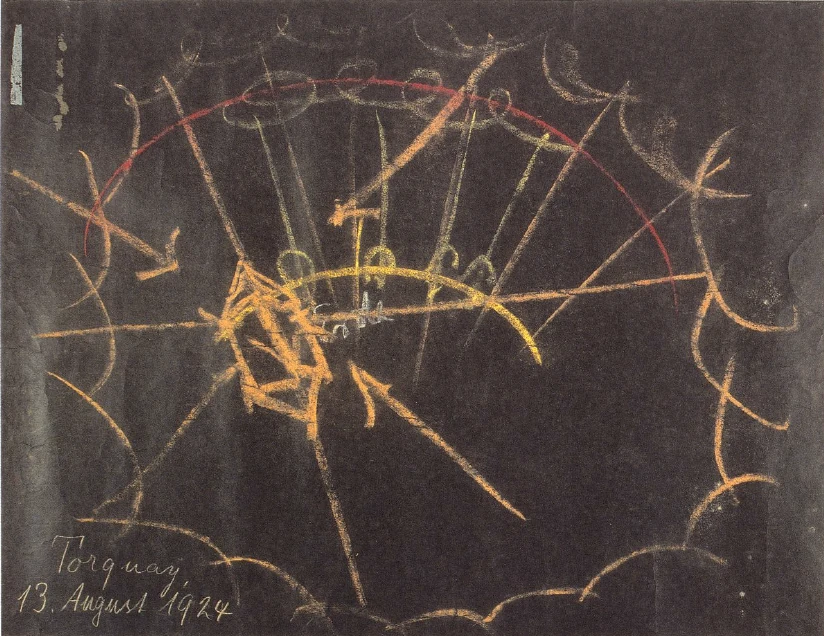
[ 9 ] If you look at the mountains outside and find a quartz crystal, it is usually resting on the ground; but there it is merely disturbed by earthly forces, and Ahrimanic powers intervene to disrupt it. In reality, it is formed in such a way that the spiritual element converges from all sides, reflecting one another, and you see the quartz crystal floating freely in the spiritual universe. In every single crystal, which forms perfectly in all directions, one can behold a small world.
[ 10 ] But there are, of course, many crystal forms: cubes, octahedrons, tetrahedrons, dodecahedrons, rhombohedral, dodecahedral, monoclinic, and triclinic forms—all kinds of shapes exist. Let’s take a look at them. We’ll see how the currents converge and intersect. Here we have a quartz crystal, a six-sided prism enclosed by six-sided pyramids; here we have a salt crystal, which may be cube-shaped; here a pyrite crystal, which may be dodecahedral. We look at all of this. Each of these crystals comes into being just as I have described, and we must tell ourselves: So there are so many differently shaped cosmic currents—in fact, so many spatial worlds; there is not just one world—there are as many spatial worlds as there are crystals that make up the Earth. We look into an immeasurable vastness of worlds. We look at the salt crystal and say to ourselves: Out there in the cosmos there is something essential; the salt crystal is for us the manifestation of something that permeates the entire cosmos as an essential being, a world in itself. — We look at the pyrite crystal, also cubic or dodecahedral. We say to ourselves: Out there in the cosmos there is something that fills all of space; the crystal is for us the embodiment, the manifestation of an entire world. — We look upon many beings, each of which encompasses a world within itself. And here on Earth we stand as human beings and say to ourselves: In the earthly realm, the deeds of many worlds converge. And as we humans on Earth think and act, the thinking and acting of the most diverse beings converge in our own thinking and acting. — In the immeasurably diverse forms of the crystals, we perceive a revelation of a great abundance of beings that express themselves in the crystals through mathematical-spatial forms. We behold the gods in the crystals.
[ 11 ] It is far more essential to allow the wondrous mysteries of the universe to take effect upon the soul—in reverence for the universe, indeed in a kind of worship of the universe—than to know anything theoretically with the mind. And anthroposophy should lead to this sense of being at one with the universe. Through anthroposophy, a person should be able to see, in every single crystal, the weaving and working of a god within the universe. Then the entire human soul is filled with the content of the universe, not just the mind with thoughts. Anthroposophy is least of all intended to fill the mind with thoughts. Anthroposophy is intended to fill the whole human being with enlightenment about the universe, with reverence and adoration for the universe. Into all objects and all processes of the world, I would say, the inner, spiritual act of sacrifice of the human being should flow. And this act of sacrifice should become knowledge.
[ 12 ] Substantiality and Metallicity of the Mineral World
[ 13 ] When one stands before the cosmic space, the cosmic cosmos, and looks into that which takes shape toward the Earth from the crystallized mineral world, one is initially presented with a satisfying sight. But this very soon gives way to the return of that state of anxiety, that state of fear, of which I have spoken. Before one perceives this god-borne, crystallized world, one experiences the fear I have described. This fear initially dissipates when one gazes upon this god-borne, crystallized world. But this ceases after some time, for one develops a peculiar feeling—the feeling that everything forming there as crystal supports you only in part.
[ 14 ] Let’s take the example I’ve chosen: a salt crystal that we’re looking at, and a pyrite crystal—a metal crystal. When you look at the pyrite crystal, you get the feeling that you can rely on it, that it will support you. When you look at the salt crystal, it seems as if you could fall right through it, as if it wouldn’t support you after all. In short, what was previously the great fear of sinking into nothingness—because the earth had become nothing—is now partially present again in relation to certain forms. And, in particular, a moral element intermingles with this feeling one has now acquired. At this very moment, when one is overcome by this fear for the second time, one feels within oneself not only all the sins one has committed in one’s past lives, but also all those one might still be capable of committing, all those one might still commit.
[ 15 ] All of this is like weights that cling to you, that want to plunge you into the abyss, into the chasm that opens up before you through the mineral crystals, through which you can fall. There, you must be able to arrive at a deeper sensation, at a deeper experience. All of this—everything one goes through there—requires courage, a courage that stems from telling oneself: You do, after all, have something within you that prevents you from falling upward, downward, to the right, or to the left; you have the center of gravity of your being within you.
[ 16 ] Oh, my esteemed audience, there is never a moment in life when one needs more self-confidence, more inner courage, than at the very instant when the leaden weight of one’s own selfishness—for selfishness is always sin—weighs upon one’s soul in the face of the crystallized mineral world. That which is transparent—that is, permeable, through which one can fall—becomes a terrifying warning. And if one retains one’s courage, one tells oneself: A drop of the divine rests within you; you cannot sink; you are of a nature that is divine. When this becomes an experience—not merely a theory—one gains the courage to remain upright and to press on.
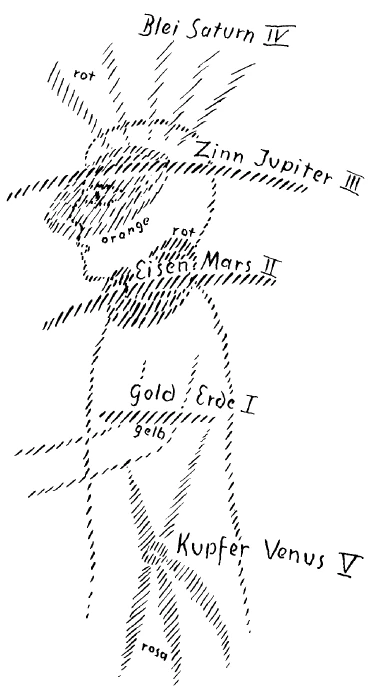
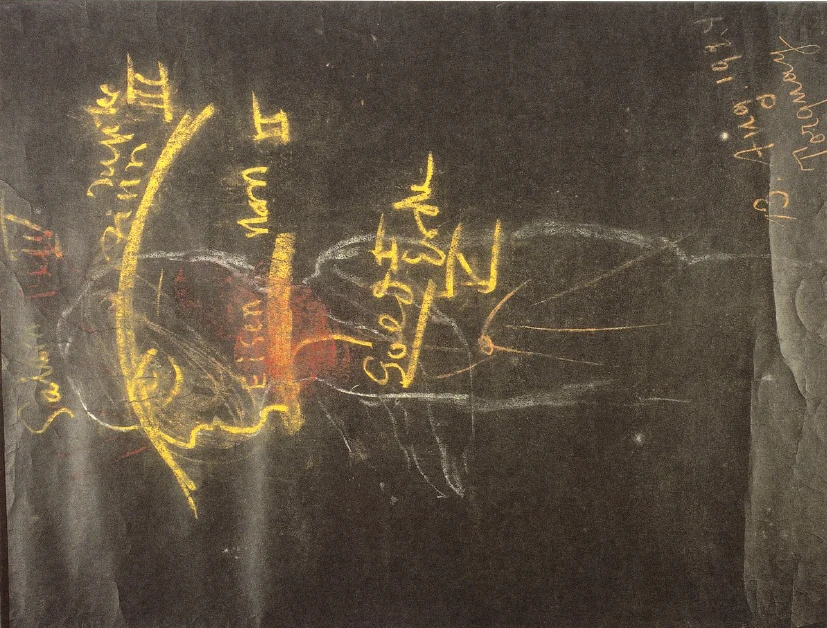
[ 17 ] And now one comes to know another aspect of the minerals. Previously, one became acquainted with the crystallized essence of the minerals. Now one comes to know their substantiality, their metallicity—that which permeates them internally as substance; previously the form, now what permeates them as substance. And one comes to realize how one is sustained in various ways throughout the universe by certain representative base metals. One now comes to know oneself as a human being in relation to the cosmos. And one comes to know the individual metallic qualities, the substantialities of the mineral being. One truly learns to feel within oneself that center I have just spoken of (see drawing on p. 59).
[ 18 ] And now, although I must express what I am saying using words that refer to material things, you must not interpret it in a material sense. When one says “heart” or “head,” people today, with their materialistic way of thinking, imagine the physical head and the physical heart. But all of this is, at the same time, spiritual. After all, it is formed out of the spirit. And so, when one now views the human being in their totality—as a spiritual, soul, and physical being—entirely from a spiritual perspective, one gains the clear sensation that it is first and foremost in the heart where the center of gravity lies—the one that prevents one from sinking down or flying up, that does not push one to the right or to the left, but rather holds one steady. If one maintains the courage I have just described, one comes to find oneself held fast in the universe. But what does it mean to find oneself held fast in the universe?
[ 19 ] Well, when one loses consciousness—when one faints—one is not held fast. When one experiences a strong inner sensation of pain, such that one feels more intensely within than in ordinary life—for pain is, after all, an intensification of inner feeling—then one is again not in ordinary consciousness. Pain drives one out of ordinary consciousness. One has a kind of intermediate consciousness in ordinary earthly life between birth and death. One must maintain this state. If this consciousness becomes too thin, one faints. If it becomes too thick, too dense, too self-absorbed, pain sets in; dissolving into nothingness in fainting and being compressed in pain are, on both sides, deviations of consciousness. This is precisely the feeling one now has toward the crystallized mineral world when one does not yet possess the metallic quality, the substantiality—the feeling that at any moment one might sink into unconsciousness, drift out into the vastness of the universe, or collapse in pain.
[ 20 ] That’s when you get the feeling: right where the heart muscles are physically located, that’s where everything that gives us a firm footing is concentrated. — And once you’ve advanced in your awareness as far as I’ve just described, you realize: everything that keeps one in earthly consciousness, in waking earthly consciousness—everything that makes this consciousness what is called “normal,” if I may use that ugly, philistine word “normal”—is the gold, Aurum, which is spread throughout the world with immense subtlety but acts with such immediacy on no other organ as on the heart.
[ 21 ] So, just as we previously perceived the formation and crystallization of the mineral realm, we now perceive its inner substance—its metallic nature. We sense how this metallic nature affects human beings themselves. Outwardly, we see the crystal that gives form to the metallic element in its mineral form. But within ourselves, we know that the force—which is spread throughout the entire universe in gold in an incredibly fine dosage—sustains our heart and thereby maintains the consciousness we possess when we are engaged in everyday life, in ordinary daily life. So that we can say: Gold acts upon the human heart (see drawing on p. 59).
[ 22 ] We can now conduct our experiments. We can learn by recalling metallic gold as it is, focusing on its color, its hardness, and its entire substantiality, and then having this inner experience that gold is connected to our heart. Then, through a different kind of concentration—for example, by focusing on iron and its properties—we can come to understand how iron affects us. Gold has an infinitely harmonizing, balancing effect on the inner being. Through the influence of gold, the inner being attains a state of inner equilibrium. If we concentrate intently on iron—after we have come to know it well—and forget the entire universe, focusing solely on iron, so that, in a sense, we ourselves are completely absorbed in iron within our inner life, become iron, and experience ourselves as iron, then we feel as if our consciousness were rising up from the heart. We still feel quite clear-headed, but we feel how consciousness rises from the heart and reaches up to the throat, to the larynx. If one has practiced sufficiently, this causes no harm. If one has not yet practiced sufficiently, then a slight fainting sensation occurs. One becomes familiar with this slight fainting sensation as consciousness rises either by actually fainting slightly, or by having developed inner activity and a strong force of consciousness. Then, little by little, one immerses oneself in this ascent of consciousness and approaches that world—including through a method such as the one I have just described—the world I spoke of yesterday, where one sees the animals with their group souls. But now one is inside the astral world by having concentrated on the metallic nature of iron.
[ 23 ] If one focuses on the form of metals, one arrives at the divine beings. If one focuses on the metallic nature, on the substantial nature, then one enters the astral worlds—the astral world, the world of souls. Here one feels consciousness rising up through the throat (see illustration on p. 59), enters a different sphere of consciousness, knows that this is due to concentration on iron, and has the feeling that one is no longer the same person as before. When one enters this state fully and precisely consciously, one has the feeling that one is no longer the same person as before; one has become ethereal. One has risen out of oneself and become ethereal. The Earth recedes; it no longer interests one. But one ascends into the planetary sphere, which is now, so to speak, one’s dwelling place. In this way, one emerges more and more from oneself and into the universe. The path from gold to iron is the path out into the universe.
[ 24 ] One can go further. Just as I described for gold and iron, one can now focus, for example, on tin—another metal—again on its metallic quality, its color, its consistency, and so on, so that one’s consciousness becomes entirely tin. You feel that your consciousness rises even further. You feel that if, as a human being, you go through this unprepared—without the necessary exercises—you become very faint; only a spark of consciousness remains. But if one has completed the exercises, one remains within this state of faintness and, on the contrary, feels oneself slipping even further out of one’s body. Now one slips out even further. One feels that one’s consciousness has risen as far as the eye region (see drawing on p. 59). You feel yourself out in the vastness of the universe. Yet you still feel yourself within the stars. The Earth, however, begins to appear as a distant star. And you think: Down there you have left your body on Earth; you have now ascended into the cosmos and are experiencing life among the stars.
[ 25 ] Yes, you see, what I’m describing to you here isn’t quite so simple. Because what I’m describing—what one experiences by undergoing the path of initiation, so that one feels during that path: your consciousness is in the larynx, you have consciousness; it is in the larynx; that you feel: your consciousness is there in the lower parts of the head and in the forehead—the fact that you feel this merely indicates that it is always present within the human being.
[ 26 ] All of you sitting here have these states of consciousness within you; you just don’t know it. How do you have them within you? Well, you see, human beings are simply not simple creatures. The moment you became aware of your entire laryngeal system—if you could cast aside your brain, cast aside your senses, and develop only your consciousness as a human being in the larynx and all that goes with it—then you would always have this subtle, subconscious feeling of powerlessness. But you do have it. It’s just covered up by ordinary heart consciousness, by golden consciousness. This consciousness I’ve just described resides within all of you; a part of your human self possesses it. A part of your human self lives with it out among the stars, not on Earth at all.
[ 27 ] Even further out in the universe lives the tin consciousness (colored orange in the drawing). It is not true at all that you live alone here on Earth. You live on Earth because you have a heart. That is what holds your consciousness together on Earth. That which resides in the larynx (Iron: red) lives out there in the universe. And even further out lives that which resides above the eyes in the head (Tin). Iron extends all the way up to Mars. Tin extends all the way up to Jupiter. It is only through Gold that you are on Earth. You are always in the universe; only the heart consciousness conceals this from you.
[ 28 ] If your concentration now turns to lead or a similar metal—again, to its substantiality, to its metallic nature—then you step completely outside of yourself. Then it becomes perfectly clear to you: Down there on Earth, your physical body rests, and so does your etheric body. That is something foreign. It is down there. It concerns me now as little as the stone resting on the rock. — Consciousness has risen out of you, here (from the upper part of the head: red). There is always a small amount of lead present in the universe. This consciousness up there extends far out. And with what is still present in the skull along with this consciousness in human beings, they are always in a state of complete powerlessness.
[ 29 ] Think of the illusions in which human beings live. They believe that when they sit at their desks, writing financial reports or feature articles, they are thinking with their heads. But that is not true at all. The head is not on Earth at all. It is on Earth only in its outward manifestation. The head extends from the neck out into the universe. The universe reveals itself solely within the head. What makes you an earthly being on Earth between birth and death is the heart. And whether someone writes good or bad feature articles, or prepares accounts that take advantage of others or do not, it all comes from the heart. The best thoughts you can have—they all come from the heart. It is merely an illusion that a person lives on earth with his head. He does not live on earth with his head. The head is, in fact, constantly powerless. That is why it can become painful in such an extraordinary way, whereas other organs do not become painful. I will elaborate on this further. So that when we think about getting to the bottom of who we are, we are actually constantly threatened, spiritually speaking, that the mind will shatter out into the cosmos, that the entire consciousness will disperse upward, disintegrating into the Mighty-Powerless. All of this is held together by the heart.
[ 30 ] Human beings actually live in such a way that we can say: In the larynx (iron), they develop the consciousness that I have described to you as that which extends into the animal kingdom, to the higher forms that underlie the animal kingdom. Here in ordinary life, this consciousness simply does not come to the fore; it is present whenever a person gazes out toward the stars. You always carry that consciousness within you. Up here is the consciousness of the plant forms; down here are their mirror images (see drawing on p. 52). And right at the top, where the consciousness of being resides, where we reach all the way up to Saturn—there, our head knows nothing of the feature article we are writing; we write that with our heart. But the head knows all that I have described to you today, all that is contained therein (see drawing p. 52). So someone can sit there, describing earthly things—it comes from his heart. Meanwhile, his head can occupy itself with the way a god reveals himself in a piece of pyrite, in a salt crystal, in a quartz crystal.
[ 31 ] And when the consciousness of the initiate now looks upon these chairs, your hearts listen to what I say; but the three superimposed consciousnesses—they are in the cosmos. Things take place there that are of a completely different nature than what exists in ordinary earthly consciousness. Above all, what lives within what unfolds there—that which is constantly expanding—are the living threads that weave karma for each person, and so on.
[ 32 ] You see, this is how one gradually comes to know human beings from the perspective of the universe. — Well, we have come to know the human being who is, in fact, connected to the external world, who is constantly in danger of fragmenting outwardly, who becomes powerless in relation to the outside world, and who is held together by the heart.
[ 33 ] From Spatial Consciousness to Temporal Consciousness
[ 34 ] We move in a completely different spiritual direction when we focus our attention on certain other types of metallicity. Just as we can do this with iron, tin, and lead, we can also do so, for example, with copper. We can concentrate on the metallic nature of copper, so to speak, become one with the copper, become entirely copper in our inner life—in its color, its consistency, that peculiar grooved surface of copper—in short, in everything that can be experienced spiritually in the metallic nature of copper. Then one does not get the feeling of slipping into a state of powerlessness; rather, the opposite occurs. One gets the feeling of being filled up inwardly with something. One becomes more tangibly present within oneself than one usually is. One literally has the feeling that this copper, on which one is concentrating one’s thoughts, fills one from head to toe, all the way to the fingertips, everywhere, right down into the skin. It fills you. It fills you with something. And whatever it is that fills you—you feel it radiating from there (see drawing $59, pink). It then radiates from this center, which lies below the heart, into the entire body. You feel as if there is a second body within you, a second person. You feel a sense of internal pressure. A faint pain begins, which intensifies. You feel everything internally compressed.
[ 35 ] But once again, with the initiate’s sense, one penetrates all of this, and in this way one senses a second human being within the human being. And it becomes significant when, precisely with this sense of initiation, one can now experience it in such a way that one can say to oneself: With your ordinary human being—the one you received through birth and upbringing, with whom you go about in the world, with whom you look at the world through your eyes, with whom you hear and feel things—with this human being you go about; but because you have trained yourself, because you have done exercises, you also enable this person—this second person who is now emerging from within you—to perceive. — This second person does indeed become a peculiar being. His eyes and ears are not so distinct; he is, as it were, entirely eye and ear; but he is like a sensory organ. He perceives with great subtlety. And he perceives things that we would otherwise not perceive. The world is suddenly enriched. And then, like a snake shedding its skin, for a certain time—which need not be long at all, which may last only seconds—one can, even in a matter of seconds, experience a great deal—with this second human being, who has developed within one, I might say, as the “copper human,” step out of the body and move freely in the world spiritually. He is separable—even if all of this causes pain, even if the pain intensifies—he is separable from the body.
[ 36 ] You can get out. If you get out now, you can experience even more than if you stay stuck inside. Above all, once you’ve managed to make this exit possible, you can follow someone who has died into the world they will enter after a few days. So someone has passed through the gate of death, and all the relationships you had with that person as an earthly human being come to an end. They are cremated or buried. They are no longer here on Earth.
[ 37 ] When one leaves the body together with this second human being I have just described, one can continue to follow the soul that has passed through the gate of death. One remains with this soul. And one then experiences how this soul, in the first years and decades after passing through the gate of death, relives its life in reverse. This is the truth. One can observe it. One can continue to walk with the deceased. One sees that whatever the person experienced here on earth in the days before their death, they relive it in reverse—the most recent event first, the second-most recent second, and so on. They relive everything. They relive their life in reverse, covering one-third of their lifetime, all the way back to the moment of their birth. If someone lived to be sixty years old, they relive approximately twenty years, going through their entire life in reverse. One can follow them.
[ 38 ] And the remarkable thing is that you come to know a great deal about a person just as they are immediately after death. A person doesn’t just relive things the way they experienced them here on Earth. Please forgive me for using a crude example. Let’s suppose that three years before your death, you slapped someone—I want to use a crude example. You were angry with that person. Your anger boiled over. Of course, I know that no one sitting here would do such a thing, but I just want to choose a crude example. So let’s assume you were angry, that anger boiled over, and you caused another person emotional and physical pain. You felt satisfied. You were content. You punished him for what he had done to you.
[ 39 ] Now, when you go back and arrive at that event—a year later, you arrive at that event—you don’t experience what you experienced as your own anger, but rather what he experienced as emotional suffering and physical pain. You fully put yourself in his shoes. You then feel the slap in your soul. You must truly empathize with the physical pain. And so it is for all events. You experience the events just as others have experienced them. In all of this, one can follow the person.
[ 40 ] You see, people knew more about these things back then than they do today—in the era I’ve been telling you about these past few days—among the ancient Chaldeans, who drew the impetus for their culture from the mysteries. It was very peculiar with these Chaldeans. They did not live so much from the heart as we do today, but rather—among the Chaldeans—they truly lived from the larynx. The Chaldeans possessed, as their natural consciousness, a kind of iron consciousness. They experienced the outer universe. The Earth did not seem as hard and solid to them as it does to us. But when they lived out there during particularly favorable hours—for example, living on Mars, living together with the Martian beings—then a moment could arise for them when beings came over from the Moon, bringing with them precisely the kind of beings one perceives when one is in this “second human” that I have just described. And so, through a roundabout path out in the cosmos, the Chaldeans came to know profound truths relating to life after death. They were instructed out in the cosmos.
[ 41 ] Today we don’t need that. We can follow the deceased directly. We can accompany him as he relives his experiences in reverse chronological order—and even in the opposite order. And the peculiar thing about this is that, once you have stepped out of your body in this way with this second person, you find yourself in a world that is much, much more real than our earthly world. The earthly world and everything you experienced there then seem like shadows compared to the dense, demanding reality you have now entered.
[ 42 ] When one accompanies the dead in the manner described, everything feels twice as heavy, three times as heavy, three times as bright, three times as loud—everything feels much more real—and the entire physical world seems quite shadowy. For those who move through this world with the consciousness of an initiate, the physical world becomes a collection of paintings, and it could well be that such an initiate—who, as part of his duties, has often interacted with the dead in this way—would say to you: “You are all just painted figures.” You are not real at all. There you are, painted on your chairs.—For the true realities—one discovers them only on the other side of existence. There, everything is much more real. This reality—you can already experience it, my esteemed audience.
[ 43 ] Perhaps some of you remember my Mystery Dramas. The others may have the opportunity to read them, since they have been translated into English. A character named Strader appears in them. This character, Strader, is based on a real person. There was a person in the last third of the 19th century—who lived well into the 20th century—whose likeness, though artistic and poetic rather than photographic, is embodied in Strader. Well, this person interested me greatly as a real-life figure. In life, this person was first a Capuchin friar, then changed course and became a philosopher; he also once visited the monastery in Dornach. I have reworked and reshaped this person, who interested me so much in real life. He lives on as Strader in my Mystery Plays—only similar, not identical.
[ 44 ] Now came the fourth mystery. As you know, Strader dies in the fourth mystery. I had to let him die. I could not have continued to develop the character of Strader any further. He could not have reappeared in a fifth mystery. My pen would have dropped from my hand if I had wanted to write anything further, to characterize him any further. Why did this happen? Well, you see, in the meantime, the real personality—the one who had gone from being a Capuchin to a philosopher—had died. And because of the interest I had in this personality, I was now able to follow him into the other world. There, he seems much more real. There, what could initially still be described in the physical world ceases to hold as strong an interest as what one now experiences with such a personality when one follows him after death.
[ 45 ] And something peculiar began to unfold. A few anthroposophists came across this situation; they figured out—after all, some people are quite astute, aren’t they—that Strader is a kind of likeness of that man. They investigated and uncovered his estate and all sorts of interesting things the man had left behind; they brought them to me, assuming that I would now be seized by a bright, jubilant interest in everything this person had left behind. I couldn’t bring myself to care about any of it. On the other hand, I was interested in everything the man was doing now, after his death. That’s much more real. Everything external—what he left behind—paled in comparison.
[ 46 ] At first, people were surprised that I was so uninterested, given that they had gone to such great lengths to obtain all sorts of items from the estate—things I didn’t even want. I still haven’t asked for them to this day. But the fact is this: earthly reality becomes an illusion compared to the powerful reality that confronts one when one follows an individual after death, where that individual stands within the very world that one experiences for oneself; when, in the way I have described, one is filled with the person who can step out of the body, even if only for a short time; but in a short time, one can experience a great deal.
[ 47 ] There is precisely this world that borders directly on our physical, sensory world—a world in which, so to speak, the dead live directly, and which one experiences as much more real because one experiences it together with the person who steps out of it. Now one is not unconscious; now one’s consciousness is more intense. If one moves one’s consciousness upward beyond the heart, then consciousness becomes more subtle; one approaches a state of fainting; if one moves downward below the heart, consciousness becomes denser. One enters the worlds that are real. One must simply be able to endure it. They press, they hurt. But if one pushes in with the necessary courage, one enters. (See drawing on p. 59.)
[ 48 ] Thus, we now have our ordinary daytime consciousness in the heart (I), a second consciousness in the larynx (II), a third consciousness in the eye region (III), a fourth consciousness at the top of the head (IV), which already leads entirely out into the cosmos, and then a fifth consciousness (V), which now leads one not out into the worlds of space but back through time. One travels through time; one makes one’s way through time when one approaches this fifth consciousness; one follows the path that the dead travel back along. One has stepped out of space and entered time.
[ 49 ] As you can see, everything depends on shifting into other states of consciousness. You come to know other worlds when you enter different states of consciousness. Human beings live here on Earth in one world because they have only one state of consciousness—because they sleep through the other states of consciousness. If you do not sleep through them, but instead enter these other states of consciousness, then you experience those other worlds. This is the secret of exploring other worlds: that human beings themselves become different within their own consciousness. For one does not enter other worlds through daydreaming or by exploring with the same means one has in ordinary life, but rather through metamorphosis—through the transformation of consciousness into other forms of consciousness.