Initiate Consciousness
True and False Paths of Spiritual Research
GA 243
12 August 1924, Torquay
Translated by Steiner Online Library
2. The Three Worlds and Their Reflections
Differences in Consciousness Between the Old and New Eras
[ 1 ] If one wishes to form an understanding of spiritual research, one must first and foremost gain a concept of the various states of consciousness in which the human soul can find itself. In the ordinary life that people lead on Earth today, they find themselves in a very specific state of consciousness. This state of consciousness is characterized by the fact that people experience a certain distinction between waking and sleeping, which roughly—though not exactly in terms of time—corresponds to the course of the sun around the Earth and the Earth’s rotation on its axis, respectively. In our present time, the order to which I am referring here has, in a certain sense, been disrupted. But if we look back to times not too long ago, when life followed a regular rhythm, we find that people then worked from about sunrise to sunset and slept from sunset to sunrise.
[ 2 ] In our time, this pattern has been somewhat disrupted. I’ve even met people who’ve reversed it, sleeping during the day and staying awake at night. I have often wondered why this is the case. The people in question—who, among my acquaintances, were mostly poets or writers—said that this is simply part of the process of writing poetry. But whenever I met them at night, I never found them actually writing poetry!
[ 3 ] Well, I would simply like to point out, my esteemed audience, that for modern consciousness, the most important fact is, so to speak, to be awake during daylight hours—or to be awake for a period as long as daylight hours—and to be asleep for a period as long as nighttime. But there is much, much more connected to a consciousness that experiences this. It is connected to the fact that one attaches a certain, very specific value to sensory perceptions. One sees sensory perceptions as the primary reality. And when one moves from sensory perceptions to thoughts, one sees thoughts as merely something conceived—something that is not as real as sensory perceptions actually are.
[ 4 ] Today, people regard the chair as something real. They can push it against the floor. They hear that, too. They regard it as something entirely real. They also know that they can sit on the chair. Yet people do not regard the idea of the chair as something real. When they give voice to the thought they believe is in their head, they do not hear it. And people do not believe—rightly so, given the nature of human beings today—that they can sit down on the thought of a chair. And surely none of you would be satisfied if we had merely placed thoughts of chairs in this hall!
[ 5 ] Well, there are many other aspects connected with this experience of consciousness that is oriented toward the sun. This was not the case for those people who received their teachings—the inspiration for all aspects of their lives—from the mysteries, such as those of the Chaldeans, whom I mentioned yesterday. These people also lived quite differently in their consciousness than people do today.
[ 6 ] First of all, you see, I can cite an external example that illustrates the difference in people’s consciousness between that time and today. Our method of calculating the year—assuming it consists of three hundred sixty-five days—does not work properly. If we were to continue counting through the centuries, always assuming the year consists of three hundred sixty-five days, we would eventually end up with a result that no longer corresponds to the position of the sun. We would fall behind the sun and its phases. We therefore insert a day every four years. This allows us to keep pace with the sun’s position over the course of longer periods of time.
[ 7 ] How did the Chaldeans do it in their earliest times? Not the way we do. For long periods, they used a counting system similar to ours, but they arrived at it differently. Because they calculated the year as three hundred sixty days, they needed to insert a full intercalary month every six years—not, as we do, a leap year with a leap day every four years, but an intercalary month every six years. So they had six years with twelve months, then a seventh year with thirteen months, followed by six years with twelve months, then another seventh year with thirteen months, and so on.
[ 8 ] You see, this is the kind of thing today’s scholars take note of. They say that’s how it was. But the fact that this is connected to profound changes in people’s states of consciousness—that is not known. These people, who inserted not a leap day every four years but a leap month every six years, viewed the world quite differently from us. Why? Because they did not perceive the difference between day and night in the same way we do today. As I hinted at yesterday, they did not experience the same clarity and brightness during the day as we do today. If anyone with today’s consciousness were to stand here and look into the hall, they would see the people—well, as you know—with sharp contours. In some cases, these contours are more widely spaced; in others, they are narrower, and so on, but one sees the people with sharp contours.
[ 9 ] That was not the case with those who drew their inspiration from the ancient Chaldean mysteries. It was quite different for them. Back then, people were seen sitting—if I may use this image—not the way we sit now; that was not customary back then, but people were seen sitting surrounded by an auric mist that was considered part of the human being. And while today we see each person sitting on their chair with sharp contours in such a philistine way—and the whole scene looks as though one could easily count them—back then one would have seen the left and right rows of chairs here as if enveloped in a kind of auric cloud that stretched out like a gas, a cloud here, a cloud there, and then darker spots, and these dark spots would have indicated the people.
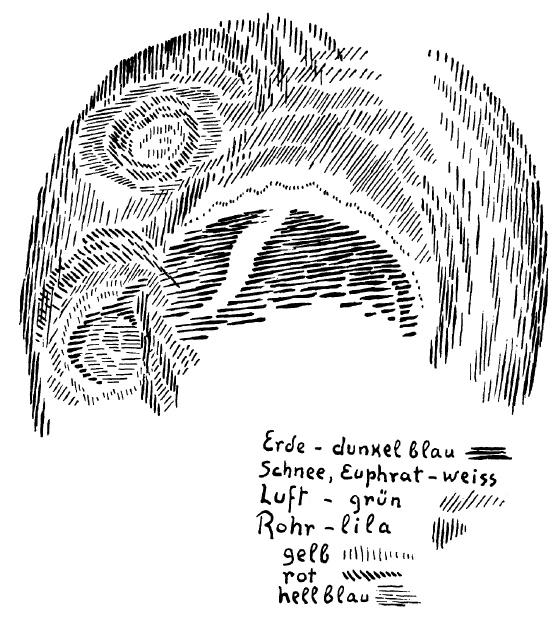
[ 10 ] Thus, one would have seen this image not in later times, but in the earliest days of Chaldea. By day, one would have seen only the dark areas within this auric mist-like formation. By night, one would have seen something quite similar, and also while asleep, for sleep at that time was not as deep as it is today. It was more dreamlike. One would not have seen it the way one would see it today. If someone were sleeping today and all of you were sitting here, he would not see any of you at all, even if you were all sitting here. That kind of sleep had not yet been attained back then; rather, even in sleep, one saw the dream-like form of the auric cloud to the left and right, and within it the individual human beings as figures of light—dark within the auric cloud by day, and as figures of light within the auric cloud by night.
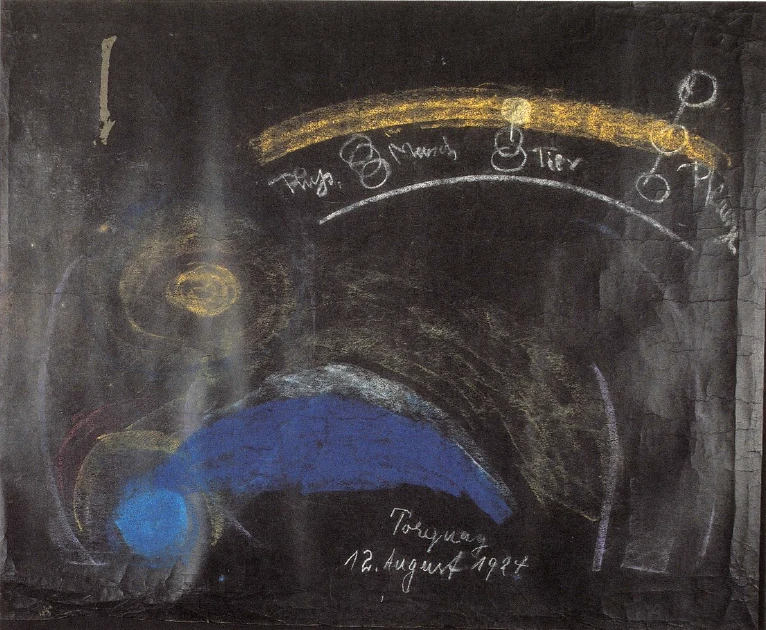
[ 11 ] Back then, there wasn’t such a great difference in the way people viewed daytime and nighttime conditions as there is today. And so people did not perceive a difference between the sun standing in the sky and the sun being absent at night; rather, they perceived it in such a way that during the day they saw the sun as a sphere of light, as a circle of light, surrounded by a wondrous solar aura—something like this, which I could draw as follows. People imagined: down below is the Earth (dark blue), water everywhere above, and snow lying at the very top. From up there, they imagined, comes the Euphrates. Then they certainly thought of the air (green) above it all. They saw the sun moving up there, enveloped in a beautiful aura. Thus the sun moved from east to west.
[ 12 ] Then people imagined that there was something about which they might say, much as we might speak today of a tube: in the evening, the sun goes into this tube; in the morning, it comes out of this tube (purple). But people saw the sun inside this tube. And they saw the night sun something like this: a greenish-blue glow in the center and a yellowish-red glow all around it. That is how people imagined the sun—emerging from the tube in the morning, bright in the center, surrounded by an aura. It travels across the vault of heaven, slips into the sky in the west, into the tube, grows dark, has an aura that extends beyond the tube, and so it continues on below. People spoke of a tube, of a hollow space, precisely because they saw the sun as dark, black. They described what they saw. So even when they looked up at the sun-filled sky, they did not see the difference between day and night as clearly as we do today.
[ 13 ] In contrast, people at that time focused very strongly on something else. They looked back on their childhood. That was where they had spent the first six or seven years of their lives. There, they saw themselves literally still immersed in the Divine, in which they had been before descending to Earth. Then, between the ages of seven and fourteen, one felt oneself gradually emerging from the auric, spiritual egg, continuing to emerge until one’s twenties; and only when one reached one’s twenties did one truly feel at home on Earth. It was then that one began to perceive the difference between day and night more clearly.
[ 14 ] One could see a process of development unfolding within one’s own being that took place over periods of six or seven years. This aligned one with the course of the moon, not the sun. The moon, which appears full and then less illuminated over the course of twenty-eight days, aligned one with what one experienced through the numbers six and seven in the course of one’s own life. And one sensed: What the moon accomplishes in a month, one goes through in twenty-eight years—in four times seven years. And this was expressed in the external calendar; every six years, a thirteenth month was inserted. People calculated according to the moon, not the sun. And they did not view external nature in the same way as we do today. Today, when one is awake, one sees external nature in its sharp contours, in a non-spiritual way. Back then, one saw external nature both day and night, though not with sharp contours; rather, one saw it spiritually, aurically. Today, one sees everything by day and nothing by night. All of this is expressed by the fact that one attaches importance to the sun, which brings about day and night.
[ 15 ] The sun did not hold this significance for the ancient Chaldeans in their mystery wisdom; rather, the moon held this significance because its phases reflected the process of human growth. People focused even more on the human being and his development. One felt quite different as a child, as a youth, and as an adult, whereas today one does not feel that at all. There is no longer such a great difference between the first seven years and the second seven years when one looks back on them. Today, children are already so clever—oh, so clever—that one simply cannot cope with them. You have to come up with special parenting methods just to cope with them. They’re just as smart as the grown-ups. And everyone is equally smart, no matter how old they are.
[ 16 ] That was by no means the case in ancient Chaldea. There, the little ones were still immersed in the divine-spiritual realm, and people later realized: when one was small, one was still immersed in the divine-spiritual realm, and only later did one become earthly, crawling out of the auric egg. And they did not take into account the effects of the sun, but rather calculated based on the moon—on the patterns the moon presents in the sky, arranged according to the number seven; they calculated according to that. Therefore, in the seventh year, they added a month—the one related to the moon.
[ 17 ] But this outward sign of civilizational development—the fact that we today calculate with leap days, while the Chaldeans calculated with leap months—actually indicates that the ancient Chaldeans did not distinguish between day and night in their consciousness, whereas they did make a clear distinction between the various stages of human life.
[ 18 ] Today, when we wipe the sleep from our eyes in the morning, we say: “I have slept.” — The ancient Chaldeans awoke at the age of twenty-one or twenty-two, gained clarity in their view of the world, and said: “I have slept until my twenty-first or twenty-second year.” They believed then that they lived awake into their fifties, but that they did not fall asleep as old people; rather, they entered a much more lucid, conscious life. Therefore, the elderly were regarded as those who were wise, who, with the consciousness they had acquired since the age of twenty, now entered the world of sleep, but became extraordinarily clairvoyant there.
[ 19 ] Thus, the ancient Chaldean experienced three states of consciousness. We experience two, with the third only hinted at as the dream state: waking, sleeping, dreaming. The ancient Chaldean did not experience these three states in the natural cycle of day and night, but rather experienced a dull, slumbering state of consciousness well into his twenties; then a state in which he lived with the world—a waking state in which he said he had awakened—well into his fifties. And then a state in which others said of him: “He carries his earthly consciousness into the spiritual world. He is now in a state where he knows much more than the others.” — People looked up to the elderly as to those who possessed knowledge. Today, people do not do that. Today, they regard them as old fools who have lost their minds. That is precisely the great difference that extends into the very innermost constitution of human life.
[ 20 ] We must be clear about this difference, for it is of immense significance for human beings. We simply do not view the world through just one state of consciousness. One can only come to know the world if one understands what the state of consciousness was like—for example, in the child in ancient Chaldea. It resembles—that is to say, it is not identical, but merely similar to—our dream state. But it is a much more vivid dream state. It is a dream state from which one acts. Today, this manifests as a pathological condition. What is considered a disease today was, among the Chaldeans, a child’s state of consciousness. And the waking state, which we today perceive as so philistine, did not yet exist. I say “philistine” because the fact that we perceive all people in their physical contours, my esteemed audience, is indeed philistine; to perceive people in their sharp contours—and even to paint them in these sharp contours—is philistine. Certainly, people will not admit this, but it is so. This state, then, did not yet exist in ancient Chaldea; rather, as I have described, people there saw others both physically and aurically. And in ancient times, one could see right through a person into their soul. It was a third state of consciousness that has been extinguished today, for it is the state in which we sleep without dreams. It can be compared to that.
[ 21 ] And so, when we look at the matter historically, we see that the further back we go in human history, the more we encounter different states of consciousness that differ more and more from one another, whereas today we cannot make much of the states of consciousness we experience in ordinary life. No value is placed at all on what a person experiences when sleeping without dreams, for as a rule, they have very little to say about it. There are very few people who can still tell us what they experience even today during dreamless sleep; but there are very few of them, very few indeed. Dreaming, people say, is just imagination, and the waking state is regarded as the respectable one—the state that can be relied upon.
[ 22 ] This was not the case with the ancient Chaldeans. The childlike state of consciousness, with its vivid dreams that also led to activity, was regarded as a state in which children were still halfway immersed in their pre-earthly life—a state in which, when they spoke, they could convey something that belonged to the divine world. People listened to the children because they knew: the children had brought down various things from the divine world. People viewed children quite differently back then.
[ 23 ] Then there was the state of consciousness in which people were already physical beings on Earth, but their auras were still spiritual. Then there was the state of consciousness of the elderly. When one listened to them, it was clear: here one learns something about the spiritual world; here one is told what is happening in the spiritual world. And of those who ascended higher and higher in the Mysteries, it was said: In their fifties, they overcome the purely solar aspect, enter into the truly spiritual realm, and transform from solar heroes into fathers—into fathers who are connected to humanity’s spiritual homeland.
[ 24 ] In this way, I wanted to use historical examples to illustrate the various states of consciousness that exist within human beings.
The Naturally Creative Imagination of Today's Dreams
[ 25 ] To examine the states of human consciousness, let us first set aside the dreamless sleep of modern humans and consider what you are all familiar with: the ordinary waking state that you experience when you say: “I am awake; I see the objects around me; I see other people; I hear them speaking to me; I talk with them, and so on.”
[ 26 ] And let’s then consider the second state, which you are all familiar with, where you believe you are asleep, but from which emerge those dreams—often so frightening, often so wonderfully liberating—to which, if you are in good health, you must say: These are things that do not belong to ordinary everyday life; they arise and weave themselves from some natural imagination and approach people in the most varied ways. The thoroughly philistine person will not pay much attention to dreams. The superstitious person will have them interpreted in an external way. The poetic person—the one who is neither philistine nor superstitious—still pays attention to this wondrous weaving and life of dreams. For something rises up from the natural depths of the human being—something that, while not having the significance the superstitious person attributes to it, nevertheless indicates that even the person asleep experiences phenomena arising from the natural realm, which rise like clouds, like mist, and, just as mountains eventually rise, sink back down again over the course of long ages. The only difference is that this happens quickly in the life of dreams, whereas in the universe as a whole, these formations rise and fall slowly.
[ 27 ] Dreams have a second peculiarity as well. We dream of snakes surrounding us, and indeed of snakes touching our bodies. People who abuse substances such as cocaine may experience this “snake” sensation in their dreams to a particularly high degree. For those who indulge in the vice of cocaine use, the dream snakes crawl out from every corner of their bodies in their dream perception, even when they are not asleep.
[ 28 ] And so we can say: We look for dreams that are of the kind just described. — Whenever we pay attention to life, we will see that it is such dreams that indicate to us that something is not right within ourselves. We notice an indigestion when we have such snake dreams. In our dream vision, the coils of the digestive organs are symbolized to us by the coils of snakes.
[ 29 ] Or someone dreams that he is going for a walk and suddenly comes to a spot where a completely white stake rises up, but its top is damaged—a white stone stake, a stone pillar with a damaged top. In his dream, he becomes restless because of this damaged top of the stake. He wakes up: a toothache! He feels an unconscious urge to touch one of his teeth—after all, he can feel the tooth. I’m referring to the average person of today, not an older person who was above such things. A typical person today would say: “Now I have to go to the dentist; that tooth needs a small filling—it’s damaged.” So what happened here? This entire dental experience, associated with pain and representing a disturbance in the entire organism, presents itself in a symbolic image. The tooth is a white peg, somewhat damaged, somewhat worn away. In the dream image, we perceive something that is actually within us.
[ 30 ] Or we might have a vivid dream in which we are in a room where we cannot breathe at all. In the dream, we become restless, though this is all part of the dream experience. There—we hadn’t noticed it before—is a stove in the corner that is very hot. It has been stoked too high. Ah, now we know in the dream why we can’t breathe: it’s hot in the room! All of this is in the dream. — We wake up. Our heart is pounding and our pulse is racing. Our circulation, which has become irregular, manifests itself externally in this way as a dream. There is something there, something within ourselves; we perceive it, but we do not perceive it as we do during the day. We perceive it in symbolic form. Or we dream that somewhere out there, beyond the window, the sun is shining brightly. But the sunlight unsettles us. In the dream, we become unsettled by this shining sun, which we otherwise take pleasure in. We wake up—the neighbor’s house is on fire. An external event is not symbolized as it is, but in an entirely different image. So we can already see that there is a naturally creative imagination at work in the dream. The external world expresses itself in the dream.
[ 31 ] But it didn’t have to stop there. The dream can, so to speak, take on a life of its own, possessing its own inner meaning and essence. We dream something, and the dream—which, admittedly, presents itself to us in images—cannot be reduced to anything external. As we gradually come to realize this, we say that a completely different world has found expression in the dream. Different beings are active there; we encounter a demonic being or even an elf-like, beautiful being. So it is not merely that our ordinary physical-sensory world, as it exists within and outside of us, is represented pictorially in the dream; a world entirely different from our own can also intrude into the dream. People can dream of the higher supersensible world in sensory dream images.
[ 32 ] Thus, modern human consciousness possesses the dream alongside ordinary waking consciousness. And one must indeed say: The predisposition to dream is what actually makes us poets. — People who cannot dream will always remain poor poets. For one must, so to speak, translate what occurs naturally in dreams into waking imagination in order to be a poet—or indeed, an artist at all—an artist in all fields.
[ 33 ] For example, someone who dreams more of the kind in which external objects are symbolized—such as a neighbor’s burning house represented by the sun shining into the room—will feel inspired to compose the very next day after having such a dream. He is a musician. Someone who, let’s say, perceives his own heartbeat as a boiling stove will feel inspired the next day to sculpt or create architectural structures. He is an architect, a sculptor, or even a painter.
[ 34 ] These things are connected in the way I have described them. In ordinary consciousness, one remains at the level of what I have just described. But one can now go further. One can develop this ordinary consciousness as I have described in my books, in How to Attain Knowledge of the Higher Worlds?, which is translated here as Initiation, or in my Outline of Occult Science, which is translated here as Occult Science. One can develop ordinary consciousness by performing certain spiritual exercises—we will speak of them later—and one can make one’s entire life of thought, feeling, and will, one’s entire inner life, more active by devoting oneself to very specific mental images and linguistic contexts, so that thoughts become almost tangible and feelings become like living beings. I will describe this in more detail later.
[ 35 ] Then something occurs that marks the beginning of a modern initiation. Then we find ourselves daydreaming. But here I come to a point where misunderstandings can easily arise. The person who slips into daydreaming quite naturally is not to be held in particularly high regard for his daydreaming. Only the person who, despite daydreaming, is as alert as anyone else and yet can still drift off into daydreams—because they have made their thinking and feeling much more active within themselves than other people—begins to become an initiate. For when one reaches this point, the following occurs. Then one sees, once again—because one is, after all, a reasonable person who is no less reasonable during the day than others, who does not get up to all sorts of crazy antics because one is dreaming, but because one is just as sober during the day as other reasonable people—then one sees, on the one hand, the person as they appear to ordinary consciousness: you see the shape of their nose, the color of their eyes, their beautiful or unattractive hairstyle, and so on. You see everything, but you begin to dream of something else around the person—only now you are dreaming the truth, dreaming the aura, and spiritually perceiving the inner, spiritual meaning of the actions performed between people. One begins to have meaningful, realistic dreams in full wakefulness. The dreaming does not stop in the morning upon waking; it lasts until one falls asleep, then transforms into sleep. But it is meaningful. What one sees in a person is truly spiritual in that person. What one sees in actions is truly spiritual there. One is engaged in a genuine activity, as one otherwise is in mere reminiscences or in mere dreams. But one dreams spiritual reality.
[ 36 ] A second state of consciousness joins the first. Daydreaming becomes a higher perception of reality than ordinary observation in philistine life. While fully awake, one perceives something in addition to ordinary reality—something that is a higher reality. Ordinary dreaming takes something away from reality; it gives us only fantastical fragments. What one experiences in the manner just described—daydreaming—in which everything is permeated, the individual human form is permeated, the animals and plants are permeated, and actions become meaningful perceptions so that spiritual content lies within them—all of this adds something to ordinary reality and enriches it.
[ 37 ] You see, a second aspect is actually added to what one normally perceives in ordinary consciousness, and one now begins to see the world in a completely, completely different way. This different way of seeing is most strikingly evident when one now looks at animals, at the animal world. This animal world now appears to one in such a way that one says: “Yes, what did I actually see before? I had only seen a part of this world. That is not at all everything I used to see of the animal world. I had only seen the outer appearance of the animals.” A whole new world is added to the animals, so that for every animal species—for all lions, for all tigers, for all the various animal species—there is something that resembles a human being, that truly resembles a human being. Such an animal species really becomes something very special. It is difficult to illustrate this using the image of a human being, but I ask you to do so in the following way.
[ 38 ] Just imagine, in a sense, that you are extending your body. Tie a string to each finger of your hands—that is, ten strings in all—and at the end of each string, attach a ball at a certain distance, perhaps even painted with all sorts of figures. So now you have ten such strings. Now learn to play with your fingers with incredible dexterity, so that they make all kinds of movements. And now do the same with your toes. Tie a string to each toe, with a ball featuring figures at the end of each string. And now get used to jumping so skillfully and moving your toes so deftly that something truly wonderful emerges from this arrangement. Each finger is much longer and has such a bead with figures on the end, and each of your toes has one too.
[ 39 ] Imagine that you now see all of this connected to your human form. Your soul controls it all. Each sphere is an individual entity, but the moment you look at it all, you feel as though it all belongs together. You are not as connected to all these spheres and strings as you are to your fingers and toes. But you control it all. It’s all a single unity. When you begin to control it the way I’ve described, you’ll see the lion’s soul up there, and the individual lions hanging from it just like the balls. That is a unity. Before that, when you have the twenty balls lying there and look at them, that’s a world unto itself. Now you come and add the human being to it, add all that inner mobility—and it becomes something entirely new. That’s how it is with your perception. You see the lions walking around individually. It’s just like the spheres moving around there. Now you look at the self-aware lion soul—which is, after all, like a human being in the spiritual world—and you see the individual lions as if captured within the spheres; you see the individual lions emerging everywhere from the lion’s self-awareness. They have ascended to a completely new being.
[ 40 ] And so, in the animal kingdom, you ascend to entirely new forms of being. Animals also have something human about them—something soulful—but it is not in the same world where humans have their soulfulness. When you walk through the world, you carry your soul around quite conspicuously on Earth, along with your self-awareness. You can throw your self-awareness in anyone’s face. The lion cannot do that. But there is a second world. It borders on this world, where we throw our self-awareness in everyone’s face. But up there, that is what the lion souls do. To them, the individual lions are merely stumbling balls. So we are struck—especially when we consider the animal kingdom in its true essence—by a consciousness that we have appropriated for ourselves. A second world comes into play.
[ 41 ] And now we say to ourselves: Oh, as human beings, we are actually part of this world, too. But we drag this world down here into the ordinary earthly realm. — The animal leaves something behind up there: its generic soul, its species soul, and walks around on Earth only with that which walks on four legs. We drag down to Earth what the animals leave behind up there; as a result, we also acquire a body shaped differently from that of the animal, but we do indeed drag it down. So that we can say: What is within us also belongs to this higher world; it is just that, as human beings, we bring it down here into the earthly world. And so, you see, we become acquainted with a completely different world—a world that we first perceive in the animals. But we must still develop a different kind of consciousness. We must awaken our dream consciousness; then we can look into what still exists in the animal world. Those who can do this then call this second world the soul world in contrast to the physical world, or the soul plane, the astral plane, in contrast to the physical plane. What is the astral plane, the astral world, in contrast to the physical world—this is attained through a different kind of consciousness. We must therefore come to terms with the fact that other states of consciousness allow us to glimpse into worlds that are not part of ordinary life.
Further Enrichment of Spiritual Life
[ 42 ] One can now go even further in strengthening and intensifying the life of the soul. One can not only meditate and concentrate, as I have described in the books mentioned, but one can also strive to eliminate what one holds within the soul as strong inner content. So that, after first strengthening the life of the soul with all one’s might—having made thinking and feeling strong—one arrives at the point of weakening all of that again and even reducing it to nothing. Thus, what one might call “empty consciousness” is brought about.
[ 43 ] Well, if you empty this consciousness in ordinary consciousness, you fall asleep. You can actually test this experimentally. Take a person. First, you deprive them of visual impressions so that they are in the dark. You deprive them of all auditory impressions so that they are in silence, in a soundless state. Then you try to dull the other senses as well. The person gradually falls asleep. It is not like that, however, if you first intensify thinking and feeling. Then you can empty your consciousness entirely at will, and you remain awake. One does nothing but remain awake through one’s own volition. One does not fall asleep. But one no longer has the sensory world before one. One no longer has one’s usual thoughts and memories within oneself. One has an empty consciousness. But then, immediately, a real spiritual world enters this empty consciousness. Just as in ordinary daily consciousness the sensory world enters with its colors, its sounds, and its richness of warmth, so too does a spiritual world enter this empty consciousness. Once we have made our consciousness awake and empty, we are surrounded by a spiritual world.
[ 44 ] Once again, we can perceive this new consciousness and this connection to a spiritual world with striking intensity in something in the external natural world. Just as we previously perceived, in a sense, the next layer of consciousness in the different way we view animals, so can we now perceive this transformed consciousness—the emergence of this new layer of consciousness—in the entirely different nature of what we see in plants, in the plant world of the Earth.
[ 45 ] How do we perceive the plant world of the Earth in our ordinary consciousness? We walk across the Earth; we see the rich colors and the greenness of the plant world sprouting from the mineral soil. We delight in what blooms in blue, yellow, red, and white, and in what lives in green. We take in this entire tapestry of the plant world and let it work its magic on our spirits. It comes alive within us. It fills us with joy. It rises to an inner exultation when we see this wonderfully colorful blanket of plants spread across the earth and rising up from it. Now we look up. We see the sun above, dazzling us. We look out into the blue canopy of the sky. We see nothing out of the ordinary—just what presents itself to us during the day, whether it’s a cloudless or cloudy day, as you all know. At first, we don’t know what connection there is between looking at the blanket of plants, the tapestry of vegetation on the earth, and looking up.
[ 46 ] But we can go even further. Let’s suppose we have experienced the deepest inner joy in the tapestry of the day that covers the earth in the plant world. On a beautiful day, we wait until night falls. We now look up at the canopy of the sky. We see the stars, arranged in manifold patterns, glowing in constellations, spreading across the entire sky, twinkling and shining. A new exultation of the soul begins—something that works from above, something that sends a joyful, inner exultation into our soul from above.
[ 47 ] Thus, during the day, we can turn our attention to what grows in the earth—in the earth’s colorful tapestry, in the plant world—a perception that fills us inwardly with joy and exultation. We can then look up and see the vault of the sky—which appears blue to us by day—studded at night with sparkling, shining stars. We can inwardly exult over what is revealed in our soul from above. This applies to ordinary consciousness.
[ 48 ] Once we have developed that state of consciousness—which is empty yet alert, into which the spiritual world has broken through—then, when we cast our gaze over the carpet of plants during the day and look up at the shining, twinkling stars at night, we say to ourselves: Yes, during the day we were drawn to—and filled with an inner exultation by—that which covers the earth like a tapestry of colors. — But what did we actually see there during the day? Now, at night, we look up at the star-studded sky. The stars no longer merely twinkle before this alert, empty consciousness—that is, consciousness that is empty in relation to the earth. The stars take on the most varied forms. The mere twinkling of the stars has ceased, and up there is something wonderfully substantial. There, growing, weaving life spreads out, great, mighty, and sublime. And we stand in recognition and adoration, adoring in recognition. Yes, we have reached an intermediate stage of initiation and say to ourselves: Plants—they are, after all, only up there. The true plant beings—that is what previously shone toward us only in isolated points within the stars. — It is now as if the true plant world were only up there. It is as if the violet did not appear to us as a violet, but rather as if, from the violet in the morning when it were covered in dew, we saw not the violet but only the single dewdrop glistening. When we see only the individual star, the single dewdrop sparkles within that star. In truth, behind it lies a powerful, essential, weaving world. It is to this world that we look up. Now we know what the plant world is. It is not on Earth at all; it is out there in the cosmos—powerful, sublime, mighty, and vast. And what is that which we saw down below during the day in the colorful blanket of plants—what is that? It is the reflection of what lies above.
[ 49 ] And we now know that the cosmos, with its weaving, formative life—its essential, formative life—is reflected on Earth. The Earth’s surface acts as a mirror. When we look into a mirror, we know that what we see is only a reflection of ourselves. We stand there. We see ourselves reflected just as we are in our outer form. The soul is not contained within it. The heavens are not reflected on Earth in a completely adequate way, but rather in such a way that they shine forth in the colors of the plants—yellow, green, blue, red, and white. This is the reflection of the heavens, the faint, shadowy reflection of the heavens. And we have come to know a new world. Up there, the plants are human beings, beings with self-awareness. And to the ordinary physical world and the astral world, we have added a third, a truly spiritual world. The stars are, after all, like dewdrops—the cosmic dewdrops of this world. The plants are the reflection of this world. They are not everything that they are here; indeed, in the form in which they appear to us here on Earth, they are not even a being—they are merely a reflection in comparison to the infinitely diverse, rich, and intense reality that exists up there in the truly spiritual world, and from which the individual stars shine forth as cosmic dewdrops. We have a third, truly spiritual world, and we now know that all these magnificent plant beings merely reflect this world.
[ 50 ] And now we come to understand how we, as human beings, also carry within us that which, in the plants, constitutes their true essence up above. We bring down into the Earth’s mirrored life only what the plants leave behind up above. The plants remain up above in the spirit realm. They send their mirror images down to Earth. Earth fills these mirror images with matter—with earthly matter. We humans bring our soul-aspects, which also belong to this world, into this mirror world; we are not mere mirror images, but are now also soul realities on Earth. We live on Earth initially in three worlds: in the physical world, in the world where animals do not live with their self-consciousness. But as human beings, we live at the same time in a second world, in which animals live with their self-consciousness—the astral world. Only we carry this with us down into the physical world. We also live in a third world—the world in which the truth of the plant kingdom lives, the spiritual world. The difference is that plants send down to Earth only their mirror images, whereas we send down our spiritual realities. And now you can say: A being that possesses body, soul, and spirit here on Earth lives with body, soul, and spirit in the physical world and is a human being.
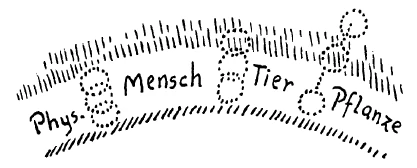
[ 51 ] An being that has a body and soul on Earth but has its spirit in a second, adjacent world—and is therefore less real in the physical world—is the animal.
[ 52 ] A being that has only its body in the physical world, its soul in the second world, and its spirit in a further, third world—so that the body is now merely a reflection of the spirit, filled only with earthly matter—that is the plant.
[ 53 ] They recognize three worlds in nature. They recognize that human beings carry these three worlds within themselves. In a sense, they feel the plants growing all the way up to the stars. They look at the plants and say to themselves: You are a being of whom I see only the reflection here on Earth—the insubstantial reflection. The more I turn my gaze upward, looking up at the stars at night, the more I see the true essence up there. Nature becomes whole when I look up from the earth toward the stars, when I behold the cosmos and the earth as one. Then I look back at myself as a human being and say to myself: What in the plant reaches all the way up there—I have gathered it within myself here on earth. As a human being, I carry within me the physical, the astral, and the spiritual worlds.
[ 54 ] To see through this, to grow upward with nature all the way to the heavens, to grow inward within human beings to the point where the heavens open up within them—that is, to ascend to the exploration of the spirit.