Initiate Consciousness
True and False Paths of Spiritual Research
GA 243
11 August 1924, Torquay
Translated by Steiner Online Library
1. Nature Is the Great Illusion: “Know Thyself”
Why are we even searching for something spiritual?
[ 1 ] I have been asked to speak in these lectures about the paths into the supersensible world, into spiritual life—paths that lead to supersensible knowledge and that can be united with the paths toward knowledge of the sensory, physical world that have been taken in such a grand and beautiful way in recent times. For only those who add to the great, admirable insights achieved by the natural sciences, the historical sciences, and other fields of knowledge in recent times what can be known about the spiritual world can truly recognize reality.
[ 2 ] Wherever the world confronts us, it is in truth both spiritual and physical, and there is nowhere anything physical that does not have, behind it in some way, a spiritual element as the actual agent. And there is no spiritual entity that, merely out of boredom with the world, leads an insubstantial, inactive existence; rather, every spiritual entity that can be found anywhere also exerts an influence into the physical realm at some time or in some place.
[ 3 ] We will discuss how, on the one hand, through physical facts and, on the other hand, through the perception of the spiritual, one can come to know the world in which human beings live in its entirety—and we will do so in such a way that the correct and incorrect methods of this knowledge are presented here in these lectures.
[ 4 ] Today, before I discuss the actual topic I will begin with tomorrow, I would like to offer a sort of introduction so that you can see what you can actually expect from these lectures and what their purpose is. The aim will be, first of all, to pose the following question to us: Why do we seek the spiritual at all? Why, as human beings who think in the world, feel in the world, and act in the world, are we not satisfied with simply perceiving the sensory-physical world and acting within it? Why do we strive for knowledge of the spiritual?
[ 5 ] I would like to point out an ancient view, an ancient saying, which nevertheless contains a truth that is ever-expanding—one that echoes from the dawn of human thought and human striving, yet which we also find when we seek the essence of the world today. Without intending to base anything here—not even the slightest thing—on foreign, ancient views, I would nevertheless like to point to such ancient views whenever it is appropriate to do so.
[ 6 ] From the Orient, across millennia, the words ring out to us: The world we perceive with our senses is Maya. This world we perceive with our senses is the great illusion, for Maya is, after all, the great illusion. And if—as has always been felt throughout the course of human development—this world is the great illusion, then human beings must go beyond this great illusion to reach true reality.
[ 7 ] But why does humanity perceive this world—which it sees with its eyes, hears with its ears, and perceives with its other senses—as the great illusion? Why did mystery sites emerge, precisely in the earliest times of humanity, when people were closer to the spirit than they are today, mystery schools—which served simultaneously to cultivate science, religion, art, and practical life, and which sought to point toward reality and truth in contrast to what, in mere external life, constitutes the great illusion in which human beings perceive and, through their ordinary activities, initially live? Why did the towering sages, who trained their disciples in the sacred mysteries of ancient times—which sought to lead to truth in contrast to illusion—why did they do that? Yes, this question can only be answered by looking at human beings themselves with a more open-minded and unprejudiced gaze.
[ 8 ] “Know thyself”—so another ancient saying echoes to us once again. And, I would say, from the combination of these two sayings: “The world is Maya,” from the East, and “Know thyself,” from the ancient Greek—the entire modern human race’s quest for spiritual knowledge sprang forth. But in all the ancient mysteries, the quest for true truth also sprang from this shared sense that the world is, in fact, an illusion, and that human beings must come to know themselves.
[ 9 ] But it is only in life that one comes to terms with this question; not through thought, but through will and by being fully immersed in the reality that is initially accessible to us as human beings. Not through full consciousness, not through clear understanding, but through an intense feeling, every person in every place on Earth tells themselves: You cannot be like the outer world that you see and hear.
[ 10 ] This is a profound realization, my esteemed audience. One need only clearly envision what it means when a person says to themselves: You cannot be like the external world that you see, hear, and perceive with your other senses. — We observe plants; we see them sprouting from their roots in the spring with their green leaves. We see them bloom over the course of the summer and develop into fruit as autumn approaches. We see them come into being and pass away. We see life bound up in the cycle of the year. We do, however, see how some plants take in something harder—if I may put it that way—from the earth, become permeated with this harder substance, and form a tree trunk. And as we drove here in the car yesterday evening to get here quickly, we saw some very, very old plants along the way that have absorbed much from the earth—not to confine their lives to an annual cycle, but to prolong their existence and continually produce new and new shoots from their trunks. But human beings also have the opportunity to observe the coming into being and passing away of such plants.
[ 11 ] Humans observe animals. He sees them come into being; he sees them pass away. Ultimately, he does the same with minerals. He observes the minerals that have been deposited in the earth, in the mighty, magnificent mountain ranges. Modern science has led him to realize that even these magnificent mountain ranges come into being and pass away. And finally, human beings turn to some system of belief—be it Ptolemaic or Copernican, or to any of the ancient or modern mysteries—and come to the realization: What you see in the majestic stars, what shines upon you from the sun and moon with all their wondrous, intricate orbits—all of that, too, comes into being and passes away. — And apart from coming into being and passing away, it possesses qualities such that, if human beings are to come to know themselves, they must not assume that they are the same as all that comes into being and passes away—plants, minerals, the sun, the moon, and the stars. But then the human being comes to the realization: I do indeed carry something within me that is different from what I see in my surroundings, from what I hear in my surroundings. I must arrive at the truth of my own being. I do not find that in what I see and hear.
[ 12 ] And in all the ancient mysteries there was a drive to arrive at the truth of the human being. In contrast to this truth of the human being that one sought, one perceived that which arises and passes away out there in space and time as the great illusion. And so, for the sake of understanding the human being, people sought something other than what the external senses revealed. And this “other” was perceived as a spiritual world. How this spiritual world can be sought correctly will be the subject of these lectures. For you can imagine that, at first, people will want to continue using the methods they are accustomed to for seeking within the sensory world. Just as they seek the nature of the external sensory world, they will want to continue their search into the spiritual world as well. But if research into the sensory world in ordinary life leads to illusions, then it is to be expected that the illusion will not diminish but rather grow larger if one chooses the same paths for gaining knowledge in the spiritual world as one does in the sensory world. And so it is. This will become clear to us. If one investigates the spiritual world in the same way as one investigates the sensory world, the illusion cannot become smaller but must become greater; and by continuing our sensory investigation into the spiritual world, we are merely immersing ourselves in an even greater, stronger illusion.
[ 13 ] And yet, when we sense the spiritual—when we vaguely sense the spiritual in dark mysticism, when we dream of the spiritual—yes, then the spiritual simply remains unknown to us. We merely sense it. We merely believe; we know nothing about it. If we merely wish to continue with this mysticism, this belief, this sense of the spiritual world, then it does not become more familiar to us, but rather increasingly unknown, so that human beings can, so to speak, find two wrong paths.
[ 14 ] On the one hand: he behaves toward the spiritual world just as he does toward the physical world. There, the physical world initially provides him with an illusion. If he seeks to continue along the same path into the spiritual world, as ordinary spiritualists do, for example, he does not arrive at a lesser illusion, but rather at a greater one.
[ 15 ] And so another path emerges: not seeking to penetrate the spiritual world through penetrating, clear research, but rather seeking to believe, to intuit it mystically. Then the spiritual world remains unknown. No matter how hard one tries to continue down this path of intuition and mystification, it becomes ever more and more unknown. In both cases, one does not enter the spiritual world. In one case, the illusion grows; in the other, ignorance grows. In contrast to these two false paths, one must seek the right one.
[ 16 ] The True Paths to Spiritual and Real Knowledge
[ 17 ] One must bear in mind how impossible it is to proceed from the realization of illusion in the sense indicated to the realization of the true self, and likewise to move from a sense of the true self—from the mystical feeling of the true self—to a clear understanding of reality within the illusion, if one wishes to prepare oneself to find the true, authentic paths leading to spiritual, real knowledge.
[ 18 ] Let’s take an unbiased look at what’s going on here. In fact, from a materialistic perspective, one can never be as great an admirer of all the modern scientists—Darwin, Huxley, Spencer, and so on—as one can be as someone who recognizes the spiritual world; for these people, and many others since the time of Giordano Bruno, have truly done an infinite amount to uncover what has always been seen through in the Mysteries as the great illusion. There is no need at all to adhere to the theories of Darwin, Huxley, Spencer, Copernicus, Galileo, and so on. People may think whatever they want, theoretically, about the universe; we do not wish to get involved in that at all; but let us first make it clear to ourselves what impetus has been provided by all these people to gain a purely material understanding of this or that organ in humans, plants, and animals, or this or that mystery that reigns within the stone. Just imagine all that we have observed in recent times regarding the functioning of the glands, nerves, heart, brain, lungs, liver, and so on, thanks to the impetus provided by this research. One cannot help but hold it in the highest regard. Yet, with all this knowledge, human beings can only go so far in the reality of everyday life. I would like to illustrate this with three examples.
[ 19 ] One can observe in extraordinary detail how the first human germ forms, how this germ gradually and miraculously develops into a human embryo, how it gradually forms organs, and how the marvelous heart and circulatory system ultimately develops from small organs arranged peripherally. One can observe all of this. One can observe how wonderfully all things in a plant develop materially, from the root up to the flower and the seed, and from this one can construct a world according to the views one has formed—a world that reaches up to the stars. Our astronomical and astrophysical theorists have done just that. They have constructed a world starting from a nebular star system that has evolved into an ever clearer and clearer structure, capable of developing life from within itself, and so on.
[ 20 ] One can build all of this up. But in the end, one stands there and asks once again about one’s own human nature—about what is supposed to be the answer to the question: “Know thyself.” And if one recognizes oneself only in that self which is contained in what one perceives in stones, plants, animals, human organs, the human glandular system, and the human circulatory system—what does one perceive? One perceives the world one enters at birth and leaves at death. Nothing else.
[ 21 ] But deep within his own being, man senses that this is not his true, ultimate limit. And so, from the very depths of his being, man must cry out in response to all that may approach him in such great perfection, in such great majesty, in the form of external knowledge: You accept all of this only between birth and death. What are you in your true essence? — At the very moment when the question of knowledge of nature and knowledge of humanity takes a religious turn, at that very moment, humanity, with what looks into the world of the great illusion, can go no further. The question: Know yourself, so that you know where you come from in the innermost core of your being, and where you are going with the innermost core of your being—this question, the question of knowledge turned toward the religious, remains unanswered.
[ 22 ] This was what the ancient mysteries made clear to their students right at the gates: You may perceive whatever you wish with your external senses, but if you approach the question from a religious perspective, the great question of humanity—the great mystery of humankind—will remain unanswered. And further. No matter how closely we may observe the shape of a human face, no matter how closely we may observe how a person moves their arms and hands, how they walk and stand, we may develop however refined a sense for the form of an animal or the form of plants, as far as we can perceive this with our senses—the moment we wish to apply this sense of ours, the moment we wish to apply what we perceive in this way artistically, a question remains unanswered once again. For how have people, from time immemorial, applied what they knew of the world artistically? In ancient times, the mysteries served as inspiration for this. People knew this or that about nature according to the powers of cognition available to them. But they deepened what they knew in this way through contemplation of the spiritual.
[ 23 ] One need only go back to ancient Greece. When we see a sculptor or a painter today—at least that was very much the case until recently, though it is less so today—he reaches for the model. He wants to reproduce something. He wants to imitate something. The Greeks did not do that. People merely believe that the Greeks did that. The Greeks sensed the spiritual human being within themselves. If they wanted to sculpt an arm in motion, they knew: Within what I see on the outside of the model, the spiritual is present. — He knew that everything material is created according to the spiritual, and he strove to recreate this spiritual aspect.
[ 24 ] Even during the Renaissance, the painter did not simply stand and look at the model; the model served only as inspiration. What he knew from within—that it lived in his arm, in his hand—that is what he brought into the movement. How a person lived inwardly with the spirit—that is what he brought into it. Merely looking at the exterior in the great illusion, in Maya—merely imitating the model—leaves us standing where we are, not within the human being, but before the human being. To put it in artistic terms: if we stop at the illusion, we stand before the great question of humanity, before the immense mysteries of humanity that remain unanswered.
[ 25 ] Once again, it was already at the threshold of the ancient mysteries that the student who was to be initiated was made to understand: If you wish to remain within the outer world of illusion, you cannot penetrate the human being, nor can you penetrate the being of any other kingdom of nature. You cannot become an artist. Through the path of art, too, one was compelled to convey to humanity the vivid message, “Know thyself.” There, one felt the necessity of spiritual knowledge.
[ 26 ] You will say: But there are certainly quite materialistic sculptors and painters; they are quite capable, after all—they know very well how to draw out the secrets from the model and imbue them into the figures and the materials. — Certainly, but where do they get that from? They don’t know it on their own. It’s just that people don’t see through it. They learned it from the older painters; those, in turn, from the [even] older painters. It is tradition. One knows how the older ones did it. One doesn’t always admit this to oneself, because one wants to be competent in one’s own right. But one isn’t. One only knows how the older artists were competent and imitates them. But the very earliest of these older artists derived the secret precisely from the spiritual insights of the Mysteries. Older painters and sculptors received it from the Mysteries; Raphael and Michelangelo received it from those who, in turn, had received it from the Mysteries. But true art must be drawn from the spiritual. There is no other way. As soon as one approaches humanity, the contemplation of the great illusion—Maya—leaves the mysteries of life and the mysteries of humanity unanswered. If we wish to return to the origins of art, to the creative artistic process, we need, once again, insight into the spiritual world.
[ 27 ] A third example: As a botanist or zoologist, one can have a wonderful understanding of every form of plant available to one. In chemistry and physiology, one can describe the processes that take place within plants. One can learn about the processes by which food is transformed in the digestive organs, within the blood, and onward to the nerves. One can learn all of this. One can become a very clever, intelligent anatomist, physiologist, botanist, or zoologist, and explore much in the world of the great illusion—but if one wishes to approach human beings in a healing, medical way with all this knowledge, if one wishes, in turn, to find the path from human nature—indeed, from the inner nature of the human being—to their very essence: one cannot do so.
[ 28 ] You might say: But there are plenty of materialistically minded doctors who want nothing to do with the spiritual world; they rely solely on what can be investigated through the natural sciences, and yet they still heal. — Yes, why do they heal? They heal because they, too, draw on the tradition of an ancient worldview. Ancient remedies were, after all, also derived from the mysteries; but they all share a remarkable characteristic. When you, my esteemed audience, pick up an old prescription: it is immensely complicated; preparing it and applying it to the condition for which tradition dictates it should be used requires an extraordinary amount of effort.
[ 29 ] If you had gone to the ancient mysteries and asked a mystery physician how such a prescription came about, he would never have answered you: “I conduct chemical experiments; first I test whether the substances interact with one another in such and such a way, and then I apply this to the patients and see what happens.” — The ancient mystery physician would never have answered you that way; it would never have occurred to him. People simply don’t know how things were in earlier times. He would have replied: “I live in the laboratory—if we want to call it that—which has been set up for me in accordance with the mystery, and when I discover a remedy, it is because the gods have told me so.” — For he was fully aware of this: Through the entire atmosphere that had been created in his laboratory, he entered into a living communion with the spiritual world. There, spiritual beings became as present to him as human beings otherwise are. And there he realized: Through the influence of the spiritual beings in the spiritual world, he could be more than he would be without such influence. And he formulated his complex prescriptions. He did not formulate them based on knowledge of nature; rather, he formulated them in the manner of the gods. Within these mysteries themselves, it was known: If one wishes to reach human beings, one must not remain in illusion; one must penetrate to the truth of the divine world.
[ 30 ] People today are even further removed from an outward understanding of the truth of the divine world than the ancients were with their mysteries. But the path must be rediscovered. For this is the third point I can cite as an example: When one is equipped with the most widespread understanding of nature—that is, the great illusion—and wishes to heal, one is once again confronted with unanswered questions regarding human life, regarding the mystery of humanity. If one approaches the human being from the perspective of illusion—from “Nature is the great illusion” to “Know thyself,” as must also be explained in the context of healing—one cannot take a single step further.
[ 31 ] And so, based on these three examples, we can say: The person who wants to bridge the gap between the world of the great illusion, Maya, and the “Know Thyself” principle sees that he stands before nothingness if he seeks to proceed solely from the illusion, as soon as he attempts to approach humanity through religious feeling, artistic creation, and helping others as a healer or physician. They cannot do so unless they move on to a completely different kind of knowledge than that of external nature—the knowledge of the great illusion, Maya.
[ 32 ] The understanding of the world in its totality through spiritual intuition within the realm of physical facts
[ 33 ] We will now make a comparison between the way in which, in ancient times, people sought to attain a comprehensive understanding of the world in the spirit of the mysteries, and the way in which people seek to do so today, in order to use this as a guide regarding the paths to such a comprehensive understanding of the world.
[ 34 ] A few millennia ago, people spoke of the world and its nature in a manner quite different from how those scholars who claim authority speak today. Let us transport ourselves back a few millennia to the time when a brilliant, majestic body of knowledge flourished in the Near East, springing from sacred mysteries; let us delve into the nature of this knowledge with a few characteristic strokes.
[ 35 ] In ancient Chaldea, for example, the following was taught: Human beings experience the outer limits of existence—the farthest they can reach with their soul forces—when they direct their spiritual, soul-eyes toward the wondrous contrast between life while they sleep—when consciousness is dull and they are unaware of their own existence— and the life one lives while awake—when everything is bright around the person, and the person is aware of their life.
[ 36 ] Thousands of years ago, these transitional states between sleep and wakefulness were experienced differently. Sleep was not as unconscious, and wakefulness was not as conscious. In sleep, people perceived shifting, powerful images—a weaving, undulating life of the worlds; when they slept, they were among beings of a higher order. The fact that sleep has become so unconscious is a development that occurred only with the evolution of humanity. In contrast, however, millennia ago, waking life was not as sun-drenched, not as brightly illuminated as it is today. Things did not have fixed boundaries; they were blurred. They still radiated all manner of spiritual qualities. There was no such abrupt transition between sleeping and waking. But one could distinguish between them, and everything in which one lived while awake in those days was called, for example, “Apsu.” That was the world of waking.
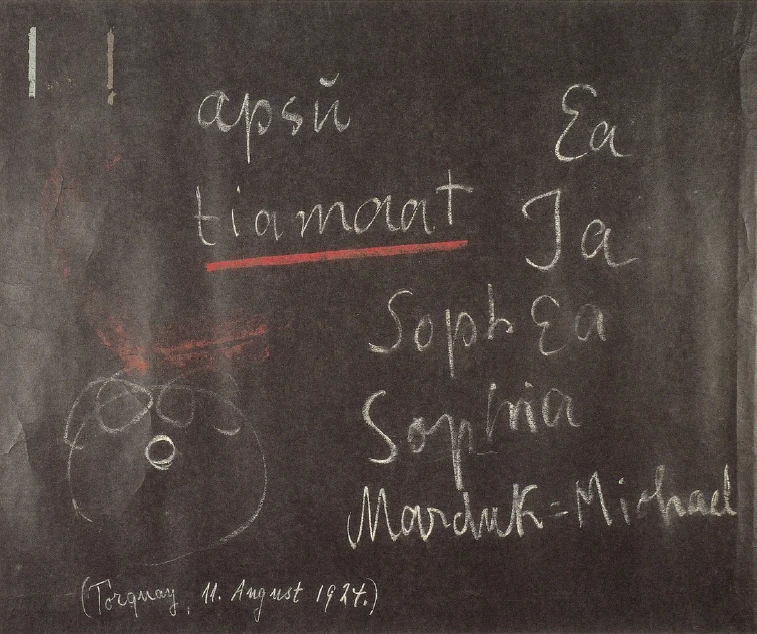
[ 37 ] The state one was in while sleeping—that weaving, undulating state in which one could not distinguish minerals, animals, and plants as clearly as when awake—was called “Tiamat.”
[ 38 ] Now, it was taught in the Chaldean mysteries: Man is more deeply immersed in the True, in the Real, when he weaves while asleep within Tiamat than when he lives awake among the minerals, plants, and animals. Tiamat is more primordial and more closely connected to the human world than Apsu; Apsu is more unknown; Tiamat represents that which is close to human beings. But changes occurred in Tiamat over the course of time. So it was said and taught to the students of the Mysteries. From the weaving and living emerged demonic figures—horse-like figures with human heads, lion-like figures with angelic heads. They arose from the fabric of Tiamat. That which lived there as demonic figures became hostile to humankind.
[ 39 ] But then a powerful being entered the world: “Ea.” Anyone who still perceives sounds today can sense, in the harmony of E and A, a reference to that mighty being who stood by humanity in a helpful way, in the spirit of this ancient mystery teaching, when the demons of Tiamat were powerful: Ea, la—which later, by adding the particle of being “soph,” became Soph Ea = Sophia. Ea—roughly what we denote with the abstract term “wisdom that reigns in all things.” Ia = the wisdom reigning in all things, Sophia. Soph = a particle meaning roughly “being.” Sophia, Sophea, Sopheia—the prevailing wisdom, the wisdom that reigns everywhere—sent a son to humanity, that son whom they called at that time “Marduk,” whom we have come to refer to in somewhat later terminology as Michael, as the Michael who reigns from within the hierarchy of the Archangels. This is the same being as Marduk, the son of Ea, the Wisdom, Marduk-Michael.
[ 40 ] And Marduk-Michael—so goes the mystery teaching—was powerful, great, and mighty. And all those demonic beings—such as horses with human heads, lion-like figures with angelic heads—all these weaving, surging demons stood before him in their collective form as the great Tiamat. He was powerful enough, Marduk-Michael, to master the storm wind that surges through the world. Thus Tiamat—all of this was conceived as a living entity, and rightly so, for that is how it was seen: as a living entity. All these demons together formed a mighty dragon that stood in fiery defiance as the sum of all the demonic forces born from Tiamat, the Night. When this fiery being confronted Marduk-Michael, he first thrust his other weapons into it, then the full force of the stormwind into its bowels, and the being Tiamat burst and rolled apart, shattering across the entire world. And Marduk-Michael was able to form the heavens above and the earth below. And thus the Above and the Below came into being.
[ 41 ] And so it was taught in the Mysteries: The great son of Ea, the God of Wisdom, vanquished Tiamat and formed the Upper Realm—the heavens—from one part of Tiamat, and the Lower Realm—the earth—from another part of Tiamat. If you look up into the heavens at the stars, O human, you will see a part of that which Marduk-Michael formed from the dreadful abysses of Tiamat above for the salvation of humankind.
[ 42 ] And if you look down, where the plants grow from the mineral-rich earth, where the animals take shape, you will find the other part that the son of Ea, the God of Wisdom, transformed from Tiamat for the salvation of humanity.
[ 43 ] And so, in ancient Chaldea, that early era of humanity looked back upon the forms in the world and gazed upon the essential nature of things. All of this was perceived as essential: these demonic figures that populated the night, everything that Marduk-Michael formed from these nocturnal figures—from the ruling, weaving beings within Tiamat that I have described to you—as the stars above and the Earth below—everything that shines down upon us from the stars: demons transformed—transformed by Marduk-Michael—all that which grows forth from the earth itself: skin transformed by Marduk-Michael, the transformed tissue of Tiamat—this is how, in ancient times, people perceived what they could bring to mind through the ancient faculties of the soul. That was knowledge.
[ 44 ] And then the leaders of a mystery school prepared their students in complete secrecy, preparing them through the powers of the soul. And when the students developed such soul powers, they were able to recognize the first elements of what we already teach children in school today as elementary science—that the sun stands still, the Earth revolves, and that worlds were formed from nebulae. This natural science that we teach children in school today was the great secret. In contrast, what was revealed to the whole world was precisely what I have just told you about the deeds of Marduk-Michael. Today we learn in our schools—even if they no longer appear mysterious—at our universities, but also as early as in the lower grades right down to elementary school, what the Copernican worldview represents as astrophysical knowledge of the cosmos—knowledge that the ancient sages were only permitted to attain, and were able to attain, after long preparation. What every schoolchild knows today could only be known in ancient times if one was initiated. Today, we learn all of this in school.
[ 45 ] There was a time—even further back than the wisdom of the ancient Chaldean mystery traditions—when people spoke only of such things as I have described to you: of Ea, of Marduk-Michael, of Apsu and Tiamat; these people spoke only of these things. At that time, they despised everything those eccentric mystery teachers said about the movement of the stars and the movement of the sun, and sought only to explore the external, the visible—not the invisible, which, even in the form of ancient clairvoyance, stood before humanity. They despised what the ancient initiated teachers and students had made their own.
[ 46 ] Then came the time when the ancient knowledge from the Orient was gradually being prepared. At that time, both were valued. People valued what they had experienced in the manifestation of the essence of the spiritual world; for example, they valued the deeds of the spiritual being Marduk-Michael; and one valued just as much what one could draw on a tablet [something like this] (it is drawn): in the center of the tablet, the sun, surrounded by the stars, moving in cycles and epicycles. All of this was valued.
[ 47 ] Then came the time when people no longer had the ability to look into spiritual worlds—into the worlds of demons and gods—and when the other kind of knowledge, intellectual knowledge, began to develop in particular—that knowledge of which modern people are so proud, which has gradually developed until reaching its culmination in our own age. We now find ourselves, in the outer world, in an age where the spiritual is despised just as the material was despised in ancient times by those for whom the spiritual was a matter of course. We must immerse ourselves in the times when we will once again be able to take in, alongside what astronomers, astrophysicists, zoologists, and biologists teach, that which spiritual knowledge provides in terms of spiritual essence. That time has come. Humanity must live toward this time if it wishes to fulfill its tasks, if it wishes to return to religion, art, medicine, and so on.
[ 48 ] Just as in ancient times spiritualism shone among people, while the material world was despised, and then an age came when material knowledge was embraced, which subsequently grew in importance and supplanted spirituality—just as people in ancient times, in their error, lived solely by the spiritual and despised the external world, and just as, in the era when the material was valued, people mistakenly scorned spiritualism, so now a time must come when, from the comprehensive and wondrous knowledge of the external world, one must once again arrive at a new knowledge of the mysteries.
[ 49 ] Now that material knowledge—which has become so marvelous—has broken away, piece by piece, from the old spirituality, so that, just as with ancient buildings, nothing remains on Earth except, at most, those remnants that are excavated just as ancient material buildings are—we must return to a spirituality, but with a full understanding of what we can reveal when we look back to ancient earthly times, just as we delve into history. We must return to such spirituality through a new religious deepening, through a new artistic creation, through a new spiritual knowledge that penetrates the human being through healing practice, and so on.
[ 50 ] These are three examples I have presented to you today in order to once again construct mysteries before which we will then stand as before something that can bring us an understanding of the totality of the world’s being and human action for the salvation of humanity in the sense of that totality, not merely of one-sided material reality.