Initiate Consciousness
True and False Paths of Spiritual Research
GA 243
18 August 1924, Torquay
Translated by Steiner Online Library
7. Understanding the Stars
The Intellectual Backgrounds of Humanity's Historical Development and Its Differentiations
[ 1 ] We have seen how, by surveying and mastering the various stages of life through spiritual insight, a person gains inspiration that enables them to gradually elevate their consciousness to the level of what the world of the stars can reveal—a world that must then, of course, be understood as an expression, a revelation of purely spiritual beings and purely spiritual realities.
[ 2 ] The point, then, is to truly strive for the appropriate states of consciousness and the appropriate spiritual dispositions necessary for the paths into the spiritual world and for research into the spiritual world—and not to fall into the error of trying to reach the spiritual world with ordinary consciousness. Today I would like to illustrate this to you using specific examples—or rather, specific cases. I would like to show you where the potential for errors in spiritual research may lie. To begin with, I would like to preface this with the following:
[ 3 ] When a person truly enters into spiritual work—through which they can gain access to the spiritual world, through which they can perceive the spiritual world and, if I may use the expression, interact with it—then they perceive great distinctions and differences, particularly in the historical development of humanity, behind which they seek the spiritual contexts. For example, there is the era that immediately precedes our own. Our era—which, as I have already indicated, we can call the Michael era (I will explain the reasons for this in greater detail in the lectures)—begins with the last third of the 19th century, around the 1870s. This era, however, is preceded by another that lasted three to four centuries and was of a completely different nature for those who have explored the spiritual world. And this era, in turn, is preceded by yet another that is again of a completely different nature, and so on. Thus, when one looks back into the past with the insight gained through initiation, one always finds a completely different kind of impression for certain eras. I do not wish to describe this merely in abstract terms, but rather to present it concretely before your soul.
[ 4 ] In the course of these lectures, I have spoken to you about figures who, in one way or another, lived during the course of human evolution. For example, I have spoken to you about Brunetto Latini, Dante’s great teacher. I have spoken to you about the teachers of the School of Chartres, about Bernardus Silvestris, about Alanus ab Insulis, about Joachim de Fiore, and I could speak to you about hundreds of other figures from the 9th, 10th, 11th, 12th, and even the 13th centuries; and with such figures, we have defined a very specific era.
[ 5 ] When someone who wishes to explore the historical life of humanity from a spiritual-scientific perspective approaches this era—that is, let us say, the age of Dante, the age of Giotto, the very era in which the Renaissance took shape and prepared itself—then they get the impression that they must absolutely interact in the spiritual world with human beings, that is, with disembodied human souls; they must, so to speak, also come face to face—figuratively speaking, of course—with the human souls as they live between their last death and their next birth. Thus, through the knowledge gained in initiation, one has the distinct feeling that one would like to interact spiritually with an individual such as, say, Brunetto Latini, just as one interacts with people here within the physical world. I have also tried to incorporate this into my descriptions. That is why, when I spoke of Joachim de Fiore and Brunetto Latini, I portrayed that era in such a way that one could sense there was a need to present the description as personally as possible, I would say. I spoke of “patting someone on the shoulder” and the like.
[ 6 ] Things are quite different, however, in the following era—the era that begins after this one and extends into the last third of the 19th century. In this era, one feels much less of a need, based on initiatory knowledge, to enter into a personal—or, so to speak, individual—relationship with the disembodied souls who come into consideration for this purpose. One would much rather observe them in their entire environment, and one does not wish to approach them directly at all, but rather to gain access to them somehow from the perspective of earthly knowledge, from the knowledge of ordinary consciousness.
[ 7 ] Please forgive me for sharing something here—something that is entirely objective—based on my immediate personal experience, but in this particular case, that personal experience is, in fact, entirely objective. You see, I am able to speak about this precisely because Goethe lived in the era that preceded our own—a figure with whom I have been deeply engaged for decades. I felt a strong need to approach Goethe initially by paving my way to him through his scientific writings and the natural sciences in general. It was only relatively late that the need arose to encounter him directly as a spiritual individuality within the spiritual world. That was not the first step. The first was to perceive him, so to speak, as a “star being” after his death within the context of the entire world, within the cosmic context—not in a personal, individual sense.
[ 8 ] If, on the other hand, one wishes to seek out in the spiritual world someone like Brunetto Latini—or, more specifically, those people who were engaged in the study of nature during the very same era in which Brunetto Latini lived—one immediately feels the need to be able to exchange opinions and views with them in a deeply personal spiritual communion. That is precisely a significant difference. And this difference is connected to the fact that the ages are quite distinct from one another in their inner spiritual structure. Today we live in an age in which it is particularly incumbent upon human beings—upon all of humanity—to grasp spiritual realities directly as spiritual realities; that is, to disseminate the science of initiation, which looks into spiritual life, directly and outwardly as human knowledge. This age, which has only just begun, must not come to an end without those whom we call educated people truly recognizing, in a purely spiritual way, the most essential spiritual facts to be grasped—that is, not the earthly facts, not the physical-sensory facts, but these spiritual facts. From now on, therefore, there must be a vigorous advocacy of a spiritual science that sheds light directly into the spiritual world for this age; otherwise, humanity on Earth would not be able to fulfill its mission in the sense intended for it. We must move ever more deeply into a spiritual age.
[ 9 ] This was preceded by an age in which entirely different forces were at work in human evolution. And if we speak from the perspective I introduced in my last lecture—the perspective of true, authentic knowledge of the stars—then we are led to say: In the age into which we as human beings entered in the 1870s—in this age—it is primarily the spiritual forces emanating from the Sun that must come to dominate everything: human physical life, human soul life, scientific life, artistic life, and religious life. What the Sun has to say to the world, what the Sun has to do in the world—this must spread ever further and further in our age.
[ 10 ] Now, for those who truly understand, the Sun is not the physical ball of gas as described by modern physics, but rather a collection of spiritual beings. And the principal spiritual beings who, so to speak, radiate the spiritual from the Sun—just as sunlight radiates physically or etherically—are all grouped around a certain being whom we could, following an ancient Christian-pagan or Christian-Jewish designation, refer to as the Michael Being. Michael works from the Sun. And what the Sun has to give the world in a spiritual sense can also be called that which Michael, together with his own, has to give to the world.
[ 11 ] That era was preceded by the other one, which I have described in the manner indicated. In that era, it was not the forces of the Sun that impelled human life, human knowledge, and human activity, but rather the forces of the Moon. They were responsible for impelling everything in that era—which ended in the 1870s and had lasted for three to four centuries prior.
[ 12 ] And once again, the guiding entities that exerted such a great influence on the development of the Earth and humanity gathered around a being who, to use an ancient name, can be called Gabriel. We could just as easily invent a name, but since the names already exist—the terminology isn’t important—we might as well keep them. So, in accordance with Christian-Jewish custom, we can refer to this being by the name Gabriel. As I have told you, one comes to know this spiritual influence from the starry worlds that is present within the human being. If, through the science of initiation, one comes to know what acts within the human being from birth until the change of teeth, then one learns to recognize everything that constitutes lunar influences in the universe. That is to say, through this retrospective view—this inspired look back at the early childhood of the human being—one comes to know something as specific as the Gabriel Age, in which the Moon is particularly active.
[ 13 ] On the other hand, one must become somewhat more mature, must reach one’s forties and be able to look back on what takes place within a person between the ages of twenty and forty—or, more precisely, between the ages of twenty-one and forty-two—in order to perceive the special character of an age such as our own. Thus, in the age that preceded our own, children—infants and very young children—were, so to speak, the most important for the cosmic guidance of the world. It was into them that the forces intended for that age were channeled. In our age, it is the people who have reached their twenties and thirties who are to receive the impulses from the solar forces. In our time, adults in particular are becoming important for the cosmic guidance of the entire world.
[ 14 ] This is something that, as a practical result, arises directly from such a real perception as I described the day before yesterday, and in turn results in further real perceptions. These are not theories I am presenting; it is simply something that arises from real insight. You can therefore also understand that, in order to gain insight into that age—the Gabriel Age—which preceded our Michael Age, there is no particular need to personally confront disembodied human souls. One then feels like a small child standing before an adult, because one must approach them with the inspired perception of the very earliest childhood.
[ 15 ] The situation is quite different, however, when one looks back to the preceding era—the era in which Alanus ab Insulis, Bernardus Silvestris, Joachim de Fiore, Johannes von Auville, and Brunetto Latini lived. This era was dominated by those forces one encounters when looking at what is at work within a person during the stage of life that lies between the change of teeth and sexual maturity. The forces of Mercury are particularly active there, as I explained to you in my last lecture. It is indeed something quite extraordinary—I would even say magnificent—what one enters into when, starting from this stage of human life, one forms, so to speak, the organs necessary to perceive the spiritual realm. For between the loss of baby teeth and sexual maturity, one is truly a child eager to learn. One becomes that again by starting from that point. One therefore also wishes to encounter people of this age quite personally. One does so with the insight gained through initiation. One wishes to stand before someone like Brunetto Latini just as a ten- or twelve-year-old child stands before someone who knows more—an educator, a teacher. And yet, with true initiatory knowledge, one does not become unconscious of the things one encounters out there in the physical world. One is, after all, an adult and at the same time a curious, inquisitive child. One stands face to face with Brunetto Latini as an equal, and yet with an immense thirst for knowledge.
[ 16 ] This gives the initiatory knowledge its distinctive character, particularly for this era, which spans from the 15th to the 9th century; here we return to an era in which Mercury provides the primary driving forces for the Earth and humanity. And the being around whom everything is centered—the being who was particularly important during this time—can in turn be referred to by an ancient name: Raphael. Raphael in this era that preceded the Renaissance, in this age of Dante and Giotto. One might say that one would like to get to know personally precisely those people who are somewhat hidden in history, who have not come to the fore in external history.
[ 17 ] Even when one enters the field of the humanities, one actually has a strange feeling about this era. At first, one is annoyed that the textbooks say so little about Brunetto Latini, Alanus ab Insulis, and so on; one wants to know something that can be acquired from external sources. But then you make a bit of progress and feel very happy, very grateful, that external history remains silent on these matters. For external history, after all, records only a scrap of information as a document. Just think for a moment what will have to be passed down to posterity from our time if newspaper clippings are ever to be regarded—by the auxiliary sciences of history—as valid or invalid evidence! One is then grateful not to be disturbed by what the general encyclopedia says about these personalities. And one then tries to approach these people in a spiritual way, using all the means available today within the Anthroposophical Society to convey what can be explored about them through spiritual science.
[ 18 ] And here it is particularly important to engage with those who, during that period—the Raphael era—were connected to the understanding of nature. A deeper understanding of nature and medicine can be conveyed by certain individuals who, I would say, emerge from the gray spiritual darkness of that era—from the 9th through the 14th and 15th centuries—to offer spiritual insight; they can introduce us to the way people thought about the elements back then, and how they viewed the entire cosmic context in relation to humanity. And when one then enters into this era and becomes acquainted with certain individuals whose names cannot be mentioned because they have not been passed down to posterity—though these individuals certainly exist—when one looks into this era spiritually, some of these figures stand out in such a way that one says: There stands “Paracelsus maior,” only he was not named, whereas “Paracelsus minor” lived later, in the Gabriel era, and still retained reminiscences, still had echoes of “Paracelsus maior,” but no longer in that unadulterated, magnificent, spiritual way in which it was present in “Paracelsus maior.”
[ 19 ] Or take Jakob Böhme. “Jakob Böhme minor” appears before us in the later Gabriel era. Once again, one might say: He did indeed uncover something magnificent there; he arrived at his conclusions based on various accounts and drew upon his own inspiration. — But when the “Jakob Böhme maior”—who did not make it into posterity and whose name appears only sporadically, like Alanus ab Insulis or Brunetto Latini—when this “Jakob Böhme maior” appears, only then does one truly understand the “Jakob Böhme minor.” And so one must say: In this pre-Renaissance era, from the end of which the great figures of Dante and Brunetto Latini emerge, followed by the teachers of Chartres—where Scotus Erigena stands, I might say, like an erratic boulder—in this era there lies something that can be immensely spiritually stimulating. — The outward history of the Middle Ages is dark; but behind this darkness lies a mighty light, precisely for the period of which I have just spoken.
[ 20 ] Lunar Entities
[ 21 ] When one delves into this age of Raphael—from the 9th to the 14th— 15th centuries, one does indeed get the impression that the figures within it—such as Dante and Giotto, but especially those who have not been historically preserved for posterity—that all the other figures I have mentioned to you stand out very strongly. One gets a direct, human impression of them. Raphael himself, as a being who was never embodied in a physical body, remains more in the background, and other spiritual beings who belong permanently to the spiritual world—or at least who, today, belong permanently to the spiritual world—also stand out less strongly. It is precisely the human beings—the deceased human beings—who appear extraordinarily vividly to the spiritually observant gaze in this era.
[ 22 ] In the age that follows—this Age of Gabriel—one gets the impression that even figures such as Goethe, Spencer, Lord Byron, and Voltaire appear merely as shadowy figures in the spiritual world. In contrast, beings appear there with great, impressive intensity—beings who do not give the impression of being human, but rather of being superhuman; beings whom one perceives through spiritual insight to be living today—just as we humans on Earth live between birth and death—they live constantly in the lunar sphere today. They are the inhabitants of the lunar sphere. Impressive figures who are now the permanent inhabitants of the lunar sphere are the ones who come to meet you first and foremost, while human souls recede more into the background. Through these figures, one learns that they were once connected to the Earth just as humans are today. The difference is that humans walk about in physical bodies; these beings once moved about on Earth in subtle, more ethereal bodies. And one comes to recognize that one is indeed encountering beings who were once on Earth, who were once connected to humanity on Earth in ancient times, who were the supersensible teachers of humanity—beings who, after fulfilling their task on Earth, moved to the Moon, entered the lunar sphere, and are no longer connected to the Earth today.
[ 23 ] As we know—you can read about this in my Outline of Occult Science, which has been translated into English as Occult Science—the Moon itself, as a celestial body, was once connected to the Earth but then separated from it. These beings followed the Moon in its separation. They later became inhabitants of the lunar sphere themselves, after having been inhabitants of the earthly sphere. So that with that level of knowledge I have been speaking of these past few days—the kind that allows one to follow the dead immediately after death and in the years following death—with this knowledge one enters a world in which, because one still possesses the former awareness of ordinary consciousness, people naturally live all around one—people whom one also gets to know physically today as physical human beings in waking daily life. But then, while still in the midst of these people, as one enters into this other state of consciousness, one begins to recognize spiritual beings who, just as we belong to the Earth, actually belong to the Moon today; they are everywhere, and they take an interest in human affairs everywhere, only in a somewhat different way than human beings do today in a physical sense.
[ 24 ] Among these beings, who were once the great teachers of humanity and who no longer inhabit the Earth today but—if we may put it that way, cum grano salis—inhabit the Moon, there are some who, I would say, appear with great sublimity; they are the most perfected among them, the most level-headed, and those imbued with inner spiritual greatness. There is much to learn from them regarding the mysteries of the cosmos. They possess knowledge that far exceeds what is possible for human beings with their present level of consciousness. But they cannot express this knowledge in abstract thoughts. I would say that they inspire you when you come near them; they express everything in poetic forms, in artistic images; in their own way, they conjure up before you something more magnificent than what Homer wrote, than what is contained in the ancient Indian poems that have become known to the world. But there is a profound wisdom contained in what these beings conjure up before you.
[ 25 ] However, there are also less perfect beings among them. Just as there are people on Earth who are, so to speak, likable contemporaries and those who are unlikable, so too are there among these beings some who have not yet attained the greatness and perfection of their companions, but who have nevertheless reached a point—simply by having been disciples, or even servants, of others who have already attained the ability to leave Earth and live and continue their work in the lunar sphere—where they can continue to be active. What immediately strikes one about these beings—if I may put it in trivial terms—when one becomes acquainted with them is that they have a burning interest in earthly affairs, but they are interested in them in a completely different way.
[ 26 ] You need not immediately imagine them—these beings—as unsympathetic, terrifying figures. Although they are imperfect compared to their contemporaries, they are by no means far beyond the level of refinement, intelligence, and insight that today’s Earth humans can attain with their ordinary consciousness. But they certainly have the habits of their kind—habits and inclinations different from those of an ordinary Earth dweller today.
[ 27 ] I would like to point out something specific in this regard. Naturally, once one comes into contact with such beings, one feels the need—so to speak; one must always express oneself somewhat trivially in these matters—to speak openly with them, to consult with them about this and that. Well, let’s suppose one were to consult with such beings—I’ll pick out one topic—about human writing, about what humans have written. So let’s say one person, for my sake, has simply written his name, and another person has written his name—that is, signatures.
[ 28 ] Well, when you consult with these beings about what is actually going on here, they say: “Oh, you humans, you’re interested in the most uninteresting things of all. You’re interested in what you say the word means.” If it says “blacksmith,” you’re interested in the fact that it says “blacksmith”; or if it says “hairdresser,” then you’re interested in the fact that it says “hairdresser.” The fact that the word means “hairdresser” is, after all, the least interesting thing of all. It’s much more interesting to watch how a person who writes this down moves while doing so—how one person writes one way, another person another way; one quickly, another slowly; one skillfully, another clumsily; one automatically, another as if painting. —They also pay particular attention to this specific way a person behaves when writing. That’s what interests them.
[ 29 ] And in the spiritual world I am speaking of here, they, too, have their own spiritual retinue: all manner of spiritual beings who are not on Earth—beings lower than earthly beings, and sometimes higher as well, but who are not on Earth. These beings do not guide them to express earthly matters in a meaningful way, but rather guide them to make the writing movements—that is, the writing movements that humans acquired during the time when they themselves were on Earth. When these beings were on Earth—those who later became inhabitants of the Moon—writing as we understand it did not yet exist.
[ 30 ] They had always observed, in their interactions with people, how writing comes about, and were interested in what had already captured their interest back then—namely, that people make all sorts of dexterous movements with their fingers; that had already interested them back then. The fact that this, through the support of finger dexterity, transforms into a tube from which something flows down, or a tube from which something flows out—that came later. They were less interested in what ended up on the paper. On the other hand, they were extraordinarily interested in the movements that were made.
[ 31 ] But now came into play what was there from the Earth—and what remained—but which had been less noticed by human beings. And there are many things, you see; first of all—and I’ll include this right away along with what I’ve just explained—there is what human beings radiate in terms of movements. So, the movements radiated by human beings—that is what can be dealt with in a very special way in connection with these beings.
[ 32 ] However, this is initially something that does not yet lead to the actual realm of these beings, for it simply did not exist during their time on Earth. On the other hand, there is already something—in a positive, not a negative sense—that shows contempt for humanity when they speak of the limited capacities of present-day people to recognize what emanates from the human being in the form of exhalations and the radiation of the liquid. They have a very special understanding of this; present-day people do not take this into account. Thus, emanations of the liquid, skin emanations of the liquid—that is what was particularly important and essential in the age of these beings. People learned to recognize human beings by what was later disregarded: by what they diffused around themselves as a vapor.
[ 33 ] The third thing to which these beings are particularly receptive is exhalation through the skin—that is, the airy element that a human being radiates from within. These beings are particularly receptive to all these emanations of a physical nature—which, as we shall see in the following reflections, can certainly take on a semi-spiritual character—to all these emanations of the human being: in the solid form through writing, in the liquid form in skin perspiration, and in the gaseous form in skin exhalation—after all, human beings are constantly exhaling through the skin—these beings are particularly receptive.
[ 34 ] Fourth, in the radiation of heat. All these things, insofar as they exist on Earth, are still of very special importance to these lunar beings, and they judge human beings precisely by the configuration of their movements in writing and by the particular nature of their radiations.
[ 35 ] Fifth, there is also the radiation of light, which is certainly present. Every human being radiates light—not only through their aura, but also through their physical organism and etheric organism. And this light radiation—which is so faint that it cannot be seen under ordinary conditions, but which, for example, has already been made visible today by natural scientists such as Moriz Benedikt in a specially equipped darkroom—this light radiation, which appears as red, yellow, and blue rays and glows around the human organism, varies from person to person in different areas. You can learn from the natural scientist Moriz Benedikt how he made this colored light radiation visible in the darkroom, so that one side—the left side—can be seen glowing in yellow-orange light, while the other side can be seen in blue light. It is simply a matter of arranging the physical setup accordingly.
[ 36 ] Then there is a sixth type of radiation: the radiation of chemical forces. In fact, this is present on Earth today only in rare cases. That is to say, it has always been present, but I mean that it is only relevant in rare cases, plays a role in rare cases—namely, in cases where black magic is practiced. So when people become aware of their chemical radiations and use them, black magic comes into being on Earth.
[ 37 ] A seventh type of radiation is the direct, immediate spiritual radiation of life. Just as black magic—in which chemical radiations almost always degenerate in our time—is something reprehensible and evil, so too is the radiation of life significant. For these lunar beings I am speaking of—who, in a positive sense, are not black magicians (black magicians, under certain circumstances, are those on Earth who engage in such practices and fall into evil)—these lunar beings can always rely on and work with the forces inherent in this chemical radiation. But only when there is a full moon, when the moon is illuminated by the sun and they can enter the realm of the sun’s rays, can they, under the influence of sunlight, draw upon these life-giving radiations.
[ 38 ] And these life radiations, you see, are precisely what must now enter our age as something good, in contrast to everything reprehensible; for all the impulses that are to be given in the Michael Age are to be gradually linked to this mastery of life radiation, of vital radiation.
[ 39 ] The main thing to be learned is not to act in a lifeless way with what comes from the spiritual world, but to act in a directly living way with what comes from the spiritual world. To find living ideas, living concepts, living insights, and living feelings—not dead theories—that is the task of our age. This comes directly from the beings who are united with the entity we call Michael.
[ 40 ] In contrast, during the past Gabriel Age, people turned their attention more—I would say—toward earthly matters. People did not want to go straight to the beings who are there—and who, under certain circumstances, may be very close to human beings—because these [beings] were interested in something for which, so to speak, the age was less predisposed. They were interested in all these occult radiations that emanate from the human being.
[ 41 ] Our world—as we experience it as the physical world between birth and death—is immediately bordered by another, spiritual world, in which, as I have described, we find the dead. But there is much else within this world. And among the things that exist there is precisely the activity of such forces as those that live in the radiations and emanations of human beings. In a certain sense, this is an extremely dangerous realm of existence into which one enters. And in these days, one must have the spiritual and soul-oriented attitude I have often mentioned, so that one may direct what comes from these lunar beings I have spoken of in a good and not in an evil sense.
[ 42 ] For, you see, the fact is that all the forces, all the impulses of the present era must be directed toward utilizing the vital radiation on Earth. But it is all too obvious that this leads one into what lies between this vital radiation and all the other forms of radiation that people so eagerly desire: black magic. People would so much like to make visible what is expressed in movements—we will have to speak of this—to make visible what is present in exhalations and so on, what is present in the radiation of light. All of this is, in a certain sense, related to something good, to that which can actually only be good, because the Age of Michael is dawning among humanity.
[ 43 ] But in between all of this lies black magic, which must be kept at bay if one is to follow the good, proper paths of parapsychological research, rather than the evil, false paths of parapsychological research.
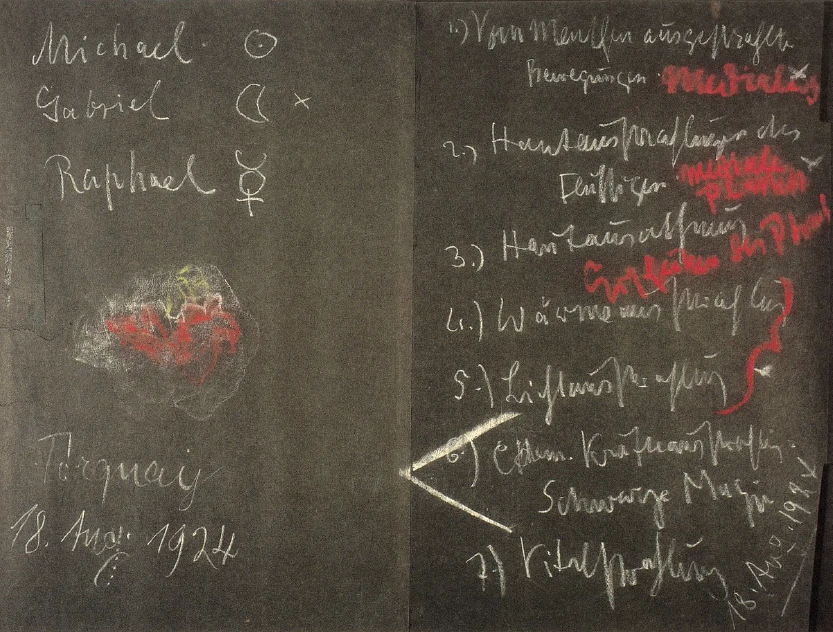
[ 44 ] (On the board:)
1. Movements Radiated by Humans
2. Skin Radiations of the Liquid State
3. Skin Radiations of the Gaseous State
4. Heat Radiation
5. Light Radiation
6. Radiation of Chemical Forces (Black Magic)
7. Vital radiation.
[ 45 ] Medial Natures and Their Radiations
[ 46 ] You see, if this interaction takes place in the spiritual world between people here on Earth and the lunar beings—and in the subconscious it does indeed take place continuously— then it is indeed possible that, as certain lunar beings develop an interest in the movements that humans also perform when writing or drawing—and as this interest manifests itself spiritually to these lunar beings—certain elemental beings of the spiritual world, in turn, take an interest in this very interest. Elemental beings who stand at a lower level than the lunar beings, who never incarnate on Earth, but who do live in the adjacent world I have spoken of, living as spiritual-etheric beings. If they, in turn, take an interest in everything that is happening there, then the following can occur. When a human being here on Earth is observed, one sees that the thoughts he or she communicates—say, through writing—affect his or her entire human being. These thoughts are initially present in the “I,” but they radiate down into the astral body, which carries out movements corresponding to those we make from the “I” when writing. They also affect the etheric body. And they extend all the way down into the physical body. These effects within the physical body are observed by certain elemental-like beings, who, so to speak, also develop a longing to move in the same way. But they cannot do so, because different laws govern their world than those in the world where writing takes place. After all, writing occurs only in the physical world of human beings here on Earth.
[ 47 ] But the following is possible. There are certain people who, when they write or even think, feel themselves deeply immersed within their etheric body. Everything in their etheric body is involved, and this then expresses itself strongly in the physical body as well. And with these people, it happens that they completely suppress what is in their “I,” and an imitation of writing or drawing comes to life in their astral, etheric, and physical bodies. These are the mediums. Because their “I” is suppressed, such mediums can then take in these docile elemental beings from the spiritual world, who have, so to speak, learned the movements of writing from the lunar beings. And such mediums then engage in an activity in which they do not make writing movements in accordance with their “I,” in accordance with their full consciousness, but in accordance with the elemental being that resides within them. As a result, everything that constitutes mediumistic writing and drawing comes about through the movements radiated by the human being while their consciousness is subdued: everything that is typically considered mediumistic. Thus, the radiated movements are utilized.
[ 48 ] The radiations of the second kind can be utilized by certain beings who, under the influence of the lunar beings, particularly assimilate the artistic element that lives within human souls. These beings, too, enter into those people who have subdued their higher consciousness and who possess a certain artistic quality in their etheric body and astral body, thereby channeling it into their radiations. Under certain circumstances, it is quite interesting to observe how such a human being can, so to speak, be possessed by elemental-spiritual beings and receive into their emanations something like vividly existing dreams—compositions consisting in part of what the human being themselves perceives in life, because this has slipped down into the etheric and astral bodies and appears in the emanations; and partly from manifestations from the world inhabited solely by elemental beings that have crept into the human being.
[ 49 ] You see, these are the results that Schrenck-Notzing obtained in his experiments. He had certain mediumistic individuals at his disposal who, especially when their consciousness had slipped away—that is, when the “I” was suspended—could be influenced by elemental beings through the fluid-like radiations emanating from their skin. There is an interesting book by Schrenck-Notzing. Some consider it a complete hoax, while others are enthralled by it. As for those who are enthralled by it, one need not be surprised that they accept these things as something marvelous. It is, after all, something marvelous. It is marvelous when there is a medium being used in an experiment, and then a three-dimensional figure emerges from the body at a specific point, possessing a spiritual quality that does not exist on Earth. But even in some of these cases, an image that the medium most recently saw in an illustrated newspaper is mixed in. So something radiates from the medium. It is the perspiration from the skin. Into this, something—let’s say, something entirely spiritual—radiates from somewhere; but alongside it is something the medium most recently saw in an illustrated newspaper—for example, a figure of Poincaré, as he appeared in newspapers, perhaps in a humor magazine.
[ 50 ] One need not be surprised that people find this astonishing. But one can indeed be very surprised at how fashionable people—individuals thoroughly familiar with good manners, even ladies—do not wish to speak of skin secretions and describe in every way what manifests itself in this manner in human beings, yet how they crave to look at the medium that reveals these plastic forms in nothing other than the most ordinary skin secretions.
[ 51 ] The things, my esteemed audience, that Schrenck-Notzing experimented with—well, that’s just the way it is—are perspired. And what is exuded in this process is precisely that which, as a plastic essence stimulated by these elemental beings, can find expression in the skin’s emanations. Likewise, certain elemental beings can stimulate the exhalation through the skin—that is, the air that is expelled. However, this exhalation is so closely connected to the human form itself—the human being imbues this exhalation so strongly with their own human form—that these beings are usually capable of little more than projecting a phantom of the human being themselves. This gives rise to those manifestations, those phenomena, in which the phantom emerges from the human being. It is, therefore, the appearance of the phantom. Here, in “Second,” we have mediumistic sculpture. Here, in “Third,” we have the appearance of the phantom.
[ 52 ] It is not so easy to draw heat and light out of a person in such a way that something of what these elemental beings inspire under the influence of lunar beings comes to light. Certain preparations must be made for this.
[ 53 ] Well, as I have told you, even natural science has now advanced to the point where it can demonstrate certain forms of light radiation—which are associated with heat radiation—in a physical darkroom. And Moriz Benedikt’s experiments in this regard are, in fact, exceptionally interesting. But the ability to truly work with these radiations—with heat and light radiations—has actually always been, and still is today, limited to those people who perform rituals in which not only the ordinary workings of the physical world are expressed, but who also use special incense, generate specific vapors, as well as the production of specific scents, the mixing of specific substances, and so on—all of which give rise to those magical processes that are discussed at length in older magical literature.
[ 54 ] All these magical preparations are intended to bring out the powers that lie in a person’s radiations of heat and light. And you can indeed read quite questionable and quite dangerous instructions on this subject in the writings of Eliphas Levi, as well as in those of Encausse, who wrote under the name Papus. There you will find questionable and thoroughly dangerous instructions regarding such matters. But here we must speak about the objective reality of these things, about their very nature, and must therefore address them.
[ 55 ] All these things then lead to direct black magic, where one works with the spiritual forces hidden within the earthly realm. Which spiritual forces? Well, I have told you—and you can read about this in my Occult Science—that the Moon was once connected to the Earth. But the Moon did not take all of its forces with it when it left; not all of those that belong to it. Many remained behind in the Earth and now permeate minerals, plants, and animals. These lunar forces are still there today. So when one works with lunar forces here on Earth, forces that do not actually belong to the normal forces of minerals, plants, animals, and humans—then one can use these lunar forces in an improper way to enter directly into the realm where one encounters the beings who, as elemental beings, learn certain things from the lunar beings, but in a way—as I have indicated to you—that does not belong in our world. And so, on the one hand, the black magician works with the lunar forces that are still here on Earth. But by working in this way, he comes into contact with elemental forces that—one might say—by watching from the sidelines, much like spectators at a game of Halma or chess, observe what is happening in the proper way between human beings and the lunar beings, and thereby learn to come as close as possible to the physical world; they either peer in or even enter this physical world. But the ordinary person, for whom all this remains in the subconscious, has nothing to do with them. The black magician, who works with the lunar forces—who possesses these forces everywhere in his retorts, crucibles, and incense—is surrounded by these forces.
[ 56 ] A good person can certainly learn a thing or two from these practitioners of black magic. Goethe depicted this phenomenon of being surrounded by forces—which borders quite alarmingly on black magic—in the first part of his Faust. Through the use of these lunar forces, a person enters the realm where beings who have entered the service of the lunar forces are ready to interact with humans. And this is where the centers of black magic arise, where magicians work together with lunar forces—with spirits who have placed themselves directly in the service of the lunar forces, but in an evil service. It is also because various activities have been directed toward this end, particularly over the course of the last few centuries, that a troubling atmosphere has been created on Earth. And this troubling atmosphere is present. Many such forces are swirling and weaving about, arising from a combination of human activity with lunar elements and lunar dynamics, together with elemental beings who stand in the service of improper lunar forces. This troubling atmosphere—it is there. And this is the region that is now working strongly against what is to come from the solar region in the Age of Michael, and what the vital radiation in the purely soul-spiritual realm is to take into account in a very special way. Picking up on that, let us continue our discussion tomorrow.
[ 57 ] (The following was written on the blackboard:)
1. Movements Radiated by Humans, Mediumship
2. Skin Radiations of Fluids, Mediumistic Sculpture
3. Skin Radiations, Appearance of the Phantom
4. Heat Radiation
5. Light Radiation
6. Radiation of chemical forces (black magic)
7. Vital radiation.