Initiate Consciousness
True and False Paths of Spiritual Research
GA 243
19 August 1924, Torquay
Translated by Steiner Online Library
8. Possible Paths of Error in Spiritual Research
Ahrimanic Elemental Beings
[ 1 ] When one develops the states of consciousness that have been discussed, each state of consciousness leads one into a specific realm of the world. I would like to present a schematic illustration of how human perception relates to these individual realms of the universe, which can be entered by attaining specific states of consciousness, as I have characterized them. Of course, the worlds—which are actually nested within one another—can only be depicted side by side here. I have also shown how the lunar world, the lunar sphere, actually permeates our sphere, and how the Mercury sphere, in turn, permeates our sphere. Now, in order to depict the various worlds, I must present them side by side.
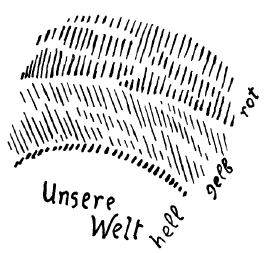
[ 2 ] If we call this our world (see diagram, light-colored), then by developing other states of consciousness, we enter different worlds. So let’s assume we develop the state of consciousness we need to enter the world where we can directly follow the dead in the years following their death. I will characterize this world by depicting it adjacent to our world here (yellow). We would then, if we were to develop the next state of consciousness—the state through which we enter more deeply into that life which the deceased then enters after having completed the path backward—and which I have called the state of empty but watchful consciousness in relation to the physical world. There we would enter another world (red)—this world where, for example, human beings come into particularly close contact with the Mercury beings, with those events and realities that lie within the sphere of Raphael in the sense described yesterday. In this sphere, one comes to know, above all, the healing powers of human nature.
[ 3 ] In this way, each state of consciousness leads one into a certain realm of the world. Through this, however, one comes to know those beings who, for a certain time, belong to that world. So if I want to get to know people as they live in the years after death, I must enter with my consciousness into the world where the dead then dwell. I cannot observe them in their true form in any other world. If I wish to observe the Mercury beings, I must enter that world of the Mercury beings with my consciousness. From this you can see that we, as human beings, can perceive the worlds as separate from one another in a certain sense and develop a specific state of consciousness for each world. We must do this if we wish to get to know the worlds in the proper sense, for only in this way can we prepare ourselves properly to come to know each being in its true character. I would like to show you, using a simple example, where such knowledge leads—that is, knowledge that seeks to develop the appropriate state of consciousness for specific regions of the world.
[ 4 ] Let’s suppose we see a plant—its leaves, its flower. We have seen how such a plant is actually a reflection of what is taking shape and forming out there in the world. What we can find right now in this world—the one we have just been talking about—we find reflected on Earth in our plants. How do we get to know the plants? We come to know them when we raise our consciousness into this world. But something very special becomes apparent here. It turns out that we must make a great, enormous distinction between the plants we encounter in the earthly realm. When we look at any plant—chicory or any other specific plant—it also appears different in this spiritual sense from many other plants.
[ 5 ] Take, for example, the common violet, and compare this violet—to give a radical example right away—with belladonna, with the deadly nightshade, then, if you look at the plant world in the way I have described, you will see how the violet stands quite openly before the eye of the soul when you are in the world to which the violet belongs—that is, in the world of empty, watchful consciousness.
[ 6 ] This is not the case with belladonna. Belladonna draws its essence from other worlds as well. I can also describe it this way: You come to know an ordinary plant by seeing that it has its physical body and its etheric body; and then you see that the flower and the fruit are surrounded by the general astral substance of the cosmos. So you look at the plant. Everywhere, the physical aspect of the plant sprouts from the earth. Everywhere, the plant has its etheric body, and above it, like clouds, the astral realm lies. This is the case with plants such as the violet.
[ 7 ] With a plant like belladonna, things are different. With belladonna, the plant grows, blooms here, and the fruit develops inside (illustrated). But there, the astral element enters the fruit. The violet, on the other hand, develops its fruit solely in the etheric realm. The belladonna absorbs the astral into the fruit. This is what makes it poisonous. All plants that absorb astral from the cosmos into any part of themselves become poisonous. So the very same force that, when it enters an animal, gives the animal its astral body and shapes the animal internally as a sentient being—when it enters a plant—turns the plant into a poisonous one. This is very interesting because we can say: Our astral body contains forces that, when they enter a plant, manifest as poison. — And this is how one must also understand poison. The only way to gain an inner understanding of poison is to realize that, normally, as human beings, we actually possess within our astral bodies the forces of every poison that exists, for this is part of the human nature.
[ 8 ] Now, in this discussion, I would like to introduce just one specific concept that we will need to apply later so that we can gain insight into the difference between the true and false paths of spiritual research. What do we see in such an example? We have a violet. We have a belladonna. If we have developed the proper consciousness for each world, we see in the violet a being that remains in its proper world, drawing nothing from a world foreign to it. In the belladonna, we see that it draws something from a world foreign to it. The belladonna appropriates something that a plant is not actually supposed to have—something that belongs to an animal. And so it is with all poisonous plants. They appropriate that which they, as plants, are not supposed to have, but which belongs to animals.
[ 9 ] Now, there are many beings in the universe who belong to a wide variety of regions of the universe. Precisely in that region we encounter when we first enter the world—where we can follow the dead for a few years, ten, twenty, or thirty years after death, until they leave this world—there are a great many beings who are real but who do not enter our physical world in a visible form. I would like to characterize such beings as a specific type of elemental being.
[ 10 ] So when we follow the deceased after they have passed through the gate of death, we enter a world that also contains all manner of elemental beings—beings that have forms one can speak of, and that truly belong to this world. We can therefore say: Since these beings belong to this world, they should in fact make use only of the forces that exist within this world. — However, among these elemental beings there are some who do not remain there, but who observe—for example, when people are writing—and who look in on all the activities carried out within the human world, that is, within the world that people experience between birth and death. We constantly have such beings who are watching. Now, watching in and of itself is not in any way a bad thing, for the entire plan underlying what I am now describing consists in the fact that all the worlds adjacent to ours—that is, the world we enter immediately after death, the world we enter decades after death—do not contain within themselves what human beings have around them here on Earth, nor what they learn here on Earth. When one enters these worlds adjacent to ours, there is, for example, no writing or reading as we understand it. There are also no airplanes as we understand them, no cars as we understand them, not even ordinary horse-drawn carriages as we understand them. None of these things exist in these adjacent worlds.
[ 11 ] But one cannot say either that because we build cars, write, and read here on Earth—because we write books on Earth that are not read by the angels—we cannot say that all of this is meaningless for the world in general. Rather, it is the case that, so to speak, the beings I have just spoken of are dispatched from the world immediately adjacent to ours. They are, so to speak, tasked with keeping an eye on what human beings are doing there. They are thus specially commissioned from other worlds with the mission of caring for human nature and preserving for future times what they learn there. For you see, we humans can carry our karma from one life into the next; we can also carry over into the next life everything that happens to our karma through external culture. What we experience as human beings in a car, we can carry over from one earthly life to the next; the car’s design, however, cannot. That which has arisen solely from earthly forces—we humans cannot carry that over from one earthly life to the next on our own. Through this, humanity has, in the course of civilization, established something that it would lose on its own if other beings did not come to its aid.
[ 12 ] Now, these beings I spoke of have been specially assigned to preserve for the future that which human beings cannot carry over from one earthly life to the next. The significant point is that we have beings right here among us in the world that surrounds us who are destined to carry over into the future what human beings cannot carry over from their external civilization, so that human beings may have it again in the future. You see, much—very much—has been lost to humanity because, in times past, it became quite difficult for some of these beings to fulfill their task; thus, much of what had already been invented in civilization in ancient times has been lost to humanity once again.
[ 13 ] So the important point I want to make here is this: there are beings among us who, within the plan of the worlds, are tasked with carrying over into the future everything that human beings cannot carry over themselves from one earthly life to the next. This applies above all, for example, to the abstract content of our libraries. We humans cannot carry this over from one earthly life to the next. This requires special beings. And those spiritual beings with whom we humans are directly connected cannot do this. And therefore, we as humans cannot do it either. These beings had to make use of other beings who were long alien to them, who have undergone a completely different development than the spiritual beings connected to us.
[ 14 ] In my books, I have called these other beings—who have undergone a completely different evolution—Ahrimanic beings. This is a completely different evolution that intersects with our own on such occasions, for example, when we design a car here. These are beings who, drawing upon their Ahrimanic world forces, are able to understand a specific contemporary endeavor—such as automobile design—and who carry forward into the future what has once been assimilated into human civilization, and what human beings cannot carry over from one incarnation to the next.
[ 15 ] Obsession
[ 16 ] Now, using the insights we have gained in this way, we can characterize what a “medium” actually is. Of course, we must distinguish between a mediumistic person in the broadest sense and what is called a “medium” in the strict sense of the word. For in essence, my dear friends, we are all mediums if we take the term “medium” in its broadest sense. We are, for example, soul-spiritual beings before we descend into the earthly world and live out our lives between birth and death. What we are in the spiritual world is embodied in what we are here in the physical world. In the physical world, we are a medium for our own spirit. So if one takes the word “medium” in the broadest possible sense, one could in some way describe every being as a medium. That is not what is meant when one speaks of a “medium” in the ordinary sense. A medium in our world—the one we experience between birth and death—is a person who has developed certain parts of the brain to such an extent that they can be switched off from their overall being. Thus, at certain times, the very parts of the brain that particularly support “I”-activity are not present in a medium as the basis for that activity.
[ 17 ] When we truly say “I” to ourselves, when we truly bring our “I” into consciousness, this development of consciousness—this development of the “I”—is always supported by very specific parts of the brain. These parts of the brain are deactivated in a medium. As a result, certain beings of the kind I have just described develop an appetite to creep into these parts of the brain in place of the human “I.” And such a medium then becomes the vessel for those beings who are actually meant to carry civilization into the future. So when these beings come across a brain somewhere that is not inhabited by its ego at a certain time, they develop an immense desire to slip into that brain. And when a medium is in a trance, as they say—that is, when the brain is shut down—then such a being, which is under Ahrimanic influence and is supposed to carry civilization into the future, creeps into the brain; and during this time, such a person, instead of a human “I,” becomes the vessel for an elemental being that is neglecting its duty in the cosmos. Please take this expression quite literally: one that is neglecting its duty in the cosmos.
[ 18 ] The duty of such a being in the cosmos is to observe how humans write. They write using the forces anchored in those parts of the brain I am speaking of right now. Instead of merely watching, as they are otherwise always compelled to do, they keep an eye out for any mediumistic brain that can be activated. Then they slip in and bring into the present human world the art of writing they have already developed through observation. Thus, such beings project into the present—with the help of mediumistic people—something that, according to their task, they are actually supposed to carry into the future. Mediumship is based on the fact that what is to be developed as abilities in the future is already being developed in the present in a chaotic manner. Hence the prophetic nature of the mediumistic being, hence its fascination. It is, in fact, something that functions more perfectly than human beings do in the present. But it is brought in by beings in the manner I described to you earlier.
[ 19 ] Just as belladonna acts as a medium for the astral world—belladonna is a medium for certain astral forces that it draws into its fruit—so too is a human medium, through his or her special brain, a medium for these elemental beings, who must necessarily play a part in our civilization because human beings cannot carry everything over from one earthly life to the next. This is the true mystery of mediumship: possession by these specific beings. Now you can imagine that, on the one hand, these beings are indeed true creations of the Ahrimanic beings. The Ahrimanic beings exist in the cosmos as beings of an intelligence far surpassing that of humanity. As soon as we approach the Ahrimanic beings in the world immediately adjacent to our own—or, if we develop our ability to see, even within this physical world—we are astonished by their immense intelligence, by their surpassing intelligence. They are far more intelligent than any human being can ever be. In terms of intelligence, they are true superhumans. And we only come to respect such beings when we realize just how infinitely intelligent they are.
[ 20 ] Some of this intelligence is then transferred to these creatures of theirs—these elemental beings—which creep into and dive down into the minds of mediums, so that all sorts of significant things can emerge through mediums in this way. One can learn all sorts of meaningful things, especially if one can observe what such mediums produce with a full, well-developed consciousness. It is not the case that, if one truly understands the constitution and nature of the spiritual world, one would deny that all sorts of true information can emerge from the spiritual worlds into the physical world through mediums. Important and meaningful things can be learned through mediums; but it is not the right path. Why not?
[ 21 ] You can learn this precisely from such plants, which serve as plant media—media for certain astral forces that turn them into poisonous plants. One can only come to understand how these things work through a well-developed consciousness. I would like to describe to you how to gain this understanding in the following way. When it comes to the spiritual worlds, one prefers to describe things vividly rather than form abstract concepts.
[ 22 ] Let us suppose that one enters, with the knowledge of an initiate, into that world where the dead dwell after their death. One follows them. It is indeed true that when one follows the dead in this way, one initially enters as it were into a completely different world. I have described it in part. I have outlined for you how it makes a much more real impression than this world of ours, in which we exist between birth and death. But when one enters this world, one immediately notices—apart from the fact that the souls of the dead are there—what strange creatures they are. Soon after a person has died, if you follow them there, you see, among the human souls who have died—and thus also around those human souls who have just passed away—strange, demon-like figures. Right at the entrance to this realm of souls, which the deceased must enter—and which one can enter with them through a certain clairvoyant gaze—one sees demonic figures that have enormously large—of course, always compared to earthly proportions, for when speaking of large and small, one can only speak in terms of comparison—which have powerfully large, well-developed webbed feet, like those of ducks, or like those of aquatic animals in general; powerfully developed, yet constantly changing webbed feet, like those of ducks or wild ducks. They also have a form that could be compared, for example, to that of a kangaroo, though half-bird-like and half-mammal-like—large, powerful beings. One passes through vast expanses inhabited by such beings when following the dead. And if one now asks: Where are these beings? — you need only properly imagine how one should think about the “where” of such beings, where they are. They are always around us, for we stand, after all, within the very same world in which the dead are. They are always around us, these beings; only, you see, they are not here in this very hall. This is where, so to speak, the path of genuine, entirely precise spiritual research begins.
[ 23 ] Consider the following. You are walking across a meadow where, in the fall, many plants of the species Colchicum autumnale—the autumn crocus—are growing. Now, as you walk there, you find autumn crocuses everywhere. Try, at the very moment you’re standing in the midst of the autumn crocuses, to evoke the state of consciousness in which you can follow the dead, just as I have described; then you will see that wherever there is an autumn crocus, there is the being I just described, with those webbed feet and that strange, kangaroo-like body. Every autumn crocus becomes such a being. And if you go to another area where belladonna, the black nightshade, grows by the wayside, and put yourself into the state of consciousness I have spoken of, you will encounter there entirely different, terribly demonic beings who also belong to the world I have just described. So one can say: Colchicum autumnale and Belladonna are media that allow the next world to enter within them and which, in their other nature, actually belong to the world of the dead.
[ 24 ] If you consider this, you will say to yourself: All around us is also what we call another world. It all depends on our entering into it with our consciousness—on seeing Colchicum autumnale and belladonna not merely with our ordinary, everyday consciousness, but with the higher consciousness in which they exist in the realm of the dead. We see belladonna with the higher consciousness in which it exists in the realm of the dead.
[ 25 ] Now you might say: Here, for my sake, is a meadow where autumn crocuses grow. — Now, if you’re in the physical world, you’d have to go a long way—perhaps all the way up a mountain—and up there are the bushes where belladonna grows. Belladonna and Colchicum autumnale are not side by side in the physical world. But in this spiritual world—the next one I am speaking of—they are right next to each other. Space is arranged quite differently there. What may be far apart in the physical world can be right next to each other in the spiritual world. The spiritual world certainly has its very own laws. Everything is different there. And now consider this: you encounter these plants—if I may put it this way—in the world of the dead. When you first begin to follow the dead, they do not at all have the dreadful impression that people on Earth have of these plants; rather, they know that the presence of these demonic figures is grounded in the wise plan of the world. So when you first follow the dead into the realm of souls, you find that realm populated by figures corresponding to the poisonous plants—demonic figures—precisely in the next world.
[ 26 ] As you proceed further into the realms from which the dead emerge after ten, twenty, or thirty years to enter a higher realm, it is only there that you will find the equivalents of our non-poisonous plants. Only there, for example, will you find violets and the like, which are non-poisonous. Thus, the plant world has its significance here in the physical world and also in the next world. We simply see them there in different forms. What I have described in its true form in the realm of the stars is reflected on Earth in the form of plants such as belladonna, Colchicum autumnale, and the violet; it is also reflected in the world into which the dead enter. Immediately after death, it is reflected just as I have described it. Everything that exists in one world also affects the other worlds. But if one wishes to recognize it in its true reality, one must enter one’s own inner world with one’s consciousness. The same is true, however, for the beings of these other worlds. What these beings are—these elemental beings, who are in fact creatures of the Ahrimanic rulers—can only be recognized by entering the next world, the one that adjoins ours.
[ 27 ] But now these entities are emerging through the media, taking possession of the media and thereby temporarily entering our world. So if we come to know these entities in our world only through a medium, then we are actually getting to know them in a world where they should be foreign; thus, we cannot come to know them in their true form. Consequently, for those who come to know these beings—whose revelations they experience only through mediums—there is no possibility whatsoever of arriving at the truth, because these beings manifest themselves in a world that is foreign to them. Spiritual revelations are certainly present; but understanding these spiritual revelations is impossible if one comes to know these beings only in a world to which they do not belong at all. This is the deceptive, in the highest sense illusory, nature of everything that enters the world through mediumistic consciousness: that those who encounter these beings do not know what their true nature actually is.
[ 28 ] These beings also have a very special destiny precisely because they enter the world in this way. For you see, one comes to know other things as well when one gets to know the world in the way I have described. When one enters the world of the dead, passing through the demonic forest of Colchicum autumnale, Belladonna, Digitalis purpurea, Datura stramonium, and so on—when one traverses this entire region—one realizes: violets will transform; in the future, they will take on entirely different forms. They hold significance for the future of the cosmos. Colchicum autumnale, by its very nature, participates in the death for which it is destined. These are dying plants—the poisonous plants, the plants in the process of dying—that do not extend into future forms. In future epochs, other poisonous beings will be present. But those beings that are poisonous today are dying out in our epoch. The epoch lasts a long time, of course, but they [these poisonous plants] carry within themselves the impulses of death. And this also spreads throughout all vegetation. When one looks at vegetation with this perspective, one sees what is sprouting, developing, and propelling itself toward the future; and what is dying off, connecting itself with death.
[ 29 ] And so it is with the entities that have taken possession of the media. In a sense, they separate themselves from their companions, whose task is to carry the present into the distant future; they penetrate this present world through the mediums, but there they also become bound to the fate of the earthly realm and lose sight of their future mission.
[ 30 ] But in doing so, they rob human beings, in the highest sense, of their future mission. And that is what one immediately faces when one truly comes to know the mediumistic being. The future is to die—so the mediumistic being actually says—the present is to be everything. And that is why, when one comes to a spiritualist séance with true insight into the facts and the essential nature of the world, one is initially struck by how all those sitting in the circle and participating in a spiritualist manifestation are surrounded by what appears to one in the form of poisonous plants. Every spiritualist séance is, in fact, framed by a garden of poisonous plants, which are not like those in the world of the dead, but which grow all around the spiritualist community, and from whose blossoms and fruits demons emerge.
[ 31 ] This is what the person who looks into the other worlds experiences during a spiritualist séance. In fact, they usually pass through a thicket—a world-thicket—that surrounds the spiritualist gathering, made up of poisonous plants that are, however, flexible, as if alive, and possess something animal-like. One can only tell from their shapes that they are poisonous plants. But it is precisely from this that one can see how strongly that which is at work in this mediumistic form—that which should flow onward in the course of human development and bear fruit in the future—is bound into the present, where it does not belong, and is developed in the present to the detriment of humanity. This is the inner mystery of the mediumistic being, which we are to come to know here in the course of these lectures.
[ 32 ] The Inner Mystery of the Mediumistic Being
[ 33 ] It is now possible to specify very precisely, very exactly, where in the nature of mediumship—so to speak—the difficult point of humanity’s constitution lies. I will have to present you with a discussion that may seem somewhat abstract, but it is precisely through this that you will gain a little insight into the nature of mediumship.
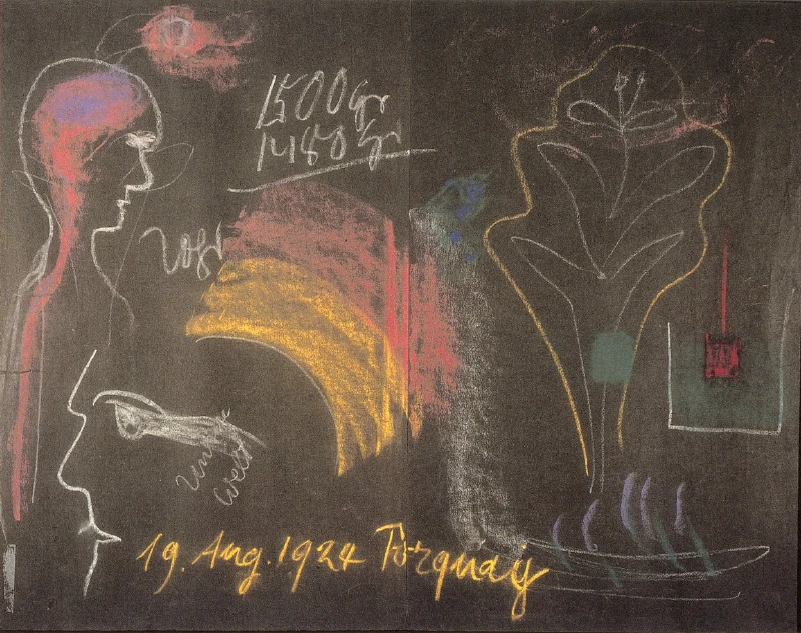
[ 34 ] You see, the human brain, as it is contained within the cranial cavity, weighs on average about one thousand five hundred grams or slightly more. That is actually a significant weight. And the fact is that if this human brain were to press down with its own weight on the delicate veins in the head that lie beneath it, it would immediately crush those veins. We humans spend varying lengths of time in this world, depending on how old we get, and our brain does not exert its weight on the vascular system beneath it. One understands this immediately when one grasps it in the right way.
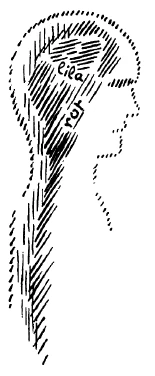
[ 35 ] Consider the human body as it is structured; I’ll sketch it out very schematically. You’ll then see that the spinal canal runs upward and widens into the brain (red). The entire structure is such that the spinal canal—with the exception of a few sections that are not solid but only semi-solid—is filled with fluid. The brain actually floats in this fluid. The human brain floats in cerebrospinal fluid (purple). Now there is something called Archimedes’ principle. You will have learned about it in your physics class. This principle is named after the ancient sage Archimedes, who, as the story goes, discovered it through a stroke of genius while he was in the bath. He conducted the obvious experiment while he was in the bath: he kept his entire body submerged, alternately extending his legs out of the water, and in doing so he noticed that, depending on whether his legs were in the water or out of it, they had a different weight for him. They are heavy when they’re out of the water; they immediately lose some of their weight when they’re submerged in the water. For someone like Archimedes, this was something entirely different than it would be for an ordinary person. An ordinary person would just play around with it. Archimedes, however, made a great, momentous discovery. “Eureka!” I’ve found it! — For he discovered that any object floating in another medium—that is, in a liquid—loses as much of its weight in that liquid as the weight of the liquid it displaces.
[ 36 ] Let’s imagine a container filled with water. I place a solid object inside it. If I make the object weighable by suspending it, then I can determine exactly that the object becomes lighter in the water—it weighs less than it does outside the water. In fact, if you were to imagine a volume of water of the same size, that volume of water would also weigh something. You must subtract that amount from the weight of the object when it is in the water. The object loses as much of its weight in the water as the weight of an equal volume of water. This is Archimedes’ principle.
[ 37 ] This Archimedean principle is of great benefit to us as human beings, given our physical constitution; for the brain floats in cerebrospinal fluid, and thus loses as much of its weight as the weight of the cerebrospinal fluid, which is equal to that of the brain. Thus, when we carry our brain within us, it does not weigh 1,500 grams; rather, it loses an amount equivalent to that of hydrocephalus—it loses 1,480 grams and weighs only about 20 grams. So in reality, we do not carry a brain weighing 1,500 grams within us, but only one weighing twenty grams. The rest is lost because the brain floats in cerebrospinal fluid according to Archimedes’ principle. Thus, we have something in our organism that is actually much lighter than it appears to be. We carry only twenty grams of brain within us. But it is precisely these twenty grams, which still have weight, that we must take great care of. For these twenty grams alone are capable of containing our “I.” Everything else about us is located elsewhere.
[ 38 ] But the entire body is filled with all kinds of solid components that also float in fluid—for example, blood cells. They all lose some of their weight; only what remains in terms of weight still contains the “I,” so that the “I” is spread throughout the blood, but not with the heaviness of the blood’s weight. We must pay attention to all of this—to everything that still contains perceptible weight—when we walk around. Yes, my esteemed audience, you must all be extremely careful with that which sits there (see drawing: brain) and is still heavy in the truest sense. For within it, your “I” may reside. It may be nowhere else; otherwise, the astral body, etheric body, and so on would have to be everywhere.
[ 39 ] The medium is now a human being in whom this heavy component of his constitution—that is, the twenty grams of brain—no longer contains the “I.” The “I” has been driven out of the heaviness, out of the weight. Then the beings I have spoken of can immediately enter these parts.
[ 40 ] Now you, too, can see something special in what I am describing here. The materialistic way of thinking seeks to identify specific locations everywhere. It asks: “Well, where exactly is the part of the human being where the elemental being takes up residence when it takes possession of the medium?” That is not how one speaks about these things; only the materialistic mind speaks that way. That is how someone who thinks mechanically and mathematically speaks. But life does not proceed mathematically or mechanically; rather, it proceeds dynamically. So one must not say: “The medium is possessed here or there, localized purely mathematically or geometrically”—but one must say: “The medium is possessed in the part that remains heavy within him, in the part that draws downward toward the earth.” — That is where the Ahrimanic beings can enter. And not only there, but also elsewhere. You see, what I have explained to you here in precise terms is only the coarsest aspect of the matter, the very coarsest. There is a finer aspect.
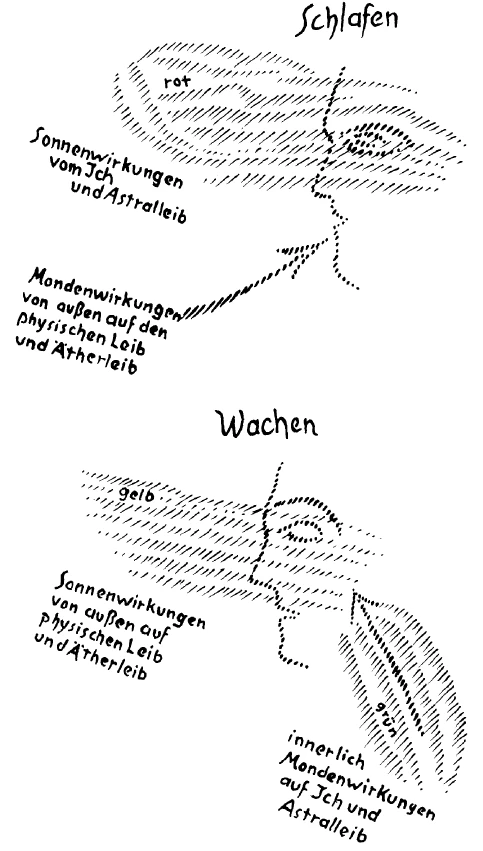
[ 41 ] How do we see on the physical plane? We have our eye (see diagram). From the eye, the optic nerve runs backward toward the brain. The optic nerve branches out within the eye and extends toward the brain. The optic nerve forms the basis of color perception. Now the materialists ponder how the optic nerve carries the colors into the brain and unloads them there. For the materialists imagine everything as if it were a ship’s or railroad cargo. Something is loaded up out there in the sensory organ, is transported through the nerves; it is unloaded somewhere along the way and enters the soul—well, not quite that crudely, but that’s the gist of it. But it is entirely different! The fact is that the optic nerve is not there at all to carry the perception of color backward to the brain, but rather to extinguish it at a specific point. Color resides only on the outer periphery. The optic nerve is designed to extinguish color the further inward you go, so that the brain is as colorless as possible, so that only very faint, fading colors enter the brain. Not only is color extinguished, but every connection to the external world is also extinguished in the brain. Hearing and seeing take place in the senses. Toward the brain, the optic nerves, auditory nerves, and thermal nerves erase everything you have at the periphery down to a faint shadow. The faint shadow is in the same proportion to sensation as twenty grams are to one thousand five hundred grams. The twenty grams are, after all, only a shadow of the brain’s weight.
[ 42 ] That is how little we still have left. When we experience a powerful, gigantic dawn that rests within our senses, we have only a faint shadow of it at the back of our brain. We must pay attention to this faint shadow once again, for only there may our “I” enter. The moment our “I” is suspended—the moment we become mediumistic—such an elemental being, as I have described it, immediately creeps into this faint shadow or into the faint sounds that come from hearing, and so on. Into all those areas where the “I” belongs—where external sensory perception is extinguished—this being creeps in, and there it takes possession of the medium. And it then creeps all the way into the nerve branches, into the formation of the will—that is, into those nerves that lead to the formation of the will. The result is that the medium begins to become active, because that which within him is meant to be grasped only by the human “I” has been seized. The rest of the brain’s weight, the rest of the sense of color, the sense of hearing—all these subtle, shadowy elements that fill us like a phantom—for these twenty grams of weight are merely a phantom, and these faint shadows of color that penetrate inward are phantom-like—into all of this the elemental being plunges, and then the human being becomes so whole that he lies there completely still with his body, lethargic, and everything that is actually meant to be filled by the “I” becomes active within him in the faint, phantom-like shadows [gap], which are otherwise filled by the “I.”
[ 43 ] So take a look at the medium. The medium can only be a medium by causing everything used by the normal person to sink back into lethargy, into absolute inertia, and by bringing to life this phantom I have described. You can observe this, for example, in the way the medium writes. Of course, the medium could not write unless everything inside—just as in the brain—became lighter; for everything heavy floats in a fluid, becomes light in feeling and sensation, and it writes there—in that which is light—just as the “I” otherwise guides the pen. In this human phantom, then, the elemental being guides the pen for the medium.
[ 44 ] You see, when the medium sits there like that or manifests in any other way, it is indeed the intrusion of another world. Just as the beings of the other world—these Ahrimanic entities—can penetrate the medium’s movements, so too can they penetrate the emanations, all the emanations I described yesterday. And there are always, especially in the regions of the human organism where glands are located, powerful fluid emanations. Thus, such beings from the elemental world penetrate these fluid emanations, just as they do the respiratory emanations and the light emanations. Only when the chemical emanations occur is there a conscious interaction between the one who uses these chemical emanations and these beings that enter into them. That is precisely where, as I already described yesterday, black magic begins—the conscious working with the beings that enter in the manner I have described.
[ 45 ] The medium—and, as a rule, the person conducting the experiment with the medium—is actually unaware of the actual processes taking place. In the case of the black magician, there is usually full awareness that by drawing upon the chemical emanations of human beings—most often his own—he summons these beings from the elemental world. The black magician is thus actually always surrounded by a host of servants consisting of such elemental beings, to whom he grants—either through his own emanations or through the incense burnings he performs in his laboratory—the ability to utilize the occult-chemical impulses here in this physical-sensory world.
[ 46 ] This leads us to the realization: Just as the belladonna grows upward into a world to which it does not belong and thereby becomes poisonous, so the spiritual world grows into our world here—the one we inhabit between birth and death—through the medium. — But fundamentally, the danger that this spiritual world will intrude in a manner similar to what we have described with regard to belladonna is ever-present whenever the state of consciousness—that is, the fulfillment of the “I”—is suppressed in a human being, that is, whenever the person is in a dazed, faint-like state or in a state of actual unconsciousness.
[ 47 ] Whenever a person’s consciousness is dimmed not by normal sleep but by something else, there is a danger that a window will open onto the world I have just described. And we will continue to explore tomorrow and in the upcoming lectures just how immensely significant it is in human life that such windows open through people’s subdued states of consciousness.