

Supplements to Member Lectures
GA 246
12 January 1908, Leipzig
Translated by Steiner Online Library
10. Occult Signs and Symbols of the Astral World
[ 1 ] When I speak today of the occult signs of the astral and spiritual worlds, “spiritual world” is meant and used in the sense of Devachan. Our physical plane is permeated by the astral world and by even higher worlds. What the occultist learns about these higher worlds is often expressed through all manner of symbols. We need not think of particularly artificial images, but rather we must take this in a symbolic sense, just as we speak, for example, of the “light of knowledge” or the “light of wisdom.” Anyone who studies poetic language or examines religious texts will find symbols. The occultist, however, never needs such images in a purely speculative sense, for occult symbols are not the product of speculation. Thus, you cannot penetrate the meaning of these images through mere reflection alone. The only path is through the secret science itself, and the same approach must also be applied to the legends and fairy tales of the peoples. You must bear in mind that a true occult symbol is something that can actually be seen in a higher world.
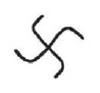
[ 2 ] A human being in their astral body can possess the very same organs of cognition and perception as the physical body. When the astral body leaves the physical and etheric bodies, unconsciousness sets in—not because the physical senses are absent, but because greater and entirely different worlds surround it, and because [the human being] has not yet developed their astral organs. These are very different from the physical senses. Based on their shape, they are called lotus flowers or wheels. They are movements of light that flash into view. If we sketch the main outlines of these movements of light—especially the rapidly moving two-petaled one—the so-called swastika emerges. Yet one understands the meaning of this drawing just as little as one knows what an eye is when one sees only its sketch. One cannot grasp the meaning of that symbol through mere contemplation, but only through knowledge of the facts of esoteric science.
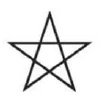
[ 3 ] Thus, the pentagram is nothing other than an organ of the etheric body. It represents the human being because it is inscribed within the etheric body. However, the lines of this pentagram follow the movements of the human body and are therefore not always straight.
[ 4 ] Today we would like to single out a few from this vast array of symbols—specifically those that, in a certain sense, are close to human experience—and draw attention to the reality that underlies them.
[ 5 ] If we consider the four aspects of the human being in terms of their perfection, the physical body is the most perfect, followed by the etheric body, then the astral body, and least of all the “I.” The physical body is the most perfect because humans had already developed it when the Earth was still Saturn. The Earth has since become the Sun and the Moon, and has further perfected the physical body at these stages. The etheric body first formed on the Sun; therefore, it attained a threefold degree of perfection: Sun, Moon, Earth.
[ 6 ] The astral body has so far attained only a twofold degree of perfection: the Moon and the Earth. The “I” is still in its infancy, but will later become a very perfect being. The occultist initially regards the human being as a perfect human only in terms of his physical body, whereas in terms of his etheric body he has the value of an animal, in terms of his astral body the value of a plant, and in terms of his “I” only the value of a mineral.
[ 7 ] What is the essence of the “I”? It is a perceiving and comprehending entity. But at present, the “I” can only comprehend the mineral world. That is why human beings initially only know how to make minerals serve them; they use them to build their machines and so on. The “I” can first incorporate the mineral into itself and, for example, use mechanical efficiency to make a watch. Human beings cannot bring a seed or a plant into existence. One day, they will also be able to produce living things—not only plants, but even bring themselves into existence.
[ 8 ] An occult rule states that human beings will only be able to create from within themselves once their work on the laboratory table has become sacramental. Only when the laboratory table has become an altar will beings be called into existence by the higher entities.
[ 9 ] Only the physical body is similar to God; that is the human being. The etheric body is essentially still at the animal level, taking on a more or less animal form, and in fact, four very specific animal forms are expressed. These were named after related animals to which they merely bear a resemblance. One (typical) archetypal form is the human; another, because it resembles a hoofed animal, is the bull; another is the lion; and finally, the fourth form, which has a striving toward the ideal, is the eagle.
[ 10 ] It is precisely these forms that emerge at the moment of death. For people today, it is still difficult to recognize this exemplary etheric form. In the Atlantean era, when the human etheric body had not yet taken possession of the human being, had not yet crept into him—that is, when no distinct individuality existed—there was a resemblance to the four animal forms. At that time, there were four group souls: human, bull, lion, and eagle. These are not symbols invented at random. Today, the occultist must distinguish between these four groups: human-human, bull-human, lion-human, and eagle-human. In this way, these images are traced back to their reality.
[ 11 ] What for many people today is merely a name actually exists: the soul of a tribe, the folk-souls. I would like to remind you here of the Cherusci, a people who appear in ancient Germanic history. They arise, reach their zenith, decline again, and disappear from history, just as a human being disappears from this plane after his life ends with death. In that people we find something that is a true folk-soul; and every single Cheruscan—though outwardly completely distinct—was nevertheless embedded in the general astral soul of the Cherusci. The soul of the Cherusci existed; it is a real astral being.
[ 12 ] Imagine that a clairvoyant had looked down and followed this development. He would not have looked at every single Cheruscan, but he would have focused his attention on the folk-souls. He would see how the soul arises and develops, but then he would see something else. When we follow a person up into the Devachan since their last death, we continue to follow their life in those higher worlds until they step back down into earthly life, and so on. We do not see a folk-soul disappear and reappear on its own plane; rather, just as it once transformed from another soul, so it takes shape anew on its own plane. The Cherusci soul had transformed itself from another folk-soul and is now shaping itself into yet another. A folk-soul consists of feelings, impulses, and desires, just as a human being consists of nerves, muscles, and so on; it arises anew from within itself time and again, generating itself again and again from the eternal fire, and such a folk-“I” does not leave its world. Such beings exist today; they never appear on Earth. And because they have appeared to some people in the form of a bird, such beings were called the “Phoenix.” It is a fact and is simply derived from the astral experience, the event. Thus, we have presented an important symbol.
[ 13 ] The cross has a profound meaning and played a major role in the Middle Ages. Probably [a student in the Middle Ages] who was entrusted to the Rosicrucian for his education. [In the form of a dialogue] I will tell you—a process that perhaps stretched on for weeks and months—how the Rosicrucian interacted with the student: “Look at the plant; it puts down roots, grows a stem, and produces flowers and fruit. Place yourself next to this plant. Now, you must not compare the flower of the plant to the head of a human being; rather, what the root is to the plant, the head is to the human being. The plant turns its fruiting organs upward toward the sun; with humans, the exact opposite is true. In animals, they lie horizontally, because the animal has only traveled halfway along its path of development. If we draw a line upward for the human’s head force, downward for the plant, and horizontally for the animal, these lines form a cross.

[ 14 ] If we trace the evolution of the human being, we will say that the human being has acquired something that is higher than the plant realm, and also something that is lower. In the plant, there is nothing of instinct or sensuality. Human beings did not retain this pure nature because they took on the astral body and, with it, desire. As a result, they gained, on the one hand, waking consciousness and, on the other, desire. If a plant were permeated with astral substance, its chlorophyll—or leaf green—would turn red, [the] color of blood, and be pulsed with desires. At a higher level of consciousness, however, human beings will have purified their instincts and desires, cast off their nature of desire, and returned to the chaste substance of the plant. There they will slay the lower aspects of their nature—the desire-filled nature of their blood. Here you are presented with a future ideal of humanity. Imagine the cross as a symbol of death and the red blood, purified, returned to its pure nature; then you will understand the wreath of red roses around the cross, the symbol of the Rosicrucian.
[ 15 ] Such symbols are meant to be felt; when they are, they become a source of strength and nourishment for your mind and soul. Something clicks for us when we have the Rose Cross before us.
[ 16 ] When the fairy tale recounts that a bee sucked on the blood of the crucified Savior as if it were a plant, it refers to something special; even then, that blood had already attained that level—it had already become the purified blood of the rose. Thus, much wisdom has found its way into legends and fairy tales.
[ 17 ] If we continue along the path even higher, beyond the astral world, we arrive at what is called the spiritual world. The astral world, especially at its middle level, is characterized by stillness and flowing light with wondrous luminous phenomena, but soon the noise of the physical world falls silent. Following this stillness, the spiritual world resounds with sounds that the students of occultism called “sphere music” in this [spiritual] world. Goethe meant the same thing when he said at the beginning of Faust:
The sun resounds in the ancient way
A contest of song in the spheres of brotherhood;
And its prescribed journey
It completes with a thunderous roar.
(Prologue in Heaven)
[ 18 ] And then, at that point in the second part of Faust—he also has Ariel speak at the beginning:
With a resounding sound to the ears of the spirit
The new day is already dawning,
Rock gates creak and rattle,
Phoebus’ wheels roll with a crackling sound:
What a clamour the light brings!
It drums, it trumpets,
The eye blinks and the ear is astonished,
The unheard cannot be heard.
[ 19 ] This describes reality; great artists do not speak in clichés. When a person learns to perceive in this spiritual world, sounds come to meet them symbolically; they resound spiritually from the heavenly realms, faster or slower. It is a different kind of sound; celestial music is not a metaphor; it is a reality that one experiences.
[ 20 ] You know, [Jupiter] moves in a certain way through space; [Saturn] moves more slowly. The actual ratios are as follows: [Jupiter] moves two and a half times as fast as [Saturn]; when Saturn stands out against the starry sky, which continues to move, Saturn moves 1,200 times faster than the sky. The ratio of Jupiter’s motion to Mars’s is five to one. Mars compared to [...], Venus, and Mercury: a ratio of [approximately three and eight] to [one]. This is how one can describe the tonal ratios in the great cosmic harmony.
[ 21 ] [But such relationships also exist in] our world—earth, water, air, and fire—which are related in very specific numerical proportions. The initiate learns to “hear” these relationships.
[ 22 ] Something very important is based on this. The first ancient initiates tuned their musical instruments accordingly. The bass note of the lyre was provided by the tone of the earth, the D string by that of water, the F string by that of fire, and the A string by that of air. Thus, the instruments are structured according to the mysteries of the cosmos; within them resounds what the initiates heard. This indicates that much in our world is symbolic in nature. — Richard Wagner, with his brilliant insight, once remarked: “In the harmony of the instruments, one can hear something of the music of higher worlds.”
[ 23 ] You can see how, out of spiritual sounds, many things come into being that serve as symbols for us. We could also list many examples that show how, even in art, many images originate from the spiritual world.
[ 24 ] Today, this brief selection may teach us: The sensory world around us is, in a certain sense, rigid; but when we ascend to the higher worlds, everything becomes fluid and capable of transformation—and there, human beings need something to express this, and so the symbol points us toward the truth of the spiritual world. Every being in the world—whether it be a stone, a plant, or the sun—is a parable. What we see coming into being and passing away, what is spread out around us in the cosmos, is a parable for the eternal. True is Goethe’s saying (at the end of the second part [of Faust II]):
Chorus mysticus:
Everything that is fleeting
is merely a parable.
[ 25 ] Thus we learn to view the world itself as a parable. Only when we learn to regard our physicality as a parable of the higher human being have we reached the highest level in our contemplation of the Supreme; when a person is able to regard his transitory nature as important enough, yet does not allow it to become overriding, when it serves as a parable of the imperishable.