

Supplements to Member Lectures
GA 246
12 January 1908, Leipzig
Translate the original German text into any language:
Versions Available:
Supplements to Member Lectures, tr. SOL
10. Okkulte Zeichen und Symbole der astralischen Welt
10. Occult Signs and Symbols of the Astral World
[ 1 ] Wenn ich heute von den okkulten Zeichen der astralen und geistigen Welt spreche, so ist «geistige Welt» in dem Sinn vom Devachan gemeint und gebraucht. Unser physischer Plan ist durchstrahlt von der astralischen Welt und von noch höheren Welten. Das, was der Okkultist von diesen höheren Welten kennenlernt, wird durch allerlei Sinnbilder oftmals ausgedrückt. Wir brauchen nicht zu denken an besonders künstliche Bilder, sondern wir müssen das sinnbildlich gesprochen nehmen, wie wir zum Beispiel sprechen vom «Licht der Erkenntnis», «Licht der Weisheit». Jeder, der dichterische Sprache verfolgt, der religiöse Urkunden untersucht, wird Sinnbilder finden. Der Okkultist braucht aber solche Bilder nie im ausspekulierten Sinn, denn okkultistische Zeichen sind nicht ausspekuliert. So können Sie auch nicht durch bloßes Nachdenken in den Sinn der Bilder eindringen. Der einzige Weg ist durch die Geheimwissenschaft selber, und derselbe Weg muss auch angewendet werden für die Sagen und Märchen der Völker. Sie müssen festhalten, dass ein wahres okkultistisches Symbol etwas wirklich zu Sehendes in einer höheren Welt ist.
[ 1 ] When I speak today of the occult signs of the astral and spiritual worlds, “spiritual world” is meant and used in the sense of Devachan. Our physical plane is permeated by the astral world and by even higher worlds. What the occultist learns about these higher worlds is often expressed through all manner of symbols. We need not think of particularly artificial images, but rather we must take this in a symbolic sense, just as we speak, for example, of the “light of knowledge” or the “light of wisdom.” Anyone who studies poetic language or examines religious texts will find symbols. The occultist, however, never needs such images in a purely speculative sense, for occult symbols are not the product of speculation. Thus, you cannot penetrate the meaning of these images through mere reflection alone. The only path is through the secret science itself, and the same approach must also be applied to the legends and fairy tales of the peoples. You must bear in mind that a true occult symbol is something that can actually be seen in a higher world.
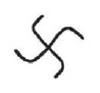
[ 2 ] Der Mensch in seinem astralischen Leib kann gerade solche Erkenntnis- und Wahrnehmungsorgane haben wie der physische Leib. Wenn der Astralleib den physischen und Ätherleib verlässt, tritt Bewusstlosigkeit ein, aber nicht weil die physischen Sinne fehlen, sondern weil größere und ganz andere Welten um ihn herum sind und weil [der Mensch] seine astralischen Organe noch nicht entwickelt hat. Sie sind sehr verschieden von den sinnlichen Organen. Nach ihrer Form nennt man sie Lotusblumen oder Räder. Es sind Lichtbewegungen, die da aufblitzen. Wenn wir diese Lichtbewegungen in den Hauptlinien zeichnen, besonders die schnell sich bewegende zweiblättrige, so kommt die sogenannte Swastika heraus. Damit kennt man den Sinn dieser Zeichnung eben so wenig, als wie man weiß, was ein Auge ist, wenn man nur dessen Zeichnung sieht. Man kann den Sinn jenes Zeichens nicht durch Nachsinnen erkennen, sondern allein durch das Wissen der geheimwissenschaftlichen Tatsachen.
[ 2 ] A human being in their astral body can possess the very same organs of cognition and perception as the physical body. When the astral body leaves the physical and etheric bodies, unconsciousness sets in—not because the physical senses are absent, but because greater and entirely different worlds surround it, and because [the human being] has not yet developed their astral organs. These are very different from the physical senses. Based on their shape, they are called lotus flowers or wheels. They are movements of light that flash into view. If we sketch the main outlines of these movements of light—especially the rapidly moving two-petaled one—the so-called swastika emerges. Yet one understands the meaning of this drawing just as little as one knows what an eye is when one sees only its sketch. One cannot grasp the meaning of that symbol through mere contemplation, but only through knowledge of the facts of esoteric science.
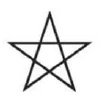
[ 3 ] So ist auch das Pentagramm nichts anderes als ein Organ des Ätherleibes. Es bedeutet den Menschen, weil es seinem Ätherleib eingezeichnet ist. Die Linien dieses Pentagrammes folgen aber den Bewegungen des menschlichen Körpers, sind deshalb nicht immer gradlinig.
[ 3 ] Thus, the pentagram is nothing other than an organ of the etheric body. It represents the human being because it is inscribed within the etheric body. However, the lines of this pentagram follow the movements of the human body and are therefore not always straight.
[ 4 ] Heute wollen wir aus der großen Reihe dieser Zeichen einige herausgreifen, und zwar solche, die in einer gewissen Beziehung dem Menschen nahcliegen, und wollen hinweisen auf das, was ihnen als Wirklichkeit zugrunde liegt.
[ 4 ] Today we would like to single out a few from this vast array of symbols—specifically those that, in a certain sense, are close to human experience—and draw attention to the reality that underlies them.
[ 5 ] Wenn wir die vier Glieder der menschlichen Wesenheit nach ihrer Vollkommenheit betrachten, so ist der physische Leib der vollkommenste, weniger der Ätherleib, noch weniger der Astralleib und am wenigsten das Ich. Der physische Leib ist deshalb der vollkommenste, weil der Mensch ihn schon entwickelte, als die Erde noch Saturn war. Nun ist die Erde noch Sonne und Mond geworden und hat auf diesen Stufen ihn weiter vervollkommnet. Der Ätherleib bildete sich erst auf der Sonne, deshalb erreichte er einen dreifachen Grad der Vollkommenheit: Sonne, Mond, Erde.
[ 5 ] If we consider the four aspects of the human being in terms of their perfection, the physical body is the most perfect, followed by the etheric body, then the astral body, and least of all the “I.” The physical body is the most perfect because humans had already developed it when the Earth was still Saturn. The Earth has since become the Sun and the Moon, and has further perfected the physical body at these stages. The etheric body first formed on the Sun; therefore, it attained a threefold degree of perfection: Sun, Moon, Earth.
[ 6 ] Der Astralleib erreichte erst einen zweifachen Grad der Vollkommenheit: Mond und Erde. Das Ich ist jetzt noch im Anfang, wird aber später ein sehr vollkommenes Wesen werden. Der Okkultist sieht nur erst den Menschen seinem physischen Leibe nach als vollkommenen Menschen, während er hinsichtlich seines Ätherleibes den Wert eines Tieres, hinsichtlich des Astralleibes den Wert einer Pflanze und hinsichtlich des Ich nur den Wert eines Minerals hat.
[ 6 ] The astral body has so far attained only a twofold degree of perfection: the Moon and the Earth. The “I” is still in its infancy, but will later become a very perfect being. The occultist initially regards the human being as a perfect human only in terms of his physical body, whereas in terms of his etheric body he has the value of an animal, in terms of his astral body the value of a plant, and in terms of his “I” only the value of a mineral.
[ 7 ] Was ist das Wesen des Ich? Es ist ein wahrnehmendes und begreifendes Ding. Jetzt aber kann das Ich nur die mineralische Welt begreifen. Deshalb versteht der Mensch nur erst, das Mineral sich dienstbar zu machen; er benutzt es zu seinen Maschinen und so weiter. Das Ich kann erst das Mineral in sich aufnehmen und sich zum Beispiel mit mechanischer Wirksamkeit eine Uhr machen. Einen Keim, eine Pflanze kann der Mensch nicht ins Dasein rufen. Einst wird er auch Lebendiges hervorbringen, nicht nur die Pflanze, sondern sogar sich selbst ins Dasein rufen können.
[ 7 ] What is the essence of the “I”? It is a perceiving and comprehending entity. But at present, the “I” can only comprehend the mineral world. That is why human beings initially only know how to make minerals serve them; they use them to build their machines and so on. The “I” can first incorporate the mineral into itself and, for example, use mechanical efficiency to make a watch. Human beings cannot bring a seed or a plant into existence. One day, they will also be able to produce living things—not only plants, but even bring themselves into existence.
[ 8 ] Eine okkultistische Regel ist, dass der Mensch erst aus sich heraus wird schaffen können, wenn des Menschen Wirken auf dem Laboratoriumstisch sakramental geworden ist. Wenn erst der Laboratoriumstisch Altar geworden ist, dann werden erst von den höheren Wesenheiten Wesen ins Dasein gerufen werden.
[ 8 ] An occult rule states that human beings will only be able to create from within themselves once their work on the laboratory table has become sacramental. Only when the laboratory table has become an altar will beings be called into existence by the higher entities.
[ 9 ] Jetzt ist erst der physische Leib Gott ähnlich; das ist der Mensch. Der Ätherleib ist noch im Wesentlichen auf der Tierstufe stehend, hat mehr oder weniger Tiergestalt und zwar kommen vier ganz bestimmte Tiergestalten zum Ausdruck. Diese bekamen ihre Namen nach verwandten Tieren, denen sie nur ähnlich sind. Die eine (typische) vorbildliche Form ist: Mensch; die andere, weil sie ähnlich wie ein Huftier ist, ist Stier; eine andere Löwe; und endlich die vierte Form, welche den Drang nach dem Idealischen hat: Adler.
[ 9 ] Only the physical body is similar to God; that is the human being. The etheric body is essentially still at the animal level, taking on a more or less animal form, and in fact, four very specific animal forms are expressed. These were named after related animals to which they merely bear a resemblance. One (typical) archetypal form is the human; another, because it resembles a hoofed animal, is the bull; another is the lion; and finally, the fourth form, which has a striving toward the ideal, is the eagle.
[ 10 ] Im Tode treten ganz genau diese Gestalten hervor. Für den heutigen Menschen ist es noch schwer, diese vorbildliche Äthergestalt zu erkennen. In der atlantischen Zeit, als des Menschen Ätherleib noch nicht von ihm Besitz ergriffen hatte, noch nicht in ihn hineingekrochen war, also noch keine ausgeprägte Individualität vorhanden war, da war die Ähnlichkeit mit den vier Tierformen vorhanden. Damals gab es vier Gruppenseelen: Mensch, Stier, Löwe, Adler. Das sind nicht willkürlich ausgedachte Symbole. Heute gibt es für den Okkultisten diese vier Gruppen zu unterscheiden: Mensch-Mensch, Stier-Mensch, Löwen-Mensch, Adler-Mensch. So sind diese Bilder auf ihre Wirklichkeit zurückgeführt.
[ 10 ] It is precisely these forms that emerge at the moment of death. For people today, it is still difficult to recognize this exemplary etheric form. In the Atlantean era, when the human etheric body had not yet taken possession of the human being, had not yet crept into him—that is, when no distinct individuality existed—there was a resemblance to the four animal forms. At that time, there were four group souls: human, bull, lion, and eagle. These are not symbols invented at random. Today, the occultist must distinguish between these four groups: human-human, bull-human, lion-human, and eagle-human. In this way, these images are traced back to their reality.
[ 11 ] Das, was für viele Menschen heute nur ein Name ist, das gibt es wirklich: Stammesseele, Volksseele. Ich möchte Sie hier erinnern an das in der alten germanischen Geschichte auftretende Volk der Cherusker. Es entsteht, erreicht eine Höhe, steigt wieder herab und verschwindet in der Geschichte, wie ein Mensch verschwindet von diesem Plan, nachdem sein Leben mit dem Tode vergeht. In dem Volke haben wir etwas, was eine wirkliche Volksseele ist; und jeder einzelne Cherusker - äußerlich völlig unterschieden -, war doch in der allgemeinen astralischen Cheruskerseele eingebettet. Die Cheruskerseele hat bestanden; sie ist ein wirkliches astralisches Wesen.
[ 11 ] What for many people today is merely a name actually exists: the soul of a tribe, the folk-souls. I would like to remind you here of the Cherusci, a people who appear in ancient Germanic history. They arise, reach their zenith, decline again, and disappear from history, just as a human being disappears from this plane after his life ends with death. In that people we find something that is a true folk-soul; and every single Cheruscan—though outwardly completely distinct—was nevertheless embedded in the general astral soul of the Cherusci. The soul of the Cherusci existed; it is a real astral being.
[ 12 ] Denken Sie sich, ein Hellseher hätte heruntergeschaut und hätte diese Entwicklung verfolgt. Er würde nicht jeden einzelnen Cherusker angeschaut haben, aber er hätte auf die Volksseele sein Augenmerk gerichtet. Er würde sehen, wie die Seele entsteht und sich entwickelt, dann würde er aber etwas anderes sehen. Wenn wir einen Menschen verfolgen hinauf ins Devachan seit seinem letzten Tode, so verfolgen wir sein Leben weiter in jenen höheren Welten, bis er wieder hinunter in das Erdenleben tritt und so fort. Eine solche Volksseele sehen wir nicht verschwinden und auf ihrem Plan auftauchen, sondern wie sie sich einst aus einer anderen Seele verwandelte, so gestaltet sie sich auf ihrem eigenen Plan von Neuem heran. Die Cheruskerseele hatte sich aus einer anderen Volksseele umgestaltet und gestaltet sich nun wieder in eine andere hinein. Eine Volksseele besteht aus Empfindungen, Trieben, Begierden, wie der Mensch aus Nerven, Muskeln und so weiter und entsteht aus sich selbst immer wieder aufs Neue, erzeugt sich immer wieder aus dem ewigen Feuer, und ein solches Volks-Ich geht nicht aus seiner Welt heraus. Solche Wesen gibt es heute; sie erscheinen nie auf der Erde. Und weil sie manchen Menschen in Gestalt eines Vogels erschienen sind, nannte man solche Wesen «Vogel Phönix». Es ist eine Tatsache und ist einfach nachgebildet aus dem astralischen Erlebnis, Ereignis. So haben wir denn ein wichtiges Sinnbild angeführt.
[ 12 ] Imagine that a clairvoyant had looked down and followed this development. He would not have looked at every single Cheruscan, but he would have focused his attention on the folk-souls. He would see how the soul arises and develops, but then he would see something else. When we follow a person up into the Devachan since their last death, we continue to follow their life in those higher worlds until they step back down into earthly life, and so on. We do not see a folk-soul disappear and reappear on its own plane; rather, just as it once transformed from another soul, so it takes shape anew on its own plane. The Cherusci soul had transformed itself from another folk-soul and is now shaping itself into yet another. A folk-soul consists of feelings, impulses, and desires, just as a human being consists of nerves, muscles, and so on; it arises anew from within itself time and again, generating itself again and again from the eternal fire, and such a folk-“I” does not leave its world. Such beings exist today; they never appear on Earth. And because they have appeared to some people in the form of a bird, such beings were called the “Phoenix.” It is a fact and is simply derived from the astral experience, the event. Thus, we have presented an important symbol.
[ 13 ] Eine tiefe Bedeutung hat das Kreuz und spielt im Mittelalter eine große Rolle. Wohl [einem Schüler im Mittelalter], der dem Rosenkreuzer zur Erziehung übergeben wurde. [In der Form eines Zwiegespräches] will ich Ihnen sagen - was vielleicht Wochen und Monate lang sich hinzog - wie der Rosenkreuzer mit dem Schüler verkehrte: «Sieh dir die Pflanze an; sie treibt die Wurzel, den Stängel, bringt Blume und Frucht hervor. Stelle neben diese Pflanze dich selbst. Nun darfst du nicht die Blüte der Pflanze mit dem Kopf des Menschen vergleichen, sondern was für die Pflanze die Wurzel, ist für den Menschen der Kopf. Die Pflanze wendet zur Sonne nach oben die Fruchtorgane; genau das Umgekehrte ist bei dem Menschen der Fall. Beim Tier liegen sie horizontal, weil das Tier erst zur Hälfte seinen Entwicklungsweg zurücklegte. Zichen wir eine Linie für des Menschen Haupteskraft nach oben, für die Pflanze nach unten und für das Tier horizontal, so entsteht durch diese Linien das Kreuz.
[ 13 ] The cross has a profound meaning and played a major role in the Middle Ages. Probably [a student in the Middle Ages] who was entrusted to the Rosicrucian for his education. [In the form of a dialogue] I will tell you—a process that perhaps stretched on for weeks and months—how the Rosicrucian interacted with the student: “Look at the plant; it puts down roots, grows a stem, and produces flowers and fruit. Place yourself next to this plant. Now, you must not compare the flower of the plant to the head of a human being; rather, what the root is to the plant, the head is to the human being. The plant turns its fruiting organs upward toward the sun; with humans, the exact opposite is true. In animals, they lie horizontally, because the animal has only traveled halfway along its path of development. If we draw a line upward for the human’s head force, downward for the plant, and horizontally for the animal, these lines form a cross.

[ 14 ] Wenn wir die Entwicklung des Menschen verfolgen, so werden wir sagen, der Mensch hat sich etwas geholt, was höher ist als das Pflanzendasein, und auch etwas, was niederer ist. In der Pflanze ist nichts von Trieben und Sinnlichkeit enthalten. Der Mensch hatte diese reine Art nicht behalten, weil er den astralischen Leib und damit die Begierde in sich aufnahm. Dadurch kam er einerseits zum Tagesbewusstsein und andererseits zur Begierde. Wird die Pflanze mit astralischem Stoff durchsetzt, da wird sich das Chlorophyll oder Blattgrün in Rot, [in] die Farbe des Blutes färben und mit Begierden durchpulst werden. Auf einer höheren Stufe des Bewusstseins wird aber der Mensch seine Triebe und Begierden gereinigt, seine Begierdennatur abgestoßen haben und zur keuschen Pflanzensubstanz zurückgekehrt sein. Da wird er das Niedere in seiner Natur abtöten, die begierdevolle Natur seines Blutes. Hier ist Ihnen ein Zukunftsideal des Menschen dargestellt. Denken Sie sich das Kreuz als Todeszeichen und das rote Blut gereinigt zurückgekehrt zur reinen Natur, dann verstehen Sie den Kranz roter Rosen um das Kreuz, das Sinnbild des Rosenkreuzers.
[ 14 ] If we trace the evolution of the human being, we will say that the human being has acquired something that is higher than the plant realm, and also something that is lower. In the plant, there is nothing of instinct or sensuality. Human beings did not retain this pure nature because they took on the astral body and, with it, desire. As a result, they gained, on the one hand, waking consciousness and, on the other, desire. If a plant were permeated with astral substance, its chlorophyll—or leaf green—would turn red, [the] color of blood, and be pulsed with desires. At a higher level of consciousness, however, human beings will have purified their instincts and desires, cast off their nature of desire, and returned to the chaste substance of the plant. There they will slay the lower aspects of their nature—the desire-filled nature of their blood. Here you are presented with a future ideal of humanity. Imagine the cross as a symbol of death and the red blood, purified, returned to its pure nature; then you will understand the wreath of red roses around the cross, the symbol of the Rosicrucian.
[ 15 ] Solche Sinnbilder sind nachzuempfinden, dann sind sie Kraft, sind Nahrung für Ihren Geist und Ihre Seele. Für uns geht etwas auf, wenn wir das Rosenkreuz vor uns haben.
[ 15 ] Such symbols are meant to be felt; when they are, they become a source of strength and nourishment for your mind and soul. Something clicks for us when we have the Rose Cross before us.
[ 16 ] Wenn in dem Märchen erzählt wird, dass eine Biene an dem Blut des gekreuzigten Erlösers wie an einer Pflanze sog, so ist etwas Besonderes gemeint; dieses Blut ist damals schon auf jener Höhe, ist schon das geläuterte Rosenblut gewesen. So ist viel Weisheit in Sagen und Märchen eingeflossen.
[ 16 ] When the fairy tale recounts that a bee sucked on the blood of the crucified Savior as if it were a plant, it refers to something special; even then, that blood had already attained that level—it had already become the purified blood of the rose. Thus, much wisdom has found its way into legends and fairy tales.
[ 17 ] Wenn wir noch höher den Weg verfolgen über die astralische Welt hinaus, so kommen wir zur sogenannten geistigen Welt. Die astrale Welt zeigt vor allem in ihrer mittleren Stufe Stille, flutendes Licht mit wunderbaren Lichterscheinungen, aber bald verstummt der Lärm der physischen Welt. Nach dieser Ruhe ertönt die geistige Welt, welches Tönen in dieser [geistigen] Welt der Geheimschüler des Pythagoras «Sphärenmusik» genannt hat. Goethe meinte das Gleiche, als er im Anfang des «Faust» sagte:
[ 17 ] If we continue along the path even higher, beyond the astral world, we arrive at what is called the spiritual world. The astral world, especially at its middle level, is characterized by stillness and flowing light with wondrous luminous phenomena, but soon the noise of the physical world falls silent. Following this stillness, the spiritual world resounds with sounds that the students of occultism called “sphere music” in this [spiritual] world. Goethe meant the same thing when he said at the beginning of Faust:
Die Sonne tönt nach alter Weise
In Brudersphären Wettgesang;
Und ihre vorgeschriebne Reise
Vollendet sie mit Donnergang.
(Prolog im Himmel)
The sun resounds in the ancient way
A contest of song in the spheres of brotherhood;
And its prescribed journey
It completes with a thunderous roar.
(Prologue in Heaven)
[ 18 ] Und dann an der Stelle im zweiten Teil des «Faust» - auch Anfang lässt er Ariel sprechen:
[ 18 ] And then, at that point in the second part of Faust—he also has Ariel speak at the beginning:
Tönend wird für Geistes-Ohren
Schon der neue Tag geboren,
Felsentore knarren rasselnd,
Phöbus’ Räder rollen prasselnd:
Welch Getöse bringt das Licht!
Es trommeter, es posaunet,
Auge blinzt und Ohr erstaunet,
Unerhörtes hört sich nicht.
With a resounding sound to the ears of the spirit
The new day is already dawning,
Rock gates creak and rattle,
Phoebus’ wheels roll with a crackling sound:
What a clamour the light brings!
It drums, it trumpets,
The eye blinks and the ear is astonished,
The unheard cannot be heard.
[ 19 ] Hierin ist Wirkliches beschrieben; große Künstler sprechen keine Phrasen aus. Wenn der Mensch in dieser geistigen Welt wahrzunehmen lernt, dann treten ihm sinnbildlich die Töne entgegen; es klingt und tönt geistig aus den Himmelsräumen, schneller oder langsamer. Ein anderes Tönen ist es; Sphärenmusik ist kein Bild, es ist eine Wirklichkeit, die man erlebt.
[ 19 ] This describes reality; great artists do not speak in clichés. When a person learns to perceive in this spiritual world, sounds come to meet them symbolically; they resound spiritually from the heavenly realms, faster or slower. It is a different kind of sound; celestial music is not a metaphor; it is a reality that one experiences.
[ 20 ] Sie wissen, [Jupiter] macht eine gewisse Bewegung im Weltenraum; [Saturn] bewegt sich langsamer. Die wahren Verhältniszahlen sind so: [Jupiter] bewegt sich zweieinhalb Mal so schnell als [Saturn]; wenn sich Saturn abhebt vom Sternenhimmel, der sich weiter bewegt, so bewegt sich Saturn 1200 Mal schneller als dieser. Die Bewegung des Jupiter zum Mars ist wie fünf zu eins. Mars mit [...], Venus, Merkur verglichen: Verhältnis [von zirka drei und acht] zu [eins]. So kann man die Tonverhältnisse angeben in der großen Weltenharmonie.
[ 20 ] You know, [Jupiter] moves in a certain way through space; [Saturn] moves more slowly. The actual ratios are as follows: [Jupiter] moves two and a half times as fast as [Saturn]; when Saturn stands out against the starry sky, which continues to move, Saturn moves 1,200 times faster than the sky. The ratio of Jupiter’s motion to Mars’s is five to one. Mars compared to [...], Venus, and Mercury: a ratio of [approximately three and eight] to [one]. This is how one can describe the tonal ratios in the great cosmic harmony.
[ 21 ] [Es gibt aber solche Verhältnisse auch in] unserer Welt - Erde, Wasser, Luft und Feuer - stehen in ganz besonderen Zahlenverhältnissen. Der Eingeweihte lernt die Verhältnisse hören.
[ 21 ] [But such relationships also exist in] our world—earth, water, air, and fire—which are related in very specific numerical proportions. The initiate learns to “hear” these relationships.
[ 22 ] Darauf beruht etwas sehr Wichtiges. Die ersten alten Eingeweihten stimmten darnach ihre Musikinstrumente. Den Basston der Lyra gab der Ton der Erde, D-Saite des Wassers, F-Saite des Feuers, A-Saite der Luft. So sind die Instrumente aus den Mysterien des Kosmos aufgebaut; in ihnen tönt, was Eingeweihte hörten. Das weist darauf hin, dass vieles in unserer Welt symbolischer Art ist. - Richard Wagner mit seinem genialen Tiefblick tat einst die Äußerung: Im Zusammenklingen der Instrumente kann man etwas hören von der Musik höherer Welten.
[ 22 ] Something very important is based on this. The first ancient initiates tuned their musical instruments accordingly. The bass note of the lyre was provided by the tone of the earth, the D string by that of water, the F string by that of fire, and the A string by that of air. Thus, the instruments are structured according to the mysteries of the cosmos; within them resounds what the initiates heard. This indicates that much in our world is symbolic in nature. — Richard Wagner, with his brilliant insight, once remarked: “In the harmony of the instruments, one can hear something of the music of higher worlds.”
[ 23 ] So sehen Sie, wie aus dem geistigen Tönen heraus manches geboren wird, was für uns Sinnbild ist. Auch könnten wir viele Dinge aufführen, die zeigen könnten, wie sogar in der Kunst manches Abbild ist aus der geistigen Welt.
[ 23 ] You can see how, out of spiritual sounds, many things come into being that serve as symbols for us. We could also list many examples that show how, even in art, many images originate from the spiritual world.
[ 24 ] Heute mag uns diese kleine Auslese lehren: Unsere Welt der Sinne um uns herum ist in einer gewissen Weise starr; aber, wenn wir in die höheren Welten hinaufkommen, da wird alles beweglich, verwandlungsfähig - und da braucht der Mensch etwas, um es auszudrücken, und so weist uns das Sinnbild auf die Wahrheit der geistigen Welt hin. Jedes Wesen der Welt, ob es Stein oder Pflanze oder Sonne ist, ist Gleichnis. Was wir erstehen und vergehen sehen, was um uns herum im Kosmos ausgebreitet ist, ist ein Gleichnis für das Ewige. Wahr ist der Ausspruch Goethes (Schluss des zweiten Teils [von Faust II]):
[ 24 ] Today, this brief selection may teach us: The sensory world around us is, in a certain sense, rigid; but when we ascend to the higher worlds, everything becomes fluid and capable of transformation—and there, human beings need something to express this, and so the symbol points us toward the truth of the spiritual world. Every being in the world—whether it be a stone, a plant, or the sun—is a parable. What we see coming into being and passing away, what is spread out around us in the cosmos, is a parable for the eternal. True is Goethe’s saying (at the end of the second part [of Faust II]):
Chorus mysticus:
Alles Vergängliche
ist nur ein Gleichnis.
Chorus mysticus:
Everything that is fleeting
is merely a parable.
[ 25 ] So lernen wir die Welt selbst als ein Gleichnis auffassen. Wenn wir erst lernen, unsere Leiblichkeit als ein Gleichnis des höheren Menschen anzuschen, dann haben wir es in Bezug auf die Anschauung des Höchsten am höchsten gebracht; wenn der Mensch sein Vergängliches wichtig genug anzuschen vermag, aber es ihm nicht überwichtig ist, wenn es ihm das Gleichnis ist von dem Unvergänglichen.
[ 25 ] Thus we learn to view the world itself as a parable. Only when we learn to regard our physicality as a parable of the higher human being have we reached the highest level in our contemplation of the Supreme; when a person is able to regard his transitory nature as important enough, yet does not allow it to become overriding, when it serves as a parable of the imperishable.