

Supplements to Member Lectures
GA 246
November 1908, Berlin
Translated by Steiner Online Library
14. The Ten Commandments
[ 1 ] Today we will examine an important document for humanity, which—though it may seem far removed from the scope of our previous series of reflections—is nonetheless connected to it. These are the Ten Commandments, which we would like to examine from a theosophical perspective, for the reason that perhaps, especially at this moment, theosophy is able to shed the proper light on this document of humanity.
[ 2 ] Scholars often claim that these Ten Commandments correspond to certain laws and commandments of other peoples and are not actually anything special, except perhaps insofar as they are a compilation of what can be found scattered throughout the various tablets of law of other peoples.
[ 3 ] What has occupied us as we have considered the course of human development in the post-Atlantean era, and what we have allowed to take effect within us, will now also serve as a guide to understanding the great and mighty event that struck humanity when the Ten Commandments were given on Mount Sinai.
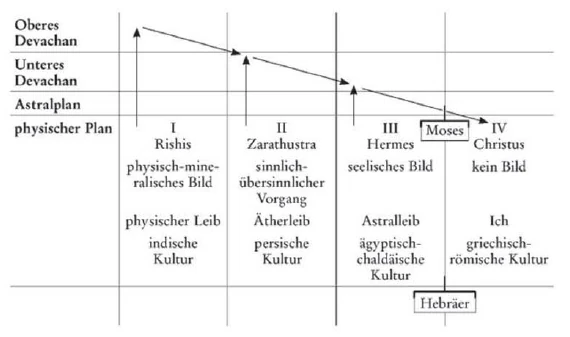
[ 4 ] Let us recall what we have observed when considering the course of human development in the post-Atlantean era. We have seen that the five cultural epochs—the Indian, Persian, Chaldean-Egyptian, Greco-Roman, and our own—represented the gradual conquest of the physical plane. Now, at the end of the third and the beginning of the fourth epoch, we are faced with what we might call “the mission of Moses.” What does this mission consist of?
[ 5 ] Let us now take a closer look at what the initiates’ inspirations were actually like during the successive periods.
[ 6 ] We have spoken of the Rishis on several occasions. It has been reported that in ordinary life they were, so to speak, simple people, but that at certain times they served as mouthpieces for higher beings. This fact was particularly striking in the days of ancient Indian civilization. At that time, these greatest teachers of post-Atlantean culture spoke of higher spiritual truths.
[ 7 ] Let us ask ourselves: Into which realms of the spirit did these ancient rishis transport themselves, if they were to be inwardly permeated and filled by the higher beings who spoke through them?
[ 8 ] While the higher powers dwelt within them, these Rishis rose not merely to the astral plane or the lower Devachan, but all the way up to the upper Devachan, so that their teachings originally emanated from the upper Devachan. In those ancient times, shortly after the Atlantean epoch, this was still possible because the ancient Indian bodies still fully allowed humans to step out of them and enter into contact with the beings of higher worlds.
[ 9 ] Now the cultural epochs continue to unfold. In the Zarathustra—Persian—cultural epoch, the highest initiates are still able to speak of the highest spiritual beings, but their ascent cannot readily reach the upper regions of Devachan; they can only rise as far as the lower Devachan. Nevertheless, they can be informed about the higher [Devachan worlds], for these high beings of the lower Devachan plane also know of the higher planes.
[ 10 ] In the world where the Egyptian initiates were primarily at home, people usually ascended to the astral plane; and by no means was it only a small circle of people in ancient Egypt who were still able to ascend to this astral plane. There was still a relatively large number of people who knew from their own observations what can take place on the astral plane—at least in certain intermediate states of consciousness between sleep and wakefulness. For example, many experienced communion with those beings who do not descend to the physical plane but are still at home on the astral plane. Thus, those who came and went on the astral plane—the ancient Egyptian initiates—still found it easy to proclaim the things that were taking place in the higher worlds.
[ 11 ] As we now draw ever closer to the later cultural epochs, the curtain before the spiritual world is, so to speak, closing more and more. Fewer and fewer people are capable of making observations in the spiritual worlds, and as a result, a special form of proclamation by the initiates became necessary as the fourth epoch approached.
[ 12 ] One of those initiates who was well-versed in all the occult arts of the Egyptians was Moses. It was precisely his people who were chosen to receive a certain revelation that would be of value to humanity even when they could no longer look up to the higher worlds. There were, after all, always initiates—though their numbers had dwindled—who could know of the higher worlds directly or indirectly because they lived consciously outside their physical bodies; the majority of the people, however, had to remain on the physical plane. The task that had to be fulfilled for humanity—at the time when Moses’ mission began—was this: to give those who were dependent on the physical plane a revelation of the spiritual. How did this mission have to be structured at first? Imagine that it first had to be made clear to the people: What is out there around you, what you can see and feel—that is precisely the physical plane. There is nothing spiritual there; you must not regard it as something that could in any way represent the spiritual to you. Rather, you must be clear that the spiritual must be sought in the spiritual realm, and that there is only one place where you can seek the spiritual.
[ 13 ] In the ancient days of Indian spirituality, when the holy Rishis spoke from the upper regions of Devachan, it was also possible to provide images that symbolized and, by way of comparison, represented what was spoken from the upper Devachan as an external, tangible image. One could present images and likenesses, and it was relatively easy to make people understand: “We do indeed give you images, but since you regard the external world as an illusion anyway, these images will be nothing more to you than images of a supersensible world.”
[ 14 ] There was no danger that these images could be used for idolatry. How could that have been possible among a people who regarded everything sensory as maya, as illusion! This people could never have practiced idolatry. That came much later. (However, in Eastern culture in particular, the idol has replaced the symbol.) It was therefore easy for the holy Rishis to make it clear to the entire Indian people: What we have to proclaim to you comes from the higher regions of Devachan, and the visible world consists of symbols representing that which is so exalted!
[ 15 ] The disciples of Zarathustra, however, could not proceed in the same way during the Persian cultural period. They could only establish a certain connection between their people and the lower regions of the Devachan plane; therefore, they were only able to speak of the supersensible in images—but in spiritual images—
[ 16 ] to speak of. They did not use any sensory image. This applies above all to the essentially spiritual being they called Aura Mazdao—the being whose outer physical form is the sun and with whom human beings unite against Ahriman.
[ 17 ] This was presented to people, so to speak, as a sensory-supernatural image. People were to create a mental image of this spiritual being within the image, but they were not to perceive it as a finished image or in the form of a likeness. At most, they could create a mental image of this divine Aura Mazdao in a process—for example, in fire—but not in an external, sensory image. All sensory images date from a later period. Ancient Persian culture had images intended to express the Devachan, the supersensible realm; that was the progression.
[ 18 ] Now we come to the third cultural stage that we encounter in Egyptian culture. As we know, the figure of Osiris stood at the center of religious thought and feeling. You will easily understand what needs to be reiterated here: What kind of being is Osiris, primarily in his divine form?
[ 19 ] Keep in mind that the Egyptian spiritual guides told people: If you fulfill your purpose here in the physical world correctly, if you do everything that makes you a worthy person in terms of your soul, then after death you will be united with Osiris!
[ 20 ] On the other hand, it has been said: Osiris lived only a short life on Earth; then he was defeated by his brother Seth and has lived ever since in the supernatural realms. His lowest realm is the astral plane; he does not descend any further, and it is not possible for Osiris to enter the physical plane. Therefore, a person cannot encounter Osiris during earthly life. After death, however, if he has made himself worthy of it, he will be united with him, because then the person enters the higher worlds. Human beings must therefore meet Osiris either when they die or when, as initiates, they enter the astral plane. For this reason, it was made clear to adherents of the Osiris religion: You should not create a mental image of the supersensible—with which you yourself are still connected—in any other way than through the image of your own soul, a soul as we conceive it under the concept of the astral body. An ideal human form was presented to them, one possessing every possible virtue. And since virtues, instincts, and so on reside in the astral body, an astral being was, so to speak, presented as the essence of Osiris.
[ 21 ] For the people who had, so to speak, passed through the school of Egyptian culture, and who were to prepare for that great event through which the spiritual descended into the physical world—not like Osiris, who descended only to the astral plane, but like Christ, who came down to the physical plane—for this people, a god was not to live in parables or symbols, as in ancient Indian culture, nor could they worship a God in a sensory-supersensory image, as in Persian culture, nor in the image of an astral body, but solely and exclusively through the supersensory mental image of the “I”! All the images originally given to the ancient Indians to help them conceive of the spiritual were images and symbols borrowed from the physical world, from the mineral kingdom—symbols that had a physical-mineral form.
[ 22 ] The forms through which the initiates of Persian culture made the supernatural clear to their people were drawn from the human etheric body, for even Aura Mazdao had become visible by assuming an etheric body and revealing himself in that form. Osiris had been presented in an astral form. The deity who revealed himself to the Jewish people was to have no qualities other than those of the “I,” the fourth member of the human being. For under the term “I,” a person comprehends something that can alone call itself “I.”
[ 23 ] But there was something else connected with this. Human beings were now to internalize the mission of Moses; they were to create a mental image of the Deity in the image of the “I”: Just as your “I” lives within you and reigns over all the members of the human nature, so you are to imagine the Being that reigns and rules in the world—not as a sensory image, nor an etheric image, nor an astral image, but solely in the form of the “I”; solely under this name are you to imagine the highest Being—“I Am Who I Am.” In the “I” itself, every human being should truly see an image of the deity.
[ 24 ] That was Moses’ mission, his purpose: to look within yourself, and there you will find a true image of the pure Divinity. — Therefore, all human interaction should take place only from self to self. This should be prepared.
[ 25 ] Let’s immerse ourselves once more in Egyptian culture. There was a great deal of influence, but it did not flow from person to person; rather, it flowed from astral body to astral body. — What does that mean? Imagine how a gigantic pyramid was built. A vast army of people was needed to bring such a pyramid into being. The workers on a pyramid followed the orders of those who were the master builders—the temple priests, the spiritual leaders of that culture.
[ 26 ] Do not imagine that these commands were given in the same way as they are today—from one “I” to another. That was not the case. You will most easily understand what took place back then if we use the word “suggestion.” Forces of a psychic nature were employed. The Egyptian priests mastered such powers to a high degree. They did not act upon the “I” by saying “Do this” or “Do that!” but rather they controlled the masses—as one who masters psychic powers does—so that people followed without will of their own, their “I” being bypassed.
[ 27 ] As initiates, the priests held positions of high responsibility; they could not be expected to abuse these powers. They put them to use for the good. However, it was through inspirations—psychic inspirations—that they worked. There was no question of the “I” having any freedom vis-à-vis the temple priest.
[ 28 ] If you understand this, you will also realize that in ancient India, the holy Rishis exercised spiritual powers to an even greater degree. It was like this: When they appeared and delivered significant proclamations, it was a matter of course that the entire people followed them unquestioningly. Just as our hand follows our head, so did the great masses follow their leader. This diminished more and more the further humanity descended into the physical plane. But in ancient Egypt, there was still some remnant of this psychic power. To tear people away from this kind of influence and to proclaim in advance the confrontation with the “I”—that was Moses’ mission. To seek within each person the divine source, to see the great World-I—the I that surges and sweeps through space—as the archetype of one’s own I: that was the great calling linked to Moses’ mission.
[ 29 ] From this perspective, we will understand how this great Cosmic “I” had to reveal itself through Moses. This is how the proclamation of the “I” Commandment must be translated into modern language, so that we truly grasp what was felt, sensed, and thought when people heard the first commandment in those days. All lexicographical translations render it in the most imprecise way imaginable.
[ 30 ] And now I would like to present to you the First Commandment, as it must truly be translated in order to convey the mental image people had when they heard it back then. - First Commandment:
I am the Eternal Divine that you feel within yourself. I led you out of the land of Egypt, where you could not follow Me within yourself. From now on, you shall not place other gods above Me. You shall not acknowledge as higher gods that which an image shows you—whether it shines above in the heavens, works from within the earth, or acts between heaven and earth. You shall not worship that which, among all these things, is beneath the Divine within you, for I am the Eternal One within you and am a Divine Being who acts ceaselessly. If you do not recognize me within yourself, I, as your divine essence, will vanish from your children, grandchildren, and great-grandchildren, and their bodies will wither away; if you recognize me within yourself, I will live on as you through a thousand generations, and the bodies of your people will flourish.
[ 31 ] Here we find a hint that we should recognize in the individual model of the “I” the reflection of the divine primordial “I,” and at the same time a hint that whoever recognizes his or her “I” as divine will be freed from the way people in ancient Egypt regarded their leaders.
I brought you out of the land of Egypt, where you could not follow Me within yourself.
[ 32 ] People followed the will of the temple priests, who employed psychic powers. The first glimmer of that freedom—which later emerged in Christianity as the freedom of grace—is evident in this reference:
I brought you out of the land of Egypt. — From now on, you shall not set other gods above me.
[ 33 ] Precisely so that the Jewish people could become the great preparatory people for the manifestation of Christianity, it had to be made clear that all other representations of the Divine—the archetype of the “I”—had to be set aside. Whatever takes on an external form—be it through constellations or anything else—had to be set aside. - The Divine was not to be represented by anything at all, for in order for human beings to become free—to find the source of everything within them—they must experience everything they can feel about the Divine within their “I” as the reflection of the great World-I:
You shall not regard as higher gods anything depicted in an image—whether it appears in the heavens above, emerges from the earth, or acts between heaven and earth.
[ 34 ] A formless Divine—the only legitimate expression of it is the human self:
I am who I am. — You shall not worship what is divine within you.
[ 35 ] As we have already emphasized: In ancient India, the image was taken from the physical body; in Persian culture, from the etheric body; and among the Egyptians, from the astral body. All of these are subordinate to the “I,” and therefore nothing in the image should be taken from the divine. We know that the physical body is derived from the mineral realm, that the etheric body is derived from the etheric realm, and that the astral body is derived from the same realm from which the astral bodies of animals are also derived. Nothing should be taken from all that is in the lower members of human nature—that which is derived from the rest of nature—from all that is beneath the “I”—for what the human being worships.
For I am the Eternal within you, and I am the ever-present Divine.
[ 36 ] That is an important statement. What had previously been a fact was then given to the Jews as law.
[ 37 ] We have already pointed out how, among all peoples bound by common blood, a certain consciousness flowed through the generations, how the son felt connected through that blood to his father and grandfather. Common blood was felt as a common “I,” an “I” that lived on through the generations. The God who first revealed himself as “I” to the Jewish people had to reveal himself by saying that it is he who has continued to act as God throughout the generations.
If you truly understand me, then you understand what continues to have an impact from generation to generation.
[ 38 ] It has been translated as:
I am a jealous God,
[ 39 ] yes, even with
an angry God,
[ 40 ] while the actual meaning is:
I am a God who continues to work from generation to generation. Never seek to form a mental image of Me; hold onto the truth within you as your mental image of Me, and then you will pass on health from generation to generation through your blood.
[ 41 ] A true medical concept is associated with this, for the One who gave this commandment linked it to the idea that—if a person has a pure mental image of the connection with the Divine—then a healthy sense of self also flows through the blood, and the people remain healthy from generation to generation. We cannot gain a true understanding of the life-giving idea behind what Moses gave to the people when he proclaimed the laws if we merely think about what he says in abstract terms. No, it is stated on the premise that the right thought is a reality: If you form a false mental image of the Divine, then this will be passed down from generation to generation; it will manifest as illness or infirmity. Right thoughts bring about health, while wrong thoughts bring about illness. This is a mental image held in the true theosophical or occult sense. All of this must be taken into account; otherwise, one cannot gain a proper understanding or a true mental image of the first commandment. That is why the Jewish people are instructed: Do not imagine this God in a false image; if you kneel before the Golden Calf, a false mental image will flow into you, and this false image of God—as it passes through the generations with the blood—will produce the lingering sin that then manifests as illness.
If you do not recognize me within yourself, I—as your Divine—will vanish from your children, grandchildren, and great-grandchildren, and their bodies will wither away. — You will bring forth viable children, grandchildren, and great-grandchildren if you embrace the correct mental image of the Divine; otherwise, that which depends on the blood will die out. By recognizing me correctly within your “I,” this passes from generation to generation, for I am a Divine Being whose influence endures. I disappear from your bodies when I live within you based on a false mental image.”
[ 42 ] This can again be seen as a purely medical mental image:
If you recognize me within yourself, I will live on through a thousand generations, and the bodies of your people will be purified.
[ 43 ] Thus, the physical will flourish in a truly occult way when linked to the correct mental image of the spiritual. In this way, the breath of human freedom enters into human development: Humanity is placed precisely at the pinnacle of the ever-active “I,” and is then linked to the Divine. This cannot be compared to any other body of law, and it is sheer amateurism to equate these Ten Commandments with other legal systems and interpret them one-sidedly simply because they outwardly resemble one another in wording. The legislation of the Ten Commandments is unique and can only be explained by the unique mission of Moses. And so it is with all the other commandments as with this first one; if we translate them correctly, the entire spirit of Moses’ mission becomes clear to us. — Second Commandment:
You must not speak of any error concerning me within you, for any error regarding the Self within you will corrupt your body.
[ 44 ] There you have directly highlighted the necessity of spiritually correct thought, which is the true creator of a healthy, sound body. A misconception about the highest Divine within oneself causes physical decline to the fullest extent. It is extremely important to understand what is stated in this second commandment:
The delusion about the “I” within you will destroy your body.
[ 45 ] There is a later proverb: “A beautiful soul dwells in a beautiful body.” — Modern, materialistic humanity sometimes interprets this to mean: “So take good care of your body, and then a beautiful soul will dwell within it.” But what is meant is that a soul that is powerful in itself is the true creator of the body and thus produces a healthy body. It is not that the body creates the soul—quite the opposite.
[ 46 ] Here we see that sometimes the exact wording isn’t all that important. Each era forms a different mental image of the same wording, depending on the prevailing sentiments and attitudes of the time.
[ 47 ] This does not always mean that one has found the right wording, but rather that one has penetrated the spirit of the times. — Third Commandment:
You shall distinguish between weekdays and holidays, so that your existence may become a reflection of my existence, for what lives within you as “I” formed the world in six days and lived within itself on the seventh day. Therefore, your actions, and the actions of your son, and the actions of your daughter, and the actions of your servants, and the actions of your livestock, and the actions of all who are with you, shall be directed outward for only six days; but on the seventh day, your gaze shall seek me within you.
[ 48 ] This is the translation of the third commandment that is absolutely true to its meaning. Not through external images, but through what one does—through what the “I” does—must one become a reflection of the Primordial “I”; and just as the Primordial “I” created the world and rested on the seventh day, so too should man distinguish between workdays and days of rest, labor for six days, and [on the seventh] day seek the Divine with the help of the “I.” Thus we see in what a wondrous way the image of the Primordial Self within us is presented as the path leading to God.
[ 49 ] In these first three commandments, we find guidance on how human beings should relate to the Divine in this new era, as it reveals itself in a new way. The fourth commandment addresses the physical plane, while the first three describe how a person should properly relate to the higher worlds. — The fourth commandment reads:
Continue to act in the spirit of your father and mother, so that the property they acquired through the strength I instilled in them may remain yours.
[ 50 ] Here we do not have the completely meaningless “Honor your father and mother, so that it may go well with you and you may live long on earth!” — The point is that—after a person has established the divine within themselves spiritually and, as we might put it, so to speak, medically as well—they must now also truly act outwardly in accordance with what the “I” transmits. It is even a practical commandment: As a descendant, look to your ancestors; if, as a descendant, you stand in opposition to them, a peaceful development can never take place.
[ 51 ] Just as the “I” is transmitted inwardly through the blood, so too will that which exists outwardly as property be preserved. The strong “I” that has been formed flows, on the one hand, through the blood down through the generations; on the other hand, however, by strengthening the “I,” one should also exert an influence on the external world. What a strong sense of self has established must be preserved; development must not be constantly interrupted: Continue to act so that what your father and mother have acquired remains intact in the external world.
[ 52 ] This is something that shows you how external rules of conduct are also established, so that what is given from within is not destroyed from without.
[ 53 ] And now come the commandments, which the “I” independently contrasts with the “I” of the other, and which, in this sense, are intended to govern the world of facts, social life. [They actually only paraphrase the biblical passage] that Paul himself says: See in the other person an “I” just as you see one in yourself!
[ 54 ] This people has been entrusted with a special mission: to pursue the divine right down into the self. That is why this people had to receive the commandments, which prescribe not only the preservation of one’s own self, but also respect for the self of others:
Fifth Commandment: You shall not murder.
Sixth Commandment: You shall not commit adultery.
Seventh Commandment: You shall not steal.
[ 55 ] Three truths that reveal a single truth: See in your neighbor the same “I” that you see in yourself.
[ 56 ] Thus, the Jewish people were indeed spiritually led out of the land of Egypt, for through this, the “I” was also to be recognized in the appreciation of the other “I.” For in the land of Egypt, people did not act by respecting the “I,” but rather through suggestion. One must not only refrain from harming or infringing upon the rights of the “I”; one must not even diminish its value with a single word. One must not speak untruths about another “I.” Whoever speaks untruths about another “I” does not realize that the other “I” is the same as one’s own “I.”—And that is why the eighth commandment states:
Do not belittle your fellow human beings by spreading falsehoods about them.
[ 57 ] This pattern continues systematically. First, the facts are presented; then, whatever else might be damaging is brought up. — The act directly encroaches on the sphere of the other self; the word, however, does so in a more subtle way.
[ 58 ] But if you truly wish to recognize the other’s self, then you must not encroach upon your neighbor’s sphere through your lusts and desires. Not only by stealing from him, but even by simply wanting something that he has, you encroach upon the other’s self. You demonstrate your full respect for the “I” of others by not allowing yourself to be tempted by what belongs to your neighbor. Hence the last two commandments. — Ninth Commandment:
Do not look with envy upon what your fellow human beings possess.
[ 59 ] Tenth Commandment:
Do not look with envy upon your fellow human’s wife, nor upon his assistants or the other beings through whom he finds success.
[ 60 ] Only by not begrudging [another] what is rightfully [theirs] can we find a healthy relationship between human beings. In this way, each person is placed alongside others. In every “I,” one should respect an image of the Divine. Thus, the relationship among the individual “I’s” was regulated. This was one of the greatest influences to have ever come upon humanity. Yet what was to come through Christ—that everyone would find the Father within themselves—had not yet been articulated. These laws still contained, so to speak, the common “I” that flowed through the generations. But it was the foreshadowing that the “I” is not merely a reflection of the Divine, but that God Himself is a living essence within it: The “I” is, in substance and essence, identical with its Father.
I and the Father are one.
[ 61 ] There we see the development of the world. It is easy to say: Everything in the world is connected by cause and effect, yet there is no sign of any wise guidance. — But when one looks closely at the course of events, when one sees how the right thing always happens at the right time, then—I would say—one has no choice but to acknowledge the wise guidance in the course of world history.
[ 62 ] If one views from an occult perspective how this proclamation took place at the end of the third cultural epoch and into the fourth period—so that people were given time to prepare themselves for the Mystery of Golgotha—then one sees how this, in particular, is one of the expressions of the greatest wisdom.
[ 63 ] Throughout the Ten Commandments, if we understand them correctly, we see how the Godhead reveals itself in a prototypical way, in preparation for the moment when the Spirit of God truly incarnates in a human being. In order for people to be able to comprehend God in the flesh—God made flesh—they first had to learn to comprehend God in their innermost being, in terms of His substance and essence. If we consider the Ten Commandments in this translation, we see from the overall tone that the Deity is still speaking to humankind, and that this discourse is entirely in harmony with the ever-increasing emergence onto the physical plane.
[ 64 ] It is always pointed out that the bodies thrive when the Divine is properly understood. Guidance is given on how to perceive the Divine in such a way that external things on the physical plane thrive. It is rightly pointed out that a sound, healthy development must take place in order for external social relationships to flourish.
[ 65 ] The mission of Moses ensures that the Divine is preserved, but that the human race accomplishes the conquest of the physical plane in the proper manner—in accordance with post-Atlantean development and in harmony with this Divine principle.
[ 66 ] The seven cultural epochs of the post-Atlantean era correspond to what the seven planets have given to humankind through what the teachers of humanity have imparted to them as religion. Thus:
I. Indertum = Saturn: Physical body. Religion: Images from the physical, mineral kingdom.
II. Persian period = Sun. Etheric body. Aura Mazdao. Religion: Sensory images of spiritual beings.
III. Egyptian period = Moon. Osiris. Up to the astral body.
IV. Greco-Roman period = Mars and Mercury. Earth’s evolution. The “I” = Christ in the flesh.
[ 67 ] We must move forward from here
V. Jupiter - Manas
VI. Venus - Buddhi
VII. Vulcan - Atma1. Indian culture: The seven sacred Rishis were initiated into the oracle of each of the seven planets.
2. Persian culture: Zarathustra was initiated into the Sun oracle itself.
3. Egyptian culture: The Hermes initiation extended to the astral body—the Moon.
4. Greco-Roman culture: Moses’ initiation extended to the etheric body; that is, the “I” began to work in the etheric body—lower Manas.
5. Christ manifested Himself as full “I”-hood: Higher Manas, Buddhi, Atma.