

The History of the German Section
of the Theosophical Society
1902–1913
GA 250
20 October 1907, Berlin
Translated by Steiner Online Library
37. Fifth General Assembly of the German Section of the Theosophical Society
Report in the “Communications for the Members of the German Section of the Theosophical Society (Headquarters: Adyar), published by Mathilde Scholl,” No. V1/1908
[ 1 ] At 10:30 a.m., the General Secretary of the German Section, Dr. Rudolf Steiner, opened the fifth regular general assembly.
[ 2 ] Point I established the voting ratio of the various lodges and their representatives.
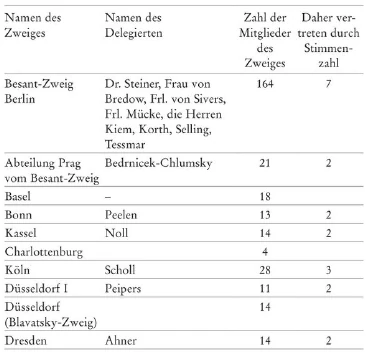
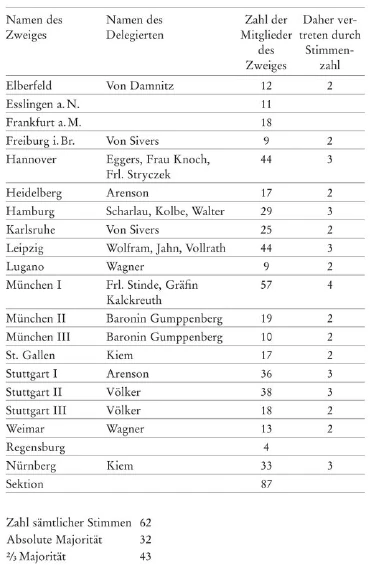
[ 3 ] The following were not represented: Basel, Charlottenburg, Düsseldorf (Blavatsky Branch), Esslingen am Neckar, Frankfurt am Main, Regensburg. — Likewise, the section members who did not belong to a branch had not exercised their right to appoint representatives.
The votes are distributed as follows:
Dr. Steiner 1
Mr. Kiem 6
Miss von Sivers 5
Mrs. von Bredow 1
Mr. Tessmar 1
Mr. Korth 1
Miss Mücke 1
Mr. Bedrnicek-Chlumsky 2
Mrs. Peelen 2
Dr. Noll 2
Miss Scholl 3
Dr. Peipers 2
Mr. Ahner 2
Mrs. Wolfram 1
Mr. Jahn 1
Dr. Vollrath 1
Mr. Wagner 4
Miss Stinde 2
Countess Kalckreuth 2
Baroness Gumppenberg 4
Mr. Arenson 5
Miss Völker 5
Mr. von Damnitz 2
Mr. Eggers 1
Ms. Knoch 1
Ms. Stryczek 1
Mr. Kolbe 1
Mr. Walter 1
Scharlau 1
[total] 62
[ 4 ] The secretary of the meeting, Mr. Selling, reads aloud the minutes of the general meeting held on October 21, 1906, which are approved by the assembly.
[ 5 ] Point II:
[ 6 ] 1. Report of the Secretary-General [Dr. Steiner]: “The fifth General Assembly is hereby opened. Before we begin this morning’s proceedings, which must, of course, be governed by the strict spirit of the Statutes, may I be permitted to extend my warmest greetings to you all in the spirit of harmony and true Theosophical unity.
[ 7 ] After a year, they have come together again to reaffirm this spirit of harmony and the spiritual, inner unity that flows from theosophy, and to experience it once more during a few days spent together. It is not only what we discuss [on business] on such occasions that matters, but the very fact that we are together, that our thoughts touch one another even more intimately through direct interaction than they otherwise can. This, too, must be counted among the things that come into play at a gathering such as ours. We must draw strength from such gatherings to work ever more vigorously, ever more powerfully, and ever more effectively in all parts of the region where we have succeeded in spreading theosophical life and thought within the German-speaking world.
[ 8 ] We may say that, in the years since we established a German Section, theosophical thought and theosophical life have spread throughout our Central European region in a most gratifying manner—and, considering the opposing factors, in an extraordinarily satisfying way. It is by no means unnecessary to observe with a watchful eye how—not only on the surface of our present life, but, one might say, in those regions that are today considered by some to be the deeper ones—forces and powers exactly opposite to our own are at work, and how hostile waves are crashing against our Theosophical activity.
[ 9 ] When the Theosophist, with his spiritual senses—which, as they should be, are refined for all human life—looks at his surroundings, he soon perceives these thoughts striving toward true Theosophical life and the Theosophical worldview. But perhaps there is nothing better than being able to let the waves of these hostile forces wash over us, so that we can then watch them with a watchful eye and, without engaging with them further or concerning ourselves with them, go about our work. It is particularly gratifying to note that, during the five years of the German Section’s work, this truly peaceful and peace-promoting—indeed, uniquely peace-promoting—idea has gained at least a little ground. The Theosophical Society cannot carry out its work by constantly repeating that its purpose is to establish brotherhood, to promote peace, and to bring goodness into the world; nor can it do so by fighting hostile forces, but rather by performing positive work—by purely receiving what flows to it from the spiritual worlds and allowing it to flow back into the world.
[ 10 ] It is also a much more beautiful feeling when hostile forces surround you, and you say nothing at all to those hostile forces, but simply assert, amidst the surging waves, what you yourself are capable of doing. We are not really here to fight—nor to fight with words—but to act, to create; and as long as the Theosophical Society remains at its present stage of development, the only actions—and perhaps the best actions—we can perform will long remain our words, imbued with the innermost essence of the Spirit. Increasingly, however, we will come to realize that the words we speak, the thoughts we harbor, and such seemingly outwardly invisible actions are the seeds of real future deeds, of real future events.
[ 11 ] There are many parties, many movements, and many societies dedicated to promoting this or that good cause. They can hardly help but spread what they believe to be good and combat the evil that flows against it. It is precisely in this way that the Theosophical Society should distinguish itself from other societies: that it can endure even when hostile forces approach it from all sides, and that the members of the Society pay no heed to them—not even in words—but calmly go about their work.
[ 12 ] It is possible that we are not always able to maintain this stance; it is possible that, in particular, the spirit that has infiltrated certain occult circles—including those that call themselves theosophical—sometimes compels us to take a stand. One cannot always fully realize in the outer world what constitutes the highest ideal; but we will never be in any doubt that, should we be compelled to fight for our spiritual worldview, this struggle represents time lost. Perhaps we are compelled to sacrifice time that is lost, to perform work that is in vain; but we are then aware that these things do not belong to the main objectives of our striving.
[ 13 ] This is precisely what, according to the intentions of the spiritual world, should increasingly find its way into our German, Central European, theosophical movement; this is precisely what I would like to use—as a spiritual greeting—to imbue with the wish, the wish [that I place within you], that we may work in harmony with such a spirit within the framework of the society in which we seek to spread the theosophical worldview.
[ 14 ] However, it can happen to us—and it has happened to us many times over the course of these five years of work—that people who may call themselves Theosophists have attacked us and caused real discord. We have experienced this time and again, and in the vast majority of cases, we have remained silent in the face of all such attacks, as was already emphasized last year by the same source and at the same time; and we have had to experience time and again that it was precisely those who attacked us—those who opposed us from within the Theosophical movement itself—who later reproached us, saying: “Well, what is this—why is there so much discord within the Society? Theosophy is supposed to bring about peace, after all.” Those who speak of this the most are the very ones who previously caused the discord. This is indeed an experience we have had.
[ 15 ] There are people who say they have the best of intentions in establishing a sect-free Theosophy. If any society has truly strived to spread a completely sect-free Theosophy, it is certainly the one that is attempting to do so within our framework. Nevertheless, it is often claimed that when Theosophy vigorously advocates the occult life from any perspective, it is seeking to found a sect. And people who have no understanding whatsoever of the difference between sects and sectarianism on the one hand, and true, lofty freedom—which must prevail precisely within the framework of such a society—on the other, very often speak of sect formation, and do so as if they themselves held the exclusive privilege or license to operate without sectarianism.
[ 16 ] As I said, even if certain excesses have occurred or may occur within the Theosophical Society, our attitude and our understanding should be that we regard any resistance as a waste of time, even when we are compelled to defend ourselves. The only truly fruitful course of action is to carry out positive theosophical work. The idea that Theosophy is a fact has become increasingly widespread. Let us emphasize that it is a fact and cannot be a set of principles or a list of program points. Theosophy is not about saying that one wants to found a society of such-and-such a nature; nor is it about saying that we have this or that principle; rather, what is a fact is Theosophy—the spiritual life that is being poured out into the world today through a number of people who are united. This positive force, which flows to us from the higher planes, is what matters. That is the image, and everything else is merely the frame. No matter how much we may argue about the best constitution for the Society, it is all a dispute over the best frame. But what matters is not the frame, but that there is also a picture within the frame, and that we learn to have the picture first, not the frame. One would like to see this idea, tinged with a touch of artistic sensibility, spread throughout the Theosophical Society. The best frame will emerge naturally over time if we approach its design in the same way we choose a frame for a good picture. Those who want a beautiful frame and then find a picture to go with it will generally go astray; but those who are able to derive the idea for the frame from the content of the picture will follow the right path.
[ 17 ] That is why we need not be afraid if the Theosophical Constitution must be amended here or there from time to time. As long as there is life and the image exists, the frame will take shape and change in accordance with the image. It differs from other images in that it is a living image rather than a dead one, and as such a living image, it will always have to renew its frame.
[ 18 ] No one who lives in the spirit of theosophy will be able to entertain any erroneous ideas about the framework. It is good if we bring to mind this truly peace-bringing attitude, which arises not from a demand for peace but from the natural result of peace—the result of the lofty teachings that flow through the Theosophical Movement— and if, at the very beginning of our time together, we all imbue ourselves with the thought that Theosophy is meant to be a wisdom not of an abstract but of a concrete nature, through which we understand the world in the true sense. And why of a concrete rather than an abstract nature? Because in Theosophy we seek the wisdom through which the world itself came into being—not thoughts that we form ourselves, but thoughts that the divine beings held when they built the world. We seek to appropriate this very wisdom, from which the world was formed, within the Theosophical Society. It was according to the concepts we seek in Theosophy that the gods first formed the world. That is why Theosophy is a true and rightful bearer of its name. If we immerse ourselves in these truths in this field, then we are not merely theoretical seekers of truth. To seek thoughts of God means to seek God’s mind itself, to seek peace in the soul of God—not the peace of inactivity, but that which arises from the true rhythm of life and is therefore the true source of work on the physical plane, which is meant to be the manifestation of the higher planes.
[ 19 ] This is the Spirit in whose name, as was stated at the beginning of these remarks, you are welcomed today. This specific Spirit was the eternal Thought of God, which is to shine forth in the individual human souls that unite in the Theosophical Society. It is this Spirit that arises in every soul as a spark, and to it, too, I extend my greeting.”
Break
[ 20 ] “My dear Theosophical friends! Our movement in Central Europe has grown in a most satisfactory manner. The current approach to our work, which has been carried on in the same spirit as before, has undoubtedly proven its worth.
[ 21 ] The past year brought us not only the lecture series held in Munich, Kassel, and Hanover, but also a wealth of activities of a more international nature. In connection with our Munich Congress—and even before that—a great deal of administrative work became necessary because the passing of Colonel Olcott had placed us in the position of having to elect a new president of the Society.
[ 22 ] Since many of the members present here were also gathered in Munich, and since we commemorated at that time the immeasurable and indescribable merits of our founding president, it is probably sufficient today to simply remind our dear friends once more of him—he who administered and guided the Theosophical Society with love and devotion for so long. There is no need for repeated words to make each of us aware of the fruitful and blessed work that Colonel Olcott accomplished during his tenure, which spanned the entire existence of the Society.
[ 23 ] In particular, the German Section—which was to undergo a certain period under Olcott’s leadership, who from the outset pursued the specific plan of integrating itself into the general Society in a completely free manner—was able to experience, as often as the spirit of true theosophical freedom could flourish within it, the way Olcott understood his role as President of the Society.
[ 24 ] In some circles, there is talk of centralization in Adyar and even of tyranny and authoritarian rule by Adyar. But anyone who has followed the matter closely here will have to admit that there can be no question whatsoever of any influence on free thought and way of thinking here in Germany. That every Theosophical region may flourish and work on its own soil, according to its own conditions—this is what Colonel Olcott also regarded as his motto. This principle, which was perhaps less explicitly stated in the past but may now be summarized as “let the right thing happen in the right place,” has become increasingly established in practice under Colonel Olcott’s leadership.
[ 25 ] Those who had the deep satisfaction of knowing Olcott personally knew that he was, so to speak, the society’s natural president. This sense of naturalness—which no one disputes because no one even considers that it could be otherwise—is a fine quality that will continue to take shape more and more within the Society.
[ 26 ] As the German Section, we too feel—at our first General Assembly following the passing of our founding president—that our thoughts and our love will continue to belong to the spirit of this extraordinary man. We feel that we will always be united with him, for theosophical communities are communities that extend far beyond the physical plane. We feel united with him and, as the German Section, express these feelings by rising from our seats.
[ 27 ] The death of Colonel H. S. Olcott meant that a new president had to be elected. It is not my place to summarize the many debates and resolutions that took place during the preparatory period and the presidential election. We note the gratifying result that Mrs. Annie Besant emerged from the election with an overwhelming majority.
[ 28 ] But even if the discussions regarding the election were protracted, [even if they took up a great deal of time—the kind of time that was earlier described as “wasted” during the non-business portion of the General Assembly—I would be the last person to repeat those words during the business portion] - a summary would still be necessary, were it not for the gratifying fact that, fundamentally, these discussions had no bearing on our German Section. The election in Germany proceeded calmly and in accordance with the rules of procedure, yielding a nearly unanimous result. Only 20 votes out of 600 were cast against Miss Besant.
[ 29 ] [The others did not vote.
[ 30 ] We may therefore set aside the events that have taken place outside our section and take comfort in the fact that Misses Besant, whose work has been devoted to the Society for many years, will continue to contribute to the Theosophical Society in her new role as President. On the one hand, the Theosophical Society will thus be preserved in its historical tradition. Misses Besant’s character provides sufficient guarantee and foundation for this. It is also entering a new phase insofar as the discussion has shown how necessary it is to steer the Society in the right direction.]
[ 31 ] Over the past year, we have celebrated not only Miss Besant’s election as president but also her 60th birthday.
[ 32 ] Since it was not possible to convene an extraordinary meeting on such an occasion, I took the liberty of greeting and congratulating Miss Besant on behalf of the section, with the intention of seeking approval from today’s meeting.
[ 33 ] At the time, I wrote to Misses Besant; the German translation reads roughly as follows:
[ 34 ] “May the German Section of the Theosophical Society be permitted to convey its heartfelt love and high esteem. The members see in your tireless dedication to the Society’s ideals and in your noble cultivation of the motives of spiritual life a spiritual model that serves to infuse the present with a spiritual ferment. The Society has taken such a direction that the members will consider it an honor to work in harmony with the President. It is their deepest wish that they might contribute as much as possible to helping you shape your high office in a manner consistent with your views. The General Secretary of the German Section of the Theosophical Society wishes to express this on behalf of the members.”
[ 35 ] The Theosophical Society owes its existence to the fact that, since its founding through the efforts of Annie Besant, a vast body of occult wisdom has flowed into the educated world. When Miss Besant assumed the presidency at such an advanced age—in addition to the other duties, which would normally require several people and which she had already performed abundantly up to that point—those who understood what was at stake for the Society’s future had to welcome this as a gratifying development.
[ 36 ] Another task that fell to us, in the context of international relations, was the convening of the Munich Congress. Through the design of the conference hall, the images of seals and columns with which the hall was decorated, and the nature of the entire program, you were able to form a picture of the intentions we had. These were aimed at taking the first step toward ensuring that Theosophy is not merely a collection of abstract dogmas, but rather that it exerts an influence on the life that surrounds us. No one can delude themselves into thinking that the harmony we achieved in the overall organization of the Congress was, compared to what lives as theosophical thought, anything more than a modest beginning. But everything has to start somewhere. If the German Section has thereby merely demonstrated what intentions might prevail at such a congress, and shown how the life that dwells in the soul can also be expressed in form, in art, and in communal life, then it has accomplished what the German Section was able to contribute on this particular occasion. From such inspiration can grow the strength that will gradually enable the Theosophical Society not merely to be a place for the dissemination of this or that dogma, but to have a profound impact on the whole of human life. [There is no need to provide a detailed description of the Congress. It has been sufficiently covered in the “Mitteilungen.” The only thing] that remains to be noted is the fact that the budget of 4,500 marks set for the Congress—which we believed would be sufficient—has been greatly exceeded. This has made the congress all the more wonderful. It is deeply gratifying to note that, on this occasion in particular, such a profound understanding was demonstrated, especially within the German Section. We needed a great deal of money; however, it has become evident that where it matters—in sustaining theosophical life—there is also understanding and a willingness to make sacrifices. Consequently, there is no deficit to report. [In fact, the budget has balanced itself out completely, which was very gratifying given that the original estimate had to be exceeded by a considerable amount.]
[ 37 ] Equally important to emphasize is the deeply gratifying fact that those who were able to do so worked with tremendous dedication. Everything that needed to be done was accomplished by our dear friends from Munich not only with dedication but also with a truly comprehensive understanding, so that this work beautifully embodied what is called theosophical unity and harmony. There was not a single person who was not willing to perform the highest spiritual work alongside—as is necessary at such a congress—even the most menial tasks. People who, in their entire lives, had never been accustomed to performing such work hauled in large items intended for this or that purpose; some hammered, others painted large columns; in short, it was all work done with devotion. Donations ranging from a thousand-mark bill to a ten-pfennig coin were collected. The administration, which had been taken over from Munich, was prudent right down to the work that demonstrated how genuine effort and genuine cooperation bring people into harmony. We managed to make it possible for the deeply satisfying performance of the Eleusinian Mystery Drama to take place. If you consider everything that had to be done to make this happen—from the translation from French to the sandals on the feet of the performers, all of whom were members and had to participate in rehearsals for weeks on end; if you knew what went on there, how beautifully and harmoniously everything unfolded, how the work was sustained by a shared vision and the devotion of feeling, then you could appreciate the practical value that arises when a common bond of work unites everyone. Just as a plant harmoniously reaches toward the sun, so too do people become harmonious when they are guided by the same feelings.
[ 38 ] [This became evident during our preparation for the Eleusinian Mysteries. We were able to take home with us this satisfying and practical insight into what it means to ground life and work in a practical way. Working together brings people closer; it makes them of one mind and one soul. Then there is no more quarreling.]
[ 39 ] We owe it to the positive spirit of this group of contributors to our Munich Congress that everything turned out the way it did. Throughout all these preparations, the spirit of harmony truly prevailed within the Munich Working Group of that time, which, in this regard, could in a sense serve as a model for the way in which cooperation and work can be carried out within the Theosophical Society as a whole. It is to be hoped that this somewhat different approach to work—as the German Section has been striving to implement for the past five years—will not only find recognition within the International Theosophical Society [though that is not necessary], but will also have a somewhat stimulating effect. The International Theosophical Society can flourish only if each section contributes its share to the cause of collective, theosophical, international activity. [The work that has been begun must be continued. The Basel and Nuremberg lodges have requested lecture series.]
[ 40 ] It hardly needs to be said that the German Section of the Theosophical Society extends its heartfelt thanks to Edouard Schuré, the author of the Mystery Drama. However, it should be expressly emphasized that we owe a great debt of gratitude to Bernhard Stavenhagen, the renowned pianist and subtle composer, who, in the midst of his heavy and pressing workload, agreed at my request to present the musical portion of the dramatic performance to us as a gift. The profound impression this composition made on all those present will remain a lasting memory for them. Everyone appreciated the beautiful harmony between the musical creation and the Mystery.”
[ 41 ] Rudolf Steiner then pays a beautiful tribute to the deceased members: Miss Eggert and Mr. Wirschmidt, whose memory the assembly honors by rising from their seats.
[ 42 ] Second: Miss von Sivers, the secretary of the German Section, provides the following report on membership trends and the organizational structure of theosophical life over the past year:
[ 43 ] Number of members: 872, compared to 591 the previous year. There were 303 new members, compared to 231 the previous year. Twelve members resigned, two transferred to other sections, and four died. The addresses of 19 members could not be determined; consequently, they have not been listed.
[ 44 ] The members are distributed among 28 branches—compared to 24 last year—and 1 center. The names of the new branches are: Kassel, Düsseldorf (Blavatsky Branch), Elberfeld, Esslingen a.N.
[ 45 ] Third: This is followed by the treasurer's financial report, presented by Mr. Seiler.
[ 46 ] Fourth: According to the report by the auditors, Mr. Tessmar and Ms. Motzkus, the treasurer is granted discharge.
[ 47 ] Item III: Mr. Bernhard Hubo’s resignation from the Executive Board made it necessary to elect a replacement. After Dr. Steiner had emphasized the dedication and self-sacrifice with which Mr. Hubo had devoted himself to the Theosophical cause and reported that his efforts to persuade him to remain in office had been unsuccessful, the assembly proceeded to elect a new member of the Executive Committee. Mr. Tessmar was elected.
[ 48 ] Items IV and V: Suggestions from the Heidelberg and Weimar branches, intended to launch a larger publicity campaign for the goals of the Theosophical Society, gave rise to a lengthy discussion in which members Wolfram, Arenson, Bedrnicek-Chlumsky, Stockmeyer, and Ahner participated.
[ 49 ] Dr. Steiner commented on this:
[ 50 ] “I can well understand that friends who are somewhat removed from the cause believe they can accomplish something through the press by having articles published in it. But anyone with experience in public life who is able to make observations knows what the ‘press’ actually means today. It pains me to have to say this. [I myself view the press as something one can love, something that corrects one’s own mistakes. But we must also view the matter impartially. [illegible] Sometimes reports about us have appeared not in the capital’s press, but in provincial newspapers. If these papers were to be of any use to us, then we would have been on very shaky ground. [illegible] The people in the press are, after all, among those who first need to understand what Theosophy is all about. [illegible] Consider that throughout the world, ever since the modern era—and particularly in the realm of spiritual life—there has been a tremendous competitive struggle. That is the worst, most corrupting thing that can exist. But another question is this: do we, as Theosophists, have anything to gain from this? Attempts have been made to publish our articles not only in the daily press but also in weekly journals. A new journal has been launched. It is called *Der Morgen*. [illegible] It is difficult to understand why these gentlemen felt it necessary to found a journal. I do not wish to speak of the lower-tier press, but this particular journal serves as a case study in journal ethics. It managed to publish a short, sensational article on a matter that is now much discussed, presenting claims that pointed the finger at specific individuals. It acted, so to speak, as a prosecutor, as if it wanted to intervene. I do not wish to pass judgment here; anyone can report inaccurately. Above all, the newspaper finds it necessary to have a correction published, stating that there is not even a shred of truth to the matter. Point by point, the attorney refuted the claims in such a way that the facts reported by the magazine not only appear to be untrue, but also [illegible]. [illegible] So if something like this is possible in exclusive magazines, then that is a symptom. And I could cite many such [examples] for you.”
[ 51 ] After Dr. Steiner had explained the reasons at length, he concluded by asking that, for the sake of the Theosophical Movement, discussions in newspapers and magazines not be published for propaganda purposes, since, as experience had shown, this could only do harm and not good.
[ 52 ] Since the discussion of these suggestions had concluded all items on the agenda, Dr. Steiner closed the business portion of the meeting and announced that the substantive, theosophical portion of the General Assembly would begin at 4:00 p.m.