

The History of the German Section
of the Theosophical Society
1902–1913
GA 250
26 October 1908, Berlin
Translated by Steiner Online Library
38. Seventh General Assembly of the German Section of the Theosophical Society
Victorialuisen-Platz 6, Auditorium of the “Lette-Verein”
Article in the “Newsletter for Members of the German Section of the Theosophical Society (Headquarters: Adyar), edited by Mathilde Scholl,” No. 8/1908
[ 1 ] At around a quarter to 11 a.m., the meeting will be opened by the Secretary General of the German Section, Dr. Rudolf Steiner.
[ 2 ] In Item I, the voting ratios of the various lodges are determined, and their representatives who are present are introduced:
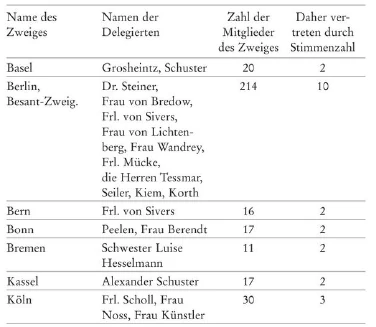
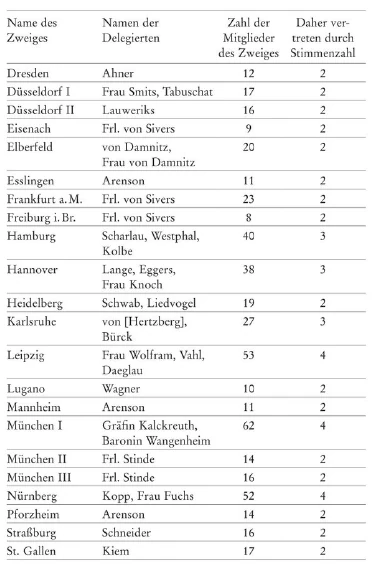
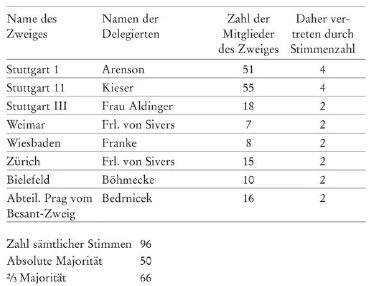
[ 3 ] The minutes of the General Meeting held on October 20, 1907, were read aloud by Mr. Selling and declared by the assembly to be accurate in both form and content.
[ 4 ] To determine the recipients of the votes, the names of the recipients and the number of votes are read aloud.
[ 5 ] [Item] IT. Report of the Secretary-General [Dr. Steiner]:
[ 6 ] “First and foremost, it is my duty to extend the warmest of welcomes to all of you gathered here for our seventh General Assembly of the German Section of the Theosophical Society. I have a strong mental image of the significance of this very welcome today and of this General Assembly in particular. With this assembly, we are entering the seventh year of the German Section of the Theosophical Society’s activities, and for anyone who has penetrated the spirit and meaning of the foundations of theosophical work and the theosophical worldview, the word ‘seven’—as an expression of profound and far-reaching world events—will undoubtedly make a corresponding impression: It is not through some superstitious mental image, but through ever-growing insight that human beings come to understand the significance of the sacred number seven, and they come to know that the number seven holds great significance not only out there in the vast universe, not only in nature and in the spiritual world surrounding us that is independent of us, but they also come to recognize that, in a corresponding way, this number seven signifies a law even where human beings themselves are the agents, where they themselves must intervene with their decisions, their views, and their work. And when he thus allows what permeates the world—and also the world of his own thinking and creating—as a law —as a law, this act of bringing it before the soul gives rise to various feelings—above all, a sense of responsibility toward the fact that we must recognize how, in a development entering its seventh period, we are to perceive something growing and becoming, something governed by law. Therefore, it seems to me that we must enter our seventh year with this strong sense of responsibility. It will come as no surprise, in light of this, to hear it said here that many things will be decided in the seventh year of our work with regard to destiny and karma—to the next phase of the Theosophical Society’s karma. Nor will it come as a surprise when it is pointed out that perhaps many of the obstacles, dangers, and trials of fate that will confront the German Section will occur precisely during this period. We will see many fruits during this period; but we will also see many obstacles and difficulties arise during this same, fateful period. Therefore, let us take time today to reflect and take to heart—each one for themselves—that we may enter conscientiously into this period characterized by the number seven. It is with this sentiment that I greet you today; indeed, I greet you in the name of the Spirit that brings us together in our work and enables us to act in unison: in the name of that truly brotherly love that is meant to unite the members of the Theosophical Society everywhere. We should not be guided merely by what is sounded from afar in such a tone that appeals to the affairs of world events—but let us take what has just been said very seriously, and then we will surely resolve to learn something from what has been said, so that we may carry something of what we have learned into the future. It must increasingly become second nature to us—even as members of the whole of humanity—to learn, within the context of Theosophical work, to set aside all our personal desires and personal affairs, our views and perspectives, indeed even our personal opinions and our personal thoughts. The more objectively we devote ourselves to what flows to us from the foundations of the occult world current, the more we will act in accordance with what the founders of that current intended with this world current. It is therefore fitting, in this welcoming address, to offer a few words of reflection that can provide us with a starting point for the introspection we need.
[ 7 ] We look back on the day when we were able to welcome our dearly revered Misses Besant on the occasion of the first General Assembly, and we may well ask ourselves: Under what stars were we standing back then? Since we are speaking of the affairs of the Section, it goes without saying that much commendable theosophical work had already been accomplished in Germany in earlier times—and before the founding of the German Section. However, for those interested in the course of events, it may be assumed that these great achievements, which predate the founding of the German Section, are well known. But perhaps a few words may be said that could, so to speak, help us grasp the spirit of the stars under which we stood when the German Section was founded. - Much has changed since then, of course. The membership has grown enormously. We were a small group back then, when we were able to found the German Section under such auspicious circumstances. But how did this small group come together? It is fair to say that for those who were able to carry out their work within that small group at the time, the way in which they linked their destiny to the affairs of the German Section was something intrinsically connected to the outward success of the theosophical work. What, then, was alive in the people who formed the core of the German Section back then? There was something within them that is perhaps most succinctly expressed by the following: These people wanted to structure theosophical work in such a way that occult sentiment and occult work would clearly be taken as the foundation of the society. Inherent in this was the idea that, in the innermost hearts of these people who helped establish the German Section, everything that could be described by the words “propaganda” and “agitation”—as these words are commonly understood in the world at large—was far removed. If I may—merely by way of illustration—draw on my own experiences, I must say that two years before the founding of the German Section could even be considered, there was a small circle that had gathered around Countess Brockdorff at a time when the members of the German Theosophical Movement felt no sense of unity—they were scattered here and there—and that, above all, within this small group there were only a few who even anticipated a Theosophical movement as such. Only a few were there when it became clear that we were entering the official fold of the Theosophical Society. But there was a small circle, and to them I was able to give the lectures that were published in the book *Mysticism*. And in the second year, the lecture series that was published in the book *Christianity as a Mystical Fact* followed. Perhaps it may be said, in all modesty, at this very moment that those lectures on *Christianity as a Mystical Fact*, which were delivered at that time to perhaps 20 people, have now also been translated into a foreign language, so that what we had in mind as the goal is indeed beginning to bear fruit. And it may be mentioned that it was precisely from this circle that the impetus came for the founding of the German Section—at least the impetus that was actually dedicated to the work, which even then contained within itself the foundation for its enduring existence. And then we always worked under the principle of “not engaging in propaganda”; rather, we said what we had to say, and did not seek to impose our convictions on anyone. Whoever wished to come of their own free will was welcome to do so. One has a duty to present what one has to say to the world, but one should not impose a conviction on anyone. The other person is a listener who comes when something compels them to do so. If any other attitude is cultivated within a society founded on occult principles, that society cannot flourish. This is the experience that underlies all spiritual societies—and this is also the inner freedom under whose influence alone theosophical work can flourish. - And when we look back at what has happened in the German Section during this time, we may say: Here, too, we recognize once again the lawfulness that we were already able to allude to with the number seven. This lawfulness, which is also at work in every human being, is different from that of “three.” We can recall at this moment, for example, that the seventh year of life is an important milestone for a child’s entire life, and entering the seventh year is also an important milestone for a spiritual child; and in a certain sense, this law certainly prevails, expressing itself in the three years that follow.
[ 8 ] When we observe a child during the first three years of life, we can clearly see how it is exposed to impressions from the entire world, and how it is much more passive than is generally assumed; and then we can see how, by the age of three, a change occurs that is very clearly perceptible. Anyone who does not view a concrete entity—such as our society—merely through words and intellectual concepts, but rather considers it in terms of its capacity for action and its inner strength, and looks back on the first three years of our existence, knows that many aspects of this period can be compared to a child’s infancy. That is how it was, and it is only natural. It was precisely in a certain passive way that this organism, which presented itself to the world as the “German Section,” first developed. And now we see how it has matured over the past three years, how it has, so to speak, reached this stage through all that we have been able to accomplish—as we know very well—with the help of those spiritual powers that underlie the Theosophical Movement; what we saw sprouting up everywhere as the independent work, the individual work of the branches. Just as everything stirs to life, just as independence develops in a child, so working groups have emerged among us everywhere. Something has truly taken place that can be compared to the development of a child between the ages of three and six. It is something similar to what a child’s parents observe when the child enters the seventh year, when all those beautiful signs, all those beautiful aspects of the soul, begin to emerge. We could sense this entry into the seventh year when we worked together in such beautiful harmony, in such a beautiful theosophical spirit—as was granted to us by the good fortune of karma—in the courses in Munich, Basel, Cologne, Hamburg, Nuremberg, Stuttgart, Leipzig, and so on. We may say that wherever a smaller number of members gathered for such theosophical endeavors, or wherever over 300 were together, as in Stuttgart, a spirit flowed through the hall everywhere—a spirit that exists precisely because so many people share the same spiritual concern in their souls. In this positive work, little attention was paid to abstract propositions, and little was preached about what had been accomplished; everything was based, so to speak, on the spiritual realm of reality. But just as all plants growing at various points on Earth reach toward the sun because they are all bathed in its light, so it is with theosophical work, where everything develops toward that one spiritual sun—and that is what we have encountered in such a beautiful way in recent years. And in another sense, too, we may say that what we have achieved as the work of the German Section can be compared, in its unfolding, to what happens in childhood from the age of three until the child’s teeth begin to fall out.
[ 9 ] At first, things are quite different; but as the seventh year approaches, one can see how those around the child begin to listen to what the young human child has to say. And in this sense, perhaps we may view the fact that our work has already been included in the chorus of the great theosophical endeavor, extending as far as Hungary, Scandinavia, and Holland; and we had the joy of being able to hold a lecture series in Kristiania that was also inspired by the same spirit. Thus, friends also gathered who wished to hear the child’s expressions of life, which went beyond mere babbling.
[ 10 ] In reality, however, this points to great laws that govern such an organism just as they do the entire universe. We can see, after all, that it is precisely in everyday life that the greatest mistakes are made when someone has the idea that a child must be a certain way; if the child is not, then this must simply be drummed into them. - People may have all sorts of beautiful, grand ideas about how a section should be; but these are unrealistic ideas of the individual. Once a section has reached a certain age, it must bring its own ideas about growth to fruition from within itself; for that alone can be the foundation for future work—that we take the fruits, or rather the seeds, of the past and bring them to fruition. It is in this spirit that I would like to welcome you at this hour. With this sense of responsibility, we will find the way to continue working in the same spirit in which we have worked thus far.
[ 11 ] It is already hinted at there what can be said about the general course of theosophical work: that the thoroughly independent work of the theosophical centers has developed with ever-increasing vigor. Anyone unfamiliar with the facts might believe that some sort of autocracy prevails among us. But those who know the facts are aware of the joy that prevails when, somewhere—in Stuttgart or Nuremberg—entirely independent initiatives emerge, springing from within the members themselves. We will not allow ourselves to be fragmented by the opinions of individuals. We know what a growing individual movement means. Where work grows in harmony, there the work will also grow more easily; for genuine work is compatible with genuine work. It therefore goes without saying that significant theosophical work has emerged in such manifestations as those that came to light in the most recent lecture series—in the lectures of our dear Dr. Unger and our esteemed Miss Völker in Stuttgart, or our esteemed Mrs. Wolfram in Leipzig. And increasingly, it will be the case that other activities will coalesce around the core of the work and expand ever further. In this way, we will make ever greater progress through positive work. All of this has become particularly evident over the past year—and much would need to be said if I were to describe everything that some of the members have truly accomplished in the past year. But since so many members gathered at the various locations where courses were held, the vast majority are aware of everything that has taken place over the past year.
[ 12 ] Now it falls to me to fulfill the special duty of commemorating, at this moment, those dear members of our society who have departed from the physical plane in the course of this year.
[ 13 ] There we have Mrs. Agnes [Schuchardt], a lady who has lived for many years in theosophical pursuit. She has long been a member of the Theosophical Movement, and although she was already bedridden when the German Section was founded, she was nevertheless deeply connected in her soul to everything that was happening, both internally and externally; and many of the letters she wrote to me showed how she followed the events with heartfelt interest.
[ 14 ] Second, Franz Vrba, who joined the Theosophical Society as a member of the Prague branch and who left the physical plane after a relatively short period of membership.
[ 15 ] Furthermore, we have two cases from our Munich branch that are particularly close to our hearts. One is Otto Huschke. The name Huschke is inextricably linked to the development of theosophical work in Germany. And Huschke was among those who offered their help when the German Section was to be founded. He was already deeply involved in the Theosophical Movement and deeply immersed in occultism. Whenever I came to Munich, it was always a cherished duty of mine to visit this gentleman—who was perpetually frail and of limited mobility—and to see what occult needs and aspirations were prevailing within the four walls of his home. - It can certainly be described as particularly painful that Mr. Huschke’s death occurred during the same days that his daughter, Miss Huschke, also left the physical plane. During their lives, they shared everything they possessed theosophically, as far as was possible. Miss Huschke, too, was a beloved member of the Munich Lodge, and above all, one of its most dedicated members. Otto and [Hilde] Huschke lived together and departed from the physical plane together within a few hours of one another; they will continue to live together theosophically in other worlds.
[ 16 ] The passing of our dear Mrs. Doser from the physical plane is a fifth case. Mrs. Doser was also one of the oldest members of the German Section. In a unique way, she allowed into herself whatever could come from the resources of the occult world movement—and everyone who knew her or came into close contact with her will have felt deep in their hearts, on the one hand, her tender and devoted nature, and on the other, the being of this magnificent woman, filled with a deep yearning for the spiritual. The final years of her life were marked by a serious illness, which she endured and bore with remarkable grace. Yet she was a person who, deep within her consciousness, harbored a sense of blissful anticipation—a feeling of moving toward a new world. She lived in such a way that, outwardly, her life seemed to fade—yet this only made her inner spiritual life grow ever richer and richer; and I am certain that those who were closest to her in life will fully recognize these feelings as her own. A number of members made it possible for Mrs. Doser to visit the sunny south, for which she longed so much; and it was truly moving to see how she was able to perceive spiritual strength in the physical sunshine. And I will never forget that in Capri, just a few hours before her death, Mrs. Doser’s soul addressed a few lines to me, revealing her longing, her state of mind, and her desire to transcend the confines of the physical plane: “I want to get out, board a ship tomorrow—out into the vast sea.” It was a feeling of the soul freeing itself from the physical body.
[ 17 ] I must mention a painful loss: the death of Fritz Eyselein. Many of you who attended the theosophical lectures know that Fritz Eyselein was a figure among you who, so to speak, fell into an unfortunate mental state early in the German Section’s development, a state that made it impossible to help him. It is neither necessary nor, perhaps, even tactful to go into detail here about what need only be hinted at—and which can nonetheless enable us to convey our deepest feelings of love and friendship to our dear Fritz Eyselein as he passes over to the other plane.
[ 18 ] We now wish to honor a person who departed from the physical plane last year and who had served for many years as the head of the Munich Lodge: Miss von Hofstetten. Drawing on her extensive life experience, she was able to assume the leadership of this Lodge in a competent manner. In this lady, who had long been in poor health—her body held together for so long only by a lively spirit—there also lived a vibrant striving in every direction, and she was always there when there was something to be done, even if she had just undergone surgery; and anyone who has come to know the beautiful outer and inner life of Miss von Hofstetten will send her the most beautiful love as she moves on to the next plane.
[ 19 ] Another member who took a more distant interest in what was happening in the Theosophical Society and has departed from the physical plane is Mrs. Fähndrich. We will also cherish her in our hearts and remember her beyond the physical plane.
[ 20 ] I would now like to remember our dear Mrs. Rothenstein, who was a member of the Heidelberg Lodge for a short time and was taken from us by a treacherous illness. She was a beautiful, reserved soul, deeply and earnestly devoted to our cause. We will send our love to her as well.
[ 21 ] “With this, I was thinking of those who are no longer physically among us, but who are always with us in spirit.”
[ 22 ] The assembly honors the memory of the aforementioned individuals by rising from their seats.
[ 23 ] Miss von Sivers provides a report on membership trends based on the most recently received lists: “Number of members: 1,150, compared to 872 last year; 336 new members, compared to 303 last year. Twenty-five have resigned or transferred to other sections; 23 could not be located and have therefore been removed from the rolls; 10 have died.
[ 24 ] Nine newly established branches are worth mentioning: Bern, Eisenach, Mannheim, Wiesbaden, Pforzheim, Strasbourg, Zurich, Bielefeld, and Malsch.
[ 25 ] The current number of chapters is 37, compared to 28 last year. In addition, the Regensburg chapter has 4 members. The Charlottenburg chapter has been dissolved.»
[ 26 ] Mr. Seiler will present the treasurer's report, including the annual financial statements and balance sheet:
Total revenue amounted to 5,643.27 marks
Total expenses were 5,478.58 marks
leaving a balance of 164.69 marks
Added to this is cash on hand of 2,020.45 marks
and inventory of 168.90 marks
resulting in total assets of 2,354.04 marks
[ 27 ] According to the report by the treasury auditors, Mr. Tessmar and Ms. Motzkus, the treasurer is granted discharge.
[ 28 ] At the request of Mr. Arenson, the entire Executive Board is hereby granted discharge.
[ 29 ] [Item] III. Election of a New Board of Directors:
[ 30 ] Dr. Steiner comments on this as follows: “Since the majority of the Executive Board has a proposal to make to you, and since I am here on behalf of the majority of the Executive Board to present this proposal to you, it was necessary to consider whether the nature of the proceedings itself did not require that this proposal be included on the agenda before item III was concluded. This had to be done in the interest of proper procedural conduct.
[ 31 ] Therefore, I must now put forward a proposal and, at the same time, explain the reasoning behind it. The point is that we should learn to apply, even in a single case, what arises from a correct understanding of such a great law as the one I described earlier regarding the number three or the number seven. Those who are gathered here today as delegates will surely be aware that, as we enter our seventh year, they are assuming a certain responsibility for the future in light of all that is happening today. Anyone who has been able not only to follow what has unfolded in the German Section—which has been, for the most part, beautiful and harmonious—but also to observe what is taking place in the great Theosophical Society worldwide will sense that there are certain conditions of existence specific to such a society. Anyone who does not operate according to maxims and concepts formulated prior to experience, but rather lets experience itself speak—how such a spiritual organism has gradually developed, as in the case of the German Section of the Theosophical Society—will realize that, fundamentally speaking, we stand at a completely different point today as we enter our seventh year, than we were when, under the auspices of our dearly revered Misses Besant, we laid the foundation for our German Section. Back then, we had a “tabula rasa” before us. We had to work from abstract principles to determine that one could proceed in one way or another. If what I am about to say had been spoken at the first General Assembly, rather than now at the seventh, it would have been utter nonsense. But anyone who understands that what might be nonsense at one time can be a necessity at another will surely now give serious consideration to the Executive Committee’s proposal.
[ 32 ] The Theosophical Society is in a completely different situation than societies founded on non-occultism. This is not to say that the Theosophical Society, as an external organization, is an occult or esoteric society. But the foundation upon which it is built can only be an occult one. If you wish to engage merely in discussion of ethics and historical morality, you can do so in any other religious society or in any society for ethical culture. The Theosophical Society, however, would be deprived of its purpose if the occult life—which radiates from the great Masters of Wisdom and the harmony of feelings—could not flow through it. Then it would no longer be the instrument it is meant to be. Friends have repeatedly and quite rightly pointed out to me here and there that a certain discrepancy—rooted in living conditions and in depth—is becoming apparent in the Society’s external institutions and structures. This was not a consideration when a society such as the German Section was founded—but it does come into play when so many years have passed—after a long period of work. When the heart and soul are connected to such work, one not only has love and enthusiasm for the task, but one must also possess a certain sense of responsibility that may be characterized as follows: Over the course of the last few years, we have built up a theosophical legacy from what we faced as a “tabula rasa” at the time of our founding. Back then, there was nothing; now there is a substantial body of theosophical work; and we not only have a duty to continue this work, but anyone who fails to be mindful of continuing to nurture this treasure and ensuring it is not endangered would be neglecting that duty. Because the work that has been accomplished must not be jeopardized, this must be said: We stand here as committed guardians of the work accumulated over the past few years and must carry it forward into the future.
[ 33 ] Now, the facts point to the necessity of a certain stability in circumstances, of consistency in circumstances. Just how necessary this stability is might become particularly clear to anyone who surveys the Great Theosophical Society. It would be very easy for us today to overlook what is now essential. How stable things were when our dear Olcott was at the helm of the Society—and how that stability was already threatened when a new president had to be elected. And anyone with insight knows that the president who was elected was the only possible choice—that he was the one whom common sense dictated must be chosen. From this instance alone, we can gauge what a blessing it is for a society—especially one built on occult foundations—when the principle of stability is given due consideration. It was not necessary to draw attention to this about three years ago. Today is the time—and in three years, the right moment might have been missed. — Our society has once again grown enormously, and there is no reason to believe that this growth will not continue. But such growth in size can also carry certain dangers. With a small circle, this is out of the question. Today, the membership numbers nearly 1,200. The Society continues to grow; imagine if a certain scenario were to occur—say, 1,500 new members were to join—and then one person—and it could be just one person—were to call upon 1,500 people to give the German Section of the Theosophical Society an entirely different character. Today we have a duty to safeguard the spiritual heritage we have built up. We must not allow our entire body of work to be wiped out by a majority that tramples on all our efforts simply because it lacks an understanding of them.
[ 34 ] Where there is to be stability in the work, there must be stability in leadership. That is why the members of the Executive Board would like to make the following proposal to you, which will simultaneously ensure stability within the Executive Board and, in turn, provide a balance as membership grows. It is only natural that, for someone who merely “counts” members, a member who joins after seven years is just as much a member as another who has been a long-time member and for whom membership signifies something tied to their experience within the association. Therefore, it is only natural that the forces within the association should not only be “counted” but also properly weighed. In this way, stability can be reflected just as much as variability is reflected when the size of the association grows through new members. For this reason, the board members are making the following proposal:
[ 35 ] Section 8 of our bylaws states:
[ 36 ] “The management of all business affairs is entrusted to an Executive Board, which is accountable to the General Assembly convened annually. The Executive Board consists of the Secretary General, the Treasurer, and at least twelve members. Two of these members, as well as the Secretary General and the Treasurer, must reside in the city where the section’s headquarters is located or in its vicinity. The Executive Board is re-elected every three years at the General Assembly.
[ 37 ] It is now proposed that the following be added to this clause of the bylaws:
[ 38 ] If a member of the Executive Board has been re-elected repeatedly so that he or she has served for seven years, he or she shall henceforth hold that office for life and cannot be removed. »
[ 39 ] The Executive Board consists of 15 members for the term from 1908 to 1911; every three years, the number of members is increased by a number such that for every 100 additional members, one new member is added to the Executive Board.
[ 40 ] So if, after three years, the society has grown by 300 members, 18 board members will be elected, not 15. This will enable those who have held a board position for seven years to truly serve as guardians of the accumulated wealth. You must realize that caring for a small society is relatively easy. As the society grows, so does the obligation of those who lead it to take on all sorts of responsibilities. Only those who are capable of fulfilling the commitments they have made can take them on; thus, as the society grows, the officeholder must maintain their responsibility in a continuous manner. Thus, the fact that a member of the Executive Board has served for seven years—whether continuously or with intervals—and, upon the expiration of the seventh year, becomes an irremovable holder of that office, creates a core that continues to develop, and the possibility of expressing what is affiliated from the outside.
[ 41 ] But there is something else as well. The Executive Council is an organization that represents the Central Leadership so that what is beneficial to the individual German branches may be expressed without hindrance. Theosophical work, however, is based on the principle that the innermost individuality of the individual branches can unfold. Wherever we have branches, there are different living conditions; and it is only healthy if these living conditions are also taken into account. Therefore, on the other hand, the Executive Committee must be supported by an organization based on the individuality of the individual branches; and this would be expressed as follows:
[ 42 ] “In addition, the Executive Board is supported by an Areopagus, which, as an advisory body to the Executive Board, is intended to give expression to the individuality of the branch work. Each branch elects to this Areopagus a number of members corresponding to the following ratios: 1–50 : 1; 51–100 : 2; 101–150 : 3, and so on.›
[ 43 ] This “Areopagus” would serve as an advisory body representing the autonomy of each lodge. How the lodge elects its Areopagus member is entirely up to it. But the members of this Areopagus will have the task of bringing out the individuality of their branch within the character of the entire German Section. If one wishes to bring individuality to the fore, one cannot simply vote. Voting accomplishes nothing in this regard. That can never be the principle of a society that operates out of its own inner necessity. How can a member living in Berlin know what the living conditions of a branch in Stuttgart or Basel are? Therefore, the Areopagus should be a body that brings out the individualities of the individual branches—a representation through which communication takes place from lodge to lodge—and with the central leadership.”
[ 44 ] These amendments are hereby submitted for a vote.
[ 45 ] The debate on this topic begins:
[ 46 ] Dr. Fränkel considers the resolution too important to be put to a vote immediately and therefore requests that it be postponed and that an extraordinary general meeting be convened to discuss this matter.
[ 47 ] Dr. Steiner: “This is a founding assembly; there is no reason why we cannot vote today. The delegates are eligible to vote. They have already been briefed on the matter. The Executive Board is making this motion so that we do not miss the crucial moment. It is essential that the delegates be able to form their own judgment on this matter. - After all, it could be that someone might want to undo the work done previously through a mass influx of 1,500 members. The Society is a free organization; no one is obligated to participate in a specific way. It is not a project confined to a specific territory into which people are drawn, but rather a working community—and the work accomplished so far must be protected against sudden, unanticipated developments.”
[ 48 ] Pastor Wendt is in favor of adopting the proposal.
[ 49 ] Dr. Fränkel requests that a measure be taken to allow section members to meet so they can elect a representative to the assembly.
[ 50 ] Dr. Steiner: “The Executive Board does not stand in the way of section members. However, if they want to make their voices heard in the section, they must come together on their own and nominate their representative.”
[ 51 ] Dr. Vollrath is not given the floor for reasons to be explained later.
[ 52 ] Mr. Hubo also supports the Executive Board's proposal regarding the Areopagus.
[ 53 ] Dr. Steiner: “The motion is intended to be a single, unified proposal. If one or the other were not included, the motion would have to be considered not to have been made. The creation of new offices prevents centralization and promotes individualization, as it ensures that the views of each individual are taken into account. If the Secretary General has a matter to address that particularly concerns the Basel branch, he will consult with the members based in Basel so that the Basel Lodge receives what it needs. It is precisely through this that as many of the members’ opinions as possible are given due consideration—not merely as a majority, nor merely according to the balance of votes prevailing at a given moment, but in proportion to the extent to which the members have remained faithful. It is precisely through this that the free movement of forces is counteracted in a certain abstract sense.”
[ 54 ] Mr. Wagner suggests that section members, 50 to a member, should also be able to elect a representative to the Areopagus; then they would have a voice through which to be heard. Dr. Steiner: “Without the slightest change, there is the possibility for section members to organize themselves. I said two years ago: If the section members have organized themselves and established a genuine executive committee, they will be regarded as a genuine branch. So that already captures the essence of what Mr. Wagner said.”
[ 55 ] Dr. Fränkel says that, since the section members are not organized, he simply wanted to make a request to that effect.
[ 56 ] Dr. Steiner: “If a section member were to suggest it, the Executive Board would, of course, do whatever it can to facilitate such an organization. So far, nothing has come from the section members.”
[ 57 ] Dr. Fränkel: “Then I’d like to offer a suggestion on that today.”
[ 58 ] Dr. Steiner: “That can happen in the future.”
[ 59 ] Mr. [Hübener] is unsure whether the new provision should take effect as of today and could be applied immediately to the members of the Executive Board who may already have been in office for seven years as of today.
[ 60 ] Dr. Steiner: “This follows from the fact that this proposal was submitted prior to the election of the Executive Board. The next election will therefore already be governed by this provision. This specific point was moved to the third position precisely so that the new election would be conducted under this provision.”
[ 61 ] The Executive Board's proposal is now put to a roll call vote and is approved by a vote of all in favor, with two votes against—those of Mr. Lauwerik.
[ 62 ] The assembly now proceeds to the election of the new Executive Board. During the election of the Secretary General, the Vice President, Mr. Adolf Arenson, proposes that Dr. Steiner be reelected by acclamation. The assembly responds with unanimous applause. Dr. Steiner is elected. Dr. Steiner expresses his heartfelt thanks to the assembly.
[ 63 ] Mr. Seiler was unanimously reelected as treasurer.
[ 64 ] The assembly now proceeds to the election of fifteen members of the Executive Committee, which is conducted by secret ballot. After the votes cast have been tallied, the assembly is adjourned until 4:00 p.m. and reconvened at 5:00 p.m. Dr. Steiner first reads a letter from Mrs. Besant. She sends her warmest greetings to the General Assembly, closely follows the work of the German Section—which she finds very satisfying—and expresses her hope that the German Section may become a leading force in the pursuit of occult matters.
[ 65 ] The election results are announced. The following have been elected:
Mr. Wagner with 90 votes
Mr. Arenson 93
Dr. Unger 9%
Mr. Kiem 85
Mr. Hubo so
Dr. Grosheintz 80
Mr. Bauer 83
Mr. Kolbe 70
Mr. Tessmar 67
Miss von Sivers 92
Miss Scholl 88
Miss Stinde 86
Mrs. Wolfram 74
Mrs. Smits 69
Mrs. Noss 77
[ 66 ] Dr. Steiner extends a warm welcome to the newly elected members.
[ 67 ] Motions from the floor:
[ 68 ] The motion [Nitzsche] to “provide vegetarian restaurants and vegetarian sanatoriums with brochures for theosophical propaganda” is rejected after a brief debate.
[ 69 ] Mr. Schwab would like to see reports in the “Mitteilungen” on the progress of the Theosophical Movement abroad.
[ 70 ] Dr. Steiner notes that this can be entered into the Golden Book as a “suggestion.” Such reports would certainly be welcome; so far, nothing has been done about this because it requires a lot of work, and no one has been available to handle it yet. “As soon as friends provide us with the necessary material, the suggestion can be taken into consideration.”
[ 71 ] Miscellaneous:
[ 72 ] Dr. Steiner: “It now falls to me—as what I consider a heavy duty—to issue a statement, on behalf of the Executive Committee members who gathered yesterday at the regular Executive Committee meeting, regarding a member who actually represents a ‘first’ case within our German Section. It became necessary yesterday at the Executive Committee meeting to address a motion that originated from one of our lodges and which concerned—something that has not yet occurred—the fact that a former member of our German Section should no longer be considered a member.
[ 73 ] It is my duty—as the spokesperson for the Executive Committee, so to speak—to inform you of this fact and to explain the reasons why it was decided to continue to no longer consider Dr. Vollrath a member of the German Section. The Executive Board had to consider this motion, which originated within our Leipzig Lodge—and there was no way to continue putting the matter off. If we are to view the matter objectively and in its proper light, it must truly be regarded in a very sober and, so to speak, real-political manner. All members of the Executive Committee who decided that Dr. Vollrath should no longer be regarded as a member of the German Section are surely aware that this in no way constitutes a judgment against Dr. Vollrath—nor does it in any way offend him, The matter should be understood as follows: the Executive Committee of the German Section had to take the request from our Leipzig Lodge seriously and give it due consideration. If you wish to examine this issue and form your own judgment, we must go into the details more closely.
[ 74 ] Dr. Vollrath was, as many of you may know, in times past a very active and leading member of the so-called “International Theosophical Society” in Leipzig, toward which we—as we have often stated—harbor no hostile feelings whatsoever; rather, we believe that, in all that is being done there, people are caught up in a misconception. We have not opposed anything, but have always held the view that we must allow these forces to act freely. We work in a positive sense. If others believe they have the right to proceed as they do, let them take responsibility for it; we simply want nothing to do with it and do not wish to have an opinion imposed on us by any party. Dr. Vollrath was a member of this society.
[ 75 ] But now I would ask you to please bear in mind that I would have much preferred it if this resolution could have been avoided. However, it is necessary to take into account certain factors that have made this resolution so significant. There is one aspect in which the work of the German Section differs markedly from that of others: Namely, it is entirely free from all propaganda and agitation; it does not impose an opinion on anyone, but seeks to allow everyone to approach it freely—so that as many people as possible are given the opportunity to come to Theosophy. It is the very essence of our conviction that the moment we abandon this principle, our work becomes utterly worthless. In that case, even all the efforts at understanding that might be made with the members of other German societies would be of no help. But why shouldn’t those who wish to work differently be allowed to work in their own way? We have made not the slightest attempt to interfere in the circles of the others. — A number of things have happened. For example, people came from there who declared that they wanted to join our society. “Of course you can join,” they were told. Then those people asked us to hold a meeting with their representatives. I told Miss von Sivers that I needed someone who had been there. Miss von Sivers went along and knows how everything went. What came of it? The people said, “Yes, we don’t like your bylaws!” “Well, that’s not necessary,” I said, “you don’t have to join, after all.” — It was a lengthy negotiation, and the result was that the other side wrote a pamphlet; and the course of the meeting was misrepresented. I have never encountered such a brilliant ability as the one displayed there—to portray something as having happened when it did not. The most unbelievable things were brought up against us. I said: “Let them write the brochure! It’s not important to us to defend ourselves, but to work. We could have defended ourselves—against every point—but then people would have said: ‘There should be peace among the Theosophists!’ There you see how the Theosophists can turn on one another.” - At that time, I also said that those who first stirred up discord are the ones who later complain the most about the discord that exists. The point is that the way things are handled differs so greatly between the other societies that call themselves “theosophical” and what constitutes the very lifeblood of our society.
[ 76 ] Now, Dr. Vollrath has never managed—even though he has been part of our society for quite some time—to even entertain the desire to immerse himself in our way of thinking theosophically. That, however, is my opinion, and one I cannot get drawn into discussions about. He simply could not understand what we were trying to achieve in the German Section. He carried over the entire manner and all the airs and graces from one society to the next. Of course, when someone is fixated on an idea, they consider it perfectly natural to act in accordance with it. The aim, therefore, is not to judge, but to make clear what really matters.
[ 77 ] At our congress in Munich, we affixed the seals and columns, and we then had the seals and columns reproduced in a folder with a red cover. Now, read the foreword that was written about it, which was intended to hint at the very unique nature of such a matter. — What is Dr. Vollrath doing? He had just opened a “Theosophical Central Bookstore” at the time. He had come to see me beforehand and asked for my advice. I told him that when you open a bookstore, the most important thing is that you understand the business—that you are a capable bookseller; then, above all, you must ensure that you set up the bookstore in such a way that it is profitable. Dr. Vollrath asked if he could publish my works; I said: Of course, there would be no objection whatsoever. In short, these were things that naturally had to be said to Dr. Vollrath, since he was a member of our association. What happened next?—One day, Dr. Vollrath wrote up flyers—anyone with a bit of sensitivity will know what I mean—flyers in an unbelievable shade of red, on which he wrote that his bookstore would handle the distribution of this portfolio and that it would be particularly suitable as a Christmas gift. He sent out these flyers, thereby forcing me to declare: “I can’t possibly have anything further to do with anyone who is even capable of doing something like this.” — Dr. Vollrath also put together a brochure back then that, in my view, was simply unbelievable. For example, if you use the phrase: “Theosophy must penetrate life!” That alone doesn’t mean the idea goes beyond the phrase; for, of course, it could just be another empty phrase. Dr. Vollrath then said: “Yes, I did hope that you would help me; but you don’t have any time for me after all!”—Even if I had all the time in the world: I would take it for granted that someone who runs a business would also stand up for their own cause.
[ 78 ] I can form a mental image of someone not understanding this way of thinking. But in that case, working together must be ruled out, and all one can say is: “You’re a really nice person, but we can’t work together anymore.” That’s all there is to it. Or does the other person have the right to say: “If you love your fellow human beings, then you must work with me!?” It is simply not acceptable to restrict another person’s intentions—to impose one’s own opinion on them. It is simply unreasonable to expect us to work with Dr. Vollrath. That, then, was the state of affairs. Various other factors came into play as well. - Time and again, in order to avoid the worst possible outcome, it had to be made clear to Dr. Vollrath that he should work in his own way, but also let us work and not constantly interfere with us. He went to Leipzig. The Leipzig Lodge then had to learn the hard way that it simply isn’t possible to work together with Dr. Vollrath. - When I arrived in Holland, someone asked me: “What exactly is this ‘Literary Department of the German Section’ that you’ve set up in Leipzig? Honorary members of the ‘Literary Department of the German Section’ have been appointed here!” So Dr. Vollrath, acting on his own authority, appoints people as honorary members of the ‘Literary Department of the German Section.’ Where is this all leading us? And you must admit that there is no logical way for me to understand this. For me, the logical possibility of this is simply out of the question. - The Leipzig Lodge made an attempt to work with Dr. Vollrath after all by appointing him as librarian. But precisely because of his way of thinking, it turned out to be impossible.
[ 79 ] When Dr. Vollrath announced his Central Bookstore, he used a certain symbolic emblem to represent it. Now, in it, an intertwined “HV” stands for a different symbol—and instead of the motto “No religion is higher than the truth,” it reads: “Peace is the first civic duty!” I once told Dr. Vollrath that the only way to get past this would be for him to say that “HV” stands for “publishing house.” - One day, like many other members—I was in Stuttgart at the time—I was surprised by a four-page “open letter” from Dr. Vollrath, in which he offered an explanation for the “HV” and “Peace is the first civic duty.” Among other things, he said that it had nothing to do with his name at all, but was merely the initials of the two “columns” of the Munich Congress: the “Ich” column and the “Bin” column. These designations are nonsense. A more grandiose display of amateurism was truly impossible. But in order to incorporate anything into the “HV” at all, the “H” first had to be reinterpreted as an “I”—so the “H” became two “I”s—and then it means “Jehovah.” And regarding that saying, which every child knows and which everyone knows where it first appeared, you can read in the “open letter”: “Peace is the first civic duty” is a deeply occult saying that has been in the public eye for about a century! It is true that in our society, dogmas and doctrines—what one person thinks—do not matter, and that everyone advocates whatever they want to advocate. But there is a limit to everything. Surely no one can do whatever they please simply because they happen to have the means to have something printed and to make people believe that they are a representative of the “Adyar Society”—for it is certainly impossible for anyone, acting on their own authority, to appoint people as honorary members of the “Literary Department of the German Section”! And if, little by little, all the members of the other society are sued, if reports keep appearing about how a former member is stirring up trouble, leading to people being convicted—even sentenced to prison—and if word of this spreads, what position will the Leipzig Lodge of our society find itself in, being exposed to all of this! The Leipzig Lodge feels that Dr. Vollrath has cut off its lifeline!
[ 80 ] Naturally, the matter came to my attention as well. I asked Dr. Vollrath—since something like this absolutely had to be resolved, and perhaps a solution could be found that would allow Dr. Vollrath to remain in our society—to come visit me, and I discussed the various issues with him. I told him: “You’ve written this ‘open letter.’ I truly believe that everyone is free to express their own opinion. But as far as I’m concerned, everything you’ve said about
[ 81 ] That was what gradually made it necessary to stop resisting the proposal of the Leipzig Lodge and to set an example once and for all—that it is not empty rhetoric that matters, but the majority—and Dr. Vollrath is in no way being accused of anything wrong by the fact that the Society can no longer consider him a member. It is simply something we have been forced to do, and we finally had to view the matter from this perspective: Merely speaking of brotherhood and love is, after all, just empty rhetoric. We must have active love so that we also help those who work—not merely leaving it at a general sense of love, but putting that love into action. Isn’t it uncharitable that the Leipzig Lodge wants to work, and if we were to tell this Lodge: “We, as the German Section, don’t care about that at all—suck it up yourself!”? Aren’t we precisely obligated to help such a Lodge, which feels its throat being choked by someone who stands beside it using its own name and its own sign?
[ 82 ] To summarize: Not the slightest judgment has been passed on Dr. Vollrath; the only decision made was that, among ourselves, we no longer regard Dr. Vollrath as one of our members, since he, so to speak, “pushed Adyar matters out into the world.” There were only two options: either to constantly issue statements to the public clarifying that these are not Adyar matters—or to no longer regard Dr. Vollrath as one of our members. It pains me greatly that such a situation has arisen. I will not engage in a discussion about my personal opinion, nor will I concern myself further with this matter. I dealt with it as long as it was necessary to postpone the decision. Now the Executive Committee has spoken, and I am the spokesperson for the Executive Committee. I myself have closed the matter regarding Dr. Vollrath. — Of course, anyone can find reasons to present what they intended differently from how the other person perceives it. My task was to inform you of what prompted the Executive Committee yesterday to pass a resolution on behalf of the Section stating that Dr. Vollrath is no longer to be considered a member of the German Section of the Theosophical Society, and I have been charged with communicating this to you and explaining the reasons that led to this decision. That is what I have done.”
[ 83 ] Miss [Steinbart] cannot understand how the Theosophical Society could expel a member who has devoted his entire life and all his wealth to this cause, and in whom everything he does and says is the purest theosophy. As a consequence of the decision, she would have to submit her resignation.
[ 84 ] Pastor Wendt believes that this man, too, can change; even if we cannot consider him a member for the time being, let us at least give him the opportunity to change.
[ 85 ] Ms. Schmidt emphasizes that if we want to be Christians, we must practice brotherly love, and recalls the saying: “Let the one among you who is without sin cast the first stone at her.”
[ 86 ] Ms. von Sonklar asks whether there is a section in the bylaws under which a member can be expelled, and whether this could also happen to another member.
[ 87 ] Dr. Steiner: “The point is that we are a society capable of making majority decisions, and that a society that admits people can also expel them—and not that anyone who ‘wants to’ can consider themselves a member; otherwise, anyone who wants to—and not those whom the others want—could seek to belong to the society. The issue is not that we are passing judgment on Dr. Vollrath, but that we do not understand one another; and when Dr. Vollrath says that we ‘do not understand him at all,’ that is precisely one reason for it. For the time being, what matters is what the majority of the society—or rather, the governing body—thinks about it. The point is that there is no possibility of working together, and that this factual reality is expressed in a formula.”
[ 88 ] Dr. Vollrath (speaking very indistinctly): “I have advocated theosophy as a worldview and have never claimed that my opinion was the truth itself, but rather what appeared to me to be the truth. I have never claimed to speak on behalf of the Adyar Society. It was just a childish impulse. One cannot be a master right away; one is merely feeling one’s way. If one is not a businessman, one simply makes such mistakes. I have no set method; I simply say and do what I consider necessary. I did not sue my colleagues; rather, I was sued and had a duty to defend myself so that I would not be pushed into a corner. I took action because Ms. Wolfram had been pressing me for weeks: “You must take action!” So I put myself in a position where I could be sued. — A “Theosophical Society” that expels someone thereby loses its cosmopolitan character. I did not violate the bylaws; I paid my dues. I have always tried to treat everyone fairly. — Stability lies in striving; outwardly, there are always ebbs and flows. — A person who is restless cannot truly grasp the moment—and when one cultivates the eternal, one must maintain inner calm. — The matter should first be discussed with me.”
[ 89 ] Ms. Wolfram: “However, Dr. Vollrath kept complaining to me that people still owed him money. So I told him that if people didn’t want to return his capital, then he’d simply have to sue them. But that’s a world of difference from publishing private letters from one’s enemies and having the whole thing splashed all over the *Leipziger Blätter*. Someone should just try it once to see how impossible it is to work with Dr. Vollrath. But he still doesn’t get it. Do you think I have time to hold a meeting every week over some trivial matter? Dr. Vollrath demanded board meetings at every turn. He had a long list of nothing but trifles; we sat down together to discuss them, and when we couldn’t address everything, he simply started crying and screaming. You should see that just once. — In Leipzig, Theosophy is so discredited that people say it should be banned by the police. I give my lectures. You’ll find that when people receive an invitation, they say, “How could I possibly go to that lodge? Haven’t you heard what’s supposedly going on there?” The wildest stories are told—whether they’re true or not doesn’t matter at all—but Dr. Vollrath is the one giving people cause to say such things. In this case, tolerance simply means: “I can do whatever I want!” And then tolerance is just nonsense. We’ve tried for three years to work with Dr. Vollrath; but it’s impossible. We know full well that Dr. Vollrath wants the very best, but he just can’t do it. He also lacks the understanding to see the issue clearly. How can anyone advise him if he doesn’t understand? If he wants to learn something, I’m more than willing to work with him. But he doesn’t want to learn anything at all. Dr. Vollrath says that theosophy is something everyone wants, and that everyone can work on it however they please. — We rebelled because other members also have every right to ensure that our good name isn’t tarnished.”
[ 90 ] Mr. Hubo: “Since concerns have been raised as to whether the Executive Board is authorized to pass such a resolution, it seems to me, on the one hand, that there is no doubt that the Executive Board can pass such a resolution; on the other hand, in light of the facts that have been presented here, it seems to me that this resolution by the Executive Board is not only appropriate but necessary in the interest of the German Section. — I move to close the debate.”
[ 91 ] The motion is put to a vote and is approved.
[ 92 ] Dr. Vollrath (very hard to understand): “There was no order in the library; there were no bylaws. I had bylaws sent to me from all the libraries. I did not say that theosophy is whatever anyone wants it to be. People will become calmer and achieve self-control.”
[ 93 ] Dr. Steiner: “It is truly surprising that two members asked what would happen to someone else if the society did not approve of him. Just think how hard we have worked for years to keep this matter from coming to light. A situation like the one with Dr. Vollrath is unlikely to occur very often. Those who are worried that the same thing might happen to them really haven’t been listening carefully; for what has been said has shown that it is quite impossible for the situation to repeat itself. It would really be necessary for you to look into this and find out what efforts have been made to keep the matter under wraps. But do not be so unchristlike and unloving as to treat the work of the Leipzig branch in such a way that you say: “Do whatever you want to deal with it; we have ‘brotherhood’ after all”—so drink your own drivel!—That is exactly how Christianity becomes mere rhetoric. Of course, someone might hold the view that Dr. Vollrath’s work in Leipzig is worth more than any other work—and also that Dr. Vollrath is a genius and the rest of us are all fools. - But we declare that the Leipzig branch has had its throat constricted, and that it must be set free again. Where exactly the unchristian behavior lies—whether in not helping the Leipzig branch at all, or in helping it by taking action against Dr. Vollrath—that is something that must first be considered.”
[ 94 ] Miss [Steinbart] asks how long one remains a member if one is expelled in this manner.
[ 95 ] Dr. Steiner: “Don’t speak of ‘expulsion.’ I had my good reasons for phrasing the statement at the last moment the way it is now. I asked the Executive Committee to use the following wording: ‘The German Section no longer considers Dr. Vollrath to be a member.’ Of course, he can request that the General Secretariat revisit the matter in a year. But we cannot consider him a member. That is why I had to say this morning that I am not in a position to give Dr. Vollrath the floor. There is absolutely no question that the resolution has not already been implemented at this very moment.
[ 96 ] Since there are no further items on the agenda, our day’s work is complete, and I hereby declare the official portion of the 7th General Assembly of the German Section of the Theosophical Society closed.»