

The History of the German Section
of the Theosophical Society
1902–1913
GA 250
24 October 1909, Berlin
Translated by Steiner Online Library
41. Eighth General Assembly of the German Section of the Theosophical Society
[ 1 ] Report in the “Bulletin for Members of the German Section of the Theosophical Society (Headquarters: Adyar),” edited by Mathilde Scholl, No. 10/1910
[ 2 ] After Secretary-General Dr. Rudolf Steiner opened the eighth General Assembly of the German Section of the Theosophical Society, the first item on the agenda was the determination of the distribution of votes and, in connection with this, the mental image of the delegates from the individual branches.
[ 3 ] Miss von Sivers read aloud the number of members in the various branches, and the number of delegates was then determined.
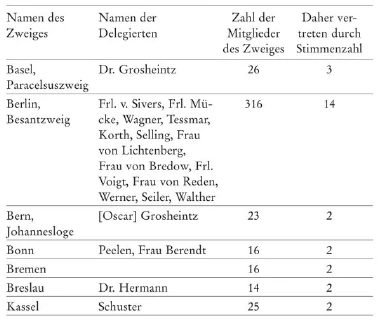
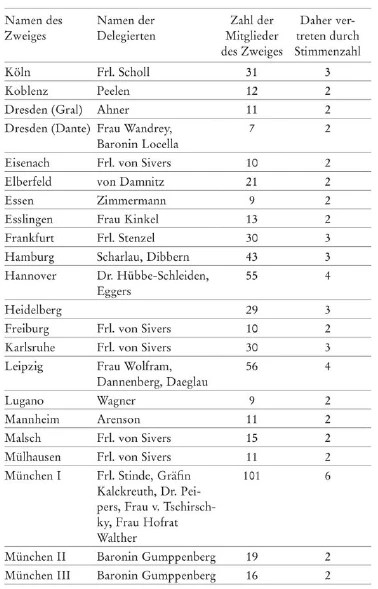
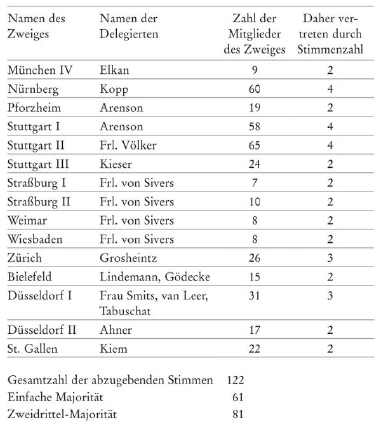
[ 4 ] Following the official welcoming remarks that the chairman, Dr. Rudolf Steiner, addressed to the assembly, he delivered the following opening speech, the essential content of which is reproduced here:
[ 5 ] “My dear Theosophical friends!
[ 6 ] Just as I was able to point out at last year’s General Assembly that we were entering the seventh year of our German Section’s existence, we can now say, at the opening of this year’s assembly, that we have now completed the seventh year of our existence as the German Section. On this occasion, it may be safely assumed from the outset that Theosophists have a sense of what is called the cyclical development of events. Accordingly, our gathering today—now that the first seven-year cycle has come to an end—represents a special kind of celebration and consecration. On such an occasion, it may well be that not only will what you might take for granted—namely, that you will be most warmly welcomed by the General Secretary—take place, but it is also fitting, now that our seventh year has come to an end, to draw attention to a number of other matters. Truly, a seven-year cycle such as the one that has just come to an end can teach us many things. It will therefore not be superfluous to take this opportunity to highlight some of the lessons that these events have taught us.
[ 7 ] Those of you who have participated in theosophical life within our German Section in various locations will have noticed that this life has undergone a development, a transformation. Those who are able to do so, thanks to their long membership, may recall the manner in which we began the life of the Theosophical Society here in Germany seven years ago. Anyone who has attended various lecture series and drawn comparisons between how the lectures were delivered in the most recent series and the manner in which they had to be delivered at the beginning of the movement will notice a significant difference. We simply had to ascend gradually from the consideration of lower spheres of knowledge to higher ones. Years ago, it was still necessary to speak in a more abstract and schematic manner than is done now. The fundamental principles of Theosophy had to be presented at that time in a way that everyone could grasp. Now, however, we are able to assimilate even such intimate teachings as those presented to us a few months ago in Munich or Basel. How many members would have regarded what was said there as wild fantasy at the beginning of the movement? A significant shift must therefore have taken place, one that everyone is surely able to perceive. This is entirely justified; for the Theosophical Movement would not progress if it could not grow from within—not merely in numbers, but also in inner substance. It is precisely this fact that must make us realize that the Theosophical Movement is not something based on a single dogmatic book or doctrine, but rather something that, like an organism, is constantly adding new members. We may also look back on a certain fruitfulness of the movement. What can be said about this can be gleaned from certain figures relating to our working conditions. I have noted the number of members who perform direct work through lectures and so on; that number has risen to twenty, and this figure includes only those members who have already expanded their activities to various locations. Added to this is the extensive and significant work carried out in the individual lodges. Hardly any of the twenty collaborators had been active through oral lectures seven years ago. This gives us a sense that we have indeed achieved something, that the Theosophical Movement has borne fruit since its inception. But this has also occurred in many other directions. For example, we have been able to expand our activities by establishing what are known as “art salons.” Mr. Wagner will likely tell us a bit later about this new initiative, as it pertains to Berlin. These events are intended to present artistic works imbued with the theosophical spirit to those who are still unfamiliar with Theosophy. Myths and legends are recounted there; for those coming from the mundane realities of everyday life, a brief overview of theosophical teachings is provided in the most accessible form, and so on. Without a doubt, this very kind of down-to-earth, spiritual work deserves to be emulated and further developed. It is very gratifying when ordinary people from the street come in to joyfully absorb the basic concepts of Theosophy. This is also a proper way to spread Theosophical work, but it must be done in a thoroughly unpretentious manner. If it were carried out in a pretentious manner, it would not bear fruit. But as it is, it is a truly practical endeavor. The point is simply that what is meant to happen in the present should actually happen.
[ 8 ] At last, it was also possible to bring to fruition a project in which one can truly sense the essence of what lies within a seven-year cycle. Seven years ago, I gave a lecture in Berlin on Schur’s drama *The Children of Lucifer*. Even then, the idea of a future performance was already looming behind that lecture. Now, in the seventh year of our existence, this idea could be realized in Munich. Thus, a movement such as the Theosophical Society returns, as it were, to its beginnings after seven years. Under certain circumstances, what once seemed like a mere intention can then come to fruition. But it takes patience to allow such intentions to mature. It would have been entirely premature to realize the idea of staging the aforementioned drama any sooner. — These are the kinds of things that must pass through our souls as we experience the sacred moment marking the conclusion of a seven-year cycle. Of course, these have been, for the time being, merely the bright sides of the development, from which one can learn that, if they truly prove to be bright sides, they should be continued in a calm manner. But one can learn much more from the dark sides. As the Society’s membership grows, it is very easy for misunderstandings to arise regarding the innermost lifeblood of the forces that are meant to be at work within the movement. For the members themselves necessarily have the task of ensuring, on the one hand, that misunderstandings do not arise too frequently within the Theosophical Society, and, on the other hand, that the body of truth derived from spiritual research is exposed to as few misunderstandings as possible out in the world. We truly have a sacred spiritual heritage to safeguard, one that can very easily be subject to misunderstandings; the symptoms of such misunderstandings are evident everywhere. For example, an article recently appeared in a Berlin morning newspaper—one that must seem extremely boring and banal to a true theosophist—in which occultism is portrayed as encompassing fields such as somnambulism, clairvoyance, telepathy, and so on. Although the author of this article is a well-known figure in journalistic circles, he actually knows as little about occultism as a bookbinder knows about the contents of the books he binds. But that is how that man had to speak, considering what is commonly referred to today as theosophy or occultism. The task of the Theosophical Movement is to appeal, first and foremost, not to the poorly informed masses but to the better-informed human heart and human reason. To do so, however, the Theosophist must gradually learn to strike the right balance. The man who wrote that article said he had met a nanny in a family who took the children to the zoo every day and, while there, occasionally encountered a lady who immediately began telling her about the nature and significance of the astral body and eventually convinced this maid so thoroughly. - I would be wary of believing that this could happen to a member of the Theosophical Society; for Theosophists do indeed gradually acquire a certain tact for such matters. It is also entirely inappropriate to promote Theosophy in this manner; whoever does so will thereby cause the greatest possible harm to the Theosophical movement. The situation is different when one systematically introduces Theosophy in an art studio to people such as that maid. If one presents Theosophical facts in such a disjointed manner to a naive person, that person will only be misled; under certain circumstances, great harm may be done to their soul.
[ 9 ] But this also leads us to discuss, in an even more serious manner, a point that is already important today but will become much more important in the future. We will also learn a great deal from this! This point concerns, in fact, the relationship between those who teach and work within society and those who wish to learn. We are at a difficult juncture here. For it can easily happen that, precisely through such a movement, what is called blind faith—faith based solely on authority—gains the upper hand. It is in this regard that sins take their heaviest toll. We would like to take this opportunity to refer to a remark by Lessing. He observed that everyone around him was singing the highest praises of Klopstock. But when he inquired into what people actually knew about Klopstock, it turned out that they had hardly read him at all. In theosophy, understanding is the only thing that matters. Anyone who, within theosophy, seeks to understand from the very source of spiritual life will surely grasp Lessing’s words, slightly modified: “We wish to be praised less, but understood more diligently.” These words should be deeply inscribed in our hearts as a salutary lesson that has emerged in recent years. We have seen how a truly estimable teacher in the field of theosophy has received unanimous praise; but we have also had to experience how a fierce opposition against her gradually asserted itself—albeit outside the German Section. Upon closer examination, one would find that the following holds true: There were many who, in years past, admired and marveled at that leading figure of the Theosophical Society. Had these admirers more often taken to heart the principle: “Let us seek to understand rather than merely admire,” the subsequent opposition would not have arisen. We should not offer the teachers outward veneration and admiration, but rather strive to understand them. Anyone well-versed in true occultism knows how pernicious admiration without understanding can be. They will tell themselves that if someone strives not merely to admire and revere a figure, but to make that figure’s cause their own—and to embrace that cause not merely for the sake of the figure who represents it, but for its own sake—then that person is on the right path. Mere personal veneration can all too easily turn into its opposite. Herein lie the true reasons for the reversal of so many attitudes within the Theosophical Movement into their opposites. You would do well to always listen to the words of those who truly work in the spirit of our Movement; then it will also become clear to you that such people, in fact, wish to be understood rather than merely admired. But there is an even more serious side to this matter! Anyone who begins to hear the teachings of Theosophy from this or that person is not immediately able to understand everything. This understanding does not require clairvoyance, but rather, at first, the mere application of sound reason. Only those who have the will to do so, who strive to understand it with their reason, will understand. Nothing has been said on my part—no matter how lofty its source in Spiritual Science—that cannot be grasped or at least examined by reason, provided it is applied comprehensively and impartially enough. We must be clear that not everyone can be a spiritual researcher, but what is communicated must in all cases be open to rational scrutiny. However, certain things often make such scrutiny difficult—for example, the lofty truths of the Gospel of Luke; but even here we can see, by way of an example, how one might proceed. First, what the clairvoyant has investigated is regarded as a mere communication. This information, presented without any supporting documentation, is then verified against existing sources—in our case, the Gospel of Luke; for in it, the author of this Gospel has, in his own way, stated the same things that emerge from direct investigation. Admittedly, this is only a preliminary, approximate verification; but in simpler cases, it can become more precise. Thus, we shall see that, over time, the evidence will multiply. The teachings on reincarnation and karma must be demonstrated in real life; for only in this way can we properly present them to a wider audience. When the accusation is made that what the spiritual researcher says can only be accepted on the basis of mere authority, such a principle is entirely false, and one should not allow it to arise at all; rather, one should say to oneself: I will summon all my reason and use it to test what has been communicated against real life. For example, we should go and study what has been said about Zarathustra—the major guiding principles provided to us by spiritual research on this subject—and compare them with what history and life have to say about it; then everything will be confirmed. I am completely at ease with those who truly draw upon the entirety of history to verify what has been said. Newly discovered facts can only provide further evidence. Even what was said yesterday as a brief outline of anthroposophy can only be confirmed by physiology, biology, and so on. The more one makes proper use of such sciences, the stronger the evidence will become. Apparent contradictions should be resolved; for they are contradictions only when examined imprecisely. This principle has been particularly adhered to in my forthcoming book *The Secret Science*.
[ 10 ] Nothing is more harmful than showing unfounded admiration for a teacher. For by doing so, the blind believer causes harm to himself by failing to develop; but he causes even greater harm to the one whom he blindly believes in and admires. For everything that is shown to the spiritual researcher as blind admiration appears to him as a stumbling block, against which the teacher must struggle in the most terrible way. There is nothing he must struggle against more than precisely such blind admiration, through which stones are literally thrown in his path. This was to be entrusted to you as a secret at the end of the seventh annual cycle! Those who wish to examine things stand before one as willing beings; with them, one can make progress. The others, however, constantly hurl clouds of obstacles at one, against which one must defend oneself.
[ 11 ] They can only be overcome if the teacher is absolutely honest. Blind admiration is the most dangerous pitfall in Theosophy. The Theosophist must train himself to be honest and strict with himself. Such matters must be considered very seriously. Teachers must, of course, in a certain sense take upon themselves what has been described here; for they are capable of examining from every angle what is presented to them. Personal following will always exist; but it should not affect the teacher at all—he must stand firm against it. Blind followers are his tempters and seducers.
[ 12 ] Thinking along these lines must gradually become a guiding principle within the Theosophical Society. One must come to the conviction that one is championing a sacred cause. Only by adhering to this principle will we make progress. - No one who wishes to teach, whether in a small or large circle, need shy away from doing so if they accept this principle.
[ 13 ] This is the kind of lesson we should learn from our major experiences. On the one hand, we should be open-minded and free of prejudice; on the other hand, however, we should exercise the utmost care in accepting what is given to us. This is what the past seven years have taught us.
[ 14 ] This is not to say, of course, that everyone should refrain from teaching until they have verified a matter for themselves. One must always make a strict distinction between what can already be understood through reason—even if only through reason—and what can only be understood later, with further development. It is unfortunate when, for the sake of convenience, we simply accept things on authority. Why do so many mediums become charlatans? They are not solely to blame; the blind listeners and believers are also at fault. Above all, one who studies the occult must possess one thing: an ever-deepening inner life of the self. The more blind faith—arising solely from convenience—is hurled at a medium, for example, the more and the sooner that medium becomes a charlatan. One cannot, in a
[ 15 ] “It is important enough to emphasize just how crucial it is, particularly in this field, to set the right path as an ideal.”
[ 16 ] With this, the chairman concluded his opening address and then, in a brief overview, referred to his external activities in recent years, his various visits to lodges, and his various trips, particularly those to Austria. On this occasion, he mentioned a beautiful experience that is particularly symptomatic of the character of the Theosophical movement. He recalled, in fact, the public lecture in Prague, where members of both Czech and German nationalities were present and sat together in the most wonderful harmony. At the end, an elderly gentleman told the speaker that what Theosophy had accomplished there would otherwise have been utterly impossible in Prague. Yet Theosophy was able to unite those people—who would otherwise have been hostile toward one another—so harmoniously on that beautiful evening.
[ 17 ] The journey in question then continued via Vienna to Klagenfurt. In Vienna, too, the work proceeded in the most peaceful manner. And this was during the days when those clashes took place between Italian and German students, during which shots were even fired; it was also the time when fierce disputes between Germans and Czechs were taking place. From this, it is clear that Theosophy has a mission, namely, to bring harmony, peace, and unity to humanity. Through Theosophy, this can indeed be achieved.
[ 18 ] Attention was also drawn to the remarkable fact that seven lecture series took place over the past year: in Rome, Düsseldorf, Kristiania, Budapest, Kassel, Munich, and Basel. Furthermore, grateful remembrance was given to those members who have repeatedly been active in a wide variety of locations; but the many others, whose names cannot all be mentioned, may accept as a token of gratitude the success that their work has achieved within the Theosophical Society, and draw inspiration from this for further diligent work. As a significant external event, the Chairman also highlighted the Budapest Congress and mentioned that at this Congress he had been awarded the Great Subba-Row Medal by the Adyar headquarters for the treatise “How Does One Attain Knowledge of Higher Worlds?”, which was available in English translation, a sign that harmony can exist among the various teachers of Theosophy even when independence prevails. Besant and Steiner thus apparently get along quite well, even though they follow different paths. It was simply necessary to unite the old current of the Theosophical Movement with a new current, to infuse it with new lifeblood from a certain direction. Nothing fruitful will come from mere empty talk of harmony. Those who are there as teachers are simply working together, each in their own way, on the one great work.
[ 19 ] Mention was also made of the founding of a “Philosophical-Theosophical Publishing House,” which is under the supervision of Miss Mücke and through which an outline of anthroposophy is also to be published from time to time.
[ 20 ] In a very solemn manner, the Secretary-General then named those of our dear members who had passed away during the course of the year, and followed each name with a brief description of the deceased’s relationship to Theosophy, particularly that of the three ladies from Stuttgart who had passed away: Mrs. Lina Schwarz, Mrs. Cohen, and Mrs. Aldinger.
[ 21 ] “Even in such a case,” the chair continued, “we can reflect deeply on the significance of what theosophy has to offer us. Let us not seek to console the bereaved families of our departed dear friends with trite phrases, but rather let us point out that, although we are only at the beginning of our movement, what is meant to be balanced in individual karma must gradually come to pass in the collective karma of the movement as a whole. Theosophists must ultimately feel obligated to actively stand up for one another in certain cases. Thus, the popular phrase of universal love for humanity is replaced by a true understanding of individual, genuine love for one’s neighbor. If love for humanity does not address individual cases and take action there, it remains a mere phrase. Such thoughts must arise in us when, from time to time, we see this or that one of our dear members leave the physical plane.”
[ 22 ] Following these remarks by the chairman, Mr. Bedrnicek from Prague took the floor on behalf of the Prague Section to express his warmest thanks to the Secretary General before the General Assembly for his efforts on behalf of the Prague Lodge.
[ 23 ] Mr. Günther Wagner, on behalf of the Besant Branch, moved to waive the reading of the minutes of the last General Assembly, since everyone had been able to familiarize themselves sufficiently with their contents in the printed “Mitteilungen.” The motion to refrain from reading the minutes of the last General Assembly was passed unanimously, and the minutes were thereby declared approved.
[ 24 ] Miss von Sivers provides a report on membership trends based on the most recent lists received:
[ 25 ] “Number of members: 1,500, compared to 1,150 the previous year; new members: 415, compared to 336 the previous year; members who resigned or could no longer be located and were therefore removed from the rolls: 30; members who transferred to other sections: 29; members who died: six.
[ 26 ] The current number of branches is 44, compared to 37 last year, plus one center. Seven newly established branches are worth mentioning: the Breslau Branch, the Cusanus Branch in Koblenz, the Essen Branch, the Paulus Branch in Mulhouse, the Novalis Branch in Strasbourg, the Dante Branch in Dresden, and the Goethe Branch in Munich.”
Mr. Seiler presents the treasurer’s report, including the annual financial statement and balance sheet:
According to the report, total revenue amounted to 5,817.69 marks
Total expenses amounted to 5,499.53 marks
This leaves a surplus of 318.16 marks
In addition, bank deposits total 2,020.45 marks
and inventory of movable property amounts to 338 marks
resulting in total assets of 2,676.61 marks
[ 27 ] Following this, Mr. Ahner from Dresden proposed that a more detailed financial report be published in the “Mitteilungen” in the future, so that even outsiders could gain a clearer insight into income and expenses.
[ 28 ] Mr. Werner proposed rejecting this motion outright.
[ 29 ] Mr. Elkan moved to close the debate, and the motion was approved.
[ 30 ] The previous motion to publish a more detailed financial report in the “Mitteilungen” was rejected by an overwhelming majority. This was followed by the reading of the report by the financial auditors, Mr. Tessmar and Ms. Motzkus. Mr. Tessmar explained that the financial records had been audited in three areas: first, for overall neatness and clarity; second, for the arithmetic; and third, for the accuracy of the individual entries. As a result, the two auditors were able to report that the financial management was entirely in order. The financial statements also correspond accurately with the entries, and the positive cash balance is in fact present.
[ 31 ] Motions were then presented from the floor. No such motions were submitted in writing to the chair.
[ 32 ] Pastor Wendt asks to speak and proposes that the “Notices” occasionally sent to members no longer be sent in an open envelope but rather in a sealed envelope.
[ 33 ] Miss von Sivers replies that this would result in a significant increase in postage costs. She suggests that individual members should instead take care to ensure that their items do not fall into the wrong hands due to their own carelessness.
[ 34 ] Mr. Ahner suggests sending the various communications as a postal package to the individual board members and having them distribute them.
[ 35 ] Pastor Wendt then withdraws his motion in favor of this second one.
[ 36 ] Mr. van Leer believes that a different type of cruciate ligament might be needed.
[ 37 ] The chairman now points out that votes can only be taken on motions that are consistent with the bylaws; however, since the bylaws stipulate that the lodges are autonomous, the General Assembly cannot decide what the individual lodges must do. It would have been best, the chairman continues, to have retained the original procedure—where everything was indeed communicated to the members in confidence—but the financial issue necessitated the change due to the society’s rapid growth. “Besides,” he says, “we’re not doing anything that needs to be kept secret, and it doesn’t really matter if a mail carrier happens to read such a letter from time to time.” Pastor Wendt had, in fact, cited such a real-life case as an example in support of his motion.
[ 38 ] Pastor Wendt proposed increasing membership dues to cover the resulting additional postage costs; however, the chair responded that, according to the bylaws, the General Assembly did not have a quorum to make such a decision. With that, the matter was settled.
[ 39 ] Mr. Oscar Grosheintz proposes compiling an address directory of all members of the German Section in order to distribute it, if not to every individual member, then at least to the lodge officers; in his opinion, this would help foster better communication among the members.
[ 40 ] Miss von Sivers replies that it had been decided on a previous occasion, for various reasons, to no longer include the names of new members in the “Mitteilungen.”
[ 41 ] Mr. Ahner believes that a directory of exact addresses would indeed be useful and particularly important for the lodge executive committees, because it would facilitate communication among members in every way.
[ 42 ] Miss von Sivers points out the dangers associated with compiling such a list of addresses, which could then be used for any other purpose. Incidentally, she notes that if members visit a location where there is a Theosophical branch, they could contact the local branch president.
[ 43 ] Dr. Steiner explains that this would be a matter of principle which, in addition to its advantages, would also have a downside, since there are people who work quite honestly within the Theosophical Society but, due to their position or other circumstances, cannot appear in public under their names as Theosophists.
[ 44 ] Such important matters should be left to the well-founded trust placed in the section’s leadership. The chair also pointed out other problems associated with publicly disclosing members’ addresses. He did not feel called upon to reveal the names of the members, as they were sacred to him. After Mr. Ahner spoke again on the same matter, Mr. Kiem finally moved to close the debate, and the motion was adopted.
[ 45 ] The previous motion to provide the lodge executive boards with the names and addresses of all members of the German Section was rejected by a large majority.
[ 46 ] No other motions were made from the floor.
[ 47 ] The representatives of the branches presented their reports: With the exception of Miss von Sivers, who read a report from the Karlsruhe branch on its behalf, no one else wished to speak on this matter.
[ 48 ] Mr. Günther Wagner then gave a brief report on the work at the Berlin Kunstzimmer and followed it with a general reflection on the usefulness of such events within the Theosophical Movement. He also encouraged others to undertake similar initiatives elsewhere, as has already been done in Berlin and Munich.
[ 49 ] No one asked to speak on the item “Miscellaneous.”
[ 50 ] The chairperson then declared the eighth General Assembly of the German Section adjourned.