

The History of the German Section
of the Theosophical Society
1902–1913
GA 250
10 December 1911, Berlin
Translated by Steiner Online Library
45. Tenth General Assembly of the German Section of the Theosophical Society
Article in the “Newsletter for Members of the German Section of the Theosophical Society (Headquarters: Adyar), published by Mathilde Scholl,” No. 13/1912
[ 1 ] At 10:15 a.m., the Secretary General of the German Section, Dr. Rudolf Steiner, opened the tenth regular general assembly with the following words:
[ 2 ] “First and foremost, it is my duty to extend a most heartfelt welcome to all of you in the spirit of our Theosophical Movement and in the spirit that brings us together. These gatherings always give us the opportunity to see many of our friends gathered in one place at the same time. And what is most important for a true Theosophist on such occasions is undoubtedly the knowledge of being united with many friends and kindred spirits—that is, with people who, in the spirit of our time, have filled our hearts with inspiring ideas about spiritual matters. That our thoughts and feelings are forces that already hold significance within reality even as individual entities is, after all, deeply ingrained in our hearts as Theosophists. But anyone who views spiritual life in terms of reality must admit that the convergence of a larger number of such individual forces signifies something entirely different. One is only at the beginning of understanding spiritual life if one believes that the spread of Theosophy depends solely on how, externally on the physical plane, fellow human beings are convinced through external propaganda or words. But whoever has penetrated the meaning of spiritual knowledge knows that the forces that invisibly govern the world—the forces of good will that flow together from genuine theosophical hearts—also form, in a supersensible way, a current that flows into the evolution of humanity. Thus, we will become increasingly inclined to view an external gathering of Theosophists as a symbol of that which takes place between hearts and emanates from them—and which cannot be perceived in the external world. This is where the sanctity and dignity of the theosophical worldview are first expressed, but also what entitles this theosophical worldview, in a very unique way, to intervene in the evolution of humanity as an element whose true power lies in the supersensible.
[ 3 ] The fact that, alongside the—admittedly—prevailing misunderstanding of our views that we encounter, we also find some understanding in the world is perhaps best evidenced by the progress we have made this year. We need only point out that we were able to stage our performances in Munich amid growing interest, and that our artistic endeavors—as expressed in our Mystery Plays—have been successful in recent years. After all, we were able to stage one performance in 1909, two in 1910, and even three in 1911. This is just one of the signs that point to genuine progress—not merely superficial progress—within our movement.
[ 4 ] Another sign of this is that a home dedicated to our worldview has already been built in Stuttgart. Anyone who truly understands Theosophy needs no explanation of what it means for the aspirations of Theosophy to be confined by spatial boundaries that are themselves born of theosophical thought. Nevertheless, I must admit that the entire manner in which this theosophical home came into being within Stuttgart troubles me almost more than what has recently—since, after all, no reality corresponds to the ideal
[ 5 ] I find this to be significant. The building was created in collaboration with an understanding architect who knew how to give theosophical ideas their outward form. Moreover, I consider something else to be a touchstone of the theosophical mindset within our circles. The building was constructed without any publicity campaign in the outside world. The entire project remained a matter among Theosophists and, even today, now that the building is complete, it remains a matter among Theosophists.
[ 6 ] Such a confirmation of our theosophical ideas is surely the best welcome our souls can receive here today; and in this sense—that the Theosophical Movement may not lose sight of what is most important, that it may work only where this spirit is met with a like-minded response and not where one must resort to outward publicity—in this sense, let this association be imbued with our Theosophical ideas.
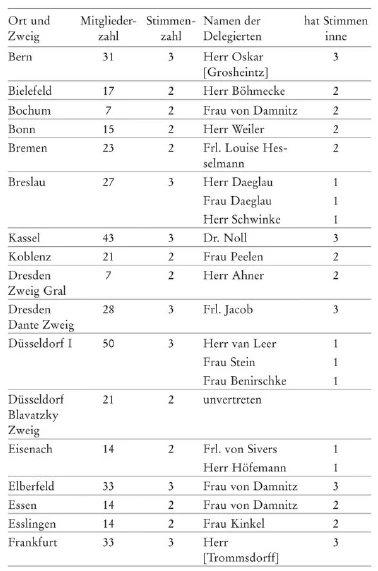
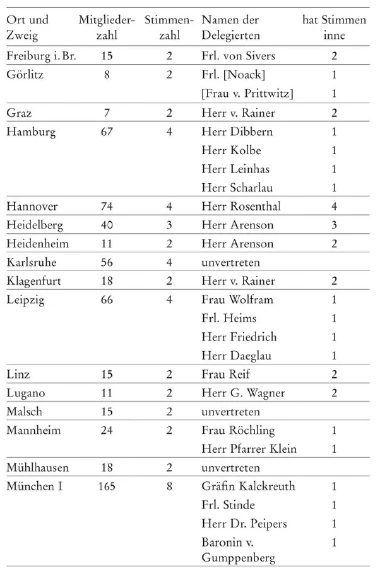
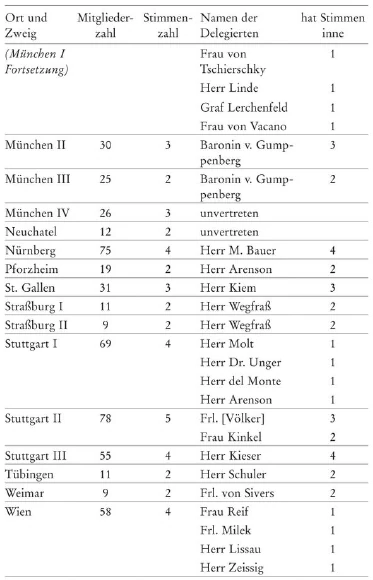
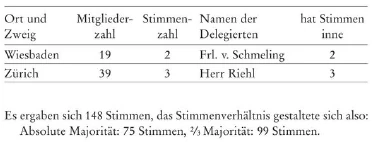
[ 7 ] Having warmly welcomed you all, we have now arrived at the business portion of our general meeting, and I ask that you conduct this portion in a strictly businesslike manner.»
[ 8 ] First [agenda item]:
[ 9 ] Determination of the voting ratio of the delegates from the individual branches.
[ 10 ] It was necessary to clarify the voting rights of members of the Swiss branches within the German Section.
[ 11 ] Dr. Steiner: “I must point out here that we are fully justified in granting the Swiss branches the right to vote in the German Section, to which they de facto still belong. A Swiss Section has been founded. Those Swiss branches that belonged to the German Section refused to join the Swiss Section. Thus, the alternative arose: either the Swiss branches would join the German Section or they would resign from the Society. Yesterday I received a letter from the President of the Theosophical Society stating that these branches have the right to form a new, independent body. Until such a body is formed, in accordance with all established practices of the Theosophical Society, the former Swiss members of the German Section must still be counted among its members. Otherwise, they would be left in limbo if we did not grant them the right to vote within the German Section.
[ 12 ] I now have to ask whether delegates have been elected by members who do not belong to any branch.»
[ 13 ] Mr. Krojanker remarks in this regard that the section members do not know one another. Dr. Steiner replies that it is up to the section members themselves to get to know one another; according to earlier General Assembly resolutions, they have the right to elect delegates. He proposed establishing a central point where all section members could register. This would mark the beginning of their unification. Mr. Krojanker agreed to accept registrations from section members so that their unification could take place in the future and the election of delegates could be carried out.
[ 14 ] The distribution of votes was then determined. The representatives of the individual branches and the holders of their votes are as follows:

[ 15 ] Second [agenda item]: Reports from the Secretary-General, the Secretary, the Treasurer, the Recording Secretary, and the Auditors.
[ 16 ] Dr. Steiner: “In previous years, I have provided a factual report at this point on the work carried out within the German Section. However, in light of the fact that, as far as the Executive Committee can foresee, all sorts of protracted matters are expected to come before the assembly, I shall refrain from delivering the customary address at this time. Instead, the business report will be presented.”
[ 17 ] The following is the report by the secretary, Miss von Sivers, on membership trends:
[ 18 ] Number of members: 2,318, compared to 1,950 the previous year
New members: 458
Resigned or no longer
traceable and therefore removed from the rolls: 67
Transferred to other sections: 3
Deceased: 20
[ 19 ] Six new branches were established:
[ 20 ] Bochum branch, Graz branch, Heidenheim branch, Linz branch, Neuchâtel branch, Tübingen branch.
[ 21 ] Two new centers were established: the Hamburg Center and the New York Center.
[ 22 ] Total number of branches: 53; total number of centers: 5.
[ 23 ] Dr. Steiner: “There is something to be added to this report. It concerns commemorating our dear members who have departed from the physical plane this year.
[ 24 ] This year in particular, we have lost a large number of members who have departed from the physical plane through death. It is fitting that we remember these members with warmth.
[ 25 ] Above all, it is my duty to remember a longtime member of the German Section and the Cologne Branch, our dear Miss Hippenmeyer, who combined an ever-increasing passion for our theosophical ideas with an extraordinary enthusiasm for the broadest global interests. Those who knew her well were drawn just as much to her beautiful, kind, theosophical heart as to her interest in the world. Miss Hippenmeyer did not pursue these interests in a narrow-minded way, but undertook extensive travels that can be called world tours. If one considers even just the external, purely practical difficulties of these journeys for a woman traveling alone—and Miss Hippenmeyer was, moreover, a frail woman—then this is something for which one cannot help but feel great admiration. She was extremely active in support of our theosophical cause in a most endearing way, and it was painful for all who had known her to hear that she had left the physical plane in Java during one of her great journeys.
[ 26 ] I must also remember an exceptionally active colleague, who was also a member of the Cologne Lodge, our dear friend Ludwig Lindemann. I still vividly recall the impression I had when I first saw Ludwig Lindemann, who vividly conveyed his convictions to me. Since then, he has grown day by day, despite facing the greatest obstacle of all: a serious illness. Nevertheless, he had no other thought than to devote his entire being to the spread of theosophical thought. And when he had to go to Italy for health reasons, he worked there to foster theosophical thought. There he founded the small centers we have in Milan and Palermo. He knew how to establish the most intense and heartfelt theosophical life in these places. Ludwig Lindemann was loved by all who knew him with the kind of love that can spring from the naturalness of a spiritual connection with another person. Lindemann pursued his great theosophical interests with great intensity, and when I visited him in the final weeks before his death, I could sense how a deep, heartfelt, theosophical enthusiasm radiated from his failing body. Thus, it gave me deep satisfaction to see how deeply our friends in Milan felt connected to our dear friend Lindemann. While I was in Milan, I was shown the room that had been prepared for Lindemann, where he could have lived had he been able to return to Italy once more. At that time, I was firmly convinced that he could have continued his work for several more years if it had been possible for him to return to Italy; everything there had been prepared for him; but karma decreed otherwise. But we remember him as Theosophists remember one who has left the stage of his life and work in the physical world in our sense, feeling just as faithfully and warmly connected to him as we did when he was still among us on the physical plane.
[ 27 ] I must also pay tribute to a third individual who, perhaps unexpectedly for many, left the physical plane so quickly; it is our dear section member, Dr. Max Asch. In his eventful life, he had to endure many things that can make it difficult for a person to draw close to a purely spiritual movement. In the end, however, he found his way to us in such a way that he—the physician—discovered the best remedy for his sufferings in the study of Theosophical literature and thought. He repeatedly assured me that no other belief could spring from the soul of a physician regarding any other remedy than that which can come spiritually from theosophical books, and that he felt the theosophical teaching flow like balm into his pain-ravaged body. Indeed, right up until his dying hour, he cultivated theosophy in this spirit. And it was a heavy sacrifice for me when, after our friend had passed away and his daughter wrote to me asking that I say a few words at his grave, I was unable to fulfill this request, since my lecture series in Prague was beginning that very day, and it was therefore impossible for me to render this final service to my Theosophical friend on the physical plane. You can rest assured that the words I should have spoken at his grave were sent to him as thoughts into the world he had then entered.
[ 28 ] Furthermore, I must remember a friend from Berlin, a member of our Besant branch, who, after many different endeavors, finally found a safe haven in our movement. He is our dear friend Ernst Pitschner, who, though long afflicted by the seeds of decline, remained among us and, until his death, was most intimately united with us in our theosophical work. It was a peculiar twist of karma that, after only a few weeks, his wife followed him into the supersensible worlds.
[ 29 ] I would also like to remember our dear member Christian Dieterle from Stuttgart. He found his way into theosophic life with difficulty but with extraordinary diligence, and in recent months he was a man who thought theosophically in the most intense way.
[ 30 ] Let us now remember an elderly Theosophist who was taken from the Mühlhausen branch: Josef Keller. This is one of those cases where, even though one has only encountered a person in person once in one’s life, one must immediately recognize in him a profound spiritual and emotional disposition. Keller, particularly in his final months, was among the most wholeheartedly committed Theosophists, and all who knew him will cherish a faithful, loving memory of him.
[ 31 ] I must also mention a man who, though confined to his bed by a serious illness, was introduced to Theosophy through the efforts of a person dear to us: Karl Gesterdings.
[ 32 ] I would like to remember our dear friend Edmund [Reebstein], who was taken from us at a relatively young age after a brief illness, and whom those who knew him well came to hold in the highest regard.
[ 33 ] I have exactly the same to say about Mrs. Major Göring, who worked within our branch for many years.
[ 34 ] The list of our deceased is so long this time that everything I would like to say would take too much time.
[ 35 ] I must also mention our members Erwin Baumberger from Zurich, Georg Stephan from Breslau, Ms. Fanny Russenberger from St. Gallen, Johannes [Radmann] from Leipzig, Karl Schwarze from Leipzig, Wilhelm Eckle from Karlsruhe, Georg Hamann from Hanover, Wilhelmine Mössner from Stuttgart I, Walter Krug from Cologne, Mrs. Silbermann from Heidelberg, and Mrs. [Liendl] from Munich I.
[ 36 ] Even today, I still consider it my special duty to commemorate here the passing from the physical plane of a personality who was well known in all theosophical circles, who was taken from us by a painful death, who accomplished much, and whom we remember with just as much love as the others—I mean Mrs. Helene von Schewitsch. You are familiar with her books; I need not describe her in further detail. I must emphasize that circumstances were such that I always complied with her request whenever she asked me to give a lecture in her circle during my stay in Munich. I would just like to suggest that, for me personally, her entire life appears to be something profoundly tragic; and I may well say that Mrs. von Schewitsch treated me with extraordinary trust, and that I am justified in saying: This life was deeply tragic. I was also granted the privilege of looking into this heart; and please understand what I call “tragic” to mean what most of you will understand by “tragedy” from my lectures.
[ 37 ] We fulfill our duty of cordiality by outwardly expressing how closely we are connected in spirit with the deceased as we rise from our seats.»
[ 38 ] Treasurer's Report:
[ 39 ] In this report, the treasurer—Mr. Seiler—points out that it is extremely difficult to complete the treasury report on time, as the branch offices submit their financial statements very late, often only a few days before the general meeting. There was also a great deal of disorganization and inaccuracy in filling out the preprinted forms, causing the treasurer considerable difficulty—particularly because many reports were not received on time. Financial Report for the 1910/11 Fiscal Year:
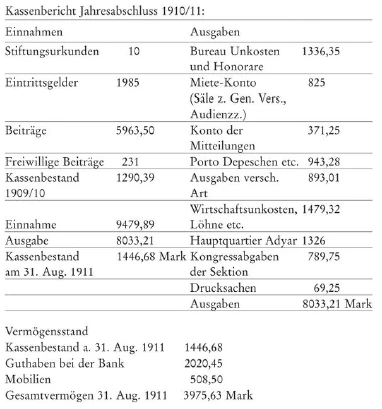
[ 40 ] Dr. Steiner: “You have just heard how difficult it is—though it would certainly be desirable—to do the right thing at the right time. But what good is it—even if it is desirable—to close the books on August 31 and send the report to the individual branches 14 days before the General Assembly, when we don’t actually receive the documents we need from the branches until just a few days before the General Assembly? It seems to me—and this is my personal opinion—that a theosophical sense of fairness should also prevail within the Theosophical Society, which would entail asking, when something is not carried out, ‘What is actually the reason for this?’ One could, of course, say that the General Secretariat has a duty to urge the lodges to do so; but what good is that if the lodges do not do it anyway? We will lose very little if we are not in a position to swear to the letter of the law.
[ 41 ] Society itself must be given some insight into the way in which this fairness is understood.
[ 42 ] I am obliged to read a letter aloud at this point, and I ask you to evaluate it objectively. I am therefore compelled to read the letter aloud because it has been expressly requested; however, I would ask you to form a completely unbiased opinion and to wait to discuss this letter until we reach the third item on the agenda: motions from the floor. It is in the interest of the assembly to also address other items, such as the granting of discharge to the entire Executive Board, only when we reach the third item. Therefore, I ask you first to listen to the reading of this letter. I will put it to a vote whether you agree to wait until the third item on the agenda to discuss this matter.”
[ 43 ] The vote results in the assembly's approval.
[ 44 ] Dr. Steiner then reads the following letters:
Leipzig, December 8, 1911
To the General Assembly of the
Theosophical Society (German Section) Berlin.Section 11 of the Bylaws states: The Section’s fiscal year ends on August 31. An annual financial statement prepared by the Treasurer and audited by the auditors shall be sent to each branch by the Secretary-General 14 days prior to the annual General Assembly.
It is clear that the General Secretary has failed to fulfill this duty for years. I therefore asked him on November 5, at a members’ meeting of the Leipzig branch, to ensure that the annual financial statement would at least be available to the delegates at the General Assembly. He rejected my modest request on trivial grounds. I then submitted a similar motion at the Leipzig members’ meeting on November 27, but it was also rejected. For this reason, I unfortunately feel compelled to approach the General Assembly myself with the request that the following motion be put to a vote under Item 2 of the agenda (Report of the Secretary-General):
Motion: The Secretary-General of the Theosophical Society, Dr. Steiner, is requested:
1) to strictly comply with the bylaws of the German Section in the future and, in accordance with Sections 9 and 11, to send the annual financial statement to each branch 14 days prior to the General Assembly for review and audit; and
2) on this occasion, due to his breach of duty, to formally request indemnity in the minutes.
Should the General Assembly, contrary to expectations, disregard the Constitution and the Bylaws, that is, law and justice, and reject my “motion” or a corresponding amendment thereto, I will consider whether to appeal to the supervisory authority—namely, the Royal “Local Court” in Berlin—to enforce the bylaws and thus have all resolutions of the General Assembly declared unlawful.
The inevitable consequence would be a new General Assembly, which would then have to be convened in accordance with § 11 of the Articles of Association.
Dr. M. Haedicke, practicing physician in Leipzig.
Leipzig, December 8, 191[1]; Burgstraße 2
To the Secretary-General of the Theosophical Society
Dr. Steiner in Berlin.Dear Dr. Steiner!
According to the bylaws, every member of the Theosophical Society has an advisory (but not a decision-making) vote at the General Assembly. Therefore, I ask you, in your capacity as General Secretary and acting officer of the Executive Committee, to have the enclosed letter read aloud to the General Assembly under Item 2 of the agenda (Report of the General Secretary) or to have it read by the Secretary. When it comes to administrative matters, even here in Saxony, the laid-back attitude and sloppiness come to an end. At the same time, I would like to remind you that I spoke here in the assembly in favor of tolerance and, among other things, said that the Catholic Church is tolerant toward lawbreakers and does not excommunicate them. You disputed that. I remained silent because, as a Catholic, you surely knew better—or should have known better. And yet you were mistaken. The Catholic Church does not excommunicate lawbreakers—that is, murderers and thieves! Of course, anti-modernists and others are excommunicated, for there is no such thing as freedom of faith or conscience, but only obedience to the Church.
How progressive, freedom-loving, and fraternally conciliatory, by contrast, do Sections 2 and 3 of our Constitution appear: no distinction based on faith or race, no “belief in any dogma.”
Dear Doctor! You have signed this Constitution with your own hand, and therefore, as a man of honor, you must either hold the Constitution sacred and inviolable, have it amended, or resign from your office. Since you have now spoken publicly here of “theosophical dogmas,” I ask you to retract your statement or to accept one of the three consequences mentioned above. For it is immediately apparent:
1) that the Theosophical Society has no dogma whatsoever, and such a claim is therefore a blatant contradiction of § 3 of the Constitution, and
2) that your claim of a “theosophical dogma” is a contradiction in terms, like, for example, “dark sun” or “tolerant Jesuit.”
Please explain, when the opportunity arises, that the Theosophical Society has no dogma and, logically, can never have one, just as Theosophy is not a Spiritual Science but, according to Blavatsky, “the wisdom of those who are divine.”
With theosophical regards!
Signed, Dr. M. Haedicke.
[ 45 ] The postponement of the discharge of liability is approved by a vote of the assembly.
[ 46 ] Dr. Steiner asks if anyone has any comments on the financial report.
[ 47 ] Pastor Wendt: “Where did the 789 marks and 75 pfennigs in conference fees go? And why was the conference canceled at the last minute, when most people were already on their way to Italy?” Dr. Steiner: “Since I have been asked this question, I must answer it. I will do so to the best of my ability. However, I must first go back a bit to the events that led up to such congresses.
[ 48 ] In 1904, a resolution was passed to hold these congresses of the Federation of European Sections of the Theosophical Society, which had been founded at that time. At that time, it was decided to hold such a congress every year. The procedures for preparing these congresses were established, as well as the manner in which the section leaderships of the country in which they were to be held were to participate in the event. It was also stipulated that a certain amount—I believe 50 pfennigs per person—should be contributed by each section.
[ 49 ] Now I come to a point that seems important to me, namely that in Paris—on the occasion of the 1906 Congress—not only was the decision made to hold a congress only once every two years, but another matter was also discussed at the same time. Namely, it was discussed—and I ask that you take this into particular consideration—whether the establishment of a European congress might not cause a bitter reaction on the part of our president at the time, Olcott, who was still alive then. It was a matter close to the hearts of all those involved at the time—a question raised by a man particularly close to Olcott, Commander Courmes—namely, whether it might not be painful for Olcott if a separate body of the European sections were established in which Olcott would have no say. It was clear to everyone that the Federation had been established on the principle that the President would have no say in its affairs. It was exceedingly difficult for us to pass such a resolution; yet it had to be passed, and it made it clear that only the Federation of Sections itself—and not the president of the Society—had a say in the matter; and as far as I know, Olcott never took this resolution to heart. This decision meant that the external arrangements were handled by the section of the respective country that had been designated to host that particular Congress. This year, Genoa had been designated. Our friends worked with the utmost dedication to prepare for and hold this Congress. Of course, funds were necessary for this, and since these funds are generally spent eight days before the congress, we have no right to discuss those funds—which were duly remitted—further here in any sense.
[ 50 ] Certain difficulties had arisen beforehand—namely, the cholera. I did not rely on what was reported in the newspapers and so on, but trusted above all the reports from our friend, Professor Penzig, who repeatedly assured me that it was not at all possible to speak of an epidemic in Genoa. I was therefore able, in good conscience, to estimate the number of German participants in Munich and report it to Professor Penzig.
[ 51 ] After the Munich series, I was forced to travel for a few days and returned to Munich on September 10 to begin my preparations for Genoa. There I found a letter from Professor Penzig, in which he expressed his delight at being able to welcome so many of our members in Genoa and assured me one last time that neither any risk of illness nor quarantine difficulties would arise. On the evening of September 10, I received a telegram: “Congress will not take place; please [notify] members.”—Now we had to track down the various addresses, which was, of course, very difficult; we were unable to locate about seven or eight of them, and I am sorry, Pastor, that you were among them.
[ 52 ] It fell to me, however, to find out at the time why the congress would not take place. Therefore, after receiving the telegram on the evening of Sunday, September 10, I sent a telegram the following morning that read roughly as follows: Since the cancellation must be highly perplexing, please state the reasons. — That evening, I received the reply: I acted on strict orders from the president and the secretary of the convention; please contact them directly.
[ 53 ] The section as such is, of course, entitled to cancel the convention, and we had to comply. If I had received a cancellation notice from London or elsewhere, I would have traveled to Genoa anyway; but as it was, the cancellation was legally binding, even if incomprehensible. However, I am not here to discuss rights, but facts. This is what happened, and you will see from this that we could not possibly raise any objection to the remittance of our congress funds, which have been used, and we have not the slightest objection to their use.”
[ 54 ] Report of the Auditors:
[ 55 ] Mr. Tessmar, as treasurer, stated that he and Miss Motzkus had properly audited the books and found them to be in order, and he again addressed the issue of the reports that the branches had not submitted on time.
[ 56 ] Third [agenda item]: Motions from the floor:
[ 57 ] Dr. Steiner: “There is a motion before us in two parts. A motion concerning Dr. Hugo Vollrath. The first part of the motion reads”:
Motion:
The undersigned members of the “German Section of the ‘Theosophical Society’” hereby submit the following motion for the General Assembly to be held in Berlin on December 10 of this year:
a) The General Assembly is requested to resolve to reexamine the events that led to the expulsion of Dr. Hugo Vollrach at the General Assembly held on October 26, 1908, in Leipzig, and to elect a commission of seven members for this purpose.
b) The elected commission shall begin its work no later than six weeks after this year’s General Assembly and shall submit the results of its investigation to the Secretary-General of the “German Section.”
c) No members who, without knowing the facts of the matter in detail, voted in favor of the expulsion at that time shall be included in the elected commission.
d) The elected commission shall decide whether the resolution passed on October 26, 1908, is to be upheld or annulled.
Weißer Hirsch, December 6, 1911, signed H. Ahner, Chairman of the “Zum Gral” Lodge in Dresden. Paul Krojanker, M.d.D.S.
Motion:
The undersigned members of the German Section of the “Theosophical Society” hereby submit the following motion for the General Assembly to be held in Berlin on December 10 of this year: a) The General Assembly is requested to resolve to reexamine the events that led to the expulsion of Dr. Hugo Vollrath in Leipzig from the “Theosophical Society” at the General Assembly of October 26, 1908, and to elect a commission of seven members for this purpose.
b) The elected commission shall begin its work no later than six weeks after this year’s General Assembly and shall submit the results of its review to the Secretary-General of the “German Section.”
c) Only those who did not vote in favor of the expulsion at the Executive Committee’s meeting may be elected as members of the commission.
d) The elected commission shall decide whether the resolution passed on October 26, 1908, is to be upheld or annulled.
Signed: Curt Richard Müller
[ 58 ] [Rudolf Steiner:] “With regard to these motions, it is necessary to submit to the General Assembly a pamphlet on the same subject written by Dr. Hugo Vollrath.
[ 59 ] Some time ago, Dr. Vollrath sent this pamphlet to the members, in which he first reproduces what I had to say at the 1908 General Assembly on behalf of the Executive Board regarding the matter at hand—acting, so to speak, as the Executive Board’s spokesperson—and to which Dr. Vollrath adds his own specific comments. The Executive Board has now decided—so that it cannot be said in any way that we are withholding anything from the members—to have Dr. Vollrath’s remarks read aloud.”
[ 60 ] Mr. Selling reads aloud Dr. Vollrath’s remarks, which are as follows:
To the Executive Committee and the members of the German Section of the Theosophical Society: At the 7th General Assembly of the Section, at the request of the Leipzig Lodge, represented by Ms. Wolfram, a resolution was announced that the undersigned was to be expelled from the Section.
At the time, I did not attach much importance to this resolution, since I recognized the purpose of this event and since I was not directly hindered in my work for the Theosophical Society. Relying on the law of karma, I viewed it as a test that would clarify for me the Section’s ethical stance regarding the Theosophical Society and prepare me for even more difficult tasks. Those closest to me knew, after all, that since 1902 I had sacrificed my honor and reputation, as well as my fortune and my work, in the service of the Masters, the founders of the Theosophical Society.
As it turned out, however, my expulsion was the source of an incalculable flood of malice of the worst kind. The harmless, friendly relationships I had with many members were immediately severed in a hurtful manner, and people now felt compelled to insult my name whenever it came up. Since Mrs. Wolfram has recently cited entirely new reasons—reasons that were impossible at the time—as the grounds for my expulsion, and since the smear campaigns are intensifying, even against my newly recruited colleagues, whom they are also systematically turning against me, I would certainly be incurring a great karmic debt upon my work by my inaction if I were to remain silent any longer.
According to the minutes, I was expelled because the Leipzig Lodge felt its throat was being squeezed. But now that the throat has been freed again, they certainly did not let me work in peace, and continued to incite others against my colleagues, even worse than before.
I therefore submitted the following motion to the Section’s Executive Committee and to the General Secretariat:
1. to dismiss Ms. Wolfram’s motion regarding my expulsion in a dignified manner,
2. to elect a court of honor to rule on and clarify existing misunderstandings and rumors.
My reasoning for point 1 is as follows: Ms. Wolfram submitted her motion—in violation of the Section’s bylaws—only shortly before the start of the 7th General Assembly, rather than at least 14 days in advance; the delegates and Executive Committee members present in Berlin were taken by surprise. They had no time to examine Ms. Wolfram’s allegations. Particularly in the case of such serious decisions, which call into question the very foundations of the Theosophical Society, the members—or at the very least the chairpersons—should have been consulted. Furthermore, in the life of an association, it is improper to attack a member without giving them the opportunity to defend themselves against these secret attacks. I demand the right to my defense. By “defense,” I do not mean justification, but rather an opportunity to present evidence against the attacks, so as to avoid giving the outside world a false representation of the facts, which would place a karmic burden on the Theosophical Society as such.
My reasoning for point 2 is this: The Court of Honor is tasked with resolving tensions that arise within the German Section. If this natural authority is bypassed, brutality and lawlessness will prevail. But arbitrariness is not freedom! Those who orchestrated my expulsion have claimed that I absolutely need the German Section, which is why I am trying to rejoin it.
Anyone under the spell of this phrase should consider my work following my expulsion—as head of the Board of Directors of the Federation for Healthy Living and the Board of Directors of the German Society for Psychical Research, as a publisher of quality theosophical literature, as editor of *Theosophy*, and as publisher of four other ethical journals, all of which are dedicated to serving the sublime cultural ideal of the Theosophical Society. If Mrs. Annie Besant has appointed me as secretary of the “League of the Star in the East,” I do not regard this as my own merit, but rather as a mark of trust placed in me by honest, great people—people who, free from fear, have the courage to renounce realpolitik and remain true to the principle, for only in this way are they worthy and fit to hold the great message of salvation from the White Lodge in their hands and proclaim it to the spirit of the age.
I shall comment only very briefly today on the most serious accusations and slanders. I therefore ask that you read the minutes carefully, as I must assume you are familiar with them. Dr. Steiner and Miss von Sivers had had bad experiences with the secession from the Theosophical Society, the so-called International Theosophical Brotherhood (L.T.V.), as well as with Paul Raatz’s Theosophical Society in Berlin. I, however, had no connection whatsoever with these organizations, neither in a business capacity nor as a member. Dr. Steiner was fully aware of this. He knew that I had moved from Wilhelmstraße 120—the headquarters of Paul Raatz’s organization—to Motzstraße 17 because I did not agree with the principles of the society, which takes an oppositional stance. This happened even before I became his student. I often met with Dr. Steiner three or four times a week. Whenever Dr. Steiner saw me anywhere, he would inquire about my relationship with his opponents in Leipzig, the representatives of the I.T.V. When, in response to his urging that I take action against these people, I told him that I felt obligated by certain friendly ties to let them work in peace, and that in such important matters I would leave the course of events to the law of karma, Dr. Steiner replied: “You should bear in mind that this is, after all, a matter of money—hard cash. We are karma; it cannot take effect if we do not want it to. It simply would not do for me to sit on the fence.” I told him that I stood on my own two feet and that my aim was not to sit idly by but to work for our cause. However, I allowed myself to be swayed by Dr. Steiner’s objections, since I believed that without him, working for the Theosophical Society would be made very difficult for me. He also knew that it was only at his and Mrs. Wolfram’s urging—both of whom were well-informed—that I reclaimed my capital from the Theosophical Central Bookstore of the I.T.V. in Leipzig, which had been used to sustain that bookstore at the time and which brought about an indirect collapse that soon followed. It was only because of this that the lawsuits were possible, for which I was blamed shortly thereafter. In these lawsuits, my opponent was consistently found guilty. My opponent was sentenced to prison five times. I never received a sentence. Dr. Steiner wrote part of my first court submission in his own hand; only when his opponents accused him—Dr. Steiner—of wanting to take possession of that bookstore through me did he distance himself from me, and he suddenly no longer understood me, as he said.
Mrs. Wolfram was always upset about my seemingly passive attitude at the time toward the work of the Theosophical Society and occasionally offered me offices and positions. $o she wanted to make me chairman of the Leipzig Lodge when Mr. Bresch stepped down, and before Mr. Jahn then took over the office. Since I was traveling back to Berlin with Dr. Steiner that same evening, I had to give up the negotiation regarding the office of chairman. Dr. Steiner never pressured me to collaborate with him. I consistently emphasized to him that I live and die for the Theosophical Society, that the interests of the Theosophical Society are my own, and that if the Master can find a place for me somewhere, he will certainly find a way. My only lecture evening at Motzstraße 17 took place at the request of Miss Sivers, who had publicly asked me to do so during an earlier lecture evening.
The idea of launching a book publishing venture took shape through my interactions with Dr. Steiner. He complained that Miss von Sivers was wearing herself out with work that brought her no income. She had a great many book orders to process, while the publisher M. Altmann in Leipzig granted her only a small discount, and she had to supplement this with postage, packaging, and labor costs. Miss von Sivers herself told me something similar. Since I was now in a position to intervene in this very matter, and since I am not ashamed of practical work—not even of the kind that might invite the accusation of being done for profit—I naturally considered it an act of philanthropy to remedy the situation. Dr. Steiner then promised me that he would have his manuscript *The Secret Science* and Miss von Sivers her translations. At that time, we had set our sights on *La prêtresse d’Isis* by Schur&. At great personal sacrifice, I immediately launched the existing publishing venture, the Theosophical Publishing House. Allegedly because of the “unbelievable red” of a brochure, Miss von Sivers wrote me a rude letter; I still have it in my possession, and both Dr. Steiner] and she severed all ties with me without any discussion, even though I personally brought the entire print run of the brochure to Motzstraße 17 for destruction and even though I assured them I would immediately dismiss my managing director, A. Strauch, if he were to produce another brochure without my specific instructions.
I was Dr. Steiner’s student and became thoroughly familiar with the exercises of his system—both those I received personally and those he distributed to others—and I was astonished by the way these sacred things were handled, but most of all by Steiner’s inconsistency. One day he told me, word for word, that the bond between us had been completely severed, while he told another student—a young lady who wanted to leave his circle—that he himself could not sever the connection.
Since I believed I had the trust of Dr. Steiner and Miss von Sivers, and since both were quite influential in the section at that time, I established a literary department intended to provide good translations of works by foreign contributors. Anyone who submitted their contributions free of charge was to be listed as an honorary member. Two members in the Netherlands and Russia, who were personally acquainted with Dr. Steiner, were listed as honorary members. If this department proved practical, it was to become self-sustaining, and at the next general assembly, I hoped to be able to officially hand over this department to the Section as a valuable working group. In the meantime, however, I was expelled, and this work was thwarted, since the question was not what had been accomplished, but rather what your actual motives were in the matter. But when one searches for motives, one is easily deceived into seeing one’s own thoughts.
The Theosophical Society is not responsible for the private lives and opinions of its members. Dr. Steiner should surely know that. Those who wish to form an objective judgment regarding Dr. Steiner’s polemic concerning the open letter may obtain as many copies as they wish from me free of charge. Dr. St[einer] did not even read the letter properly, and yet he attempts to generalize from what he did read. Such a lack of objectivity would already earn a modern scholar the accusation of unscientific behavior. The occultist, however, has a duty to demonstrate even greater objectivity than today’s academic. What I said in the open letter is based in some respects on the Esoteric Doctrine, and everyone is free to accept whatever accords with their reason and conscience. As is well known, scholarly disputes and blind faith have no place in the Theosophical Society. What I said about the nervousness of certain circles is my personal experience, which I will not allow Dr. Steiner to reinterpret or generalize on my behalf. As the proverb so rightly says: “Bitten dogs bark.” Since I have not committed myself to any particular system, but rather see the revelation of truth in all systems, I have a much freer judgment regarding the entire Theosophical movement in Germany than Dr. Steiner does. Through his extensive remarks justifying my expulsion, Dr. Steiner has, even to the most impartial observer, presented a truly vivid picture of restlessness and irritability. A section that finds its peace and stability in divine law and in the Spirit hardly needs to be thrown into a state of agitation by a single member who did not even hold an office, neither on the executive board nor in any lodge. One need only read a little between the lines of the minutes. The determined worker does not allow others to unsettle him. When I explained my motives in an open letter regarding the adoption of a publisher’s logo—a relatively insignificant matter—and all sorts of malicious motives were attributed to me, the harsh condemnation of Dr. Steiner as an occult teacher is out of place. His words: “Nonsense, grandiose dilettantism, drink your own drivel, hammered sheet metal”—these are no evidence of understanding or tolerance toward the opinions of aspiring members. Anyone who wishes to be a spiritual guide—and claims such a role for themselves—must show leniency. Tolerance, however, is the foundation of all collaborative work; what would be the result if we were to pass judgment on Dr. St[einer] and make his divorce proceedings the subject of a general assembly? This is by no means intended to offend Dr. Steiner, for he has already dramatized his criticism in this case in his *Rosicrucian Mystery*, in which, on page 38, he has Johannes’s estranged wife clearly depict the situation. I have not offended the honor of any member of the German Section; let anyone who claims the contrary come forward. I have not allowed myself to interfere in the inner lives of others. When I spoke with Dr. Franz Hartmann a few weeks ago, he complained that he was very often harassed by letters containing the most vehement accusations against Dr. Steiner’s occult training, which have already driven a number of people into the insane asylum and onto their deathbeds. Dr. Hartmann gave me various names. I, too, have received addresses of those who have lost their physical and mental health due to Steiner’s teachings.
Certain manipulations by Steiner’s administration are in direct violation of commercial law. Is it up to the majority of the Section to decide whether this is right or wrong? As long as such matters—and similar ones of a deeply far-reaching nature—continue to occupy public opinion in Germany, does Dr. Steiner have the right to discredit members and expose them to the ridicule of his Section without any opportunity to defend themselves?
Occultism is the practical science of love and wisdom; why, then, does Dr. Steiner alone have the right to engage in polemics and condemnation? He made ample use of this right during the smear campaign against his colleague in the Theosophical Society, C. W. Leadbeater, in the private meetings of the German members at Miss von Sivers’s residence during the 1905 Paris Congress. I was surprised by Steiner’s scathing polemic; and although I held him in the highest regard at the time, I could not refrain from pointing out, in a completely objective manner, the constitution of the Theosophical Society—but I was sharply rebuffed by Miss von Sivers and Dr. Steiner. After the meeting concluded, both assured me that they had nothing against me personally.
It is untrue—to use Dr. Steiner’s own words—that I send my writings out into the world as “Adyar matters.” I have always upheld the principle of the Theosophical Society, according to which each member is personally responsible for what they write, and not the Society or its official representatives. The success of my work to date confirms to me the validity of this principle.
It is untrue when Dr. Steiner claims that my expulsion was the result of a majority vote. Dr. Steiner abstained from voting during the Executive Board meeting. The representative of the Dresden Lodge, on the other hand, voted against it. However, one could only speak of a majority decision if Ms. Wolfram’s motion had been duly submitted to the lodge chairpersons at least 14 days before the general assembly, so that the members could be informed of its contents. Of course, it is now difficult to rectify this, because the members have already been swayed against me. With this manipulation of the expulsion, the section has shown that its organizational ethics fall even below those of the Social Democratic Party. When this party expels one of its members, the grounds for expulsion are officially announced so that the person concerned can defend themselves. It is customary at General Assemblies—as the minutes prove—to debate trivial matters for hours on end; yet in a matter of expulsion, which is by no means trivial, they fear public opinion.
It is utterly incomprehensible how an occultist can believe that spiritual progress can be achieved through a majority decision. Anyone who believes this is not only uneducated but also superstitious. Belief in the majority is a delusion.
I was, however, very patient with Ms. Wolfram. As long as I listened to her lectures on Friedrich Nietzsche—she gave me this private instruction twice—I was her good friend. I had to confront her on several occasions—and I did so in a considerate manner—when she attacked representatives of the theosophical worldview in her lodge lectures. She was constantly preoccupied with one person or another. She established certain criteria by which she judged the worth of the members. For example, when I refused to blindly concede that Dr. [Steiner] was the greatest initiate in Europe, and that in the next presidential election Dr. [Steiner] absolutely had to succeed Mrs. Besant—since Dr. [Steiner] was a much better speaker, as she had tried to convince various, even older members at the Munich Congress— and when I did not ask her for advice at every opportunity—such as during the founding of the Theosophical Publishing House—this woman’s hatred poured down upon me, a hatred whose intensity is all the more admirable because it revealed a great negative force that, in the end, must also indirectly serve the Master’s work. To avoid all slander, I now decided to found a lodge in Leipzig myself, as had been done, for example, in Munich, Stuttgart, and other cities; but this only intensified Mrs. Wolfram’s hatred. When Dr. Steiner gave a series of lectures in Leipzig in 1908, she barred my colleagues and me from attending, even though the lectures were open to the public. Dr. St[einer] later lifted the ban. She instructed her members to ensure that Dr. Vollrath be removed not only from the German Section but from the Theosophical Society altogether. She exploited the sanctity of the inner circle (E.S.) to induce, under the guise of silence, one of my colleagues to abandon me immediately after the founding of the Theosophical Publishing House, so that the company would be forced to file for bankruptcy. Dr. Vollrath, she claimed, was insane, and now it would still be possible for his father to have him committed to a decent mental institution. (The witnesses are still alive.) In committing this atrocity, she cited the testimony of her teacher, Dr. Steiner. She promised to secure a position for my colleague in Dr. Steiner’s General Secretariat. Another colleague, in her opinion, suffered from dangerous delusions of grandeur. This poor man was not physically able to protect himself against this woman’s occult attacks as well as I could, and his delicate, sensitive constitution suffered for months from the most terrible mental depression. These experiences were a terrible chapter for me in the history of the Theosophical Society. Mrs. Wolfram’s scheming has spread throughout the entire section over the past three years. When I was spotted at the Budapest Congress, a veritable smear campaign began. Only when I explained to the Secretary-General of the Hungarian Section that I would invoke the intervention of our esteemed President was I graciously permitted to participate in the Congress, even though I had already held the admission card in my hands for months.
In the transcript, Ms. Wolfram states that I was crying and screaming. It certainly was a situation that made one want to scream. I did cry once—and I am not ashamed of that even today—and the others who were present at the time are still alive today. It was a moment when the majesty of humanity and the dignity of womanhood seemed to me to be fading away in one of their representatives. The immediate proximity of unimagined malice triggered a pain within me that I could not hide at the time, even though I was hardly ever one to shed tears! Today, four years later, despite much work, this emotional impact still stands vividly before my eyes.
I knew where Mrs. Wolfram got the money to pay for her two children’s education—she had two at the time. She was very embarrassed about it, and she feared that I was in on the secret; that partly explains her bold attempt to neutralize me.
The occultist’s keen spiritual sensitivity, which allows him to look more deeply into the inner lives of others, does not permit him to completely reveal the inner lives of his opponents to the public, for in doing so he would draw others’ attention too much to the unessential—the person—at the expense of the essential: the principles and tasks of the Theosophical Society, to which attention and focused interest are primarily directed. I have therefore attempted only to offer some hints that might shed light, to a certain extent, on the circumstances of my expulsion, which were deliberately obscured. However, I cannot yet foresee what consequences will ensue, as this depends on the response I receive from the German Section.
It is in my nature, as a representative of the Aryan race, after having tried for three years to remain silent, to enter the realm of gentleness and peace as an undefeated warrior—but not as a scholarly, diplomatic armchair philosopher sitting by a warm stove. Where would we end up in the Theosophical Society if we were to decide by majority vote whether a General Secretary may eat old cheese, tie an artistic tie, or send his wife a letter of divorce? The authority of an occult teacher, a Master, or a Theosophist cannot be established by a majority vote! Do we have the right to see the base in our members? Or is it our duty to expect greatness from them, for are we not the heralds of greatness, truth, beauty, and strength? Are we not working toward a civilization founded on brotherhood, love, and wisdom? Must we not, therefore, be the first to praise and put into practice these qualities within ourselves, in our surroundings, and in our circles? Should arbitrariness, majority decisions, and realpolitik take over the leadership of the Theosophical Society, and should members who stand on the side of principle be exposed to ridicule? No, “There is a limit to the power of tyrants! When the oppressed can find no justice anywhere, when the burden becomes unbearable, he reaches up to heaven with undaunted courage and claims his eternal rights, which hang above, inalienable and unbreakable like the stars themselves.”
So that the dreadful—yet fruitless—smear campaigns against my colleagues and my work may finally come to an end, I am having this petition printed in large quantities and sent to all members of the section in order to awaken their public conscience and to prompt the establishment of an arbitration tribunal, where at least the most egregious instances of organizational arbitrariness within the section can be discussed, where the rumors that have been circulated can be examined for their validity, and where decisions can then be made on a just basis!
I had an excerpt printed from the minutes of the seventh General Assembly that reproduces the entire proceedings verbatim and is necessary for a better understanding of the matter.
Dr. Hugo Vollrath
Letters from Dr. Vollrath and Dr. Hübbe-Schleiden are then read aloud. Their content is as follows.
[ 61 ] [Rudolf Steiner:] “Dr. Vollrath wrote to me yesterday”:
League of the Star in the East. Secretariat for Germany: Dr. Hugo Vollrath, Leipzig, Salomonstr. 18. Date: December 8, 1911.
Dear Dr. Vollrath!
I have heard that tomorrow a number of members of the section are holding a meeting in
Berlin to table a motion regarding my expulsion. Wouldn’t it be better if we could work to ensure that the discussions necessary to form that commission are kept as brief as possible? I have observed that more dust is being kicked up than is necessary, and that our opponents are interpreting this matter in a completely different light than I would like, given your position. For, when all is said and done, you are infinitely closer to me than those who want to throw the baby out with the bathwater. Should the course of events lead to my becoming a member of the section again, it would naturally be much more pleasant for me—without great vexation and without causing further discord—to extend to you the hand of reconciliation, which I can offer from the bottom of my heart. Should you, however, be thoroughly averse to this—whether because you still harbor the old mistrust toward me—then I am also prepared to take whatever measures my intellectual instinct for self-preservation places at my disposal. The sacred beings will continue to stand by my side.
However, I always consider it wiser, when resolving disagreements, to first address the root causes in order to save time and effort.
Should the balance within the Section be disrupted in any way by my possible readmission, I would of course be prepared to step down—voluntarily. The founding of the Free International Section, German Branch, would then be the natural consequence.
If you feel it would be advisable to discuss this with me before the General Assembly, please let me know; you can reach me at the Evangelical Hospice St. Michael at Anhalter Bahnhof.
With theosophical regards! Yours sincerely, Dr. Hugo Vollrath.
[ 62 ] [Rudolf Steiner:] “Dr. Hübbe-Schleiden wrote to me a few days ago”:
Göttingen, December 8, 1911. Dear Dr. [Name]!
The reason for this letter is that Dr. Vollrath has just written to me asking me to co-sign his motion to the Section Assembly calling for the establishment of a commission to review his expulsion from the Section.
In response, I am writing to you directly today: I support his motion to establish the review commission for the following reason: I was not present at the 1908 meeting at which Vollrath was expelled. “However, from the report and subsequent communications on the matter, I have gained the impression that the decision at that time was not reached in a satisfactory manner, even if it seemed necessary at the time given the circumstances. At present, it is surely in the interest of both you and Ms. Wolfram herself that this matter be formally and definitively settled sine ira et studio.
Finally, I would like to mention—though this is likely self-evident to you—that I most certainly do not agree with the tone and content of Dr. Vollrath’s printed rebuttal and the rationale for his request for a reconsideration of his case. Should his request require my support, I hereby grant it; for I am fully in favor of him receiving the most impartial justice possible. However, I ask that I not be identified with Dr. Vollrath; and since I am not personally familiar with the actual circumstances, I ask that my support for this request not be interpreted, objectively, as being either for or against Dr. Vollrath.
Yours sincerely,
Dr. Hübbe-Schleiden.
[ 63 ] Mr. Michael Bauer would like to speak on this matter:
[ 64 ] “Dr. Vollrath has no right to submit a motion, and in my opinion, we have no reason to respond to him. After reviewing this letter and pamphlet, we could take the position of dismissing the matter, since it reveals a certain mindset and strikes a tone that we find objectionable and that suggests we should put the whole thing behind us by dealing with it swiftly. It would never occur to us to try to refute Dr. Vollrath, for one can only refute certain things. There are so many things in the world that cannot be changed by words. There are, however, perspectives that can help us get past them—humor, for example. In my opinion, Mr. Vollrath’s viewpoint belongs among such things. We do not intend to attempt to refute him; we merely wish to point out facts—namely, the fact that he has asserted utter nonsense and seeks to justify it. For example, when he refers to the two columns in the Munich Congress Hall and claims that one column is the “I” column and the other the “Am” column—and tries to justify this—one can only tell him that he might just as well call one column the “Jacob” column and the other the “Benjamin” column.
[ 65 ] When he takes issue with the term “rolled sheet metal,” I am convinced that sheet metal is far too good a term—one might rather say “cardboard.” When one writes such things, it is completely unnecessary to look for a way to ridicule such a person. But there are other issues at hand as well, so we cannot refrain from examining the matter more closely—not to mention all the logical contradictions.
[ 66 ] What must prompt us to examine this matter more closely is not the pamphlet itself—which, after all, was written outside the Theosophical Society—; the reason why we must address it is a very sad one, namely that, following the publication of this pamphlet, there have been people within our Society who share this mindset. A year ago, one could still say, “I believe that Dr. Hugo Vollrath was rightly expelled,” but one can no longer say that today. Today one must say, “I know that Dr. Hugo Vollrath was rightly expelled.”
[ 67 ] Dr. Vollrath speaks of circumstances surrounding his expulsion that were deliberately concealed. You, who voted in favor at the time, are therefore complicit in those deliberately concealed circumstances. It would have been fair enough to expel Dr. Vollrath simply because he sent out those notes back then—truly, for that reason alone.
[ 68 ] Today we have heard about individual forces and effects; this is precisely the distinctive feature of our current development—that individual human beings can unite—and this is precisely the deepest aspect of Christian development. But when one engages in propaganda, one appeals to feelings that do not go hand in hand with free humanity. Anyone who does so is not working in accordance with our principles. Any member who engages in propaganda must be expelled. People say: Tolerance must guide us; brotherly love commands us to tolerate such members among us. — If one says that, then one simply does not know what a society is. Of course, we must tolerate what is happening in the world—what we cannot prevent—but we must keep at a distance those who cannot work in accordance with our principles.
[ 69 ] Dr. Vollrath omitted a statement from the General Assembly at that time from his pamphlet; he said: “A society that excludes someone loses its cosmopolitan character.” But what does that even mean! One could just as easily say: A garden from which one throws a weed over the fence ceases to be a garden. A society must reserve the right to expel members, for it is its duty to remove all elements that no longer belong within it if it wishes to continue its work in the proper manner. Now, from this point of view, we are a society. The tolerance that is always invoked should surely be practiced not only toward our opponents, but also toward our friends. It is necessary that we come clean and think clearly. If we let this continue, if we say, “We have to let these people stay in society”—what kind of society will we end up with?
[ 70 ] Of course, there are many topics that can be discussed, but this one does not belong in our society. I once heard someone say: “We should discuss things in our lodges, such as the cooking box.”
[ 71 ] But all of that is actually not even the most painful aspect of the whole matter when we say that the very foundations of society have been shaken to their core, and yet we still have to hear members say, “Perhaps he was wronged after all.” For me, the most painful aspect is something entirely different. Try to remove from your mind and consciousness everything you have gained in terms of clarity, elevation, and strength through Theosophy, as we have received it from Dr. Steiner, and create a mental image of yourself standing before your library, which contained only books you knew before, and then please consider for a moment all the joy, elevation, the joy of insight, and enrichment—and compare that with the experiences you had before; then you will have a picture of what the Society was like before and what it is like today. I was a part of it. One must say that something so immense has happened in these last few years—for which I have only one expression from Rama Krishna: “When a saint comes, he can make buried springs flow; a messenger of God can make springs flow where there were none.”
[ 72 ] We have experienced this, but we have also learned that there were people among us who poisoned and polluted these sources. It has become perfectly clear to me that things cannot continue this way. We cannot simply allow society to grow without addressing the danger that we might end up with a majority that does not truly belong in society and that could make it impossible for us to function properly within it. Our society is an organism through which inner life is meant to influence the world. If it is too lazy, too complacent, so that it can no longer expel pathogenic substances, then it is bound to decay. We may still have the opportunity today to restore the body to health, and I appeal to you to take an active part today so that we no longer face such issues at a future General Assembly—so that attacks against us cannot be launched from within the Society itself. The General Assembly must take action here; this is not about Dr. Steiner as a person, but about the Society and its organism. Something must happen today that cannot be done later. We have no choice but to take radical action.
[ 73 ] I have not yet received the motion that may be submitted, and I have no intention of prejudging the matter in any way. What I wanted to achieve was to give you a sense of the immense gravity of this moment. We must not approach this matter with complacency or a lack of vigilance. This is no trivial matter; it is not enough simply to dismiss Mr. Vollrath; it is essential that we, in unity, embark on a path that will restore the organization to health by excluding from the society that which does not belong there.” Mr. Ahner: “Your eyes are fixed on a certain spot, and you will expect me to offer my opinion on what has just been said. It is always a significant event when those from all parts of our fatherland who are called to carry forward the lofty goals pursued by Theosophy gather here to offer something to all of humanity, so that it may continue to develop in accordance with the wishes of the great Masters.
[ 74 ] This is a matter that, in my opinion, should not occur in a theosophical society. I do not wish to go into the whole story of what lies before us here. As for what Dr. Vollrath is alleged to have done, I will not say a word about it, for it is completely futile for me to attempt to provide a clear picture. Dr. Hübbe-Schleiden, after all, supports these motions by actually requesting that a commission investigate the facts once again. At the time when Mrs. Wolfram’s motion to expel Dr. Vollrath was read aloud, I myself was a member of the Executive Committee of the German Section. I found no reason why such a zealous, active member should be expelled. At that time, I pointed out what theosophy is. One thing is important: I would like to refer here to a Bible verse that is true: “For where two or three are gathered in my name, there am I in the midst of them.”
[ 75 ] Hundreds are gathered here—shouldn’t he be here among us? I believe so, and I hope that he is in all our hearts—that spirit of Christ who says: “Love your enemies; bless those who curse you.” And now, as we approach Christmas, this feast of love when Christ was born, may he also be born within us. Let this birth take place; tell yourselves, “Let us forget everything; let us act as brothers and sisters, love for love, heart for heart!” I have taken the persecuted one under my wing; I ask you, reach out your hand to me—you have me entirely. Let love act through love.”
[ 76 ] Mr. Krojanker: (Initially unintelligible) “That’s not possible; we have to get back to the facts.” I must admit that I was very surprised by the reading of Vollrath’s brochure, which is referred to here as a pamphlet. We, the petitioners, could not have foreseen this. I also consider it a misguided decision by the Executive Board. If a commission were appointed, it could go into the details; here before the General Assembly, that is simply inconceivable. We should resolve to elect a commission; its sole purpose would be to investigate once more what actually happened. The General Assembly should only decide whether a commission should be elected. I must emphasize that, as a proposer, it is certainly not my intention to offend the Executive Committee, but based on what I have examined, I must assume that it has not been sufficiently informed. Therefore, a commission should now be elected so that these matters can be brought to light. As for what Mr. Bauer has said here, I must admit that the theosophical aspects of his remarks struck a chord with me, but we do not need Mr. Bauer to tell us what Theosophy is. He has taken the liberty of passing judgment on the reasons that lead us to stand up for Vollrath. I have given this a great deal of thought, and I assure you that if these matters are not brought to a conclusion within the framework of the Theosophical Movement, they will be pursued elsewhere. If Mr. Bauer, in his capacity as a teacher, takes offense at the fact that certain statements are not entirely accurate, I find that downright incomprehensible. I, too, do not agree at all with everything that has been printed there. I ask you to accept the motions, and they should not be mentioned again. I only ask that you allow the facts to be examined individually before the commission. I emphasize, however, that I do not in any way wish to identify with Vollrath’s printed work. Do not forget that in Vollrath we are dealing with a person who is not yet emotionally mature, who is full of anger. He let time pass and simply wanted to vent his frustration in this pamphlet, as it is called.”
[ 77 ] Dr. Unger: “Allow me first to set the record straight on a few points that have just been brought to our attention. The aim is to come to the aid of our friend, Mr. Bauer, in the face of the accusations leveled against him, and to underscore, as it were, what he has stated. It was said: ‘We do not want Mr. Bauer to tell us what Theosophy is.’ Yet Mr. Vollrath and his associates have constantly lectured us on what Theosophy is supposed to be. It was further stated that the proposer does not agree with the manner in which the brochure was drafted; nevertheless, the motion has been submitted, as he says, in the interest of the Theosophical Society. It is important to me that this be made absolutely clear. For if someone morally supports what another person hurls as slander and filth against the Theosophical Society—and supports it by citing a flawed form—that is not logical. That is unacceptable. It is duplicity to say: “I do not agree at all with what is being said there; I am only supporting the motion.” It is claimed that the Executive Committee members at the time were not informed about the matter on which they made their decision. Either one of these is true, or the other is. If one does not agree with the pamphlet, then one must not level the accusation that the Executive Committee was not informed. The proposers demanded that Dr. Vollrath be given the opportunity to justify himself. We have the defense right here before us. This is what that defense looks like. Slander, defamation, venom, and threats—that is the content of this defense. Mr. Bauer quite rightly said: “We can see from what lies before us what kind of spirit lies behind it.” But if something like this is supported, then the proposer is aligning himself with that spirit! That such support could come from within our own circles is something about which we must say: This cannot go on. Mr. Krojanker objects to Mr. Bauer telling us what we are supposed to understand by “theosophy”; yet that does not prevent the opposing side from doing exactly that all the time. Mr. Ahner said he did not want to give us a lecture on Christianity. But now he has, after all, told us what his Christianity is and spoken at length about love, Christianity, brotherhood, and God knows what else. But where, then, is the love in this pamphlet? Where is the brotherhood and the Christianity? That is the question. To those who are overflowing with love, and who then put that love into practice by supporting such a pamphlet, it must be said that while they may be members of the Theosophical Society, they are not part of the Theosophical Movement! Someone who speaks of love but commits such acts has no idea what we mean by Theosophy. Anyone who has ever truly been involved in our work knows that we must stick together like burrs in order to share in the spiritual heritage we have built up over the past ten years. This body of work must be respected. It makes no sense to say that our only conditions for admission are the three points of our bylaws. We do not need to admit everyone who applies to join us, by any means. Three years ago, the motion was accepted—with general understanding—to protect the fruits of our labor. Our Society should gradually become a body—this is the view of us all—that is an expression of what exists as the theosophical spirit. Let the Theosophical Society fall apart; the Theosophical Movement will remain. It would be better for the Society to fall apart than for even a single fragment of the spiritual heritage we have acquired to be lost. Let it be emphasized even more strongly: What we, as the Theosophical Movement, have gradually built up—which can never be completed, can never be confined to the letter of the law—that truly exists. But if we receive motions such that, according to the Society’s bylaws, theosophical work can be systematically undermined in accordance with procedural rules, then we will simply amend the bylaws.
[ 78 ] The tasks are before us; whether society will be able to fulfill them is precisely what this moment will decide. For what is to take shape in Munich in the coming years—for the growth of the theosophical body of work that we have acquired, which is to take on a life of its own in the world—we need a physical body; we need members, but not bylaws; those will never bring it about. If it has been said today that it was a significant event that we were able to dedicate a building to theosophic life in Stuttgart, let it be noted here, based on our own experience, what Dr. Steiner said in the dedication speech for this building: “Trust is necessary.” It is not necessary for everyone to contribute their own wisdom; that is precisely why a board of directors was created—as an expression of trust. And to throw a legalistic roadblock in its path at every opportunity is unacceptable; in this way, we accomplish nothing at all, and we certainly would not have been able to complete this Stuttgart building if the members had not generously placed their trust in the board. With committees, as today’s motions demand, we would not only have no building, but also no money for it.
[ 79 ] Because of this pamphlet and what happened today, the Executive Board feels deeply insulted in what is the very essence of its honor. It must look to today’s meeting to restore its honor.
[ 80 ] A proposal was discussed to form a commission from this assembly—not one in the sense proposed by the petitioners, but one that would draft a new constitution that would make it impossible for anything like what is expressed in these motions to ever happen again. It is my conviction that if the members of the Theosophical Society were also members of the Theosophical Movement, any constitution would be acceptable. Since that is not the case, we must align the constitution with the spirit of our Movement. The Executive Council itself refrains from submitting such a motion, as it expects the assembly to restore its reputation.
[ 81 ] It might be better to dismiss such attacks by ignoring them. There is certainly something appealing about saying that we do not want to concern ourselves with slander. But here it becomes our duty to call a spade a spade. If we want to be able to immerse ourselves in our work, we must first clear the air; the sword of wrath must also be wielded as it should.
[ 82 ] It may be that some people would currently prefer to hear objective theosophical discussions. However, it is important to give voice to our indignation; I feel it is important to emphasize that I am not ashamed of such indignation. I would be ashamed if, as our friend Bauer said, we were so lethargic that we could not bring ourselves to take action. It must be ensured that no one can be tripped up anymore, and that the General Secretary and the Executive Board are protected from such slander in accordance with the bylaws. That is why the Executive Board expects you to take action today!”
[ 83 ] Following a proposal by Dr. Steiner, it was decided to take a break of one and a half hours and to resume the meeting at 4:00 p.m.
[ 84 ] At half past three, Dr. Steiner resumed the meeting by reading aloud a telegram with the following content: “I hereby send my respectful greetings and best wishes to the German Section for its General Assembly. Kinell.”
[ 85 ] This was followed by a speech given by Pastor Klein on the significance of theosophy in light of St. Paul’s words on “the wisdom of God.”
[ 86 ] Dr. Steiner then announced the list of speakers, which included the following: Mr. Arenson, Mr. Molt, Rev. Klein, Pastor Wendt, Mr. von Rainer, Architect Schmid, and Mr. Walther.
[ 87 ] Mr. Arenson was the first to speak: “When I first heard about the motions that had been submitted for this general meeting, when I was told that the seemingly impossible had become possible—that members of our society had come forward to ensure this motion could be brought forward, who, so to speak, supported what Dr. Vollrath demanded in his pamphlet: namely, to be heard here and to begin a review of this case once again —my first thought, my initial impulse, was to move on to the agenda; there is nothing else to do but simply ignore such matters. But upon careful reflection, the outcome turned out somewhat differently. It is certainly a good thing to work in a positive manner and, when something stands in our way, to move on to the agenda without further ado. But we cannot possibly do that in this case. This is a matter that must be addressed with all our energy if we do not want to fall victim to the filth.
[ 88 ] Now, turning to the matter at hand, one might ask: On what, exactly, is this motion to reopen the case based? Such a reopening of proceedings is justified only if new evidence has been found that needs to be examined to determine whether it is capable of casting the existing evidence in a different light. We know that this is not the case; we know there is no reason to reopen proceedings now that were conducted with the utmost thoroughness at the time. I can only say very briefly here that the members of the Executive Board who made the decision at that time examined the matter in a way that is simply no longer possible today. It is a complete ignorance of the actual circumstances that seeks to make people believe here that we acted on a momentary impulse and thereby brought about Dr. Vollrath’s expulsion. On the contrary, we were fully informed of every detail and knew exactly what had happened. We knew every minute detail, and we knew it so well that, had we summarized the entire situation in just a few words, anyone else would have been able to reach the same decision that was made at that time within a few minutes. Thus, we were fully aware of the circumstances that inevitably led to the well-known decision. It is now difficult to verify this, because everything we had thoroughly considered at the time has been cast in a completely new light by what has since been made public in writing and speech, and therefore can no longer lead to an understanding of the situation as it was then.
[ 89 ] We can say—and this is certainly not meant to be ironic, but is the bitter truth—that the key to the truth in everything Dr. Vollrath says can be found by simply reversing the claims he makes. Let us take a specific example to illustrate what this means: Dr. Vollrath states in his pamphlet that Dr. Steiner took vigorous action against Leadbeater in Paris at that time. The relevant passage reads as follows: “Occultism is the practical science of love and wisdom; why, then, does Dr. Steiner alone have the right to engage in polemics and condemnation?” He made ample use of this right during the smear campaign against his colleague in the Theosophical Society, C. W. Leadbeater, in the private meetings of the German members at Miss von Sivers’s residence during the Paris Congress [1906]. I was surprised by Steiner’s scathing polemic, and, although I held him in the highest regard at the time, I could not refrain from pointing out, in a completely objective manner, the constitution of the Theosophical Society; however, I was sharply rebuffed by Miss von Sivers and Dr. Steiner. After the meeting concluded, both assured me that they had nothing against me personally.”
[ 90 ] The truth of the matter is this: Back in [1906], Leadbeater found himself in a very difficult situation, and Dr. Steiner was the only one who defended him vigorously and on objective grounds. It should be noted in this context—since most of our members in Germany knew nothing at all about the case—that even our president, Annie Besant, was a fierce critic of Leadbeater and, regarding the matter at hand, declared it to be a case of “moral insanity,” whereas Dr. Steiner, on well-founded grounds, took Leadbeater’s side and defended him. The fact that Dr. Steiner acted in this manner later earned him many accusations. We need not concern ourselves today with what the Leadbeater case actually was. However, the fact remains—and can be substantiated at any time by witnesses—that the exact opposite is true of what Dr. Vollrath expresses in his pamphlet. We can go through this sentence by sentence.
[ 91 ] Furthermore, when we read what Dr. Vollrath writes: “It was only when I explained to the Secretary General of the Hungarian Section that I would seek the intervention of our esteemed President that I was graciously permitted to participate in the congress, even though I had already had the admission card in my possession for months.” It should be noted here that those who were present know that Dr. Steiner did not deny him participation, but rather made it possible. However, when Dr. Vollrath states that he was not admitted, even though he had held the admission card for months, it must be clarified that he had obtained this admission card by submitting his diploma from the German Section—which had become invalid due to his expulsion—to the Budapest office and subsequently receiving the admission card in return.
[ 92 ] And so it goes on. It would take us far too far afield if we were to go through everything that is written here in this diatribe. The only thing one can say is that, in this way, every sentence contains a touch of hidden malice. Take what you heard just now. Isn’t it the purest irony when Dr. Vollrath then says on page 9 of his diatribe: “The occultist’s refined spiritual sensitivity, which looks more deeply into the inner lives of others, does not permit him to completely expose the inner lives of his opponents to the public, for in doing so he draws the attention of others too much to the unessential—the person—at the expense of the essential: the principles and the tasks of the Theosophical Society, to which, however, attention and concentrated interest are primarily directed.” I have therefore attempted only to offer some hints that might, to a certain extent, shed light on the deliberately obscured circumstances of my expulsion. However, I cannot yet foresee what consequences will ensue, as this depends on the response I receive from the German Section.”
[ 93 ] This tells us who the soul researcher is—one who is tactful enough not to completely expose the inner lives of his opponents to the public. But this tactful psychologist reveals just enough to have an effect in his own way, following the old principle: “Even if it isn’t true, something of it still sticks.”
[ 94 ] “I have not offended the honor of any member of the German Section; let anyone who claims otherwise step forward.” To put this statement in its proper context, I ask you once again to listen to the following words, which you have, unfortunately, already had to hear: “I knew the source from which Mrs. Wolfram obtained the money for the education of her two children—she had two at the time. This was deeply embarrassing to her, and she feared that I was privy to this secret; that partly explains her audacious effort to neutralize me.”
[ 95 ] My friends, anyone who uses such language joins the ranks of those who no longer belong among decent people. A person who speaks in this manner—saying something that, it must be said, not only borders on meanness but also takes on the character of a threat—is not worthy of being counted among decent people. But we stand for something more than merely the claim to be decent people. What is generally regarded as a virtue in the world should be something so self-evident to us that we do not even need to mention it as something special. We have something to uphold that stands far above all that is recognized as ordinary duty or ordinary virtue. That is why it is also our duty to conduct ourselves in such a way that unity and harmony are reflected in our actions; and that is why the previous speaker so emphatically stressed that we cannot be content simply to move on to the agenda now or to accept a vote of confidence in the manner that is otherwise customary. No, our esteemed leader, the entire Executive Board has been deeply offended by what has happened. There is only one solution to these matters, namely: that today’s General Assembly express itself in some distinctive way, so that we may be certain in the future that such things will not again rob us of our precious time, and that such things will not introduce into our meetings an atmosphere that truly has no place in Theosophical General Assemblies.
[ 96 ] Take it all in all. Isn’t every word spoken here—both what Dr. Vollrath himself says and what his supporters put forward to justify the motion—full of contradictions? Or isn’t it a contradiction when Dr. Hübbe-Schleiden’s letter states that he does not agree with the tone or the content of Dr. Vollrath’s remarks, yet he nevertheless supports his motion? Isn’t it strange that Dr. Hübbe-Schleiden cannot agree with either the form or the content—what is actually left then? —yet he still supports the motion? “I was not present at the general meeting,” “the content of Dr. Vollrath’s submission contradicts my sensibilities,” “the form contradicts my sensibilities”—but I support the man: These are contradictions in themselves; there is nowhere to find a firm footing, solid ground on which to stand. Out of the blue, a bolt of lightning is supposed to strike us. We do not want to rehash old issues, nor do we want to subject to renewed deliberation something that has already been decided, that has long since been settled, and for which there is no reason to ever deal with it again. It is not a matter of dealing with something that has long since been thoroughly settled, but rather of taking a stand against such trends, which manifest themselves in actions—sometimes even in a completely inappropriate manner—that are carried out in an unbelievable way. I would just like to recall the letter that was read to you, in which the submission of the financial report—as required by the bylaws—is demanded. They are proceeding by threatening lawsuits and court action; and then these people even claim to be doing all these things in the interest of Theosophy.
[ 97 ] And then: Isn’t there a grotesque contradiction in the fact that the very same person who wrote this pamphlet is also the author of the other letter, in which he extends a conciliatory hand and expresses himself in a way that makes it seem almost unbelievable that these two documents were written by the same person? For us, who have been active on the Executive Committee for many years, this has made it clear that under no circumstances can we continue to work in this manner. We did our duty in its time; we knew that then, and we know it today. Today, however, we can do nothing more. Today it is the Theosophical Society—that is, its German Section—that holds the power to determine whether the outcome will be for the good or for the bad. We have just heard from an authoritative source what it means for us to have joined this movement, as it manifests itself in our German Section; we have heard words that will certainly have a lasting effect on the hearts of those who are Theosophists from the depths of their being—not because they pay their dues, but because they feel in their innermost being what a blessing it is to be able to serve such a movement. And in the words that described this great and mighty work, it also sounded to us like a powerful reminder that such a blessing, entrusted to us, also imposes a great responsibility upon us. The purpose of my remarks is that this responsibility may become clear to you, that you may agree that we can only be worthy of such a treasure if we remain constantly aware of the immense responsibility we have taken upon ourselves. Let us be clear about this: It is not our opponents who can destroy our society, the outward form of the Theosophical Movement; nor is it Dr. Vollrath, nor even those who seek to support him. But we ourselves can destroy it if, in a spirit of false sentimentality, we fail to resolutely reject those who seek to shake the very foundations of our movement and our convictions. Let us stand up with all our strength for our cause as people who, admittedly, do not yet consider themselves Theosophists; but who earnestly strive to become Theosophists.” Now Mr. Molt has the floor: “I believe I speak on behalf of everyone present when I express my heartfelt thanks to Mr. Arenson for his warm address; at the same time, however, I also make myself the mouthpiece of that same sentiment by saying: There is no need for an appeal to take the right course in this case. I feel that we are giving the author of the libel far too much credit if we even bother to address its details with a single word. I feel I speak on behalf of the vast majority here when I say that we must refuse to allow our precious time and the pleasant atmosphere with which we have come here to be spoiled by such matters. A cry of outrage and indignation must go up through our ranks that such matters are still being brought before us on a day like this; and I must confess that I pity those who have appeared here as proposers in this matter and dared to support such a thing. I believe I may take it for granted that we will close the debate, and I further believe that no vote of confidence in the Executive Board is needed to confirm that it acted correctly at the time. We need only let the words that echo at us from the defamatory pamphlet sink in to realize that Dr. Vollrath has been expelled with full justification. If he had not already been expelled, he would have to be expelled not just once, but three times today. To cut the debate short and express our sentiments, I have taken the liberty of drafting a motion. I find it beneath our dignity to address the matter again, even with a single word. I have divided the motion into three parts. They read:
[ 98 ] 1. The Tenth General Assembly hereby expressly expresses its outrage and indignation at Dr. Vollrath’s defamatory pamphlet.
[ 99 ] 2. It therefore rejects the motions submitted by Ahner, Krojanker, and Müller.
[ 100 ] 3. She asks these gentlemen, who by submitting their motion have clearly placed themselves at odds with the spirit of the movement, to take the logical step of resigning.»
[ 101 ] Dr. Steiner: “Since the motions presented are on the merits and not procedural motions, those esteemed friends who are already on the list of speakers will still be given the floor.”
[ 102 ] The next speaker is Pastor Klein: “Christian love and tolerance have been emphasized in moving terms. As a Christian preacher, this struck a chord with me, and I had to ask myself whether we might not be breaking a commandment by opposing this entire matter here. But I must also remind Mr. Ahner that he has portrayed Christ in a one-sided manner. Jesus Christ was by no means always the ‘loving Savior,’ and words of forbearance and tolerance did not always flow from his lips. There was a point where this loving, forbearing Christ was unyielding, and that was the point where the matter itself was called into question. The Pharisees were also good people; people who led honorable lives, who argued for their religion out of complete sincerity—in short, people who were, in many respects, exemplary individuals. But we also know that Christ acted precisely against these people, who always raised the question: “What is true Christianity? What is true Judaism?”—just as we always hear from Dr. Vollrath: “What is Theosophy®?”—He proceeded in the most ruthless manner. I need only recall the expressions “brood of vipers” and so on. These are strong words. And why was the gentle, forgiving Jesus compelled to hurl them at these Pharisees? They believed he was acting out of false, evil powers, that he was casting out demons with Beelzebub, and so on, and they viewed his very appearance with the utmost suspicion. That is the crux of the matter. So to those who appeal to our tolerance and gentleness and say, we should make peace with Mr. Vollrath, I would like to remind them that those who raged against Jesus back then—those who so thoroughly misunderstood his nature, who so shamefully rejected his nature—were confronted with the sharpest words, and indeed by Jesus of Nazareth himself, in whom Christ dwelt. We see here as well, in our own case, that the man who conveys God’s wisdom to us is misunderstood and misjudged in this way. But whoever, on top of that, attributes such motives to him as has happened here—who misunderstands him so thoroughly and pursues his opposition in such an ugly manner—can no longer remain in our ranks—for the sake of Christ and our cause. Christ himself was the one who confronted the Pharisees when they misunderstood and misjudged him in this way. We have a clear conscience when we confront these matters in the same way. We, who have known nothing of this whole affair until now, might say: Let a new trial be held in this matter. Ms. Wolfram should be given another chance to defend herself. We could do that if we were a bowling club or a veterans’ association. But we cannot do so because we are a Theosophical Society. Since we form a spiritual community, these matters must be handled in an entirely different way. If we were to stir up these issues again, we would be declaring that we have not the slightest confidence in either our leader or our executive committee. “We weren’t there at the time,” we might say, “we want to examine the matter again.” But in doing so, we would be implying that we do not trust our teacher to see through Dr. Vollrath. But if he were unable to do so, then he would not be our teacher, nor could he be our leader. If, however, he does possess this ability, then we must not apply the usual standard—not the standard of other associations—and say: “This must be investigated again; a court of honor must be convened,” and so on.
[ 103 ] I already pointed out this afternoon what I understand and think about this matter. Therefore, we must not under any circumstances allow our leader to be disparaged in this way. After all, an association may proceed in the manner suggested if its chairman has been attacked. But when a man who imparts God’s wisdom to us is attacked in this way, that is something we cannot tolerate under any circumstances.
[ 104 ] Mr. Bauer said that it was unfortunate that such a course of action has still found support within our own ranks. There is something else that is unfortunate. And this is what I am about to say: I believe that Dr. Vollrath, despite having been expelled from our section, receives tremendous support from the President of our Theosophical Society, who honors him in a very special way with her trust and bestows offices upon him, so that his actions against us are given further support and strength by President Annie Besant. We must therefore get to the root of the problem. We must make it clear to Adyar that we regard any support for Dr. Vollrath—whether direct or indirect—from the Adyar headquarters as detrimental to theosophical work in Germany. We will not tolerate the constant vilification of our Section’s General Secretary here, nor will we tolerate such individuals finding protection and support there. And that is the crux of the matter. I feel clearly that we are at a critical juncture, and we must make it known to Adyar that we will not tolerate such games—that the man who vilifies our leader and General Secretary finds support there.
[ 105 ] I ask you to approve the following motion: Since the 1911 General Assembly, following thorough deliberations, has recently endorsed with great unanimity and determination the revocation of Dr. Vollrath’s membership—a decision previously made by the Executive Board and the 1908 General Assembly— the General Assembly calls upon the headquarters in Adyar to bear in mind that, from now on, any direct or indirect support for Dr. Vollrath, such as has taken place recently, must be regarded by the German Section of the Theosophical Society as damaging to its reputation and its work.”
[ 106 ] Molt: “I move to close the debate.”
[ 107 ] Ahner: “Now that the whole matter has come this far, I would ask that the debate not be interrupted. It would be an injustice to the persons under attack if they were not given a chance to speak after having been exposed in such a manner. This is required by the principle of justice and out of consideration for each of the persons under attack. It is no great feat to attack someone whom you know cannot defend themselves.”
[ 108 ] Dr. Steiner: “I have resolved not to intervene in this debate in any way, and have therefore refrained from handing over the chair to anyone else during the debate. I do not think it matters whether I hand over the chair to someone else during this debate; what matters is that you agree with the objectivity with which I am striving to conduct the proceedings. You will therefore also agree that I now say a few words to you.
[ 109 ] It is impossible for us to accept a motion to close the debate at this time. The matter must be discussed, and we have no right to propose or accept a motion to close the debate at this stage, after so many issues have been raised in the course of the debate. Matters of the utmost importance to us and our Theosophical Society have been raised. What would truly be harmful here would be to conveniently brush the matter aside by accepting a motion to close the debate. Even though this method of avoiding overly long debates has often been used, I nevertheless ask: Do not once again set the debate aside in this convenient manner today, but consider it your duty to actually see the matter through to the end. With the remarks made by Reverend Klein, so many new perspectives have entered the debate, and now we are supposed to accept a motion to close the debate? That is impossible. I really do not understand why, in the course of such a debate—given that a whole number of speakers are still on the list, quite apart from who here is the defender and who is the accuser, the attacked and the attacker—they should not be allowed to speak at length? Since further discussion of these matters is desirable, I would ask you not to make this unreasonable motion to close the debate.
[ 110 ] What I just said also applies to the motion I have received in writing and which I still need to have read aloud.»
On behalf of the Hamburg and Bremen chapters, the delegates of these chapters move that, “since the discussions that have taken place regarding the matter at hand appear to have sufficiently clarified the motions that have been submitted, the discussion be closed, the motions be rejected, and the section’s executive board—in particular Dr. Steiner—be thanked and expressed our confidence in them by rising from our seats; furthermore, that the General Assembly authorize the Executive Board to bring similar motions to a final decision within the Executive Board in the future, while at the same time preparing appropriate amendments to the bylaws that will prevent similar incidents from occurring in the future.”
G. F. Scharlau, J. G. Schröder,
Sister Louise Hesselmann,
Albert Dibbern, Leinhas.
[ 111 ] [Rudolf Steiner:] “What matters today is not obtaining a vote of confidence, but rather that we reach a decision on the matters of principle at hand. This is not about the Executive Board, not about Dr. Vollrath personally, not about me personally, but about matters of principle, and one cannot express one’s opinion by rising from one’s seat. We must not settle this matter in such a convenient manner today.”
[ 112 ] The motion to close the debate is denied.
[ 113 ] The motions by Molt, Hamburg, and Bremen are then withdrawn, and the debate continues.
[ 114 ] Pastor Wendt: “Three years ago, I was the one who proposed: ‘For the time being, let us no longer consider Dr. Vollrath one of our own.’ I said ‘for the time being’ because I told myself back then that the young man might improve in three years. He hasn’t done that; on the contrary, he keeps pushing it. But now it’s high time we cracked down on this rabble. I’m an old man now, but back in our fraternity days, we often had to drag “foxes” through the ranks. But if the boys tried to chicken out before a duel, they were kicked out without mercy. That was a given for us. But when people disparage our cause as much as they have here, then I still say today: Out with them. I don’t want to sit with such boys, with such riffraff, in hell—let alone in heaven.”
[ 115 ] Dr. Steiner: “Let’s avoid using terms like ‘boy’ and so on.”
[ 116 ] Pastor Wendt: “The fact is that someone wants to remain in our society even though he is working against it. If we work against the truth, we have made a mistake—we know that. But if, on top of that, we deny the mistake, then we cannot move forward at all. Bringing the principle of Christ into the world is far too sacred, far too serious a matter for me to consider it justified to use it in this way in the debate. After learning of these things, I also told the Lord earlier: “Now we are estranged; it’s over between us. How can you put such things out into the world and, on top of that, threaten to expose us to the public in this way?” “Dear son,” I said, “there is something else to consider here.” I would like to note that the best way out of this situation—so that we do not have to deal with it every year—seems to be that we protect ourselves for the future by adopting the following motion: Any member who, in the judgment of the General Assembly, has violated the spirit of the Theosophical Society shall be expelled. If necessary, I could explain the seriousness of the matter to you even further. It is an old adage: He who does not exclude does not include either. But under the prevailing circumstances, we must protect and preserve our work and must not, as it were, carry water on two shoulders. Rather, we must say plainly and clearly: “Man, you do not belong with us.”
[ 117 ] Ahner: “It is regrettable that we have to deal with this matter here, and this old story is not really about considering what happened back then. I myself was on the executive committee at the time: when Ms. Wolfram submitted the motion to expel Dr. Vollrath. But I must frankly admit that I had not received the slightest information about the matter beforehand. I was simply faced with a completely obscure situation and was, in fact, extremely surprised to hear this motion from Ms. Wolfram. At the time, during the executive committee meeting, I could see nothing in the matter other than personal issues between these two individuals. And for this reason, I told myself: No one can be expelled from the Theosophical Society on the basis of personal misunderstandings. Dr. Vollrath also never had the opportunity to defend himself. He was not invited to the Executive Committee meeting; he did not have the opportunity to present material to the Executive Committee members that would have allowed them to gain insight into the matter. Only Ms. Wolfram was heard. “But one man’s word is not another man’s word; one must hear both sides [fairly].” This, I believe, is an old German saying that still holds true today among people who love justice.
[ 118 ] I must also admit here that I have absolutely no intention of personally defending Dr. Vollrath or of in any way placing myself in opposition to any member of the board. As far as I’m concerned, individuals count for nothing in this matter. To me, individuals are a zero in this matter. Only in people where the individual has the upper hand—where the individual wants to be everything—can the personal aspect hold any weight, for, as you know, the individual has no value before God. So I say: Personally, I consider this matter to be insignificant. I would withdraw the motion if my proposal were accepted. Let the spirit of Christian charity prevail and allow Dr. Vollrath to be a section member. Then all will be well. Could he do any harm there? No. If that is what you think, then examine the 2,000 members of the Society as well; examine their hearts; start with the principle of social democracy: whoever does not toe the line is out. Do as you please, but I must say: Today is a decisive day for the Theosophical Society. Annie Besant, if she were here, would certainly speak in favor of peace, and even the elderly Dr. Hübbe-Schleiden, who is now eighty years old, supports the motion. As for the petition submitted by Dr. Vollrath, I completely reject it. We did not write that, and we do not need to defend it. But I say: Do not judge according to earthly reason, but reach into your heart; remember that your intellect is something transitory, and that we must let go of the personal, which has no standing before God. Let Christ speak within you. The pastors have presented everything quite well. But I must admit: There are always passages in the Bible that can be exploited to prove the opposite of what is said. I understand what the Bible says about the spirit of love. I believe the pastors have also read the chapter in 1 Corinthians that deals with the Song of Love; or if they haven’t read it, then they should take a look at it.”
[ 119 ] Arenson: “It is not true that only Ms. Wolfram was mentioned in this matter; things happened exactly as described in the transcript. We had the opportunity to examine the matter thoroughly. Mr. Vollrath had the opportunity to speak. Whether Mr. Ahner was able to fully grasp the situation is not for us to decide. If he says that was not the case, we believe him immediately. The rest of us, however, gained a complete understanding of the matter and were able to reach our decision.”
[ 120 ] Dr. Steiner: “It should be customary here to point out the truth even in seemingly insignificant matters: Dr. Hübbe-Schleiden is not 80, but about 62 years old—Mr. Günther Wagner corrects that to 65. Please do not regard this as pedantry when I emphatically defend his youthfulness.”
[ 121 ] Mr. von Rainer has the floor: “As the chair mentioned, this debate should not be viewed as a personal one, but rather as a matter of principle, and I do not see the issue at stake in this entire debate as one concerning specific individuals, but rather as the question of whether the association’s constitution, as it currently stands, can continue to exist, and whether it can continue to exist in our society in the same way it generally does in other associations. If we reflect on what has been said today and the manner in which motions were proposed and justified, we must conclude: There is something here that is characteristic of our current associational and public life and that is based on a misunderstanding of general human rights—namely, the notion that every person in an association or in public life should be granted the right to raise any issue they wish. This is simply a misuse of the term. We must admit that fine words have been used to support the motions, but we must also say that they are merely words that have been misused in the manner indicated. The issue is not that fine and sound reasons have been cited for the motion, but rather something else—and each of the proposers and defenders of these motions says they want nothing to do with that other thing. The issue, in fact, concerns the content and form of the motions that have been introduced here. Therefore, we must state that we cannot continue with a bylaw in its current form, and for this reason I move the following resolution: May the Tenth General Assembly resolve that a commission be established to revise the bylaws in accordance with the views expressed by Messrs. Bauer and Unger, whose members are to be appointed by the Executive Board.
[ 122 ] If you put this motion to a vote, you will be supporting the positive aspects of what has been discussed here today; you will be highlighting the positive aspects. You will then be demonstrating that you have confidence in our Executive Committee. Because we have this confidence, we are entrusting it to them to draft a constitution that is appropriate for our Society. The Executive Committee will then also be able to find a way to express that an understanding is beginning to take root in our assembly regarding what is being offered to us here as members of the Theosophical Society. This will be a powerful impulse born of us, from which the Executive Committee will draw strong inspiration, and which must at the same time give it the confidence to continue its work. When someone reads something like this pamphlet, they should also have the opportunity to know what to make of the nonsense that is being spouted about Theosophy and its leaders. Then the words that have been spoken will not be able in the least to affect our relationship with our leader in any way. I therefore recommend that this motion be adopted unanimously.”
[ 123 ] The next speaker is Mr. Walther: “This morning, the supporters of that document—which we have already had to hear so often—argued that Dr. Vollrath’s expulsion was unjustified. In contrast, as a participant in that general assembly, I may state that Dr. Vollrath was indeed permitted to present his objections during the general assembly—that is, publicly before all members—that we all heard those objections and were also allowed to hear the reasons that led to his expulsion, and these reasons were of a very serious nature, for they concerned the very existence of a part of our society, namely the Leipzig branch. When our board stated that our Leipzig branch could no longer exist if a member such as Dr. Vollrath continued to harass this branch, then we had to—and indeed out of our Christian duty—come to the aid of this branch. We had to support this motion, and at the time we did so almost unanimously. There may have been a few among us who did not vote in favor of it then, but the vast majority certainly did. Today we face an even more weighty matter; today we must defend our entire body against the attacks that have been leveled against our section from another quarter. This is not about individuals here; it is not about whether this or that person is on the executive committee, or whether this or that person teaches among us, but rather about what is being taught. As members, we have a duty to examine the teachings presented to us and, after such examination, to make a decision, and in this regard, I believe—speaking for myself—that it is not out of a personal inclination toward my teacher, but out of my deepest conviction, in exactly the way this was also described by our dear member, Pastor Klein—out of a conviction that has been attained through arduous intellectual labor. It was not, therefore, the person of the leader who drew me to him, but the cause itself. Based on this fact, I feel compelled to speak to you and say: Examine the truths presented to you here, compare them, and then make your decision. And once you have examined these matters with all your intellectual power, you will find the path you must take; you will make your decision based on the matter itself; and you will see that we must protect a treasure of wisdom here—one that is in danger of being stolen from us by falling into the hands of those who are unqualified. The danger of such a possibility has, after all, already been pointed out. Therefore, I ask that the latest proposals presented here be opened for discussion, so that a new charter can be drafted as a result, one that provides the means to protect this treasure of wisdom. Even if we were to have to work entirely on our own within our Theosophical groups, let us nevertheless stand firm, for we have recognized that it is wisdom from divine heights that is at stake here, and that we must work toward forging, as it were, a shield for the German Section by drafting a statute under which it will no longer be possible for elements to enter our society or operate within it that seek to breach the edifice we have built with such great effort. I therefore ask that you take a position on this motion, namely that we have our Executive Committee—in which we have had, and still have, confidence that it will carry out this work for our benefit—draft the bylaws.”
[ 124 ] The next speaker is architect [Schmid]; “To the remarks of the previous speakers—or rather, to Mr. von Rainer’s motion—there is only one thing left to add, (at this point, Mr. Krojanker interrupts, stating that he had previously asked to speak, to which Dr. Steiner replies that Mr. [Schmid] is already listed before him on the list of speakers), namely that it should not be stated that the Executive Board is entrusted with selecting a commission, but rather that the Executive Board should carry out this work itself. It is very important to me that the motion be adopted in this form, because in a certain sense it allows us to express what we intend with this whole matter—namely, that we consider our Executive Board, both with regard to the past and for the future, to be fully capable and trustworthy to work out all such matters on its own initiative. In doing so, we are also emphasizing what has already been suggested this evening: that only the Executive Board should handle such documents internally. However, in light of Mr. von Rainer’s new motion, it will not be necessary to maintain this position. I do, however, ask that you express a vote of confidence—even though we do not actually need one—that we consider the Executive Board sufficiently capable of making these amendments to the bylaws on its own.”
[ 125 ] Dr. Vollrath has the floor: “There has been so much back-and-forth that I feel I must say something after all. Above all, Dr. Vollrath has been accused—and is even being attributed downright ulterior motives—of wanting to damage Dr. Steiner’s reputation. I feel qualified to say that this is not the case. Dr. Vollrath would not have made this complaint in any way had he not repeatedly heard from members of the Leipzig Lodge who had come to us that Ms. Wolfram was claiming in her courses that Dr. Vollrath was guilty of intellectual property theft by compiling material from Dr. Steiner’s lectures and then publishing it. Dr. Vollrath was very upset about this. I told him at the time: “It’s no use stirring up the whole expulsion affair again.” But he said: “No, this must be done; I cannot let this go; for, first of all, my journal *Theosophy* publishes only translations, and second, it would never occur to me to interpret Dr. Steiner in any way.” My only concern is that the matter be put to rest in some way. Dr. Vollrath was not clear on the facts of the matter or on how much truth there was in the reports he had received.
[ 126 ] But even the assembly at that time knew only to a very small extent that Mrs. Wolfram did not have good motives in her actions against Dr. Vollrath. The fact that she did not is evident from the way she received me when I visited her in response to her invitation—a reception that can hardly be described as theosophical. She greeted me with the words: “Have you heard the latest? Dr. Vollrath has gone mad.” This was very painful for me, having known Dr. Vollrath for ten years, and I believe that if anyone is truly unwell or their nerves are a bit frayed, one should not spread such thoughts within a Theosophical Society, because as a Theosophist one must surely know that such things also affect people. It can indeed happen that a person goes mad—not because of illness, but because of the negative thoughts of others. I am convinced that all those involved in this matter have created heavy karma for themselves. So I would just like to say here that Dr. Vollrath is being falsely accused of having improper motives. Consider this one thing: one does not distribute Theosophical writings if one intends to harm the Theosophical Society. We have invested so and so many thousand marks in our work, and we continue to invest daily; we have not earned anything yet. But Dr. Vollrath is also of a different disposition than the others. He does not want to cling to Dr. Steiner’s coattails; he does not want to be led. I mean, for that reason alone, he could still have been considered a member. Then one could have told him back then: “Just drop the matter; don’t go spreading these things around.” - Dr. Vollrath is a peculiar character who always does the opposite of what others want if you don’t lay it all out on the table and speak openly with him. But if you had told him, “Leave it alone, it’s no use, just stop it,” and had explained the reasons to him, then he probably could have been reasoned with. I am convinced of this. In a work as great as our movement, no one should expect that all his companions are his equals—equally intuitive, equally courageous, and so on. But the first step on the path is to be considerate toward people of highly disparate characters and qualities, and so on. It would be a sign of regression to expect others to love what one loves oneself, to act as one acts oneself, and Mahatma Kuthumi says: “As long as one has not yet developed a perfect sense of justice, one should rather show compassion than commit the slightest injustice.”
[ 127 ] Mr. Krojanker has the floor: “Even in a political association, it is not customary to attack opponents as personally as has been the case here. If it has been regretted that a General Assembly of the Theosophical Society was forced to deal with such matters and come to terms with them, I must certainly shift the blame away from the proposers. We left it up to you to simply elect a commission. There was no need to dwell on the details here; and despite this dwelling on them, you may still not be fully informed. To be sufficiently informed, such a committee would have to be elected. Why, then, does the Executive Board feel personally offended? Because such a committee is to be elected? Just look around the world and consider the matter in comparison to a court of law. Of course, it is taken for granted that a judge renders his verdict to the best of his knowledge and belief. But can he therefore be angry if a case is referred to another panel of judges for reconsideration? No, because it may well be the case that the first judge did not see this or that at all. I find it very strange that this request is being attacked in this way. This is not at all about offending Dr. Steiner; it is not at all about offending the Theosophical Society. A distinction must be made between Theosophy and a General Assembly of the Theosophical Society. The latter is, after all, intended to deal with worldly matters. If you do not want that, then simply abolish the General Assembly. When a General Assembly is convened, one assumes that matters will be discussed there, and the points raised here are, after all, matters that are entirely within the scope of a Theosophical Society. But that is no reason to simply tear down those who, for once, are swimming against the current, as has happened here. No one has the right to judge how much of a Theosophist I am or am not; no one can judge how I can or cannot be of use to the Theosophical Society. You have just heard Mrs. Vollrath speak here, and she has spoken with infinite tact. If you expel the matter from the Society, the Society itself will still remain as such, and in particular, the Vollrach-Wolfram affair is likely not yet over.
[ 128 ] Why, then, have personal attacks been directed against us? Are our names listed on Dr. Vollrath’s petition or on our own petition? Is there perhaps something defamatory about it? Does it violate the principles of the Theosophical Society? No, everything contained therein is valid and factually justified. If you do not wish to accept our petition, then the matter simply will not come before the commission. The personal attacks, however, should be avoided.”
[ 129 ] Dr. Steiner: “In a certain sense—and that is why I must say a few words here—there is a veiled attack on the current leadership in what Mr. Krojanker is saying, since this is the second time he has criticized the fact that these matters are being addressed so extensively. There is a veiled attack on the management in this, just as there is in Mr. Krojanker’s statement that the entire brochure did not need to be read aloud. A motion has been submitted here that I could not have taken responsibility for presenting to you had the supporting documents not been prepared at the same time, documents that allowed you, to a certain extent, to form a thorough judgment. I would nevertheless like to ask you whether, with regard to reaching a decision on this motion, some of the grounds on which the motion was based should not, after all, have been taken into serious consideration. Surely you had to know why you were being asked to approve a seven-member commission. Certain documents were necessary for reaching a judgment, and I must admit that from this purely business-like standpoint—which I will maintain for the time being—I do not see how, on the one hand, a decision can be made on the motion as presented, and how, on the other hand, one can avoid doing what would enable individuals to adopt the correct stance toward the matter and reach the correct judgment. The alternative would mean: We submit the motion; accept it under any circumstances. I would simply like to ask here: What would the gentlemen who submitted the motion say if the motion had been rejected outright? The proposers should view it as the greatest concession that we have spent the entire day reviewing the matter so that we could familiarize ourselves with all the documents that might serve to form a correct judgment. To our satisfaction, we have not dragged this matter out, and it is good that this eliminates the possibility of speaking with a forked tongue. For on the one hand, it would imply that the Theosophical Society is governed solely by blind faith in authority, and that its members know nothing else but to parrot what is said by certain quarters. But when certain authorities then appeal to the members in an appropriate manner to truly see a matter through to the end, it is said on the other hand: Why not cut the debate short and first read us the necessary documents for reaching a judgment? I say this only in response to the veiled accusations against the executive committee. It is now six o’clock. Still on the list of speakers are Mr. Tessmar and Ms. Wolfram. I very much regret that, due to the layout of the Architektenhaus, no other schedule was possible. I therefore ask you to now attend to matters outside and, once everything has been taken care of, to gather here again for a social gathering. There are two options here: one is to enjoy the scheduled artistic performances, and the other is to continue the debate we began today and postpone the social gathering until tomorrow. In the latter case, we could resume the interrupted debate at 8:00 p.m. In the other case, the debate would have to resume tomorrow morning at 10:00 a.m. Since we are now voting on the time of the meeting, I ask that you consider this to be the founding assembly.”
[ 130 ] The assembly decided to resume the debate at 8:00 p.m.
[ 131 ] To be continued at 8:00 p.m.:
[ 132 ] Ms. Wolfram wishes to state that she never said anything that could have harmed Dr. Vollrath. She merely answered questions truthfully. These answers were spread through lodge gossip, of which she herself knew nothing. She only learned of this at the general meeting of the Leipzig Lodge. The claim that she accused Dr. Vollrath of intellectual theft is baseless, since Dr. Vollrath himself is not the author. Furthermore, Ms. Wolfram objects to Mr. Krojanker’s threat that the entire matter would be taken outside the society if all motions were rejected within the society, stating that she has long been prepared to face any eventuality such as the one that seems to be implied here. Ms. Wolfram further emphasizes that she had refused to provide the publishing house “Wahres Leben” with information that had been requested regarding Dr. Vollrath.
[ 133 ] Dr. Vollrath acknowledges the possibility of some gossip within the lodge. She said she had believed what had been conveyed to her. She also states, on behalf of Mr. Krojanker, who is not present, that there has been a misunderstanding on his part, as he had believed that the brochure was to be presented first to the commission to be elected, not to the General Assembly.
[ 134 ] Dr. Steiner: “Please forgive me for interjecting into the debate at this point with a few remarks that are necessary. I would like to express what I would like to say at this moment in the form of a few questions. It is, of course, entirely up to Dr. Vollrath whether she chooses to answer or not.
[ 135 ] Dr. Vollrath has, in a manner I must readily admit is extremely engaging, elaborated on various points that are important to me in two respects. On the one hand, this gives us some insight into what Dr. Vollrath is actually complaining about; after all, we could not discern that from the document itself. On the other hand, what she said is interesting to me because it allows us to see how the proceedings in that commission would unfold. New points would constantly be raised, and there would be no end to it. So let me ask the question, and I ask Dr. Vollrath to answer me. Dr. Vollrath has stated that her husband complains that he was accused of having published certain things derived from my books or my lectures. I would now like to point out that I myself have never discussed such matters—or at most only ironically. I would really have to go back quite far, not only to my theosophical period but also to my pre-theosophical time, if I were to regard everything that others have taken from my ideas as plagiarism. I would seriously object only in cases where it could lead to errors. In this case, however, it has not actually led to any error. Within certain limits, I regard that which is produced spiritually as a good that is brought into the world so that it may be disseminated. But it was said today—something that is not mentioned in that very pamphlet—that Dr. Vollrath felt offended by this accusation; why didn’t Dr. Vollrath include this matter in his pamphlet, but instead, for example, included the matter concerning Leadbeater—about whom, objectively speaking, the exact opposite is true? It is not a trivial matter that, while older members actually spoke of Leadbeater as if he had to be kicked out with the heels of their boots, I defended him at the time. If Dr. Vollrath feels attacked by what Dr. Vollrath has put forward, why does he not write about that, but instead writes something that is not true? It is not a trivial matter whether Dr. Vollrath’s pamphlet, if sent to Adyar, for example, creates a strange impression when people there hear that I attacked Leadbeater rather than defending him. Now I ask: Why doesn’t Dr. Vollrath say what he really has to complain about, but instead says something that is objectively incorrect?
[ 136 ] I would like to note right now that it would be quite strange of us to allow ourselves to be intimidated and influenced by threats. It would be significant—and very important to me—if everything that can be brought up were to be brought up. We do not want to be spared in any way. We simply want to get to the bottom of the truth. So the fact that it was suggested that something would happen if we did not comply with the minority’s wishes is, I must admit, a strange way to conduct a debate.
[ 137 ] Please, Dr. Vollrath, do not take this to mean anything other than that I am striving to handle this matter as objectively as possible. It would indeed be easy to bring up many other points, but I will refrain from doing so. Of course, it is not my intention to force you to answer in any way. And, of course, you don’t have to do so right away.”
[ 138 ] Dr. Vollrath: “I do not know the specific reasons that led Dr. Vollrath to write this. The impetus is that he has been attacked once again. That is why he wanted to describe the earlier events.”
[ 139 ] Dr. Steiner: “Does anyone else have anything to say that might help in reaching a decision on the motions that have been made?”
[ 140 ] Pastor Klein: “I would like to ask to what extent Dr. Vollrath has recently been harassed and attacked by members, and what exactly the offenses that are said to have been committed against him consist of?”
[ 141 ] Dr. Vollrath: “The conversation has always been solely about the Leipzig Lodge. Dr. Vollrath says that because a knife was held to his throat, he became aggressive. He had to defend himself.
[ 142 ] Would it still be possible for me to make a motion at this point? Wouldn’t it be possible to hear Dr. Vollrath before a committee or the board so that he can defend himself? Please allow a discussion to take place. If it is possible, then I will make this motion; that is the only thing I wish to do.”
[ 143 ] Dr. Steiner: “I would like to note that, in light of the events that have taken place, I personally have the following to say. However, I ask that this be understood as my own personal opinion. My understanding of the entire matter is that I do not believe being excluded from the Society should be viewed as a condemnation in this case. It is not a matter of denying anyone the right to be a member of the Society; rather, it became apparent that Dr. Vollrath’s views were at odds with those of the Society. There is nothing defamatory about that. At the time, I myself requested that the measure be mitigated—not to expel Dr. Vollrath, but to no longer consider him a member of the society. This clearly indicates what is at stake. It simply means that we cannot work with him. My request to the board at that time was made in a strictly objective manner. I would like to note that I am, of course, willing to hear Dr. Vollrath out, but that every word would then have to be recorded verbatim. Bear in mind that Dr. Vollrath has, in fact, presented exactly the opposite of what actually happened at the Paris meetings. I would consider a discussion to be fruitless unless every word were recorded precisely. Furthermore, you yourself, Dr. Vollrath, since you are the petitioner, would have to be present at such a discussion. I consider the matter itself to be entirely fruitless, but I take the position that it need not be abandoned for that reason, since it could, after all, have the benefit of establishing that very fruitlessness.
[ 144 ] I would like to make one more aside. According to one motion, only those who did not vote at the time should be elected to the commission. I did not vote.
[ 145 ] Of course, I must now treat Dr. Vollrath’s proposal as a motion. The Executive Board will have to comment on it. However, that is not possible immediately; they would first have to reach an agreement on the matter.»
[ 146 ] Pastor Klein: “I ask that the motion be rejected, as I consider an agreement out of the question based on what we heard from the pamphlet today.”
[ 147 ] Dr. Vollrath: “Dr. Steiner is surely above such things. Dr. Vollrath should simply be given the opportunity to make amends.”
[ 148 ] Pastor Klein: “Even though Dr. Steiner is, of course, above such things, we are not. We must protect our leader.”
[ 149 ] Dr. Steiner: “It would really be quite good if we didn’t make this a personal matter. After all, it’s quite easy to separate the person from the issue here. We would have viewed the matter in a completely false light if anyone were to be left with the impression that personal matters were being discussed here. What business is it of ours what Ms. Wolfram and Dr. Vollrath are doing, or what business is it of ours what Dr. Steiner is doing? It could just as easily be three random people. Why not use designations, such as A, B, and C? Let’s say “B” refers to a woman—it doesn’t matter whether it’s Ms. Wolfram or someone else. Something has been written about this woman. It doesn’t matter that it was written by Dr. Vollrath. I now ask you quite objectively, without regard to the person, what someone who is sensitive, who takes things as they have come to our attention, what does that person think about the moral quality of this sentence: “I knew the source from which Mrs. Wolfram obtained the money for the education of her two children; she had two at the time. This was very embarrassing to her, and she feared that I was privy to this information; that partly explains the bold effort to neutralize me”?
[ 150 ] So the fact is that this motion is being put forward: a public figure who wrote such a sentence is to be readmitted into society. One might assume that there is nothing else at issue here but this sentence. I now ask you whether it is possible for someone to write this sentence and still be a part of our society. If anyone is of the opinion that there should be someone within our society who is permitted to write such a sentence about a lady, there are two possibilities: Either there is some truth to it—and then there would be nothing at all to say about it—... or this sentence was written, perhaps without due consideration. I now ask you: Is a Theosophist even permitted to write something like this, even if it was done without due consideration? Should we always just talk about love and the like? Shouldn’t we even ask whether the person who belongs to our society is capable of developing this love, if he is in a position to write this sentence? Is it acceptable for such a sentence to be written in a Theosophical Society? I would consider it a great misfortune if such a sentence could fall from the sky and rain down here. In our case, the issue is that one also reads a text, that it is taken as the expression of some human manifestation. Please note that the offense caused by this sentence is nothing short of outrageous, so much so that I do not understand how anyone could even conceive of defending such a thing from a human standpoint. The issue here is really not merely that this is written here, but that it is even possible to write such a sentence at all. This would, after all, be regarded as a serious insult to one’s honor even in bourgeois society. These are matters that come into play as nuances of sentiment. Set aside everything else for a moment, and consider whether it is possible for such a statement to appear in a pamphlet associated with our society. The point today is not to pass judgment on anyone. The point is not that these things are being thrown around carelessly, but that we realize that in Theosophy, the main thing comes down to feeling and sensation. After all, we do have a standard we can apply here. That is why I believe it is truly necessary for us to view the matter from this objective perspective. It is a fruitless endeavor to try to communicate with someone who speaks a different language. There is no common ground for understanding. It really is as if one were speaking German and the reply came back in Chinese. We could certainly listen to Dr. Vollrath, but nothing would come of it. The law of karma is, after all, a law; one must accept the consequences of one’s actions. One cannot make such a statement today and then apologize for it tomorrow. That is why that letter from Dr. Vollrath was read aloud to you.
[ 151 ] Please consider this my personal opinion. I would not have raised this point if I had not felt that it had not been given sufficient consideration. Setting aside everything else, please consider what has been presented here as an objective document; it then serves as a basis for reaching a decision on Dr. Vollrath’s motion. This matter cannot be resolved immediately. It must first be discussed by the executive board.”
[ 152 ] Pastor Klein: “The General Assembly may, however, request that the Executive Board not vote on this matter.”
[ 153 ] Dr. Steiner: “But the Executive Board can still hear Dr. Vollrath if it sees fit.” Mr. Tessmar: “I cannot speak here as a member of the Executive Board, because I have no mandate to do so. But I would like to express my personal opinion. I have a favorable impression of the way Dr. Vollrath spoke, but I consider a discussion with Dr. Vollrath to be completely fruitless. What more is there to discuss in this matter? Mr. Krojanker spoke of courts of appeal. In the outside world, within the German Empire, the Imperial Court of Justice can rule as the court of last resort; there is no higher authority. But something very similar has happened here. The General Assembly, acting as the final authority at the time, ratified the Executive Board’s resolution. That certainly amounted to some action. Then Mr. Ahner said that he had been on the Executive Board at the time and had no idea what Dr. Vollrath had been accused of. But that is simply not true. One cannot possibly pass such a resolution without having something on which to base it. If Dr. Vollrath were to say that Dr. Steiner advocates for Mazdaznan, and we’d all be very surprised, and it turns out that Dr. Steiner was speaking of Ahura Mazda, then that would simply put an end to everything. There are some things that are simply impossible. If the opposing side doesn’t understand that, there’s no way to explain it to them with words. Anyone who doesn’t feel that it must be over at that point is beyond help. What would happen if we were to say, “Well, here’s a brotherly hand—come on, Dr. Vollrath!”? Then we’d have the same story all over again tomorrow. The petitioners do not trust the Executive Board. Personally, I have no trust in Dr. Vollrath. If Mr. Vollrath were readmitted, people would say: “See, the Executive Board was wrong!” Secondly, however, there is still the threat of legal action. This is such a mean and veiled threat that it is quite impossible to negotiate with this group. What is at stake here is the theosophical cause, which stands above our personal feelings. It concerns theosophical life. This morning, during the speeches by Mr. Ahner and Mr. Krojanker, some members clapped. From this, one can see that the misfortune has already had further repercussions. If you are a gardener and want to have beautiful strawberries, then you must pull out the weeds. You must kill the caterpillars, or you will get no strawberries. It is bad enough that in this hall, where we have already been privileged to hear so many wonderful lectures, a worm like me must speak. I am no parliamentarian; I would much rather not have to speak. I would also prefer to help Dr. Vollrath. But it is simply impossible. “Diem perdid”—we have lost this day. Something must be done to ensure this doesn’t happen again. I have taken to heart what Dr. Steiner has given us; and when Mr. Krojanker raised an issue years ago, I said even then: It’s not about the person here, but about the issue. So please create the conditions so that a person like me no longer needs to speak here before you.”
[ 154 ] Dr. Steiner: “But it is really necessary now to get down to business. So please consider the motion to be on the table: that the Executive Board give a response tomorrow to Dr. Vollrath’s proposal. After all, it’s just a matter of a yes or no. However, the motion cannot be resolved at this moment. The Executive Board must be able to reach a decision. That goes without saying. I suggest that you allow me to ask the Executive Board to say either yes or no tomorrow. I cannot possibly put this matter to a vote here in accordance with the rules of procedure.”
[ 155 ] Miss von Sivers: “We could agree on that right away. We know that Dr. Vollrath cannot present any true facts and often distorts the facts.”
[ 156 ] Dr. Steiner: “Under the rules of procedure, it is impossible for the Executive Board to comment now on a matter that it can only address as a whole.”
[ 157 ] A motion is made for the Executive Board to take a five-minute recess.
[ 158 ] Dr. Steiner: “Of course, it would be much better if that didn’t hold us up.”
[ 159 ] A vote is taken on the motion, and the motion is rejected.
[ 160 ] Mr. Ahner: “I’d like to correct something else. Mr. Tessmar stated that the board had been fully informed at the time, and that I, too, must have been informed. However, I did not have the opportunity to hear Dr. Vollrath speak for himself at the time, so I cannot vote in good conscience. Both parties must be heard. As a result of my vote, I was not re-elected to the board.” Pastor Klein moved that Dr. Vollrath not be heard further on this matter.
[ 161 ] The motion is put to a vote and is approved.
[ 162 ] Dr. Steiner: “We now come to a number of motions, most of which are of a highly complex nature. There are four motions on the table. First is the Molt motion, which actually consists of three sub-motions. The first point is: The Tenth General Assembly should express its outrage and indignation.”
[ 163 ] Miss Stinde: “So much indignation has already been expressed here that it would not be necessary to explicitly repeat it again.”
[ 164 ] Miss Brandt: “There is no need to express indignation, since one can only feel pity for Dr. Vollrath.”
[ 165 ] Dr. Steiner: “It will be necessary to express what we have to say more forcefully than by merely voicing our outrage and indignation. It is necessary that we take actions that are less directed against a specific individual. The libelous text was not read aloud for the purpose of evaluation, but for the purpose of reaching a verdict.”
[ 166 ] Mr. Hubo: “I would like to ask Mr. Molt to withdraw this part of the motion.”
[ 167 ] Mr. Molt: “I believe it was sufficient that we were able to acknowledge the outrage earlier, and therefore I believe I can withdraw this point.”
[ 168 ] Dr. Steiner: “We now come to the second point of the Molt motion, that the assembly reject the motions by Krojanker, Müller, and Ahner.”
[ 169 ] Mr. Hubo supports this motion and moves that a vote be taken on it immediately.
[ 170 ] This motion by Hubo is put to a vote and approved.
[ 171 ] Molt's motion is put to a vote and approved by the assembly with all in favor except one. The motions by Krojanker, Müller, and Ahner are rejected.
[ 172 ] Dr. Steiner: “We now come to the third point of the Molt motion: ‘Those gentlemen who, by supporting the motions of Krojanker, Müller, and Ahner, have violated the spirit of the Theosophical Movement, should face the consequences of their actions by declaring their resignation from the Society.’” Mr. Ahner: “As I understand this motion, it is considered un-Theosophical to hold an opinion different from that of the majority, and un-Theosophical to come to the aid of a brother in distress who has done no small amount for Theosophy, whose work is fully recognized by the headquarters in India. He has been appointed Secretary of *The Star of the East* by Mrs. Besant. If you cite a person’s personal opinion as grounds for no longer recognizing him as a brother, you are free to do so. For me, that is no reason. I take the Christian standpoint. I do not consider it a disgrace to stand here as Dr. Vollrath’s defender. I have already said that it is very convenient to go with the flow. But to refuse to help the helpless—I will not accept that accusation. I do not need a theosophical assembly or a theosophical society to attain true knowledge. All spiritual development must come from within oneself. You can fill your brain with dogmas all you want, but that will not bring you enlightenment by a long shot. Judge as you will; as far as I am concerned, there is no reason to announce my resignation.”
[ 173 ] Dr. Stein: I am reluctant to intervene in the debate, since this is a matter of decision-making. I would like to note that today must be regarded as an exceptionally fruitful day. Something has been accomplished, because the most important thing that has happened is that a number of prominent figures have spoken here, allowing us to hear opposing views. Words are, in a sense, actions as well. Let me now express my opinion as well. I see absolutely no reason why this point of the motion, which has just been read aloud, should be adopted. I do not see how this point will achieve anything other than the exact opposite of what the proposer would like to achieve. We have found proof of my belief in the speech given by our esteemed friend, Mr. Ahner. By submitting such a motion, you will only cause people out in the world to say what has just been said here: “Anyone who comes to the aid of a helpless brother is cast out of the Theosophical Movement.”—I ask you to consider these words carefully. As theosophists, we must always stand on the ground of truth. The question, then, is whether one has the right to say: “We came to the aid of a helpless brother.” This statement contains an accusation that has no basis in reality—namely, that the others mistreated the helpless one. But in truth, did anyone actually do anything to Dr. Vollrath? What actually happened? An organization with more than 1,000 members declared that it no longer considered Dr. Vollrath a member. This is identical to my saying that I cannot associate with a certain person in my home. Of course, everyone is free to practice their own brand of Theosophy. So in reality, nothing happened other than the acknowledgment that everyone has the right to say they cannot work with this or that person. If one then calls that person “helpless” and claims to have stood by him, that constitutes a very serious accusation. At the time, I explicitly told Dr. Vollrath: “If you were a member of the Berlin Lodge, the situation would be entirely different; it would not be necessary for you to resign.” We would have accepted him. If someone now comes along and says they stood by this helpless person, that is a serious accusation that does not testify to a very loving disposition. But it is also objectively untrue; it is not reality. For nothing at all happened to Dr. Vollrath. One would truly overestimate the Theosophical Society if one were to describe it as an organization that one absolutely must belong to in order to be a Theosophist. I, too, may have my reasons for being unable to work with someone because that person is far too brilliant for me. I find it completely incomprehensible when someone comes along and says, “I want to be part of a society that doesn’t even want me.” What tyranny would come into the world if everyone could force a society to accept them at all costs? If tyranny could go so far that anyone could impose themselves on a society that does not want to work with them, where would that lead us? If you agree with this third point, you’ll achieve nothing other than having words like “I stood by a helpless person, and that’s why I was cast out of society” heard out in the world. I believe that if every member is aware of what has been expressed today—that words are deeds—that is sufficient. Understanding is not possible when words are used that are objectively incorrect.” Mr. Molt withdraws his motion. A motion by Pastor Wendt concerns the expulsion of those members who supported the motions regarding Vollrath.
[ 174 ] Dr. Steiner asks that this motion not be adopted, as its content is identical to the Molt motion, which has already been withdrawn.
[ 175 ] Pastor Klein (submitting a resolution): “I would like to ask you to listen to a few very urgent words from me. I consider it of the utmost importance that you give this resolution serious consideration. It is not possible for Dr. Vollrath to be honored with special titles from Adyar. It is not possible for this to continue. Surely it must be known in Adyar what took place in 1908. It is completely incomprehensible that Dr. Vollrath was appointed Secretary of the Order of the Star from the East. It’s one or the other! If Dr. Vollrath insults the General Secretary in such a pamphlet, and the General Assembly strongly protests this fact, then such an honor is inherently impossible. This is not a matter of Christian brotherhood, but of clarity. Christ said, “I am the truth.” Yet people in Adyar should know how things have been handled here. The Adyar headquarters is not acting with clarity. Nor can it be that the headquarters continues to operate in the same manner as before. I would like it to be known in Adyar that we are not willing to tolerate this, and that we regard it as detrimental to our work when Dr. Vollrath is supported from Adyar in this unclear manner—to put it mildly. I am well aware of the far-reaching implications of this step, but I believe that we would have done only half the work today if we did not send a signal to Adyar that the trust placed there in Dr. Vollrath, after the events of 1908 had become known, has deeply wounded us; that one cannot do whatever one pleases with the German Section, and that the German Section cannot agree to the conferral of the title upon Dr. Vollrath.”
[ 176 ] Dr. Steiner: “Since this is a very serious matter, and since I am the General Secretary, it is necessary for me to comment on this issue. For me, this has absolutely nothing to do with my person. However, it may indeed be necessary to protect the Society if its very existence is threatened—that is, if the Theosophical teachings can no longer be disseminated as they have been. On this point, we can even more easily and definitively than before separate the factual from the personal. The facts are as follows.
[ 177 ] The pamphlet by Dr. Vollrath that was read to you today was published in late October or early November. This pamphlet is now out there, and in as large a print run as possible. This pamphlet contains a number of things which, if they were true, would certainly be enough to ensure that not a single dog would take a morsel of bread from us anymore. Just suppose for a moment that the things written there were true! I would then like to ask you: Wouldn’t there be a stain on the reputation of those about whom these things are said? Not a single dog would take another piece of bread from those named therein. Around the same time, an “Adyar Bulletin” was published. It listed Dr. Hübbe-Schleiden as the representative of the Star of the East and Dr. Hugo Vollrath as the spokesperson. As the German Section, we are an integral part of society as a whole. Is it right, then, to stand up for the president whenever possible, or is it an abnormal situation if one cannot stand up for her? Let’s suppose I myself were asked: “Do you stand up for the president?”—Yes.—Would I then be told: ‘But then you’re agreeing with the person who wrote this brochure. After all, the President appoints as her representative someone who speaks out against you like that?’—But let’s suppose someone were to say: ‘You don’t need to do that. You can stand up for the President even though these things are in the brochure, because the President can, after all, make a mistake.’ - But the President was, as required by her duty, fully informed of the situation from the very beginning. What had happened was described to her with the necessary clarity from the start. Nevertheless, the President cast this vote of no confidence against the General Secretary of the German Section. So either one or the other is fundamentally flawed. Miss Besant must have known how things stood. The situation is such that Adyar has now placed the General Secretary in a position where it is impossible for him to defend the President. This is an abnormal state of affairs, and I assure you that there could hardly be a more painful alternative for me. It is a very painful matter for me. You know how far I have always gone, whenever possible, in defending the President. But there is one thing that must absolutely be decisive, and that is standing firmly on the ground of truth. I have set this one task for myself, and I may mention that. Anyone who may not be familiar with the occult background, but only with the history of the occult movement, knows how closely charlatanism and occultism have always been linked. It is a fundamental experience in the occult that there is only a thin, gossamer thread separating the two. But I may take credit for this one thing: I have set myself this ideal—to test whether absolute sincerity and honesty, down to the finest detail, can be combined with an occult movement. If everything we can do here were to fade away, there is one thing I would like to remain—something that can never fade away—namely, that a Theosophical Movement once existed that adopted as its motto: It must be shown that one can truly be an occultist and at the same time a representative of unvarnished, absolute truth. Anyone familiar with the history of religious movements will agree with me.
[ 178 ] I therefore consider it a grave anomaly—if I may express my personal opinion—that the short-sightedness of Adyar’s policies has made it impossible to defend the President. The most painful thing is that this could have happened within our Theosophical Movement. It is a deep pain for me, more painful than anything else, for I must confess that no one can love Miss Besant more than I do. But this pain is wrung from the truth, and the truth is what one might call the highest good. Yet, measured against love, it is, as a poet says, cruel. This is something that needed to be said.
[ 179 ] Now, one could easily say: Then let’s just leave the Adyar Movement. Adyar’s policies are not identical to those of the Theosophical Society. But we cannot take the stance of saying, “We don’t like this,” or “We’re not playing along anymore.” Rather, the point is that we must know positively what we truly want to stand for in the world. Either what we want is the truth—and then it will prevail—or it is not, and then no one can save us. Therefore, I cannot agree that resigning would be a necessary consequence for us. As long as we are always aware of what we want, we can always say what we want. No matter how many members we have, we know what we want and can express it.
[ 180 ] Theosophy stands above any office in the Theosophical Society. So we may also say this to the President in Adyar. Our task is to say: This is what we want. And no matter what anyone in Adyar may think about it: This is what we want if, by making this motion, we take the first step toward standing on the ground of sovereign will. If we speak in such terms, it is merely the logical consequence of what has been said today. So if the matters discussed today are justified even one-hundredth of the way, then we are already entitled to say: This is what we want—no matter how many members of the Society may oppose it. This does not refer to teachings, but to administrative matters. And if we take the first step of not simply parroting every word from Adyar, then we have something to say. In a certain sense, it will come down to our ability to speak clearly with Adyar for once. We will then find the way forward. It is always only a matter of administrative issues; other matters do not belong here.
[ 181 ] Theosophy is, just as it is cosmopolitan across the globe, at the same time individual to the point of excess. It makes no sense to establish as many sections as there are national borders. After all, one could just as easily establish as many sections in Switzerland as there are cantons. These current arrangements do not correspond at all to the theosophical spirit. But all of this would not fully capture what this is really about. The point is that a painful anomaly has been created, and that we have no choice but to face it head-on. But we must also give voice to this. That is why I ask you to comment on this motion.”
[ 182 ] Miss Stinde: “I would like to support Pastor Klein’s motion—if he hadn’t made it, I would have.”
[ 183 ] Dr. Unger: “My question is whether we should consider drafting this resolution a bit more carefully. Another suggestion or proposal would be to appoint a smaller group to discuss how this protest should be expressed, and to allow this group a certain amount of time to do so.”
[ 184 ] Pastor Wendt requests that the drafting of the resolution be entrusted to the executive committee.
[ 185 ] Dr. Steiner: “I ask once again that you examine the matter closely from the perspective I have just outlined. It is impossible—unless one wishes to obscure the truth—to defend Adyar at this time. Of course, this can also be misrepresented to the outside world. I also ask you to bear in mind that things that have happened cannot be swept under the rug with excuses. We are therefore faced with the question of whether the resolution should be considered.”
[ 186 ] The vote is now being taken.
[ 187 ] The assembly approves the adoption of the resolution.
[ 188 ] The assembly also approved Pastor Wendt’s motion that the executive board be tasked with drafting and promoting the resolution.
[ 189 ] Mr. von Rainer:
[ 190 ] “I would like to propose the establishment of a commission to draft the bylaws in accordance with the remarks made by Mr. Bauer and Dr. Unger.”
[ 191 ] A vote will be taken on this motion.
[ 192 ] The motion is approved.
[ 193 ] Dr. Steiner: “To ensure that there is no grounds for this General Assembly to be declared invalid, it is necessary for the Assembly to grant me immunity, since, according to the bylaws, the financial statements are to be sent to the individual lodges by the Secretary General fourteen days prior to the General Assembly, but this has not been done.”
[ 194 ] Mr. Arenson: “It is my view that such a statement by the General Assembly would have to be accompanied by another, namely that the Assembly refrain from speaking to our Secretary-General in such a tone—quite apart from the fact that one could have inquired as to the reasons for the delay—and that such a matter be addressed in different terms.”
[ 195 ] Ms. Wolfram: “I would like to add that Dr. [Haedicke] was fully aware of the difficulties involved in such matters.”
[ 196 ] Dr. Steiner: “I have also told Dr. [Haedicke] that if there is any negligence, it is not our fault, but that of the individual lodges. It would therefore be pointless to speak with a man who has heard these reasons repeatedly and yet continues to press his case. Dr. [Haedicke] writes: ‘You have signed the constitution with your name and must therefore, as a man of honor, either hold the constitution sacred and inviolable, or have it amended, or else resign from your office. Since you have now spoken publicly of “theosophical dogmas.”’ This is an assertion that does not even have the semblance of truth to it.
[ 197 ] We do not wish to go into the logic of this. We can see what is possible from these examples—that one must accept these impossible, tangible things as a lesson: Please explain, when the opportunity arises, that the Theosophical Society has no dogma and, logically speaking, can never have one, just as Theosophy is not a Spiritual Science but, according to Blavatsky, the wisdom of those who are divine.”
[ 198 ] So someone comes along and says: There are no theosophical dogmas. But then he claims that I should explain that Theosophy is divine wisdom.
[ 199 ] “So what we have before us now would be to grant indemnity for the breach of duty this time.”
[ 200 ] Mr. Seiler: “I don’t want to go into the fact that they’re threatening to take this to the Royal District Court. I just want to say that you can’t take legal action against the Secretary-General. If anyone is at fault, it’s me. If anyone needs to apologize, it’s me. This can only stem from the fact that Mr. [Haedicke] is a very young member who doesn’t know how things work here at all. One must realize that one cannot approach Dr. Steiner with such matters and must understand that we must all make every effort to keep the Secretary-General as free as possible from such things. It strikes me as an enormous impertinence when members’ intentions reach this forum in such a way that Dr. Steiner is expected to publicly apologize. That should not be demanded of our Secretary-General.”
[ 201 ] Dr. Steiner: “But according to the bylaws, there is no other option but for you to grant me indemnity, because otherwise Dr. [Haedicke] could declare the general meeting invalid. I think we’ve all had enough of this meeting; we’d then have to go through the whole thing all over again. That is why it is necessary for us to word this item as it must be formally worded. We cannot allow ourselves to pass an incorrect resolution today. It is necessary for you to grant me indemnity because the bylaws have been violated.”
[ 202 ] Mr. Tessmar: “It is clear that Mr. [Haedicke]’s motion is based on accurate facts. It is merely incorrect in form, since the gentleman in question does not know how the financial report is prepared. Here we have the remarkable situation in which even we, the auditors, can now rightly say: No, we are to blame! The fact is that Dr. [Haedicke] is actually correct in his motion. Here in the bylaws, the words state: ‘Shall be delivered by the Secretary-General.’ But in order to deliver something, he must first have something to deliver. My personal view is that this really isn’t all that important; what matters is that theosophical work is being done.
[ 203 ] You, Dr. [Haedicke], are now the one who has done what I have been hoping for for eight years. In doing so, you have accomplished something good. For now the bylaws will be revised—specifically for those who have not understood the Theosophical cause and have thus become nitpickers over the fine print. There will no longer be a “Lex [Haedicke].”
[ 204 ] “I would like to move that the General Assembly grant indemnity to the Secretary-General.”
[ 205 ] Mr. Hubo: “Following Mr. Tessmar’s motion, I would like to propose an amendment stating that this alleged omission be considered not the result of any fault, and that the meeting proceed to the agenda regarding all other points of [Haedicke’s] motion.”
[ 206 ] Dr. Steiner: “A motion has been submitted to grant the Secretary-General immunity. Whether he is at fault or not is irrelevant.”
[ 207 ] The General Assembly grants indemnity to the Secretary-General by a vote.
[ 208 ] Dr. Steiner: “There is another motion on the table, the Arenson motion: ‘The General Assembly should state that the tone set by Dr. [Haedicke] is unacceptable.’”
[ 209 ] The motion is approved.
[ 210 ] Dr. Steiner: “We now turn to the granting of discharge to the Executive Board. I would like to expressly note that I have absolutely no intention of resigning from the office of General Secretary at any time, should it become necessary—for example, because the way in which the Society must operate would make the two offices—the leadership of the Theosophical Movement and the office of General Secretary—no longer compatible with one another. This could arise if a certain fairness were not to prevail in the context of theosophical life. Why should that not be possible? You must view what I am saying now in the light of the fact that I never wish to be anything other than a theosophical teacher, and that everything I do must be done in the interest of upholding theosophical truth. Anyone in such a position must, of course, say something unpleasant to this or that person. After all, he is obligated to speak the truth. But the truth does not always have to be understood. Since the Theosophical teacher is compelled to speak the unvarnished truth to every single person, he must, of course, have enemies and opponents. It cannot be any other way. The nature of this opposition, which is brought about by the activities of the Theosophical teacher, may, under certain circumstances, be incompatible with the duties of the Secretary-General of the Theosophical Society. Should the time come when a combination of these two offices is no longer conceivable, it will be necessary to consider a different arrangement.
[ 211 ] I would also like to note that no one has the right to say that I said anything today against the President of the Theosophical Society. I merely stated that it is impossible for me to defend the President.
[ 212 ] We now come to the matter of granting discharge to the entire Board of Directors.»
[ 213 ] The General Assembly grants discharge to the entire Executive Board.
[ 214 ] Dr. Steiner: “We will now proceed to the election of new members of the Executive Board, insofar as the members of the Executive Board are not elected for life. The Executive Board proposes for this election the current members of the Executive Board whose terms have expired: Mr. Bauer, Dr. [Grosheintz], Mr. Tessmar, Dr. Unger, Ms. Noss, Ms. Wolfram, and Ms. Smits. Furthermore, the Board must be expanded to include twelve new members, since one Board member must be elected for every 100 members, and the Society has grown by 1,180 members since the last election. For this election, the Board of Directors proposes the following candidates: Ms. von Bredow, Ms. Völker, Ms. Wandrey, Mr. Del-Monte, Dr. Peipers, Dr. Noll, Countess Kalckreuth, Mr. von Rainer, Count Lerchenfeld, Professor Gysi, Mr. von Damnitz, and Ms. Mücke.
[ 215 ] The following are nominated by the assembly: Pastor Klein, Mr. [Walther], Mr. van Leer, Miss Winkler, Miss von Eckardtstein.
[ 216 ] Mr. Molt, on a point of order: “I would ask that we adopt the Executive Board’s proposals. I believe that would be the best way to express a vote of confidence.”
[ 217 ] Dr. Steiner: “We must vote on this motion immediately.”
[ 218 ] Molt's motion is approved.
[ 219 ] Fourth [agenda item]: Reports from branch representatives: A report from the Zurich branch has been submitted. It is proposed that, due to the late hour, this report be included in the “Mitteilungen.”
[ 220 ] The motion is approved.
[ 221 ] Fifth [agenda item]: Miscellaneous:
[ 222 ] Dr. Steiner: “I would also like to note that the first general meeting of the Johannesbauverein will take place, if possible on Tuesday. The time will be announced later.”
[ 223 ] Since no one had any comments on the fifth item, the Secretary-General closed the business portion of the General Assembly. The Executive Board’s response to Dr. Vollrath’s motion is to be given the following morning. (The Executive Board rejected negotiations with Dr. Vollrath, providing a reasoned explanation.)