

Difficulties of Living Together
in the Anthroposophical Society
The Dornach Crisis in the Summer of 1915
GA 253
14 September 1915, Dornach
Translated by Steiner Online Library
5. Freudian Psychoanalysis, Swedenborg's Visionary Tradition, Sexuality, and Modern Clairvoyance
[ 1 ] My dear friends, when I spoke to you yesterday—in a way, as an aside—about the topic of psychoanalysis, since it is so relevant given the case that affects us all, you must surely have noticed that I characterized psychoanalysis’s—or rather, the psychoanalytic perspective’s—distinction between the conscious and the unconscious as one aspect of the psychoanalytic perspective; and as I then went on—at least in passing—to explain how the entire psychoanalytic worldview, so to speak, “spills over” into sexualism, you could see how, on the other hand, a truly desolate—one might even say “horrific”—element has emerged within our spiritual life precisely through this psychoanalytic worldview. This, however, points to something characteristic of the intellectual endeavors of the present.
[ 2 ] By distinguishing between an unconscious and a conscious inner life, the psychoanalytic worldview undoubtedly adds something true to our spiritual life, and we can view much of it in such a way that we see: people have stumbled upon a certain lead; people have realized that one must seek the psychological deeper than what ordinary human consciousness encompasses. But now this correct line of inquiry is being pursued by people who have taken their materialism so far that it does not merely function as it does, for example, in what is currently and erroneously called monism—that is, by encompassing that line of thought—but the psychoanalyst’s materialism operates in such a way that the lower human drives are incorporated into the theory and, together with the theory, bring about the transformation of a truly subjective—the most subjective—element, the element of the sexual drives themselves, into the inner impulse of scientific life.
[ 3 ] It is precisely this phenomenon in contemporary intellectual life that must be viewed with particular clarity, for the reason that, on the one hand, we see that what—independently of human beings—compels people to acknowledge a higher spiritual reality than that of which we are initially aware compels even the most crude and blockheaded materialists to acknowledge it. What, then, are these followers of Freud and the Freudian school other than people who stand on a crassly materialistic foundation—not only in their intellect but right down to their instincts—yet are compelled by the objectivity of the world to explore something that transcends ordinary consciousness? That is the objective side. The other, the subjective side, is that human beings are so deeply entangled with materialism that—because this belongs to materialism just as the left hand belongs to the right, the left eye to the right, or perhaps like things that belong together even more closely—the basest, most subjective drives simultaneously enter into the process of worldview formation. Remaining stuck in materialism inevitably involves—if one lets oneself go completely—falling, or I would say “plummeting,” into the basest human instincts.
[ 4 ] And yet, my dear friends, this entire way of looking at things, as it presents itself to us, can only become fully clear to a person when he uncovers many of the mysteries of the world order. The danger of worldviews such as the psychoanalytic one is that people stumble upon the truth and project their impure instincts precisely into that truth. It is far less harmful when impure instincts are projected into error—into complete error—than when they are projected into something that is partially true. And what is correct about the psychoanalytic worldview lies in the recognition of the fact that, in human life, there is so much that is unconscious—truly unconscious. And in this regard, psychoanalysts do indeed uncover a great deal that is true and correct. They are led down the right path.
[ 5 ] Let’s see how psychoanalysts are sometimes led down the right track. In the book I mentioned to you yesterday, the leader of the psychoanalytic school attempts to explain certain customs among primitive peoples by drawing on certain psychoanalytic theories and on the connections that psychoanalysis posits between childhood, infantile life, and the later state of neurosis in humans.
[ 6 ] Yesterday we saw how the sexual element comes into play precisely in these theories. Now, in his book *Totem and Taboo*, specifically in the essay “The Taboo and the Ambivalence of Emotions,” Freud compares certain views and mental images found among primitive peoples with certain infantile traits of civilized people that manifest in neurosis—a certain type of mental disorder—and in nervous mental disorders. From yesterday’s discussion, you will recognize that psychoanalysts explain much of this by positing that impulses are exerted on a person in very early life, which then retreat into “islands of the psyche” and continue to exert their influence, rising up from the unconscious. As a result, however, the infantile life continues to exert an influence, as it were, in civilized human beings; and according to this view, neurosis—or a certain type of neurosis—consists precisely in the fact that there are people who are now 40 years old but whose psyches are still particularly influenced by their very earliest childhood experiences, that is, their infantile experiences.
[ 7 ] Freud compares a mental image of “savages” with experiences in neurosis. He says, for example: “A Maori chief will not fan a fire with his breath, for his sacred breath would impart its power to the fire, which would then pass it on to the pot standing in the fire, the pot to the food being cooked in it, the food to the person eating it, and thus the person would die after eating the food cooked in the pot that stood in the fire into which the chief had blown his sacred and dangerous breath.” Now Freud does not, of course, compare the reluctance to breathe into the fire—so that another might not then eat from the pot that had stood in the fire—with the lifestyle of the person we have had to discuss these past few days—because he did not know her or her reluctance to allow her aura to be affected— but he compares it to another person who came to him as a patient. He says: “The patient demanded that an everyday object her husband had brought home from shopping be removed; otherwise, she claimed, it would make the room in which she lives unlivable.” So a patient comes to the psychoanalyst and explains that an everyday object her husband brought home from shopping must be removed, because otherwise it would make the room where she lives unbearable.
[ 8 ] Now, such a patient could also be examined from the perspective of a healthy-minded scholar of the humanities; he would have to explore his thoughts about such a patient in all sorts of directions. But such a patient could also be examined by psychoanalysts, and in doing so they might—or perhaps not at all—come across a certain clue. However, a mystic—one of the “misguided” mystics—might engage in profound reflections on all sorts of magical influences that have affected this person or that emanate from such a refined personality, who is at such an advanced stage of evolution or development that certain objects are not permitted to be in the space she inhabits!
[ 9 ] Well, the psychoanalyst says of this patient: “Because she heard that this object was purchased at a store located on, let’s say, Hirschengasse.” So the psychoanalyst discovers that she heard that the object was bought in a store located on Hirschengasse. The mystique grows ever stronger! The psychoanalyst continues: “But Hirsch is now the name of a friend who lives in a distant city, whom she knew in her youth by her maiden name. This friend is now “off-limits” to her—a taboo—that is, something she does not want to touch, “and the object purchased here in Vienna is just as taboo as the friend herself, with whom she does not want to come into contact.” So now we see what the psychoanalyst in question has uncovered: The patient once had a friend with whom she got into some kind of trouble. The friend’s name was Hirsch. This lives on in the “island of the soul.” In the superconscious—in ordinary, everyday consciousness—there is no trace of it, but it is present in the unconscious, though in such a way that the connecting link remains entirely hidden. It manifests itself only in such a way that the name serves as the connection, insofar as the girlfriend whom he hated in his youth—and toward whom the hatred has remained in the subconscious—is named “Hirsch,” and the object originates from “Hirschen” Lane. The connection lies in the resonance between the name Hirsch and Hirschengasse. This is how the subconscious influences the conscious mind.
[ 10 ] In general, people who like to attach a mystical significance to everything tend to interpret many things through the sound of names; they very easily find similarities in names that, without their bringing it into their conscious awareness, lead them to all sorts of mystical interpretations. For example, it could happen that a person who once played the role of Persephone believes she can consider herself a reincarnation of Persephone because she claims to have heard a stranger call out the name “Persephone” to her in passing. But it could also be that someone nearby simply said they had “seen a lady on the phone,” and that she interpreted those sounds as “Persephone.” The person in question thus only heard “Persephone” where “phone” was actually said, and now she is spinning her mystical thread further. - This is, of course, only a hypothesis, but one that certainly reflects real possibilities in this area.
[ 11 ] I could cite many more examples from these or many other essays by Dr. Freud and his students that would show you that the psychoanalytic worldview is truly on the path to exploring the connections between the unconscious and the conscious. However, certain tendencies of our time lead it to view the unconscious as containing nothing but the sexual, as I explained to you yesterday. Well, my dear friends, here we are truly faced with a point that must be regarded as extraordinarily important.
[ 12 ] The day before yesterday, I spoke to you about Swedenborg and his clairvoyance. In Swedenborg’s case, we are dealing with a clairvoyant who—on the path he once followed—was extraordinarily gifted and advanced. We noted as a characteristic of his that he was unable to cross the threshold where one ascends to the other state of consciousness, so that the fundamental fact of his consciousness is no longer: “I am looking at—” but rather: “I am being looked at.” — He always wanted to look himself. He looked at his imaginations. He was not looked upon from the sphere of the angels, but rather he looked at them with the same form of consciousness with which one looks here on the physical plane. Let us consider this once more very carefully in order to clarify for ourselves the regular ascent from the physical to the higher plane. On the physical plane—and we must make this very clear to ourselves—human beings perceive various objects. These objects, as we know, are reflected through their physical body and thereby become their mental images. In this way, they arrive at the important inner fact of consciousness: “I look at the objects.”
[ 13 ] (During the following remarks, drawings were made on the blackboard. The original blackboard drawings have not been preserved, but Rudolf Steiner later included the sketches reproduced below in Franz Seiler’s transcript.)
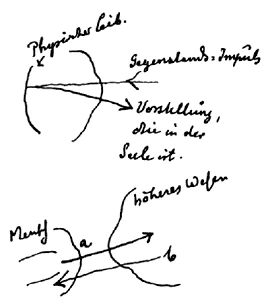
[ 14 ] Physical body
Object-impulse
Mental image that exists in the soul.
Human / Higher Being
a) The human being’s subconscious impulse toward a higher being
b) The spiritual experience of being perceived by a higher being.
[ 15 ] But the moment we ascend to a higher level of consciousness, this changes fundamentally. Now I would have to draw the spiritual realm—which, of course, is impossible—so I’ll draw it like this:
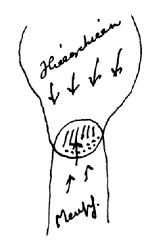
[ 16 ] There, our “I” is welcomed by beings of a higher order, and now we become aware: I am being perceived; I am being looked at.
[ 17 ] Swedenborg now describes a third state: the state in which he has an entire world of objects that are not on the physical plane and yet are perceived by him just as objects on the physical plane, only more subtly. Thus, Swedenborg perceives spiritual objects that are presented to him in the form of imaginations, just as if the spiritual world were nothing more than a finer manifestation of the physical world. He views the spiritual world in the same way that one views the physical world in everyday life.
[ 18 ] Where does this come from? We have, after all, traced how Swedenborg arrived at this conclusion. He discovered spiritual beings who, he realized, were certain inhabitants of Mars; yet he could not understand them because they suppressed all their emotional responses and expressed themselves only through mental gestures. He knew—as I told you on Sunday—that he could not understand these beings because they had made themselves capable of concealing their inner lives. Had Swedenborg been able to see with the consciousness of the Angeloi themselves—as would have been the case if he had truly ascended into the spiritual world, that is, if he had also carried his consciousness up into the spiritual world—he would nevertheless have seen through these Martians to their very essence. As it was, however, the contents of the Martians’ souls appeared to Swedenborg as a cold world of thought. This is very strange.
[ 19 ] Just think what a dreadful fear people here on the physical plane usually have of the cold, abstract world of the mind. How much disparaging talk does one hear about this cold, abstract world of thought, from which people seek to escape, just so they won’t—at any cost—think in mere thoughts. And if someone expects people to elevate themselves to the level of pure thought, that person is immediately regarded as someone who is out of touch with life and hostile to it. That is the feeling people on the physical plane have toward the abstract world of thought. This point of view is very, very widespread. And I am certainly not taking offense at any of you, my dear friends—for those present are always exempt—when I say the following, for example. For a number of years now, a large number of people have been reading my *Philosophy of Freedom*—a work of pure thought. It was published in the early 1890s. It would be interesting if someone were to take the trouble to count how many of those individuals within our movement who are reading *The Philosophy of Freedom* today would have read it as well if it had come into their hands in the early 1890s—without knowing anything about me or our movement—simply as a book. It would be interesting to find out how many of them would have read it back then and how many of them would have said: “No, I can’t make my way through such a web of ideas—it has no meaning at all!”
[ 20 ] From this you can see, my dear friends, how many—of course, those present are always excluded—read this body of thought for purely personal reasons! For only those read it for impersonal reasons who would have read it even if they had never met me in person. One simply has to face this fact in a completely matter-of-fact and sober manner. This is the horror of the supposedly abstract on the physical plane.
[ 21 ] Now, when Swedenborg sees beings on the astral plane—this particular category of Martian beings I have spoken of—he is, despite being such a great scholar, still unable to comprehend that pure thoughts can exist in souls that are entirely free from all emotions. To apply this to the physical plane, it would be comparable to someone saying about *The Philosophy of Freedom*: “That’s all Greek to me; it’s not even a language that a reasonable person can read anymore!”—meaning that one would consider it completely incomprehensible. In exactly the same way, Swedenborg considers these Martian beings on the astral plane to be incomprehensible.
[ 22 ] What matters, however, is that one must at least have the good will and the aspiration to progress toward a mode of thinking that is free of emotion—at least free of the emotions one encounters in the world in ordinary life. For example, someone has not attained pure thought if he is drawn to what is written in *The Philosophy of Freedom* because, driven by their feelings, they now tend toward a more spiritual worldview; rather, the one who approaches the *Philosophy of Freedom* in the right way is the one who embraces precisely what lives within it because of the way the thoughts consistently grow apart from one another and support one another.
[ 23 ] Swedenborg, for his part—despite being such a great scholar—had absolutely no inkling of such an inclination toward a world of thought that is purely a world of thought and that truly contains nothing more of the motives rooted in the emotional and the affective. My dear friends, we must try to understand—and we have plenty of resources for this in our literature—how, in ordinary life, we decide in favor of one truth or another based on emotional impulses that are given to us on the physical plane, whether karmically, through upbringing, or in some other way. The subjective ceases only when one truly ascends with one’s own soul life into such a sphere of thought where thoughts sustain one another, where the subjective content has been removed from the thoughts.
[ 24 ] But one must take it a step further. Once one has truly reached the point of being able to think in such a way that one has grasped the pure thought—that one can have a sequence of pure thoughts in one’s inner life—then one’s own mind, the subjective “I,” is no longer involved. Hence the rigor one feels when one has arrived at pure thinking. One can no longer bend or break it as one might subjectively wish. If one takes a train of thought as it is presented, for example, in *The Philosophy of Freedom*, it is impossible to reshape it. One cannot carve it in any arbitrary way, but must let it grow within oneself like an organism. One is truly detached from one’s ego; thinking itself thinks. But it matures solely through the fact that what one has emptied out—one’s own ego-content—is now replaced by something else: Instead of our own mental content, the mental content of the spirits of the higher hierarchies must now enter into this emotionless thinking. And when you succeed in gradually removing this subjective content—which I have outlined here with dots (see page 88)—from your thinking, which is filled with your emotions, and retain only the pure concepts as such, then the divine content can flow in. And now you have the content from above.
[ 25 ] Swedenborg was unable to achieve this. He could not separate his personal emotions from his thoughts, even though he was a great scholar. He was unable to make his thinking entirely free from his emotions. Since he had now ascended to the astral plane, his thinking—which was still bound up in his personality—made him completely alien to those beings who thought in pure thought: namely, the Martians in question, whom he could not understand. They communicated with him through gestures that were utterly incomprehensible. Where does this come from; what is actually underlying it? Why was Swedenborg, as it were, cut off from the world of higher consciousness as if by a barrier; why could he not enter the world of higher consciousness? Why did he carry the kind of perception one normally has on the physical plane up into the spiritual world, into which he was, after all, truly immersed, and why did the words—the gestural words of the spirits who could think in pure thought, who could express the subjective content of their minds—remain incomprehensible to him? There is no need to examine the reason for this; they were simply able to keep them out—why did these remain incomprehensible to him?
[ 26 ] These questions answer themselves for us, my dear friends, when we ask: Yes, what was it actually like with Swedenborg—what did he bring up onto the astral plane? Isn’t it true that he did not completely separate his spiritual self from his physical self? For if he had managed to do so, he would have perceived his “I” as an object in the sphere of higher consciousness. His “I” would have become like a memento to him, just like the broken pots in the analogy I used some time ago. He was unable to detach himself sufficiently from himself. But now this is precisely the defining characteristic—as was also evident from our entire discussion—that Swedenborg did not merely see illusions; he did not merely see maya, but he was, for example, truly able to recognize the objective fact that he was dealing with Martians of such and such a nature. That was indeed correct. He simply saw the spiritual world as having the character of Maya—through an illusory veil, so to speak. He did indeed have real Martian beings before him; he just could not understand them, since he now had real spiritual beings before him.
[ 27 ] Well, my dear friends, let’s be really smart for a moment—in a way that most of those who wish to develop their clairvoyant abilities are not. After all, Swedenborg could not see these beings—who are inhabitants of Mars—with his ordinary senses or with the power of his ordinary eyes; he saw them in the spiritual world, after all. So he could not see them with his eyes, nor hear them with his ears, nor perceive them with any of his other sensory faculties—not even with his ordinary power of thought. For I have explained to you that this power of thought was actually an ancient gift from the Moon—that is, something that had developed before the power of Mars... [gap in the transcript]. Thus, among the known cognitive faculties of human beings, he possessed no faculty with which to perceive these beings. So we are faced with the peculiar fact that Swedenborg had spiritual beings before him whom he undoubtedly recognized, but he did not perceive them through higher faculties; he saw them with something through which he actually should not have been able to see them, because he lacked the consciousness for it. For the ordinary powers of consciousness on the physical plane are not sufficient to explain what he saw there. What, then, was it with which he saw? Well, Swedenborg was not only a great scholar but also a pure person in his life; and within him, the power that a human being possesses on the physical plane—which is already somewhat similar to clairvoyant power, except that on the physical plane it has a different purpose than the exercise of clairvoyance—had been transformed. By what means, then, did Swedenborg see?
[ 28 ] Yes, you see, Swedenborg saw with a power that perceives the external world without touching it, without coming into contact with it—a power that perceives it without the intervention of the eye. What kind of power is this? On Earth, on the physical plane, it is the power that manifests itself in sexual life—in proper sexual life—that mysterious power which draws people together in earthly love, a power distinct from all other powers of perception. Swedenborg had preserved this force, and at a certain age it was transformed within him, yet it remained, in a sense, sexual force. He saw the spiritual world through sexual force. That is to say, Swedenborg’s clairvoyance is truly a form of clairvoyance based on this transformed sexual force.
[ 29 ] From this you will now be able to conclude that, during human evolution on Earth, a force is given to human beings that manifests itself as sexuality during this earthly development, but which will one day appear in a transformed form when it is no longer bound to the physical. On the other hand, however, you will also be able to conclude how closely related the forces that lead to pictorial clairvoyance are to those forces associated with the currently basest instincts of human nature, and how, so to speak, one sphere can be drawn to the other.
[ 30 ] Yes, my dear friends, it follows that clairvoyance is not something to be trifled with. Certainly, what I am saying now does not refer to Spiritual Science as such, but it does refer to any clairvoyance that is merely snatched up, unjustifiably sought after, or acquired. This must truly be taken seriously: clairvoyance should not be sought in such a way that merely the transformed form of perception from the physical plane is carried upward, but rather a new kind of perception for the higher planes should be sought—a new way of perceiving the spiritual world that has nothing to do with sexual energy, for that is physical; it exists only for the physical plane. To assume that one can carry the same kind of perception used on the physical plane up into the spiritual worlds—that is, to say, “I perceive as one perceives on the physical plane”—brings out in a person the tendency to build a bridge between clairvoyance and sexual forces.
[ 31 ] There are various ways to protect oneself from this, and we are now at a crucial point in human development where such things must be understood. What I have just told you is, after all, an ancient truth. The people of ancient times protected themselves in the following way. They said: When bringing a person into contact with the spiritual world, one must bear in mind that human beings are weak, but that strength of character, self-discipline of the soul, and the removal of all unbridledness of the soul’s impulses are necessary in order to ascend properly into the spiritual worlds. Yes, human beings are weak—and become quite feeble, said the ancient sages—so one must keep them far removed from the possibility of mixing these two spheres. —Well, how can one do that? One simply isolates him from the opposite sex when speaking to him about truly spiritual matters, so that he does not cross over to the opposite sex at all. That is to say, one does not allow women to participate at all in those gatherings where matters of Spiritual Science are discussed. Hence the exclusion of women in earlier times from all gatherings of Spiritual Science that were held. This prevented the men from mixing the two spheres in any way; for they were bound by a strict vow not to speak at all outside the lodge about what took place within it. The women, therefore, could derive nothing from their association with Spiritual Science other than the white gloves, which were a significant symbol of this entire situation.
[ 32 ] We have now truly moved beyond those times, and we should strive, through movements such as our Spiritual Science movement, to no longer rely on this compulsion. This, however, requires keeping the spiritual realm entirely separate from the other sphere that has been referred to; truly keeping them separate—that is, the two realms must not be mixed together.
[ 33 ] Recently, we have witnessed a case of the most appalling confusion. That is to say, we have seen how sexual impulses were at work, but were interpreted as something else. In their interpretation, they were all sorts of mystical things; in reality, they were sexual impulses. It is important to take this fact very seriously and to understand it from within—to understand it from the inner nature of the fabric of the world. Truly, only the utmost seriousness and the highest dignity that one finds in the spiritual life can keep the egoistic elements within the spiritual life at bay; as soon as the egoistic mystical element enters, one is no longer safe from mixing the two distinct spheres in the worst possible way.
[ 34 ] Similarly, we saw how, in Swedenborg’s case, a restrained sexuality filled what would otherwise have been empty—his imaginations—but could only fill them to a certain degree. Where he encountered beings who could themselves express all their feelings through their gestures, he could no longer fill that sphere, because it was only a human sphere that arose from his projecting his sexuality beyond his imaginations.
[ 35 ] Swedenborg, in particular, is a striking example of what should be avoided on the path to the spiritual worlds in modern times. For such an endeavor, which bears any resemblance to Swedenborg’s, always puts a person in danger that—while striving for clairvoyance—the sexual sphere will be stirred and the two spheres will become intermingled.
[ 36 ] In the context of Spiritual Science, we must, of course, be able to speak openly about these things, my dear friends. It would be very unfortunate if we could not discuss these matters objectively and scientifically, for it is necessary for those who strive earnestly to also recognize the dangers of this striving. This is also why an impure imagination can so easily misjudge what is being sought as a pure spiritual endeavor! We are now at a very, very significant point in these lectures on Spiritual Science, at an extremely significant point, and I wanted, so to speak, to trace the lines that lead to this point.
[ 37 ] Tomorrow, at the same time—or whenever it works out; we can decide that when we part ways today—I will continue these reflections, because I need to be very thorough when I speak to you about these matters.