

The Occult Movement
in the Nineteenth Century
and its Relationship to World Culture
GA 254
16 October 1915, Dornach
Translate the original German text into any language:
Versions Available:
The Occult Movement, tr. SOL
Dritter Vortrag
Third Lecture
[ 1 ] Ich will heute -— weil noch andere Dinge zur Besprechung vorliegen — nur eine kurze Episode zu den Betrachtungen einfügen, die wir in den vorangehenden Tagen gepflogen haben. Morgen werden wir dann noch einiges Genaueres zu sagen haben über die okkulte Bewegung im 19. Jahrhundert und ihre Beziehung zur Weltkultur. Ich muß aber eben einfügen dem ganzen Gang der Betrachtung eine Sache, die sehr wichtig ist. Wenn Sie sich erinnern an die verschiedenen Auseinandersetzungen, die wir gepflogen haben, namentlich an einzelne Bemerkungen, die ich habe machen können im Anschluß an die Broschüre des Herrn von Wrangell: «Wissenschaft und Theosophie» — ich muß das noch einmal sagen, obzwar ich es schon betont habe -, so werden Sie sehen, daß man genötigt war, gerade von dem Gesichtspunkte unserer Geisteswissenschaft aus, dem Heraufkommen des Materialismus, der materialistischen Weltanschauung im 19. Jahrhundert eine große Bedeutung beizumessen, sich zu diesem Heraufkommen des Materialismus nicht bloß so zu stellen, daß man eben einfach sich kritisierend verhält.
[ 1 ] Today—since there are other matters to discuss—I would like to add just a brief episode to the reflections we have been sharing over the past few days. Tomorrow we will then have more specific things to say about the occult movement in the 19th century and its relationship to world culture. But I must now insert into the overall course of our discussion a point that is very important. If you recall the various discussions we have had—particularly the individual remarks I was able to make in response to Mr. von Wrangell’s pamphlet, *Science and Theosophy* —I must say this once more, even though I have already emphasized it—you will see that, precisely from the standpoint of our Spiritual Science, we were compelled to attach great significance to the rise of materialism and the materialistic worldview in the 19th century, and not merely to adopt a critical stance toward this rise of materialism.
[ 2 ] Kritisierend sich zu verhalten, ist immer das Allerleichteste, wenn man einer Sache gegenübersteht. Es ist also nötig, so sich zu verhalten, daß man begreift, daß gerade im 19. Jahrhundert jene Strömung heraufziehen mußte in der Menschheitsentwickelung, die man eben materialistische Weltanschauung nennen kann. Charakterisiert haben wir sie ja genügend. Wir können zunächst zwei Gesichtspunkte anführen, durch welche uns die ganze Bedeutung der materialistischen Weltanschauung klarwerden kann.
[ 2 ] Adopting a critical stance is always the easiest thing to do when faced with an issue. It is therefore necessary to adopt an attitude that allows us to understand that, precisely in the 19th century, that current in human development—which we can call the materialist worldview—was bound to emerge. We have, after all, characterized it sufficiently. We can begin by citing two perspectives through which the full significance of the materialist worldview becomes clear to us.
[ 3 ] In der Form, in welcher der Materialismus im 19. Jahrhundert als Weltanschauung heraufgezogen ist, war er eigentlich vorher nicht vorhanden. Gewiß, es hat einzelne materialistische Philosophen wie Demokrit und andere gegeben — Sie können darüber nachlesen in den «Rätseln der Philosophie» -, die gewissermaßen die Vorläufer dieses Materialismus als Theorie sind. Aber wenn wir ihre Weltanschauung, so wie sie wirklich ist, vergleichen mit dem, was sich in dem Materialismus des 19. Jahrhunderts ausspricht, so müssen wir sagen: In der Form, in der der Materialismus im 19. Jahrhundert Weltanschauung geworden ist, war er früher nicht da. Insbesondere konnte er so nicht vorhanden sein, sagen wir im Mittelalter oder in den Jahrhunderten, die eben der Morgenröte des neuzeitlichen Geisteslebens vorangingen. Er konnte nicht vorhanden sein, denn die Menschen hatten in ihrer Seele viel zu viel Zusammenhang noch mit den Impulsen der geistigen Welt. Sich vorzustellen, daß die ganze Welt eigentlich nichts ist als eine Summe von sich bewegenden Atomen im Raum, die sich zu Molekülen ballen, durch welches Ballen dann alle Erscheinungen des Lebens und des Geistes zustande kommen, das war erst dem 19. Jahrhundert vorbehalten.
[ 3 ] In the form in which materialism emerged as a worldview in the 19th century, it did not actually exist before that. Certainly, there were individual materialist philosophers such as Democritus and others—you can read about them in *The Riddles of Philosophy*—who, in a sense, were the precursors of this materialism as a theory. But if we compare their worldview, as it truly is, with what is expressed in 19th-century materialism, we must say: In the form in which materialism became a worldview in the 19th century, it did not exist before. In particular, it could not have existed in that form, say, in the Middle Ages or in the centuries that preceded the dawn of modern intellectual life. It could not have existed because people’s souls were still far too closely connected to the impulses of the spiritual world. To have a mental image of the entire world as nothing but a sum of moving atoms in space, which clump together to form molecules—and through this clumping all phenomena of life and spirit come into being—was a concept reserved for the 19th century.
[ 4 ] Nun kann man sagen: eines ist da, das immerzu wie eine Art roter Faden, dem man nachgehen kann, da sein wird, selbst in den allerschlimmsten Weltanschauungen. Und wenn man diesem roten Faden nachgeht, der sich so durch die Menschheitsentwickelung hindurchschlingt, dann wird man durch diesen roten Faden zum mindesten das Unmögliche der materialistischen Weltanschauung einsehen müssen. Und dieser rote Faden ist einfach in der Tatsache bestehend, daß die Menschen denken müssen. Ohne Denken ist es nämlich unmöglich, daß der Mensch auch nur zur materialistischen Weltanschauung kommt. Er hat sie ja ausgedacht, diese materialistische Weltanschauung! Nur daß man in der materialistischen Weltanschauung vergißt, Selbsterkenntnis zu üben, nämlich das bißchen Selbsterkenntnis: Du denkst ja, und die Atome können nicht denken. - Wenn man nur dieses bißchen Selbsterkenntnis übt, so hat man etwas, woran man sich halten kann. Und hält man sich daran, dann wird man immer finden, daß es mit dem Materialismus nicht geht.
[ 4 ] Now one might say: there is one thing that will always be there, like a common thread that one can follow, even in the very worst worldviews. And if one follows this common thread, which winds its way through the development of humanity, then this very thread will at the very least force one to recognize the impossibility of the materialistic worldview. And this common thread consists simply in the fact that human beings must think. For without thinking, it is impossible for a person to even arrive at a materialistic worldview. After all, it was conceived by human thought—this materialistic worldview! It’s just that in the materialistic worldview, people forget to practice self-knowledge—namely, that little bit of self-knowledge: You do think, and atoms cannot think. - If one practices just this little bit of self-knowledge, one has something to hold on to. And if one holds on to it, one will always find that materialism doesn’t work.
[ 5 ] Aber um so recht zu finden, daß es mit dem Materialismus nicht geht, mußte er erst in seiner eigentlichen Gestalt ausgearbeitet sein. Bedenken Sie doch nur: solange man gewissermaßen ein verfälschtes Bild des Materialismus hatte, ein Bild, in dem immer noch geistige Impulse mitgedacht waren, da konnte man sich an das bißchen Geist, das man noch in den Naturerscheinungen und so weiter suchte, halten. Erst dann, als man allen Geist herausgeworfen hatte - durch den Geist, denn das Denken ist nur dem Geiste möglich -, erst als man durch den Geist den Geist im Weltenbilde herausgeworfen hatte, konnte einem die ganze Ode der materialistischen Weltanschauung entgegentreten. Es mußte überhaupt den Menschen einmal entgegentreten diese ganze Ode des materialistischen Weltbildes. Aber Sie sehen, notwendig ist nun dazu die Selbstbesinnung auf das Denken. Ohne das geht es nicht. Aber sobald wir nur ein wenig hinschauen auf die Selbstbesinnung des Denkens, dann müssen wir uns sagen: Es mußte einmal in der Entwickelung das ganze öde Bild des Materialismus heraufkommen, damit die Menschen gewahr werden, was sie darin haben.
[ 5 ] But in order to truly realize that materialism was not the answer, it first had to be worked out in its true form. Just consider this: as long as one had, so to speak, a distorted image of materialism—an image in which spiritual impulses were still factored in—one could cling to the little bit of spirit that one still sought in natural phenomena and so on. Only then, once all spirit had been cast out—through the spirit, for thinking is possible only through the spirit—only once the spirit had been cast out of the worldview through the spirit itself, could the full force of the materialist worldview confront us. This entire force of the materialist worldview simply had to confront humanity at some point. But you see, what is necessary for this is self-reflection on thinking. It cannot be done without it. But as soon as we look even a little at this self-reflection on thinking, we must say to ourselves: At some point in the course of development, the entire bleak picture of materialism had to emerge so that people might become aware of what they have in it.
[ 6 ] So wäre der eine Punkt gekennzeichnet. Aber man versteht ihn doch nicht recht, wenn man ihn nicht auch von seiner anderen Seite aus noch kennzeichnet. Von der anderen Seite gekennzeichnet, sehen Sie: materialistisches Weltbild - Raum - im Raum Atome, die in Bewegung sind — dieses das All. Es wäre im Grunde genommen alles nur eine äußere Folgeerscheinung, ein Blendwerk der einseitigen Wirklichkeit des Raumes und der sich in ihm bewegenden Atome, also jener kleinsten Teile, von denen wir schon in den vorigen Vorträgen gezeigt haben, daß das Denken es nicht leidet, daß sie eigentlich sind. Aber man kommt immer wieder auf diese Atome zurück. Wie findet man sie eigentlich? Wie kommt der Mensch eigentlich zu der Annahme von Atomen?
[ 6 ] That would be one way to describe it. But one cannot truly understand it unless one also describes it from the other side. Described from the other side, you see: a materialistic worldview—space—atoms in motion within that space—this is the universe. Essentially, everything would be merely an external consequence, an illusion arising from the one-sided reality of space and the atoms moving within it—that is, those tiniest particles of which we have already shown in previous lectures that thought cannot accept that they actually exist. But we keep coming back to these atoms. How do we actually find them? How does humanity actually arrive at the assumption of atoms?
[ 7 ] Gesehen kann sie keiner haben, denn sie sind erdacht, sie sind richtig erdacht. Es muß also der Mensch eine Veranlassung haben, abgesehen von der Wirklichkeit, sich eine atomistische Welt auszudenken. Er muß durch irgend etwas veranlaßt, geneigt sein, sich eine atomistische Welt auszudenken. Die Natur selbst führt den Menschen wahrhaftig nicht dazu, sie sich atomistisch vorzustellen. Man kann gerade mit dem Physiker — ich rede hier nicht hypothetisch von etwas Ausgedachtem, sondern ich habe wirklich mit Physikern solche Gespräche geführt -, man kann gerade mit dem Physiker sich darüber unterhalten, weil er die äußere Physik kennt. Er könnte eigentlich gar nicht auf den Atomismus verfallen! Und man müßte sagen, wie auch tatsächlich schon in den achtziger Jahren die gescheiteren Physiker darauf gekommen sind: der Atomismus ist eine Annahme, eine Arbeitshypothese, damit man darin eine Abbreviatur, eine Rechenmünze habe, aber man muß sich klar sein, daß man es mit keiner Wirklichkeit zu tun hat. Denkende Physiker möchten am liebsten bei dem bleiben, was sie mit den Sinnen wahrnehmen. Aber sie fallen doch immer wieder, wie die Katze auf die Pfoten, auf den Atomismus.
[ 7 ] No one can have seen them, for they are imagined—they are truly imagined. Human beings must therefore have a reason, apart from reality, to conceive of an atomistic world. They must be prompted or inclined by something to conceive of an atomistic world. Nature itself certainly does not lead people to form a mental image of it in atomistic terms. One can discuss this very topic with a physicist—I am not speaking hypothetically here about something made up, but I have actually had such conversations with physicists—one can discuss this very topic with a physicist because he knows the observable aspects of physics. He really could not possibly fall into atomism! And one would have to say—as the more astute physicists in fact already realized in the 1980s—that atomism is an assumption, a working hypothesis, providing a shorthand, a unit of calculation, but one must be clear that it has nothing to do with reality. Thoughtful physicists would prefer to stick to what they perceive with their senses. But they keep falling back on atomism, time and again, just like a cat always lands on its feet.
[ 8 ] Wenn Sie verfolgen, was wir im Laufe der Jahre uns erarbeitet haben - es ist schon sehr oft über diese Dinge gesprochen worden, seit ich in München die Vorträge über die «Theosophie des Rosenkreuzers» gehalten habe —, wenn Sie das verfolgen, werden Sie sehen, daß der Mensch die Anlage zu dem physischen Körper auf dem alten Saturn erhalten hat, daß er dann nach und nach durch die Sonnen- und Mondenentwickelung hindurchgegangen ist und dann in der alten Mondenzeit eingegliedert bekommen hat in seinen Organismus, in das, was da_ zumal von seinem physischen Organismus vorhanden war, sein Nervensystem.
[ 8 ] If you follow what we have worked out over the years—these matters have been discussed very often since I gave the lectures on the “Theosophy of the Rosicrucians” in Munich— if you follow that, you will see that human beings received the predisposition for the physical body on ancient Saturn, that they then gradually passed through the solar and lunar stages of development, and that during the ancient lunar era, their nervous system was integrated into their organism—specifically into what was present there of their physical organism.
[ 9 ] Nun stellt man sich aber die Sache ganz falsch vor, wenn man meinen würde, das Nervensystem wäre während der alten Mondenzeit so gewesen, wie es sich heute einem Anatomen oder Physiologen darstellt. Das Nervensystem war in der Mondenzeit eigentlich nur als Urbild, als Imagination vorhanden. Physisch, oder besser mineralisch, so wie es physisch-chemisch ist, ist es erst während der Erdenzeit geworden. Und die ganze Gliederung, wie sie jetzt in unserem Körper sitzt, ist ein Ergebnis der Erdenorganisation. Während der Erdenorganisation wurde das Mineralische, die Materie, in die imaginativen Urbilder unseres Nervensystems wie auch in die anderen Urbilder hineingegliedert. Und dadurch entstand unser jetziges Nervensystem.
[ 9 ] However, one would be completely mistaken if one were to assume that the nervous system during the ancient Lunar Age was as it appears today to an anatomist or physiologist. During the Lunar Period, the nervous system actually existed only as an archetype, as an imagination. It did not become physical—or rather, mineral, in the sense of its physical-chemical nature—until the Earth Period. And the entire structure, as it is now organized within our bodies, is a result of the Earth organization. During the Earth period, the mineral element—matter—was integrated into the imaginative archetypes of our nervous system as well as into the other archetypes. And this is how our present nervous system came into being.
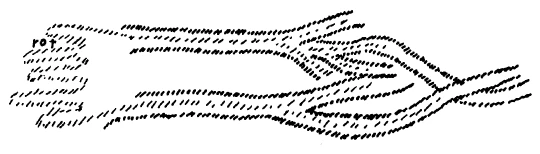
[ 10 ] Nun, der Materialist sagt sich: Mit diesem Nervensystem denke ich oder nehme ich wahr. - Wir wissen, daß das ein Unsinn ist. Denn wenn wir uns den Vorgang wirklich vorstellen wollen, so können wir uns irgendeinen Nerven vorstellen, der im Organismus verläuft. Stellen wir uns nun aber verschiedene Nerven vor, die im Organismus verlaufen. Diese verlaufen dann so, daß sie Verzweigungen wie Äste aussenden. Ein Nerv verläuft gewissermaßen so, daß er einen Stamm hat und dann Äste aussendet; es ist sogar so, daß Äste in die Nähe von anderen Ästen kommen und daß dann da ein anderer Strang weitergeht. Das ist ja nur schematisch und ungenau gezeichnet.
[ 10 ] Well, the materialist says to himself: “With this nervous system, I think or perceive.”—We know that this is nonsense. For if we really want to create a mental image of the process, we can imagine any nerve running through the organism. But let’s now create a mental image of various nerves running through the organism. These nerves extend in such a way that they send out branches like tree limbs. A nerve, so to speak, has a trunk and then sends out branches; in fact, branches come close to other branches, and another strand continues from there. This is, of course, only a schematic and imprecise illustration.
[ 11 ] Wie verläuft denn eigentlich nun das menschliche Seelenleben innerhalb dieses Nervensystems? Das ist die Frage, die wir vor allen Dingen aufstellen müssen. Man gelangt zu keiner Vorstellung davon, wie das Seelenleben im Nervensystem verläuft, wenn man nur das tagwache Bewußtsein ins Auge faßt. Sobald der Mensch aber den Moment ins Auge faßt, wo er mit seinem Ich und mit seinem astralischen Leibe aus dem Nervensystem herausschlüpft -— herausschlüpft aus dem ganzen Leibe und damit also auch aus dem Nervensystem -, und insbesondere den Moment, wo er beim Aufwachen wiederum hineinschlüpft, dann merkt er die eigentümliche Erscheinung: man ist eigentlich während des Schlafes außerhalb seiner Nerven gewesen, das heißt mit seinem astralischen Leibe und seinem Ich. Man schlüpft wieder in seine Nerven hinein, man steckt dann wirklich darinnen. Erst fühlt man sich außerhalb gestellt und dann wie in die Nerven hineinfließend. Also besonders beim Aufwachen schlüpft man so in seine Nerven hinein.
[ 11 ] How, then, does human soul life actually unfold within this nervous system? That is the question we must ask above all else. One cannot form any mental image of how soul life unfolds in the nervous system by considering only waking consciousness. But as soon as a person considers the moment when, with their “I” and their astral body, they slip out of the nervous system—slip out of the entire body and thus also out of the nervous system—and especially the moment when, upon waking, they slip back in again, they notice a peculiar phenomenon: one has actually been outside one’s nerves during sleep—that is, with one’s astral body and one’s “I.” One slips back into one’s nerves; one is then truly inside them. First one feels placed outside them, and then as if flowing back into the nerves. Thus, especially upon waking, one slips back into one’s nerves in this way.
[ 12 ] Der Prozeß des Aufwachens ist viel komplizierter, als man zunächst ihn schematisch darstellen kann. Und so ist man eigentlich den Tag über mit seiner Seele so in seinem Leibe darinnen, daß man außerdem, wie man sonst mit seinem astralischen Leibe ausfüllt seinen physischen Leib, die Nerven ausfüllt. Dieses Ausfüllen ist nicht so, daß man wie mit einer Art Nebel den physischen Leib ausfüllt, sondern man füllt ihn organisierend aus. Indem man sich in die verschiedenen Organe hineinbegibt, schlüpft man auch wie mit Fühlfäden bis in die äußersten Verzweigungen der Nerven hinein.
[ 12 ] The process of waking up is much more complicated than can initially be represented schematically. And so, throughout the day, one is actually so deeply immersed in one’s body with one’s soul that, in addition to filling one’s physical body with one’s astral body as one normally does, one also fills the nerves. This filling is not like filling the physical body with a kind of mist, but rather a structured, organized filling. As one enters the various organs, one also slips, as if with sensory threads, into the outermost branches of the nerves.
[ 13 ] Stellen Sie sich das bitte ganz lebhaft vor. Ich will es noch einmal schematisch zeichnen, ich kann es aber nur so zeichnen, daß es gewissermaßen verkehrt, wie eine Art Spiegelbild ist. Ich muß von außen zeichnen, müßte aber von innen zeichnen. Nehmen wir an, das wäre der astralische Leib und das wären die Fühlfäden, die er ausstreckt (rot). Das ist alles astralischer Leib, was ich jetzt zeichne. Hier streckt er gewisse Fühlfäden in die Nervenstränge hinein. Das zeichne ich so.
[ 13 ] Please imagine this very vividly. I want to draw it schematically once more, but I can only draw it in such a way that it is, so to speak, reversed—like a kind of mirror image. I have to draw from the outside, but I would have to draw from the inside. Let’s assume this is the astral body and these are the feelers it extends (red). Everything I’m drawing now is part of the astral body. Here, it extends certain feelers into the nerve cords. I’ll draw it like this.
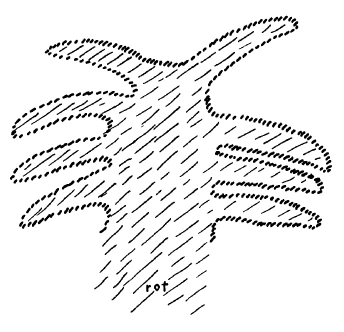
[ 14 ] Also wirklich, hier schlüpft er in die Nervenstränge hinein. Denken Sie sich, mein Rockärmel wäre da vorne zugenäht und ich würde mit meinem Arm wie in einen Sack hineinschlüpfen. Denken Sie sich, ich würde hundert Arme haben und würde sie so in Säcke hineinstecken, dann würde ich mit den hundert Armen da so anstoßen, wo die Ärmel zugenäht sind. So schlüpfen wir also hinein bis dahin, wo der Nervenstrang endet. Das kann man im physischen Leibe verfolgen, wo der Nervenstrang endigt, und bis dahin schlüpft man hinein. Solange ich da hineinschlüpfe, fühle ich nichts. Ich fühle nur, wenn ich dahin komme, wo der Ärmel zugenäht ist. Ebenso ist es mit den Nerven: wir fühlen den Nerv nur da, wo er endet. Wir stecken den ganzen Tag in der Nervenmaterie und berühren immer die Enden unserer Nerven. Das bringt sich der Mensch zwar nicht zum Bewußtsein, aber es kommt in seinem Bewußtsein zum Ausdrucke, ohne daß er es will. Wenn er nun denkt - und er denkt ja mit seinem Ich und astralischen Leibe -, so können wir sagen: das Denken ist eine Tätigkeit, die da ausgeübt wird und sich vom Ich und astralischen Leib auf den Ätherleib überträgt. Vom Ätherleib schlüpft auch noch etwas da hinein, wenigstens seine Bewegung. Das, was die Ursache des Bewußtseins ist, das ist, daß ich immer mit dem Denken an einen Punkt komme, wo ich anstoße. An unendlich viele Punkte stoße ich an, wenn ich da hineinschlüpfe, nur kommt es mir nicht zum Bewußtsein. Zum Bewußtsein kommt es nur dem, der den Prozeß des Aufwachens bewußt erlebt: Wenn er bewußt hineintaucht in den Nervenmantel, dann spürt er, daß es ihm überall entgegensticht.
[ 14 ] Honestly, here he slips right into the nerve fibers. Imagine if the sleeve of my jacket were sewn shut at the front and I were to slip my arm into it as if into a sack. Imagine I had a hundred arms and were to stick them into sacks like that; then I would bump into the seams with all those arms. So that’s how we slip in—all the way to where the nerve tract ends. You can trace where the nerve tract ends in the physical body, and that’s as far as you slip in. As long as I’m slipping in there, I feel nothing. I only feel something when I reach the point where the sleeve is sewn shut. It’s the same with the nerves: we only feel the nerve where it ends. We’re immersed in the nervous tissue all day long and are constantly touching the ends of our nerves. Although a person is not consciously aware of this, it finds expression in their consciousness without them intending it. When they think—and they do think with their “I” and astral body—we can say: thinking is an activity that is carried out there and is transmitted from the “I” and astral body to the etheric body. Something else also slips in from the etheric body—at least its movement. The cause of consciousness is that, through thinking, I always reach a point where I encounter resistance. I encounter an infinite number of points when I slip in there, but I am not aware of them. This becomes conscious only to the one who consciously experiences the process of awakening: when he consciously plunges into the nerve sheath, he feels that it pricks him everywhere.
[ 15 ] Ich habe sogar einmal einen interessanten Menschen kennengelernt, der in abnormer Weise dies in sein Bewußtsein bekommen hat, was ich in der folgenden Weise darstellen möchte. Der Mensch war ein ausgezeichneter Mathematiker und bewandert in dem ganzen damaligen Stande der höheren Mathematik. Er hatte sich natürlich auch viel beschäftigt mit Differential- und Integralrechnung. Differential ist in der Mathematik das Atomistische, das Kleinste, das, was noch als Kleinstes vorgestellt werden kann. Mehr kann ich heute darüber nicht sagen. Da kam nun, ohne daß es so eigentlich über die Schwelle des Bewußtseins herauftauchte, dem Manne das zum Bewußtsein, daß er da überall gestochen wird, wenn er so hineinfährt. Wenn es nicht regelrecht zum Bewußtsein kommt, wie es durch die Übungen in «Wie erlangt man Erkenntnisse der höheren Welten?» zum Bewußtsein gebracht werden kann, so können dabei ungewöhnliche Dinge auftreten. So glaubte er überall bei sich zu empfinden die Differentiale, er war voll von Differentialen, überall fühlte er die Differentiale. Ich bin voller Differentiale — sagte er -—, ich bin überhaupt nicht integral. — Das bewies er auch auf eine sehr scharfsinnige Weise, daß er überall von Differentialen strotze.
[ 15 ] I even once met an interesting person who had come to realize this in an extraordinary way, which I would like to describe as follows. This man was an outstanding mathematician and well-versed in the entire state of advanced mathematics at that time. Naturally, he had also devoted a great deal of time to differential and integral calculus. In mathematics, the differential represents the atomistic, the smallest unit—that which can still be conceived of as the smallest. I cannot say more about this today. Then, without it actually rising above the threshold of consciousness, it dawned on the man that he was being pricked everywhere whenever he delved into it. If it does not come into consciousness in the proper way—as it can be brought into consciousness through the exercises in *How to Attain Knowledge of the Higher Worlds?*—then unusual things can occur. Thus, he believed he could sense differentials all around him; he was full of differentials; everywhere he felt the differentials. “I am full of differentials,” he said, “I am not integral at all.” — He also proved this in a very astute way, demonstrating that he was brimming with differentials everywhere.
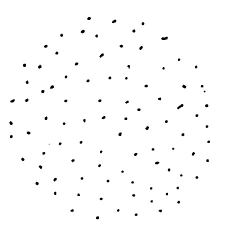
[ 16 ] Stellen Sie sich lebendig diese Stiche vor. Was tut der Mensch damit, wenn sie nicht in sein Bewußtsein heraufkommen? Er projiziert sie in den Raum und füllt den Raum damit aus, und das sind dann die Atome. Das ist in Wahrheit der Ursprung des Atomismus. Gerade so macht es der Mensch, wie Sie es machen würden, wenn da vor uns ein Spiegel wäre und Sie keine Ahnung hätten, daß da ein Spiegel ist. Sie würden sicherlich glauben, da draußen wäre noch eine Versammlung von Menschen. Deshalb stellt der Mensch sich den ganzen Raum erfüllt vor von dem, was er da hineinprojiziert. Dieser ganze Nervenprozeß spiegelt sich in den Menschen zurück wegen des Umstandes, daß er da anstößt. Aber das ist dem Menschen nicht bewußt, daß er da anstößt, und der ganze Raum ist ihm daher ringsumher scheinbar erfüllt mit Atomen. Die Atome sind die Stiche, die seine Nervenendigungen ausüben. Die Natur nötigt uns nirgends, Atome anzunehmen, aber die Menschennatur nötigt uns dazu. In dem Augenblicke, wo man im Erwachen zu sich selbst kommt, taucht man in sich unter und man wird in sich gewahr eine unzählige Anzahl von Raumpunkten. In diesem Augenblicke ist man gerade in derselben Lage, in der man sich befindet, wenn man einem Spiegel entgegengeht, man stößt daran an und weiß dann, daß man nicht dahinter kann. Ähnlich ist es beim Aufwachen. In demselben Momente, wo man aufwacht, stößt man an seine Nerven an, und man weiß: da kannst du nicht hinüber, darüber kannst du nicht hinauskommen. — Es ist also das ganze Atombild so, als ob es eine Spiegelwand wäre: in dem Augenblick, wo man merkt, daß man nicht darüber hinauskommt, weiß man die Sache.
[ 16 ] Create a vivid mental image of these impulses. What does a person do with them if they do not rise into his consciousness? He projects them into space and fills the space with them, and those are then the atoms. That is, in truth, the origin of atomism. This is exactly what a person does—just as you would do if there were a mirror in front of us and you had no idea that a mirror was there. You would surely believe that there was another group of people out there. That is why a person creates a mental image of the entire space filled with what he projects into it. This entire nervous process is reflected back to the person because of the fact that he is making contact there. But people are not aware that they are making contact there, and the entire space around them therefore appears to be filled with atoms. The atoms are the pricks exerted by their nerve endings. Nature does not compel us anywhere to assume the existence of atoms, but human nature compels us to do so. The moment one comes to oneself upon waking, one delves into oneself and becomes aware of an innumerable number of points in space. At that moment, one is in exactly the same situation as when one approaches a mirror: one bumps into it and then knows that one cannot go beyond it. It is similar upon waking. At the very moment one wakes up, one comes up against one’s nerves, and one knows: you cannot go beyond this, you cannot get past it. — Thus, the entire atomic image is as if it were a mirrored wall: the moment one realizes that one cannot go beyond it, one understands the matter.
[ 17 ] Und jetzt nehmen Sie einen Ausspruch, den ich Ihnen schon angeführt habe als von Saint-Martin herrührend. Was sagt der Naturforscher? Der Naturforscher sagt: Analysiere die Naturerscheinungen und du findest die atomistische Welt. - Wir wissen, die atomistische Welt ist nicht da. In Wahrheit sind nur unsere Nervenendigungen da. Was ist denn da, wo die atomistische Welt vermutet wird? Da ist nichts! Wir müssen stehenbleiben bei dem Spiegel, bei den Nervenendigungen. Der Mensch ist da, und der Mensch ist ein Spiegelapparat. Wenn man nicht erkennt, daß er ein Spiegelapparat ist, so vermutet man hinter ihm allerlei Zeug: nämlich die materialistische Weltanschauung, in Wahrheit muß man aber den Menschen finden. Das kann man aber nicht, wenn man sagt: Analysiere die Naturerscheinungen -, denn die geben einem ja den Atomismus. Da muß man schon sagen: Versuche, über den bloßen Schein hinwegzukommen! — Man muß also sagen: Versuche den Schein zu durchschauen! - Dann kann man aber nicht sagen: Und du findest die atomistische Welt -, sondern man muß sagen: Du findest den Menschen! - Und jetzt erinnern Sie sich an das, was wie aus einer Prophetie heraus, die er selber noch nicht völlig verstanden hat, Saint-Martin gesagt hat mit dem Satze, den ich Ihnen aufgeschrieben habe: «Dissipez vos ténèbres matérielles et vous trouverez l’homme.» Es ist derselbe Satz, es ist ganz dasselbe, nur kann es mit Hilfe der Betrachtung, die wir angestellt haben, erst verstanden werden.
[ 17 ] And now take a statement that I have already cited to you as coming from Saint-Martin. What does the naturalist say? The naturalist says: Analyze natural phenomena and you will find the atomistic world. — We know that the atomistic world does not exist. In truth, only our nerve endings are there. What is there where the atomistic world is presumed to be? There is nothing! We must stop at the mirror, at the nerve endings. The human being is there, and the human being is a mirror apparatus. If one does not recognize that he is a mirror apparatus, one presumes all sorts of things behind him: namely, the materialistic worldview; but in truth, one must find the human being. But one cannot do that if one says: “Analyze natural phenomena”—for they lead one to atomism. There one must say: “Try to look beyond mere appearances!”—One must therefore say: “Try to see through the appearances!” - But then one cannot say: “And you will find the atomistic world”—rather, one must say: “You will find the human being!” - And now recall what Saint-Martin said—as if from a prophecy that he himself had not yet fully understood—in the sentence I wrote down for you: “Dissipez vos ténèbres matérielles et vous trouverez l’homme.” It is the same sentence; it is exactly the same, only it can be understood for the first time with the help of the analysis we have conducted.
[ 18 ] Sie sehen, wir erfüllen durch die Art und Weise, wie wir zusammenbringen unsere Geisteswissenschaft mit der Naturwissenschaft und mit den Irrtümern der Naturwissenschaft, ein Programm, das in der menschlichen Sehnsucht lebt, seit es Menschen gibt, die etwas ahnten von der Unmöglichkeit der modernen materialistischen Weltanschauung. Das ist eben das unendlich Bedeutsame, das einen überkommt in seinen Wirkungen, wenn man die ganze Eigenart unserer Weltanschauung ins Auge faßt: Geisteswissenschaft ist da, weil sie ersehnt worden ist von denjenigen, die ein Gefühl hatten für das Wahre, für das, was kommen muß als die Wahrheit, die einzig und allein der Menschheit bringen kann, was die Menschheit in der neueren Zeit braucht.
[ 18 ] You see, through the way we bring together our Spiritual Science with natural science—and with the errors of natural science—we are fulfilling a program that has lived on in human longing ever since there have been people who sensed something of the impossibility of the modern materialistic worldview. This is precisely the infinitely significant reality whose effects overwhelm one when one grasps the full nature of our worldview: Spiritual Science exists because it has been longed for by those who had a sense of the True—of that which must come as the truth that alone can bring to humanity what humanity needs in modern times.
[ 19 ] Morgen werde ich Ihnen zu zeigen haben, warum gerade der Irrtum entstehen mußte, als die Probe gemacht wurde mit dem Spiritismus im 19. Jahrhundert. Wie ich Ihnen so vielfach gezeigt habe, hatte man es mit Suggestionen von lebenden Menschen zu tun, während man glaubte, daß man es zu tun habe mit Einflüssen von seiten der Toten. Diese sind nur dann zu erlangen, wenn man sich auf denjenigen Teil des psychischen Menschen zurückzieht, welcher herausgehoben werden kann aus dem physischen Leibe. Alles das, was der Mensch durchlebt zwischen dem Tode und einer neuen Geburt, kann nur erkundet werden durch das, was der Mensch außerhalb des physischen Leibes erleben kann; so daß man dazu nicht eigentlich Medien, im richtigen Sinne des Wortes, gebrauchen kann. Doch davon morgen weiter. Und das wird auch zusammenhängen mit dem Kapitel über das Leben zwischen dem Tod und einer neuen Geburt, worüber ich schon bei einer der letzten Besprechungen eine Andeutung gemacht habe, daß darüber noch einiges kommen soll.
[ 19 ] Tomorrow I will have to show you why this particular error was bound to arise when the experiment with spiritualism was conducted in the 19th century. As I have shown you so many times, people were dealing with suggestions from living human beings, while they believed they were dealing with influences from the dead. These can only be attained by withdrawing into that part of the psychic human being which can be separated from the physical body. Everything that a person experiences between death and a new birth can only be explored through what the person can experience outside the physical body; thus, one cannot actually use mediums, in the true sense of the word, for this purpose. But more on that tomorrow. And this will also be connected to the chapter on life between death and a new birth, about which I already hinted in one of the last discussions that there is still more to come on this subject.